© 2019, IRJET | Impact Factor value: 7.34 | ISO 9001:2008 Certified Journal | Page 1306
COMPRESSED AIR POWERED ENGINE FOR THE DESIGN AND
DEVELOPMENT OF SINGLE CYLINDER ENGINE
GOPI CHAND BOOSA
1, P. CHANDRA BHUSHAN
2,
M. DHANUNJAYA
31
Assistant Professor, MECHANICAL Engineering Department, SMSK, T.S, INDIA.
2
Assistant Professor, MECHANICAL Engineering Department, SMSK, T.S, INDIA.
3
Assistant Professor, MECHANICAL Engineering Department, SMSK, T.S, INDIA.
---***---ABSTRACT -
Compacted air controlled motor for theplan and improvement of single chamber motor which can be controlled by the packed air. Current four strokes single chamber motor (bicycles/sulked) can be kept running on the packed air with a couple of changes that are the primary goal of the investigation. Packed air filled by power utilizing a blower. The power necessity for packing air must be considered while processing generally speaking proficiency. By and by the packed air vehicle will add to diminishing an air contamination and will in general zero contamination level and advancing extraordinary condition. Fundamental bit of leeway of this motor is that no hydrocarb1on fuel required methods no ignition procedure is occur.
Light utility vehicles are winding up well known methods for free transportation for short removes. Cost and contamination with oil and diesel are driving vehicle producers to create vehicles energized by elective energies. Designers are guiding their endeavors to utilize air as a vitality source to run the light utility vehicles. The utilization of compacted air for putting away vitality is a technique that isn't just effective and clean, yet in addition efficient. The serious issue with compacted air autos was the absence of torque created by the "motors" and the expense of packing the air. As of late a few organizations have begun to create packed air vehicles with numerous favorable circumstances and still numerous genuine bottlenecks to handle. This paper quickly condense the guideline of innovation, most recent advancements, favorable circumstances and issues in utilizing packed air as a wellspring of vitality to run vehicles.
The most recent pattern in the car business is utilized of Compacted air as a wellspring of vitality. Which is inexhaustible just as contamination free vitality. Each car industry is finding the answer for diminish the heaviness of the vehicle as it helps in the better treatment of the vehicle. Consistent contamination with oil and diesel are driving vehicle producers to create vehicles fuelled by elective energies. Architects are guiding their endeavors to utilize air as a vitality source to run the light utility
vehicles which expands the productivity of the moving vehicle where Packed air filled by power utilizing a blower. The power prerequisite for compacting air must be considered while registering in general productivity. Presently days, the overwhelming shipping vehicles are known for creating a lot of hurtful gases/toxins like CO2, SO2 and so on which go about as the real hotspot for a worldwide temperature alteration just as contamination. So research is proceeding to locate a light weight vehicle which will in general zero dirty the earth. Probably the best option is the utilization of packed air to create capacity to run a car vehicle. Because of the one of a kind and ecological neighborly properties of air, it is considered as one of the most significant future energizes which will run the shipping vehicles. So in this audit paper an exertion is made to consider the degree of research done and the potential points of interest and burdens of the in the zone under compacted air innovation.
1.
INTRODUCTION
Have you been to the gas station this week? Considering that we live in a very mobile society, it's probably safe to assume that you have. While pumping gas, you've undoubtedly noticed how much the price of gas has soared in recent years. Gasoline which has been the main source of fuel for the history of cars, is becoming more and more expensive and impractical (especially from an environmental standpoint).
© 2019, IRJET | Impact Factor value: 7.34 | ISO 9001:2008 Certified Journal | Page 1307
using gasoline as our primary fuel. It is also damaging tothe environment, and since it is not a renewable resource, it will eventually run out. One possible alternative is the air-powered car.
Air powered cars runs on compressed air instead of gasoline. This car is powered by a two cylinder compressed engine. This engine can run either on compressed air alone or act as an IC engine. Compressed air is stored in glass or fiber tanks at a pressure of 4351 psi.
Within the next two years, you could see the first air-powered vehicle motoring through your town. Most likely, it will be the e.Volution car that is being built by Zero Pollution Motors.
The cars have generated a lot of interest in recent years, and the Mexican government has already signed a deal to buy 40,000 e.Volutions to replace gasoline- and diesel-powered taxis in the heavily polluted Mexico City.
It is hard to believe that compressed air can be used to drive vehicles. However that is true and “air car” as it popularly knows has caught the attention of research worldwide. It has zero emission and is ideal.
For city driving condition. MDI (Moteur Development International) is one company that holds the international patents for compressed air car. This review study reveals aim is to run the four strokes bike with help of compressed air, it will try to achieve a 50 km/h speed and range of refilling compressed air is after running of 70-80 km. Two technologies have been developed to meet different need Single energy compressed air engines.
Dual energy compressed air plus fuel engines. The single energy engines will be available in both Minicats and Citycats. These engines have been conceived for city use, where the maximum speed is 50 km/h and where MDI believes polluting will soon be prohibited with use of compressed air technology which having zero pollution level.
The dual energy engine, on the other hand, has been conceived as much for the city as the open road and will be available in all MDI vehicles. The engines will work exclusively with compressed air while it is running under 50 km/h in urban areas. But when the car is used outside urban areas at speeds over 50 km/h, the engines will switch to fuel mode. The engine will be able to use gasoline, gas oil, bio- diesel, gas, liquidized gas, ecological fuel, alcohol, etc. Both engines will be available with 2, 4 and 6 cylinders, When the air tanks are empty the driver will be able.
We are living in a very mobile society so light utility vehi- cles (LUV) like bikes and cars are becoming very popular means of independent transportation for short distances. Petrol and diesel which have been the main sources of fuel in the history of transportation, are becoming more expensive and impractical (especially from an environmental standpoint). Such factors are leading vehicle manufacturers [1-9] to develop vehicles fueled by alternative energies. When at pre- sent level of technological development fuel-less flying (like birds) i.e., flying based on the use of bio-energy and air power in the atmosphere seems to be almost impossible for human beings then engineers are fascinated at least with the enormous power associated with the human friendly as well as tested source of energy (i.e., air) to make air-powered vehicles as one possible alternative. Engineers [1-9] are directing their sincere efforts to make use of air as an energy source to run the LUVs which will make future bikes and light/small cars running with air power for daily routine distances and the travel will be free from pollution and cost effective.
© 2019, IRJET | Impact Factor value: 7.34 | ISO 9001:2008 Certified Journal | Page 1308
going on around the entire world which will in generalthink of inventive thoughts which will be executed in viable life. In any case, an unnatural weather change is likewise one of the most serious issues which is influencing the biosphere just as way of life of people. The temperature of the earth is expanding definitely and this thusly is causing climatic changes which legitimately influence our condition. The petroleum products are generally utilized as a wellspring of vitality in different various fields like power plants, inner and outer burning motors, as warmth source in assembling ventures, and so on and on the off chance that we contrasted with batteries or any electrical source, packed air is favourable due to a high vitality thickness, low poisonous quality, quick filling requiring little to no effort and long administration life. Be that as it may, its stock is restricted and because of this huge use, non-renewable energy sources are reducing at quicker rate. Along these lines, in this universe of vitality emergency, it is important to create elective innovations to utilize sustainable power sources and decrease contamination, with the goal that petroleum products can be moderated. One of the significant wellspring of the contamination is the smoke turning out from the apparatus under the territory autos. So an elective method for creating the running the vehicle must be made with the goal that we can anticipate further harm to the earth and condition. The elective wellsprings of vitality accessible are sun oriented, electric, climatic air and so forth. Air acts like a cover for the earth. It is the blend of different gasses, which makes it impartial and non-dirtying. It has the property to get compacted to a high weight and hold it for a significant stretch of time. It is modest and can be found richly in the environment. So it very well may be utilized as an elective fuel for the autos. Much research is going on in this field and researchers are attempting to improve the adequacy of this great innovation. It is tentatively discovered that the effectiveness of the vehicle ranges from 72-95%. So this can be considered as one of the ideal decisions to run the vehicle.
2.
HISTORY
In fact, two centuries before that Dennis Papinapparently came up with the idea of using compressed air (Royal Society London, 1687).
In 1872 the Mekarski air engine was used for street transit, consisting of a single stage engine. Numerous locomotives were manufactured and a number of regular lines were opened up (the first in Nantes in 1879).
In 1892, Robert Hardieintroduced a new method of heating that at the same time served to increase the range of the engine which in turn helped to increase the distance
that could be traveled at a stretch. One of its new features was regenerative braking. By using the engine as a compressor during deceleration, air and heat were added to the tanks, increasing the range between fill-ups.
However, the first urban transport locomotive was not introduced until 1898, by Hoadley and Knight[6], and was based on the principle that the longer the air is kept in the engine the more heat it absorbs and the greater its range. As a result they introduced a two- stage engine.
Charles B. Hodges[6] will always be remembered as the true father of the compressed air concept applied to cars, being the first person, not only to invent a car driven by a Compressed air powered engine but also to have considerable commercial success with it.
After twelve years of research and development, Guy Negre[6] has developed an engine that could become one of the biggest technological advances of this century. A French engineer by profession, he has designed a low consumption and low pollution engine for urban motoring that runs on compressed air technology. “air car” from Motor Development International is a significant step for zero emission transport, delivering a compressed air-driven vehicle that is safe, quiet, has a top speed of 110 km/h and a range of 200 km. Guy Nègre is the head of Research and Development at Moteur Development International (MDI) cars, where the Zero Emission Vehicle (ZEV) prototype has been in production since 1994.
3.
LITERATURE REVIEW
Compressed air powered engine by modifying an 4-stroke, single cylinder SI engine by replacing the spark plug with the help of pulsed pressure valve, and using compressed air as the working fluid which id pollution free or tend to zero pollution. The working of this engine is very well explained theoretically and the cost analysis is made which shows that the Compressed air powered engine is cheaper than Spark ignition engine i.e. SI engine on the frame of reference of conventional SI engine.
Study of Compressed Air Storage System as Clean Potential Energy for 21st Century.
© 2019, IRJET | Impact Factor value: 7.34 | ISO 9001:2008 Certified Journal | Page 1309
of 500 to 750 rpm at 4 to 6 bars air pressure to runningspeeds of 2000 to 3000 rpm using 2 to 3 bars air pressure. The test was conducted in HBTI Kanpur.
After conducting this research they have concluded that overall performance of air turbine for working Pressure ranging from 2.7-6 bar is found varying from 72%-97%. This technology can be used in the area under the future automotive industry.
4. PROCESS DESCRIPTION
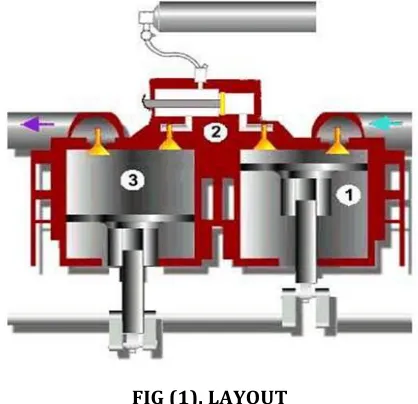
1. The first piston takes in ambient air and compresses it to approximately 300 psi and 200*f in the compression chamber during the first cycle of the engine.
FIG (1). LAYOUT
2. When the piston pause, a small amount of compressed air from the tanks is released into the expansion chamber to create a low pressured, low temperature volume of about 140psi.
3. Shortly before the valve to the exhaust cylinder is opened, a high-speed shutter connects the compression and expansion chambers. The sudden pressure and temperature difference between the low chambers creates pressure waves in the expansion chamber, thereby producing work in the exhaust chamber that drives the piston to power the engine.
The air tanks for storing the compressed air are localized underneath the vehicle. They are constructed of reinforced carbon fiber with a thermoplastic liner. Each tank can hold 3,180 ft3 of air at a pressure of up to 4,300 psi. When connected to a special compressor station, the tanks can be recharged within 3-4 minutes. They can also be recharged
using the on-board compressor 3-4 hours after connecting to a standard power outlet.
TECHNOLOGY OVERVIEW
These new vehicles incorporate various innovative and novel systems such as storing energy in the form of compressed air, using new materials such as fiberglass to build the car and vegetable oil for the motor lubrication. Numerous innovations have been integrated in the engine design.
FIG. (2). Movement of the piston in relation to the driving shaft rotation.
The car engine runs on compressed air and incorporates the three laws of thermodynamics.
1. The first law states that energy can neither be destroyed nor be wasted.
2. The second law describes the disorder within substances.
The third law defines that only in crystals at 0o k, there is absolute disorder.
5.
VEHICLE PARTS
5.1
COMPRESSED AIR TANKSOne of the most frequently asked questions is about the safety of the compressed air storage tanks. These tanks hold 90 cubic meters of air compressed to 300 bars. Many people ask whether this system is dangerous in case of an accident and if there is a risk of explosion. The answer is NO. Why? Because these are the same tanks used to carry the liquid gas used by buses for public transport. The tanks enjoy the same technology developed to contain natural gas. They are designed and officially approved to carry an explosive product: methane gas.
[image:4.612.331.568.230.350.2] [image:4.612.57.266.279.481.2]© 2019, IRJET | Impact Factor value: 7.34 | ISO 9001:2008 Certified Journal | Page 1310
Instead they would crack, as they are made of carbon fiber.An elongated crack would appear in the tank, without exploding, and the air would simply escape, producing a loud but harmless noise. Of course, since this technology is licensed to transport an inflammable and explosive gas (Natural gas), it is perfectly capable inoffensive and non-flammable air.
It is fitting, therefore, that MDI has reached an agreement with the European leader in aerospace technology Airbus Industries for the manufacture of the compressed air storage tanks. With a remote supervision arrangement, Airbus Industries oversees the making of the storage tanks at each MDI factory. The coiled carbon fibre technology used in the construction of the tanks is complex and requires a substantial quality control process which the multinational company, home of the Airbus aircraft, will provide for our vehicles.
5.2 BRAKE POWER RECOVERY
The MDI vehicles will be equipped with a range of modern systems. For example, one mechanism stops the engine when the car is stationary (at traffic lights, junctions etc). Another interesting feature is the pneumatic system which recovers about 13% of the power used.
5.3 THE BODY
The MDI car body is built with fibre and injected foam, as are most of the cars on the market today. This technology has two main advantages: cost and weight. Nowadays the use of sheet steel for car bodies is only because of cost - it is cheaper to serially produce sheet steel bodies than fibre ones. However, fibre is safer (it doesn’t cut like steel), is easier to repair (it is glued), doesn’t rust etc. MDI is currently looking into using hemp fibre to replace fibre-glass, and natural varnishes, to produce 100% non-contaminating bodywork.
5.4 THE AIR FILTER
The MDI engine works with both air taken from the atmosphere and air pre-compressed in tanks. Air is compressed by the on-board compressor or at service stations equipped with a high-pressure compressor. Before compression, the air must be filtered to get rid of any impurities that could damage the engine. Carbon filters are used to eliminate dirt, dust, humidity and other particles, which unfortunately, are found in the air in our cities.
This represents a true revolution in automobiles - it is the first time that a car has produced minus pollution, i.e. it
eliminates and reduces existing pollution rather than emitting dirt and harmful gases. The exhaust pipe on the MDI cars produces clean air, which is cold on exit (between -15º and 0º) and is harmless to human life. With this system the air that comes out of the car is cleaner than the air that went in.
5.6 THE CHASSIS
Based on its experience in aeronautics, MDI has put together highly resistant, yet light, chasses, aluminium rods glued together. Using rods enables us to build a more shock-resistant chassis than regular chasses. Additionally, the rods are glued in the same way as aircraft, allowing quick assembly and a more secure join than with welding. This system helps to reduce manufacture time.
5.7
ELECTRICAL SYSTEMGuy Nègre, inventor of the MDI Air Car, acquired the patent for an interesting invention for installing electrics in a vehicle. Using a radio transmission system, each
electrical component receives signals with a
microcontroller. Thus only one cable is needed for the whole car. So, instead of wiring each component (headlights, dashboard lights, lights inside the car, etc), one cable connects all electrical parts in the car. The most obvious advantages are the ease of installation and repair and the removal of the approximately 22 kg of wires no longer necessary. Whats more, the entire system becomes an anti-theft alarm as soon as the key is removed from the car.
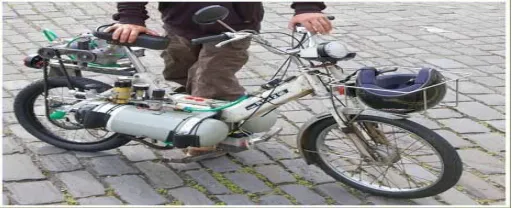
FIG. (3). COMPRESSED AIR POWERED MODEL
6.
REVIEW OF PREVIOUS RESEARCH WORK
[image:5.612.327.583.467.571.2]© 2019, IRJET | Impact Factor value: 7.34 | ISO 9001:2008 Certified Journal | Page 1311
diagram for the both systems. As per author’s knowledgeand belief only few works reported on this study.
FIG (4). COMPRESSED AIR ENGINE
FIG (5). LIQUID AIR ENGINE.
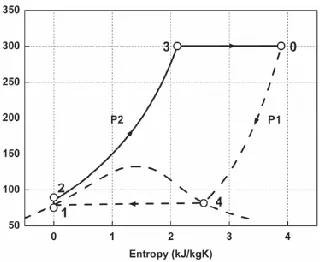
FIG (6). T–S DIAGRAM OF ENGINES COMPRESSED AIR POWERED ENGINE.
FIG (7). T–S DIAGRAM OF ENGINES LIQUID AIR ENGINE.
Following conditions are used in the analyses Ambient pressure: P1 = 1.013 bar.
Working pressure: P2 = 300 bar. Ambient temperature: T0 = 300 K. Volume of tank: V = 300 lit.
The reasons to consider a fuel tank with 300 lit volume and 300 bar working pressure include:
(i) 300 l and 300 bar are technically feasible (ii) a high pressure and a large volume are essential to give sufficient work output for an acceptable travel distance and (iii) compressed air vehicles with a 300 lit fuel tank within initial pressure of 300 bar have been demonstrated practically.
They have concluded in their paper is two types of air fuelled engines for zero emission road transportation are compared in terms of their shaft work, coolth, efficiency and energy density. It was found that the shaft work output and the coolth of both the fuels increase with increasing working pressure or temperature. Given the working pressure and temperature, liquid air powered engines have a slightly lower specific work outputs than compressed air powered engines. At P = 300 bar and T = 300 K, the practical net work outputs of the Compressed air powered engine for isothermal ties of γ= 0.75 and 0.90 are respectively 222.8 kJ/kg and 284.2 kJ/kg, whereas the corresponding values for the liquid air engines are 184.1 kJ/kg and 245.6 kJ/kg. The volumetric energy density of liquid air fuel, however, is about 2.45 times that of compressed air fuel, and liquid air engines produce much more coolth than compressed air engines. On the other hand, the efficiency of compressed air powered engine is higher than that of liquid air powered engines, mainly because of its high energy consumption of liquefaction plants. Their analyses also suggested that an effective use of coolth is a key to improve the overall efficiency of liquid air powered engines.
[image:6.612.80.244.116.496.2] [image:6.612.82.243.534.665.2]© 2019, IRJET | Impact Factor value: 7.34 | ISO 9001:2008 Certified Journal | Page 1312
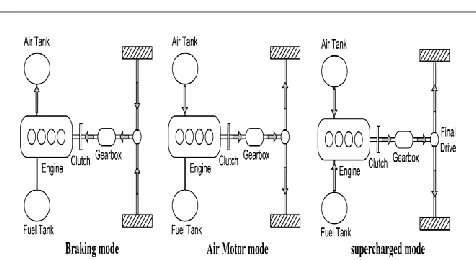
FIG (8). ENERGY FLOW AT DIFFERENT OPERATIONALMODE.
The theoretical and experimental results showed the advantage of the proposed strategy over the conventional single-storage system. The proposed compression algorithm can be utilized in an air hybrid vehicle to increase the efficiency of energy recovery by the compression braking system. Compared to the double-stage regenerative braking, the double-tank system doubles the air flow rate because only one cylinder is needed to implement the proposed concept and thus, all the cylinders can be connected directly to the main tank. The proposed compression algorithm can be applied not only in air hybrid vehicle compression braking system, but also in any other applications, where higher pressure with higher air mass flow rate is demanded such as typical reciprocating compressors. Double-tank compressors are expected to have the same working pressure and outlet flow rate as double-stage compressors, but with a weight of almost half of a double-stage one.
Thermodynamic Analysis of Compressed Air Vehicle Propulsion Ulf Bossel [3] had done thermodynamic analysis. At 20°C 300 liter tank filled with air at 300 bar carries 51 MW of energy. Under ideal reversible isothermal conditions, this energy could be entirely converted to mechanical work. However, under isentropic conditions (no heat is exchanged with the environment) not more than 25 MW become useful. By multi-stage expansion with inter-stage heating the expansion process is brought closer to the isothermal ideal.
The analysis is extended to the compression of air. Again, the ideal isothermal compression is approached by multi-stage processes with inter- cooling. By this approach energy demand for compression is reduced to acceptable levels and system pressure and temperature are kept within safe limits. The results of this analysis seem to indicate that the efficiency of the four-stage expansion process is acceptable, while even a four-stage air compression with inter-cooling is associated with significant losses. However, the overall energy utilization could be increased if the waste heat generated during the
air compression process would be used for domestic water and space heating.
Design of a low pressure air engine for third world use. J.Gary Wood et al. [4] used low pressure stirling engine to produce 4KW of shaft work. The engine is burn rice husks for fuel. The main advantage of this application is that it is fired by rice husks instead of expensive and difficult to obtain petroleum based fuels. Performance study on three-stage power system of compressed air vehicle based on single-screw expander HE Wei et al. [5] had proposed new compressed-air engine system based on three-stage single screw expander was proposed to improve the performance of power system. Three different structure styles were presented, and the studies on the power performance and the distribution of expansion ratios between stages were carried out by programming and mathematical modeling of each style.
FIG (9). FIRST STAGE HEATING STYLE.
FIG (10). SECOND STAGE HEATING STYLE.
FIG (11). THREE STAGE HEATING STYLE.
The structure design of three-stage power system based on single screw. [5]
[image:7.612.43.281.69.199.2] [image:7.612.339.565.527.637.2]© 2019, IRJET | Impact Factor value: 7.34 | ISO 9001:2008 Certified Journal | Page 1313
performance. The comparison between two systems tookthe same work condition: the storage pressure and volume of air tank were 30 MPa and 0.2 m3; the heating temperature of inlet air was 300 K; the efficiency of engine was 0.64. According to the former calculating method and results, the new system could obtain the total output work of 11192 kJ when adopting “three-stage heating” type. However, it was about 9100 kJ.when taking the original reciprocating type. Therefore, the new system in this paper has good advantage whether in the structure or in the power performance. The amount of power output is directly related to the endurance mileage of vehicle. In the purpose of increasing the endurance mileage, two facets should be studied. First, we should improve the performance of expander and try to increase the efficiency of expander. Second, we should adopt the design of multiple expanders with intermediate heating, optimize expander ratio, and try to increase the heating quantity of system. But it also should be noticed for the balance in income. Therefore, the balance in the optimal design of system needs to be considered in general and it is one of the important directions to study in future.
7.
ADVANTAGES OF COMPRESSED AIR POWERED
TRANSPORT VEHICLE
In comparison to petrol or diesel powered vehicles “Air powered vehicles” have following advantages:
• Air, on its own, It is Natural resource, non- flammable, abundant, economical, transportable, storable and, most importantly, non-polluting. • Compressed air technology reduces the cost of transport vehicle production by about 20%, because there is no need to build a cooling system, fuel tank, spark plugs or silencers.
• High torque for minimum volume.
• The mechanical design of the air compressed engine is very simple and robust.
• Low manufacture and maintenance costs as well as easy maintenance.
• Lighter vehicles would mean less abuse on roads, thus, resulting in longer lasting roads. • The price of fuelling air powered vehicles will be significantly cheaper than current fuels.
• When the air has been compressed at reasonable speeds, it heats up. The heat given off during
compression could be reclaimed for space heating or water heating, or used in a Sterling engine. •Does not required Transportation of such a fuel does due to drawing power off the electrical grid. This presents significant cost benefits. Pollution created during fuel transportation would be eliminated.
• Compressed-air transport vehicles are comparable in many frame of references even to electric vehicles and their potential advantages over electric transport vehicles include:
• Compressed-air vehicles are unconstrained by the degradation problems associated with electrical battery systems.
• Much like electrical vehicles, air powered vehicles would ultimately be powered through the electrical grid which makes it easier to focus on reducing pollution from one source, as opposed to the billions of vehicles on the road.
• Compressed-air storage tanks does not create any danger can be disposed of or recycled with less pollution than batteries and tend to zero pollution.
• The tank may be able to be refilled more often and in less time than batteries can be recharged, with refueling rates comparable to liquid fuels. • The tanks used in a compressed air tank which used in compressed air motor have a longer lifespan in comparison with batteries, which, after a while suffer from a reduction in performance • Air, on its own, is non-flammable, abundant, economical, transportable, storable and, most importantly, nonpolluting.
• Compressed air technology reduces the cost of vehicle production by about 20%, because there is no need to build a cooling system, fuel tank, spark plugs or silencers.
• High torque for minimum volume. The mechanical design of the engine is simple and robust.
© 2019, IRJET | Impact Factor value: 7.34 | ISO 9001:2008 Certified Journal | Page 1314
• The price of fueling air powered vehicles will besignificantly cheaper than current fuels.
• When the air is being compressed at reasonable speeds, it heats up. The heat given off during compression could be reclaimed for space heating or water heating, or used in a stirling engine. • Compressed-air vehicles are unconstrained by the degradation problems associated with current battery systems.
• Much like electrical vehicles, air powered vehicles would ultimately be powered through the electrical grid which makes it easier to focus on reducing pollution from one source, as opposed to the millions of vehicles on the road.
• Compressed-air tanks can be disposed of or recycled with less pollution than batteries.
• The tank may be able to be refilled more often and in less time than batteries can be recharged, with re- fueling rates comparable to liquid fuels. • The tanks used in a compressed air motor have a longer lifespan in comparison with batteries, which, after a while suffer from a reduction in performance.
8.
CONCLUSIONS
Nowadays continue need of energy is increases, but basically conventional source of energy is limited due to that rate on price of petroleum is also continues hiked day by day. To satisfy there need alternate fuel or energy is required. But while considering alternate fuel some of factors are to be considered like availability, economy, and environment friendly etc., based on that CAT (Compressed Air Technology) is best technology which tend engine to zero pollutions. If further improvement is carried out with stress analysis, thermodynamic analysis, minimize compressed energy loss and other losses then efficiency of CAE may be further increases.
It’s important to remember that while vehicles running on only compressed air might seem like a distant dream, but they still have public interest due to their environmental friendly nature. Compressed air for vehicle propulsion is already being explored and now air powered vehicles are being developed as a more fuel-efficient means of transportation. Pneumatic vehicle will be replace the battery operated transport vehicles used in industries. Pneumatic powered vehicle requires very less time for refueling as compared to battery operated vehicle. On the
whole, the technology is just about modifying the engine of any regular IC engine vehicle into an Air Powered Engine. The Air Powered Engine technology is cheaper in cost and maintenance, can be easily adapted by the masses and it doesn’t cause any kind of harm to the environment. Instead, it’s wide spread use will help mankind in controlling the serious problem of global warming. At the end of this review we conclude that the compressed air technology can be tested and developed using the Vanned Type Novel Air Turbine as there are minimal losses and practically their efficiency varies from 72-97% which is very high when compared to a conventional IC engine. Future developments can be made by designing an ideal vehicle for this kind of engine.
Compressed air for vehicle propulsion is already being explored and now air powered vehicles are being developed as a more fuel-efficient means of transportation. Some auto- mobile companies are further exploring compressed air hy- brids and compressed fluids to store energy for vehicles which might point the way for the development of a cost effective air powered vehicles design. Unfortunately there
are still serious problems to be sorted out before air powered vehicles become a reality for common use but there is a hope that with the development in science & technology well sup- ported by the environmental conscious attitude and need to replace costly transportation methods, air-powered vehicles will definitely see the light of the day.
REFERENCES
1. Sullivan, M. World's First Air-Powered Car: Zero Emissions by Next Summer, Popular Mechanics http://www.popularmechanics.com/automotive/
new_cars/4217016.html (June 2008 issue),
2. Harley, M.; Ford, G.M. Considering Joint Engine
Development,http://www.autoblog.com/2008/08
/04/ford-gm-considering-joint-
engine-development, (accessed Aug 2008).
3. Haisheng Chen et al. “Air fuelled zero emission
road transportation: Acomparative study”
,Applied Energy 88 (2011), 24 June 2010, pp: 337– 342
4. Amir Fazeli et al. “A novel compression strategy for air hybrid engines” Applied Energy 88 (2011), 8 March 2011,pp:2955–2966.
5. Ulf Bossel “Thermodynamic Analysis of
© 2019, IRJET | Impact Factor value: 7.34 | ISO 9001:2008 Certified Journal | Page 1315
Fuel Cell Forum, Morgenacherstrasse
2FCH-5452 Oberrohrdorf/Switzerland, April 2, 2009. 6. Rose Robert, William J. Vincent, 2004, Fuel Cell
Vehicle World Survey 2003-Breakthrough
Technologies Institute, February’ 2004,
Washington, D.C.
7. B R Singh and O Singh, “DEVELOPMENT OF A
VANED- TYPE NOVEL AIR TURBINE”, JMES993 © IMechE 2008, Proc.IMechE Vol. 222 Part C: J. Mechanical Engineering Science, pp. 2419-2426.
8. Singh B.R. and Singh O., 2010, CRITICAL EFFECT