Published Online August 2012 in SciRes (http://www.SciRP.org/journal/ce) http://dx.doi.org/10.4236/ce.2012.34063
A Cognitive Analysis When the Students Solve Problems
Elena Fabiola Ruiz Ledesma
Posgraduated College of Computational Studies, Institute Polytechnic National, Mexico City, Mexico
Email: [email protected]
Received May 21st,2012; revised June 25th, 2012; accepted July 5th, 2012
The research reported in this paper shows an analysis of the cognitive process of students from the senior technical program on food technology, whom are asked to solve a contextualized event on systems of lin-ear algebraic equations within the context of balance of matter in situations of chemical mixtures. The cognitive analysis is founded on the theories of Conceptual Fields and vents. For the analysis attention is focused on the representations carried out by students regarding the invariants in the schemes that they build when they face an event of contextualized mathematics. During the acting process of students emerge different types of representation which are appropriate to the context in which the research de-velops, with which a proposal for the classification of them.
Keywords: Mathematics; Conceptual Fields; Contextualize Events; Problem Solving
Introduction
Te qualitative research allows the analysis of the cognitive processes of students for the construction of knowledge of various sciences who are linked. Addressing science events such as a chemical or physical system or a natural phenomena, where mathematics should be applied for their solution, is a complex task; because on the one hand it is necessary to inte-grate the knowledge and on the other hand carrying out activi-ties of analysis for knowledge, which is both explicit and im-plicit in the event to be addressed, playing an important role in the representations which can be formulated about the events to be dealt with, in order to promote the construction of knowl-edge. Moreira (2002) assumes that we do not apprehend the world directly, but we do it from the representations of the world that we build in our minds.
Learning mathematics, among others, implies that the learner is able to use them to solve specific events in their area of pro-fessional and labor training (Ruiz, 2009). Thus, in the construc-tion of knowledge of various related sciences, it is important to know from the cognitive point of view what happens to stu-dents when they work with contextualized mathematics.
Research Problem
There are many actions that favor the construction of knowl- edge in students, among them stands the learning and teaching activities with contextualized mathematics. The research that is carried out regarding the cognitive process of students provides a guideline for the design and redesign of these didactic activi-ties in students at upper-level and technical programs. The re-search reported makes use of the conceptual fields by Vergnaud, 1991.
Thus, the research problem deals with the issues of how the cognitive processes of students carried out when they are faced with contextualized events, from the perspective conceptual fields bay Vergnaud.
Purpose
The objective of the research seeks to analyze the cognitive process of a group of students by means of analyzing the repre-sentations they make about the invariants in the schemes they build when they address the learning activities associated with contextualized events where systems of algebraic equations are linked to balance of matter; that is to say the events being ad-dressed deal with mixing chemical solutions.
Theoretical Framework
Conceptual Fields
The theory of conceptual Fields deals with the formation of mathematical concepts from a psychological and didactic ap-proach, which leads us to consider the learning of a concept as the set of “problem situations”, which constitute the reference of their different properties and the set of schemes brought into action by the subjects involved in those problem situations (Vergnaud, 1991). The sense of the mathematical concept is acquired through the schemes evocated by the individual sub-ject to solve a problem situation.
Vergnaud (1996) defines Conceptual Fields as “a set of prob-lem situations, concepts, invariants, schemes and operations of thought that are related to each other for a specific area of knowledge”. The theory of Conceptual Fields allows the cogni-tive analysis in the problem situations proposed to the students through the analysis of the conceptual difficulties, the repertoire of available procedures and possible forms of representation.
and chemistry.
For the representations that are one of the operations of thought, Vergnaud mentions that the student transforms an action on the mathematical object, establishing control by him-self through the relationships and classifications in his reality, in such as way that invariants arise in the development of knowledge, in this way the representations for Vergnaud are all those tools, whichever notation or sign of symbols which rep-resent something that typically some aspect of the of our world, that is from our imagination.
Several research results show that student cognitive charac-teristics seem to have a great effect on the strategies of how they learn, navigate and search learning resources (Liu & Reed, 1994; Ford & Chen; 2000; Chen & Macredie, 2002). However, there is little evidence showing that the differences in cognitive characteristics have a great impact on learning performance. Some research results show there is a positive relationship be-tween cognitive styles and learning performance in hypermedia environments (Andris, 1996; Parkinson & Redmond, 2002).
Chen and Macreedie (2002) point out that it is necessary with the problem of learning and teaching of mathematics at univer-sity level programs where mathematics is not a goal in itself but a tool to support sciences and a subject of training for students of them. To this end, the theory conceives the process of learn-ing and teachlearn-ing as a system where the five phases of the theory intervene: curricular, cognitive, didactic, epistemological and educational, moreover, factors of emotional, social, economic, political and cultural kind appear as well. All the phases are necessary to ensure the completion of the philosophical as-sumption posed, moreover, all stages are interrelated among them, and none of them is unrelated to the others. As a theory, in each of the phases a theoretical methodology is included, in accordance with the paradigms upon which it is based, which serve as a guide for the steps of curricular design, the didactics to be followed is described, the cognitive functioning of stu-dents is explained and epistemological elements are provided on mathematical knowledge relating to the activities of profes-sionals, among others.
The cognitive analysis addressed in this research directly af-fects the cognitive phase of the theory, where a contextualized mathematical concept acquires sense by means of the activities of the context itself, because the concepts are not isolated, they are constituted as a network and they bear a relationships among them. Therefore, for the cognitive analysis it is impor-tant to set the contextualized events and define from them the learning activities that lead to the construction of knowledge, both of the concepts of each science involved in the event and the linkages between them.
To finish with this section it is important to mention that the “problem situations” referred to in the theoretical framework by Vergnaud correspond to the “contextualized events” and the “learning activities” proposed by the Contextualize Events (Liu & Reed, 1994; Ford & Chen, 2000; Hen, Macredi, & Andris, 1996; Parkinson & Redmond, 2002).
Methodology
The methodology used to carry out the analysis of the cogni-tive process of students around the conceptual content of sys-tems of linear algebraic equations in the context of balance of matter involves the following three blocks:
Contextualization of systems of linear algebraic equations
in the balance of matter.
Determination of the learning activities to be applied to the group of students.
Analysis of the cognitive process of students through the operations of thought that they make upon the invariants in the schemes that they construct , constituting, this block, the section for results and their discussion.
The Sample
Being an analysis of qualitative kind, we worked with a group of two students in the first quarter of the Technician in Food Technology program, who are currently enrolled in a mathematics course that includes the topic of systems of linear algebraic equations as well as a chemistry course which ad-dresses the topic of balance of matter by mixing chemical solu-tions, both courses are not related in a curricular way. The ac-tivities are carried out by the students in the chemistry labora-tory, in different sessions, covering a total of twelve hours.
Observation Instruments
The data collection from the cognitive process is made by obtaining written and film productions that help to refute or confirm the analysis conducted with the written information. The analysis is qualitative focusing on the operations of thought that they perform on the invariant patterns that build in their cognitive processes in the activities of contextualized event.
Development of Research
For the first block the contextualized event students are to face is contextualized, which is a phenomenon that recurrently appears in specific operations in the area of professional and labor training of the technician in food. It says: We have 100 ml of sugar solution to 60% and 100 ml of sugar solution to 35%. From these solutions it is desired to obtain 100 ml of a sugar solution to 50%.
The contextualization stages described in the section of the- oretical framework, which are immersed in the didactic strategy of Mathematics in Context, is the methodological process that is used for the contextualization of systems of linear algebraic equations in the balance of matter, generally in contextualized events of mixing of solutions.
con-cepts such as management of concentrations, visualization of the phenomenon as a system with inputs and outputs, mixing substances to obtain a desired concentration and concentration measurements. The schemes and operations of the invariants mediate the action over reality, as well as the forms of organi-zation and structuring of the different concepts of interest and criteria for acquisition of meanings.
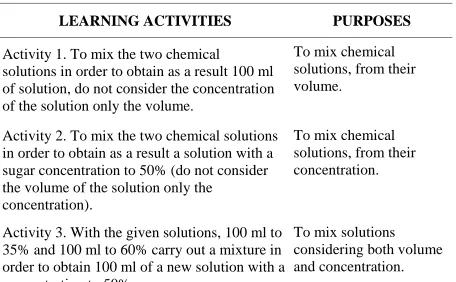
From the contextualization of the first methodological block derive the activities to be determined in the second block, which are shown in Table 1. Learning activities have the objec-tive that the student analyzes the linear behavior by means of the obtaining of combinations of concentrations and volumes, each one separately, to later on confront him with the idea of managing the two variables simultaneously, and the pursuit of mathematical model the event in context, see Table 1.
Results and Discussion
With the above it can be established conceptual field of sys-tems of linear algebraic equations in the context of balance of matter. As it has been mentioned in the theoretical framework section, the conceptual fields are constituted by the problem situations (contextualized event and learning activities), the concepts, the invariants, the schemes and the operations of thought.
Results and Discussion
[image:3.595.59.287.583.724.2]For the third block, which determines the results and discus-sion, the behavior of students is analyzed through the opera-tions of thought that they make of the invariants in the schemes they build. It must be pointed out that during activities that emerge from the contextualization of systems of linear alge-braic equations with balance of matter, it was detected in the actions of the students the recurrent use of different operations of thought, which were considered proper of the linking of two specific areas of knowledge, that is to say, under other circum-stances they may or may not arise. These operations of thought relate specifically to representations, for it was necessary to define a classification of the types of representations found, which is expressed below.
Table 1.
Contextualized event and its learning activities.
CONTEXTUALIZED EVENT
We have 100 ml of sugar solution to 60% and 100 ml of sugar solution to 35%. From these solutions it is desired to obtain 100 ml of a sugar solu-tion to 50%.
LEARNING ACTIVITIES PURPOSES
Activity 1. To mix the two chemical solutions in order to obtain as a result 100 ml of solution, do not consider the concentration of the solution only the volume.
To mix chemical solutions, from their volume.
Activity 2. To mix the two chemical solutions in order to obtain as a result a solution with a sugar concentration to 50% (do not consider the volume of the solution only the concentration).
To mix chemical solutions, from their concentration.
Activity 3. With the given solutions, 100 ml to 35% and 100 ml to 60% carry out a mixture in order to obtain 100 ml of a new solution with a concentration to 50%.
To mix solutions considering both volume and concentration.
Propositional representation type: it is considered as the de-scription of the event the made by the student, in the first in-stance, in his own language (natural language), from the cogni-tive point of view it is of great use to the student to understand the activity to be performed. He can use some isolated concepts of mathematics, the chemical science or other sciences, without articulating them. The overall purpose is to communicate and try to understand the event to be solved.
Non-operating figurative type representations: it is when the student perceives the information of the event but if asked to represent the situation in written form, he draws pictures, wanting to see the link between the two areas of knowledge; however, it does not allow him for a procedure of solution. For the particular event that has been addressed in this research, once the group of students understands the activities in their language they proceed to make some drawings (figures) of the area in context in which it is perceived that there is understand-ing of what is asked. However, do not shift from these figures to a written expression that enables the solution of the given event, that is to say, they still fail in linking the two areas of knowledge.
Figurative operating type representations: the student con-tinues to make drawings but he already takes into account the numerical information, the drawing can therefore, serve as a support for the solution of the event without algorithms. Again, the experiment presented in this document, the students recur-rently makes schemes (figures) representing the balance of matter of the proposed activities; which allow them on the one hand to understand the variables and constants involved, and on the other hand they serve to give way to the symbolic represen-tation that allows the resolution of the event. Then, at this point begins the comprehension of the link between the two areas of knowledge.
Representations of analogous type: the student retains the relevant information to solve the event and simplifies the in-formation by using symbols, points, crosses, use of images. He uses the experience of having solved previous events to solve the new one, at least partially, by a very primitive process and of very local scope, that is to say, the processes of similar events are considered to verify if they are helpful in solving the new event. He leans over understanding to resolve the event. The analogous representation can be used after the proposi-tional and even after the non-operating figurative one and it is when the student refers to processes that appear similar to the one he faces and that can be useful for understanding and reso-lution of the event. His search for similar events allows him to support the emerging understanding of the previous representa-tion.
been considered the one that allows the proficiency of the con-cepts of interest.
In general terms, it is observed that the different types of representations of the invariants play an important role in the resolution of the contextualized event and the learning activities that have been posed to the students. The approach to learning activities was characterized by because they commuted by dif-ferent types of representation to until reaching a symbolic rep-resentation and obtaining a satisfactory result. In the acting of the students it was detected that when the group addresses the learning activities and builds knowledge, the types of represen-tation, found during the research and considered as being proper to the linking of two sciences, are developed gradually at the same pace as the conceptualization of systems of linear algebraic equations in the context of mixing chemical sub-stances. Additionally it enables the student to develop skills to solve new contextualized events that they may be posed.
As it has been mentioned, the group of students moves through the different types of representations until reaching the symbolic one, which enables the students to construct their own knowledge about the phenomenon of study that links mathe-matical concepts and sciences. That is why, the generation of symbolic representation was discussed in great depth, identify-ing three related processes, which other types of representation are present. Interpretation and selection process, Structuring process and Operationalization process.
Interpretation and selection process, following the contextu-alized event, where it is considered as a fundamental part in the context, the group of students performs a selection of informa-tion that seems relevant, in it the available prior knowledge is considered and students translate the information into a type of representation, such as algebraic (linear equations), arithmetic (simple rule of three), tabular (tables of data) or graphics, even in a figurative operating representation. See Figures 1 and 2.
[image:4.595.306.537.392.713.2]Structuring process, in this one intervene again the knowl-edge, we resort to analogies with events which have been pre-viously solved and which appear to be similar to the pose done; it seems that the previously solved events are stored in the
Figure 1.
Figurative operating representation (drawing).
Figure 2.
Symbolic representation (arithmetic).
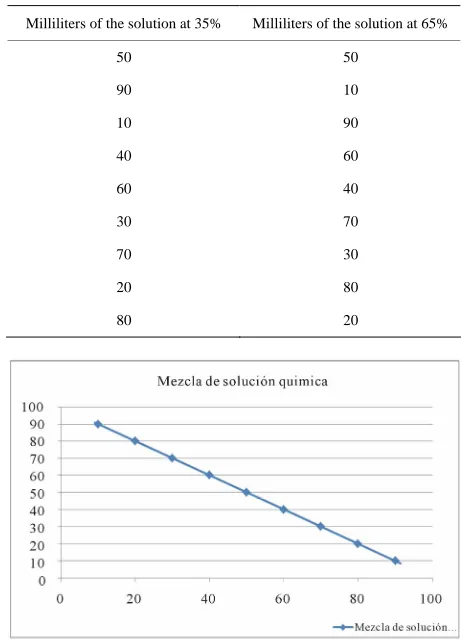
memory and constitute a part of the knowledge brought into play by the group of students, similarly, the procedures and strategies which were followed undergo a restructuration and advance progressively as attempts to solve the event are made. See Table 2 and Figures 3.
Operationalization process, it takes place when representa-tions are manipulated and the group of students attains the solu-tion of the posed contextualized event. It is identified that dur-ing this process the group of students applies the operatdur-ing knowledge that come from their experience and with that the group formulates procedures or strategies. In this process the previous knowledge of the group of students plays an important role as they allow modeling the event and working with the mathematical model by symbolic modes of representation that are more operational than the propositional.
Following is shown the procedures used by the students in the case showed in this paper.
Student 1: “It is required to make a solution of 100 milliliters having a 50% of sugar starting mixing 2 solutions each one of 100 milliliters too, one of this solutions has a 60% of sugar and the other a 35% of sugar.”
Student 2: “There are several ways to obtain the 100 millili-ters of the new solution as shown in the Figure 4”.
Student 1:“If we take 10 milliliters of the first solution and 90 of the second one, how much sugar has the new solution?”
The student made arithmetic procedures as shown in Figure 5. Table 2.
Tabular representation.
Milliliters of the solution at 35% Milliliters of the solution at 65%
50 50
90 10
10 90
40 60
60 40
30 70
70 30
20 80
80 20
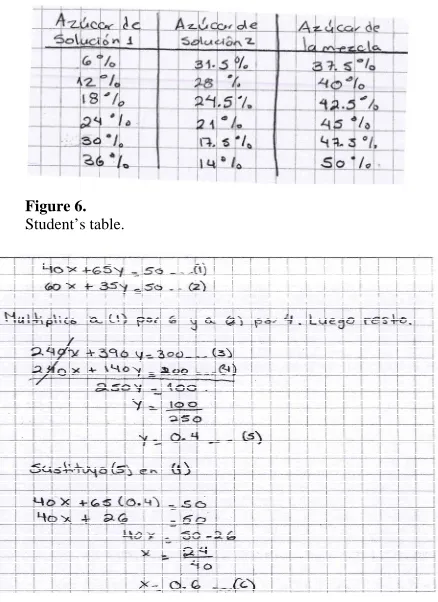
[image:4.595.55.285.498.585.2]Student 1: “Using arithmetic I can get the percentage of sugar in the milliliters that each solution uses and adding I get the total percentage of the third solution. I can fill a table.”
See Figure 6.
Student 2:“A 50% of sugar is obtained in the third solution when we take 60 milliliters of the first solution and 40 millili-ters in the second one.”
Student 2: “It can also be solved using a equations system.” See Figure 7.
Conclusion
By way of conclusion, it can be observed from the research that it has been sought to contribute to the understanding of the construction of knowledge of the student in a conceptual con-tent derived from the link between two different contexts, mathematics and technical area of the working field of a Senior Technical in Food Technology. The shown analysis has been addressed paying attention to the action of the student in the solution of contextualized events and teaching activities with systems of linear algebraic equations in the context of balance of matter, which constitute a means of analysis upon which the construction of knowledge is described. This is a study of cog-nitive type which uses as a theoretical framework the Concep-tual Fields by Vergnaud 1996, initially developed to carry out research in elementary education and that has been retaken to explain a contextualized phenomenon at Senior Technical level.
During the analysis of the activities by the group of students it was necessary to define the types of representations of the invariants in the schemes, which emerged in a spontaneous way during the performance of students. If students, at the end of the sessions, have acquired appropriate schemes to face contextu-alized events that require systems of linear algebraic situations, it is necessary to further explore into it, above all in different contexts.
Another important element to be mentioned is that the more
Figure 4. Student’s table.
Figure 5.
[image:5.595.314.533.83.384.2]Arithmetic procedures of the student 1.
Figure 6. Student’s table.
Figure 7.
Equations system made by student.
diverse contexts are used and the more contextualized events are addressed by the student, he could be constructing his knowledge in a more everlasting way and will be able to carry out the transference of mathematical knowledge to other sci-ences.
REFERENCES
Andris, J. (1996). The relationship of indices of student navigational patterns in a hypermedia geology lab simulation to two measures of learning style. Journal of Educational Multimedia and Hypermedia, 5, 303-315.
Chen, S. Y., & Macredie, R. D. (2002). Cognitive styles and hyperme- dia navigation: Development of a learning model. Journal of the American Society for Information Science and Technology, 53, 3-15. doi:10.1002/asi.10023
Ford, N., & Chen, S. Y. (2000). Individual differences, hypermedia navigation and learning: An empirical study. Journal of Educational Multi-Media and Hypermedia, 9, 281-312.
Liu, M., & Reed, W. M. (1994). The relationship between the learning strategies and learning styles in a hypermedia environment. Com- puters in Human Behavior, 10, 419-434.
doi:10.1016/0747-5632(94)90038-8
Moreira, M. A. (2002). Mental models and conceptual models in the teaching & learning of science. Revista Brasileira de Pesquisa em Educação em Ciências, 3, 37-57.
Parkinson, A., & Redmond, J. A. (2002). Do cognitive styles affect learning performance in different computer media? ACM SIGCSE Bulletin, 34, 39-43. doi:10.1145/637610.544427
Ruiz. E. F. (2009). Diseño de Estrategias de Enseñanza para el con- cepto de variación en Áreas de Ingeniería. Las matemáticas y la Educación,9, 27-37.
[image:5.595.65.281.472.712.2]lemas de la enseñanza de las matemáticas en la escuela primaria. México: Editorial Trillas.
Vergnaud, G. (1996). The Theory of Conceptual Fields. In L. Stette, P.