warwick.ac.uk/lib-publications
Original citation:Day, Sophie E. and Lury, Celia. (2016) New technologies of the observer : #BringBack, Visualization and Disappearance. Theory, Culture & Society.
Permanent WRAP URL:
http://wrap.warwick.ac.uk/88218
Copyright and reuse:
The Warwick Research Archive Portal (WRAP) makes this work by researchers of the University of Warwick available open access under the following conditions. Copyright © and all moral rights to the version of the paper presented here belong to the individual author(s) and/or other copyright owners. To the extent reasonable and practicable the material made available in WRAP has been checked for eligibility before being made available.
Copies of full items can be used for personal research or study, educational, or not-for profit purposes without prior permission or charge. Provided that the authors, title and full bibliographic details are credited, a hyperlink and/or URL is given for the original metadata page and the content is not changed in any way.
Publisher’s statement:
This had been posted ahead of publication.
Day, Sophie E. and Lury, Celia. (2016) New technologies of the observer : #BringBack, Visualization and Disappearance. Theory, Culture & Society. Copyright © 2017 The Authors. Reprinted by permission of SAGE Publications.
http://journals.sagepub.com/home/tcs A note on versions:
The version presented here may differ from the published version or, version of record, if you wish to cite this item you are advised to consult the publisher’s version. Please see the ‘permanent WRAP url’ above for details on accessing the published version and note that access may require a subscription.
For Peer Review
1
#BringBack: across the shifting grounds of observation 2
For Peer Review
2 When [Wittgenstein] says, “if the color changes you are no longer looking at the one
I meant,” the ground is suddenly pulled out from under you. How did the color
change? Who, or what, was the agent? (Bochner, 2008: 202)
Introduction
In her book Close Up at a Distance, Laura Kurgan discusses a well-known series of images of
the planet earth that began with The Blue Marble, a photographic view of the earth as seen
by the Apollo 17 crew travelling towards the moon in 1972, and ended with the 2012 digital
versions of this image. She describes these later versions as being,
… assembled from data collected by the Visible/Infrared Imager Radiometer Suite
(VIIRS) on the Suomi NPP satellite in six orbits over eight hours. These versions are
not simply photographs taken by a person traveling in space with a camera. They are
composites of massive quantities of remotely sensed data collected by
satellite-borne sensors. … This is not the integrating vision of a particular person standing in a
particular place or even floating in space. It’s an image of something no human
could see with his or her own eye … because it’s a full 360-degree composite, made
of data collected and assembled over time, wrapped around a wireframe sphere to
produce a view of the Earth at a resolution of at least half a kilometer per pixel – and
any continent can be chosen to be at the center of the image. [Moreover] … it can
always be updated with new data. (2013: 11-12)
As a patchwork or composite of satellite data, this image has no (visible) edges: it is
boundless and, as such, might lead us to imagine that contemporary visualization has no
limits.Yet there are very many ways in which in-visibility or non-visibility can be achieved
today, as Hito Steyerl’s deadpan film How Not to be Seen: A Fucking Didactic
Educational.MOV File (2013) demonstrates.
Partly set in a now disused photo calibration test site in a Californian desert i How Not to be
Seen presents itself as an instructional video, educating viewers about how to remain
invisible in an age of surveillance. Various possible strategies are identified, including
camouflaging oneself (to demonstrate, Steyerl smears green paint on her face), cloaking and
hiding in plain sight. Additionally, so a voice-over announces, you can be rendered invisible if
you are poor, undocumented, living in a gated community or in a military zone, a woman
over 50, if you own an ’anti-paparazzi handbag’, are disappeared by the authorities,
eradicated or annihilated, or if you are ‘a dead pixel’. To demonstrate this last possibility, 2
For Peer Review
3 several people appear on the screen, wearing black boxes on their heads, only to be faded
out. Digitally rendered ghosts dance in the desert landscape as The Three Degrees' When
Will I See You Again? plays on the soundtrack.
In this article, we analyse two very different examples of disappearance in terms of relations
of observation: the disappearance of Malaysia Airlines Flight 370, and the 276 Nigerian girls
who went ‘missing’ at about the same time in 2014. To focus on relations of observation, we
suggest, is not to downplay the situations we describe: to the contrary, we propose
sustained attention to relations of observation as a method for exploring how events take
place. As part of this analysis, we put forward the term ‘surface’ as a way to highlight the
ways in which relations of observation are constantly shifting, implying and sometimes
precluding points of view, and shaping the contours of events by providing ever-changing
conditions for visibility and invisibility across situations. However our concern with processes
of ‘surfacing’ events is not to deny or minimize the importance of the complex materialities
of observation. Following Crary, we believe that observation is not the purposeful,
perceptual practice of an individual; rather, our presumption is that the observer is ‘the
effect of an irreducibly heterogeneous system of discursive, technological and institutional
relations’ (1990: 6).
In line with this understanding of the observer, our emphasis in exploring relations of
observation is on vision as a holding term for many functions: ‘a physical sense, a set of
practices and discourses, and a metaphor that translates between different mediums and
different communications systems’ (Halpern 2014: 21). As Halpern points out, ‘Vision is … a
discourse that multiplies and divides from within’ (Halpern 2014: 21). In this regard, the
history of the term ‘visualization’ is instructive: it is a relatively recent term, only appearing
in the Oxford English Dictionary in 1883, and it was initially used to depict the formation of
mental images of things ‘not actually present in sight’ (Halpern 2014: 21). In the decades
that followed, however, it has come to mean any ‘action or process of making visible’:
Visualization slowly mutated from the description of human psychological processes
to the larger terrain of rendering practices by machines, scientific instrumentation,
and numeric measures. Most important, visualization came to define bringing that
which is not already present into sight. Visualizations, according to current
definition, make new relationships appear and produce new objects and spaces for
action and speculation. (Halpern 2014: 21) 2
For Peer Review
4 The proponents of second order cybernetics, as Halpern notes, were particularly important
in securing this definition. They refused to treat vision as a series of discrete mechanisms,
such as a causal chain of stimulus-response behaviour, proposing instead an analysis in
which relations of feedback were central to the patterning of the relationship between ‘the
being seen’ and ‘the seer’.
The period following the formulation of this analysis has seen the development of an
environment of large-scale automated data collection and surveillance that supports this
understanding. Not only have the technical mechanisms of observing or collecting data
multiplied but so too have the opportunities for feeding back or sharing these observations.
As we have argued elsewhere (xx and xx in press), these opportunities for feedback have
produced new opportunities for a variety of forms of tracking, all of which involve the
repeated folding of data, or looping of observation, into analysis at defined intervals in time.
This ongoing analysis turns traces into tracks as data are related, linked, or connected to
each other, so allowing feedback to ‘feed forward’. As a consequence, at the same time that
‘knowledge is decentralized and distributed across persons, practices, documents and
information infrastructure’, the question becomes ‘not simply ‘who knows whom?’ or ‘who
knows what?’ but ‘who knows who knows what?’’ (Contractor, quoted in Stark 2009: 174).
Indeed, some commentators have gone as far as suggesting that ‘modern society has moved
- in every field - from first-order observation to second-order observation’ (Esposito 2013:
4)ii. We put forward instead an analysis focusing on composition (Day, Lury and Wakeford 2014) as a way to explore the many layers, moving ratios and multiple dimensions of the
surfacing of surfaces of visualization.
Composing a surface of visualization
To illustrate our compositional approach we begin by introducing Flusser’s nested analysis of
‘the gesture of photography’iii (2014). Flusser starts with a quotidian situation: that of a man
positioning a camera so as to take a photograph of another man sitting in a chair, smoking a
pipe. He points out that even in such an apparently straightforward situation it is hard for
the photographer to know where to position himself so as to get the right perspective, and
give the object being photographed – in this case, the man with the pipe – the depth of
vision that it requires to be seen. Describing this struggle, he observes,
The center of this situation is the man with the apparatus. He is moving. Still, it’s
awkward to say of a center that it is moving in relation to its own periphery. When a 2
For Peer Review
5 center moves, it does so with respect to the observer, and the whole situation then
moves as well. We must therefore concede that what we are seeing when we watch
the man with the apparatus is a movement of the whole situation, including the
man sitting on his chair. (2014: 74-5)
In other words, while the photographer might believe that he is positioning the camera so as
to find the best standpoint from which to photograph a fixed situation, he is, if he is
performing the gesture of photography rather than taking a picture, looking for the position
that best corresponds to a situation that is moving.
Flusser then adds a further observation. He notes that we too are part of the moving
situation. Mores specifically, he recursively folds himself - and us - into the gesture of
photography:
… the man with his apparatus is the center of the situation only for us, watching
him, not for himself. He believes himself to be outside the situation, for he is
watching it. For him the man on the chair, at the center of his attention, is the
center of the situation. (2014: 75)
In short, Flusser suggests that what is required of the photographer by the gesture of
photography – moving to find a position from which to take a photograph of a situation
which is changing as he moves - is also true of us as observers of the gesture: ‘we, too, are
located in the space, watching the man with the apparatus’ (2014: 75). While we too might
believe ourselves to be outside the situation, we are (also) inside. Although ‘our’ location
could ‘mislead us’ into supposing that there are two different situations, ‘one in which the
man with the apparatus, whom we transcend, is at the center and another in which the man
on his chair is at the center and in which we are involved’, this is not the case. Instead, so
Flusser asserts, ‘The two situations are different yet bound up with one another’ (2014: 75).
Flusser’s analysis of the gesture of photography is captured in the photograph we reproduce
here (Figure 1). The image shows the positioning of the camera deemed necessary by the
police to record the scene of a crime in the late nineteenth and early twentieth century:
‘[the image’s] center will pass exactly between the eyes of the cadaver – at the root of the
nose’
(http://www.vice.com/en_uk/read/crime-and-death-in-paris-philippe-charlier-photography-876). This position - directly above the object of concern – has since been
institutionalised in a variety of forms of surveillance, including the aerial viewpoint of the
bomber or the drone (Virilio 1989). This image might thus appear to demonstrate better 2
For Peer Review
6 than many others that photography is produced from a position that is above or outside the
situations that it observes. Yet the photograph is (also) an observation of an observation,
and makes it clear that the position of the observer above or outside the situation is also,
recursively, part of the situation. The assumption of a fixed position in a stratified hierarchy
of observation is shown to be unstable since, from outside the image, we are already drawn
into the context of observation.
Figure 1: Studio Demonstration of Bertillon’s ’bec à gaz’ camera technique, La Musée de la
Préfecture de Police, Paris. (Image posted at VICE website)
By staging a halt to the gesture of photography with a different, orthogonal view on the
vertical nature of the ‘god’s eye’ view, the image makes visible the gesture of photography
as the making of a surface in motion across situations.
Drawing on this analysis, we suggest that the operation of the gesture of photography
described by Flusser is not restricted to photography but is enabled by a whole array of
technical supports. We note, for example, the way in which the constantly changing
organization of the relations established across the three sites of television - the place of
recording, the place of reception, and the place of transmission – continually remake
situations as (geo-political) events (Weber 1996). And we suggest that the event-making
capacities of observation are rapidly changing across relations that now routinely, 2
For Peer Review
7 recursively and massively take place between the military, governments, corporations and
everyday users of location-based devices and applications. In short, our proposal is that the
recursive binding together of situations described by Flusser as the gesture of photography
is fundamental to the making of contemporary surfaces of visualisation. We turn now to our
two examples to illustrate and expand this claim.
The case of the disappearing plane
It was widely reported that Malaysia Airlines Flight 370, a scheduled passenger flight from
Kuala Lumpur to Beijing, lost contact with air traffic control on 8 March 2014 at 01:20
Malaysian time (MYT), less than an hour after takeoff. The aircraft was carrying 12
Malaysian crew and 227 passengers from 14 nations. No explanation of this disappearance
has yet been officially confirmed although debris from the plane was recently found on a
beach on the Pacific Ocean island, Réunion. iv In relation to this, our first case, we ask: how can a plane ‘disappear’? In a discussion elsewhere (in press), we proposed that the
‘disappearance’ is a consequence of a combination of ‘double blind’ and double bind.
Double blind is a term used by one of the architects of cybernetics, Heinz von Foerster
(1995). A blind spot, or scotoma, is an obscuration of the visual field. A particular blind spot
known as the physiological blind spot, or punctum caecum, is the place in the visual field
that corresponds to the lack of light-detecting photoreceptor cells on the optic disc of the
retina where the optic nerve passes. Since there are no cells to detect light on the optic disc
at this point, the brain interpolates the blind spot based on surrounding detail and
information from the other eye, with the result that the blind spot is not normally perceived.
Von Foerster draws on this understanding in his presentation of the double blind; indeed, he
sums up the long-established finding that each of our two eyes has a blind spot with the
aphorism: ‘We do not see what we do not see’ (or as he put it elsewhere, ‘We do not see
that we do not see’). A consequence of this double negative, we suggested, is a (false)
positive, that is, a belief that we can see everywhere, as illustrated for example by
contemporary versions of The Blue Marble (introduced above). As we pointed out, however,
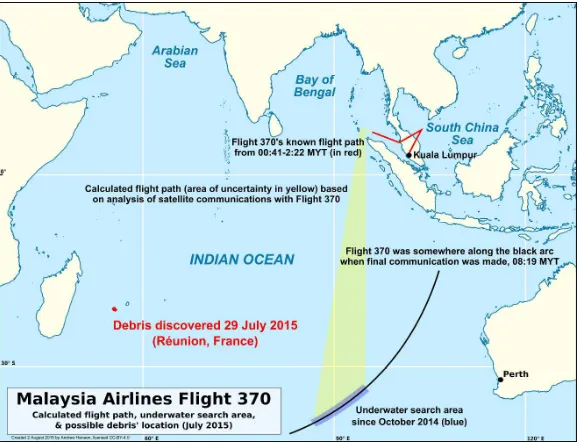
the plane’s disappearance demonstrated that ‘we’ cannot see always and everywhere
(Figure 2), even with the aid of the huge technical complex of GPS, civilian and military
satellites, drone cameras, GoogleMap and so on. The disappearance revealed that there are
edges (which might appear as gaps, corridors, or out-of-focus patches) in today’s apparently
boundless surface of visualization, even if we do not always know where they are or how
they operate, where or when we might fall into a crevice or over an edge. 2
For Peer Review
8 Figure 2: Map plotting the disappearance of Malaysia Airlines Flight 370 after debris was
found in Reunion, compared with MH370 flight paths and underwater search area. By
Andrew Heneen, created with public domain data from NaturalEarth.v
We thus considered it fundamental that this disappearance was visible even as the plane
itself disappeared.Its visibility, we suggested, was a consequence of the operation of double
blind and double bind, a phenomenon described by the anthropologist and fellow
contributor to second order cybernetics, Gregory Bateson (1987). Bateson suggests that
double bind – which he describes as ‘an experienced breach in the weave of contextual
structure’ - is a characteristic of all adaptive change. Such change, he says, depends upon
feedback loops, ‘be it those provided by natural selection or those of individual
reinforcement’. He continues, ‘In all cases, then, there must be a process of trial and error
and a mechanism of comparison.’ Significantly he further notes, ‘trial and error must always
involve error, and error is always biologically and/or psychically expensive. It follows
therefore that adaptive change must always be hierarchic’. The introduction of hierarchy is
necessary (and beneficial) for Bateson since, ‘There is needed not only that first-order
change which suits the immediate environmental (or physiological) demand but also
second-order changes which will reduce the amount of trial and error needed to achieve the
first-order change’. Here then Bateson argues that the introduction of hierarchy is a recursive
process that is necessary for learning and for the adaptation of an entity to its environment:
as he says, ‘And so on’ (1987: 201). 2
[image:9.595.108.399.119.340.2]For Peer Review
9 In observing some of the responses that made the disappearance of the plane visible we
suggested that the double bind in operation for some, especially state observers, involved
the co-existence of the injunction to ‘see everything’ (or at least the injunction, ‘do not see
what you do not see’) and the contradictory injunction to ‘see nothing’ (which is to say, ‘do
not see what you see’). Relatives in China and elsewhere personify the imperative to see
everything; they focus the minds of state actors who do not want to admit the failure (of the
fantasy) of total planetary observation that is the double blind hypothesis. However, in
order for this double blind hypothesis to be preserved, observers who are differently
situated in relation to the context(s) of observation needed to reveal to each other what
they had (not) seen. But such comparison, as Bateson notes, has significant political ‘costs’
for such observers, especially for those observers acting on behalf of states who might
reveal their own positions as they compare their observations with those of others. This
dilemma intensifies a situation in which such observers simultaneously feel compelled to
observe the injunction to not see what they do not see and to not see what they do see.
These twin injunctions inform a slow dance of observe and (don’t) tell, the outcome of
which, we suggested, was the creation of unstable hierarchies of first and second orders of
observation. Yet the costs and opportunities of comparison can lead to other outcomes, as
we suggest with reference to our second case.
And so on: the Chibok abduction
On April 14, 2014, 276 girls were kidnapped from a school in the north-east of Nigeria. This
violence was attributed to Boko Haram, an organisation antagonistic to both the Nigerian
regime, which is associated with the south of the country, and western powers: their name
is commonly translated as ‘western education is sinful’. In this example too, we suggest, a
disappearance is rendered visible but in this case the situations that are bound together do
not establish the grounds for any, even unstable, hierarchies of observation.
We start then by recording some of the myriad observations made locally, nationally and
internationally. First, citizens took to the streets of Abuja in protest and demanded the
return of the girls, fifty-nine of whom had managed to escape shortly after their abduction.
There was a rally in Cardiff, UK and hundreds of other cities; church congregations joined in
prayer, and international church leaders in negotiation. One by one, the girls were 2
For Peer Review
10 individually named. Speculation about their fate, about Boko Haram and the Nigerian state
was rife.
The political impetus to find the girls was amplified globally in a hashtag campaign on
Twitter, #BringBackOurGirls, which attracted commentary in turn. The campaign started in
Nigeriavi and attracted the support of Michelle Obama (Figure 3), Malālah Yūsafzay, the Nobel Prize laureate and activist from Pakistan, and many others, who were bound together
in outrage at the abduction of the young women. The First Lady’s address of May 10th 2014 was given on the US holiday for honouring mothers.
Figure 3: Michelle Obama, #BringBackOurGirls, posted to her official Twitter account
(Wikipedia, Chibok Schoolgirls Kidnapping, accessed May 2015)
One of the most emotive posters attached to #BringBackOurGirls was tweeted by rapper
Chris Brown, as well as the US embassy in Madrid, Kim Kardashian and global girls’ rights
activist Becky Makoni among many others (Figure 4). The picture is of a girl from Guinea
Bissau, a country more than 1,000 miles away from Nigeria, taken by photographer Ami
Vitale in 2000, some considerable time before the abduction. The girl in question, Jenabu
Balde, was not abducted and the teardrop running down her cheek was photoshopped in
(Felicity Morse, 13 May 2014). By 7th May 2014, more than one million people had signed up to the Twitter campaign and, according to Wikipedia’s hashtag activism entry, the photo has
received over two million retweets. 2
For Peer Review
11 Figure 4: #BringBackOurGirls image, shared by Chris Brown on Twitter, 1 May 2014
It only became clear to international observers gradually that the kidnapping was far from
an isolated event. For example, just over a month before the girls were abducted in Chibok,
59 boys were shot or burned to death by Boko Haram at a secondary school in Yobe, Nigeria.
To observers from the outside at least, it seemed unclear whether the Nigerian state would
hold. On CBS News, the US Defence Secretary, Chuck Hagel asserted that it was an open
question whether Nigerian forces were capable of rescuing the girls. The audience were told
that the Muslim north would never vote for a Southern Christian president and so electoral
mathematics could not justify a ‘disproportionate’ response. As the US deployed surveillance
aircraft over the area with and without crew, White House spokesperson, Jay Carney, said
there would be no active deployment of US forces in Nigeria because, ‘we’ don't know
enough yet… what to recommend to Nigerians, where they need to go, what they need to
do, to get those girls back’ (Smith, Sherwood and Soal, 16 May 2014).
Kidnappings, executions and destruction continued in the north of Nigeria throughout 2014.
A ceasefire announced in October did not last, and it was not until February 2015 that
concerted military interventions by the Nigerian army in collaboration with neighbouring
countries led to the reclamation of much of the territory held by Boko Haram, leaving them
only the Sambisa forest. Many people were also rescued from this forest, including a group
of nearly 300 women and children (BBC News, 4 May 2015). Some of those freed came from
villages close to Chibok, but they did not include the missing young women. vii 2
For Peer Review
12 On the anniversary of the abduction, April 14 2015, the Nigerian President Elect
acknowledged, ’We do not know if the Chibok girls can be rescued. Their whereabouts
remain unknown. As much as I wish to, I cannot promise that we can find them….’ (Dearden,
14 April 2015). Around the world, vigils and marches were staged once more. In New York,
the Empire State Building was lit up in red and purple in honour of the missing girls.
Supporters from New Zealand to the United States again posted online, using the hashtags
#365DaysOn, #ChibokGirls and #NeverToBeForgotten. Since then, sporadic reports,
associated with videos and messages from Boko Haram, assert that the disappeared young
women converted to Islam, now hate their parents, have been married off, sent into sexual
slavery, or trained as suicide bombers (Nayar 2015).
The continuing speculation and dismay indicates that it has been difficult to establish a
ground from which to make observations or to which the young women could be returned,
let alone a ground in relation to which a hierarchy between first and second order
observations could be established. To consider the difficulties of observation in this case, let
us explore the Bringback hashtag campaign further. The observations on Twitter were made
largely from the global north and west, and were often articulated from the position of
mothers. Nayar (2015) suggests that the victims of the abduction ‘were kidnapped for being
girls.’ She observes that the BringBack rhetoric in the USA ‘shrewdly notes that educated
girls are a rarity in Nigeria (5% of the total population)’, and argues that the posts imply ‘that
by kidnapping them Boko Haram has stalled modernisation itself’. She argues that the role
of maternal and filial testimonies was instrumental in harnessing the personal to the
political, and the affective history (primarily of loss and anguish) of the family to the social
history of the nation. Khoja-Moolji (2015) claims that hashtag feminism implies a certainty
about the lives of ‘girls’ in the global south and its own role (from the global north) in
alleviating their suffering, rearticulating longstanding colonial relations with campaigns of
redress. viii Even though these analyses are enlightening, the radical uncertainty introduced into events by the gesture ‘BringBack’ can be demonstrated by the (im)possibility of a
#BringBackOurBoys campaign on the part of Michelle Obama . We ask: would the hashtag
#BringBackOurBoys have the ability to refer to what commentators see as homeland racist
killings in the US, or campaigns for the return of US soldiers from one or more of the US
military interventions taking place in other parts of the world, or the Israeli social media
campaign that was launched in June 2014 by students of the University of Haifa? This 2
For Peer Review
13 campaign called upon the international community for action after three teenage Israeli
boys were abducted by pro-Palestinian militants and it was directly inspired by
the #BringBackOurGirls campaign.ix
Rendition
Having briefly introduced our two cases, we now bring them together in a practice of
comparison so as to ‘learn’ how relations of observation, including our own, operate across
changing contexts. First, we return to Flusser’s analysis of the gesture of photography to
highlight the way in which he conceptualizes this gesture in terms of three aspects that are
recursively linked. He says,
A first aspect is the search for a place, a position from which to observe the
situation. A second aspect is the manipulating of the situation, adapting it to the
chosen position. The third aspect concerns critical distance that makes it possible to
see the success or failure of this adaptation. (2014: 77)
It is the links across these three aspects, we suggest, that produce a surface in which the
recursive doubling of the position of observer is neither mere duplication nor hierarchical
subsumption of one position by the other, but something more complicated. In other words,
the gesture of photography, as it is implemented in multiplying feedback loops, produces a
surface that is always being made, un-made and re-made and as such is never coincident
with itself. Put simply, we understand the doubling of observation in Flusser’s account of the
photographic gesture to describe observation as (re-)entry into a surface of visualization
that is changing, not least because it is itself the object of observation.
Flusser proposes that, ‘This view of ourselves in a situation (this ‘reflexive’ or ‘critical vision)
is characteristic of our being-in-the-world, and we see it, we ‘know’ about it’ (2014: 75). He
says that this reflexive position is not an objective one. Indeed, he characterizes the
photographic gesture, and more widely any gesture, as a release from a particular role and
suggests that this release is just as available to the man with the apparatus inside the
photograph as to the observer outside the image. Both, he suggests, are bound to a ‘place’
from which we can assert that ‘we are experiencing the same situation twice’. He says that
this ‘place is ‘the basis for a consensus, for intersubjective recognition. If we encounter the
man with the apparatus on this basis, we don’t see the situation ‘better’: rather, we see it
intersubjectively, and we see ourselves intersubjectively’ (2014: 75-6). Our examples
suggest, to the contrary, that ‘we’ are not experiencing the same situation twice. 2
For Peer Review
14 Our first case suggests to us that double bind, double blind and first and second order
observation may emerge as the outcomes of this process of recursion. As they happen,
these compositional processes organise and reveal the surface in which they take place.
Insofar as they involve a halting, pausing or momentary suspension in the process of
recursion, they permit (collective) contemplation of what is visible and what is invisible, and
also speculation about how visibility and in- or non-visibility are inter-related, and from
which positions. But our second case demonstrates that these are not the only possible
outcomes.
To develop an analysis that is adequate to both examples, we turn to consideration of
doubling as recursion – ‘And so on’ as Bateson puts it. In this respect, it is worth noting that
recursive functions are explicitly acknowledged to have a variety of effects in second order
cybernetics: bi-stable, multi-stable or endless. It is also understood that recursive functions
may not only be techniques for the production of composite images such as The Blue
Marble, but are themselves composite. For example, while recursion is sometimes
understood solely in terms of successor functions, that is, functions that operate on their
own outcomes, the (algorithmic) recursion that is characteristic of today’s surfaces of
visualisation typically comprises three different kinds of functions: zero, projection and
successor functions (Totaro and Ninno 2014). In mathematical terms, zero functions are
those functions whose value can be zero; in social scientific terms it is perhaps equivalent to
the assumption or determination of ceteris paribus (that is, all other things being equal or
held constant). Projection functions are those operations that allow for a mapping of one
space onto another. Importantly, such mappings are one of the ways in which is possible to
pass a subset of the arguments of one function to another function. Understood in more
social terms, projection functions can be understood as comparisons that allow for the
passing, or sharing, of some characteristics of the entities compared. Moreover such
functions may be sequenced in many different ways. In other words, recursive functions are
continually being de- and re-composed in the ongoing composition of today’s surfaces of
visualization, with the consequence that the grounds of observation may only
retrospectively be established, and even then only temporarily.x More generally, as Steyerl
says, while many,
aerial views, 3D nose-dives, Google Maps, and surveillance panoramas do not
actually portray a stable ground … they create a supposition that it exists in the first
place. Retroactively, this virtual ground creates a perspective of overview and 2
For Peer Review
15 surveillance for a distanced, superior spectator safely floating up in the air. Just as
linear perspective established an imaginary stable observer and horizon, so does the
perspective from above establish an imaginary floating observer and an imaginary
stable ground. (2011)
Similarly Weizman (2012) argues that vertical sovereignty splits space into stacked
horizontal layers, separating airspace from the ground, and the underground from the
ground, multiplying sites of conflict and violence. But, so our examples suggest, what is
above and what is below or adjacent to us cannot always be easily stabilized.
In both cases many different contexts or grounds were brought into play in attempts to
make visible the disappearances. Just as the disappearance of the plane made some layers
or orders visible and others invisible, the disappearance of the young women from Chibok
silenced some and caused others to speak (see Figure 5). But, in the case of the missing girls,
no single ground could be established to cover up or blank out the others entirely. The
failure to establish the degree zero of a ground of comparison across contexts meant that
the layers could not be made to line up in an orderly fashion; the interference or patterns of
diffraction produced across their non-aligned edges created turbulence rather than shared
[image:16.595.164.430.448.625.2]orders of observation.
Figure 5: Afolabi Sotunde, Reuters, in Adam Chandler, Nigeria's Violent Year Since 'Bring
Back Our Girls'. The Atlantic, 14th April 2015
Indeed, we suggest that the contingency of comparison introduced by the gesture of
photography across changing situations or contexts is fundamental to the patterning of 2
For Peer Review
16 observation in contemporary surfaces of visualisation. xi Chow makes a similar argument in a discussion of the inter-relationship between the conduct of war on the basis of knowledge
production and the production of knowledge on the basis of war. Specifically, she proposes
that the spatial logic of the grid is giving way to,
an archaeological network wherein the once assumed clear continuities (and unities)
among differentiated knowledge items are displaced onto fissures, mutations, and
subterranean genealogies, the totality of which can never be mapped out in
taxonomic certitude and coherence. Knowledge production [is] … a matter of
tracking the broken lines, shapes and patterns that may have been occluded, gone
underground or taken flight. (2006: 81)
She further suggests that in the absence of an a priori secure ground, from which to
establish likeness, comparison becomes an act of judging the value of different things
‘horizontally, in sheer approximation to one another’. For Chow this act is necessarily
speculative rather than conclusive because it is inseparable from history. She writes,
comparison would also be an unfinalizable event because its meanings have to be
repeatedly negotiated – not only on the basis of the constantly increasing quantity
of materials involved but more importantly on the basis of the partialities,
anachronisms, and disappearances that have been inscribed over time on such
materials’ seemingly positivistic existences’ (2006: 81).
A breakdown of the composite nature of recursive functions, as we have attempted above,
provides some analytical resources for an exploration of the contingent politics of the
‘unfinalizable’ (Chow 2006) composition of events. However, we want to introduce a term
drawn directly from the vocabulary of composition to sum up the ways in which Flusser’s
analysis of the gesture of photography is telling for an analysis of ‘surfacing’ today.
Rendering or rendition is a term with many everyday as well as technical definitions,
including: a performance, a translation, an artistic depiction, a representation of a building
or an interior executed in perspective, as well as to return, to make a payment (in money,
kind or service) as by a tenant to a superior, and to pay in due (a tax or tribute). The origin
for all these uses of the term is the Latin reddere: ‘to give back’. There are also more
specialised meanings. In computer science, rendering refers to techniques, including chroma
key compositingxii. In law, rendition is a surrender or a handing over of persons or property, particularly from one legal jurisdiction to another. For criminal suspects, extradition is the
most common type of rendition. Extraordinary rendition or irregular rendition is the 2
For Peer Review
17 government-sponsored kidnapping and extra-judicial transfer of a person from one country
to another.xiii
Working across the meanings of rendition in these two cases, we propose rendering as a key
compositional process in the dynamics of contemporary surfaces of visualisation. Steyerl’s
account of the skills of editing provides a way to think about what this involves: editing, she
says, is
… being expanded by techniques of encryption – techniques of selection – and ways
to keep material safe and to distribute information. Not only making it public,
divulging or disclosing, but really finding new formats and circuits for it. I think this is
an art that has not yet been defined as such, but it is, well, aesthetic. It’s a form. …
Now it's not only about narration but also about navigation, translation, braving
serious personal risk, and evading a whole bunch of military spooks. It's about
handling transparency as well as opacity, in a new way, in a new, vastly extended
kind of filmmaking that requires vastly extended skills. (Steyerl and Poitras, 2015:
311)
In line with our emphasis on composition, Steyerl proposes that the question of how
information is ‘stored, secured, circulated, redacted, checked, and so on … [the] entire art of
withholding and disseminating information and carefully determining the circumstances’ is a
‘formal decision’. Like us, she emphasizes that this formal decision has an unstable
temporality:
When I'm working with After Effects,xiv there is hardly any real-time play back. So
much information is being processed, it might take two hours or longer before you
see the result. So editing is replaced by rendering. Rendering, rendering, staring at
the render bar. It feels like I'm being rendered all the time.
What do you do if you don't really see what you edit while you're doing it? You
speculate. It's speculative editing. You try to guess that what it's going to look like if
you put key frames here and here and here. Then there are the many algorithms
that do this kind of speculation for you. (Steyerl and Poitras, 2015: 312)
In dialogue with Steyerl, the filmmaker Laura Poitras discusses the programme
TREASUREMAP used by the US National Security Agency (NSA) to provide analysts with ‘a
near-real-time map of the Internet and every device connected to it’. She suggests that at
the core of the NSA's approach to data collection is ‘retrospective querying - how to see
narrative after the fact’ (Steyerl and Poitras, 2015: 312). In our terms, even though the 2
For Peer Review
18 feedback loops of the photographic gesture may be consistently halted for contemplation,
‘real-time developments’ constantly render each framing ‘merely’ historical. As Kurgan says,
the map that emerges from contemporary practices of composition is neither a top-down
view, nor a bottom-up account, but both.
Identify an area. Zoom in and examine the specific conditions. Zoom out and then
consider both scales at the same time. The resulting image is no longer hard data. It
is a soft map that is infinitely scalable, absolutely contingent, open to vision and
hence revision. (2013: 204)
In practices of rendition, an appearance may rest upon a disappearance: the Chibok girls
appear as the disappeared but their missing neighbours do not. However, even when
something appears, it can change colour, become blurred or smeared as the ground is
suddenly pulled out from under the observer. As Bochner says in relation to certain recent
art, frustration is an understandable response:
Frustration because the viewer is looking for a complete ‘idea’ and is foiled. What is
thought and what is experienced continually replace each other. The concealed is
the source of thought. And thought, which we hoped to use to ‘fill in the gaps’, is in
itself bottomless or … incomplete. (2008: 49)
In the layered circuits of contemporary surfaces of visualisation that emerge in the gesture
of photography, what we once could see but is no longer visible is rendered co-existent with
what is not yet but can be visualised. Techniques of pre-emption make loops in time in ways
that secure a ground that is not stable and frustration mutates into ‘insecurity’ in the highly
contingent relations of proximal intimacy emerging across situations.
Conclusion: ‘I want to show that there is no resolution, no firm ground. Everything that is given is immediately taken away.’ (Bochner, 2008: 166)
In this paper, we have investigated two very different examples of disappearance in terms of
composition. To do this, we drew on Flusser’s account of the gesture of photography, an
account that led us to focus on the recursive organisation of a tri-partite set of relations: the
search for a place or position from which to observe a changing situation; the change or
manipulation of the situation, adapting it to the chosen position; and the setting up of a
relation from which to judge the success or failure of this adaptation. By drawing attention
to the changing inter-relationships of changing positions of observation in changing
environments in terms of composition, we showed how surfaces of visualisation emerge 2
For Peer Review
19 from a patterning of relations of observation that we described as rendition. In doing so, we
showed how relations of observation are both formal and constitutive of events. xv
An interest in the constitutive role of knowledge practices (including observation) is evident
in a range of recent approaches. In a discussion of ratings in finance, for example, Esposito
argues that the economy has ‘evolved towards an increasing abstraction of its criteria and its
operations (expressed by finance), abandoning any reference to the world and its data’
(2013: 3). She then generalizes her analysis to make the claim we introduced earlier, namely
that ‘modern society has moved in every field from first-order observation to second-order
observation’. In her discussion of the field of genetics, Franklin discusses Rabinow’s
prediction in 1992 that we would see the ‘truly new form of autoproduction called
biosociality’ involving ‘the formation of new group and individual identities and practices
arising out of . . . [the] new truths’ of the human genome project. She suggests that one of
the distinctive features of biosociality is that the direction of analogical flow – from nature
to culture – is ‘reversed, so it flows backwards’ (2014: 245). The change, she says, is not only
‘one of relationalities (biosocial identities, connections and groups) but also of context and
perspective (molecularization)’ (2014: 245); indeed, her proposal is that ‘context itself can
change, and be changed’ as the result of what she calls analogic return (2014: 244).
The examples of finance and the biological sciences are of interest because they
demonstrate the way in which the travel of analogies or comparisons is constitutive of
operations, identities and hierarchies in specific forms of expertise. However, our examples
indicate that comparisons may operate across contexts with extreme lability, problematizing
the generalizability of understandings of ‘hierarchical’ orders of observation or ‘directions’
of traffic flow. While the examples we have discussed differ in many respects, they both
speak to the specificity of contemporary surfaces of visualisation, in which each
dis/appeared and re/appeared is composed as a generic singularity – an event that emerges,
fractionally, across time and space. The recursive operation of ‘across’ locates observers
both inside and outside the image that they (we) see. As both a preposition and an adverb,
‘across’ can imply one or all of: moving from side to side or crossing a space; a width or
spaces as a whole and relative positions in that space; and the process of moving as when a smile spreads across a space. ‘Across’ thus describes relations of observation that do not
operate between fixed positions, but constitute the contexts they bring in relation to each
other, at least partially, in that relation. Not only are we up close at a distance, as Kurgan 2
For Peer Review
20 puts it, we are also beside, or next to, from above. And it is to capture this doubling that we
suggest that the vocabulary of composition, rather than either that of first and second order
observation or the language of analogic return, is required. It is only then that the blue
planet whose centre is everywhere but whose circumference is nowhere (Borges 1993) can
come into view.
One final observation can be made from the position of the object, as proposed by Žižek in
The Parallax View. Parallax describes the displacement or difference in the apparent position of an object viewed along two different lines of sight, and it is the basis of depth perception. In computing, the parallax effect is used to produce computer stereo vision. It can be used to establish the distance between seer and seen, and Žižek suggests that the relation established in a parallax view is not unidirectional:
… the subject's gaze is always-already inscribed into the perceived object itself, in
the guise of its 'blind spot,' that which is 'in the object more than object itself', the
point from which the object itself returns the gaze. Sure the picture is in my eye, but
I am also in the picture. (2006: 17)
Or as Chow would put it, the blue planet is the age of the world target.
iThese sites were constructed in the 1950s and 60s to test the resolution of airborne cameras and drones. According to the Center for Land Use Interpretation (http://www.clui.org) most of them follow the same general lay-out: a rectangular concrete or asphalt pad constructed flat on the ground, coated in heavy black and white paint. The pattern painted on the targets comprises sets of parallel and perpendicular bars, and, sometimes, a large white square: the smallest group of bars marks the limit for the optical instrument that is being tested. They have been described by Michael Connor as ‘a kind of optometrist's chart for the ancestors of drones’ (http://rhizome.org/editorial/2013/may/31/hito-steyerl-how-not-to-be-seen/).
iiEsposito draws on the distinction made by Luhmann (1988), namely, that while first order observation observes things, second order observation observes things, including other observers, in their environment of observation.
iii In the introduction to a collection of essays in which he discusses a whole series of
gestures, Flusser says that ‘gesture is a movement of the body or of a tool connected to the body for which there is no satisfactory causal explanation’. He continues, ‘And I define satisfactory as that point in discourse after which any further discussion is superfluous’ (2014: 2).
ivA serial number inside the wing piece found on the beach corresponds with that recorded by the Spanish company that supplied the piece to Boeing, which built the plane in 2002. On its own, this discovery neither confirms nor contradicts crash investigators’ belief, based on 2
For Peer Review
21 radar data and satellite signals, that the plane went down somewhere in an empty stretch of the Indian Ocean, southwest of Australia.
vAt
https://en.wikipedia.org/wiki/Search_for_Malaysia_Airlines_Flight_370#/media/File:Reunio n_debris_compared_to_MH370_flight_paths_and_underwater_search_area.png (consulted January 2016)
vi The provenance of #BringBackOurGirls is widely contested. In one account, the first use was on April 23 2014 by Ibrahim Abdullahi, a corporate lawyer in Abuja, Nigeria. He, however, credits the phrase to a former vice president of the World Bank for the Africa region, Obiageli Ezekwesili, who said the four words in a TV appearance. NBC News covered the so-called hashtag wars in which Kimberly C. Ellis claimed that Ramaa Devi Mosley, a Los Angeles filmmaker, ‘essentially stole an African woman’s voice, a Nigerian woman’s voice, who started the phrase and started the movement’ (http://www.nbcnews.com/tech/social-media/hashtag-wars-whos-behind-nigeria-bringbackourgirls-movement-n100771).
viiAccording to Amnesty International, 2,000 women were kidnapped in Nigeria during the first four months of 2015.
viiiSimilarly, Murphy (2013) has traced the spiralling investments in what she calls the ‘Girl Effect’, that is, the use of the girl as an ascendant ‘transnational figure of rescue and investment’, charged with speculative futures.
ixThis Israeli campaign aims to ‘Stop the terrorism against Israel & help us #BringBackOurBoys! A search for ‘#bringback’ in Twitter (May 2015) yielded, first, #bringbackourgirls, second, in reference to the Charlie Hebdo shooting in Paris, #bringbackcharlie, third, #bringbackcrystalpepsi and, in fourth place, #bringbackthenhs. Each of the terms is constituted in and constitutive of many and sometimes partially overlapping grounds of observation.
xTo illustrate the way in which movement and position need not be either subsequent or anterior to observation, but may be already included, consider the history of axonometric projection as described by the art historian Yve-Alain Bois and discussed by Kurgan. An axonometric drawing shows an object in ways that cannot be seen simply by looking at it from a single position. To do so, it typically rotates an object along one or more of its axes such that the surface of the top and two sides are in view simultaneously. This mode of projection has been variously employed by computer scientists, as well as architects and artists, who use graph theory to produce ‘flat’ networks with ‘non’-perspective.
xiThe use of search terms provides a related illustration of de- and re-composition, of the ground being pulled from under the feet of the observer. In a discussion of metadata, Boellstorff (2015) shows how these terms, which he considers to be a prototypical example of ‘metadata’, can become ‘data’ in some social practices. One example he provides concerns the use of searches to track possible influenza outbreaks. Another example occurred when LGBT activists responded to the heterosexist stance of former Pennsylvanian congressman Rick Santorum by consistently using his name as part of a search string for sexual fluids, temporarily pushing a ‘spreadingsantorum.com’ Website to first place in Google’s results for the term ‘santorum’. In instances like these, Boellstorff argues, phenomena typically classed as meta-communication act as forms of communication. In our vocabulary, the way in which search terms perform comparison across contexts can be understood as an instance of the gesture of photography such that ‘above’ is always in tension with ‘beside’.
xiiThis is a post-production technique for joining two or more images or video streams together based on colour hues. The technique is typically used to remove a background from the subject of a photo or video – particularly in television news, film and the videogame 2
For Peer Review
22 industry. A colour range in the top layer is made transparent, revealing another image behind.
xiiiThe United States and the United Kingdom are known to have ‘renditioned’ prisoners to nations that practice torture, called torture by proxy.
xivAdobe After Effects is a digital visual effects, motion graphics application developed by Adobe Systems. It is used in the post-production process of filmmaking and television production. Among other things, After Effects can be used for keying, tracking, rotoscoping, compositing and animation. It also functions as a basic non-linear editor, audio editor and media transcoder.
xvThe concept of pattern describes a field of force in which actuality and potentiality are held in tension. As Whitehead says, ‘The manner of a pattern is the individual essence of the pattern. But no individual essence is realizable apart from some of its potentialities of relationship, that is, apart from its relational essence’ (1978: 115, quoted in Manning, 2013: 165). As patterns, relations of observation are able to act as ‘modes of attunement’ that ‘populate expression at the edge of intelligibility’ (Manning 2013: 165); their oscillating effects create alternations in mood in such a way as to provoke ‘our bodies into a visceral response rather than a purely visual grasping of form alone’ (Jeffries, 2012: 130).
References
Bateson, G. (1987) Steps to an Ecology of Mind, Chicago: University of Chicago Press.
BBC News, ‘Nigeria's Chibok girls seen with Boko Haram in Gwoza', 14 April 2015, URL
(consulted May 2015):http://www.bbc.co.uk/news/world-africa-32292854
BBC News, ‘Boko Haram freed Nigerian women tell of captivity horror’, 4 May 2015, URL
(consulted May 2015):http://www.bbc.co.uk/news/world-africa-32574777
Bochner, M. (2008) Solar System and Rest Rooms: Writings and Interviews, 1965-2007,
Cambridge, Mass.: The MIT Press.
Boellstorff, T. (2015) ‘Making Big Data, in Theory’, pp. 87-108 in T. Boellstorff and B. Maurer
(eds.) Data, Now Bigger and Better!, Chicago: University of Chicago Press.
Bonnici, T. ‘Kidnapped Boko Haram girls make long walk to freedom.’ The Times, Africa, 12 October 2014, cited in Wikipedia.
Borges, J. L. (1993) ‘Pascal’s Sphere’, URL (consulted May 2015)
http://www.filosofiaesoterica.com/ler.php?id=1355#.Vo1fhPmLTcs.
Chow, R. (2006) The Age of the World Target: Self-Referentiality in War, Theory, and
Comparative Work. Durham, North Carolina: Duke University Press.
Crary, J. (1990) Techniques of the Observer: On Vision and Modernity in the Nineteenth
Century. Cambridge, Mass.: The MIT Press.
Day, S., Lury, C., and Wakeford, N. (2014) ‘Number ecologies: numbers and numbering
practices’, Distinktion, 15(2): 123-154. 2
For Peer Review
23 Dearden, L. (2015) ‘Chibok kidnappings: Schoolgirls may never be brought home, Nigeria's
President-elect admits’, The Independent, 14 April 2015.
Esposito, E. (2013) ‘Economic circularities and second-order observation: the reality of
ratings’, Socologica, no. 2, URL (consulted 2015):
http://www.sociologica.mulino.it/doi/10.2383/74851
Flusser, V. (2014) Gestures, Minneapolis: Minnesota University Press.
Foerster, H. von (1995) Anthology of principles, propositions, theorems, roadsigns,
definitions, postulates, aphorisms etc., URL (consulted September 2015):
http://www.cybsoc.org/heinz.htm).
Franklin, S. (2014) ‘Analogic return: the reproductive life of conceptuality’, Theory, Culture
and Society, vol. 31 no. 2-3: 243-261.
Halpern, O. (2014) Beautiful Data. Durham and London: Duke University Press.
Jeffries, J. (2012) ‘Pattern, patterning’, pp.125-135 in C. Lury and N. Wakeford (eds) Inventive
Methods, London: Routledge.
Khoja-Moolji, S. (2015) ‘Becoming an “Intimate Publics”: Exploring the Affective Intensities
of Hashtag Feminism’, Feminist Media Studies, 15, 2: 347-50.
Kurgan, L. (2013) Close Up at a Distance: Mapping, Technology and Politics, New York: Zone
Books.
Luhmann, N. (1998) Observations on Modernity. Stanford, California: Stanford University
Press.
Manning, E. (2013) Relationscapes: Movement, Art, Philosophy. Cambridge, Mass.: The MIT
Press.
Morse, F. ‘The Bring Back Our Girls Campaign is working: Boko Haram should be scared of a
hashtag’. The Independent, 13 May 2014.
Moskatova, O. (2013) ‘Re-inscriptions: microscopy of time and motion’, pp. 96-116 in C.
Taban (ed.) Meta- and Inter-Images in Contemporary Visual Art and Culture, Leuven: Leuven
University Press.
Murphy, M. (2013) ‘The Girl: Mergers of Feminism and Finance in Neoliberal Times’, The
Scholar and Feminist Online, 11.2., URL (consulted 2014):
http://sfonline.barnard.edu/gender-justice-and-neoliberal-transformations/the-girl-mergers-of-feminism-and-finance-in-neoliberal-times/
Nayar, P. K. ‘The Violence of Disappearance: Reading the Boko Haram Kidnapping’, URL
(consulted September 2015):
http://www.esocialsciences.org/Articles/ShowPDF/A20155495757_41.pdf 2
For Peer Review
24 Smith, C. (2015) The technology of hope : twitter and the #BringBackOurGirls campaign. MA
Dissertation, Royal Roads University, Canada, URL (consulted September 2015):
https://dspace.royalroads.ca/docs/handle/10170/842
Smith, D., Sherwood, H., and Soal, J. (2014) ‘Nigerian schoolgirls' home town in despair after
president cancels visit.’ The Guardian, 16 May 2014.
Stark, D. (2009) The Sense of Dissonance, Princeton NJ: Princeton University Press.
State Department Daily Press Briefing 14 April 2015, URL (consulted September 2015):
http://iipdigital.usembassy.gov/st/english/texttrans/2015/04/20150414314665.html?CP.rss
=true#axzz3bi7EP2bq
Steyerl, H. (2011) ‘In free fall: a thought experiment on vertical perspective’, e-flux journal
#24, URL (consulted May 2015):
http://www.e-flux.com/journal/in-free-fall-a-thought-experiment-on-vertical-perspective/
Steyerl, H. and Poitras, L. (2105) ‘Techniques of the observer’, Artforum, May, pp. 306-317.
Totaro, P. and Ninno, D. (2014) ‘The concept of algorithm as an interpretative key of modern
rationality’, Theory, Culture and Society, 31 (4): 29-49.
VICEAcid, Passion and Dried Blood: Photos from Murder Scenes in 1880s Paris, March 31,
2015, photos by Glenn Cloarec, URL (consulted May 2015):
http://www.vice.com/en_uk/read/crime-and-death-in-paris-philippe-charlier-photography-876
Virilio, P. (1989) War and Cinema: The Logistics of Perception. London: Verso.
Weizman, E. (2012) Hollow Land: Israel’s Architecture of Occupation. London: Verso.
Wikipedia, Chibok Schoolgirls Kidnapping, URL (consulted May 2015):
https://en.wikipedia.org/wiki/Chibok_schoolgirls_kidnapping
XX and XX (in press) ‘Biosensing: tracking persons’, in D. Nafus (ed.) Biosensors in Everyday
Life. Cambridge, Mass.: The MIT Press.
Žižek, S. (2006) The Parallax View. Cambridge, Mass.: The MIT Press.
‘short biographical note (3-7 lines) should be included at the end of the article. current postal address and e-mail’ – to be added.
For Peer Review
Thank you for the feedback on our article, which we are now resubmitting. We are not sending a track change version of the paper since the changes have been quite extensive. Instead, we indicate here how we have responded to the points raised by the editorial board and reviewers.
Editorial board
We would ask you to produce a revised version that takes into account and the following suggestions:
1. The introduction could be more tightly focused and state more clearly what is at stake in the paper and draw in the reader more directly.
We have made the introduction more direct, and indicated more clearly what is at stake in the analysis of our two cases of disappearance in terms of relations of observation.
2. Every attempt should be made to make the paper as accessible as possible for the non-specialist reader. Attention also needs to be given to a clearer line of argument linking the various sections together. You might consider cutting some of the asides and footnotes to keep focused on the core argument.
We have made the argument more directly, reduced the number of asides, and made clearer links across the sections of the paper, as well as
expanding on our key terms. We have also reduced the number and length of footnotes.
3. There are some doubts about the relevance of the examples you have chosen.
We have acknowledged that the two examples of disappearance are very different in some respects, while at the same time showing how they are relevant to understanding the composition of surfaces of visualization.
4. The conclusion could be better integrated into the paper.
We have substantially revised the conclusion, linking it to a broad set of debates about the significance of observation and knowledge-making practices.
5. The title could be improved to gain a wider readership. Reversing the title and subtitle could work better.
We have proposed a new title.
6. I have enclosed a number of referees’ reports that makes a series of other useful points.
These reports make a number of suggestions. We have responded to those that we thought were in line with the revisions proposed by the editorial board. Thus, we have:
For Peer Review
- made clearer our argument about the significance of observation, and demonstrated that relations of observation are not trivial or incidental to the making of events, but constitutive;
- developed the distinctiveness of our argument by emphasizing the vocabulary of composition, in part in contradistinction to notions of feedback, first and second order observation, recursion and
directionality of travel. This allows us to foreground the shifting
grounds of observation, which we describe as a surface of visualization;
- integrated more closely our use of Flusser’s gesture of photography into the analysis of the two cases;
- made the paper more clearly a stand-alone article, whilst at the same preserving – and emphasizing – the importance – of our position as observers in the making of the events we describe.
We also wanted to request further guideline on the TCS instructions as follows:-
As far as we are aware, the images are in the public domain but we would be grateful for any further advice before uploading these at the Author’s Centre, and we also wanted to check whether they had to be in black and white.
We have not yet added a biography to the end of the paper, to preserve anonymity.
We look forward to your response,
For Peer Review
1
New Technologies of the Observer: #BringBack, Visualization and Disappearance.
For Peer Review
2 Keywords: surfaces, vision, rendition, double blind, double bind
Abstract:
This paper explores two examples of non-visibility as a way of describing the specificity of contemporary surfaces of visualization. The two cases are the disappearance of Malaysia Airlines Flight 370, the
scheduled passenger flight from Kuala Lumpur to Beijing, which lost contact with air traffic control on 8 March 2014 at 01:20 MYT, and the 276 Nigerian girls who went ‘missing’ at about the same time. The analysis is developed through an exploration of these examples in terms of the patterning of vision produced in recursive relations, or relations of feedback with the environment. We argue that changes in the organization of this feedback, which we describe as
‘rendition’, equip contemporary observers with both the capacity to see ‘close up at a distance’ and the capacity to be situated adjacent, next to or ‘beside from above’.
When [Wittgenstein] says, “if the color changes you are no longer looking at the one
I meant,” the ground is suddenly pulled out from under you. How did the color
change? Who, or what, was the agent? (Bochner, 2008: 202)
Introduction
In her book Close Up at a Distance, Laura Kurgan discusses a well-known series of images of
the planet earth that began with The Blue Marble, a photographic view of the earth as seen
by the Apollo 17 crew travelling towards the moon in 1972, and ended with the 2012 digital
versions of this image. She describes these later versions as being,
… assembled from data collected by the Visible/Infrared Imager Radiometer Suite
(VIIRS) on the Suomi NPP satellite in six orbits over eight hours. These versions are
not simply photographs taken by a person traveling in space with a camera. They are
composites of massive quantities of remotely sensed data collected by
satellite-borne sensors. … This is not the integrating vision of a particular person standing in a
particular place or even floating in space. It’s an image of something no human
could see with his or her own eye … because it’s a full 360-degree composite, made
of data collected and assembled over time, wrapped around a wireframe sphere to
produce a view of the Earth at a resolution of at least half a kilometer per pixel – and
any continent can be chosen to be at the center of the image. [Moreover] … it can
always be updated with new data. (2013: 11-12) 2