Values-First SE: Research Principles in Practice
Maria Angela Ferrario
1, Will Simm
1, Stephen Forshaw
1[a],
Adrian Gradinar
2, Marcia Tavares Smith
1[b], Ian Smith
3School of Computing and Communications1
, Lancaster Institute of Contemporary Arts2
, Faculty of Health and Medicine3, Lancaster University, UK
{
m.ferrario,w.simm,a.gradinar,i.smith}@lancaster.ac.uk, [email protected][a],
ABSTRACT
The realization that software has a far reaching impact on politics, society and the environment is not new. However, only recently software impact has been explicitly described as ‘systemic’ and framed around complex social problems such as sustainability. We argue that ‘wicked’ social prob-lems are consequences of the interplay between complex eco-nomical, technical and political interactions and their under-lying value choices. Such choices are guided by specific sets of human values that have been found in all cultures by ex-tensive evidence-based research. The aim of this paper is to give more visibility to the interrelationship between values and SE choices. To this end, we first introduce the concept of Values-First SE and reflect on its implications for soft-ware development. Our contribution to SE is embedding the principles of values research in the SE decision making process and extracting lessons learned from practice.
Categories and Subject Descriptors
D.2.9 [Management]: Software Process Models; K.2.4 [ Soft-ware Engineering]: Social Issues; D.2.1 [Requirements/ Specifications]: Elicitation methods
General Terms
Management, Design, Human Factors, Theory.
Keywords
agile methods, action research, design thinking, values the-ory, socially conscious software
1.
INTRODUCTION
The 2015 diesel car emissions scandal, a“complete abdica-tion of law and social responsibility”[24], has attracted pub-lic condemnation, likely massive financial penalties, pubpub-lic image damage, and software professionals’ outrage. Ethics and software rarely make headlines as they both seem to be difficult to grasp: one covers the“mushy stuff”that human
Permission to make digital or hard copies of all or part of this work for personal or classroom use is granted without fee provided that copies are not made or distributed for profit or commercial advantage and that copies bear this notice and the full cita-tion on the first page. Copyrights for components of this work owned by others than ACM must be honored. Abstracting with credit is permitted. To copy otherwise, or re-publish, to post on servers or to redistribute to lists, requires prior specific permission and/or a fee. Request permissions from [email protected].
ICSE ’16 Companion, May 14-22, 2016, Austin, TX, USA
c
2016 ACM. ISBN 978-1-4503-4205-6/16/05. . . $15.00
DOI:http://dx.doi.org/10.1145/2889160.2889219
values are made of [31], the other is often hidden, concealed, and immaterial. However, when the ‘code’ is breached, ethics and software suddenly become a public story, text book material, and“engineering history in the making”[24]. Feenberg, reflecting on the ten paradoxes of technology, ar-gues that“what is most obvious is most hidden”[13]. Like-wise the values embedded into software are often invisible and taken for granted, except when the catastrophic conse-quences of their breach manifest.
The aim of this paper is to give more visibility to the inter-relationship between values and Software Engineering (SE) choices. We do so by drawing on findings from evidence-based values research [10, 36, 37] that has identified, quan-tified and mapped basic human values across all cultures. To this end, we first introduce the concept of‘Values-First SE’and reflect on its implications to software development. Values-First SE explicitly uses human-values as a reference framework for decisions making at key stages of software de-velopment: from project planning to requirement capture, from system development to reflection on its impact.
Our contribution to SE is embedding the principles of val-ues research [10, 36, 37] in the SE decision making process and extracting lessons learned from practice. In particular we reflect on Values-First SE implications on the planning, design, and development of Snap, a digital health wearable for anxiety reflection and management. We conclude with reflections on the transferability and the broader implica-tions of a Values-First approach in SE.
Definitions -Valuesrepresent our guiding principles in-fluencing our decision-making processes as groups, individ-uals, and organizations [8, 36]. Ethics describes a gener-ally accepted set of moral principles, and“addresses any intentional action that impacts negatively or positively the lives and values of others”[21]. In other words, ethics pro-vides moral guidance through principles; morals describe the goodness or badness of actions; values describe what an in-dividual or a group thinks is valuable or important [18, 1].
to capture values structuresbeforejudging what values may be right or wrong.
Motivation -The realization that billions of lives depend on software systems is not new, and has since led many in computing“to wrestle with the ethical impact of their daily decisions and the values embedded therein”[21] and to work hard towards the codification of software Ethics [22]. Simi-larly, the realization that software has a far reaching impact on the environment, society, politics and economy is not new [18, 44]. However, only recently software impact has been explicitly described as ‘systemic’ [12], and framed around the concept of sustainability and its long-term implications [2]. Much effort has since been made into seeking a “com-mon ground”and a“shared language”[2] not only to bring sustainability to the SE community attention but also to embed it in SE practice through standards [34].
Challenge -Complex concepts such as sustainability, dif-ferently from the“emergent”[34] nature of ‘Safety’ and ‘Se-curity’ requirements, call for long term, systemic thinking. We argue that by trying to reduce them to standards, the risk is that complex issues will be either dismissed or reduced to regulations that inadequately capture their complexity. In line with Cabot et al. [7], we argue that complex ‘wicked’ problems [12] such as sustainability should be treated as a “softgoals”, not as functional requirements.
Approach - We contend that sustainability is a conse-quence, not a departure point of values-sensitive choices. Such choices are guided by specific sets of values that have been codified and found in all cultures [37]. Our approach is to integrate principles of values research to SE practice, reflect on its impact, and plan its next course of action. To do so, we combine action research [14, 26] with design think-ing techniques [33], circular economy principles [6, 42], and agile development practice [31, 38]. We argue that a deep insight into human values combined with practice can offer some powerful tools to start tackling wicked problems by supporting long-term thinking through reflection, and offer-ing alternative conceptual framoffer-ings to our actions [29].
2.
RELATED WORK
Our work draws on“within and beyond the software com-munity”[2]; we focus on the role of values within SE, by looking at SE Ethics [21], SE Economics [4, 3, 27] and Sus-tainable SE [2, 34], and Values Sensitive Design in ICT [18, 45]. We also lookbeyondSE by drawing on values research [10, 36] and principles of Circular Economy [23, 42, 43].
2.1
SE Ethics and Values Systems
[image:2.612.317.556.53.234.2]Gotterbarn states that“technical decisions should be con-sciously guided by values”[21], Friedman [18] and Van den Hoven [44] speak of‘intentionality’. The words“consciously” and“intentional”are key: any decision, including techni-cal ones, arede-facto driven by values. The missing part of the argument is what values drive such decisions. Val-ues need to be formally characterised to lead to valVal-ues- values-conscious decisions and actions: over the years, values re-search has identified and categorized a number of universal human values worldwide [36, 37]. Most importantly, exten-sive research, as reported in [28], has found that rather than occurring randomly, these values are related to each other: some tend to go together, others tend to be opposed as Fig-ure 1 shows. For example, people who identify strongly with Self-enhancing or extrinsic values (e.g. personal ambition)
Figure 1: Schwartz’s values system as a circumplex. The ten groups of values are divided along two axes:
Self-enhancement vs. Self-transcendence; Openness to Change vs. Conservation. Adapted from [37].
tend not to identify withSelf-transcending or intrinsic val-ues (e.g. mutual help). In addition, several independent studies [28] suggest that intrinsic values are correlated with sustained pro-environmental behavior and extrinsic values are negatively correlated with these behaviors.
The fact that extrinsic and intrinsic values sit on ‘oppo-site’ quadrants, does not mean they are mutually exclusive, however their co-occurrence is likely to challenge the deci-sion making process. Research on universal values is not primarily concerned about morals (i.e. no value can be said to be ‘good’ or ‘bad’ per se’): it is concerned about the interrelationships between values and how they affect de-cisions. Principles of values research have been applied to several domains from health staff recruitment [32] to NGO marketing campaigns design [9, 10]. Embedding the prin-ciples of Schwartz values theory in SE will not stop people from breaking rules and standards, but its clear taxonomy, could be embedded in goal-oriented techniques [7] and help values-conscious SE practitioners to more quickly identify and respond to values divergences in software development.
2.2
Sustainable SE and Circularity
guaran-tees; supporting the development of second life firmware for older recycled phones; facilitating hardware self-diagnostics for better use and reuse of smart devices; cloud off-loading through ‘servitisation’ of functionality.
However, any technology intervention can have unexpected and often unforeseeable effects: even a sustainably designed technology may still lead to undesirable consequences to in-dividuals and society at large [1]. For example, cloud off-loading and servitization could further lock users into cor-porate values-chains as previous research has found [11]. Al-ternatives such as community cloud computing [30] could be hence explored. We argue that the application of values sys-tems principles can make SE Ethics more actionable, whilst industry CE practices can offer valuable insights into the role of software in sustainable SE practices.
2.3
Value-based and Values-First SE
Values-First SE is different from Value-based SE (VBSE) in that the former builds on values research [36] and sees val-ues aswhat drives SE decisions. VBSE, instead, is founded on SE Economics principles [3, 27] and sees value as‘what software is worth’[27]. Similarly to Boehm’s non-neutrality of ‘value’, we argue that ‘human values’ are not neutral: they do have different qualities (e.g. intrinsic or extrinsic) and depending on the cultural, economic, social and political context some ‘weight’ more than others. SE decisions could be hence described as a function of the weighted values held by all parties involved in the SE decision making process.
However, VBSE by focusing on the‘customer - software’ relationships tends to primarily focus on first order effects and less on long term impact. For example, the decision to ‘servitise’ system functionality, if purely based on short-term monetary factors, may miss considerations of medium to long term implications. By consciously introducing a Values-First approach in SE design decisions, alternatives which take environmental impact, privacy policies, and fairness of employment may be explored.
2.4
VSD and Values-First SE
VSD offers many valuable insights into values theory and its application to design [18, 20, 19]. Similarly to VSD, we adopt participatory design principles to challenge biases in technology development. We do so by systematically apply-ing techniques that create knowledge neutrality processes where“participants are equally inexpert”[15]. However, we found three main challenges when trying to apply VSD to SE values mapping exercises: firstly, VSD is a“methodological framework”specifically devised to handle“the value dimen-sion in design work”, whereas Values-First SE focuses on a“values taxonomy”that can be consistently used to map values across domains, disciplines and cultures. Secondly, VSD values system is“grounded in theory”[19], whereas Values-first SE builds on extensive empirical investigations that ground human values to the universal requirements of human existence [37]. Finally, VSD places particular empha-sis on“values with ethics import”[20], whereas Values-First SE aims to give equal representation to all human values at play.
3.
APPROACH
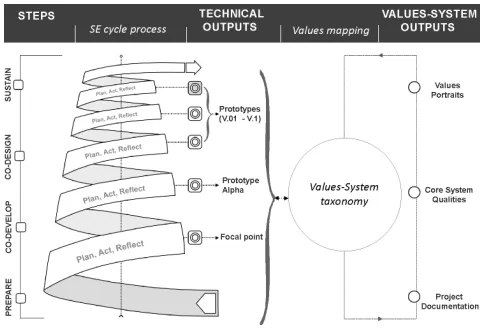
[image:3.612.315.555.52.217.2]Values-First SE consciously uses representations of the human values system to guide SE decisions, to reflect on the impact of SE interventions, and to plan the next course
Figure 2: Values-First process model.
of action. Values-First SE sits at the core of a Social SE framework [14] that combines action research [26] with de-sign thinking techniques [33], and agile development prac-tice [31, 38]. This framework, which we refer as ‘Speedplay’ [14], is hence characterised by the following qualities: 1) Values-First- it intentionally uses human values as reference for SE decisions; 2) participatory - it works in partnership with stakeholders and end-users at all stages: from design to implementation and evaluation; 3) system-thinking - it applies creative, design thinking techniques to visioning and problem solving; 4) iterative - it uses an agile approach to software development; 5) reflective - it operates within an action research framework6) technology mediated - it uses rapid prototyping for quickly exploring risks and impacts of possible software interventions on society.
Speedplay follows a traditional‘plan, act and reflect’ ac-tion research process across four overlapping steps (prepare, co-design, co-develop, and sustain) as shown in the left part of Figure 2. In prior work we described the role of design thinking, action research, and agile development in the co-design [33] and co-development [40, 38] steps, here, we focus on the role of values research in the sustain step both across and within projects. Figure 2 visualises this role by plotting values system outputs in three groups: Values Portraits -summary representations of the project partnership values; Core System Qualities - high-level descriptions, or ‘check-lists’, of the system requirements; Project Documentation - i.e. a project brief and workplan. Section 4 further de-scribes these three outputs by introducing actual examples using ‘Snap’ as a case study.
Speedplay is, above all, a mindset which is best captured by its ‘work-style principles’ introduced in early work [14] and further explained in the next section. These principles emerged over the years through innovation research projects involving a variety of stakeholders including hard-to-reach communities [41, 40]. As an example, we report on the two main steps that led to the bottom-up adoption of such prin-ciples within and across Social SE projects.
re-Figure 3: Values system map adapted from [8].
search and collaboration with practitioners facing the same challenges, Schwartz’s values system - as introduced and ap-plied by Crompton et al. [10] and Chilton et. al [9] - was identified as a suitable starting point. To put theory into practice, the team printed an A1 size poster of a detailed version of the values system map shown in Figure 3. This map was then used during a project-review to draft its mis-sion statement, which reads as follows: “The driving val-ues of this project are quintessentially human: respect, trust, empowerment and mutual understanding. These values are, and must be, the drivers of our research and development process.”
Sharing values across projects -The team work-style principles were drafted a year later on completion of a digital-health project [40], and before the start of a community energy renewables project [38]. Because of the fast pace, problem complexity, and ever changing domains and team composition, both the team and the partners required a ref-erence framework to ensure continuity of action and best practice sharing. The principles were drafted by the team, and included in the project documentation. These princi-ples are not normative, each team member interprets and adapts the principles to their own working style, but they are embedded in the day-to-day research practices. These practices include sharing the same office space and research tasks: for example, developers take part in ethnographic re-search themselves while others familiarize with the software code and hardware functionality.
4.
SNAP CASE STUDY
[image:4.612.316.556.49.289.2]Snap is a customizable hand-made digital stretch wrist-band that records anxiety interactions for later reflection. Snap co-development is part of a broader participatory de-sign and development effort that has spanned two years and engaged well over 300 people including health profession-als, the general public, those diagnosed with ASD, and their support, the description of this part of the process has been described in [40, 39]. This paper specifically focuses on the three-month co-development process with adults diagnosed with Autism Spectrum Disorder (ASD) and their support from which Snap emerged. During this phase we engaged in three design workshops with 13 participants (7 people diag-nosed with ASD and 6 support), followed by a three-week
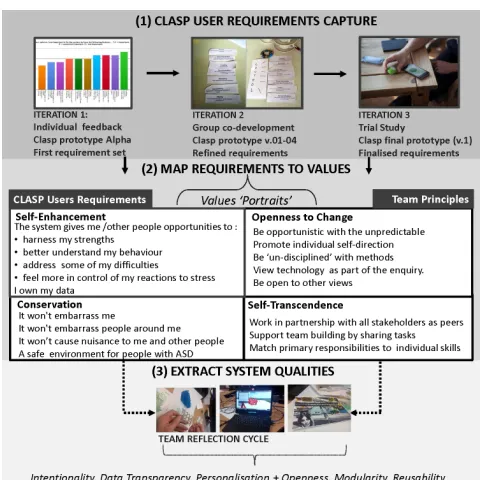
Figure 4: Clasp to Snap process: Clasp user re-quirements capture, values mapping, and core sys-tem qualities extraction leading to next project plan.
summer study that involved 5 participants and their support wearing a Snap device and reflecting on its value.
From Clasp to Snap -Snap builds on a prior research project in anxiety management conducted in partnership with adults diagnosed with ASD [40]. This work resulted in the development of ‘Clasp’, a tactile anxiety management and peer support network system, comprising a number of customisable components. One of the main lessons learned from Clasp’s development is that“everybody is unique”and “has different needs”. For example, one of Clasp’s compo-nents, a stress-ball like tactile device, keeps a log of the anxiety triggers every time is squeezed. However, the design of such device does not suit all: some prefer it as a wearable device, others as an interactive phone cover, whereas family members worry about the risk of“technology dependence”. These findings come from Clasp iterative user requirements capture visualised in the top part of Figure 4.
Figure 4 maps the three-phase process that links Clasp and Snap together: (1) the top part of the figure represents Clasp iterative requirements capture process through rapid prototyping; (2) the mid part represents the values-mapping process of both the user requirements and the team princi-ples, which resulted into two Values-Portraits; (3) the bot-tom part outlines the six Core System Qualities emerged from a four-week team ‘reflection cycle’. The values por-traits were the starting point of this reflection cycle. The resulting system qualities informed the plan of our next in-tervention (Figure 5) from which Snap emerged.
[image:4.612.53.293.56.217.2]core user group. Every iteration was matched by the release of a new version of Clasp. The next three paragraphs give practical examples of the three values-process outputs intro-duced in Figure 2, namely the Values Portraits, Core System Qualities, and the Project Documentation - exemplified her by Snap project outline plan.
Values Portraits -The resulting requirements were sum-marised and manually mapped to values [9] by two team members into theValues Portraits, shown in Figure 4. Once juxtaposed, research team and user values portraits appear located in opposite quadrants of the values system: Self-enhancementandConservationfor the users; Self-transcen-dence and Openness to change for the research team. Re-search shows thatSelf-enhancement and Conservation are associated to experience of anxiety and a sense of vulnerabil-ity [37], whereas the team values indicate an orientation to-wards Self-transcendence (e.g. equality, responsibility) and Openness to change. Research shows that such values tend to be associated with sustainable and humanitarian prac-tices [28]. The uniqueness of needs around ASD anxiety and the responsibilities associated with it, raised the fun-damental research questions: how can the team ‘open-up’ a technology to suit both individual and collective needs? How can we do it in transparent, sustainable way? How can we move beyond commercial ‘gadgets’ and investigate the long-term societal and ethical implications of personalised health-technology?
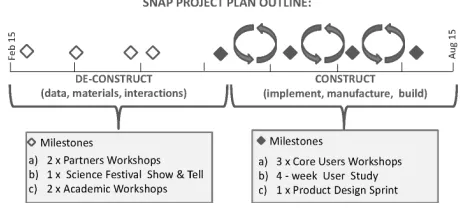
Core System Qualities - to address these questions, and reconcile two apparently opposite values sets into a co-herent plan after an eighteen-month funding-gap, the de-velopment team went through a four-week ‘reflection cycle’ of scrum-like discussions, informal stakeholder meetings, in-dustry show visits, and lo-fi prototyping. The aim was to identify high-levelCore System Qualities that would inform an outline plan (Figure 5) to take to our partners at the start of the new project.
These qualities are summarised as follows: Intentional-ity, the system must afford control to its users including in-tentional interactions, not only passive automated sensing; Personalisation, the system needs to adapt to unique users’ needs;Data Transparency, the system affords end-user data ownership, transparent data capture, storage, and curation; Openness, the system must access and can be accessed by other services;Modularity, system functionalities can be eas-ily added or removed;Reusability, the system can be easily re-purposed for other domains.
These six core system qualities combine both end-users and developer team values. End-users desiredIntentionality, PersonalisationandData Transparency, that is agency and control over their interactions with the system, its function-ality, and the data captured; the team aspired toOpenness, ModularityandReusability, that is freedom to open the sys-tem to anyone who wished to use it, in any combination of functionality and domain.
[image:5.612.321.551.58.169.2]Snap Outline Plan -the need to reconcile system qual-ities that stemmed from two very different values sets led to a two-phase plan shown in Figure 5. The need for Per-sonalisation, in particular, led to the decision of opting out of incremental development of Clasp, which afforded Inten-tionalitybut offered limited scope forPersonalisation. This resulted in a project plan that aimed to first,de-construct Clasp into its key components and then iteratively and par-ticipativelyconstruct a new system.
Figure 5: Snap two-phase outline plan.
5.
PRACTICE
In the Snap project we are exploring how devices which support intentional interaction can help people to under-stand and live with anxiety. We first investigated the pos-sibility of re-purposing existing devices, but those identified at the time were found unsuitable as they did not fit the identified core system qualities.
5.1
Limits to re-purposing
There are many existing health and fitness wearable de-vices on the market and we first considered taking an ap-proach which equipped our participants with a combination of these devices. For this, we checked the identified core sys-tem qualities against existing devices to help with the choice. Figure 6 summarises the findings. We wanted to go beyond Clasp, which works with off-the-shelf devices, and test very specific customized interactions. These interactions could be captured using modified off-the-shelf wearable devices, however we found such devices were‘locked-in’ in terms of firmware and supporting systems. The embedded software is impossible to modify for our purpose.
Empatica E4 is a state of the art example of physiological data automatic capture. It also includes an intentionality element: an event button to be used to bookmark specific events. Unfortunately its high cost, limited personalisation and availability does not make it suitable for re-purpose.
Figure 6: System qualities and devices considered1.
5.2
Snap device
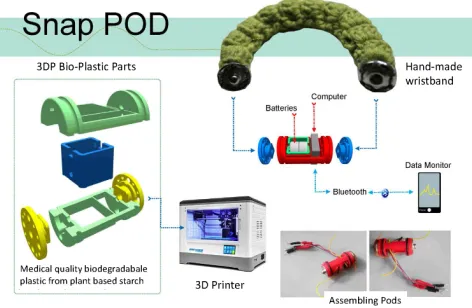
It is a complex task to design wearable hardware that is robust, comfortable and stylish enough for a participant to wear all day over an extended period of time. Prior re-search has comprehensively investigated the aspect of auto-matic capture of physiological and environmental signals in numerous health conditions and stress [35]. The desire for users to intentionally control their interactions with the de-vice offers an opportunity to explore intentive interactions currently under explored in digital health. The Snap device (Figure 7) specifically focuses on intentive interaction and here we investigate its role in anxiety reflection.
Snap is designed to be customizable physically, electron-ically and in terms of software functionality. Open source software and widely available ‘maker’ hardware was used along with DIY techniques such as crochet and 3D print-ing to build in customizability and DIY manufacture. A minimum-viable prototype of Snap was quickly made with a battery, microcontroller and crochet wristband and taken to one of the three workshops for feedback from participants. This first (alpha) prototype has an LED light that increases intensity according to the degree of stretch of the band and communicates this data to a laptop that plots a real-time line chart. The second prototype has a 3D-printed (3DP) enclosure (or ‘pod’); its physical and electronic design has been described in [38], here we outline elements of its soft-ware design.
Software Design -At the core of the pod is an£11 RF-Duino microcontroller - the smallest microcontroller devel-opment board we could find at 23x29x18mm to contain Blue-tooth Low Energy (BLE) for communication and is compat-ible with the Arduino Development environment and code libraries. The design of the software running on the micro-controller allowed us to embed the core system qualities in the operation of the device. Since the RFDuino libraries were developed for the popular Arduino IDE, the software can easily be extended by users familiar with the environ-ment. The code is open-source, people can assemble their own devices and modify the code using the accessible, widely used, well documented and free to use ‘maker’ platform. The flexibility of the RFDuino device offers the potential to re-ally customize the way the pod works - for example it could
1
fitbit.com, mi.com, angelsensor.com, empatica.com
Figure 7: Snap Device. Conductive cord in crochet wristband changes resistance when stretched.
communicate real-time high resolution stretch data live to a mobile phone over BLE (as in the first prototype) and onto cloud services or social networks. However, our users cited trust and privacy concerns with this approach and indicated they would prefer data to be stored only on the device unless they explicitly authorize sharing.
For the study prototype, the data exists only on the de-vice (here stored in the dede-vices limited flash memory) until a user authorizes sharing. The data would be ideally stored encrypted on the device; however this was not implemented in time for the study. In any microcontroller project with communications there are compromises to be made between frequency and size of communications and battery usage, and resolution of data that can be stored and the size of memory available. The design decisions made by our par-ticipants to have a minimum of communication, and little interest in high resolution data in the long-term, coincided with reduced power and memory demand. However we are acutely aware that not everybody would make the same de-cision - some may prefer to have real-time or at least more frequent communication with a Smartphone for higher res-olution data storage and/or communication to the cloud or social networks (in a similar manner to Clasp [40]).
The device can be configured to operate in either mode, however the user would need to be aware of the impact on battery life. The first Snap prototype varied the LED brightness with the degree of stretch of the band. In con-junction with the live communication and display of the data on a Smartphone screen, this made for a nice demonstration of the wristband. However we found this function was of limited value to users and in fact was difficult to interpret in bright environmental light conditions. Having the LED operate also increases power consumption, so the function of the light was limited to a brief flash when the device is recording data to memory. In the study prototype, the wristband recorded to memory a timestamp when the device is stretched beyond a threshold value, and then again when the device is relaxed and not stretched for a timeout. This allowed us to record the length and frequency of interactions.
[image:6.612.53.294.119.230.2]the day over a period of a month when the Snap band has recorded interactions. At the end of the study, when the participant data was downloaded the design of this interface was discussed with each participant, and ideas for future features were discussed. There are a number of emerging design directions that can be taken with this interface, such as automatic pattern extraction and overlay with additional data from other sources such as GPS log, calendar entries, and physiological wearable.
6.
REFLECTIONS
6.1
Snap Usage Feedback
We reflect on feedback on Snap usage over a three-week user study involving 5 participants - four diagnosed with ASD and a non-ASD participant diagnosed with an anxi-ety condition. As part of the study participants attended a group induction, chose their handmade Snap band ‘style’ (e.g. beaded, plain bamboo, or floral crochet as shown in Figure 8), and took them home to use. Each participant kept a visual diary of their Snap usage to ‘triage’ the data automatically captured by the device. Feedback was pro-vided through two individual feedback sessions with each participant and concluded with a final group discussion. In this section we report on emerging findings from the partic-ipants feedback.
Characterising Intentionality -Participants reported a dozen ‘anxiety’ interactions with Snap: from ‘push’“yeah, well in anxiety I just push like that and then it calms things down”to ‘rub’“I was a bit stressed myself [...] so I was rubbing the beads onto my skin it felt nice”. Overall, the participants’ feedback about the device highlighted a va-riety of individual haptic interactions. This points at the opportunities for an ‘intentive’ approach to wearable digi-tal health, but it also comes with the challenges associated with the characterization of different interaction modalities “how do we decide the usage of a wristband...? every usage
is different, but that’s something to think about”.
In summary, the participants feedback highlights three main challenges toIntentionality: 1) the personalization of the interaction (e.g. a strong pull for me may be a weak pull for another); 2) the ambiguity of the data captured (e.g. un-derstanding when a person is just ‘playing’ with the device or intentionally using it to cope with anxiety); 3) the risk of false positives (e.g. pulling the band while putting on a jumper). One of the participants explicitly suggested a click button as both inherently satisfying“I would definitely sit and click that all day”and as means to reduce data ambi-guity and false positives:“if it was a clicker that picked up every time you clicked it you have to do it on purpose, you can’t do by accident”.
Transparent Data Choices -Snap usage data was au-tomatically captured and then transferred onto the researchers’ laptop through BLE connection during the individual feed-back sessions. Two participants were surprised at the wire-less data transfer“Oh, I didn’t know that, I thought it had to be connected”, and at the unexpected technology capability of the device“yeah, I didn’t realise it had that much technol-ogy in it”. Furthermore, participants identified the positives “it was a good surprise because that meant that I could access it any time I wanted”, but also highlighted privacy concerns “that would mean it is vulnerable [...], so you’d definitely need to password protect it”, which are often dismissed
be-Figure 8: Participant wearing her chosen Snap.
cause“[...] we’re getting more and more accepting of it, but you’d definitely want to encrypt it, [...] we have so much of our privacy invaded”.
Participants also wanted to choose with whom to share their data“I don’t mind any health care professional look-ing at my data if its for research [...]. But I’ll choose my-self whether I want my family to see it”, and for what“if you’ve got an app on your phone where you track your diet, so it would be the same sort of data and then you could go to your doctor and see how you’ve done that month; we could actually see how you improve”. Participants preferred a scheduled viewing of their data, every month, week or at the end of the day, rather than real-time feedback“as looking at data telling you that you are anxious, when you actually are, would not be helpful”. In particular, there was a desire of mapping progress rather than anxiety incidents, for exam-ple by highlighting lack of interactions as a sign of progress in anxiety reduction.
Personalization Aspects -The device physical design is very important because its form-factor influences Snap us-age. In other words, the shape of the ‘pod’, or the material of the wearable substrate may lend to different modes of inter-action and signal capture. This has software development implications related to the characterization of interactions as described above. In addition, the device feedback (e.g. sound, light) needs further consideration; one of the partic-ipants did not think of using Snap in an anxiety incident“ because there wasn’t enough interaction. The flashing light is nice, but not enough”. Other feedback feels more reward-ing, for example a sound“I just like sit and flick it like this [flicks phone cover]. The sound is satisfying”. Finally, the participants were also keen on data presentation customiza-tion“...you could customize it yourself, like if you’ve got your own [colour] system”, they were also interested in iden-tifying patterns of usage“the pattern between the time of the day that you used it the most”, and wanted to chose what to display and what not“How many times I used it, but not necessarily for how long I used it”.
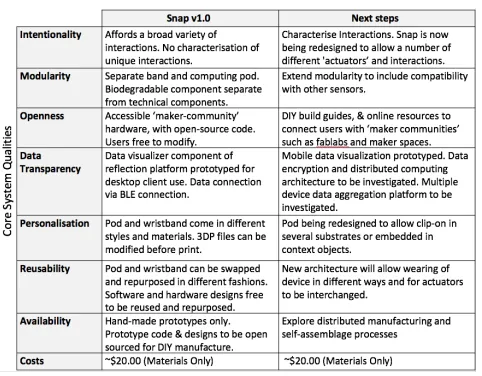
[image:7.612.316.557.51.211.2]Figure 9: Snap system qualities and next steps.
and Little Devices DIY approach2. We consider such ap-proaches as promising alternatives to mainstream ‘one fits all’ digital health devices (e.g. Fitbit), which could not match with the identifiedCore System Qualities. Snap is our first attempt at implementing such qualities, Figure 9 maps them to Snap next development steps.
6.2
Transferability
In this section we outline elements of transferability in terms of: (1) methodological process - what would be needed to make Values-First SE replicable for others; (2) the broader implications of Values-First SE for the SE community.
Transferring Values-First SE -Our experience of the Values-First SE emergence is a bottom-up one, however, to be transferable Values-First SE must be a management choice. Senior management must be genuinely interested in giving equal representation to all values in the system, be fa-miliar with the principles of evidence-based values research and their application, and translating such principles in ac-tionable mission statements and working style principles.
Language -Mission statements and principles need to be deeply framed [29] in every day work communication and language. For example, our approach values ‘Equality’ hence we tend not to speak of ‘users’ and ‘testing’, but of ‘peers’, ‘partners’, and ‘studies’ (i.e. the Summer Study), making it clear that team and partners are equal parties by sharing a common language.
Practice -Values-First SE language needs to be translated in every day working practice. For example, in our team software developers engage in ethnographic research while less technical staff familiarises with the code and the elec-tronic components of the device. Likewise sharing non-work related activities can give values-conscious team leaders a deeper understanding of the values held by both the team and the partners. Away-days, time for purposeful reflection as described in Section 4, and motivational focal points as described in [14] are examples of this practice.
Tools - Values-First SE practice needs tools. It is not by chance [29] that intrinsic values, such as Benevolence, are more difficult to measure and communicate than ex-trinsic ones, such as Achievement. However, they can be equally captured through a variety of facilitation tools and
2
phonebloks.com, littledevices.org, fairphone.com
techniques, including widely available values questionnaires, cards, and values maps [8]. These tools can be used dur-ing stakeholders’ requirements elicitation, rapid prototyp-ing or internal communications. For example, a large print of the values-system map as shown in Figure 3 was used during an away-day to discuss the values-orientation of the team vs. senior management views and expectations. This helped to resolve tensions (i.e. management was re-assured timely output delivery whilst the team maintained freedom of self-direction). Familiar visualisations tools such as pie charts, network graphs can also be used to map values. Fi-nally, values-mapping can be done both through manual [9] and automatic [5] thematic extraction. Natural Language Processing tools, for example, could be used to support the values-mapping process at a much larger scale.
Context -Is this approach generalizable? Is there a busi-ness case for Values-First SE? Firstly, the use of universal values in SE helps to raise the level of abstraction of soft-ware development: systematically capturing a project values structure, that is its broad human goals, helps to unearth conflicts before they translate into software specifications. We argue that this process of abstraction can be transferred to other domains including, for example, the design of com-plex sociotechnical systems such as smart grids [17]. Sec-ondly, Speedplay mechanisms [14] and facilitation tools [15, 16] emerged from Social SE context and have already been applied to very different domains [38, 40, 41]. These mecha-nisms could be transferred to projects that share similarities with Social SE including partnership volatility, social im-pact, and uncertainty of outcomes. Finally, with regard to Values-first SE economic sustainability, let’s reflect on three points: first, economic goals are also human values and as such must be represented in a project values-system. Sec-ond,“moral values can also support economic goals”, exam-ples include the ‘marketability’ of features such as privacy and security [18]. Last, there is a growing case for values-led products: fair-trade products, ethical banking, and green broadbands. It would be worth exploring the opportunities for “Values-led SE” certifications.
Broader Implications for SE -Here we reflect on three key lessons learned from our practice that have broader im-plications for the SE community.
Security andSafetyto self-enhancing ones - could core sys-tem qualities be used as clues for values and vice versa?
Personal Data and SE Responsibilities - Currently, the vast majority of data is proprietary, held by large corpora-tions who solicit data in return for a service. Efforts towards a more ‘open data’ culture exist, but a ‘data divide’ is emerg-ing in which large companies and governments leverage on data from citizens, businesses and organizations with limited skills, opportunity and ‘know how’ to put this data to use. This is creating unsustainable power-relations within society with catastrophic effects on the environment and quality of life of people on this planet. These challenges are unlikely to be addressed through theory and unifying frameworks but through a concerted, capillary effort of values-conscious practices. Emergent research in Human Data Interaction (HDI) [25] and community based cloud computing [30] are promising examples of such practices. Values-First SE aims to build more transparent and values-sensitive software to help deal with complex societal issues, as well as with the complexity of data itself, in particular personal data and its interplay with basic human values and freedoms.
Diversity in Partnerships -It is important to bring into the development process a rich representation of the societal mix, to include the hard-to-reach, vulnerable communities but also policy influencers. Our quest for alternative values for innovation stemmed precisely from working with these communities: their values challenged the ones of our re-search framework. Without practice, these challenges would not have been tackled ‘head-on’. These values-frictions are deep and often left unresolved, leaving developers to deal with unsatisfactory compromises. It is important to stress that software development approaches are themselves laden with values [31]: choosing agile methods over a plan-driven one may not solely depend on the task at hand but on the values deeply held by the development company or team. There is a massive role that research and education can play in unpacking these challenges through practice-based learn-ing of the long-term impact of software on society [12].
7.
CONCLUSIONS
This paper introduces elements of Values-First SE and ex-emplify their use through practice in the digital-health do-main. We use Schwartz’s values system as our primary ref-erence framework, however we invite the SE community to explore other well researched values systems, apply them to practice and compare results. One of the biggest challenges for Values-First SE is perhaps the cultural unease about accepting human values as drivers for our decisions and, most importantly, giving equal consideration to both intrin-sic and extrinintrin-sic values during decision making processes. There are however clear indications that the SE community is growing more acutely aware of the role of human values in software practices. For example, Grady Booch, during his keynote address at ICSE20153, answered a question about values pointing at the spiritual roots of software: the bi-nary code system, ‘invented’ by the 17th century German polymath and philosopher Leibniz, was inspired by Chinese mathematical thinking and used to affirm the universality of his Christian beliefs: the binary system was conceived as the representation of the duality between Creation (1) and Nothing (0). This is no trivial matter, but when brought up,
3
https://www.youtube.com/watch?v=h1TGJJ-F-fE
it is often dismissed as a philosophical musings thus missing the interplay between values and human choices, and their long term impact on society and life on the planet.
We argue that we need to speak more openly and less self-consciously about human values, and use tools, languages and techniques that prevent their dismissal.Software can help with a broader adoption of values-conscious approaches, for example, by helping with the identification and retrieval of code that is built on sustainable values premises, perhaps by identifying core system qualities as clues for values and vice versa. SE can help with the re-use and re-purpose of values sensitive software, embed values practices from other disciplines, and engage with different parts of society to best address current needs instead of creating new ones.
8.
REFERENCES
[1] Z. Bajm´ocy and J. G´ebert. The outlines of innovation policy in the capability approach.Technology in Society, 38:93–102, 2014.
[2] C. Becker, R. Chitchyan, et al. Sustainability design and software: The karlskrona manifesto. InProc. of the 37th International Conference on Software Engineering, pages 467–476. IEEE, 2015.
[3] B. Boehm and L. G. Huang. Value-based software engineering.Computer, 36(3):33–41, 2003.
[4] B. W. Boehm et al.Software engineering economics, volume 197. Prentice-hall Englewood Cliffs (NJ), 1981. [5] W. S. R. Boyd, R L et al. Values in words: Using
language to evaluate and understand personal values. InNinth International AAAI Conference on Web and Social Media, 2015.
[6] M. Braungart, W. McDonough, and A. Bollinger. Cradle-to-cradle design: creating healthy emissions. Journal of cleaner production, 15(13):1337–1348, 2007. [7] J. Cabot, S. Easterbrook, et al. Integrating
sustainability in decision-making processes: A modelling strategy. InIn Companion Proc. of the 31st International Conference on Software Engineering, pages 207–210. IEEE, 2009.
[8] P. I. R. Centre. The common cause handbook, 2011. [9] P. Chilton, T. Crompton, T. Kasser, G. Maio, and
A. Nolan. Communicating bigger-than-self problems to extrinsically-oriented audiences.Common Cause Research, UK, 2012.
[10] T. Crompton and T. Kasser.Meeting environmental challenges: The role of human identity. WWF-UK Godalming, UK, 2009.
[11] F. Curmi, M. A. Ferrario, and J. Whittle. Bioshare: a research tool for analyzing social networks effects when sharing biometric data. InProc. of the 2014 Conference on Designing interactive systems, pages 101–104. ACM, 2014.
[12] S. Easterbrook. From computational thinking to systems thinking: A conceptual toolkit for
sustainability computing. InICT for Sustainability 2014 (ICT4S-14). Atlantis Press, 2014.
[13] A. Feenberg. Ten paradoxes of technology.Techn´e: Research in Philosophy and Technology, 14(1):3–15, 2010.
agile development. InCompanion Proc. of the 36th International Conference on Software Engineering, pages 520–523. ACM, 2014.
[15] S. Forshaw, L. Cruickshank, and A. Dix. Collaborative communication tools for designing: Physical-cyber environments. InFourth International Workshop on Physicality, page 47, 2012.
[16] S. Forshaw, P. Newman, M. A. Ferrario, W. Simm, A. Friday, and P. Coulton. Stimulating a dialogue on renewable energy through making. InProc. of the 2014 companion publication on Designing interactive systems, pages 17–20. ACM, 2014.
[17] S. Frey, A. Diaconescu, D. Menga, and I. Demeure. A holonic control architecture for a heterogeneous multi-objective smart micro-grid. In2013 IEEE 7th International Conference on Self-Adaptive and Self-Organizing Systems, pages 21–30. IEEE, 2013. [18] B. Friedman. Value-sensitive design.interactions,
3(6):16–23, 1996.
[19] B. Friedman, D. G. Hendry, A. Huldtgren, C. Jonker, J. Hoven, and A. Wynsberghe. Charting the next decade for value sensitive design.Aarhus series on human centered computing, 1(1), 2015.
[20] B. Friedman, P. H. Kahn Jr, A. Borning, and A. Huldtgren. Value sensitive design and information systems. InEarly engagement and new technologies, pages 55–95. Springer, 2013.
[21] D. Gotterbarn. Software engineering ethics. Encyclopedia of Software Engineering, 2001.
[22] D. Gotterbarn, K. Miller, and S. Rogerson. Computer society and acm approve software engineering code of ethics.Computer, 32(10):84–88, 1999.
[23] GreenAlliance. A circular economy for smart devices opportunities in the us, uk and india, 2015.
http://www.green-alliance.org.uk/resources/ Acirculareconomyforsmartdevices.pdf.
[24] Hackaday. Ethics in engineering: Volkswagen’s diesel fiasco, 2015. http://hackaday.com/2015/09/23/ ethics-in-engineering-volkswagens-diesel-fiasco/. [25] H. Haddadi, R. Mortier, D. McAuley, and
J. Crowcroft. Human-data interaction.University of Cambridge, 2013.
[26] G. R. Hayes. The relationship of action research to hci.ACM Transactions on Computer-Human Interaction (TOCHI), 18(3):15, 2011.
[27] M. Khurum, T. Gorschek, and M. Wilson. The software value map–an exhaustive collection of value aspects for the development of software intensive products.Journal of Software: Evolution and Process, 25(7):711–741, 2013.
[28] B. Knowles, L. Blair, S. Walker, et al. Patterns of persuasion for sustainability. InProc. of the 2014 conference on Designing interactive systems, pages 1035–1044. ACM, 2014.
[29] G. Lakoff. Why it matters how we frame the environment.Environmental Communication, 4(1):70–81, 2010.
[30] A. Marinos and G. Briscoe. Community cloud computing. InCloud Computing, pages 472–484. Springer, 2009.
[31] K. W. Miller and D. K. Larson. Agile software development: human values and culture.Technology and Society Magazine, IEEE, 24(4):36–42, 2005. [32] S. L. Miller. Values-based recruitment in health care.
Nursing Standard, 29(21):37–41, 2015.
[33] P. Newman, M. A. Ferrario, W. Simm, S. Forshaw, A. Friday, and J. Whittle. The role of design thinking and physical prototyping in social software
engineering. InProc. of the 37th International Conference on Software Engineering, pages 487–496. IEEE, 2015.
[34] B. Penzenstadler, A. Raturi, D. Richardson, and B. Tomlinson. Safety, security, now sustainability: The nonfunctional requirement for the 21st century. Software, IEEE, 31(3):40–47, 2014.
[35] R. W. Picard. Recognizing stress, engagement, and positive emotion. InProc. of the 20th International Conference on Intelligent User Interfaces, pages 3–4. ACM, 2015.
[36] S. H. Schwartz. Universals in the content and structure of values: Theoretical advances and empirical tests in 20 countries.Advances in experimental social psychology, 25(1):1–65, 1992. [37] S. H. Schwartz. Basic human values: Theory,
measurement, and applications.Revue fran¸caise de sociologie, 47(4):249–288, 2006.
[38] W. Simm, M. A. Ferrario, A. Friday, P. Newman, S. Forshaw, M. Hazas, and A. Dix. Tiree energy pulse: exploring renewable energy forecasts on the edge of the grid. InProc. of the 33rd Annual ACM Conference on Human Factors in Computing Systems, pages 1965–1974. ACM, 2015.
[39] W. Simm, M. A. Ferrario, A. Gradinar, M. Smith, S. Forshaw, I. Smith, and J. Whittle. Anxiety and autism: towards personalized digital health. InProc. of the 34rd Annual ACM Conf. on Human Factors in Computing Systems., page in Press. ACM, 2016. [40] W. Simm, M. A. Ferrario, A. Gradinar, and
J. Whittle. Prototyping clasp: implications for designing digital technology for and with adults with autism. InProc. of the 2014 conference on Designing interactive systems, pages 345–354. ACM, 2014. [41] J. Southern, R. Ellis, M. A. Ferrario, R. McNally,
R. Dillon, W. Simm, and J. Whittle. Imaginative labour and relationships of care: Co-designing
prototypes with vulnerable communities.Technological Forecasting and Social Change, 84:131–142, 2014. [42] W. Stahel and G. Reday. The potential for
substituting manpower for energy, report to the commission of the european communities, 1976. [43] B. Su, A. Heshmati, Y. Geng, and X. Yu. A review of
the circular economy in china: moving from rhetoric to implementation.Journal of Cleaner Production, 42:215–227, 2013.
[44] J. Van den Hoven. Human capabilities and technology. InThe Capability Approach, Technology and Design, pages 27–36. Springer, 2012.