warwick.ac.uk/lib-publications
Original citation:
Chen, Li, Zhao, Nan, Chen, Yunfei, Yu, F. Richard and Wei, Guo (2018) Over-the-air
computation for IoT networks : computing multiple functions with antenna arrays. IEEE
Internet of Things Journal.
Permanent WRAP URL:
http://wrap.warwick.ac.uk/102844
Copyright and reuse:
The Warwick Research Archive Portal (WRAP) makes this work by researchers of the
University of Warwick available open access under the following conditions. Copyright ©
and all moral rights to the version of the paper presented here belong to the individual
author(s) and/or other copyright owners. To the extent reasonable and practicable the
material made available in WRAP has been checked for eligibility before being made
available.
Copies of full items can be used for personal research or study, educational, or not-for profit
purposes without prior permission or charge. Provided that the authors, title and full
bibliographic details are credited, a hyperlink and/or URL is given for the original metadata
page and the content is not changed in any way.
Publisher’s statement:
“© 2018 IEEE. Personal use of this material is permitted. Permission from IEEE must be
obtained for all other uses, in any current or future media, including reprinting
/republishing this material for advertising or promotional purposes, creating new collective
works, for resale or redistribution to servers or lists, or reuse of any copyrighted component
of this work in other works.”
A note on versions:
The version presented here may differ from the published version or, version of record, if
you wish to cite this item you are advised to consult the publisher’s version. Please see the
‘permanent WRAP URL’ above for details on accessing the published version and note that
access may require a subscription.
Over-the-air Computation for IoT Networks:
Computing Multiple Functions with Antenna Arrays
Li Chen, Nan Zhao,
Senior Member, IEEE,
Yunfei Chen,
Senior Member, IEEE,
F. Richard Yu,
Fellow, IEEE,
and Guo Wei
Abstract—Over-the-air computation combines communication and computation efficiently by utilizing the superposition prop-erty of wireless channels, when Internet of Things (IoT) networks focus more on the computed functions than the individual messages. In this work, we study the computation of multiple linear functions of Gaussian sources over-the-air using antenna arrays at both the IoT devices and the IoT access point (AP). The key challenges in this study are the intra-node interference of multiple functions, the non-uniform fading between different IoT devices and the massive channel state information (CSI) required at the IoT AP. We propose a novel transmitter design at the IoT devices with zero-forcing beamforming to cancel the intra-node interference and uniform-forcing power control to compensate the non-uniform fading. In order to avoid massive CSI requirement, receive antenna selection is adopted at the IoT AP and a corresponding signaling procedure is proposed utilizing the “OR” property of the wireless channel. The performance of the proposed transceiver design is analyzed. The closed-form expression for the mean squared function error (MSFE) outage is derived. Due to the complexity of the expression, an asymptotic analysis of the MSFE outage is further provided to demonstrate the diversity order in terms of the transmit power constraint and the number of IoT devices. Simulation results are presented to show the performance of the proposed design.
Index Terms—antenna array, distributed data aggregation, function computing, Internet of Things, multiple access scheme, wireless sensor network
I. INTRODUCTION
The 5th generation cellular system is predicted to provide an Internet of Things (IoT) that interconnects up to 1 trillion
This research was supported by National Science and Technology Major Project of China MIIT (Grant No. 2017ZX03001003-003), National Natural Science Foundation of China (Grant No. 61601432), and the Fundamental Research Funds for the Central Universities. This research was supported in part by the open research fund of National Mobile Communications Research Laboratory, Southeast University (No. 2018D03), the Xinghai Scholars Pro-gram, and the Fundamental Research Funds for the Central Universities under DUT17JC43. (Corresponding author: Nan Zhao)
L. Chen and G. Wei are with Department of Electronic Engineering and Information Science, University of Science and Technology of China. (e-mail: {chenli87, wei}@ustc.edu.cn).
N. Zhao is with the School of Info. and Commun. Eng.,Dalian University of Technology, Dalian 116024 China, and also with National Mobile Commu-nications Research Laboratory, Southeast University, Nanjing210096, China (email:[email protected]).
Y. Chen is with the School of Engineering, University of Warwick, Coventry CV4 7AL, U.K. (e-mail: [email protected]).
F.R. Yu is with the Department of Systems and Computer Engi-neering, Carleton University, Ottawa, ON, K1S 5B6, Canada (email: [email protected]).
Copyright (c) 2012 IEEE. Personal use of this material is permitted. However, permission to use this material for any other purposes must be obtained from the IEEE by sending a request to [email protected].
devices with a million connections per square kilometer [1]. This raises new challenges to the distributed data aggregation for IoT networks [2].
Unlike conventional wireless networks whose main objec-tive is to provide end-to-end information transmission, IoT networks are more interested in the functions of the observa-tions rather than the individual observaobserva-tions. For example, an IoT-based monitoring system does not care about the abundant individual observations but the computed functions thereof, such as the sum and the mean [3]. The big data computing was made to extract meaningful data from a large dataset for large-scale smart grid in [4], which deleted a large amount mean-ingless data before communication. In [5], the traffic volume was predicated before making service degradability to alleviate the communication pressure if the network has a heavy load. A statistical machine learning approach was employed to identify the anomalies within the incoming dataset collected via various probes in the network [6]. Many event-driven IoT applications define the triggering event based on the functions of observations, such as the weighted linear combination [7]. This makes the traditional “communication-and-computation separation” method inefficient. Reconstructing a function over wireless multiple-access channel (MAC), referred to as “over-the-air computation”, provides great potential for IoT network to compute the target function using a summation structure in an efficient way. It utilizes the superposition property of wireless channel instead of making the interference between different IoT devices orthogonal.
analog computation of two correlated Gaussian sources in [12]. In order to achieve reliable function, the use of channel cod-ing in over-the-air computation has also been widely studied. Using nested lattice coding to compute the noisy modulo sum was investigated in [13] based on the linear property of nested lattice coding. Nested lattice coding has also been applied to compute-and-forward network to recover the combination of transmitted messages [14]. M. Goldenbaum et al.proposed a unified digital scheme to compute structured functions over-the-air in [15], where each node in the network first quantizes its real-valued pre-processed readings and then employs a nested lattice code to protect the sum of messages against Gaussian channel noise. Using randomized network coding through appropriate choice of the subspace codebooks at the source nodes was proposed for function computing in [16], where a lower bound on the number of transmissions required to ensure successful computation was provided. The over-the-air computation for a generalized IoT model consisting of multiple clusters was studied in [17], where the network was divided into several clusters with independent target functions computed. The risky virtual machines were captured in prior based on real data trace, thus guaranteeing high reliable virtual machines transferring among data centers in [18].
Since the nodes in IoT networks are generally low-power and low-cost, a practical way to realize over-the-air computa-tion is through analog scheme. Uncoded transmission where the channel input of IoT devices is merely a scaled version of its noisy observation has been proved to be optimal for a standard Gaussian multiple-access channel in [19]. A robust analog function computation scheme was proposed in [20]. By employing random sequences, the proposed scheme is robust against synchronization errors. Utilizing retransmission to in-crease reliability, the achievable rate for analog computation was defined and analyzed in [21]. Considering the difficulty of gathering the channel state information (CSI) of all nodes, the effect of channel estimation error was studied in [22], [23]. The work in [24] selected a subset of sensors in an opportunistic way to improve the performance of function computation, which achieves a nonvanishing computation rate even when the number of sensors approaches infinity. Various experimental platforms have been built to verify the idea of analog over-the-air computation in [25]–[27].
To the best of our knowledge, the use of multiple functions in over-the-air computation has never been studied before. Although multi-antenna has been applied to compute-and-forward network [28], [29], it was intended to improve the communication rate using the multiplexity gain of multi-antenna and its key challenge is integer coefficient selection for adapting to the fading MAC [30], [31]. In the case of over-the-air computation, the coefficient of multiple functions becomes arbitrary and the key challenge becomes the transceiver design to create an equivalent MAC with the target coefficient.
Motivated by this observation, we study how to compute multiple functions over-the-air with antennas arrays at the IoT devices and the IoT access point (AP), where multiple linear combinations with arbitrary coefficient of Gaussian sources are computed over the Gaussian MAC. The main contributions of the work can be summarized as follows.
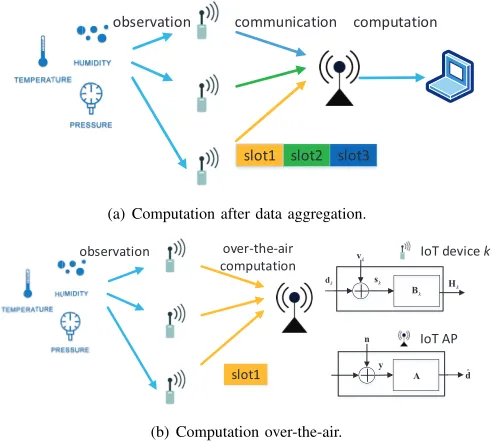
slot3 slot2 slot1
observation communication computation
(a) Computation after data aggregation.
slot1 observation over-the-air
computation
IoT device k
IoT AP
k
d
k v
k s
k B Hk
n y
A dˆ
[image:3.612.319.565.59.280.2](b) Computation over-the-air.
Figure 1. The communication and computation model of the IoT network
• A novel transceiver design: The transmitter is designed to cancel the intra-node interference between multiple func-tions and compensate the non-uniform fading between different IoT devices. Also, receive antenna selection and its corresponding signaling procedure is proposed to avoid massive CSI requirement at the IoT AP.
• The computation performance: We define the mean squared function error (MSFE) to analyze the perfor-mance of the computation. The closed-form expression of MSFE outage is derived for Gaussian sources over Gaussian MAC. Due to its complexity, the asymptotic analysis with large transmit power constraint and large number of IoT devices is provided.
• The diversity order: The diversity order of MSFE outage is further derived in terms of the transmit power constraint and the number of IoT devices, which depends on the number of antennas, the number of functions and the correlation coefficient between different sources.
The remainder of this paper is organized as follows. Section II presents the system model. The transceiver and signaling procedure are designed in Section III. The performance is analyzed in Section IV. Simulation results and discussions are present in Section V, and conclusion is given in VI.
Throughout the paper, we will use boldface lowercase to refer to vectors and boldface uppercase to refer to matrices. The real and complex numbers are denoted as R and C
respectively. Let AH denote the conjugate transpose of a matrixAand letA−1 denote inverse of a matrixA. Letkak
denote the norm of a vectora, and letaT denote the transpose of a vectora.
II. SYSTEMMODEL
pressure, etc.) indexed by l ∈ {1,· · ·, L}. The observations of IoT device k are expressed as an L-dimensions vector
dk ∈ RL. And the target functions at the IoT AP are linear combinations of the observations which is expressed as
d=
K X
k=1
wkdk, (1)
where wk = diag{wk1· · ·wkL} is the function coefficient matrix.
As illustrated in Fig. 1(a), the AP can aggregate the ob-servations first and then computes the target function. The distributed data aggregation requires multiple access schemes (e.g. time division multiple access (TDMA), carrier sense multiple access (CSMA)), which requires multiple time slots and incurs a high latency.
If we utilize the summation property of wireless MAC to reconstruct the target function, we can avoid the multiple access scheme for data aggregation and compute the target function in one time slot as illustrated in Fig. 1(b).
The transmit vectorsk ∈ RL of IoT devicekis
sk=dk+vk, (2)
where vk ∈ RL is the observe noise vector. The elements of dk and vk are assumed to be Gaussian distributed, i.e.,
dkl ∼ N 0, σ2dl
andvkl∼ N 0, σvl2
. Thus, the elements of
sk are also Gaussian distributed, i.e.,skl ∼ N 0, σdl2 +σ 2 vl
. Each IoT device is equipped with Ntantennas and the AP is equipped with Nr antennas. We assume that Nt≥L and
Nr ≥L. After coherent MAC, the estimated functions at the AP can be written as
ˆ d=A
K X
k=1
HkBksk+An, (3)
where Bk ∈ CNt×L is the transmitter matrix of IoT device
k, Hk ∈ CNr×Nt is the channel matrix between IoT device
k and the AP with each element distributed as CN(0,1),
A ∈ CL×Nr is the receiver matrix of the AP, and n∈ CNr is the receive noise vector with each element distributed as
CN 0, σ2 n
.
Comparing the target functions in (1) with the estimated ones in (3), the corresponding error vector is e= ˆd−d. We define the metrics of MSFE and MSFE outage to evaluate the performance of over-the-air computation.
Definition 1. (MSFE and MSFE outage) Given the target
functions d and the estimated ones dˆ, the estimation error vector can be calculated as e= ˆd−d. Then, the MSFE is defined as
MSFE=
Ekek2
Ekdk2
. (4)
Given a MSFE threshold ξ∈[0,1], the corresponding MSFE outage is defined as
Pout = Pr (MSFE> ξ). (5)
III. TRANSCEIVERDESIGN FORMULTIPLEFUNCTIONS
According to the system model, the key challenges to compute multiple functions over-the-air are the intra-node interference of multiple functions, the non-uniform fading between different IoT devices, and the massive CSI gathering at the AP. In this section, we design the transceiver to combat these challenges. The signaling procedure is proposed to avoid massive CSI gathering at the AP.
A. The case thatNr=L
We first consider the case that Nt≥L and Nr =L. The case thatNr> Lwill be discussed in the subsection III-B. In this case, the pseudo-inverse matrix of channel matrix exists. The transmitter matrix of IoT devicekis designed as
Bk =
√
ηHkH
HkHkH
−1
wk, (6)
where wk is the function coefficient matrix in (1), andη is the power control factor considering transmit power constraint of the IoT device. Then the estimated functions in (3) can be rewritten as
ˆ d=A
K X
k=1
√
ηHkHkH
HkHkH
−1
wksk+An
=√ηA K X
k=1
wksk+An
, (7)
where the non-uniform fading is compensated to the uniform level √η. If
A=√IL
η, (8)
we have that
ˆ d=
K X
k=1
wkdk+ K X
k=1
wkvk+ n √
η. (9)
The transmit power of IoT devicek is
Pk =kBkskk 2
=η(wksk)
H
HkHkH
−1
(wksk)
= η
τk
(10)
where
τk =
(wksk)H
HkHkH
−1
(wksk) −1
, (11)
and τk is “the ratio between the channel power gain to the effective signal power”. Considering a special case thatNt=
Nr = 1, τk can be rewritten as τk = |hk| 2
/|wksk| 2
, where
|hk| 2
and|wksk| 2
are the channel power gain and the effective signal power of IoT devicek respectively.
With a instantaneous power constraint considered, i.e.,Pk ≤
η=P0min
k (τk), (12)
which depends on the IoT device with the minimum ratio between the channel power gain to the effective signal power.
Remark 1. (To avoid massive CSI gathering) The transceiver
design avoids massive CSI gathering at the AP. According to transmitter matrix in (6), each IoT device needs its own CSI Hk and the power control levelη to determineBk.Hk can be estimated based on the broadcasting pilots. And η
is determined at the AP and broadcated to all IoT devices subsequently. According to receiver matrix in (8), the AP only needsη to determineA. It seems that the AP requires all IoT devices’ CSI to determineηin (12), which may incur massive CSI gathering at the AP. In the subsection III-C, we will propose a novel signaling procedure to determine η without gathering all IoT devices’ CSI.
B. The case that Nr> L
WhenNr> L, we adopt receive antenna selection to select
Lreceive antennas fromNr. Although it is not optimal, it also avoids massive CSI gathering at the AP and only needs the power control level η. The selected subset from Nr receive antennas is Φi, wherei∈
1,· · ·, CL
Nr . The corresponding receiver matrixAΦiis composed ofLrows ofINr/
√
η, where the index set of selected rows is Φi. The equivalent channel matrix after receiver is
HkΦi =AΦiHk. (13) Then the transmitter matrix for IoT devicek can be rewritten as
Bk=
√
ηHkΦi HH
kΦiHkΦi H−1w
k, (14)
The optimal selection criterion for subsetΦi is
Φopt= arg max
Φi mink τkΦi, (15)
where
τkΦi =
(wksk) H
HkΦiHkΦiH
−1
(wksk) −1
. (16)
The optimal antenna selection algorithm is based on exhaus-tive search and sort, whose complexity is related to the search space. Thus, the complexity of the optimal antenna selection algorithm in terms of the search space will beO CL
Nr
, where
CL
Nr is the size of the search space. In order to avoid the prohibitive complexity, we adopt a sub-optimal algorithm as illustrated in Algorithm 1. Instead of comparison and selection over CL
Nr possible subsets, we simplify the search and sort intoM =bNr/Lcdisjoint subsets. The corresponding receive antenna subsetΦmconsists of antennas from(m−1)L+1to
mL, wherem∈ {1,2,· · · , M}. Thus, the complexity of the Algorithm 1 in terms of the search space will beO(bNr/Lc). Also, due to the independence between antennas subsets, the analytical evaluation of Algorithm 1 becomes tractable, which will be provided in Proposition 6.
Algorithm 1 Antenna selection with disjoint subsets
• Step 1IoT devicekestimates its own CSIHk based on
the broadcasting pilots of AP. It further calculatesτkΦm for receive antennas subset Φm according to (16).
• Step 2 The AP determines the τΦm = minkτkΦm for
each selected antennas subsets m respectively. Then it sortsτΦm, and selects theΦm with the largestτΦm.
device k AP
Pilots broadcasting
Estimate
Calculate & quantize
k H
Response Inquire to devices with 1 in MSB
Inquire to devices with 1 in MSB and 1 in Second MSB
Response
Г
Request to devices with 1 in LSB
Response
Determine
Calculateh
Broadcast
D
h
k t
( )
min k [image:5.612.315.569.133.448.2]k t
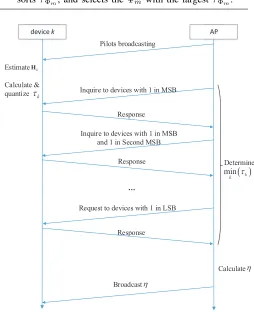
Figure 2. The signaling procedure to avoid massive CSI gathering
C. Signaling Procedure
According to the transceiver design above, both the IoT devices and the AP requires the power control levelη in (12). In order to avoid gathering all IoT devices’ CSI to calculate
η, we utilize the ”OR” property of the wireless channel [32] to determine themax (1/τk), i.e.,min (τk).
Firstly, each IoT deviceklocally calculates its ownτk based on its own CSI according to (11) and quantizes the(1/τk)into a binary representation as
1
τk
=
bM X
b=−bL
νb2b, (17)
where νb ∈ {0,1}, bM is the most significant bit (MSB) and bL is the least significant bit (LSB). Then the AP uses several rounds of inquiry from MSB bM to LSBbL in order to determine themax (1/τk), i.e.,min (τk). It can be described in Algorithm 2.
Algorithm 2Utilizing “OR” property of the wireless channel to determinemin (τk)
• Step 1 In the first inquiring round, IoT devices with 1
in the MSB respond, while IoT devices with 0 in the MSB keep silent. The AP detects the signal to determine whether the MSB of max (1/τk)is 1. If so, the MSB of
max (1/τk)is set as 1. Otherwise, it is set as 0.
• Step 2 In the second inquiring round, if MSB is set
as 1, the AP inquires the IoT devices with MSB as 1 whether they have 1 in the second MSB. Otherwise, the AP inquires all IoT devices whether they have 1 in the second MSB. Then the second MSB is determined.
• Step 3 The AP inquires in this way until the LSB
is determined. Then max (1/τk), i.e., min (τk), can be determined according to (17).
where τmin andτmax are the minimum value and maximum value of τk . The MSB bM is determined by the 1/τmin, i.e., 2bM > 1/τ
min. And the LSB bL is determined by the maximum tolerable quantization error ∆, i.e., 2−bL 6 ∆. Thus, the length of the quantized 1/τk satifies
b=bM +bL>log2
1
τmin∆
. (18)
The pilot signal for each IoT device should be anNt×Nt matrix for estimating an Nr×Ntchannel matrix. It takes at leastNtsymbol slots to complete the channel training process in Algorithm 2. According to the length of the quantized1/τk, it takesbsymbol slots to determine themin (τk). Thus, it takes
Nt+b symbol slots for Algorithm 2.
In contrast, the conventional channel training process for each IoT device takes at least Ntsymbol slots for estimating an Nr×Ntchannel matrix. Thus, it takesKNt symbol slots to obtain all IoT devices CSI at the AP. Consider a typical dense sensor network with K= 100andNt= 2, it takes 200 time slots for conventional channel training process. Assuming
b = 18, it only takes 20 time slots for the proposed channel training process in Algorithm 2, which achieves 10-time of time complexity reduction in this example.
IV. PERFORMANCE OFMULTIPLEFUNCTIONS
COMPUTATION
In this section, we further provide the performance of multiple functions computed over the air based on the defined MSFE in Definition 1. Both the exact and asymptotic analysis is given, and the diversity order in term of the transmit power and the number of devices is also derived.
A. Exact analysis of MSFE
Proposition 1. (The expression of MSFE) Assuming that
different observation sources are i.i.d. and the observation sources of different IoT devices are correlated, the MSFE of multiple functions computed over-the-air with the transceiver designed above can be calculated as
MSFE=
L P
l=1 K P
k=1
wkl2σ2vl+Lσ2n
η
L P
l=1 K P
k1=1
K P
k2=1
wk1lwk2lρ
(l) k1k2σ
2 dl
, (19)
whereρ(kl)
1k2 is the correlation coefficient between IoT device
k1 and IoT devicek2 for the observation sourcel.
Proof. According to the target functions in (1) and the esti-mated ones in (9), the error vector is
e=
K X
k=1
wkvk+ n √
η. (20)
Due to the distribution of vk and n, the lth element of
PK
k=1wkvk satisfies N
0,PK
k=1wkl2σvl2
and the lth el-ement of n√
η satisfies CN 0, σ2 n
η
. For dk, the target
functiondl satisfiesN
0,PK k1=1
PK
k2=1wk1lwk2lρ
(l) k1k2σ
2 dl
. Then according to Definition 1, the expression of MSFE in (19) can be given.
Remark 2. (A case that MSFE is a function of K) We
consider a special case that the target function has the same coefficient, and the data sources have the same spacial corre-lation coefficient, i.e., wkl = 1 andρ
(l)
k1k2 =ρc for k1 6=k2.
Also, the observation data and noise for different sources obey the same distribution, i.e., σ2dl=σd2 and σvl2 =σv2. Then the corresponding MSFE in (19) is a function of the number of IoT devicesK and can be simplified as
MSFE= σ
2 v+σ2n
Kη σ2
d+ (K−1)ρcσd2
. (21)
The MSFE is a function of power control factorη, andη in (12) is a function ofτk. We first provide the following lemma about the distribution ofτk.
Lemma 1. (The distribution ofτk)τk in (11) is a
transforma-tion of Wishart distributed matrixHkHkH, which obeys a chi-square distribution with 2 (Nt−L+ 1) degrees of freedom. Specifically,
2µkτk∼χ2(2 (Nt−L+ 1)), (22) whereµk is defined as
µk =kwkskk 2
=
L X
l=1
(wklskl)2. (23)
Proof. The proof of Lemma 1 is provided in Appendix A.
Then with fixed µk, the cumulative distribution function (CDF) ofτk can be given as
Fτk(τk, µk) =
γ(Nt−L+ 1, µkτk)
Γ (Nt−L+ 1)
, (24)
Lemma 2. (The distribution of µk) µk in (23) is the linear combinations of independent chi-square random variables, which can be approximated as a chi-square distribution. Specifically,
bkµk
ak
∼χ2(bk) (25)
where the constant ak andbk are given as
ak = L X
l=1
wkl2 σ2dl+σ 2 vl
(26)
and
bk =
L
P
l=1
wkl2
2
L P
l=1
wkl4
. (27)
Proof. The proof of Lemma 2 is provided in Appendix B.
Then the probability distribution function (PDF) of µk is
fµk(µk) =
1 2bk/2Γ (bk/2)
bk
ak
bkµk
ak
bk/2−1
e−bkµk2ak , (28) whereak andbk are given in (26) and (27) respectively.
According to Lemma 1 and Lemma 2, we can further derive the closed-form expression of MSFE outage.
Proposition 2. (The expression of MSFE outage) The MSFE
outage can be calculated as
Pout (a)
= Pr
P0 min
k (τk)< ψ
(b)
= 1−
1−Fτk
ψ P0
K
,
(29)
where
ψ= Lσ
2 n
ξ
L P
l=1 K P
k1=1
K P
k2=1
wk1lwk2lρ
(l) k1k2σ
2 dl−
L P
l=1 K P
k=1
wkl2σ2vl
,
(30)
Fτk(·)is the CDF ofτkgiven as (31) at the bottom and2F1(·) is the Gauss hypergeometric function.
Proof. The procedure (a) is calculated according to (19). The procedure (b) is because the ordered distribution of the minimum one of K i.i.d. variables. The CDF of τk can be derived by
Fτk(τk) =
Z ∞
0
Fτk(τk, µk)fµk(µk)dµk
(c)
=
bk ak
bk2R∞
0 µk bk
2−1e−
bkµk
2ak γ(Nt−L+1, µkτk)dµk
2bk2 Γ bk
2
Γ (Nt−L+ 1)
,
(32) where Fτk(τk, µk) and fµk(µk) are given in (24) and (28) respectively. The integral (c) can be calculated according to [33, 6.455.2]. That is
Z ∞
0
xµ−1e−βxγ(ν, αx)dx
=α
νΓ (µ+ν)
ν(α+β)µ+ν2F1
1, µ+ν;ν+ 1; α
α+β
(33)
B. Asymptotic Analysis of MSFE
The exact closed-form expression of MSFE outage in Propo-sition 2 is too complex to give us any insights. Thus, we will provide some asymptotic analysis to illustrate the diversity order in terms of the transmit power constraint and the number of IoT devices.
We first give the definition about the diversity order of MSFE outage in terms of the transmit power constraint and the number of IoT devices.
Definition 2. (The diversity order) The MSFE outage Pout is
a function of the transmit power constraintP0and the number of IoT devicesK, the diversity order of MSFE outage in terms of the transmit power constraint is defined as
DP = lim
P0→∞
logPout(P0)
logP0
, (34)
and the diversity order of MSFE outage in terms of the number of IoT devices is defined as
DK = lim
K→∞
logPout(K)
logK . (35)
Then we provide the asymptotic analysis with a large transmit power constraint P0. Based on series expansion of the MSFE outage expression in Proposition 2, we have the following results.
Proposition 3. (Asymptotic MSFE outage with large P0)
As the transmit power constraint P0 is sufficiently large, the MSFE outage can be approximated as
logPout a
→ −(Nt−L+ 1) logP0. (36)
Fτk(τk) =
Γ Nt−L+ 1 + b2kτkNt−L+1
bk 2ak
bk2
Γ (Nt−L+ 2) Γ b2k
τk+2bak k
Nt−L+1+bk2
2F1 1, Nt−L+ 1 +
bk
2 ;Nt−L+ 2;
τk
τk+2bakk !
where→a means asymptotically converging to (asP0becomes large).
Proof. The Proposition 3 is proved in Appendix C.
Remark 3. (The diversity orderDP) According to Definition
2, the diversity order of MSFE outage in terms of transmit power constraint P0 is DP = Nt−L+ 1, which depends on the number of the transmit antennas and the number of computed functions.
Then we provide the asymptotic analysis with a large number of IoT devices. According to the extreme value theory of ordered statistics, if some specific convergence conditions are satisfied, the distribution of mink(τk) with large K approaches to Weibull-αdistribution with CDF given by
FW(x) = 1−exp (−xα), x >0, (37) whereα >0is the shape parameter.
The specific convergence conditions are provided by the following lemma, and the value of α is also determined accordingly.
Lemma 3. (The extreme value theory of ordered statistics)
F(·)is the CDF of X. iffF−1(0)is finite and
lim
ε→0+
F F−1(0) +εx F(F−1(0) +ε) =x
α (38)
for all x > 0. When n is sufficiently large, one can choose
a∗n =F−1(0)andb∗
n=F−1(1/n)−F−1(0) such that
(Xn:n−a∗n)/b∗n d
→W, (39)
whereW is a Weibull distribution variable with CDF given in (37), Xn:n is the nth large (minimum) variable fromn i.i.d. randomx, and→d means convergence in distribution. Proof. [34, Theorem 8.3.5&8.3.6]
Proposition 4. (Weibull approximation of mink(τk)) The
distribution of mink(τk) satisfies the convergence condition in Lemma 3. And we have
min
k (τk)
K−Nt−1L+1C−1
d
→W(Nt−L+ 1), (40)
where
C=
Γ (N
t−L+ 1 +bk/2)
Γ (Nt−L+ 2) Γ (bk/2)
Nt−1L+12a k
bk
. (41)
Proof. The Proposition 4 is proved in Appendix D.
In order to make the analysis tractable, we consider the MSFE in Remark 2, which is an explicit expression of the number of IoT devices K. Based on the Weibull approxima-tion, the asymptotic MSFE outage for large number of IoT devices can be given as follows.
Proposition 5. (Asymptotic MSFE outage with largeK) As
the number of IoT devicesK is sufficiently large, the MSFE outage in (21) can be approximated as
logPout a
→
−(Nt−L) logK, ρc= 0
−(2Nt−2L+ 1) logK
−(Nt−L+ 1) logρc,
ρc>0
. (42)
Proof. The Proposition 5 is proved in Appendix E.
Remark 4. (The diversity order DK) When ρc > 0, the
diversity order of MSFE outage in terms of the number of IoT devices K is DK = 2Nt−2L+ 1 according to Definition 2. The increasing of correlation coefficient ρc will achieve the diversity gain with the diversity order unchanged. When
ρc = 0, the diversity order of MSFE outage in terms of the number of IoT devicesK decreases toDK=Nt−L.
Finally, we discuss the selection diversity for the sub-optimal selection algorithm proposed in Algorithm 1. Due to the independence between antenna subsets, the analytical evaluation of selection is tractable. The asymptotic MSFE outage of the proposed algorithm can be given as follows.
Proposition 6. (Asymptotic MSFE outage with antenna
se-lection) For the proposed sub-optimal Algorithm 1, as the transmit power constraintP0 is sufficiently large, we have the MSFE outage in Proposition 3 asymptotically converges as
logPout a
→ −M(Nt−L+ 1) logP0. (43)
And as the number of IoT devices K is sufficiently large, we have the MSFE outage in Proposition 5 asymptotically converges as
logPout a
→
−M(Nt−L) logK, ρc= 0
−M(2Nt−2L+ 1) logK
−M(Nt−L+ 1) logρc,
ρc>0
, (44)
whereM =bNr/Lcis the number of antenna subsets. Proof. The Proposition 6 is proved in Appendix F.
Remark 5. (The diversity order of antenna selection) The
diversity order of MSFE outage in terms of transmit power constraint and that in terms of the number of IoT devices both increaseM =bNr/Lctimes for the proposed Algorithm 1 due to antenna selection diversity.
V. SIMULATIONRESULTS ANDDISCUSSIONS
In this section, we provide some simulation results to illustrate the performance of multiple functions computed over-the-air. The simulation parameters are set as follows unless specified otherwise. The number of transmit and receive antennas Nt = Nr = 2, the number of computed functions
L = 2, the number of IoT devices K = 10, the observation data of sourcelfor IoT devicek dkl∼ N(0,1), the threshold of MSFE outageξ= 0.1, the target function coefficient matrix for IoT device k wk =IL, the signal to observe noise ratio (SONR)σd2/σo2= 10dB and the signal to receive noise ratio (SRNR)σ2
d/σ 2
0 5 10 15 20 25 30 SRNR (dB)
10-6 10-5 10-4 10-3 10-2 10-1 100 101
MSFE Outage
Nt= 2
Nt= 3
Nt= 4
[image:9.612.62.285.65.246.2]Diversity order
Figure 3. The MSFE outage versus different SRNR with different numbers of transmit antennas
12 14 16 18 20 22 24 26 28 30 SRNR (dB)
0.1 0.11 0.12 0.13 0.14 0.15 0.16 0.17
MSFE
[image:9.612.323.550.66.248.2]optimal selection random selection proposed selection
Figure 4. The mean MSFE of different receive antenna selection schemes
The MSFE outage versus different SRNR from 0dB to 30dB with different numbers of transmit antennas is illustrated in Fig. 3. Firstly, the MSFE outage is a monotone-decreasing function of SRNR. That is because the computed error caused by receive noise decreases. Then, the log function of MSFE outage almost linearly decreases with the increase of SRNR at the high SRNR regime. And the decreasing rates increases with the increase of the number of transmit antennas Nt. It verifies the Proposition 3 which reveals that the diversity order of MSFE outage in terms of transmit power constraint isNt−
L+ 1.
The performance of different receive antenna selection schemes is present in Fig. 4, where the number of receive antennas Nr is 6. The mean MSFE of 106 Monte Carlo simulations is shown. The random selection scheme, the optimal selection scheme based on brute-force search, and the sub-optimal scheme proposed in Algorithm 1 are all illustrated with different SRNR from 10dB to 30dB. For
100 101 102
The number of sensors 10-5
10-4 10-3 10-2 10-1 100
MSFE outage
exact approximated
Nt=2
Nt=3
Figure 5. The MSFE outage versus different numbers of IoT devices with different numbers of transmit antennas
100 101 102
The number of sensors 10-5
10-4 10-3 10-2 10-1 100
MSFE outage
exact approximated
ρc= 1
ρc= 0
ρc= 0.1
diversity order
diversity gain
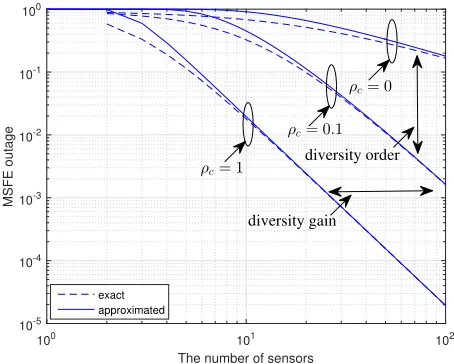
Figure 6. The MSFE outage versus different numbers of IoT devices with different correlation coefficientρc
random selection, we have no prior knowledge. Any selection chosen L elements from the set with Nr elements can be regarded as random selection. In our simulated results, we just chose the first L antennas from all Nr antennas. It can be seen that the performance of Algorithm 1 is between the performance of the optimal selection and the performance of the random selection. The reason can be explained from the search space point of view. There is no doubt that the optimal selection based on brute force search will go over the entire search space. It can obtain the optimal performance at the price of the high complexity. The motivation of the proposed algorithm is to make a tradeoff between the complexity and the performance, where the search space is limited to
[image:9.612.322.549.300.482.2] [image:9.612.60.287.304.484.2]SRNR becomes large, the performance gap between different schemes decreases. That is because receive antenna selection only affects the transmission error. As the SRNR increases, the MSFE caused by transmission error decreases and the observation error gradually dominates the whole errors.
The MSFE outage versus different numbers of IoT devices from 2 to 100 is present in Fig. 5 and Fig. 6 with different numbers of transmit antennas Nt and different correlation coefficientρc. Both the exact expression and Weibull approx-imation are shown. According to these two figures, the MSFE outage is a monotone-decreasing function of the number of IoT devices. On one hand, it is due to the increase of the combined received signal power, which decreases the transmission error caused by the receive noise. On the other hand, it is due to the decrease of the observation error when the observe sources of different IoT devices are correlated with each other. Also, it can be observed that the Weibull approximation proposed in Proposition 4 is accurate, especially when the number of IoT device is in a large regime. In Fig.5, the MSFE outage almost linearly decreases when the number of IoT devices
K exponential increases. And the decreasing rate increases with the increase of the number of transmit antennas Nt. It verifies the Proposition 5 that the diversity order in terms of the number of IoT devices increases with Nt. In Fig.6, when
ρc>0, the decreasing rate with the increase of the number of IoT devices is the same for different correlation coefficientρc. And the increase ofρcwill bring diversity gain. Whenρc= 0, the diversity order decreases. That verifies the Proposition 5.
VI. CONCLUSION AND FUTURE WORK
In this paper, we propose a novel transceiver design for mul-tiple functions computed over-the-air. The transmitter matrix is designed to cancel the intra-node interference of multiple functions and compensated the non-uniform fading between different IoT devices. The receive antenna selection is adopted and the corresponding signaling procedure is proposed to avoid massive CSI gathering problem by utilizing the ”OR” property of the wireless channel. The performance of MSFE outage is derived based on the signal and channel distributions. Due to the complexity of the expression, asymptotic analysis is provided by series expansion and Weibull distribution approx-imation. The diversity order are defined and derived in terms of transmit power constraint and the number of IoT devices, which are determined by the number of transmit antennas, the number of functions, and the correlation coefficient between different sources.
In the future work, we will study the robust design for multi-ple functions computed over-the-air, where the CSI estimation error and the synchronization error will be considered. Also, the network model will be extended to the IoT network with multiple clusters and experimental platforms will be built.
APPENDIXA
PROOF OFLEMMA1
Considering τk defined in (11),HkHkH obeys a complex Wishart distribution with Nr dimensions and2Nt degrees of freedom with Rayleigh fading assumed, i.e.,
HkHkH∼ CW
1
2INr, L,2Nt
(45)
Then according to [35, Proposition 8.9] about the transfor-mation of Wishart distributed matrix. That is supposeS0 has a nonsingular Wishart distribution, sayW(Σ, p, n), and letA
be an r×pmatrix of rank r. We have
AS−01AH−1∼ W AΣ−1AH−1, r, n−p+r. (46)
Thus,τk =
(wksk) H
HkHkH
−1
(wksk) −1
also obeys
a complex Wishart distribution, i.e.,
τk∼ CW
(wksk) H
2INr(wksk)
−1
,1,2 (Nt−L+ 1)
.
(47) The above one-dimensional complex-valued Wishart distribu-tion is actually a chi-square distribudistribu-tion with2 (Nt−L+ 1), i.e.,2µkτk∼χ2(2 (Nt−L+ 1)).
APPENDIXB PROOF OFLEMMA2
We adopt the Welch-Satterthwaite approximation to ap-proximate the linear combinations of independent chi-square random variables [36].
That is letM1,· · ·, Mn be independent random variables, and let a1,· · · , an, b1,· · · , bn and k1,· · · , kn be positive numbers. If we have that
bjMj
aj
∼χ2(bj) (48)
Then the distribution of M = k1M1+· · ·+knMn can be approximated as
bM a ∼χ
2(b) (49)
with
a=k1a1+· · ·+knan (50) and
b= a
2
(k1a1)2
b1 +· · ·+
(knan)2 bn
. (51)
Becauseskl∼ N 0, σdl2 +σ 2 vl
,we have
(skl) 2
σ2 dl+σvl2
∼χ(1) (52)
The distribution of µk = PLl=1(wkl)2(skl)2 is ap-proximated as chi-square distribution according to Welch-Satterthwaite approximation, i.e.,
bkµk
ak
∼χ2(bk) (53)
ak = L X
l=1
wkl2 σ2dl+σ 2 vl
(54)
and
bk=
L
P
l=1
wkl2 σ2dl+σ 2 vl
2
L P
l=1
[wkl2(σ2dl+σvl2)] 2
=
L
P
l=1
wkl2
2
L P
l=1
wkl4
.
(55)
APPENDIXC PROOF OFPROPOSITION3
The series expansion of the Gauss hypergeometric function
2F1(·)in [33, 9.100] is
2F1(α, β;γ;z) = 1 +
αβ
γ z+O z
2
, (56)
As the transmit power constraint P0 is large, ψ/P0 → 0. The closed-from expression ofFτk(τk)in (38) is approximated as
Fτk
ψ
P0
≈ Γ Nt−L+ 1 +
bk 2
Γ (Nt−L+ 2) Γ b2k
2akψ bk 2akψ
bk +P0
!Nt−L+1
(57) by ignoring the higher order terms. And the MSFE outage in (29) is approximated as
Pout ≈KFτk
ψ P0
. (58)
Combining (57) and (58), we have that
logPout≈ −(Nt−L+1) logP0+log
KΓ Nt−L+1 +b2k
Γ (Nt−L+2) Γ b2k
+ (Nt−L+ 1) log
2akψ
bk
(59)
APPENDIXD PROOF OFPROPOSITION4
According to the series expansion of2F1(·)[33, 9.100] in (56) andFτk(τk)in (58), we have that
lim
ε→0+
Fτk(εx)
Fτk(ε)
= lim
ε→0+
(εx)Nt−L+1
(ε)Nt−L+1 =x
Nt−L+1 (60)
for large number of IoT devices.
According to the extreme value theory of ordered statistics in Lemma 3, the distribution of mink(τk) converge to a Weibull distribution with α=Nt−L+ 1,
a∗n =Fτk
−1(0) = 0, (61)
and
b∗n=Fτ−k1(1/K)≈K−Nt−1L+1C−1 (62)
withC given in (41).
APPENDIXE PROOF OFPROPOSITION5
According to the Weibull approximation in Proposition 4, we get that
Pr (min (τk)≤x)≈1−exp
−CNt−L+1KxNt−L+1 (63)
Then the corresponding MSFE outage in (29) can be further approximated as
Pout= Pr
min (τk)<
ψ P0
(a)
≈1−exp
−CNt−L+1K 1
P0
Lσ2 n
Kξ[1 + (K−1)ρc]σd2
(b)
≈CNt−L+1K
1
P0
Lσ2 n
Kξ[1 + (K−1)ρc]σ2d
Nt−L+1
,
(64) where the procedure (a) is due to (12) and (21), the procedure (b) is due to the series expansion of exponential function for
ψ→0. Then we have that
logPout a
→−(Nt−L) logK−(Nt−L+1) log [1 + (K−1)ρc]. (65) Then the proposition is proved.
APPENDIXF PROOF OFPROPOSITION6
Because of the independence between antenna subsets, the MSFE outage with the selected subsetΦm can be calculated according to ordered distribution, i.e.,
Pout = Pr
max
Φm mink τkΦm <
ψ P0
=
"
1−
1−Fτk
ψ
P0
K#M
.
(66)
Then the asymptotic analysis for large transmit power con-straint in (58) can be rewritten as
Pout ≈KM
Fτk
ψ
P0
M
. (67)
Pout ≈C
M(Nt−L+1)
KM
1
P0
Lσ2n
Kξ[1+(K−1)ρc]σ2d
M(Nt−L+1)
(68) Then the MSFE outage with large P0 and large K can be given in (43) and (44), respectively.
REFERENCES
[1] M. Agiwal, A. Roy, and N. Saxena, “Next generation 5G wireless networks: A comprehensive survey,” IEEE Commun. Surv. Tutorials, vol. 18, no. 3, pp. 1617–1655, thirdquarter 2016.
[2] K. Yang, “Interference management in lte wireless networks [industry perspectives],”IEEE Wireless Commun., vol. 19, no. 3, pp. 8–9, June 2012.
[3] F. Zhang, M. Liu, Z. Zhou, and W. Shen, “An IoT-based online monitoring system for continuous steel casting,”IEEE Internet Things J., vol. 3, no. 6, pp. 1355–1363, Dec 2016.
[4] W. Hou, Z. Ning, L. Guo, and X. Zhang, “Temporal, functional and spatial big data computing framework for large-scale smart grid,”
IEEE Trans. Emerging Top. Comput., 2017, to be published, doi: 10.1109/TETC.2017.2681113.
[5] W. Hou, Z. Ning, L. Guo, and M. S. Obaidat, “Service degradability supported by forecasting system in optical data center networks,”IEEE Syst. J., 2018, to be published, doi: 10.1109/JSYST.2018.2821714. [6] K. Yang, R. Liu, Y. Sun, J. Yang, and X. Chen, “Deep network analyzer
(DNA): A big data analytics platform for cellular networks,” IEEE Internet Things J., vol. 4, no. 6, pp. 2019–2027, Dec 2017.
[7] P. Kolios, C. Panayiotou, G. Ellinas, and M. Polycarpou, “Data-driven event triggering for IoT applications,”IEEE Internet Things J., vol. 3, no. 6, pp. 1146–1158, Dec 2016.
[8] B. Nazer and M. Gastpar, “Computation over multiple-access channels,”
IEEE Trans. Inf. Theory, vol. 53, no. 10, pp. 3498–3516, 2007. [9] A. Giridhar and P. R. Kumar, “Computing and communicating functions
over sensor networks,”IEEE J. Sel. Areas Commun., vol. 23, no. 4, pp. 755–764, April 2005.
[10] N. Karamchandani, R. Appuswamy, and M. Franceschetti, “Time and energy complexity of function computation over networks,”IEEE Trans. Inf. Theory, vol. 57, no. 12, pp. 7671–7684, Dec 2011.
[11] N. Karamchandani, U. Niesen, and S. Diggavi, “Computation over mismatched channels,” in 2012 50th Annual Allerton Conference on Communication, Control, and Computing (Allerton), Oct 2012, pp. 1042–1048.
[12] R. Soundararajan and S. Vishwanath, “Communicating linear functions of correlated gaussian sources over a mac,” IEEE Trans. Inf. Theory, vol. 58, no. 3, pp. 1853–1860, March 2012.
[13] B. Nazer and M. Gastpar, “Compute-and-forward: Harnessing interfer-ence through structured codes,”IEEE Trans. Inf. Theory, vol. 57, no. 10, pp. 6463–6486, Oct 2011.
[14] J. Zhan, B. Nazer, M. Gastpar, and U. Erez, “MIMO compute-and-forward,” in2009 IEEE International Symposium on Information The-ory, June 2009, pp. 2848–2852.
[15] M. Goldenbaum, H. Boche, and S. Staczak, “Nomographic functions: Efficient computation in clustered gaussian sensor networks,” IEEE Trans. Wireless Commun., vol. 14, no. 4, pp. 2093–2105, April 2015. [16] N. Karamchandani, L. Keller, C. Fragouli, and M. Franceschetti,
“Func-tion computa“Func-tion via subspace coding,”Phys. Commun., vol. 6, pp. 134 – 141, 2013.
[17] M. Goldenbaum, H. Boche, and S. Staczak, “Harnessing interference for analog function computation in wireless sensor networks,”IEEE Trans. Signal Process., vol. 61, no. 20, pp. 4893–4906, Oct 2013.
[18] W. Hou, Z. Ning, L. Guo, Z. Chen, and M. S. Obaidat, “Novel framework of risk-aware virtual network embedding in optical data center networks,” IEEE Syst. J., 2017, to be published, doi: 10.1109/JSYST.2017.2673828.
[19] M. Gastpar, “Uncoded transmission is exactly optimal for a simple gaussian sensor network,”IEEE Trans. Inf. Theory, vol. 54, no. 11, pp. 5247–5251, Nov 2008.
[20] M. Goldenbaum and S. Stanczak, “Robust analog function computation via wireless multiple-access channels,”IEEE Trans. Commun., vol. 61, no. 9, pp. 3863–3877, September 2013.
[21] M. Goldenbaum, S. Staczak, and H. Boche, “On achievable rates for analog computing real-valued functions over the wireless channel,” in
2015 IEEE International Conference on Communications (ICC), June 2015, pp. 4036–4041.
[22] J. Huang, Q. Zhang, Q. Li, and J. Qin, “Robust parallel analog function computation via wireless multiple-access mimo channels,”IEEE Signal Process Lett., vol. 22, no. 9, pp. 1297–1301, Sept 2015.
[23] M. Goldenbaum and S. Stanczak, “On the channel estimation effort for analog computation over wireless multiple-access channels,” IEEE Wireless Commun. Lett., vol. 3, no. 3, pp. 261–264, June 2014. [24] S. W. Jeon and B. C. Jung, “Opportunistic function computation for
wireless sensor networks,” IEEE Trans. Wireless Commun., vol. 15, no. 6, pp. 4045–4059, June 2016.
[25] S. Sigg, P. Jakimovski, and M. Beigl, “Calculation of functions on the RF-channel for IoT,” in2012 3rd IEEE International Conference on the Internet of Things, Oct 2012, pp. 107–113.
[26] A. Kortke, M. Goldenbaum, and S. Staczak, “Analog computation over the wireless channel: A proof of concept,” in IEEE SENSORS 2014 Proceedings, Nov 2014, pp. 1224–1227.
[27] O. Abari, H. Rahul, and D. Katabi, “Over-the-air function computation in sensor networks,” CoRR, vol. abs/1612.02307, 2016. [Online]. Available: http://arxiv.org/abs/1612.02307
[28] J. Zhan, B. Nazer, U. Erez, and M. Gastpar, “Integer-forcing linear receivers,” IEEE Trans. Inf. Theory, vol. 60, no. 12, pp. 7661–7685, Dec 2014.
[29] T. Yang, “Distributed mimo broadcasting: Reverse compute-and-forward and signal-space alignment,” IEEE Trans. Wireless Commun., vol. 16, no. 1, pp. 581–593, Jan 2017.
[30] W. Liu and C. Ling, “Efficient integer coefficient search for compute-and-forward,”IEEE Trans. Wireless Commun., vol. 15, no. 12, pp. 8039– 8050, Dec 2016.
[31] Q. Huang and A. Burr, “Low complexity coefficient selection algorithms for compute-and-forward,” IEEE Access, vol. 5, pp. 19 182–19 193, 2017.
[32] S. Katti, H. Rahul, W. Hu, D. Katabi, M. M´edard, and J. Crowcroft, “XORs in the air: Practical wireless network coding,” inProceedings of the 2006 Conference on Applications, Technologies, Architectures, and Protocols for Computer Communications(SIGCOMM), 2006, pp. 243– 254.
[33] A. Jeffrey and D. Zwillinger,Table of Integrals, Series, and Products, Fifth edition. Elsevier Science, 2007.
[34] B. Arnold, N. Balakrishnan, and H. Nagaraja,A First Course in Order Statistics, ser. Classics in Applied Mathematics. Society for Industrial and Applied Mathematics, 2008.
[35] M. Eaton,Multivariate statistics: a vector space approach, ser. Lecture notes-monograph series. Institute of Mathematical Statistics, 1983. [36] F. E. Satterthwaite, “An approximate distribution of estimates of
variance components,”Biometrics Bulletin, vol. 2, no. 6, pp. 110–114, 1946. [Online]. Available: http://www.jstor.org/stable/3002019
Li Chenreceived the B.E. in electrical and
Nan Zhao(S’08-M’11-SM’16) is currently an Asso-ciate Professor at Dalian University of Technology, China. He received the B.S. degree in electronics and information engineering in 2005, the M.E. de-gree in signal and information processing in 2007, and the Ph.D. degree in information and commu-nication engineering in 2011, from Harbin Institute of Technology, Harbin, China. His recent research interests include UAV Communications, Interference Alignment, and Physical Layer Security.
Dr. Zhao is serving or served on the editorial boards of 7 SCI-indexed journals. He received Top Reviewer Award from IEEE Transactions on Vehicular Technology in 2016, and was nominated as an Exemplary Reviewer by IEEE Communications Letters in 2016. He won the best paper awards in IEEE VTC’2017-Spring and MLICOM 2017.
Yunfei Chen(S’02-M’06-SM’10) received his B.E.
and M.E. degrees in electronics engineering from Shanghai Jiaotong University, Shanghai, P.R.China, in 1998 and 2001, respectively. He received his Ph.D. degree from the University of Alberta in 2006. He is currently working as an Associate Professor at the University of Warwick, U.K. His research interests include wireless communications, cognitive radios, wireless relaying and energy harvesting.
F. Richard Yu (S’00-M’04-SM’08-F’18) received
the PhD degree in electrical engineering from the University of British Columbia (UBC) in 2003. From 2002 to 2006, he was with Ericsson (in Lund, Sweden) and a start-up in California, USA. He joined Carleton University in 2007, where he is cur-rently a Professor. He received the IEEE Outstanding Service Award in 2016, IEEE Outstanding Leader-ship Award in 2013, Carleton Research Achievement Award in 2012, the Ontario Early Researcher Award (formerly Premiers Research Excellence Award) in 2011, the Excellent Contribution Award at IEEE/IFIP TrustCom 2010, the Leadership Opportunity Fund Award from Canada Foundation of Innovation in 2009 and the Best Paper Awards at IEEE ICNC 2018, VTC 2017 Spring, ICC 2014, Globecom 2012, IEEE/IFIP TrustCom 2009 and Int’l Conference on Networking 2005. His research interests include wireless cyber-physical systems, connected/autonomous vehicles, security, distributed ledger technology, and deep learning.
He serves on the editorial boards of several journals, including Co-Editor-in-Chief for Ad Hoc &Sensor Wireless Networks, Lead Series Editor for IEEE Transactions on Vehicular Technology, IEEE Transactions on Green Communications and Networking, and IEEE Communications Surveys &
Tutorials. He has served as the Technical Program Committee (TPC) Co-Chair of numerous conferences. Dr. Yu is a registered Professional Engineer in the province of Ontario, Canada, a Fellow of the Institution of Engineering and Technology (IET), and a Fellow of the IEEE. He is a Distinguished Lecturer, the Vice President (Membership), and an elected member of the Board of Governors (BoG) of the IEEE Vehicular Technology Society.
Guo Wei received the B.S. degree in electronic