warwick.ac.uk/lib-publications Manuscript version: Author’s Accepted Manuscript
The version presented in WRAP is the author’s accepted manuscript and may differ from the published version or Version of Record.
Persistent WRAP URL:
http://wrap.warwick.ac.uk/128950
How to cite:
Please refer to published version for the most recent bibliographic citation information. If a published version is known of, the repository item page linked to above, will contain details on accessing it.
Copyright and reuse:
The Warwick Research Archive Portal (WRAP) makes this work by researchers of the University of Warwick available open access under the following conditions.
Copyright © and all moral rights to the version of the paper presented here belong to the individual author(s) and/or other copyright owners. To the extent reasonable and
practicable the material made available in WRAP has been checked for eligibility before being made available.
Copies of full items can be used for personal research or study, educational, or not-for-profit purposes without prior permission or charge. Provided that the authors, title and full
bibliographic details are credited, a hyperlink and/or URL is given for the original metadata page and the content is not changed in any way.
Publisher’s statement:
Please refer to the repository item page, publisher’s statement section, for further information.
1
An approach for identifying collaborative business
opportunities for networked organizations: application to
connected and autonomous vehicles
Alexandros Zafeiriadis ([email protected])
Warwick Manufacturing Group, University of Warwick, Coventry CV4 7AL, UK
Ahmet Onur Agca
Warwick Manufacturing Group, University of Warwick, Coventry CV4 7AL, UK
Abstract
This paper presents the results of a study conducted with a network of organizations involved in the connected and autonomous vehicle's technology as an emerging trend, which aimed at developing an approach for the identification of collaborative business opportunities by deploying coopetition theory, design thinking principles, and business model theory. The purpose of this paper is twofold. Firstly, it tries to develop an approach that will enable organisations to identify collaborative business opportunities and, secondly, provides insights into the challenges and requirements for the realization of full scaled solutions for the connected and autonomous vehicles.
Keywords: design thinking, coopetition, connected and autonomous vehicles
Introduction
Emerging technologies and innovations are creating a new landscape of competition with disruptive business models being introduced into traditional industries. Therefore, it is suggested that firms should be strategically prepared to respond to emerging trends. A common strategy for that involves the transformation from separate product and service offering toward more complex value propositions that will enable firms to harness market opportunities to sustain and grow their market position. However, high uncertainty for the final offering, products’ short life cycles, technology convergence and R&D expenditure intensity are just some of the reasons of why vertically-integrated resources and capabilities are never enough for a standalone firm when new industries are formed (Bengtsson and Kock, 2014). Hence, these product-service value propositions can only be realised where different actors collectively create and deliver value by integrating their resources and capabilities to overcome technological and commercial challenges.
2
ecosystem of multiple partners who contribute to the technological readiness and will be part of the value propositions for the emerging opportunities around CAVs. Thus, an approach that identifies collaborative business opportunities seems relevant to move forward.
This study views coopetition as an entrepreneurial process that can cope with uncertainty, explore and exploit opportunities and develop innovative solutions within a collaborative environment. Therefore, the aim of this study is twofold. Firstly, it tries to develop an approach that will enable organisations to identify collaborative business opportunities under the coopetition theory by utilising design thinking principles and the business model canvas. Secondly, empirical data is analysed to provide insights into the challenges and requirements for the realisation of full scaled solutions for the connected and autonomous vehicles.
Context
Coopetition
Coopetition - the simultaneous competition and cooperation among firms- is discussed in strategic management as an alternative for rival organisations to complement their competencies through collaboration (Bengtsson, Kock and Lundgren-Henriksson, 2018; Gnyawali and Ryan Charleton, 2018; Hoffmann et al., 2018). In their review of coopetition research, Bengtsson and Kock (2014:182) provide an inclusive definition of coopetition, which is seen as ‘a paradoxical relationship between two or more actors simultaneously involved in cooperative and competitive interactions, regardless of whether their relationship is horizontal or vertical’. This definition outlines that coopetition includes relationships in both the inter-organizational and the intra-organizational level of analysis. In this paper, we discuss coopetition as the simultaneously collaborative and competitive relationship among firms in the value chain of connected and autonomous vehicles that constitute an emerging technological innovation.
Coopetition fit for opportunities and innovation
3
than two firms are involved in coopetition (Yami and Nemeh, 2014). On the other hand, strategic innovations on their own can lead to increased cooperation and competition (Roy and Yami, 2009). All of the above evidence suggests that coopetition can be beneficial during the innovation process and can determine ways to move forward for the post-launch phase. Hence, it is important to be considered for connected and autonomous vehicles where new collaborative value propositions are likely to be offered in the future.
Coopetition and uncertainty
Coopetition strategies have been seen as mechanisms to cope with uncertainty (Bouncken and Frefrich, 2012). While innovation is strongly linked with uncertainty, and coopetition is a source of opportunities for enhancing innovation efforts, it is a beneficial practice under other conditions as well (Ritala, 2012). For example, the application of coopetition is relevant when industry develops swiftly, and its future is unpredictable. Firms involved in coopetition can harness multiple benefits under those conditions such as a risk of failure and cost sharing and increase their market performance (Ritala, Golnam and Wegmann, 2014). Moreover, competitors that operate in similar domains possess similar resources or complementary resources, and insights about the business environment, hence, they can better determine what these new offerings and new markets will be decreasing uncertainty. Ritala, Golnam and Wegmann (2014) suggest that in the creation of industries and offerings, coopetition is beneficial due to positive network externalities. These network externalities refer to offerings where the value that is delivered to the customer from a product or service depends on the number of other customers utilising the same product or service (Wang and Xie, 2008). For example, the mobility benefits of CAVs are expected to increase as the adoption of the technology increases in the market; therefore, competing firms are in critical roles to form a common basis for utilizing resources that work together.
Design thinking
Design thinking has different definitions as the technique has been developed simultaneously by different groups and organisations. Gruber et al. (2015, p.2) describe design thinking as a ‘human-centered approach to innovation that puts observation and discovery of often highly nuanced, even tacit needs right at the forefront of the innovation process. It considers not just the technological system constraints but the socio-cultural system context'. Design thinking can be practised at multiple levels by people with different capabilities since it depends on an argumentative process in which the people involved can perceive a problem and explore potential solutions gradually.
4 Business models
A business model has been seen as a platform between strategy and practice, describing the mechanisms of value creation and capture for organisations (e.g. Amit and Zott, 2001; Chesbrough and Rosenbloom, 2002; Teece, 2010). Essentially, a business model is a story that explains how an organisation works. To that end, business models and coopetition are linked since, in both, value creation and capture are central elements (Nalebuff and Brandenburger, 1997). Business model tools can be used to support the innovation process. Utilising the business model canvas, developed by Osterwalder and Pigneur (2011), is an effective way to understand a firm's business model by reducing complexity through a holistic analysis. Having developed a logical and tangible perspective of an organisation is important for facilitating discussion, debate and exploration of potential innovations in existing business models and promote the creation of new value through the joint resource utilisation of coopeting firms (Ritala, Golnam and Wegmann, 2014).
Approach/methodology
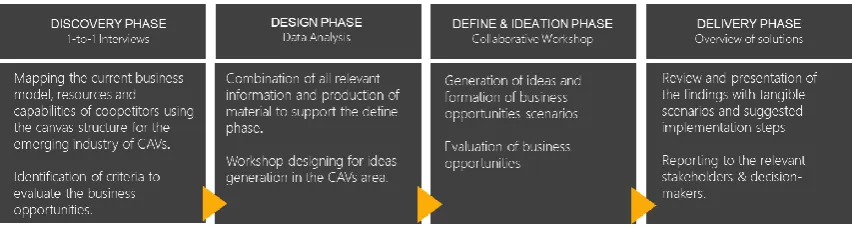
The 4-stages approach is based on co-creation design thinking using closed-loop processes to enable the generation of ideas based on customer aspirations and to translate them into product features and services. In particular, for emerging industries and new technologies, such as CAVs, new insights, innovations and new capabilities can be realised rapidly. The method used in this project was made up of the following four phases: discovery; design; define and ideation, and delivery phase and consisted of the following elements:
The utilisation of the business model canvas to map organisational elements, resources, capabilities and the relationship of each organisation with its customers, suppliers and partners using semi-structured interviews with each participant organization. The business model canvas permits to visualize the main elements and was used as a guide in the ideation process (Bocken et al., 2014).
The analysis of the business model elements and the expectations for participant organisations about the connected and autonomous vehicles were utilized to design the workshop that was introduced in the define and ideation phase. This involved the visualisation of all relevant information in enabling information and knowledge transfer among the coopeting organisations informing each organisation about relevant resources, capabilities and the perception for the technology solutions around the CAV.
Following the background work and based on resulting syntheses, a workshop was organized following these specific activities
o Activity 1 was dedicated to helping participant organisations to understand the business model elements of their coopetitors and complement on resources and capabilities for the connected and autonomous vehicles. This facilitated a draft of the key points of the business models to assist the innovation process.
5
o Activity 3 consisted of framing the problem of commuting and finding out how CAV can provide a solution to these problems. This allowed participant organizations to work for a common goal and connect product and services related to CAVs with actual problems.
o Activity 4 was dedicated to the analysis of the ideas for products and services of the previous activities to allow clustering them and combine them in relevant business opportunities.
o Activity 5 involved the discussion around which business opportunities seems more appealing from each organisation's perspective and voting for the most favourable. The participants evaluated the concepts that reached a consensus and then selected the ones as more likely to be further developed.
o Activity 6 was dedicated to exploring how competing organisations will co-create value for the most favourable business opportunities. This involved the allocation of relevant resources and capabilities of each organization to enable the development of the business opportunities scenarios.
o Activity 7 was dedicated to the identification of barriers for the realization of these scenarios considering the technical robustness and the fit with to the users. Then, mitigating actions to these barriers were defined.
In the last phase, the documentation of the solutions and recommendations for next steps in a report allowed participating organisations to provide their feedback.
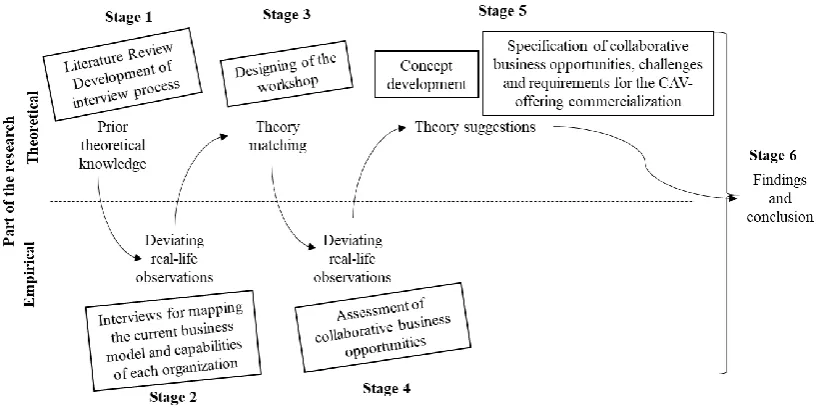
[image:6.595.91.500.505.710.2]An abductive research process was followed since it is a way of working that enables data collection and theory development to take place simultaneously and fits the purpose of study that targets on a specific problem in the automotive industry (Saunders et al., 2015). Moreover, there is a clear link of abductive reasoning with the design thinking process.
Figure 1-The abductive process adopted by Kovács and Spens, 2005
6
[image:7.595.97.506.157.245.2]connected and autonomous vehicles. A case study is the most appropriate research method since it moves away from just closing theoretical gaps through basic research and explores theory to provide a solution to a problem. To enhance the research, interviews and a workshop were selected as the most appropriate data collection tools.
Figure 2- The interview process
All interviews were conducted via face2face meetings to secure that participant organisations were adequately informed, and their input was captured, providing them with the chance to follow-up on issues if needed. Organisations that collaborate in an established project and will be involved in the formation of commercial solutions for the connected and autonomous vehicle were interviewed. Through that, the necessary technological and market knowledge was secured, as well as, the fit of coopetition theory. Table 1 provides a full list of companies and their relevant role.
Table 1- Participant information
No. Participant organisations Description of their role Interviews Workshop
1 Automotive OEM Car manufacturer
2 Infrastructure provider 1 Physical road network and maintenance 3 Infrastructure provider 2 Physical products and software solutions
4 Telecom company Mobile connectivity
5 Automotive supplier Devices and software solutions
6 Local authority Urban road network
7 University 1 Research and development
8 University 2 Research and development
Findings
As illustrated in Figure 3, a new approach based on design thinking was developed, called the 4-stages modified design thinking process. The modified approach provides a strategic approach to identifying the most advantageous co-creation opportunities for an emerging industry where the final offering is still uncertain.
Figure 3- 4-stages design thinking process
[image:7.595.85.513.585.700.2]7
enabling organizations to provide feedback on the information gathered through the interviews. Moreover, the business model canvas provided an effective way for knowledge and information sharing enhancing the cooperation and allowed matching ideas for co-creation with relevant resources and capabilities of each organization (Osterwalder and Pigneur, 2011; Bouncken and Kraus, 2013).
Design thinking worked as a mean to dissolve competing relationships in the ideation stage by positioning participants in the role of the customer where details of user's lives led to new and more profound insights for offerings enabled by the connected and autonomous vehicles that were translated into products and services. A second impact during the ideation stage was observed by focusing on exploring the problem of commuting itself and, then, based on the new understandings; ideas were generated for products, services and business models to solve these problems. Dorst (2015) has argued that problem framing is one of the key design practices that make the method more likely to yield better solutions than conventional approaches to problem-solving. This stage was enhanced by having participants with different backgrounds from academics, product managers, business developers to technology specialists as different perspectives on the examined issues were combined.
[image:8.595.122.472.487.674.2]Participant organizations had to collaborate in order to achieve a consensus about the most beneficial business opportunities and match their resources and capabilities to these scenarios. To achieve this, organizations had to define which technology will be used for the connectivity side. Despite that, opportunistic behaviour can be seen on determining the mix of technologies as organisations compete following their individual strategies, consensus on the resources and capabilities that are required for the realization of the final three business opportunity scenarios was found. In that sense, coopetition seems to be seen as a strategic choice for the CAVs among the networked organizations (Roy and Yami, 2009). Figure () describes the results of following the developed approach.
Figure 4- Results of the approach
8
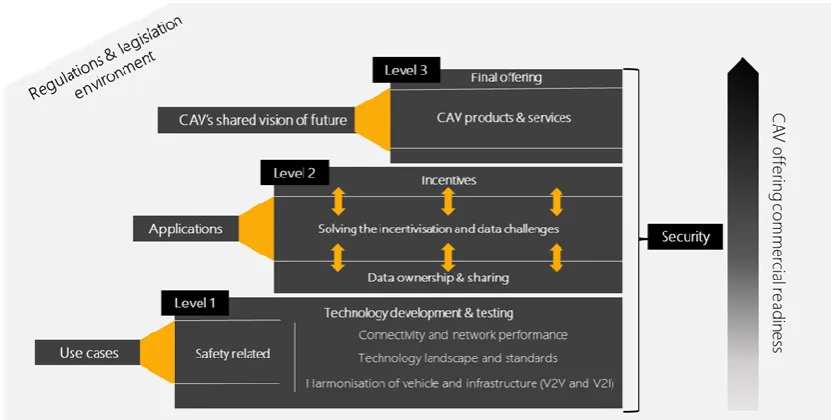
[image:9.595.94.510.257.467.2]identified as two challenges that organizations should overcome to realise the final offering of connected and autonomous vehicles. To that end, the collaborative efforts should be targeting on understanding how the customers will adopt the technology and how to demonstrate these benefits through the offerings. Moreover, the huge amounts of data that will be generated and collected as the connected vehicle interacts and exchanges data with other vehicles and the infrastructure should be classified in order to build a joint agreement about its usage and ownership. Finally, specific attention should be given around the security of the systems and the formation of an adaptive regulatory environment for the CAV technologies, products and services, with the involvement of both organisations and governments to clarify the path in all levels of commercial readiness. Figure 5 illustrates the framework for CAV commercial readiness.
Figure 5- Framework for CAV products and services commercialization
Conclusion
9 References
Amit, R. and Zott, C. (2001) ‘Value creation in e-business’, Strategic Management Journal. doi: 10.1002/smj.187.
Bengtsson, M. and Kock, S. (2014) ‘Coopetition-Quo vadis? Past accomplishments and future challenges’,
Industrial Marketing Management. doi: 10.1016/j.indmarman.2014.02.015.
Bengtsson, M., Kock, S. and Lundgren-Henriksson, E.-L. (2018) Coopetition research: Rooting and future
agendas, Routledge Companion to Coopetition Strategies.
Bocken, N. M. P. et al. (2014) ‘A literature and practice review to develop sustainable business model archetypes’, Journal of Cleaner Production. doi: 10.1016/j.jclepro.2013.11.039.
Bouncken, R. B., Clauß, T. and Fredrich, V. (2016) ‘Product innovation through coopetition in alliances: Singular or plural governance?’, Industrial Marketing Management. doi: 10.1016/j.indmarman.2015.11.011.
BOUNCKEN, R. B. and FREDRICH, V. (2012) ‘COOPETITION: PERFORMANCE IMPLICATIONS AND MANAGEMENT ANTECEDENTS’, International Journal of Innovation Management. doi: 10.1142/S1363919612500284.
Bouncken, R. B. and Kraus, S. (2013) ‘Innovation in knowledge-intensive industries: The double-edged sword of coopetition’, Journal of Business Research. doi: 10.1016/j.jbusres.2013.02.032.
Chesbrough, H. and Rosenbloom, R. (2002) ‘The Role of the Business Model in Capturing Value from Innovation: Evidence from Xerox Corporation’s’, technology spin-off companies, Industrial and
Corporate Change. doi: 10.1093/icc/11.3.529.
Dunne, D. and Martin, R. (2006) ‘Design thinking and how it will change management education: An interview and discussion’, Academy of Management Learning and Education. doi: 10.5465/AMLE.2006.23473212.
Gnyawali, D. R. and Ryan Charleton, T. (2018) ‘Nuances in the Interplay of Competition and Cooperation: Towards a Theory of Coopetition’, Journal of Management. doi: 10.1177/0149206318788945. Gruber, M. et al. (2015) ‘Management by Design (From the editors).’, Academy of Management Journal.
doi: 10.1097/JPN.0b013e31827f0238.
Hoffmann, W. et al. (2018) ‘The interplay of competition and cooperation’, Strategic Management Journal. doi: 10.1002/smj.2965.
Kovács, G. and Spens, K. M. (2005) ‘Abductive reasoning in logistics research’, International Journal of
Physical Distribution and Logistics Management. doi: 10.1108/09600030510590318.
Nalebuff, B. J. and Brandenburger, A. M. (1997) ‘Co opetition: Competitive and cooperative business strategies for the digital economy’, Strategy & Leadership. doi: 10.1108/eb054655.
Osterwalder, A. and Pigneur, Y. (2011) ‘The Business Model Canvas’, Viitattu.
Quintana-García, C. and Benavides-Velasco, C. A. (2004) ‘Cooperation, competition, and innovative capability: A panel data of European dedicated biotechnology firms’, Technovation. doi: 10.1016/S0166-4972(03)00060-9.
Ritala, P. (2012) ‘Coopetition Strategy - When is it Successful? Empirical Evidence on Innovation and Market Performance’, British Journal of Management. doi: 10.1111/j.1467-8551.2011.00741.x. Ritala, P., Golnam, A. and Wegmann, A. (2014) ‘Coopetition-based business models: The case of
Amazon.com’, Industrial Marketing Management. doi: 10.1016/j.indmarman.2013.11.005.
Ritala, P. and Hurmelinna-Laukkanen, P. (2013) ‘Incremental and radical innovation in coopetition-the role of absorptive capacity and appropriability’, Journal of Product Innovation Management. doi: 10.1111/j.1540-5885.2012.00956.x.
Roy, P. and Yami, S. (2009) ‘Managing strategic innovation through coopetition’, International Journal of
Entrepreneurship and Small Business. doi: 10.1504/ijesb.2009.024105.
Saunders, M. N. K., Thornhill, A. and Lewis, P. (2015) ‘Research Methods for Business Students (5th Edition)’, in Research Methods for Business Students. doi: 10.1007/s13398-014-0173-7.2.
Talebian, A. and Mishra, S. (2018) ‘Predicting the adoption of connected autonomous vehicles: A new approach based on the theory of diffusion of innovations’, Transportation Research Part C: Emerging
Technologies. doi: 10.1016/j.trc.2018.06.005.
Teece, D. J. (2010) ‘Business models, business strategy and innovation’, Long Range Planning. doi: 10.1016/j.lrp.2009.07.003.
Velu, C. (2016) ‘Evolutionary or revolutionary business model innovation through coopetition? The role of dominance in network markets’, Industrial Marketing Management. doi: 10.1016/j.indmarman.2015.11.007.
Vinnakota, T. R. and Narayana, M. G. P. L. (2014) ‘Integration of design thinking with strategy and innovation in an enterprise context’, in ICMIT 2014 - 2014 IEEE International Conference on
Management of Innovation and Technology. doi: 10.1109/ICMIT.2014.6942413.
10
Technology? The Impacts of the Supporting-Firm Base in Markets with Network Effects, SSRN. doi:
10.2139/ssrn.1114976.
Yami, S. and Nemeh, A. (2014) ‘Organizing coopetition for innovation: The case of wireless telecommunication sector in Europe’, Industrial Marketing Management. doi: 10.1016/j.indmarman.2013.11.006.