© 2019, IRJET | Impact Factor value: 7.211 | ISO 9001:2008 Certified Journal | Page 4947
Analytical Study of High Volume Fly Ash Concrete Bubble deck slab
Saranya P
1, Sankaranarayanan KM
21
PG student, Structural Engineering, Sreepathy Institute of Management and Technology, Vavanoor, India
2Assistant Professor,
Department of Civil Engineering,
Sreepathy Institute of Management and Technology,
Vavanoor, India
---***---Abstract -
Fly ash and plastic balls were used for preparinghigh volume fly ash concrete bubble deck slab with an aim of limited usage of cement for construction and dead weight reduction of the slab. The strength of M40 mix with 50% cement replacement after curing for 56 days was used for the work.These slabs were constructed by insertion of plastic balls of 6.5cm diameter at four various arrangements. One with no balls, second with sixteen balls, third with alternate horizontal arrangement of eight balls and fourth alternate diagonal arrangement of eight balls.The finite element analysis of the same was carried out using ANSYS Workbench 16.1. The results of the work showed that the slab could achieve comparable strength that of normal reinforcement concrete slab. Hence this is a highly innovative practice that can be implemented in the construction industry as the method is environmental friendly and cement can be saved considerably.
Key Words: Bubble deck slab, HVFA concrete, Plastic balls, ANSYS Workbench, Finite element analysis
1. INTRODUCTION
Human impact on the environment due to today’s race in building tall and large structures is enormously high. The construction industry mainly uses cement as a binder whose production involves emission of a lot of CO2. This intern is a way of increasing global warming. Majority of the conventional buildings is made of concrete whose dead load is very high making its foundation more complex and heavy. Researches in green concrete have been carried out in different parts of the world in order to provide solutions for many of these problems. Partial replacements for cement have been carried out with different waste products, one of them being fly ash. And also reducing the dead weight of structures has been a major topic of concern.
As per code IS 456: 2000, the replacement of cement with fly ash is allowed up to 35%. A concrete with cement replacement more than this is called high volume fly ash concrete. Fly ash is a byproduct of coal mining whose disposal has been a serious matter of concern. It is a hazardous substance if buried in earth may leach into ground water turning the water into toxic waste water. When such a product is used as a replacement it is a solution for two different environmental issues. Depending on the amount of lime they are mainly classified into class F and class C. When the amount of lime is less than 20%, it has lesser binding properties and requires a cementing agent for cementitious compounds. This is class F, whereas class C fly
ash has self cementing properties with amount of lime more than 20%.
HVFA concrete has many advantages over conventional concrete. Fly ash is highly pozzolanic in nature which gives it a cementitious property. It increases the long term strength and durability. This also reduces the heat of hydration of the mix and reduces the thermal shrinkage. Fly ash concrete is known for its resistance towards acids and sulphates, also resists corrosion. The density of high volume fly ash concrete is less than that of ordinary concrete. This helps in reduction of dead weight of overall structure. But it requires more setting time than ordinary concrete. From studies in the past it has been seen that as the curing period increases the strength of HVFA concrete increases. This thesis acknowledges the effect of curing in high volume fly ash concrete. The HVFA concrete are now a days used in pavements, dams etc which requires mass concreting.
In the middle of 1990s biaxial hollow core slab was invented by Jorgan Breuning from Denmark. The great invention reduces the dead load up to 30% and construction cost reduction to 10%. According to the manufacturer, bubble deck slab can reduce total project costs by three percent. The main issue of heavy dead weight mainly arises for high rise building whose foundation is much more complicated and consumes a lot of cement. The dead weight of a structure is due to slabs and beams of each storey. The concrete in the middle portion of a slab acts as a spacer which does not provide any strength to the slab. The bubble deck slab is a type of hollow core biaxial flat slab invented in Denmark. Here the concrete is replaced by high density polypropylene hollow balls which help in reducing the dead weight of the slab. As the dead weight is lower, longer spans without beams and columns can be used. Without compromising with the strength, a large amount of concrete is saved. With decreasing in weight of slab, the design excavation and depth of foundation is reduced. It is environmental friendly as well as economical as the overall use of cement and other construction materials is reduced. Construction is faster since the slabs are semi precast. The bubble deck slabs are transported to the site in large trucks. Many skyscrapers, airports, malls, have been constructed by now, Millennium tower Rotterdam being the first among them.
2. OBJECTIVES
To familiarize green concrete
© 2019, IRJET | Impact Factor value: 7.211 | ISO 9001:2008 Certified Journal | Page 4948
To analyze the behavior of bubble deck slabs with different arrangements of balls
To study the finite element analysis of the same using software ANSYS Workbench 16.1
3. MATERIAL PROPERTIES
The materials used in this thesis are explained as below.
3.1 Plastic balls
The plastic balls used are of 65mm diameter. The plastic balls are of high density hollow spheres.
3.2 Steel reinforcement
The reinforcement are provided as meshes at top and bottom with a diameter of 8mm. They are Fe 500 grade placed 150 mm apart.
3.3 Concrete
[image:2.595.339.544.334.520.2]The concrete used here is high volume fly ash concrete with a curing of 56 days which increases the compressive strength. The compressive strength is 56.29 MPa. The HVFA concrete was prepared by replacing 50% of cement in a design mix for M40 grade concrete. Here the cementitious material was increased by an amount of 45%. The mix design was done according to IS 10262:2002.
Table -1: Material properties Materials Properties Value
Concrete
Young’s modulus
of elasticity 37616 MPa
Poisson’s ratio 0.15
Compressive
strength 56.29 MPa
Steel Young’s modulus of elasticity 200000 MPa
Poisson’s ratio 0.3
Yield strength 500 MPa
Plastic ball
Young’s modulus
of elasticity 950 MPa
Poisson’s ratio 0.3
4
.
MODELING
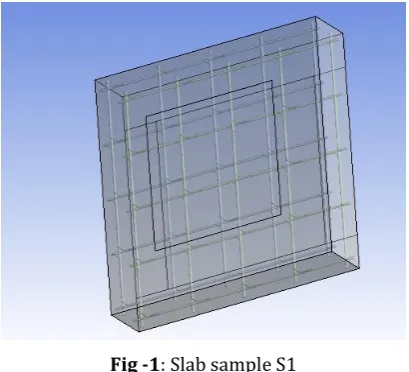
The modeling of the slab was done through geometry, design modeler. Using different tools such as drawing tool- rectangle, circle etc and modifying tools - extrude, mirror, pattern, translation, boolean etc the conventional slab, bubble deck slab, bubble deck slab with different arrangements were created in the software. The mesh was created with 8mm bars at 150mm centre to centre distance. From the end 50mm distance was provided for the reinforcement. Two layers of the mesh at top and bottom were created. The two layers were provided at a distance of 70 mm. Later on the required numbers of spheres were created and placed in required positions. Solid slab of adequate size of 700x700x110mm was created. The stages of modeling are given in the figures from 10.4 to figure 10.7. The areas required for providing support were created in the modeling section. 10cm wide area is provided in the bottom portion of the slab in all four sides. In the top an area of 400 x 400 mm area is provided for the loading. These areas were provided using the tool Boolean.
Fig -1: Slab sample S1
[image:2.595.60.264.424.724.2]© 2019, IRJET | Impact Factor value: 7.211 | ISO 9001:2008 Certified Journal | Page 4949
Fig -2: Slab sample S2
Fig -3: Slab sample S3
Fig -4: Slab sample S4
4.1 Meshing
The models are to be linked to the materials in order to show the characteristics of the material. That is done in the third step of analysis in Ansys workbench. After the materials are assigned to respective geometries, the local coordinate system of each is fixed with global coordinate system. The connections are provided between each component of the model such as reinforcement bars and concrete, concrete and plastic balls etc as bonded connections. Meshes are provided for the model to make the finite element analysis more accurate. More meshes make the analysis more proximal to the results.
Fig -5: Meshing of models
5. ANALYSIS
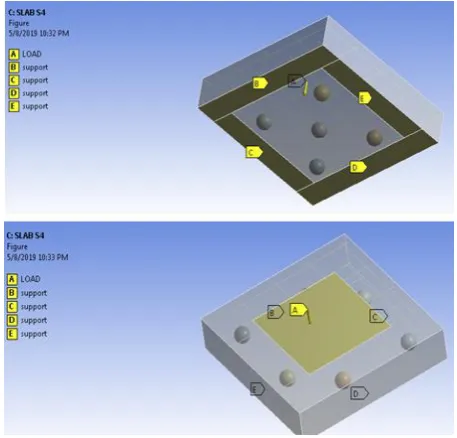
The finite element analysis of the models was done. In order to provide the loading in steps the auto time stepping was kept on with steps and sub steps. The solver type used was direct. Uniformly distributed load was provided in the centre of the slab in an area of 400 x 400 mm. The support condition provided was simply supported on all four sides in 100mm width space. The total deformation, force reaction, stresses and strain etc was computed after the analysis. The analysis was completed with no errors and minimum number of warnings.
Fig -6: Support and loading condition
6
.RESULTS AND DISCUSSIONS
[image:3.595.73.560.50.646.2] [image:3.595.326.555.457.676.2]© 2019, IRJET | Impact Factor value: 7.211 | ISO 9001:2008 Certified Journal | Page 4950
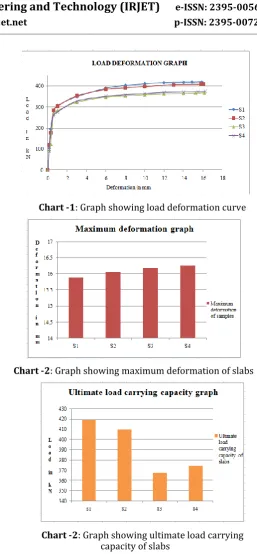
deformation graphs are plotted. The maximum deformationsare found where the load is applied and the least deformation was found to be obtained at the supports.
Fig -7: Deformation of Slab S2
Fig -8: Stress distribution of Slab S3
Fig -9: Strain distribution of Slab S4
Table -2: Maximum stress and strain Slab
sample m stress Maximu (MPa)
Maximu m strain
(mm)
S1 2.537 0.0884
S2 2.288 0.175
S3 2.193 0.114
S4 2.315 0.130
Chart -1: Graph showing load deformation curve
Chart -2: Graph showing maximum deformation of slabs
Chart -2: Graph showing ultimate load carrying capacity of slabs
[image:4.595.298.556.49.605.2] [image:4.595.51.285.136.575.2]© 2019, IRJET | Impact Factor value: 7.211 | ISO 9001:2008 Certified Journal | Page 4951
7. CONCLUSION
This work concludes that on overall comparison, slab with 16 balls HVFA concrete with 50 % cement replacement was concluded to be feasible as the dead weight was reduced without much reduction in strength. The slabs with eight balls are not preferable since it has much lesser strength and less reduction in dead weight. Among the two considering the position diagonal arrangement is preferred. The HVFA concrete can be considered as a good area of research as it is economical, eco friendly and has sufficient strength.
FUTURE SCOPE
The shear strength of the slab shall be analyzed using FEA method.
The optimum number of balls and their diameters shall be determined with varying HVFA mixes.
ACKNOWLEDGEMENT
We wish to express sincere thanks & gratitude to all people who extended their helping hand for the completion of this work.
REFERENCES
[1] Putte Gowda.B.S., Aswath.M.U, Muthu.K.U., “Behaviour of
fly ash concrete slabs containing higher levels of fly ash” International journal of innovative research & development, vol 2 issue 4, April 2013
[2] T.Ch. Madhavi, L.Swamy Raju, Deepak Mathur, “
Durabilty and strength properties of high volume fly ash concrete,” Journal of civil engineering research, vol. 4 no. 2a, pp. 7-11, Februvary 2014
[3] Bhagyashri G. Bhade and S.M Barelikar, “An
experimental study on two way bubble deck slab with spherical hollow balls,” International Journal of Recent Scientific Research, Vol. 7, Issue, 6, pp. 11621-11626, June, 2016.
[4] M.Surendar, M.Ranjitham, “ Numerical and experimental
study on bubble deck slab” , International journal of engineering science and computing, volume 6, issue 5, may 2016
[5] Sameer Ali, Manoj Kumar, “Analytical study of
conventional slab and bubble deck slab under various support and loading conditions using ansys workbench 14.0” International research journal of engineering and technology, vol.4 issue 5,may 2017
[6] Abhija Mohan and Archana Sukumaran, “ Performance
analysis of bubble deck slab with elliptical balls” International journal of research and technology, vol.6 issue 06, special issue 2018
BIOGRAPHIES
Saranya p.
PG student, Structural Engineering, former Publication is “Strength of high volume fly ash concrete with curing”, International Journal of Modern Trends in Engineering and Science, Volume: 06 Issue: 01 (march 2019 )