CD
'
.
s
2
a
2
_ .
Itt
5
;
,
.
7
&
;
7
an
August,
1968
S C
1263
56856
04
6
8
6th Annual
Computer
Art
Contest
Perry Publica1
is making hea
The system was designed so pt:i Florida newpapers could use onE ter in West Palm Beach.
Every
day the Perry papers seradvertising
and editorial matter 1be prepared for typesetting mach; Since speed is essentia I, Perry mitting-receiving centers whe copy is puton paper tape. The ta~ Type 2 Dataspeed*Service (at 1 minute) to West Palm Beach.
At the center, tapes are read puters at 1000 characters per sec
Ii
I
em
i.
have a 50,000 :> them. so that paper column here necessa ry. is a new tape iervice and feds.
y will help you :omputer instal-:ations Consul-tip you plan.a It any deadline. I Bell System
m
DataspeedE:3
Service ".... Bell SystemIJ.-.I
Central OfficeThe world's first medium size
computer at a small computer price.
$1~900
complete.
Never before has a computer with the power of the PDP-9, the 18-bit word length of the PDP-9, the program-mability, the multi-channelling, the expandability of the PDP-9 been available at a price near the price of the new PDP-9/l.
PDP-9/l is a leaner version of the PDP-9, but it's a medium size com-puter by any standards. Expandable 4K memory, with 1.5 p,sec cycle time.
Teletype. Standard 1-0 bus. Eight built-in high-speed data channels. Devices interface directly to the 1-0 bus by inexpensive FLIP CHIP modules. And it can be expanded to 32K memory. When you reach 16K, back-ground-foreground programming becomes available. But even the 4K software inaludes assembler, editor, debugging aids, math package, and utility programs. .
If your investigations require a medium size computer, but you simply couldn't afford one before, write us. The new PDP-9/l is designed for you.
COMPUTERS'MOOULES
DIGITAL EQUIPMENT CORPORATION, Maynard, Massachusetts 01754. Telephone: (617) 897-5111 • Cambridge, Mass .• New Haven • Washington, D.C. • Parsippany, Palisades Park, N.J. • Princeton, N.J. • Rochester, N.Y. • Long Island, N. Y. • Philadelphia • Pittsburgh • Cleveland'. Dayton • Huntsville • Cocoa, Fla. • Chicago • Denver· Ann Arbor • Salt Lake City • Houston • Albuquerque • Los Angeles • Palo Alto • Seattle. INTERNATIONAL, Carleton Place and Toronto, Ont. • Montreal, Quebec • Edmonton, Alberta, Canada • Reading and Man· chester, England • Paris, France • Munich and Cologne, Germany. Oslo, Norway ·.Stockholm, Sweden • Sydney and West Perth, Austr.alia .•
Letters To The Editor
Computers and Education
The March issue of Computers and
Automation was especially interesting to
me. I am a mathematics teacher in high school in suburban Minneapolis and have recently taken .. some computer courses and become interested in this area of mathematics-related work in high schools. The topic of "Computers and Education" decided for me that I would accept your invitation for com-ments and suggestions.
Are there any publications specializ-ing in computers and/or programmspecializ-ing for teachers? It seems to me that a good many math teachers might appre-ciate such a publication or such a de-partment in a current publication. If it were known by math teachers that such a department existed in a computer magazine it would be quite a good way to keep informed in the field and should be a good source of potential sub-scribers. Why not put such a depart-ment in C&A, make it known through such an organization as National Coun-cil of Math teachers, or the various state organizations of math teachers, and see if there is enough demand for a sec-tion aimed at secondary school use of computers and programming?
I enjoy your magazine and feel it is a good way of keeping informed on devel-opments in the field of programming at a nominal cost.
CHARLES HUTCHINSON
Crystal, }.1inn. 55427
( Ed. Note - There are publications specializing in computers and program-ming for teachers and people in educa-tion_. and there will be more and more. As to our having a department on this
subject, we like your idea, and we will
try to find someone who might handle this as a deIJartment.)
Notice to Ing Jaroslav Kucera,
Prague
We thank you for your letter of :March 18, and we wish to reply to it - but your letter does not have your street address. \Vould you please tell us your street ad-dress?
The Editor
The Ten-Mile Gap -
Comments
I read with great interest the article in your March issue, "The Ten-Mile Gap - Part I: The Problem". I felt that the article clearly set out one of the major causes of unrest in our cities today. It is very encouraging to see someone in a position of responsibility take positive action to help correct some of our social problems today. While your article did not mention specific methods of overcoming the problem, I'm sure you are well aware that defining the problem is usually the hardest part of solving it.
I hope that this letter, along with any others that you may have received, will help spur you to greater efforts in attacking the problem created by those of us who do not have the proper at-titude toward social concern.
R. M. MERRITT
Manager
ISD Systems & Procedures
Wilcox Electric Company, Inc. Kansas City, Mo. 64127
Law and Computer Technology
It may 'please you to know that my article, "The Impact of Data Processing Technology on the Legal Profession", in your April issue has generated many more inquiries than the first publication of the article in a legal magazine.
If I write anything I think you might be interested in, I'll surely advise you.
VACGHN C. BALL
Univ. of Southern Calif· Law Center
Los Angeles, Calif. 90007
CAUML Comments
Your January editorial ("A:cess to Information and a Mailing List of All Computer People") has us in complete agreement. \Ve would like to have our n;mes included in your name and ad-dress files: . . .
I find your magazine very helpful in this rapidly changing field.
KEN~ETH W. KEMNER
T'ice President
Automated Data Processing, Inc. St. Mary's, Pa. 15857
©
(Q) [j
-U-=U
CQ)
~~ r~ ~
[j~©
and automation
Vol. 17, No.8 - August, 1968
Editor Edmund C. Berkeley
Associate Edito1' Sharry Langdale
Assistant Editors
Contributing Editors
Ad1lisor), Committee
Art Directors
Fulfillment Manage,.
Moses M. Berlin Linda Ladd Lovett Neil D. MacDonald John Bennett Andrew D. Booth Dick H. Brandon John W. Carr III Ned Chapin Alston S. Householder Peter Kugel Leslie Mezei Rod E. Packer Ted Schoeters T. E. Cheatham, Jr. James J. Cryan Richard W. Hamming Alston S. Householder Victor Paschkis Ray W. Hass Daniel T. Langdale William J. McMillan
Advertising Representatives
NEW YORK 10018, Bernard Lane
37 West 39 St., 212-279-7281
CHICAGO 60611, Cole, Mason, and Deming
737 N. Michigan Ave., 312-787-6558
PASADENA, CALIF. 91105, Douglas C. Lance
562 Bellefontaine St., 213·682-1464
SAN FRANCISCO 94123, Richard C. Alcorn
2152 Union St., 415-922-3006
ELSEWHERE, The Publisher Berkeley Enterprises, Inc.
815 Washington St., 617-332-5453 Newtonville, Mass. 02160
Editorial Offices
BERKElEY ENTERPRISES, INC. 815 WASHINGTON STREET, NEWTONVillE, MASS. 02160
CIRCULATION AUDITED BY AUDIT BUREAU OF CIRCULATIONS
COMPUTERS AND AUTOMATION IS PUBLISHED MONTHLY AT 815 WASHINGTON ST., NEWTONVILLE, MASS. 02160, BY BERKELEY ENTER· PRISES, INC. PRINTED IN U.S.A. SUBSCRIPTION RATES, UNITED STATES, $15.00 FOR 1 YEAR, $29_00 FOR 2 YEARS, INCLUDING THE JUNE DIRECTORY ISSUE; CANADA, ADO 50¢ A YEAR FOR POSTAGE; FOREIGN, ADO $3_50 A YEAR FOR POSTAGE. ADDRESS ALL EDITORIAL AND SUBSCRIPTION MAIL TO BERKelEY ENTERPRISES, INC., 815 WASHINGTON ST., NEWTONVillE, MASS., 02160. SECOND CLASS POSTAGE PAID AT BOSTON, MASS.
POSTMASTER, PLEASE SEND ALL FORMS 3579 TO BERKELEY ENTER· PRISES, INC, 815 WASHINGTON ST., NEWTONVILLE, MASS. 02160.
August, 1968, Vol. 17, No.8 T he magazine of the design, applications, and implications of information processing systems.
Special Feature: Sixth Annual Computer Art Contest
8 Hummingbird 9 The Fisherman 10 Labyrinth in Motion 10 Spires of Contribution
11 Inspiralation 12 Tower of Babel 14 Idealized Brush Strokes 15 Plexus
16 Star Kennedy 16 Monroe in the Net
17 Return to Square
17 Abraham Lincoln
18 Christmas Wreath - Computer Style 18 Whirlpool
19 Peek-a-Boo Circles 19 Tragedy of Seven 20 Ring Motif 21 Cybernumerics 22 The Sun Bather 22 March of Polygons 23 Sliced Nuclear Reactor 23 The Orbit Tree 24 Concentric Circles 24 Output Vs. Input 25 Lindy Star
25 Deformation of Sharaku 26 Op Art Computerized 26 Upheaval Collection
Kerry Strand and Gary Craigmile Kerry Strand
Petar Milojevic Lloyd Sumner A. M. France
Leslei Mezei and David Payne Dr. Evan Harris Walker
Kerry Strand, Larry Jenkins and Gary Craigmile Masao Komura and Haruki Tsuchiya
Haruki Tsuchiya
Masao Komura and Kunio Yamanaka Michael H. Craven
Maughan S. Mason Mrs. Leigh Hendricks Petar Milojevic Haruki Tsuchiya Petar Milojevic H. Philip Peterson Paul H. Sobel Haruki Tsuchiya D.
J.
DiLeonardo Lloyd Sumner Lawrence Nolan Bob Schultz L. David AndersonHaruki Tsuchiya, Koji Fujino and Kamoto Ohtake Donald Robbins
Masao Komura and Kunio Yamanaka
34 COMMUNICATIONS DATA PROCESSING OR TIME·SHARING?
by Lester A. Probst
Some strong arguments why the requirements of most on-line commercial (and military) computer applications can best be satisfied with a communications data processing sys-tem rather than a time-shared syssys-tem.
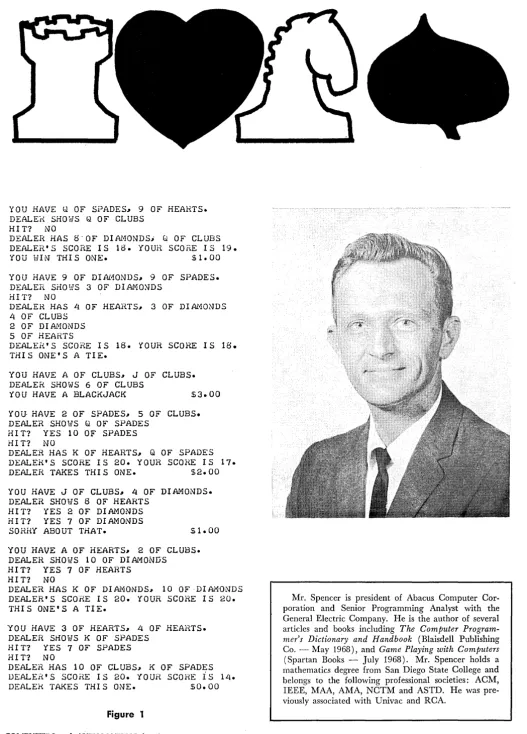
38 GAME PLAYING WITH COMPUTERS
by Donald D. Spencer
How a digital computer plays games, and why game playing with computers is so popular . . . and some examples of blackjack and chess played by a human being and a computer.
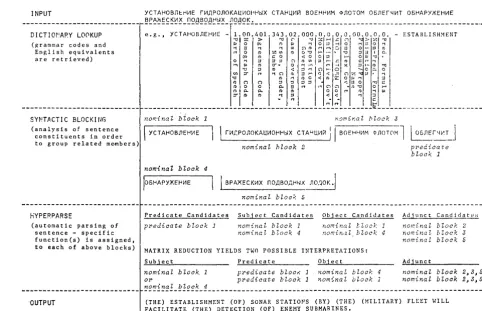
44 MACHINE TRANSLATION IN REVIEW
by Harry H. Josselson
A review of the progress that has been made toward: (1) compiling automatic dic-tionaries and developing efficient storage and retrieval of language data and translation rules; (2) encoding the grammar of words; (3) writing word order rules for sentence analysis; and (4) developing procedures for analyzing and codifying the meaning of words.
Regular Features
Editorial
6 How to Spoil One's Mind - as Well as One's Computer, by Edmund C. Berkeley
C& A Worldwide
48 Report from Great Britain, by Ted Schoeters
Fifteen Years Ago in "Computers and Automation"
50 Computers in the Factory (Part 2), by David W. Brown
Ideas: Spotlight
32 Although Computers Can Do Only What They Are Told To Do, It Is Not Possible Practically To Foresee All Of The Consequences, by Richard W. Hamming
Multi-Access Forum
28 28 29 30 31 31 31 32 32
Special Interest Committee for Social Science Computing of the Association for Computing Machinery is Proposed, by George Sadowsky
Congress Has Not Really Entered the Computer Age - and Should, by Congressman William S. Moorhead
National Academy of Sciences Establishes a "Computer Science and Engineering Board" Verification of Computer Directory Information, by I. J. Kusel and the Editor
Is the Computer an Artist's Paintbrush?, by Daniel T. Langdale Computers - A New Public Utility
Japanese Computer Industry is Growing Rapidly
4th Australian Computer Conference, Adelaide, South Australia, August 1969 - Call for Papers Contributions Welcome to "Who's Who in the Computer Field"
The front cover shows the entry which won first prize in the Sixth Annual Computer Art Contest of Computers and
Automation -
IIHumming-bird", by Kerry Strand and Gary Craigmile. A description of tHis picture, and other en-tries in the contest, are in the computer art section of this is-sue beginning on page 8.
Departments
52 Across the Editor's Desk - Com-puting and Data Processing
Newsletter
70 Advertising Index
70 Book Reviews and Notices
49 Calendar of 'Coming Events
4 Letters to the Editor
66 Monthly Computer Census
64 New Contracts
65 New Installations
69 New Patents
by Raymond R. Skolnick
51 Problem Corner
C-
a
EDITORIAL
How to Spoil One's Mind-as Well as One's Computer
Anybody who has been in the computer field for some time is bound to consider the differences and similarities be-tween the way in which programmed computers solve prob-lems and the way in which human beings solve probprob-lems.
The programmed computer solves a problem because the combined brainpower of a number of human beings (a num-ber that may range from two or three up to several hundred or even a thousand) has been organized and adapted, so that when appropriate data are put into the computer, correct answers come out. And as a corollary, with wrong data or incorrect programs, the, computer produces wrong answers; as we say in the computer field, "garbage in, garbage out." We spoil the functioning of the computer.
A human being solves a problem because his brainpower (capacity to program himself) and his education (program-ming from many other human beings) and his data (observa-tions, experiences, the statements he accepts from other people, his emotions, etc.) are organized and adapted to producing a correct answer. And the same corollary is true for human beings, "put garbage into the mind and garbage will come out." We spoil the functioning of the mind.
Just as one of the most potent sources of error for com-puters is wrong data, so one of the most potent sources of error for human beings is wrong data. However, there is an extremely important difference between the way a computer processes information and the way a human being processes information: The memory of a computer can be completely changed at enormous speed. Usually the entire contents of the core memory of a computer can be changed in less than a second. And the computer will afterwards remember literally nothing of what it previously stored.
This is not true for a human being. Once erroneous infor-mation is stored in the mind, it is hard to get rid of it. All of us know the difficult problem of unlearning wrong infor-mation. Errors and lies spoil the mind.
There are many sources of errors and lies for spoiling the mind, and we will try to consider a few of them here. As usual nowadays, the most important sources are man-made. A great many people are inclined to believe what a demo-cratic government says officially to them; and the fact that the government may be deliberately lying is not usually taken into account. For example, for a number of months the figures given by the United States government about U.S. airplane losses in Vietnam carefully excluded certain classes of losses. As a result, many people in the United States thought that the Democratic Republic of Vietnam was lying when it claimed that U.S. plane losses were far greater. Finally, the United States government admitted that plane losses were at least twice as high. Now, there is no possible military advantage in concealing from an ~nemy how many airplanes have been shot down over enemy territory. The enemy knows. The main advantage to the lying was that the administration of the United States government was able to deceive the people of the United States and persuade them to continue to accept certain policies for a while longer.
At least a dozen big and important lies have been told by the United States government from 1960 to the present,
under three presidents: Eisenhower (the U 2 incident), Ken-nedy (the Bay of Pigs incident), and Johnson (the polite name for that collection of lies is the "credibility gap"). (A list will be furnished by the editor on request.)
Members and former members of the United States gov-ernment have even defended the right of a govgov-ernment to lie to its people. It seems to me that this argument is demon-strably wrong. People all over the world have the right to be told the truth by their government, so that the people can decide whether or not to continue that government in power over them. And even if there is often some question about what is the precise truth, there is usually no doubt whatever about what is a big lie.
Foreign countries who are harmed by a lie should have the right to come into the courts of the country where the lie has been told and sue for damages - in the same way as an individual harmed by libel has the right to sue.
Another great source of lies for spoiling the minds of people - and producing wrong results if the lying data are fed into computers - is in the advertising of commercial products. Take for example cigarettes. There now exists profoundly convincing evidence that, for great numbers of people if not all, cigarette smoking produces lung cancer, circulatory diseases and other serious physical harm. Fur-thermore, there is evidence that some people can stop smok-ing easily, but that other people find it extremely hard to stop because they have become addicted, "hooked." Dr. Sigmund Freud, the founder of psychoanalysis, tried to stop smoking more than a dozen times, and even had more than thirty surgical operations for removing cancer due to smoking from his mouth and jaw (until he no longer had his own jaw) - and still he could not stop smoking, and he died from cancer. Consequently, until scientists can predict which people can smoke with impunity (like Winston Churchill) and which cannot, the only safe course of action for young people who have never started smoking is never to begin.
Yet this logical course of action is largely drowned out in radio advertising, TV advertising, magazine advertising, etc., where the companies that sell cigarettes are freely able to entice young people who have never begun to start smoking.
, The human mind is one of the most remarkable develop-ments of two thousand million years of evolution, Yet it is easy to spoil: just put into the mind information that is not true; hammer it in with continual repetition and fallacious arguments; and insulate the mind from opportunities to test the information against the real world and contrary argu-ments.
I t is unreasonable to argue for no exposure to wrong infor-mation. Thus it is vital for people to learn how to distin-guish between what is correct and useful information for
THE SIXTH ANNUAL COMPUTER ART CONTEST
OF COMPUTERS AND AUTOMATION
HUMMINGBIRD - Kerry Strand
Gary Craigmile
The first prize in our 1968 Computer Art Contest has been awarded to Kerry Strand and Gary Craigmile, both of California Computer Products, Inc., Anaheim, Calif. Their winning entry appears in color on the front of this issue, and is entitled "Hummingbird". It was de-signed and programmed by Mr. Strand; the color coor-dination and plotting techniques were executed by Mr. Craigmile.
The artists describe their work as follows:
The "Hummingbird" is an extension of the "three bug problem". The basic design produced by the "three bug problem" is modified by drawing only two sides of the triangle. This pattern is then mathematically manipulated into the desired position. Three different line widths, each with a different color, were plotted overlaying each other.
Mr. Strand and Mr. Craigmile submitted several more entries in the contest which are shown on the fol-lowing pages.
The other computer art published in this issue re-ceives honorable mention. For some of the drawings the explanation is obvious or can be inferred easily; for oth-ers, explanations are given. In a number of cases, the computer and the peripheral equipment which produced the computer art have not been specified as much as we would like because the information did not reach us by the close of the contest, July 5. We would, of course, like to identify the equipment that produced the art.
Sup-plementary information of this kind should be sent to us for publication in a future issue.
The responses to our Sixth Annual Computer Art Contest have been splendid. We are grateful to all those persons who sent us entries.
It is interesting to note the development in the com-puter art that we receive from year to year. As with computer technology itself, computer art is becoming more sophisticated, more creative, and more visually appealing. We now find a widespread use of color. We notice artists and professors, as well as technicians, working with the computer to learn more about design, color, and artistic techniques. We find groups being es-tablished to explore their mutual interests in computer art. One notable group is the Computer Technique Group (CTG) in Tokyo, Japan, which consists of eight individ-uals whose professions vary from architectural design to behavioral science to systems engineering.
For August 1969, we plan our Seventh Annual Com-puter Art Contest, and we cordially invite contributions of computer artfrom all our readers and others who are interested in computer art.
A complete alphabeticallisting of the names and ad-dresses of all persons whose art is published in this is-sue appears on page 27.
A SEA STAR
- Petar Milojevic
The three-point net technique is used to get a pleasing drawing through some elements for which computers are described as best performers. Programmed in Fortran, and plotted off line on a CalComp 565 digital plotter.
THE FISHERMAN
- Kerry Strand
A composite of one basic deFlign repeated in various positions and shape\;. Done on a GE 425 computer and a CalComp 760/502 incremen-tal plotter with a step size of O. 01 inches.
d ith the help 0
Produce w
l OTION " T H IN 1\ MilojevlC L A
BY RI N Petar I
- der lIml " "ted contro . roduced un ff line on a design was p nd plotted 0
This random d in Fortran a ramme
It was prog digital plotter. CalComp 565
RIB UTION OF CaNT 1 d Sumner
SPIRE S - Loy 565 plotter.
INSPIRALATION
- A. M. France
TOWER OF BABEL
- Leslei Mezei, Artist, and David Payne, Programmer
The five pictures shown on this and the adjacent page are part of a series based on a "Tower of Babel". The original tower was made up of the word "BABEL" repeated twenty times, each word placed on top of the last, with the width at the bottom being four times that at the top. Each of the pictures is a mathematical or random distortion of this same tower. The programming language Sparta (a graphic procedure-oriented language consisting of Fortran IV subroutines) was used on an IBM 7094-II.
An oblique transformation was applied which in effect transformed the vertical axis through the center of the tower into a line making an angle of 300 with the horizontal axis.
The distance r of each point from a point 1/5 of the way up the tower was replaced by re-r .
Each point of the tower was displaced both horizontally and vertically by a random amount. The random displacement was obtained from a Gaussian distribution with a mean of zero
and a standard deviation of 0.05. The maximum displacement The distance r of each point from the center was replaced by
IDEALIZED BRUSH STROKES
- Dr. Evan Harris Walker
The idea behind this picture is that by studying mathematically the compositional elements employed by the great artists, one might discover artistic principles; and with the aid of a computer, these principles could be tested by using them to generate new examples of art. As a starting point, completely random arrangements of rectangles (idealized brush strokes) were examined. This picture makes use of several concepts that have been developed to produce organization in pattern and color.
PLEXUS
- Designed and programmed by Kerry Strand and Larry Jenkins Color coordination and plotting techniques by Gary Craigmile
MONROE IN THE NET - Haruki Tsuchiya
A pattern deformation system was applied to a photo-graph of James Monroe. The canvas was first set as a net ready for deformation. The data from the photo actuated each element of the net by random number. An IBM 7090 computer and CalComp 563 plotter were used.
\
'"'"t'
....
to-N
K
STAR KENNEDY
- Designed by Masao ~omura
Programmed by Haruki Tsuchiya
A pattern deformation system was applied to a photograph of John F. Kennedy. Stars of random size were put on the point of data from the photo. An IBM 7090 computer and CalComp 563 plotter were used .
.l-II
J..
~
~ :...
~
,
...4
t< 1
~
f
t ~t:~\: ~ J- I""-
~
~...,.
t:::Z
,., ~
~
...
\
7
1\ +-'
'r:J
~
~ ,... "X7
RETURN TO SQUARE
- Designed by Masao Komura Programmed by Kunio Yamanaka
This is a computer metamorphosis. A square is metamorphosed into a profile of a woman, and then returned to a square again. The profile is input data. The process of metamorphosis is visualized as a movement; and metamorphosis itself is presented as an object. An IBM 7090 computer and CalComp 563 plotter were used.
ABRAHAM LINC OLN
- Michael H. Craven
CHRISTMAS WREATH - COMPUTER STYLE
WHIRLPOOL
- (Mrs.) Leigh Hendricks
This design resulted from a programming bug in a polar equation using a Fortran program. Initially the coordinates were exposed on black and white film from a CRT (S-C 4020).
For the picture shown here, a 35 mm slide was exposed directly on color film on an S-C 4020 which has been modified for color work.
PEEK-A-BOO CIRCLES - Petar Mil oj evic
A drawing with r:llldom elements exhibiting visual illusions. It was programmed in Fortran and plotted off line on a CalComp 565 digital plotter.
TRAGEDY OF SEVEN
- Haruld Tsuchiya
RING MOTIf
- Petar :Mil oj evic
This drawing is done without lifting the pen from the first to the last point. It was programmed in Fortran and plotted off line on a CalComp 565 digital plotter.
CYBERNUMERICS
- H. Philip Peterson
Preprocessing for this digigram of Prof. Norbert Wiener involves correcting the Gamma curve of the film to the "Gamma" of the shaded number set for plotting. A histogram of the scanned
num-bers (NS) is computed and the low (L) and high (H) ends of the - - -... ~ distribution are detected. The number plotted (NP) is calculated
THE SUN BATHER
- Paul H. Sobel
Using a Fortran program on an IBM 7094, a tape was generated for off-line use on an SC 4020, which made the plot. The plotting subroutine interpreted a matrix as the dependent height variable. An angle of 40 degrees was specified, and hidden lines were tested for and removed. The figure is generated by sums of Gaussian functions.
(j(7ff'{J~~~cf.qJ~~~<Q~~~~
R~~<A ~ ~~
<J
V \
~"'<\ ~
D
~~
~4" ~.;J
0
~
0<:)
0J
<>~
{/
b
~90.
0
<±
o.1'V
+-
C>V ()
-yJ
1
<1
<1
<>
P'-tJ.
~
q
~
\J
(J
4
\ )
~
-q
D.
6()!\
<J
<}
~
<1..
LJ
~
1:0
~ C)~
<1
~
. d
d
~
V
<J
b
A7
9rp,~~<Ov<r<J<J-,
~ ~
«
&-
-Z7
0~
c!J,
~
~L;J
11
11
4
CJ
~
f).
~
{J
Yt-
p
)j
l::J
'*
l.~~~~~?~~ck~*9--~~'iS
MARCH OF POLYGONS
- Haruki Tsuchiya
SLICED NUCLEAR REACTOR - D. J. DiLeonardo
A perspective of the fuel material distribution in a slice through a nuclear reactor. Drawn on a CDC Model 280 Microfilm Recorder using contour and perspective routines run on a CDC-6600 computer.
THE ORBIT TREE
- Lloyd Sumner
Produced with the help of a Burroughs B5500 computer and a CalComp 565 plotter.
OUTPUT VS. INPUT - Bob Schultz
This design was generated on an IBM 360/50 and an SC 4020 by plotting the output of a digital filter against its input.
CONCENTRIC CIRCLES
- Lawrence Nolan
LINDY STAR
- L. David Anderson
A composite of one basic design which is repeated in various positions and shapes to pro-duce the final drawing. Computer used was a GE 425, with a CalComp 770/702 incremental plotter with a step size of O. 002 inches.
DEFORMATION OF SHARAKU
- Idea by Haruki Tsuchiya, Program by Koji Fujino, Data by Kamoto Ohtake
OP ART COMPUTERIZED - Donald Robbins
Here an op art picture by Jeffry Steele (which appeared in Time magazine in 1961) was turned into a subroutine in an investigation of some perspective properties, without actually going through the perspective transformation. Arguments to the subroutine consisted of the length and height, the number of spikes per side, the number of bands, the interior rotation, etc.
UPHEAVAL COLLECTION
- Idea by Masao Komura, Program by Kunio Yamanaka
COMPUTER ARTISTS IN THIS ISSUE
The following is a list of persons whose art is published in this issue as part of the Sixth Annual Computer Art Contest of Computers and Automation.
Anderson, L. David, California Computer Products, Inc., 305 N. Muller St., Anaheim, Calif. 92803 Craigmile, Gary, California Computer Products, Inc.,
305 N. Muller St., Anaheim, Calif. 92803 Craven, Michael H., 718 N. State, Apt. #4, Kent,
Wash. 98031
DiLeonardo, D. J., Westinghouse Electric Corp., Bettis Atomic Power Laboratory, Box 79, West Mifflin, Pa. 15122
France, Alan M., International Computers and Tabula-tors, Ltd., Bridge House, Putney, London, SW 15, England
Fujino, Koji, Computer Technique Group, 7-26, 4chome, Kitasuna, Koto-ku, Tokyo, Japan
Hasegawa, Takeshi, Computer Technique Group, 7-26, 4chome, Kitasuna, Koto-ku, Tokyo, Japan Hendricks, Mrs. Leigh, Sandia Corp., Sandia Base,
Albuquerque, N. Mex. 87115
Jenkins, Larry, California Computer Products, Inc., 305 N. Muller st., Anaheim, Calif. 92803
Kakizaki, Junichiro, Computer Technique Group, 7-26, 4chome, Kitasuna, Koto-ku, Tokyo, Japan
Komura, Masao, Computer Technique Group, 7-26, 4chome, Kitasuna, Koto-ku, Tokyo, Japan Mason, Maughan S., 18910 Cyril Place, Saratoga,
Calif. 95070
Mezei, Leslie, Associate Professor, Dept. of Computer Science, University of Toronto, Toronto, Canada Miloj evic, Petar, McGill University Computing Center,
Montreal, Quebec, Canada
Niwa, Fujio, Computer Technique Group, 7-26, 4chome, Kitasuna, Koto-ku, Tokyo, Japan
Nolan, Lawrence, 2620 Delmar, Granite City, TIL 62040 Ohtake, Makoto, Computer Technique Group, 7-26,
4chome, Kitasuna, Koto-ku, Tokyo, Japan
Payne, David, Institute of Computer Science, University of Toronto, Toronto, Canada
Peterson, H. Philip, Control Data Corp., Northwest Industrial Park, Third Ave., Burlington, Mass. 01804
Robbins, Donald, Div. 9424, Sandia Corp., Sandia Base, Albuquerque, N. Mex. 87115
Schultz, Bob, Polytechnic Institute of Brooklyn, Dept. of Electrical Engineering, 333 Jay st., Brooklyn, N. y.. 11201
Sobel, Paul H., Jet Propulsion Laboratory, 4800 Oak Grove Drive, Pasadena, Calif. 91103
Strand, Kerry, California Computer Products, Inc., 305 N. Muller St., Anaheim, Calif. 92803 Sumner, Lloyd, Computer Creations, P. O. Box 1842,
Charlottesville, Va. 22903
Tsuchiya, Haruki, Computer Technique Group, 7-26, 4chome, Kitasuna, Koto-ku, Tokyo, Japan Walker, Dr. Evan Harris, National Aeronautics and
Space Administration, Electronics Research Center, 575 Technology Square, Cambridge, Mass. 02139 Yamanaka, Kunio, Computer Technique Group, 7-26,
4chome, Kitasuna, Koto-ku, Tokyo, Japan
EDP
opportunities in
Social Science Research
The BROOKINGS INSTITUTION is a private, independent organiza-tion devoted to policy-oriented research and educaorganiza-tion in the social sciences. The .expanded role of computer applications has created these professional positions:
ASSISTANT
DlR~CTOR,
COMPUTER
CENTER-... requires substantial research or academic programming experience, theoretical training and experience in mathematical and statistical tech-niques, and previous participation in the social sciences, as weB as operations management ability. Advanced substantive work in com-puter or social sciences is highly desirable.
CREATIVE
PROGRAMMERS-... requires interest and background in procedural language design and interactive language design and implementation, as well as nu-meric informational retrieval systems, for social science research ap-plications. Experience may be in a related field.
APPLICATIONS
PROGRAMMERS-... requires creative persons with substantial experience in FORTRAN programming with applications to basic research studies, a superior academic record and previous academic or research computing ex-perience. A knowledge of mathematical and statistical methods is essen-tial; in economics or political science, it is highly desirable.
Our stimulating academic environment offers growth potential, sala-ries commensurate with experience and ability, and an exceptional benefit program. For prompt, confidential consideration, send your resume, including requirements and professional interests, to Mr. George Sadowsky.
III
I I
The
Brookings Institution
1775 MASSACHUSETTS AVENUE N.W. WASHINGTON D.C. 20036
An equal opportunity employer
Designate No. 13 on Reader Service Card
CYBERNETIC SERENDIPITY
An International Exhibition exploring and demonstrating the relationship behveen technology and creativity
computer generated graphics - computer animated films - computer composed and played music computer verse and texts - cybernetic devices as works of art - remote controlled robots _ cybernetic environments painting machinery
-Institute of Contemporary Arts
MULTI-ACCESS FORUM
SPECIAL INTEREST COMMITTEE FOR SOCIAL SCIENCE COMPUTING OF THE
ASSOCI-ATION FOR COMPUTING MACHINERY IS PROPOSED
Mr. George Sadowsky
The Brookings Institution, Computer Center
1775 Massachusetts Ave., N.W.
Washington, D.C. 20036
On behalf of a group of members of the Association for Computing Machinery, I am submitting a petition to the Council of the Association to consider the establishment of a Special Interest Committee for Social Science Computing
(SICSOC).
The use of computers by social scientists is rapidly increas-ing in universities, government, and business; yet there does not now exist an organization whose scope is sufficiently broad to appeal to a substantial number of these individuals. We propose SICSOC as an organization that would attempt to focus upon our common interest of the use of computers in the social sciences. Examples of areas the committee might concern itself with are: (1) statistical programming; (2) sta-tistical systems; (3) social science procedural languages; (4)
information retrieval in the social sciences; (5) simulation of social models and social systems; and (6) the application of computers to public policy formation. These examples in-dicate some topics of current interest, and are not intended to exhaust areas of potential committee activity.
Our present conception of the committee's functions is that it serve as an exploratory device to ascertain the most appropriate domain of interest for such a group and to deter-mine the viability of the group as a productive association of individuals. As an initial action, we anticipate holding an organizational meeting at the forthcoming ACM Conference in Las Vegas. Two immediate purposes of this meeting would be (1) to begin a search for a qualified, well-known social scientist who would be interested in heading a more formalized group, and (2) establishing informal channels of communication (probably a newsletter) between interested individuals. In this way, we hope to be able to explore our potential for various kinds of activities informally through the year.
Readers of Computers and Automation who are interested in participating in the committee's activities are invited to write me at the address above, outlining the nature of their interest and their suggestions concerning the committee's future.
CONGRESS HAS NOT REALLY ENTERED THE COMPUTER AGE - AND SHOULD
Congressman William S. Moorhead
U.S. House of Representatives
Washington, D. C. 20515
Private enterprise, the executive branch of the federal gov-ernment, and state legislatures have entered the computer age -- but Congress has not really entered the computer age.
Two years ago I spoke before a National Information
Re-t ricval Colloquium and said:
Today except for one sm~ll unit which the Library of Congress uses to handle its payroll, the Congress of the United States does not possess one penny's worth of
automatic data processing equipment.
When I tell you this I am expressing my concern for the future of representative government in the United States.
Since that date there has been very little progress. The Clerk of the House now has an NCR 500 to handle some of the payroll on the House side of the Capitol. I understand the Sergeant-at-Arms of the Senate is considering the acqui-sition of similar computer facilities.
The Legislative Reference Service has designed a com-puter-centered system which allows entering synoptic infor-mation on bills and resolutions introduced in both chambers of the Congress to be relayed via keyboard terminals to a remote computer. The magnetic tape generated by this sys-tem may be utilized in the future by the Government Print-ing Office "Linotron" System in publishPrint-ing the Digest of Public Bills.
This is progress, but I would hardly call it an all-out entry into the computer age, and I do believe that Congress should make full use of computer capability.
Writing in the introduction to Congress Needs Help, David Brinkley said:
Congress has great power, more than any other branch of the government. But effective use of power or leader-ship certainly requires change to accommodate to the changes in society. A leadership institution that fails to change will become an interesting and perhaps charming irrelevance . . . like an elderly gentleman whose oil por-trait hangs in the boardroom, who mouths 19th century platitudes, who is ceremoniously honored for his early achievements and always remembered on his birthdays -and otherwise ignored.
Congress has not yet reached this state of honored irrele-vance, but it is moving toward it, and unless it makes some changes in itself, it will shortly arrive.
• I believe that the Congress should enter fully into the computer age.
• I believe we should change the name of the Legislative Reference Service to the Legislative Research Service, and give it full compllter capability.
• I believe that the Federal Budget should be put on a computer for ready access to the Congress. (This year, the
American Enterprise Institute has used automatic data pro-cessing to measure and analyze the priorities in the Presi-dent's 1969 Budget.)
• I believe that we need on Capitol Hill a central read-out facility that could tap the memory banks of all of the other computers in the federal government, not to secure privileged data, but to secure such public factual information as economic statistics, demographic profiles, and figures on such things of daily concern to a Congressman's office as funds allocated to his district, and project and contract awards. • I propose that there be read-out devices or closed circuit television screens in the offices of Senators and Representa-tives and in committee offices linked to the Legislative Re-search Office. And that we need a highly selective staff in the Legislative Research Service to provide Members with research and factual information on a range of topics.
• I propose that there be systems-trained people on all committees of the Congress; if we cannot initially purchase the hardware for the Congress, we can at least make a begin-ning with the software using the existing computer facilities of the Library of Congress and other agencies, perhaps on a "time-sharing basis", as is currently being done in the business world.
The computer, then, can help us solve problems by provid-ing information that previously was too costly to obtain, took too long to process, or was literally beyond human capacity to obtain. But the choice of problems to be solved, the estab-lishment of priorities and the broad outlook of the attack on these problems, are decisions for men, not computers.
Top leadership in the Congress, as in all organizations, will find that while the computer relieves them of minor burdens, it will enormously increase the demands on them to wrestle with the moral and ethical consequences of the policies they choose and implement.
The Congressman of the future will have to be a perpetual student of the techniques of rationalized decision-making, and even more a student of the humanities.
Computers cannot make congressional decisions, but as our world gets more and more complex, Congress will be unable to make rational decisions without computers.
NATIONAL ACADEMY OF SCIENCES ESTABLISHES A "COM PUTER SCIENCE AND
ENGINEERING BOARD"
National Academy of Sciences
2101 Constitution Ave. N.W.
Washington, D.C. 20418
The rapid evolution of computers and their increasing in-fluence on the lives of individuals and the nation has led to the establishment of a Computer Science and Engineering Board within the National Academy of Sciences.
The new Board, which is composed of a distinguished group of academic and industrial experts in computer and information science and related areas, will report directly to the Council of the Academy. In announcing the Board, Academy President Frederick Seitz said:
The Board's assignment will be, generally speaking, to assess the implications of the enormous and somewhat heterogeneous growth of information processing
tech-nology as it affects the public and private sectors of our nation. It will be expected to take a broad view of this subjlict and of its applications to research and educa-tion in other branches of science and engineering as well as to the workaday needs of government, commerce, in-dustry, and education.
In recommending the establishment of the Board, Dr. Oettinger stated:
During the past several years a number of competent studies have raised fundamental questions regarding the general magnitude, composition, rate of growth, and use of the information store that is the foundation for de-cisions in our society. These questions demand a national effort to establish an authoritative base of facts and best judgments in areas which in the past have often been laced with controversy.
An early goal of the Board will be to establish priorities for orderly development of the computer field. One such priority may well be the training of computer engineers and technicians to avoid an impending systems failure that some authorities foresee as the result of a shortage of personnel. Another might be the exploration of the pure and theoretical science aspects of the design of hardware, hardware systems, and hardware-software systems.
The Board will begin its task by organizing four commit-tees: (1) Education, to include both the training of puter science and engineering personnel and the role of com-puters in instruction; (2) Research and Development; (3) National Programs; and (4) Data Base, to compile essential facts on the present and predictable future extent of com-puter research and development, usage, and manufacture.
The Board will be funded by the Advanced Research Proj-ects Agency of the Department of Defense, the American Federation of Information Processing Societies, and by other private and governmental organizations.
Members of the Board, in addition to the chairman and vice chairman, are: Launor F. Carter, Vice President and General Manager of the Public Systems Division, System Development Corporation, Santa Monica, Calif.; David C. Evans, Director, Computer Science, University of Utah, Salt Lake City; Sidney Fernbach, Head, Computation Labo-ratory, Lawrence Radiation LaboLabo-ratory, Livermore, Calif.; Jerrier A. Haddad, Vice President for Engineering, Pro-gramming and Technology, IBM Corporation, Armonk, N.Y.; W. F. Miller, Professor of Computer Science, Head of the Computation Group for the Linear Accelerator Center, and Associate Provost for Computing, Stanford University, Stanford, CaUf.; Nathan M. Newmark, Head, Department of Civil Engineering, University of Illinois at Urbana; Ken-neth Olsen, President of Digital Equipment Corporation, Maynard, Mass.; Alan
J.
Perl is, Head, Department of Com-puter Science, Carnegie-Mellon University, Pittsburgh, Penna.;J.
Barkley Rosser, Director, Mathematics Research Center, U.S. Army, University of Wisconsin, Madison; and Alan Westin, Department of Public Law and Government, Columbia University, New York City.VERIFICATION OF COMPUTER DIRECTORY INFORMATION
I. From I.
J.
Kusel Data Processing Manager Walter E. Heller & Co. 105 West Adams St. Chicago, III. 60690I received my copy of the Computer Directory and Buyers'
Guide, 1968, and I feel it has some excellent listings. But I
have a question: Is there any verification done on the type of services performed by the so-called consulting firms? I am very familiar with two of the firms listed. By reading the reports on them in your magazine I find that these firms will solve all my data processing problems, from instructing
II. From the Editor
As stated in our Directory, the information we publish is compiled from questionnaires which we send to organiza-tions reportedly in the computing and data processing field. We do not publish information received from organizations that we consider not in the field. We often "tone down" and edit over-sanguine descriptions of what is sent to liS. But the time and expense involved for verifying or auditing each returned questionnaire would be formidable, and thus far we have not been able to undertake systematic and complete verification.
Some observations which appeared in "How to Choose and Use an EDP Service Bureau" in our March, 1968 issue should perhaps be repeated here:
The need for careful -selection is emphasized by the high mortality rate of the service bureau industry. As an example, the Chicago classified telephone directory listed 32 service firms in 1963. Four years later, less than 20 were still in business. And since 1963, over 60 new ser-vice firms have begun business in Chicago. Many are
basic machine operations to installing a time-sharing com-puter. Unfortunately, this is not true, and I am wondering what type of verification is done. A major problem in the data processing consulting field seems to be that each and every consulting firm claims to be a "mecca" to the users.
Would you please inform me what type of verification or audit has been done on the listing?
undercapitalized, understaffed, and underequipped. They can use only low prices to attract business.
There are three types of firms to avoid: (1) the "one-man" bureau where the salesman is not just a salesman, but also estimates, programs and controls your job on a continuous basis. If he leaves the firm, so does all knowledge about your job. (2) The one-machine opera-tion, even if it claims back-up on someone else's ma-chine. Back-up equipment has a way of not being avail-able when needed, and your job will be delayed. (3) The bureau whose salesman offers you a "free survey" of your information system. This is a gimmick - adequate sur-veys require the services of expensive specialists. In the case of a "free" survey, you will probably get just what you pay for - nothing.
IS THE COMPUTER AN ARTIST/S PAINTBRUSH?
Daniel T. Langdale Art Director
Computers and Automation
Is the computer a tool for an artist, as is a brush? And is the work produced "art"? And is the user an "artist"? Let's explore that a minute.
When man picked up a stick and scratched a line in the dirt, a number of things happened. The stick became a "tool", the ground (with line) became a medium, and the man, an artist. And so with pen, pencil, and brush, to name
just a few tools. Some of these tools became mechanized -the air brush, for instance substituting for -the pig's bristles-lending new results and adding considerably more equipment
(an air compressor, a rubber tube or two, a bottle and the mechanical gun itself). Isn't the computer a good bit alike?
COMPUTERS - A NEW PUBLIC UTILITY
It applies ink to paper just as the air brush applies paint to wood. Both can be closely controlled by the user, or loosely controlled. The results, then, can be very precise or quite free - at the user's command.
The difference between the two would seem to be one of degree, rather than kind. Logically speaking then, the com-puter is a tool, the work is art, and the user an artist. Good art or bad, competent artist or a fraud? That depends on the viewer's personal opinion. But the conclusion - that computer art is art and the machine a very complex brush, seems to be irrefutable.
What do your readers say?
(Based on an article by Len Carter in the Ottawa Journal, Ottawa, Canada, June 25, 1968.)
Each year the Canadian government becomes more com-plex. New departments are created to concern themselves with the welfare of Canadians as their problems become more and more complex. In the past, new departments usu-ally required more space, but now the computer could swing things the other way. Although many government depart-ments already have computers of their own, a number of them are seriously looking into the possibility of tying into a central computer system.
The beginnings of this trend can be seen at Northern Electric's laboratories in Ottawa, where a time-sharing, multi-access computer system is in operation. The system is a fantastic storehouse of scientific knowledge that is almost instantly available, not only to scientists in the laboratory, but to scientists in other cities.
An electrical engineer in Toronto can sit down at a type-writer and outline to the computer the composition of a component he is thinking of adding to some piece of elec-tronic equipment. The computer in Ottawa, in a matter of seconds, will reply either that the component will work -or as much as tell him "back to the drawing board".
Northern Electric's computer system even has a boss moni-tor that constantly checks to see what the various computers
are up to. It checks all incoming lines, jobs in progress, assigns other tasks when one is completed, and in slack times puts the computers to work sorting information.
In the same way, before long, a government information bank in a central computer complex will be tied in with regional outlets across the country. Perhaps the optimum result of this will be when a person can walk into regional tax office and have his form processed immediately. The regional outlet will transmit the information to the central taxation computer in Ottawa and he will have his rebate to spend - if the computer decides he has one coming -in a matter of seconds.
This same principle can be applied to many areas of man's endeavors. In a matter of seconds after stopping a car, a policeman could know if a car is stolen, who owns it, and the history of the person driving it.
France has already tried to use the computer to eliminate the disparity of sentences handed out according to the likes and dislikes of various sentencing officials. Relevant informa-tion about the crime and the convicted person's background is fed into a computer. Out comes an appropriate sentence, presumably devoid of individual human prejudice. There are still some bugs to be ironed out, however, according to report.
JAPANESE COMPUTER INDUSTRY IS GROWING RAPIDLY
(Based on a report in the tJlainichi Daily News, Tokyo, Japan, June 5, .1968.)
Japan has entered the age of computer utility, and is combining computers and communications. Large numbers of qualified personnel are needed and must be trained. More complete and more general data banks are required. These are three main conclusions of a recent report issued by the Japanese Electronic Computer Development Association.
According to the report, there are currently 3,700 com-puters installed in J aj:>an, which is therefore' second to the United States, which had 32,500 units as of June last year. West Germany i~ third, with 3,300 computers at that time. Among recent Japanese milestones are these: (1) An in-formation processing division has been created in the Indus-trial Structure Study Council, and the Japan Information
Processing Development Center has been inaugurated; (2) An automatic ticketing system for the Japanese National Railways has been established; and (3) A long-distance in-formation processing system has been adopted by city banks.
The report predicted that Japan will become a center for Asia in the international exchange of information. A plan for Japanese-U.S. data bank is being considered.
4TH AUSTRALIAN COMPUTER CONFERENCE, ADELAIDE, SOUTH AUSTRALIA, AUGUST
1969 - CALL FOR PAPERS
Dr. G. W. Hill
Programme Committee Chairman, A.C.C. 69 c/o C.S.I.R.O.
Computer Science Bldg. University of Adelaide
Adelaide, South Australia 5000
Papers are invited for the 4th Australian Computer Confer-ence to be held in Adelaide, South Australia, August 11-15, 1969. The Conference is being sponsored and organized by the Australian Computer Society.
Papers should be original and should concern the practice or theory of the application or design of computer or infor-mation processing systems. Subjects could include all aspects relating to the use of computers in the commercial world, industry, government, technology, and research. All phases in establishing and using computer systems are within the scope of the conference, including systems design, program-ming, performance, control, management, measurement of effectiveness, and ~pplications for which computer systems are being or can be used. Papers dealing with the effects of computers on the community, on organizations, or on the
CONTRIBUTIONS WELCOME TO "WHO'S
WHO IN THE COMPUTER FIELD"
The Fifth Edition of Who's Who in the Computer Field
will he published by Computers and Automation during 1968. We plan to include over 10,000 capsule biographies of per-sons who have distinguished themselves in the field of com-puters and data processing. If you wish to be considered for inclusion in Who's Who, please complete the following form (which may be copied on any piece of paper) :
1. Name? (Please print) _ _ _ _ _ _ _ _ _ _ _ _ _ 2. Home Address ? _ _ _ _ _ _ _ _ _ _ _ _ _ _ _ _ 3. Organization ? _ _ _ _ _ _ _ _ _ _ _ _ _ _ _ _ 4. Its Address ? _ _ _ _ _ _ _ _ _ _ _ _ _ _ _ _ _ 5. Your Title ? _ _ _ _ _ _ _ _ _ _ _ _ _ _ _ _ _ 6. Your Main Interests?
Applications ( ) Mathematics ()
Business ( ) Programming ()
Construction () Sales ( )
Design ( ) Systems ( )
Logic ( ) Other ( )
Management () (Please specify) _ _ _ _ _ _ _
7. YearofBirth? _ _ _ _ _ _ _ _ _ _ _ _ _ _ _ ___ 8. Education and degrees ? _ _ _ _ _ _ _ _ _ _ _ _ _ 9. Year Entered Computer Field ? _ _ _ _ _ _ _ _ _ _
10. Occupation? _ _ _ _ _ _ _ _ _ _ _ _ _ _ _ _ _ 11. Publications, Honors, Memberships, and Other
Distinctions? _ _ _ _ _ _ _ _ _ _ _ _ _ _ _ _
(attach paper if needed)
12. Associates or friends who should be sent "Who's Who" entry forms?
Name and Address
When completed, please send to:
Who's Who Editor, Computers and Automation,
815 Washington St., Newtonville, Mass. 02160
individual may be included, also those of a survey, tutorial, or interdisciplinary nature.
A summary of each proposed paper is required. Following initial refereeing, recommended authors will be asked to sub-mit final papers complete with any charts, drawings or photo-graphs.
Summaries should be approximately 800 words long. Three copies are required, typewritten, double spaced, one side of paper only. On the first page include the title of the pro-posed paper, name, address, and affiliation of author.
It is expected that final papers will not usually exceed 6,000 ,,·ords. Deadline for summaries is Sept. 14, 1968; dead-line for final papers is Feb. 14, 1969. Send summaries to Dr.
G. W. Hill at the address above.
IDEAS: SPOTLIGHT
Although Computers Can Do Only What
They Are Told To Do, It Is Not Possible
Practically To Foresee All Of The
Conse-quences
Richard W. Hamming Bell Telephone Laboratories Murray Hill, N.J.
One often hears the remark that:
computers can do only what they are told to do.
True, but that is like saying that insofar as mathematics is deductive, once the postulates are given all the rest is ,trivial. An outsider not well acquainted with mathematics is apt to admit readily the truth of this last statement, but the mathe-matician knows well how much is being concealed when one says that all of deductive mathematics is trivial.
Similarly, any person who has had reasonably extensive ex-perience with modern computers well knows how much is being concealed when one admits that machines can do only what they are told to do. The truth is that in moder-ately complex situations such as the postulates of geometry or a complicated program for a computer, it is not possible on a practical level to foresee all of the consequences.
Indeed, there is a known theorem that there can be no program which will analyze a general program to tell how long it will run on a machine without actually running the program (or a direct simulation of the program).
- From "Impact of Computers"
in The American Mathematical Monthly, Part II,
"Computers and Computing", February, 1965.