warwick.ac.uk/lib-publications
Manuscript version: Author’s Accepted Manuscript
The version presented in WRAP is the author’s accepted manuscript and may differ from the
published version or Version of Record.
Persistent WRAP URL:
http://wrap.warwick.ac.uk/125719
How to cite:
Please refer to published version for the most recent bibliographic citation information.
If a published version is known of, the repository item page linked to above, will contain
details on accessing it.
Copyright and reuse:
The Warwick Research Archive Portal (WRAP) makes this work by researchers of the
University of Warwick available open access under the following conditions.
Copyright © and all moral rights to the version of the paper presented here belong to the
individual author(s) and/or other copyright owners. To the extent reasonable and
practicable the material made available in WRAP has been checked for eligibility before
being made available.
Copies of full items can be used for personal research or study, educational, or not-for-profit
purposes without prior permission or charge. Provided that the authors, title and full
bibliographic details are credited, a hyperlink and/or URL is given for the original metadata
page and the content is not changed in any way.
Publisher’s statement:
Please refer to the repository item page, publisher’s statement section, for further
information.
DEPARTMENT: AFFECTIVE COMPUTING AND SENTIMENT ANALYSIS
Commonsense
Knowledge Enhanced
Memory Network for
Stance Classification
Jiachen DuHarbin Institute of Technology (Shenzhen)
Lin GuiUniversity of Warwick
Ruifeng XuHarbin Institute of Technology (Shenzhen)
Yunqing XiaSearch Technology Center, Microsoft
Xuan WangHarbin Institute of Technology (Shenzhen)
Stance classification aims at identifying
in the text the attitude towards the given targets as
favorable, negative or unrelated. In existing models
for stance classification, only textual representation
is leveraged, while commonsense knowledge is
ignored. In order to better incorporate commonsense
knowledge into stance classification, we propose
a novel model named Commonsense Knowledge
Enhanced Memory Network which jointly represents
textual and commonsense knowledge representation
of given target and text. The textual memory module in our model treats the textual representation as
memory vectors, and uses attention mechanism to embody the important parts. For commonsense
knowledge memory module, we jointly leverage the entity and relation embeddings learned by TranE
model to take full advantage of constraints of the knowledge graph. Experimental results on the
SemEval dataset show that the combination of the commonsense knowledge memory and textual
memory can improve stance classification. Moreover, the visualization of learned representation
empirically confirms that the knowledge commonsense extracted by our model can benefit the
identification of the stance towards given targets.
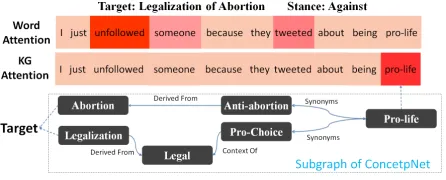
Unlike the conventional aspect sentiment classification, the main challenge of stance classification is that the target relating content may not appear explicitly in the text. Furthermore, it is difficult for models to infer the relationship between the discussed object in the text and in the target. For example, if the target and the discussed entity in the text are from opposite standpoints, the stance polarity can be inconsistent with the sentiment expressed by the text with high probability. As depicted in Figure 1, the text expresses against attitude with respect to the given target “ legaliza-tion of aborlegaliza-tion”. However, without any commonsense knowledge about the relation between “abortion” and “pro-life”, it is difficult for a pure textual feature based classifier to predict stance
polarity.
Figure 1. An example of stance classification.
Previous models for stance classification only mainly leverage the linguistic context to capture the relation between the text and the target in predicting the stance1,2.However, the commonsense knowledge beyond the context has been underutilized, which hinders the performance of current stance classification methods. To address this problem, we present a stance classification model that resembles how we human beings solve the problem: leveraging the commonsense knowledge. Such commonsense knowledge is usually not explicitly stated in the text. However, it is very critical for conducting accurate stance prediction in some cases illustrated in Figure 1.
Commonsense knowledge generally refers to the factual knowledge that might not be explicitly available in the text but structurally stored in external commonsense knowledge bases (CKBs) such as Dbpedia3, FreeBase4and ConceptNet5. It is vital for a broad range of natural language
processing (NLP) tasks such as dialogue modeling6, short text classification7, and textual
rea-soning8, to incorporate commonsense knowledge for better performance and interpretability. In previous CKB-based models, the knowledge is usually introduced incorporated by attaching the words in entities as “pseudo words” to the text sequence7or appending the entity embeddings to the word vectors on the token level8. We argue that entities in CKB and words in text are not always consistent in the same common feature space. Previous methods cannot take advantage of complementary semantics of text and CKB, and they are not suitable for knowledge-sensitive NLP tasks such as stance classification.
In order to make use of the distinct characteristics of text and CKB, we proposed a novel model based on memory network9, which separately memorizes text and commonsense knowledge in
RELATED WORK
Stance Classification:Recently, there is a growing interest in detecting the stance polarity of text on microblogs. Unlike ordinary sentence-level10,11and aspect-level12,13sentiment classification,
stance classification is a more challenging task. SemEval-2016 Task 614involves two stance
de-tection subtasks in tweets in supervised and weakly supervised settings. Augenstein et al.1used two bidirectional Recurrent Neural Network (RNN) to model both target and text for stance de-tection. However this model requires a very large unlabeled Twitter corpus in order to predict the task-relevant hashtags as an auxiliary task to initialize the word embeddings. Du et al.2proposed an RNN based model, which incorporates target-specific information into stance classification by using a new attention mechanism. Li et al.15introduced deep memory networks for stance detection (they calledattitude identification), which employs attention mechanism to capture the informative context words by leveraging external memory components. In order to mine the relationship between targets, multi-target stance detection16,17, which is more challenging, gains more increasing attention and emphasis. Unlike the existing models which attempt to predict the stance label by using only textual feature, we leverage external commonsense knowledge base to construct a commonsense knowledge memory module to improve the performance of stance classification.
Commonsense Knowledge:With rapid growth of knowledge engineering, several commonsense knowledge bases have been published, such as Dbpedia, FreeBase, ConceptNet and SenticNet. In our model, ConceptNet is used to enhance the capacity for modeling the relation between the context and target. ConceptNet is a knowledge representation project, providing a large-scale semantic graph that describes facts and human knowledge. CKBs have been widely used in var-ious NLP tasks, such as open-domain conversation generation, visual question answering and sentiment analysis. For conversation generation, there are several end-to-end conversation models levering CKB6,18, which improve the relevance and diversity of generated responses in open-domain conversations. For visual question answering, Su et al.19proposed visual knowledge memory networks to leverage self-built CKB for supporting visual question answering. For sen-timent analysis, Xu et al.20modified ordinary recall gate function in RNN to leverage CKB. For
sentiment analysis, Ma et al.21integrated integrated external CKB into RNN cell to improve the
performance on aspect sentiment classification .
OUR PROPOSED MODEL
We formalize the problem of stance classification as follows. Suppose that the text is a sequence of wordsx = {x1, x2, . . . , xn}, the goal of our model is to predict the stance polarityy ∈
{−1,0,1}(corresponding toAgainst,NoneandFavorrespectively) towards the targetz =
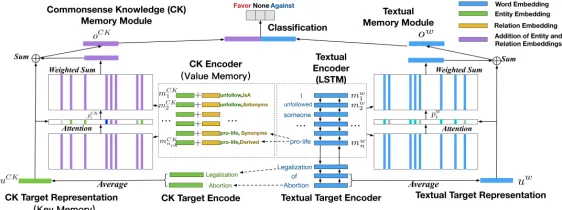
Figure 2. Architecture of Commonsense Knowledge Enhanced Memory Network.
Textual Memory Module
The textual memory module, shown in the right part in Figure 2, aims to obtain the textual mem-ory representations of the text and the target. This module is composed of three parts: textual encoder, textual target encoder, and textual output component.
Textual Encoder:LetEw ∈Rdw×|V|denote the word embedding lookup matrix initialized by
Glove or Word2vec, where|V|is the vocabulary size,dwis the dimension of word embedding. The one-hot representation of a wordxi ∈ R|V|is converted to its embedding vector byvwi =
Ewxi|. Inspired by recurrent attention on memory framework proposed by Chen et al.22, we use bidirectional recurrent networks with Long-Short Term Memory (bi-LSTM) units as the textual encoder to capture the long-term dependency from both forward and backward directions. The hidden state−→hiat stepiis used as the representation of wordi. The backward LSTM is same as forward LSTM, except that it receives the reversed sequence of words and emits the hidden state
←−
hi. The forward and backward hidden states are concatenated to construct the textual memory slot of wordibymWi =
h−→
hi,
←−
hi i
∈R2dh.
Textual Target Encoder:In order to represent the target words in the same vector space of the text, the identical bi-LSTM is applied to represent the target. Inspired by bidirectional conditional encoding method proposed by Augenstei et al1, the bi-LSTM here is initialized by the last hidden
states of the bi-LSTM in the textual encoder. The target is represented by taking the average of hidden states of the words in targetuw = 1
t Pt
j=1m
t
j, whereu w ∈
Rdhis the text memory
vector of the target,mtj = h−→
hj,
←−
hj i
is the concatenation of the forward and backward hidden states, andtis the target length.
Textual Output Component:As shown in Figure 2, for the feature vector fed into the stance classifier, its right half, i.e.,ow, is computed as the sum of the textual memory vector of the target (i.e.,uw
) and the weighted sum of the memory slots of the textow =uw+P ip
w
imwi, where the weightpw
i ofmwi is the attention score showing the importance ofxi, computed aspwi = Softmax((uw)|mw
i).
Commonsense Knowledge Memory Module
The commonsense knowledge base used in our model is consists of a large number of factual triplesf∈F. Each fact takes the form of triple like< e1, r, e2>(e.g.,(anti-abortion, synonyms,
pro-life)is a factual triple in CKB), in whiche1, e2are entities or concepts (e1isanti-abortion
ande2ispro-life) andris the relationship between the two entities (rissynonyms). The goal of
classification. Specifically, the representation of the target is treated as akey vectorfor searching the most related commonsense knowledge memory representation of the text (i.e., the value vector) by attention mechanism.
Commonsense Knowledge Encoder:We first retrieve all of entities appeared in text as input to commonsense knowledge memory module by an entity linking tool built on Concept. Extracted entities are denoted as one-hot entity vectorsxe = {xe
1, xe2, . . . , xene}, x
e i ∈ R
|E|
for the text , andze = {z1e, z
e
2, . . . , z
e te}, z
e i ∈ R
|E|
for the target, whereneandteare the number of entities mentioned in text and target. Besides the mentioned entities, the corresponding relations connecting these entities are also retrieved from CKB.
We adopt TransE23to represent entities and relations in a CKB as low-dimension vectors. For a triple< e1, r, e2 >in CKB, the goal of TransE is to minimize the distance betweene1+r
ande2in vector space, which assumese1 +r ≈ e2. LetECK ∈ RdCK×(|E|+|R|)denote the
entity and relation embedding matrix pre-trained on the whole set of ConceptNet 5.5, where|E|
is the number of CKB entities,|R|is the number of relations in CKB,dCKis the dimension of common-sense knowledge graph embedding. The one-hot representation of the extracted entity
xe i ∈R
|E|
in the text is converted into its entity vectoreibyei=ECK(xie)|. whereei∈RdCK.
Similarly, the relations connecting entitiesxe
iare convert to vectors{ri1, . . . , r|iri|}by looking up
the same embedding matrixECK. For an entityxe
i , the vectors of relations connecting to entity
xeiarer i
={r1i, r
2
i, . . . , r
|ri|
i }, r j i ∈R
dCK
, where|ri|is the number of connected relations to en-tityxCKi . The commonsense knowledge memory slots of entityx
e iare{m
CK
1 , m
CK
2 , . . . , m
CK
|ri|}
(indexiomitted) obtained by taking the sum of the entity embeddingeiand the corresponding relation vectors by
mCKj =ei+rji (1)
wherej∈1,2, . . .|ri|is the index of relations connecting to entityxci. Note that the total number of commonsense knowledge memory slots of text isPne
i |ri|.
We use the average of entity embeddingsze ={z1e, ze2, . . . , ztee}as the representation of targets
targetuCK=t1
e
Pte
j=1z
e
j, wherezjeis the entity embedding ofj-th entity mentioned in target.
Commonsense Knowledge Output Component:The additive property of TransE embedding (
e1+r≈e2) allows us to use entity embedding of target askey(query) to search the most related
facts appeared in text (value). We use a neural attention function to compute the relatedness score of entities in target and entity-relation tuples in text. The commonsense knowledge output memory representation is obtained by computing the weighted sum of commonsense knowledge memory vectors of text and target representationueby
pCKi =Softmax((u CK
)|mCKi )
oCK=uCK+X i
pCKi m CK
i (2)
wherepCKi is the attention score of commonsense knowledge facti, ando CK
is the output repre-sentation of commonsense knowledge memory module.
Stance Classifier
In order to jointly leverage the textual and commonsense knowledge representation of the text and the target, the output of both memory modules are concatenated to obtain the combined representation and then fed to stance classifier:
whereow⊕oCK ∈ RdKB+2dhis the concatenated representation of text with entities,ow ∈ R2dhandoKB ∈ RdCKare output representation representations of textual and commonsense
knowledge memory modules as depicted above,Wpis the weight of stance classifier,bpis a bias term, andp(ˆy|x, z)is the predicted probability of stance polarity. We use the cross-entropy between the predicted and ground-truth labels as the loss function of our model. All components can be trained end-to-end by minimizing the loss function.
EXPERIMENTS
Dataset and Commonsense Knowledge:Semeval-2016 Task 614released a dataset for stance classification on English tweets. IIn total, there are 4,163 tweets in this dataset, and the stance of each tweet is manually annotated as favorable or unfavorable toward on of five targetsAtheism,
Climate Change,Feminist Movement,Hillary Clinton, andLegalization of Abortion. This dataset has two subtasks, including subtask-A supervised learning and subtask-B unsupervised learning. In this evaluation, we merely work on the subtask-A, in which the targets provided in the test set can all be found in the training set.
ConceptNet is used as the commonsense knowledge base in our proposed model, which contains 1.5 million entities and 18.1 million relations. The knowledge in ConceptNet is organized as entity-relation triples. The number of retrieved knowledge triples is 17,426 (containing 8,052 entities).
Metrics:The micro average ofF1-score across targets, which is the official evaluation measure for Semeval-2016 Task 6, is adopted as the evaluation metric for stance classification. First, the
F1-score is calculated forFavorandAgainstcategories for all instances in the dataset. Then, the average ofFF avorandFAgainstis calculated as the final metric. Note that the final metric does not consider theNoneclass. By taking the average F-score for only theFavorandAgainstclasses, we treatNoneas a class that is not of interest.
ANALYSIS
[image:7.567.122.454.564.690.2]We first analyze the results on the experimental data. Then, the word attention and selected com-monsense knowledge learned by our model are visualized. Finally, we demonstrate the learned representations of text and commonsense knowledge.
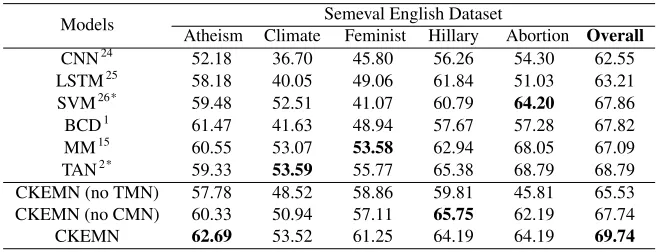
Table 1. Performance comparison on the SemEval Dataset. SVM and TAN train separate model for each target
Models Semeval English Dataset
Atheism Climate Feminist Hillary Abortion Overall
CNN24 52.18 36.70 45.80 56.26 54.30 62.55 LSTM25 58.18 40.05 49.06 61.84 51.03 63.21 SVM26* 59.48 52.51 41.07 60.79 64.20 67.86
Main Result The experimental results of the baselines and our proposed model on SemEval dataset are reported in Table 1. First, it is observed that SVM26performs better than CNN24and LSTM25, since SVM trains a separate classifier for each target. However, this training strategy is not capable of classifying stance when there is no explicit targets. BCD1, which employs condi-tional LSTM to learn a representation of the tweet considering the target, also outperforms CNN and LSTM. It is also observed that TAN2outperforms other baseline models since it has the ca-pability of capturing the target information to improve the performance of stance detection. Our model Our proposed CKEMN model outperforms all competing baseline methods significantly. This verifies that combining textual representation and commonsense knowledge base can benefit stance classification.
The variants of the proposed CKEMN model, which remove the Textual Memory Network (TMN) and the commonsense knowledge memory network (CKEMN) respectively, also show satisfactory results. It can be found that when removing the textual or commonsense memory modules, the performance drops dramatically. More importantly, it is empirically found observed that TMN has more effects on performance than CKEMN, since the textual representation is more suitable for capturing the similarity between context and target.It is also shown that the representations of the textual text and commonsense knowledge can be complementary to each other, and combining them can further improve the performance of stance classification.
[image:8.567.175.398.455.545.2]Case Study To make it more intuitive, we randomly select an example from the test set, and show the word and KG attention scores obtained by textual memory and KG memory modules respectively in Figure 3. For KG attention, the word-level attention score is obtained by taking the average of all entity-relation pairs corresponding to a word. It is observed that the word attention focuses on "unfollowed" that is a word expressing emotion of the author, but it ignores the relation between the word "pro-life" in text and the target. Unlike the word attention, KG attention fo-cuses on word "pro-life", which is more contextually related to the target in the external KG. This exemplary case indicates that the proposed KG memory module improves the performance of stance classification mainly by capturing the complementary knowledge rather than the superficial information of the language.
Figure 3. Example of attention visualization.
CONCLUSION
ACKNOWLEDGEMENTS
This work was supported by National Natural Science Foundation of China (NSFC No. U1636103, 61632011 and 61876053), Key Technologies Research and Development Program of Shenzhen (No. JSGG20170817140856618), Shenzhen Foundational Research Funding (No. 20170307150024907 and JCYJ20180507183527919).
REFERENCES
1. I. Augenstein et al., “Stance detection with bidirectional conditional encoding,”Proceedings of EMNLP, 2016, pp. 876–885.
2. J. Du et al., “Stance Classification with Target-Specific Neural Attention Networks,” Proceed-ings of IJCAI, 2017, pp. 3988–3994.
3. S. Auer et al., “Dbpedia: A nucleus for a web of open data,” The semantic webSpringer, 2007, pp. 722–735.
4. K. Bollacker et al., “Freebase: a collaboratively created graph database for structuring human knowledge,”Proceedings of the 2008 ACM SIGMOD international conference on Manage-ment of data, 2008, pp. 1247–1250.
5. R. Speer, J. Chin, and C. Havasi, “ConceptNet 5.5: An Open Multilingual Graph of General Knowledge.”Proceedings of AAAI, 2017, pp. 4444–4451.
6. T. Young et al., “Augmenting End-to-End Dialog Systems with Commonsense Knowledge,”
Proceedings of AAAI, 2018, pp. 4970–4977.
7. J. Wang et al., “Combining knowledge with deep convolutional neural networks for short text classification,”Proceedings of IJCAI, 2017, pp. 2915–2921.
8. T. Botschen, D. Sorokin, and I. Gurevych, “Frame-and Entity-Based Knowledge for Common-Sense Argumentative Reasoning,”Proceedings of the 5th Workshop on Argument Mining, 2018, pp. 90–96.
9. S. Sukhbaatar et al., “End-to-end memory networks,”Proceedings of NIPS, 2015, pp. 2440– 2448.
10. L. Gui et al., “Learning representations from heterogeneous network for sentiment classifica-tion of product reviews,”Knowledge-Based Systems, vol. 124, 2017, pp. 34–45.
11. T. Chen et al., “Improving sentiment analysis via sentence type classification using BiLSTM-CRF and CNN,”Expert Systems with Applications, vol. 72, 2017, pp. 221–230.
12. N. Majumder et al., “IARM: Inter-aspect relation modeling with memory networks in aspect-based sentiment analysis,”Proceedings of EMNLP, 2018, pp. 3402–3411.
13. H. Peng et al., “Learning multi-grained aspect target sequence for Chinese sentiment analy-sis,”Knowledge-Based Systems, vol. 148, 2018, pp. 167–176.
14. S. M. Mohammad et al., “Semeval-2016 task 6: Detecting stance in tweets,”Proceedings of the 9th Semeval, 2016, pp. 31–41.
15. C. Li, X. Guo, and Q. Mei, “Deep Memory Networks for Attitude Identification,” Proceed-ings of the 2017 WSDM, 2017, pp. 671–680.
16. P. Sobhani, D. Inkpen, and X. Zhu, “A dataset for multi-target stance detection,”Proceedings of EACL, vol. 2, 2017, pp. 551–557.
17. C. Xu et al., “Cross-Target Stance Classification with Self-Attention Networks,”Proceedings of ACL, 2018, pp. 778 – 783.
19. Z. Su et al., “Learning Visual Knowledge Memory Networks for Visual Question Answering,”
Proceedings of CVPR, 2018, pp. 7736–7745.
20. Z. Xu et al., “Incorporating loose-structured knowledge into conversation modeling via recall-gate LSTM,”Proceedings of IJCNN, 2017, pp. 3506–3513.
21. Y. Ma, H. Peng, and E. Cambria, “Targeted aspect-based sentiment analysis via embedding commonsense knowledge into an attentive LSTM,”Proceedings of AAAI, 2018, pp. 5876– 5882.
22. P. Chen et al., “Recurrent attention network on memory for aspect sentiment analysis,” Pro-ceedings of EMNLP, 2017, pp. 452–461.
23. A. Bordes et al., “Translating embeddings for modeling multi-relational data,”Proceedings of NIPS, 2013, pp. 2787–2795.
24. Y. Kim, “Convolutional neural networks for sentence classification,”Proceedings of EMNLP, 2014, pp. 1746–1751.
25. A. Graves, “Generating sequences with recurrent neural networks,”arXiv preprint arXiv:1308.0850, 2013.
26. S. M. Mohammad, P. Sobhani, and S. Kiritchenko, “Stance and sentiment in tweets,”ACM Transactions on Internet Technology, vol. 17, no. 3, 2017, p. 26.
ABOUT THE AUTHORS
Jiachen Duis a PhD student at Harbin Institute of Technology. His research interests include nat-ural language processing and sentiment analysis. Contact him at [email protected].
Lin Guiis a Marie Sklodowska-Curie Individual Fellow with the University of Warwick, U.K. He received the Ph.D. degree from the Harbin Institute of Technology, Shenzhen, China. His research interests include natural language processing, and sentiment analysis. Contact him at [email protected].
Ruifeng Xuis currently a Professor with the School of Computer Science and Technology, Harbin Institute of Technology, Shenzhen, China. He received the Ph.D. degree in computer science from The Hong Kong Polytechnic University. He has published more than 100 papers in natural language processing, sentiment analysis, and social media analysis. Ruifeng Xu is the corresponding author of this work. Contact him at [email protected].
Yunqing Xiais principal applied scientist with Search Technology Center, Microsoft, Beijing, China. He received the Ph.D. degree in computer science from Institute of Computing Technol-ogy, CAS, China. His research interests include sentiment analysis, text classification and clus-tering. Yunqing Xia is the corresponding author of this work. Yunqing Xia is the corresponding author of this work.