© 2019, IRJET | Impact Factor value: 7.211 | ISO 9001:2008 Certified Journal | Page 1494
Comparative study of 3D Printer
Pratyusha ACDS
1, Dr. Arun Chavan
21
M.E., Department of Electronics and Telecommumnication Engineering, Vidyalankar Institute of Technology,
Maharashtra, India.
2
HOD, Department of Computer Engineering, Vidyalankar Institute of Technology, Maharashtra, India.
---***---
Abstract - Additive manufacturing which is referred as 3D
printing, have the potential to vastly accelerate innovation, compress supply chains, minimize materials, minimize energy usage, and reduce waste. 3D printing technology form the basis of Z Corporation’s prototyping process. By solidifying layers of deposited powder using a liquid binder 3DP technology creates 3D physical prototypes. We can say 3D Printer is an extremely versatile and rapid process which accommodates geometry of varying complexity in different applications and supporting many types of materials. Z Corp. has developed 3D printers that operate at unpredictable speeds, extremely low costs, and within a broad range of applications. This paper describes the core technology in biological domain and its related applications. Additive manufacturing which is often referred as 3D printing, is a new way of manufacturing products and components from a digital model. A 3D printer creates components by depositing thin layers of material one after the other when and where required , using a digital blueprint until the exact component have been created. Interest in additive techniques is growing as applications have been progressing from rapid prototyping to the production of end-use products. Additive equipment can now use many different products like metals, polymers, composites, or other powders to “print” a range of functional components, layer by layer, including complex structures that cannot be manufactured by any other means. Industries including defence, aerospace, automotive, biomedical, consumer products, and metals use additive manufacturing.
Keywords—3D printing, Additive manufacturing, Nicrome wire, Structures, FDM technology
1. Introduction
In manufacturing area a new technology have proven to be very a promising and is known as rapid prototyping which is also called as additive manufacturing. This technology have been improved and have evolved into a very useful tool for many fields like researchers, manufacturers, designers, engineers and scientists. It is collaborating different fields and forms a single package.
3D printers include design, manufacturing, electronics, materials and business. 3D printing is a process of creating an object with depositing material layer by layer to form different three dimensional structures. The most important difference between traditional manufacturing and 3D printing is that the 3d printer involves additive approach and most of the traditional manufacturing processes involve
subtractive approach that includes a combination of grinding, bending, forging, moulding, cutting, gluing, welding and assembling In the beginning 3D printing was seen as a tool to shape and bring it to the artistic or different designs, but in the last few years this technology is developing to that point where the mechanical components and the required parts can be printed. It completely changed not only the industrial/manufacturing field but also our lives in future as 3D printer makes it possible to complete the entire model in a single process.
For consumer level additive manufacturing there are two main techniques to print 3D objects which are Fused Deposition Modelling and Stereo lithography. Both processes adds up the material layer by layer, to create an object. Stereo lithography (SLA) uses an Ultra-Violet light source to cure the resin while Fused Deposition Modelling (FDM) extrudes semi-liquid plastic in a required layout to create objects. The vast growth in this technology have allowed great inventions. 3D printing (mainly Fused Deposition Modelling or FDM technique) have reduced the cost of manufacturing, the build up time and weight of the object. The biggest advantage is the reduction of waste compared to some traditional manufacturing techniques.
3D printing or additive manufacturing is a technique of making a three-dimensional object of almost any shape from a 3D model or any electronic data source through additive techniques in which successive layers of material are laid down under the computer’s control.[3]
© 2019, IRJET | Impact Factor value: 7.211 | ISO 9001:2008 Certified Journal | Page 1495
1. Literature SurveyThe 1980s: Birth of the 3 main 3D Printing Techniques.
The first 3D printing attempts are granted to Dr Kodama for his development of a rapid prototyping technique in 1980. He was the first to describe a layer by layer approach for manufacturing. Over less than ten years, the three main technologies of 3D printing were patented and 3D printing was born!
The 1990s: Emergence of the Main 3D Printers Manufacturers & CAD tools
In Europe, EOS GmbH was founded and created the first EOS ―Stereos system for industrial prototyping and production applications of 3D printing. Its industrial quality is today recognized worldwide in SLS technology for plastics and metals. The 1990s were also the decade of the first application of 3D printing by medical researchers, who started to combine medicine and 3D printing, opening the path to many uses.[1]
In 2000, the millennium saw the first 3D printed working kidney. We will have to wait 13 more years to see it transplanted into a patient. 3D printed kidneys are now perfectly working and researchers are experimenting on accelerated growth to transplant organs very rapidly.
In 2008, 3D printing reached an even greater media presence thanks to another medical application: the first 3D printed prosthetic limb.
The 2010s: Years of Visibility, Innovation and Hopes for 3D Printing
The recent years have been very important for 3D Printing. With the FDM patent expiration, the first years of the decade have become the years of 3D printing.
In 2013, President Barack Obama mentioned 3D printing as a major issue for the future in his State of the Union speech, which finished to make ―3D printing an absolute buzzword. In 2010, Urbee was the first 3D printed prototype car. Its body was fully 3D printed using a very large 3D printer. In 2011, Cornell University began to build a 3D food printer. At first sight, it could seem slightly trivial, but NASA is now researching how astronauts could 3D print food for in space. In 2014, NASA brought a 3D printer in space to make the first 3D printed object of the earth.[6]
2. BASIC CONCEPTS OF 3D PRINTING
A) Terminology
1. ADDITIVE MANUFACTURING – Technology that
create objects through sequential layering.
2. RAPID PROTOTYPING – Group of techniques used to
quickly fabricate and scale model of a physical part or assemble using 3D computer aided design CAD data.
3. SUBTRACTIVE PROCESS – removal of material by
methods such as cutting or drilling.
4. STEREOLITHOGRAPHY - system for generating three
dimensional objects by creating a cross-sectional pattern of the object to be formed.
B) Methodology
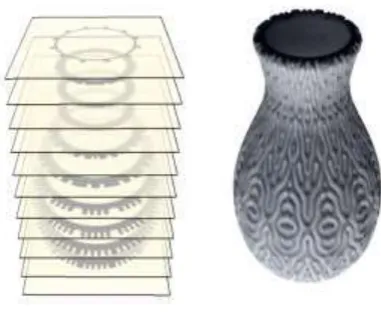
[image:2.595.332.523.371.529.2]For printing any object in 3 dimensions, firstly the object must be sliced in the direction of one of the axis and in the plane parallel to remaining two axes. Then, at each plane, the list of points associated with object is saved along with plane number. This list of points and lines is known as ‘G-code’. This G-code is different for different machines and it is dependent on the capabilities and support of particular machine.
Fig. 1. Layered image of the object
Once the machine is provided with the point list, it starts the preparations for printing. It preheats the printing head and bed as per the requirement. Once done with preparations, the printing head is moved to each point in the list and the material is dropped there with the help of the nozzel. Once all the points in a layer are done, header moves along the slicing axis for printing all the points in next sliced layer.[2]
© 2019, IRJET | Impact Factor value: 7.211 | ISO 9001:2008 Certified Journal | Page 1496
Fig .2. Flow chartC)Work division
3D printer needs 3D designs to print. These designs are made with the help of software. This software also creates a printable version of the 3D models designed. The printable formats of 3D models can be converted into machine specific G-Code by other software. The hardware comes in picture once the Code is ready. Hardware unit then reads the G-Code and follows all the points in it. Maintaining the same precision in software and hardware is a huge challenge.
Duties of Software:
1. 3D designing.
2. Converting in printable format
3. Generating G code for printing.
Duties of hardware:
1. Preparing heater and bed according to material in use.
2. Keeping precision in printing.
3. Working with fastest possible speed with accuracy.
D)The software
1. Using one software we can do 3D – designing of objects and then covert it into printable format. 2. This is considered as step 1 in software
development.
3. Using software which is compatible we make the G- code for that particular printable format.
4. This is considered as the step 2 in software development.
E)The hardware
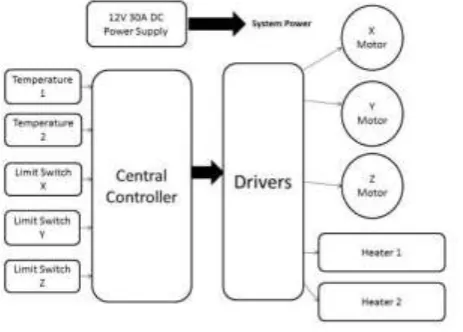
The hardware consists of central controller for handling all the events and driving different parts of printer. The printer has following electrically moving parts and sensors
1. 3 Stepper motors, 1 for each axis. 2. A printing head
3. A filament roll and feeder 4. Printing bed with heating facility. 5. Temperature Sensor
6. Limit switches
Stepper motors are used to move the header in the direction of the particular axis. Stepper motors are used for fine precision. Printing head is the actual printing part having a heater. The printing head heats up and extrudes the material provided by feeder. Feeder assembly continuously takes the printing material from its roll and feeds it to the printing head. Temperature sensors are used for PID controller to control the temperature of bed and printing head. Limit switches are implemented for detection of extreme point in any direction. It is of most importance as when the printer starts up, the position of head may be different than home. Hence we need limit switches to bring it back to home[5].
Hardware unit also consist of drivers required to drive the motors and heaters. Drivers are required as actuators and heaters consume a lot of power and need higher current and voltages that microcontroller cannot handle.
F)Important components and explanation
Hardware part also have a 12V 30A DC power supply for powering up the heaters and motors. Power supply is SMPS and isolated type.
Central Controller - Central controller is the brain of the system. It controls all the actions. The Sensors provide information about current status of the system and the work to be done is provided through the serial interface. It is hardcoded to perform a specific set of operations for the specific commands and sensor conditions. It also drives a LCD display to display the system working point and status.
For our system we are using 16F877A microcontroller from Microchip to drive the system. It is chosen for following features it provides,
• In built 10 bit precision ADC
• In built USART
• Two 16 bit timers
• CMOS outputs
• High speed operations at low cost
• Robust
• Easy market availability
• Cheaper solution
X, Y and Z motor Drivers - The motor drivers are used for
© 2019, IRJET | Impact Factor value: 7.211 | ISO 9001:2008 Certified Journal | Page 1497
circuit cannot provide this current, we need drivers. X Y andZ motors are used to drive the system in these directions precisely. The Speed of the motors can be controlled by using the PWM signal to the driver, and direction can be changed just by inverting the direction pin. The 3pin_header provided for it is having A PWM pin, A Direction pin and A Common Ground pin.[4]
The X Y and Z Limit - Sensors Limit sensors are the limit switches attached to the ends of the axis to indicate the end of the printing area. They cut the power supply to the motors and also indicate to the central controller that the printing header is reached at the extremity. It is just a switch pressed when header reaches at end, and released when header moves in again.
Heater Drivers - Heater Drivers are used to drive heaters in plate and extruder. The Nicrome wire is used as the resistive heating element. The heating temperature is controlled by using the PWM from the central controller while the heating current is provided by the heater drivers. The heater in the base plate is use to keep the base warm for best results and extruder heater is used to melt the filament.
Temperature Sensors - The temperature sensors are used to
detect the current temperature value. The central controller adjusts the PWM signal according to these values. The sensor used to extruder and plate are RTD PT500 sensors as the temperatures in this portions are going above 200 degree Celsius. The sensor employed at the circuit is a LM35 sensor used to detect any extra heating component in the circuit to avoid any accidents.
Filament Detector - This sensor is used to detect if the filament is available or not. This sensor plays very important role to avoid overheating of the header and also saves the energy by cutting off the heating when the filament is not available.
The PC interface - The PC interface is the source of information to the system. The commands and directions are provided by the PC software to the system. The system is connected with the computer via serial RS232 interface at the baud rate of 115200 bits per seconds. This speed is required as system needs to know the next point of operation in the 3d space. The communication from the computer to the system follows a specific sequence to avoid loss of data or the invalid commands. The printer hardware does not have memory. Hence the PC software needs to be connected to the system continuously to print. This is a disadvantage over the existing systems, but it is very effective to reduce the cost and overall complexity of the system hardware.
3. PROBLEM DEFINITION AND PROPOSED WORK
1) PROBLEM DEFINITION –To develop a 3D printer in an
affordable budget with high precision which has its
application in biomedical field to prints organs such as tooth, bone and such smaller objects.
2) PROPOSED WORK - 3D printer is a very innovative
technology to print any object in 3 Dimentional format. Nowadays, 3D printing is used in every field such as educational, smart phone, space manufacturing and artificial jewellery. Apart from this it is widely used in medical field for printing many parts of the body such as tooth, bone and etc using plastic as a material with moderate complexity and very good finishing taking medical applications to a very next level.
In the proposed work, we will be using 16F877A microcontroller as the central controller which will be controlling all the actions and it will be the brain of the system. It will be connected series interface with sensors and other components. It will also drive the LCD display.
To drive high power motors, we will connect them to motor drivers. The driving power is consumed directly from the source while the control is provided from this interface to the stepper motors.
Limit sensors are used as the limit switches to indicate the end of the printing area. We also use the filament detector sensor to detect if filament is available or not. NICROME wire is used as the resistive heating element.
Temperature sensors are used to detect the current temperature value.
Finally, PC interface is the source of information to the system. The commands and direction are provided by the PC software to the system. The system will be connected with the computer via serial RS232 interface at the band rate of 115200 bits per second.
[image:4.595.318.550.578.744.2]Hardware part also have a 12V 30A DC power supply for powering up the heaters and motors. Power supply is SMPS and isolated type.
© 2019, IRJET | Impact Factor value: 7.211 | ISO 9001:2008 Certified Journal | Page 1498
4. CONCLUSIONAs 3D printer is a very useful device it should be analysed with the advantages, disadvantages and how the device can change the society and engineering etc in mind. The nature of 3D printer is creating a part layer by layer, instead of subtractive methods of manufacturing lead themselves to lower the cost in raw material. Instead of starting the printer with a big chunk of plastic and carving away the surface in order to produce the product. Additive manufacturing only "prints" what is required and where it is required. 3D printing is the ultimate just-in-time method of manufacturing. Just have a 3D printer which is waiting to print your order. Additive manufacturing takes your design to a whole new level because undercuts, complex geometry and thin walled parts are very difficult to manufacture using traditional methods. In addition, the mathematics behind 3D printing is simpler than subtractive methods. This mathematical difference is hard to explain but it is the fundamental reason why 3D printing is superior to all other manufacturing techniques. It always better to keep things simple and additive manufacturing is simple by its nature. With so many potential benefits of 3D printing, there is no surprise that this method is making its way in industries and quickly becoming a very favourite tool of progressive marketers. Comparing the numerous advantages, applications and future scope, we can conclude that 3D printer and its technology are able to create a next industrial revolution.
5. REFERENCES
[1] Dipayan Dey, Souvik Mondal2,Arijit Kumar Barik "3-Axis CNC Router Modifiable to 3D Printer" International Journal of Innovative Research in Science, Engineering and Technology Vol. 5, Issue 9, September 2016
[2] Siddharth Bhandari,B Regina "International Journal of Computer Science and Information Technology Research" Vol. 2, Issue 2, pp: (378-380), Month: April-June 2014
[3] Medhavi Kamran, Abhishek Saxena “A Comprehensive study on 3D printing technology, MIT International journal of mechanical engineering, Vol. 6, No.2, August 2016
[4] Charlie Wapner, “Toward a more printed union library 3D printing democratizes creation, December 2015.
[5] Bob Hayward, David Moschella, Jon Schreiber, Simon Wardley, Howard Smith, “3D printing and the future of manufacturing” CSE, the rise of 3D printing.