LEAF DISEASE DETECTING USING CNN TECHNIQUE
**Prof Ramya C N, *Naveen G C, *Aiswariya Dev S, *Sucharitha N N,
*Department of Electronics and Communication Engineering, Atria Institute of Technology, Bengaluru,
India
**Asst Professor, Department of Electronics and Communication Engineering, Atria Institute of
Technology, Bengaluru, India
---***---
Abstract--Identification of plant disease is very difficult in agriculture field. If identification is incorrect then there is a huge loss on the production of crop and economical value of market. Leaf disease detection requires huge amount of work, knowledge in the plant diseases, and require the more processing time. Therefore, we can use image processing for identification of leaf disease in MAT LAB. Identification of disease follows the steps like loading the image, contrast enhancement, converting RGB to HSI, extracting of features and SVM. We have proposed system has used to design and implementation Digital image processing techniques for detecting, quantifying and classifying plant diseases using SVM and KNN with ANN Algorithm the K-means clustering technique for the segmentation purpose and Artificial Convolution Neural Network (CNN) technique for the classification of the mango, pomegranate ,guava, sapota leaf disease. The system as been tested with the different numbers of test data set collected from different regions. This system has tested for different numbers of clusters to get the optimal number of cluster that can produce the best performance of the proposed leaf disease identification and control prediction system. This proposed system has overcome the problem of identification of mango leaf disease manually.
Key words---K-Means Clustering, ANN Convolution method, Leaf Disease
1.INTRODUCTION
Digital image process is the use of computer algorithms to perform image process on digital pictures. It permits a far wider vary of algorithms to be applied to the computer file and might avoid issues like the build-up of noise and signal distortion throughout process. Digital image process has terribly important role in agriculture field. It is widely accustomed observe the crop disease with high accuracy. Detection and recognition of diseases in plants mistreatment digital image method is extremely effective in providing symptoms of characteristic diseases at its early stages. Plant pathologists will analyze the digital pictures mistreatment digital image process for diagnosing of crop diseases. Computer Systems area unit developed for agricultural applications, like detection of leaf diseases, fruits diseases etc. altogether these techniques, digital pictures are collected employing a camera and image process techniques are applied on these pictures to extract valuable data that are essential for analysis. The diseases are mostly on leaves and on stem of plant. They are Potassium, Magnesium, Calcium, Zinc, or iron deficiencies
due to insects, rust, nematodes etc. on plant. It is important task for farmers to find out these deficiencies as early as possible. Following example shows that how deficiencies on plant Leafs reduces the productivity from Image processing techniques is been used to detect on mango, pomegranate, guava, sapota etc.
2.LITERATUREREVIEW
the images suitable for the next steps. Then important features are extracted from the image and used as an input for the classier (Al-Hiary et al. 2011). The overall classification accuracy is therefore dependent on the type of image processing and feature extraction techniques used. However, latest studies have shown that state of the art performance can be achieved with networks trained using generic data. CNNs are multi-layer supervised networks which can learn features automatically from datasets. For the last few years, CNN’s have achieved state-of-the-art performance in almost all important classification tasks. It can perform both feature extraction and classification under the same architecture (Atabay 2016b). [5] Xu et al. (2011) proposed a method to detect nitrogen and potassium deficiencies in tomato plants. The algorithm begins extracting a number of features from the color image. The color features are all based on the b* component of the L*a*b* color space. The texture features are extracted using three different methods: difference operators, Fourier transform and Wavelet packet decomposition.[6] in this paper S.jeyalakshmi and R. Radha Explains Plants and crops require 13 essential mineral nutrients to grow and survive. They acquire these nutrients from the soil. Deficiency of these nutrients affects the growth and quality of the plant/crop. Thus, diagnosing nutrient status of minerals plays a crucial role in agriculture and farming. Nutrient deficiency symptoms in plants/crops would normally be visible in leaves. These symptoms include interveinal chlorosis, marginal chlorosis, uniform chlorosis, necrosis, distorted edges, reduction in size of the leaf etc[7] Sjadojevic et al. have presented the concept of deep convolution neural network (CNN) and fine tuning for the identification of plant leaf diseases. Authors have considered thirteen different types of dataset images with healthy leaf images for the experimentation. Deep learning based Caffe framework as been used along with the set of weights learned on a very large dataset by authors. The core of framework developed in C++ and provides command line, Python, and MAT LAB interfaces. Authors have used the 10- fold cross validation test for the accuracy assessment. The overall results shows the accuracy of 96 % and precision value lie between 91 % to 96 %.Fine-tuning has not shown significant changes in the overall accuracy, but augmentation process had greater influence to achieve respectable results.[8] Mohanty et al. have used the concept of deep convolutional neural network for the analysis of plant leaf diseases. Authors have used the Plant Village dataset having 38 classes based 54, 306 images for the experimentation. This dataset consists of 14 crop species and 26 types of disease-affected plants. Deep learning based architecture of Alex Net and Google Net have been considered. Training mechanism of transfer learning and training from scratch approaches had been using. Testing has also performed with different ration aspect of training and testing. Authors have shown the accuracy of 99.35 % for the disease analysis. However, there were some limitations with the concept. Approach is limited to applied dataset and presented approach is not able to detect the leaf diseases if the leaf side changed apart from the front area.
3.PROBLEMIDENTIFICATION
By a detail study of literature, we have identified the following problems:
The leaf disease as identified manually. In this technique, a man who has the information of the plant leaf as been called for examination for the diseased plant then the leaf diseases will be distinguish by the learning and that individual advises experience of that individual and the control. This all procedure happens physically so the time it now, prolonged and has a great deal of shots of being misguided judgment of right leaf diseases identification proof.
Until now, the various automated systems have been developed for the cotton, grape, banana, bamboo, rice, herb leaf diseases but there is not any system that can automatically detect leaf diseases, so this proposed work will provide an automated system, which will be able to identify leaf deficiencies and predict the appropriate control for the leaf disease.
4.PROPOSEDSYSTEMANDEXPLANATION
The proposed method for the identification and control prediction of mango, pomegranate, guava, sapota leaf deficiencies is composed of image processing using convolution neural network techniques. The framework of proposed approach are made for detection of deficiencies, two image databases are required, one for training purpose and other for testing. In addition, for deficiencies detection, Image preprocessing is required for enhancing images. The next step is image segmentation is required; otherwise, the feature of non-infected region will dominate over the feature of infected region. After segmentation, feature extraction done from segmented image and finally the training and classification are performed. Each step of proposed system is discussed in this section The block diagram of proposed mango, pomegranate, guava, sapota leaf disease identification and control prediction algorithm is shown in block diagram
This method utilizes the techniques of image processing and neural network in a composite manner to obtain the desired goal. The proposed leaf deficiencies identification and control prediction algorithm consist of the following steps:
Step 1: Image Acquisition
The camera is vertically oriented and approximately a distance of 0.5-meter distance to be maintained while capturing the images. Image quality is definitive for the after effects of investigation, influencing both the ability to detect features under examination and accuracy of consequent estimations. Image enhancement techniques are used to emphasize features of interest and highlight certain details hidden in the image. To improve the quality of the image, preprocessing steps are applied over the image. MAT LAB version is used for implementation of the digital image processing algorithms. Mango, pomegranate, guava, sapota leaf images are captured from different regions by using digital mobile camera, are used for training and testing the system then the background data are removed and stored in standard jpg format.
Step 2: Image Pre-Processing
Preprocessing of the image includes shade correction, removing artifacts, and formatting. Some images, originally from camera, manifest uneven lighting called shade. Due to variation in outdoor lightning conditions, some regions are brighter and some others are darker than the mean value for the whole image. This phenomenon is a consequence of inaccuracy in the system. Precise tuning of camera is done to minimize this effect. The images contain some artifacts induced like scratches, coat, or mark, lumps of dust or abrasive particles. Hence, median filter and infielder is been used to remove such artifacts. Formatting deals with storage representation and setting the attributes of the image. The images acquired from the camera are of 1920 x 1080 pixels and reduced to suitable size for the reasons of reducing computational time required for feature extraction and their storage on the medium. Image pre-processing includes the following three modules:
Cropping leaf image.
Resize.
Median filter.
Step 3: Image Conversion
The image conversion includes the following types of conversion for different purposes:
RGB to gray.
Gray to binary.
RGB to L*a*b* color shape.
Step 4: Segmentation
Image segmentation used to serrate the distinct parts with some information in the image. K means clustering method used for the proposed method.
K Means Segmentation
K-Means clustering algorithm classifies the input data points into many number of classes based on clusters inherent distances. The algorithm assigns that data features to create a vector space for clustering. These data points have clustered around centroids.
∑ ∑ ( )
Where k is number of clusters Si, I = 1, 2,…k and µi is the mean or centroids of all points
Algorithm Steps:
1. Computing the histogram based on the intensities. 2. Initialize the centroids with k random intensities. 3. Perform the steps until the cluster labels of the
images reaches constant.
4. Clustering is done based on distance from the intensities of centroids to the cluster intensities from the c
| |
5. New centroids of each cluster is computed
∑
∑
Where k is the number of clusters to be found, I number of iterations, k-means clustering is performed to split the image into three clusters. In these three clusters, one or two clusters resemble the diseases, which will give the segmentation. To extract the ROI in diseased mango leaf the K-means clustering algorithm is used. This algorithm clusters the point nearest to the centroids. The centroids is basically the average of all the points in that cluster and has coordinate as the arithmetic mean over all points in the cluster, separately for each dimension.
Step 5: Feature Extraction
A pattern can denote a quantitative or morphological description of an object or some other point of interest in an image, in which some organization of underlying structure can be supposed to live. In other words, a pattern is an arrangement of descriptors. Descriptors are also called features in pattern recognition literature. Only significant features are extracted from the processed image. This is where the features reduction method is adopted. In the present work, feature extraction employs color features based on RGB, HSI color models, texture features based on GLCM
1) Area: The actual number of pixels in the region of interest.
2) Orientation: The angle θ (in degrees ranging from -90
to 90 degrees) between the x-axis and the major axis of the ellipse that has the same second- moments as the region
√
3) EquivDiameter: It specifies the diameter of a circle with the same area as the region. Computed as:
4) Extent: It specifies the ratio of pixels in the region to pixels in the total bounding box. Computed as:
rea of OI (3)
5) Solidity: It specifies the proportion of the pixels in the convex hull that are also in the region and computed as:
Solidity= rea (4)
6) Convex Area: It specifies the number of pixels in 'Convex Image'.
7) Major Axis Length: It specifies the length (in pixels) of the major axis of the ellipse that has the same normalized second central moments as the region.
8) Number of Objects: It is the number of white pixels, which are disconnected to each other in binary image. Color feature extraction
Color feature extraction
One of the primary facets of color feature extraction is the selection of a color space. A color space is a multidimensional space, in which different dimensions represent different constituents of the color. Most color spaces are three-dimensional. An instance of a color space is RGB, which attributes to each pixel a three element vector, giving the color intensities of the three primary colors, namely, red (R), green (G), and blue (B). The space covered by the R, G, and B values completely describes visible colors, which are entitled as vectors in the 3D RGB color space. Therefore, the RGB color space offers a useful starting point for representing color features of the images the following method is adopted in the extraction of RGB features. The foremost step is the separation of RGB components from the original color images. The next step is the computation of mean, standard deviation, variance, and range from the separated RGB components using the following Equations
∑
Where,
N is the total number of panels, Xi is the ith pixel value
⁄ ∑ √
Maximum element and minimum elements from given input color (RGB) image is calculated using Equation (3).
max1=max (image), max2=max (max1) (4)
The above function returns the row vector containing maximum element from each column, similarly find minimum element from whole matrix using Equation (2) to (4)
min1=min (image),min2=min(min1) (5)
Range is the difference between the maximum and minimum elements and is given in the Equation (2) to (6). Range=max2-min2 (6)
When humans see a color object, the object is depicted by its hue (H), saturation (S), and brightness or intensity (I). Hue is a good descriptor of a pure color (pure yellow, orange or red), whereas saturation refers to the amount of pure color mixed with white light. The chromatic notion of intensity (gray level) which describes brightness is the most useful descriptor of monochromatic images. The intensity component is easily quantifiable and interpretable. The HSI color model separates the intensity component from the color carrying information (hue and saturation) in a color image. Therefore, the HSI model is an absolute aid for developing image processing algorithms based on color descriptions that are natural and instinctive to humans, who, after all, are the developers and users of these algorithms. The hue, saturation, and intensity components are extracted from the RGB components RGB color space can be transformed to HSI color space using the Equations (7) to (10).
Color feature reduction
It is found through experimentation that only eight color features, which are common in all the sample images, are significant. Hence, these eight features contribute more to the classification of plant diseases. Therefore, eight features have been considered as first-level feature reduction. The reduction is done based on threshold and delta value. Any feature values below the threshold are discarded. The threshold is chosen based on average of minimum feature value and maximum feature value. The threshold value is empirically determined as 0.2. Delta is the minimum difference between two feature values and is empirically determined as 10-3 .The procedure involved in color feature reduction is given in the Algorithm 1
Algorithm1: Color feature reduction Input: color (RGB) image.
Output: Reduced color feature vector. Se
Step 1: Separate the RGB components from the original 24-bit input color image
Step 2: obtain the HIS components using the Equation (7), (8),(9) and (10)
Step 3: Compute mean, variance, and range for each RGB and HIS components using the Equation (1) through (6) Step 4: Threshold= (minimum feature value +maximum feature value)/2
Step 5: Initialize feature vector to zeros
Step 6: For(i = 1 to size of the feature vector) if (value of feature(i)>threshold) Select as reduced feature
Step 7: For (i= 1 to size of the reduced feature vector) Compare each feature with the other if (feature values are equal OR feature values differ by data) Discard the feature Else Select as reduced color feature Stop.
Texture feature extraction
For texture features based on spatial domain analysis, one way to describe the descriptor is using a second order statistics of pairs of intensity values of pixels in an image using co-occurrence matrix method [89]. The co-occurrence matrix method of texture description is developed using spatial gray level dependence matrices (SGDMS), which is based on repeated occurrence of some gray level configuration in the texture. This configuration varies rapidly with distance in fine texture and slowly with coarse textures. The GLCM Pφ, d (i, j) represents a matrix of relative frequencies describing how frequency pair of gray levels (i, j) appear in the window separated by a given distance d= (dx, dy) at an angle ‘φ’ [105]. Gray level co- occurrence matrices (GLCMs) method counts how often pairs of gray level of pixels separated by certain distance and oriented in a certain direction, while scanning the image from left-to-right and top-to- bottom. In the present work, a distance of 1 (d=1) when ‘φ’ is 0° or Equations (11) to (16) are used to evaluate the textural features
∑ ∑ (11) ∑ (12)
∑ ∑
(13)
Maximum Probability =max (P(x, y)) (14)
∑ ∑ (15)
The differentiation between sample images is carried out in the simplest way, quantifying average gray levels within the matrix, change in the gray level with respect to average level of minimum and maximum gray levels present in the matrix. Hence, basic co-occurrence features, namely, mean, variance, and range has been considered using the Equations (1) to (6).
Texture feature reduction
It is found through experimentation that only five texture features, which are common in all the sample images, are significant. Hence, these five features contribute more to the classification of plant diseases. Therefore, five
features have been considered as first-level feature reduction. The reduction is done based on threshold and delta value. Any feature values below threshold are discarded. The threshold is chosen based on average of minimum feature value and maximum feature value. The threshold value is empirically determined as 100. Delta is the minimum difference between two feature values and is empirically determined as 10-3 [8].The procedure involved in texture feature reduction is given in the Algorithm 2 Algorithm 2: Texture feature reduction
Input: Color (RGB) image.
Output: Reduced texture feature vector
Description: Pφ, d (x, y) means GLCM matrices in the direction (φ=00, 450, 900, and 1350) and‘d’ is the distance. Delta is the minimum difference between two features and is set to 10-3. Threshold is the average of minimum and maximum feature value and is set to 100.
Start
Step 1: For all the separated RGB components, derive the co- occurrence matrices Pφ, d (i, j) in four directions 00, 450, 900, and 1350 and d=1
Step 2: Compute mean, variance, and range for each RGB components using the Equations (1) through (6)
Step 3: Threshold = (minimum feature value + maximum feature value)/2
Step 4: Initialize feature vector to zeros
Step 5: For (i =1 to size of the feature vector) If (value of feature (i) >threshold) Select as reduced feature
Step 6: For (i=1 to size of the reduced feature vector) Compare each feature with the other If (feature values are equal OR feature values differ by delta)
Discard the feature Else
Select as reduced texture feature Stop.
Step 6: Classification
study has adopted artificial neural network based classifiers using CNN classifiers in the recognition of images of plant disease and studied their behavior in terms of suitability of classifiers for identification of different plant diseases.
Step 7: Disease Identification and Control Prediction the CNN assigns an appropriate mango leaf disease class i.e. Potassium, magnesium, calcium, and zinc or iron leaf spot. Then it appropriate control prediction for the bacterial leaf spot or red rust gives by the system automatically. The process of recognition and classification is given in the Algorithm 3.
Percentage = correctly recognized sample images Accuracy (%) total number of test sample images x100
Algorithm 3: Recognition and classification of plant diseases affecting agriculture/horticulture crops
Input: Colour (RGB) images of plant diseases affecting agriculture/ horticulture crops.
Output: Recognized and classified images. Start
Step 1: apply color, texture feature extraction input color image, obtain color, and texture features
Step 2: apply color and texture feature reduction Algorithms 1 and 2 to color, texture features, and obtain reduced color and texture feature vector
Step 3: Train the SVM and CNN with reduced color and texture feature vector
Step 4: Accept test images and repeat Steps 1 and 2
Step 5: Recognize and classify the images using SVM and CNN Stop.
II. SYSTEMREQUIREMENTSPECIFICATIONS 1. Operating System: Window
2. Software: MAT LAB
3. Programming language: Embedded C
III. HARDWARE REQUIREMENTS SPECIFICATIONS
1. Main processor: Intel i7 Core 2. Hard Disk Capacity: 1 TB 3. Cache memory: 500 MB
5.EXPERIMENTALRESULTS
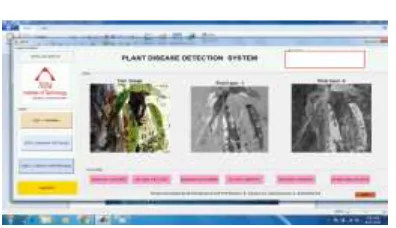
The experimental environment is worked on a 2.23 GHz Intel(R) Core(TM) i7 CPU M730 with 4 GB of RAM PC. By using computer simulation, “M TL B we are performaning the leaf deficiencies identification
SVM based Pixel classifier
A support vector machine (SVM) is used to recognize plant disease affecting agriculture/horticulture crops. The study has chosen SVM because of its efficient
[image:6.595.327.530.286.367.2]implementations and performances proved to be excellent for high dimensional problems and small data sets. Viewing training input vector in an n-dimensional space, SVM constructs a hyper-plane in the space, which can be used for classification that has the highest distance to the closest training data point of any class (functional margin). To compute the margin, two parallel hyper- planes are constructed, one on every side of the isolating hyper-plane, which are pushed up in opposition to the two data sets. The aim is to determine which class a new data point belongs based on data points associated to one of the two classes. In the case of support vector machines, a data point is computed as a p-dimensional vector (a list of p numbers) and it is meant to know whether such levels can be forked by a (p−1) dimensional hyper-plane. This is called a linear classifier or maximum margin.
Figure 1.1 shows the different Hyperplane K-NN Deficiency Classifier
Fig. K-Means segmentation of RBG image
[image:7.595.69.276.306.444.2]K-means clustering is simple and computationally faster than other clustering techniques and it works for large number of variables. However, it produces different cluster result for different number of number of cluster and different initial centroids values. So it is required to initialize the proper number of number of cluster k and proper initial centroids
Fig 1.2 K-Means segmentation of hue image CNN based classifier
The study has considered CNN as a model to identify plant disease symptoms affecting agriculture/horticulture crops. Leaf diseases image database is created by acquiring images under challenging conditions such as illumination, size, pose and orientation, using a Mobile camera of resolution 4608 x 3456. It consists of 1200 images of both diseased and healthy leaves. The diseases include Potassium, Magnesium leaf spot, leaf gall, leaf Webber, leaf burn of plant. In order to reduce the computational time complexity, the images are resized from the size 4608 x 3456 to 256 x 256. The proposed CNN architecture consists of an image input layer followed by three hidden layers and then the output layer. The layer implementation is represented in Table 1.
TABLE I. LAYER IMPLEMENTATION OF THE CNN MODEL
Figure 2.4. Leaf image cropping and resize example. (a) Input image,
(b) Cropping image, (c) 229 × 229 image.
The leaf images of size 256 x 256 x 3 are given as input to the input layer. Data augmentation is performed in order to increase the dataset by generating artificial data. The images are then passed through the hidden layers. Each hidden layer consists of a convolutional layer, batch normalization layer, Rectified Linear Unit followed by the max pooling layer. Feature extraction is performed using convolutional and pooling layers, whereas classification is per- formed by the fully connected layer. Each convolutional layer and pooling layer consists of different number of filters, of varying size. The three convolution layers consists of 32, 64, 128 filters of size 11x11, 7x7, 5x5 respectively with stride 2 and padding. The batch normalization layer and the ReLU layer increase the training process and network performance. The three max pooling layers consists of 5x5, 3x3 and 3x3 filters respectively with stride 1 and padding, P=1 for maxpooling layer 1 and P=0 for maxpooling layers 2 and 3. Then 50% dropout is employed to deactivate the least learned features. The features learnt by the convolutional and pooling layers are then classified by using two fully connected layers of size 64 and 6 respectively. The size of the second fully connected layer is equal to the number of classes. It specifies the probability distribution for each class. Steepest Gra dient Descent algorithm is used to train the proposed
CONCLUSION
. The proposed CNN based leaves disease identification model is capable of classifying four different deficiencies in leaves from the healthy one. Since CNN does not require any tedious preprocessing of input images and hand designed features, faster convergence rate and good training performance, it is preferred for many applications rather than the conventional algorithms. The classification accuracy can be further increased by providing more images in the dataset and tuning the parameters of the CNN model.
Result
REFERENCES
[1] Youssef Es-saady, Ismail El Massi, Mostafa El Yassa,
Driss Mammass and Abdeslam Benazoun, “ utomatic recognition of plant leaves diseases based on serial combination of two SVM classifiers” 2nd International Conference on Electrical and Information Technologies(ICEIT), IEEE, 2016.
[2] Sanjeev S. Sannakki, Vijay S Rajpurohit, V. B. Nargund
and PallaviKulkarni, “Diagnosis and Classification of Grape Leaf Diseases using Neural Networks”, International Conference on Computing Communications and Networking Technologies IEEE, 2013.
[3] Lumb, Manisha, and Poonam Sethi, Texture Feature
Extraction of RGB, HSV, YIQ and Dithered Images using GLCM, Wavelet Decomposition Techniques, International Journal of Computer Applications, 68 (11), 2013
[4] Atabay, H. A. 2016b. A convolutional neural network
with a new architecture applied on leaf classification. IIOAB J 7(5):226–331.
[5] Xu G, Zhang F, Shah SG, Ye Y, Mao H. Use of leaf color
images to identify nitrogen and potassium deficient tomatoes. Pattern Recognit Lett. 2011;32(11):1584– 1590. doi: 10.1016/j.patrec.2011.04.020.
[6] A review on diagnosis of nutrient deficiency symptoms
in plant leaf image using image processing by S.jeylakshmi and R. radha ICTACT journal on image and video processing,May 2017, volume:07, issue:04 ISSN: 0976-9102,DOI: 1021917/ijivp.2017.0216.
[7] Sladojevic, Srdjan, Marko Arsenovic, AndrasAnderla,
DubravkoCulibrk, and DarkoStefanovic. "Deep Neural Networks Based Recognition of Plant Diseases by Leaf Image Classification." Computational Intelligence and Neuroscience 2016 (2016).
[8] Mohanty, Sharada P., David P. Hughes, and Marcel
Salathé. "Using Deep Learning for Image-Based Plant Disease Detection." Frontiers in Plant Science 7 (2016)
[9] Leaves Classification Using SVM and Neural Network
for Disease Detection by Bhushan R. Adsule, Jaya M.
Bhattad vol 3, issue 6, june 2015 ISSN:2320-9801,DOI: 10.15680.
[10] Davoud Ashourloo, Hossein Aghighi, Ali Akbar Matkan,
Mohammad eza Mobasheri and mir Moeini ad, “ n Investigation Into Machine Learning Regression Techniques for the Leaf Rust Disease Detection Using Hyperspectral Measurement” IEEE Journal Of Selected Topics In Applied Earth Observations And Remote Sensing, pp.1-7, May 26, 2016.
[11] Youssef Es-saady, Ismail El Massi, Mostafa El Yassa,
Driss Mammass and bdeslam Benazoun, “ utomatic recognition of plant leaves diseases based on serial combination of two SVM classifiers” 2nd International Conference on Electrical and Information Technologies(ICEIT), IEEE, 2016.
[12] Sonali Dash, K.Chiranjeevi, Dr.U.R.Jena and
akula.Trinadh, “Comparative study of image texture classification technique”,International Conference on Electrical, Electronics, Signals, Communication and Optimization IEEE, 2015.
[13] Barbedo, G.C.A. (2013) Digital image processing
techniques for detecting quantifying and classifying plant diseases, Springer Plus, 2:660.
[14] Carmago, A. and Smith, J.S. (2009) Image pattern
classification for the identification of disease causing agents in plants, Computers and Electronics in Agriculture, 66(2009), p. 121-125.
[15] Chaerle, L., Lenk, S., Hagenbeek, D., Buschmann, C., Van
Der Straeten, D. (2007) Multicolor fluorescence imaging for early detection of the hypersensitive reaction to tobacco mosaic virus, Journal of Plant Physiology, 164(3), p. 253-262.
[16] Kulkarni, A. and Patil, A. (2012) Applying image
processing technique to detect plant diseases, International Journal of Modern Engineering Research, 2(5), p. 3361-3364.
[17] Lopez, M.M., Bertolini, E., Olmos, A., Caruso, P., Gorris,
M.T., Llop, P., Penyalver, R., Cambra, M. (2003) Innovative tools for detection of plant pathogenic viruses and bacteria, International Microbiology, 6, p. 233-243.
[18] Purcell, D.E., O’ Shea, M.G., Johnson, . ., Kokot, S.
(2009) Near infrared spectroscopy for the prediction of disease rating for Fiji leaf gall in sugarcane clones, Applied Spectroscopy, 63(4), p. 450-457.
[19] Sankaran, S., Mishra, A., Eshani, R. and Davis, C. (2010)
A review of advanced techniques for detecting plant diseases. Computers and Electronics in Agriculture, 72.
[20] Schaad, N.W. and Frederick, R.D. (2002) Real time PCR
and its application for rapid plant disease diagnostics, Canadian Journal of Plant Pathology, 24(3), p.250-258.
[21] Spathis, C., Georgakopoulou, K., Petrellis, N. and Birbas,
A. (2014) Integrated microelectronic capacitive readout subsystem for lab-on-a-chip applications, IOP Measurement Science and Technology, 25, 055702.
[22] Arivazhagan, S., R. NewlinShebiah, S. Ananthi, and S.
Vishnu Varthini. "Detection of unhealthy region of plant leaves and classification of plant leaf diseases using texture features." Agricultural Engineering International: CIGR Journal 15, no. 1 (2013): 211-217.
[23] Kranz, J. "Measuring plant disease." In Experimental
techniques in plant disease epidemiology, ISSN no. 978-3-642-95534-1, page no. 35-50. Springer Berlin Heidelberg, 1988.
[24] James, W. Clive. "Assessment of plant diseases and
losses." Annual Review of Phytopathology Vol. 12, issue no. 1, page no. 27-48, 1974.
[25] Khirade, Sachin D., and A. B. Patil. "Plant Disease