warwick.ac.uk/lib-publications
Original citation:
Hümmerich, Stefan, Gröbel, Rainer, Hambsch, Franz-Josef, Dubois, Franky, Ashley, Richard,
Gaensicke, B. T. (Boris T.), Vanaverbeke, Siegfried, Bernhard, Klaus and Wils, Patrick. (2017)
NSV 1907 - a new eclipsing, nova-like cataclysmic variable. New Astronomy, 50 . pp. 30-36.
Permanent WRAP URL:
http://wrap.warwick.ac.uk/86783
Copyright and reuse:
The Warwick Research Archive Portal (WRAP) makes this work by researchers of the
University of Warwick available open access under the following conditions. Copyright ©
and all moral rights to the version of the paper presented here belong to the individual
author(s) and/or other copyright owners. To the extent reasonable and practicable the
material made available in WRAP has been checked for eligibility before being made
available.
Copies of full items can be used for personal research or study, educational, or not-for-profit
purposes without prior permission or charge. Provided that the authors, title and full
bibliographic details are credited, a hyperlink and/or URL is given for the original metadata
page and the content is not changed in any way.
Publisher’s statement:
© 2017, Elsevier. Licensed under the Creative Commons
Attribution-NonCommercial-NoDerivatives 4.0 International http://creativecommons.org/licenses/by-nc-nd/4.0/
A note on versions:
The version presented here may differ from the published version or, version of record, if
you wish to cite this item you are advised to consult the publisher’s version. Please see the
‘permanent WRAP url’ above for details on accessing the published version and note that
access may require a subscription.
arXiv:1608.07610v1 [astro-ph.SR] 26 Aug 2016
NSV 1907 - a New Eclipsing, Nova-Like Cataclysmic Variable
Stefan H¨ummericha,b, Rainer Gr¨obela, Franz-Josef Hambscha,b,c, Franky Duboisc,d, Richard Ashleye, Boris T.
G¨ansickee, Siegfried Vanaverbekec,d,f, Klaus Bernharda,b, Patrick Wilsc
aBundesdeutsche Arbeitsgemeinschaft f¨ur Ver¨anderliche Sterne e.V. (BAV), Berlin, Germany bAmerican Association of Variable Star Observers (AAVSO), Cambridge, USA
cVereniging Voor Sterrenkunde (VVS), Brugge, Belgium dAstrolab IRIS, Ieper, Belgium
eDepartment of Physics, University of Warwick, Coventry, UK fCenter for Plasma Astrophysics, University of Leuven, Belgium
Abstract
NSV 1907, formerly listed as an irregular variable in variability catalogues, was classified as an Algol-type eclipsing binary in the Catalina Surveys Periodic Variable Star Catalogue. We have identified NSV 1907 as an ultraviolet (UV) bright source using measurements from the GALEX space telescope and detected obvious out-of-eclipse variability in archival photometric data from the Catalina Sky Survey, which instigated a closer examination of the object. A spectrum and extensive multicolour photometric observations were acquired, from which we deduce that NSV 1907 is a deeply eclipsing, nova-like cataclysmic variable. Apart from the orbital variations (deep eclipses with a period of P ≈ 6.63 hours), changes in mean brightness and irregular short-term variability (flickering) were observed. The presence of a secondary minimum at phase ϕ ≈ 0.5 was established, which indicates a significant contribution of the companion star to the optical flux of the system. We find possible evidence for sinusoidal variations with a period of P ≈4.2 d, which we interpret as the nodal precession period of the accretion disc. No outbursts or VY Scl-like drops in brightness were detected either by the CSS or during our photometric monitoring. Because of its spectral characteristics and the observed variability pattern, we propose NSV 1907 as a new moderately bright long-period SW Sextantis star. Further photometric and spectroscopic observations are encouraged.
Keywords: binaries: eclipsing, stars: variables: cataclysmic variables, stars: variables: SW Sex stars, stars: individual: NSV 1907
1. Introduction
Cataclysmic variables (CVs) are interacting binary sys-tems which comprise a low-mass secondary star (mostly a red dwarf) losing material to a white dwarf (WD) pri-mary star. They exhibit complex photometric variabil-ity, which is characterised by a variety of phenomena like e.g. eclipses, rapid oscillations, ellipsoidal modulation and abrupt and conspicuous brightenings (i.e. dwarf nova erup-tions or nova outbursts). Other tell-tale signs of CVs are the presence of strong emission lines in their optical spec-tra, their blue colour and, especially in the case of mag-netic CVs, their X-ray luminosity, all of which are made good use of in searches for this kind of variable stars. For a general review of CVs, the reader is referred to Warner
(1995) andHellier(2001).
Nova-like cataclysmic variables are characterised by high mass transfer rates and prominent steady state accretion discs and do not show large amplitude outbursts. Among this subgroup of CVs, the SW Sextantis stars are set apart by several common traits, which include unusual V-shaped eclipse profiles, single-peaked emission lines exhibiting cen-tral absorption dips around orbital phases ϕ≈0.4−0.7, a substantial orbital phase lag (0.1–0.2 cycle) of the
ra-dial velocities of the Balmer lines and high-velocity emis-sion S-waves with maximum blueshift near phaseϕ≈0.5 (Thorstensen et al. 1991;Rodr´ıguez-Gil et al. 2007a). SW Sex systems are not rare but dominate in the period range 2.8≤Porb≤4 hours (Rodr´ıguez-Gil et al. 2007b; Schmid-tobreick et al. 2012), just above the period gap. Recently, evidence has been mounting that the SW Sex phenomenon is an evolutionary stage in the life of CVs (Schmidtobreick et al. 2012).
Optical transient surveys such as the Catalina Real-time Transient Survey (CRTS;Drake et al. 2009) and the All-Sky Automated Survey for SuperNovae (ASAS-SN1;
Shappee et al. 2014) are routinely discovering new dwarf novae by the hundreds through detection of their out-bursts. Equally, X-ray observatories like e.g. ROSAT ( Vo-ges et al. 1991), INTEGRAL (Ubertini et al. 2003) or Swift (Cusumano et al. 2010) have contributed to the discovery of many magnetic CVs.
report the identification of NSV 1907 as a candidate mod-erately bright long-period SW Sex star. The method of identification and observations of our target star are pre-sented in Section2. Our data analysis is described in Sec-tion3 and we conclude in Section4.
2. Method of Identification and Observations
2.1. Method of Identification
As has been pointed out above, nova-like cataclysmic variables are difficult to identify because of the absence of large-scale outbursts that are readily detected by optical transient surveys. However, the optical spectra of nova-like stars, including the SW Sex stars, are characterised by very blue continua. It is therefore not surprising that a substantial fraction of this class of variables has been discovered in ultraviolet (UV) excess surveys ( Rodr´ıguez-Gil et al. 2007b).
As a starting point in the search for nova-like CVs, we have investigated the extensive sample of variable stars compiled in the Catalina Surveys Periodic Variable Star Catalogue (Drake et al. 2014) using UV photometry from the GALEX (Galaxy Evolution Explorer Space Telescope;
Martin et al. 2005) satellite, which has been monitoring the sky in F U V (1344−1786 ˚A, λeff = 1538.6 ˚A) and
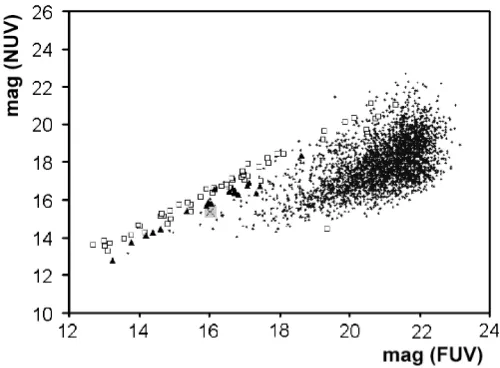
[image:3.595.309.563.260.410.2]N U V (1771−2831 ˚A, λeff = 2315.7 ˚A) simultaneously (Morrissey et al. 2007). To this end, both source cata-logues were cross-matched and the resultant list of objects was investigated in F U V vs. N U V colour space. The result is shown in Fig. 1.
Figure 1: F U V vs.N U V diagram of all sources in the Catalina Sur-veys Periodic Variable Star Catalogue (Drake et al. 2014) with good GALEX photometry. Post-common envelope binaries are denoted by open squares. Definite or probable SW Sextantis stars from the ’Big List of SW Sextantis Stars’ (Hoard et al. 2003) are represented by filled triangles. The grey square marked with a cross indicates the position of NSV 1907.
Groups of interest were identified, like e.g. post–common envelope binaries (class code ’16’ in Drake et al. 2014; de-noted by open squares in Fig. 1) and definite or probable
[image:3.595.42.292.450.634.2]SW Sex stars from the ’Big List of SW Sextantis Stars’ (Hoard et al. 2003)1(represented by filled triangles in Fig. 1). UV bright objects situated near the expected loci of nova-like CVs were investigated in more detail. We con-centrated in particular on stars that had been classified as short-period eclipsing binaries in the Catalina Surveys Periodic Variable Star Catalogue, which brought to our attention NSV 1907 (F U V = 16.028 mag;N U V = 16.043 mag; (F U V −N U V)≈0; position indicated by the grey square marked with a cross in Fig. 1). Inspection of the corresponding light curve from the Catalina Sky Survey (CSS; Drake et al. 2009) resulted in the detection of ob-vious out-of-eclipse variability, which instigated a closer examination of the object.
Figure 2: Light curve of NSV 1907, based on data from the Catalina Sky Survey (Drake et al. 2009).
2.2. Target Star
The variability of GSC 00104-02193 = USNO-B1.0 0935-0067535 = 2MASS J05165408+0332525 (RA, Dec (J2000) = 05h 16m 54s.085, +03◦32’ 52”.45; UCAC4 position) was discovered by C. Hoffmeister on Sonneberg plates and the star was announced as a long-period variable with an am-plitude of 0.5 mag (Hoffmeister 1963). The star was pri-marily designated as S 8003 and later included in the New Catalogue of Suspected Variable Stars (Kukarkin & Kholopov 1982) as NSV 1907. No more information on the type of variability had been available until the object was included in the Catalina Surveys Periodic Variable Star Catalogue (Drake et al. 2014) under the designation of CSS J051654.1+033252 and classified as an Algol-type eclipsing binary (GCVS-type EA) with a period ofP = 0.2761060 d and an eclipse depth of 1.10 mag.
2.3. Archival Photometry
Archival photometry of NSV 1907 was procured from the CSS, which observed NSV 1907 during a timespan of about 2915 days. 283 observations of NSV 1907 are available in Data Release 2, which were downloaded from the corresponding website2. Magnitudes derived from the
1
http://www.dwhoard.com/biglist
2
http://nesssi.cacr.caltech.edu/DataRelease/
Figure 3: Phase plot of NSV 1907, based on data from the Catalina Sky Survey (Drake et al. 2009). The data have been folded with a period ofP = 0.2761060 d (Drake et al. 2014). Also included are the CSS light curves of three constant, nearby stars of similar magnitude (denoted as C); see text for details.
CSS are unfiltered values that have been calibrated against
V-band magnitudes and are designated hereafter as ’mag (CV)’. The CSS light curve is shown in Figure 2. The corresponding phase plot, folded with the ephemeris given in Drake et al. (2014), is given in Fig. 3. Note the ob-vious out-of-eclipse variability and the irregular depres-sion suggestive of a shallow secondary minimum at phase
ϕ≈0.5. Also included are the CSS light curves of three constant, nearby stars of similar magnitude (C1 = CSS J051653.6+033028; C2 = CSS J051648.0+033034; C3 = CSS J051651.3+033311; the light curves of C2 and C3 have been offset by respectively -1.0 mag and -1.8 mag to match the light curve of C1). The constancy of their light curves gives credit to the reality of the observed variability in the CSS light curve of NSV 1907.
2.4. New CCD Photometry
To investigate the star in more detail, and to ensure that the observed secondary variability in CSS data is real and not an artefact, we have secured CCD photometric observations of NSV 1907 at three different sites. The instrumentations used are described in the following; an overview of the newly acquired photometry for NSV 1907 is given in Fig. 4.
• Private Observatory, Eckental, Germany
In 11 nights from 14/12/2014 to 15/12/2015, ex-tended image series were acquired mostly under un-even sky conditions with a 250/10 SCT in a semi-automated mode and a SBIG ST8XME camera. With 120s exposure time in the 2x2 binning mode, a total of 1369 measurements were taken (referred to here-after as the Gr¨obel dataset). To increase the S/N ratio, no filter was used. Twilight sky-flat images
[image:4.595.310.558.128.440.2]were used for flatfield corrections. The reductions were performed with the MUNIWIN program pack-age (Motl 2011).
Figure 4: Light curve of NSV 1907, based on our own photometric observations, as indicated. The (unfiltered) relative Gr¨obel data have been shifted by +14.8 mag to match theV observations.
• Remote Observatory Atacama Desert (ROAD), Chile
Additional filtered observations were procured at the ROAD observatory (Hambsch 2012), using an Orion Optics, UK Optimized Dall Kirkham 406/6.8 tele-scope and a FLI 16803 CCD camera. Data were ob-tained in 20 nights from 07/01/2016 to 19/03/2016. Images were taken through Astrodon Photometric
B, V, and IC filters. With 60s exposure time in the 3x3 binning mode, a total of 2241 measurements were acquired (referred to hereafter as the ROAD dataset). Twilight sky-flat images were used for flat-field corrections. The reductions were performed with the MAXIM DL program3 and the determina-tion of magnitudes using the LesvePhotometry pro-gram4.
• AstroLAB, Ieper, Belgium
Further photometry was acquired at the AstroLAB observatory, Belgium, in 5 nights during the time
3
http://www.cyanogen.com
4
span 08/01/2016 to 13/02/2016. The instrumental setup consisted of an 684/4.4 Newton telescope on a Keller alt-azimuth mount and an SBIG STL-6303 E camera. AstrodonB and V filters were used. A total of 591 measurements were taken in the 3x3 bin-ning mode, with either 60s (dataset 16/01/2016,V
filter; dataset 17/01/2016,V filter) or 120s (dataset 08/01/2016,V filter; dataset 02/02/2016, B filter) exposure time. The LesvePhotometry program was employed for the determination of magnitudes.
2.5. Spectroscopic Observations
A spectrum of NSV 1907 was obtained on the night beginning on the 19th of January 2016 using the Interme-diate Dispersion Spectrograph at the 2.5m Isaac Newton Telescope (INT) at the Roque de los Muchachos Observa-tory in La Palma, Canary Islands. The grating used was the R400V grating, a medium dispersion grating with a dispersion of 1.55 ˚A per pixel. The central wavelength was 5513.6 ˚A.
[image:5.595.311.547.441.629.2]The spectrum is shown in Figure 5. It is the result of combining 3 individual exposures of 400s taken in suc-cession. Since no suitable standard was available in that night’s data, the spectrum was flux-calibrated using a stan-dard, SP0946+139 (aka HD 84937), taken with the same instrument setup (grating, slit width and central wave-length) on the night of the 26th January 2016. The spec-trum was reduced using the ’molly’ reduction software5 written by Tom Marsh at the University of Warwick.
Figure 5: Spectrum of NSV 1907 obtained with the Isaac Newton Telescope (INT). See text for details.
The spectrum (Fig. 5) is typical for a cataclysmic vari-able, exhibiting the characteristic hydrogen and neutral helium emission lines. In addition to that, there is some ev-idence of higher excitation lines (’Bowen blend’ at around 4640 ˚A, caused by ionised carbon and nitrogen, with pos-sibly some contribution from He II emission at 4686 ˚A), which indicates the presence of a source of ionising pho-tons (likely an accreting white dwarf). Except for the Hα
line, which shows some slight indication of asymmetry, the
5
http://deneb.astro.warwick.ac.uk/phsaap/software/
Balmer emission lines are symmetric and single-peaked, which is reminiscent of SW Sex systems (Thorstensen et al. 1991) and argues against the presence of a high-inclination accretion disc. However, spectroscopic observations with higher resolution are needed to investigate this matter in detail.
The spectrum clearly exhibits secondary star features (Mg I 5168, 5174, 5185 ˚A), which goes along well with the observed secondary eclipse (cf. section3.2). This suggests a K spectral type for the secondary component, which would be expected for the observed long orbital period (Peters & Thorstensen 2005; cf. also section3.1). The Na D lines (5892, 5898 ˚A) likely show an absorption compo-nent from the interstellar medium.
2.6. Spectral Energy Distribution
The spectral energy distribution of NSV 1907 is shown in Figure6, which has been based on data obtained with the VizieR Photometry viewer6. Both reddened (filled symbols) and unreddened (open symbols) values are shown. Values in the WISE W3 and W4 bands denote upper limits and are represented by triangles. Reddening es-timates have been based on the calculations of Schlafly & Finkbeiner (2011) which should be considered as the maximum column density; extinction coefficients for the GALEX passbands were taken from Yuan et al. (2013). We estimate an interstellar extinction ofAV≈0.27 mag andE(B−V)≈0.09 mag in the line-of-sight to our target.
Figure 6: Spectral energy distribution of NSV 1907, based on data obtained with the VizieR Photometry viewer. Filled symbols denote unreddened values, open symbols are based on extinction corrected values. Values in the WISE W3 and W4 bands denote upper limits and are represented by triangles. See text for details.
The shape of the SED is typical of nova-like variables, with the accreting WD contributing strongly to the short
6
http://vizier.u-strasbg.fr/vizier/sed/
[image:5.595.40.287.442.586.2]wavelength region. The secondary star contributes signif-icantly at optical wavelengths, which is in agreement with its presumed spectral type and the observed secondary eclipse at an orbital phase of ϕ≈0.5.
3. Data Analysis and Discussion
3.1. Period Analysis
From our newly acquired observations and an analysis of CSS data, the following ephemeris could be derived, where phase zero corresponds to the primary eclipse.
M in(HJD) = 2457060.3785(2) + 0.2761069(2)×E (1)
The corresponding times of minima are given in Table
[image:6.595.312.551.81.279.2]1. The CSS light curve is not well sampled around the times of primary eclipse and the resulting errors in the times of minima are large; we have thus chosen to exclude CSS data from the period analysis.
Table 1: Observed times of minima.
Observer HJD-2450000 Error Epoch (O-C)
Gr¨obel 7060.3790 0.00028 0 0.0005 Gr¨obel 7068.3850 0.00028 29 -0.0006 Gr¨obel 7070.3185 0.00022 36 0.0001 Gr¨obel 7080.2582 0.00014 72 0.0000 Gr¨obel 7364.6485 0.00052 1102 0.0002 Gr¨obel 7387.5648 0.00036 1185 -0.0004 Dubois 7396.4006 0.00018 1217 0.0000 Hambsch 7401.6470 0.00034 1236 0.0004 Hambsch 7403.5791 0.00036 1243 -0.0003 Gr¨obel 7425.3916 0.00018 1322 -0.0002 Hambsch 7425.6677 0.00022 1323 -0.0002 Dubois 7431.4666 0.00040 1344 0.0004
3.2. Additional Variability and Amplitudes
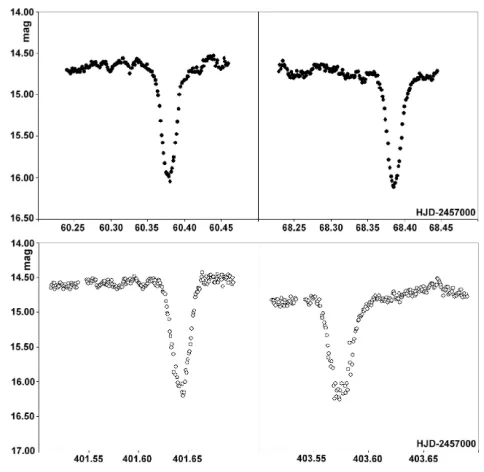
From our new observations, the reality of the additional variability seen in CSS data in addition to the eclipses (short-term irregular variability, long-term variations) could be established, as well as the presence of a secondary min-imum which seems to be a constant feature and takes the form of a small, irregular depression at phase ϕ ≈ 0.5. The primary minimum seems to be slightly variable, too. Figure 7, which has been based on part of the unfiltered Gr¨obel data, nicely illustrates the observed additional vari-ability. Detailed views of primary eclipses are presented in Figure 8.
During our photometric coverage, the observed changes in mean brightness of the system outside of primary eclipse amounted to ∼ 0.3 mag (CR), ∼ 0.5 mag (V), and ∼
0.5 mag (B), respectively. Archival data from the CSS indicate mean brightness variations of up to 0.7 mag (CV),
[image:6.595.310.552.341.577.2]Figure 7: Phase plot of NSV 1907, based on part of the unfiltered Gr¨obel data (as indicated in the inset legend) and folded with the ephemeris given in Eq. (1). Note the obvious out-of-eclipse variabil-ity and the presence of a secondary minimum at phaseϕ≈0.5.
Figure 8: Detailed view of eclipses of NSV 1907. The plots have been based on unfiltered Gr¨obel data (upper panels; full circles) and ROAD V data (lower panels; open circles). Note the short-term irregular variability that is present outside of eclipses.
which becomes especially obvious during the active phase around HJD 2454500.
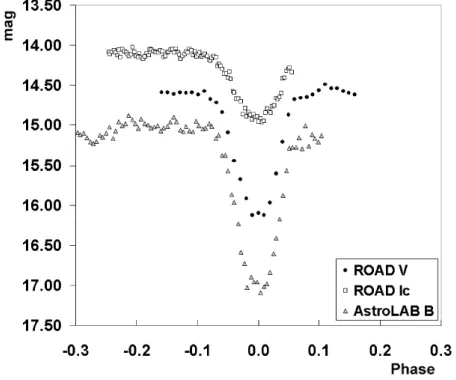
[image:6.595.37.289.347.520.2]pre-sented in Fig. 9. Although the scatter in the B and
[image:7.595.316.549.84.275.2]IC observations is relatively large, it is obvious that the amplitude of the eclipse increases to shorter wavelengths (∆B > ∆V > ∆IC), indicating that the hot object is eclipsed around phase ϕ ≈ 0. We derive eclipse ampli-tudes of ∆B ≈2.0 mag, ∆V ≈1.5 mag, and ∆IC≈0.8 mag.
Figure 9: Detailed view of eclipses based on AstroLABBand ROAD V IC data. Outlying datapoints have been removed by visual inspec-tion. The data were acquired on different orbital cycles (see text for details).
The presence of a secondary minimum in the light curve of NSV 1907 is remarkable as this is seldom observed in eclipsing cataclysmic variables. There are exceptions like e.g. the SW Sextantis system V363 Aur (Thoroughgood et al. 2004). This star exhibits a secondary eclipse in theR
band light curve, which is absent in theB band, implying that this feature is stronger at longer wavelengths. Appar-ently, the reverse holds true for NSV 1907; from Fig. 10, it becomes apparent that the amplitude of the secondary eclipse is greater inB than inV.
Likely, then, different mechanisms are at work in NSV 1907. It seems probable that the accretion disc occults the companion star that contributes a significant amount to the optical flux output of the system, which results in the observed secondary eclipse at phase ϕ≈0.5. The re-flection effect (heating of the companion star by the WD primary and/or the accretion disc) may be important in this respect. There could also be material above and be-low the disc plane that contributes to the eclipse of the secondary.
3.3. The 4.2 day period - the nodal precession period?
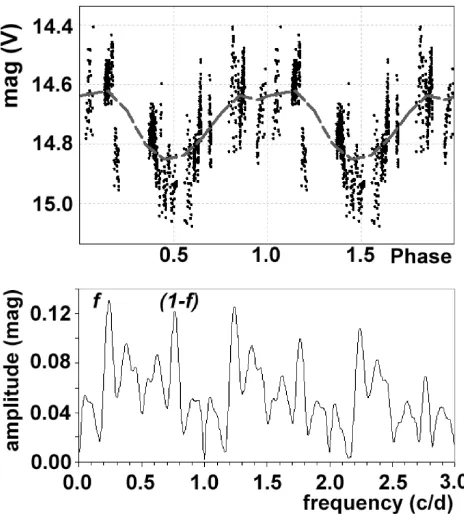
[image:7.595.49.277.181.371.2]We have searched for periodic signals other than the orbital period in the ROAD V dataset, which covers the most consecutive orbital cycles. To this end, eclipses were removed by visual inspection and the resulting data were searched in the frequency range of 0 < f(c/d)< 3 using
Figure 10: Detailed view of secondary eclipses based on AstroLAB BV data. Outlying datapoints have been removed by visual inspec-tion. The data were acquired on different orbital cycles (see text for details).
Period04 (Lenz & Breger 2005). We find possible
evi-dence for sinusoidal variations with a period ofP ≈4.2 d (Fig. 11), which is reminiscent of the findings ofde Miguel et al.(2016) who find a period ofP ≈3.68 d from an anal-ysis of long-term photometric observations on the nova-like variable UX UMa. The authors interpret this signal as the signature of a retrograde precession of the accretion disc.
If we adopt the same interpretation for NSV 1907, i.e. that the 4.2 day period is the nodal precession period, the superhump periodPsh can be deduced fromfsh = forb + fnodal. Assuming Porb = 0.2761 d (forb = 3.6219 c/d) and Pnodal = 4.211 d (fnodal = 0.2375 c/d), a superhump period ofPsh = 0.2591 d (fsh = 3.8594 c/d) is derived. From this, the observed fractional period excess of the superhump periodǫ= (Psh -Porb) /Porb (Patterson et al. 2005) can be derived, which – in the case of NSV 1907 – amounts toǫ≈0.06.
It has been shown that ǫ is strictly a function of the mass ratio q = M2/M1 (Patterson et al. 2005). Using equation (8) ofPatterson et al.(2005), we deriveq≈0.25. Considering the long period of NSV 1907, which allows for a bigger and more massive secondary star than found in most other nova-like variables, this value seems reasonable (cf. Fig 9 ofPatterson et al. 2005).
However, because of the short time baseline of our data, these values have to be regarded as very preliminary only. More observations are needed to confirm the reality of the proposed period and verify its consistency over a longer timespan. Monitoring of the secondary eclipse might also be useful in establishing the presence of a tilted accretion disc in the system, in which case the secondary eclipse should be variable in time as a result of the changing pro-jected area of the disc and WD system.
Figure 11: ROAD V data, folded on the proposed 4.2 day (f = 0.2375 c/d) variations (upper panel; eclipses have been removed by visual inspection) and the corresponding power spectrum (lower panel), which is dominated byf, (1−f), and the corresponding daily
aliases.
4. Conclusion
From our observations, we deduce that NSV 1907 is a deeply eclipsing, nova-like cataclysmic variable. Apart from the orbital variations (eclipses), changes in mean brightness and irregular short-term variability (flickering) were observed. The presence of a secondary minimum at phaseϕ≈0.5 was established. This is rarely observed in CVs and indicates that the contribution of the companion star is not entirely negligible as compared to the luminosity of the hot object. We have searched for periodic variability other than the orbital period and find possible evidence for sinusoidal variations with a period ofP ≈4.2 d, which we interpret as the nodal precession period. However, more observations are needed to confirm or disprove the reality of our finding.
No outbursts or VY Scl-like drops in brightness were observed either by the CSS or during our photometric monitoring. Because of its spectral characteristics (single-peaked emission lines, high-excitation lines) and the ob-served variability pattern (high-inclination, eclipsing sys-tem; V-shaped eclipses; mean brightness changes; flicker-ing), we propose NSV 1907 as a new member of the SW Sextantis class.
In fact, the star’s properties and light curve are strongly reminiscent of other long-period SW Sex systems like e.g. V363 Aur (the longest-period definite SW Sex star with
Porb ≈7.71 h), which, incidentally, also exhibits a con-spicuous secondary eclipse and secondary star features in
[image:8.595.311.551.190.340.2]its spectrum (Thoroughgood et al. 2004). Figure12shows the orbital period distribution of SW Sex stars. The plot has been based on data from the ’Big List of SW Sextan-tis Stars’ (Hoard et al. 2003). Only definite members of the group and probable candidates have been considered. With an orbital period ofP ≈6.63 hours, NSV 1907 – if confirmed as a member – would be the SW Sex star with the fourth longest period.
Figure 12: Orbital period distribution of SW Sex stars, based on data from ’The Big List of SW Sextantis Stars’ (Hoard et al. 2003). Only definite SW Sex stars (dashed area) and probable candidates (white area) have been considered. The position of NSV 1907 is indicated by the dark area.
Further photometric and spectroscopic observations are encouraged. Time-resolved spectroscopy, in particular, should prove valuable in investigating class-defining features such as the radial velocity variations of the emission lines, which exhibit maximum blueshift near an orbital phase ofϕorb≈
0.5, or the typical displacement of the radial velocity curve of the line wings (Rodr´ıguez-Gil et al. 2007a).
Acknowledgements
We thank Tom Marsh at the University of Warwick for the use of the ’molly’ reduction software and Marek Skarka for helpful discussions. The research leading to these results has re-ceived funding from the European Research Council under the European Union’s Seventh Framework Programme (FP/2007-2013) / ERC Grant Agreement n. 320964 (WDTracer). This research has made use of data from the Catalina Sky Sur-vey. The CSS survey is funded by the National Aeronautics and Space Administration under Grant No. NNG05GF22G is-sued through the Science Mission Directorate Near-Earth Ob-jects Observations Program. The CRTS survey is supported by the U.S. National Science Foundation under grants AST-0909182. Furthermore, use was made of the SIMBAD database and the VizieR catalogue access tool operated at CDS, Stras-bourg, France.
References
Cusumano, G., La Parola, V., Segreto, A. et al. 2010, A&A, 524, 64 de Miguel, E., Patterson, J., Cejudo, D. et al. 2016, MNRAS, 457,
Drake, A. J., Djorgovski, S. G., Mahabal, A. et al. 2009, ApJ, 696, 870
Drake, A. J., Graham, M. J., Djorgovski, S. G. et al. 2014, ApJS, 213, 9
Hambsch, F.-J. 2012, JAVSO, 40, 1003
Hellier, C. 2001, Cataclysmic Variable Stars, Springer, London Hoard, D. W., Szkody, P., Froning, C. S. et al. 2003, AJ, 126, 2473 Hoffmeister, C. 1963, Astronomische Nachrichten, 287, 169 Kukarkin, B. V., Kholopov, P. N. 1982, Publication Office Nauka,
Moscow, 287, 169
Lenz, P., & Breger, M. 2005, Communications in Asteroseismology, 146, 53
Martin, D. C., Fanson, J., Schiminovich, D. 2005, ApJ, 619, 1 Morrissey, P., Conrow, T., Barlow, T. A. et al. 2007, ApJS, 173, 682 Motl, D. 2011, C-Munipack, http://c-munipack.sourceforge.net Patterson, J., Kemp, J., Harvey, D. A. 2005, PASP, 117, 1204 Peters, C. S., & Thorstensen, J. R. 2005, PASP, 117, 1386
Rodr´ıguez-Gil, P., Schmidtobreick, L., G¨ansicke, B. T. 2007, MN-RAS, 374, 1359
Rodr´ıguez-Gil, P., G¨ansicke, B. T., Hagen, H.-J. et al. 2007, MNRAS, 377, 1747
Schlafly, E. F., & Finkbeiner, D. P. 2011, ApJ, 737, 103
Schmidtobreick, L., Rodr´ıguez-Gil, P., G¨ansicke, B. T. 2012, Mm-SAI, 83, 610
Shappee, B. J., Prieto, J. L., Grupe, D. 2014, ApJ, 788, 48 Thoroughgood, T. D., Dhillon, V. S., Watson, C. A. 2004, MNRAS,
353, 1135
Thorstensen, J. R., Davis, M. K., Ringwald, F. A. 1991, AJ, 102, 683
Ubertini, P., Lebrun, F., Di Cocco, G. et al. 2003, A&A, 411, L131 Voges, W., Aschenbach, B., Boller, Th. 1999, A&A, 349, 389 Warner, B. 1995, Cataclysmic Variable Stars, Camb. Astrophys. Ser.,
Vol. 28
Yuan, H. B., Liu, X. W., & Xiang, M. S. 2013, MNRAS, 430, 2188