An Efficient E2E Verifiable E-voting System
without Setup Assumptions
Aggelos Kiayias, Thomas Zacharias, and Bingsheng Zhang
Abstract—End-to-end (E2E) verifiability has been widely identified as a critical property for the adoption of e-voting systems in real world election procedures. In this work, we present a new e-voting system that is E2E verifiable without any additional “setup” assumption or access to a random oracle. Previously known E2E verifiable e-voting systems required such additional assumptions (specifically, either the existence of a “randomness beacon” or were only shown secure in the random oracle model). Furthermore, our scheme only employs conventional cryptographic building blocks, such as the ElGamal encryption, and it does not require any cryptographic functionality at the client-side to cast a vote. The E2E verifiability property of our scheme is guaranteed information theoretically given the existence of a consistent bulletin board, and the voter privacy is achieved under the well-known DDH assumption.
Index Terms—End-to-end verifiability, internet voting, e-voting, election integrity, security modeling
F
1
INTRODUCTIONIn an end-to-end (E2E) verifiable election system, voters have the ability to verify that their vote was properly cast, recorded and tallied into the election result. Intuitively, the security property that an E2E verifiable election intends to capture is the ability of the voters to detect a malicious election authority that tries to misrepresent the election outcome.
E2E verifiability mandates that the voter can obtain a
receipt at the end of the ballot casting procedure that can
allow her to verify that her vote was (i) cast as intended, (ii) recorded as cast, and (iii) tallied as recorded. Furthermore, any external third party should be able to verify that the election procedure was executed properly. In fact, it is imperative that the receipts in an E2E system aredelegatable
i.e., the voter may outsource the task of verifiability to any interested third party, for instance an international organiza-tion that aggregatively performs verificaorganiza-tion and is trusted by some voters to do so. This requirement, as well as the fact that it should be infeasible for the voter to use her receipt as a proof of the way she voted (this is necessary to deter vote-selling/buying), make the design of E2E verifiable systems a challenging problem.
All known e-voting systems that offer E2E verifiability are able to support it only under some “setup” assumption, such as (i) the existence of a trusted party that provides
• Aggelos Kiayias and Thomas Zacharias are with the Department of Informatics, The University of Edinburgh, UK. E-mail: [email protected] and [email protected].
• Bingsheng Zhang is the corresponding author, and is with School of Computing and Communications, Lancaster University, UK. E-mail: [email protected]
A preliminary version [1] of this paper was presented at the 34th An-nual International Conference on the Theory and Applications of Crypto-graphic Techniques (EUROCRYPT 2015). This research was partly supported by ERC project #259152 (CODAMODA), Horizon 2020 project #653497 (PANORAMIX), and project FINER, Greek Secretariat of Research and Technology, funded under action ARISTEIA 1.
a stream of unbiased and unpredictable random coins (a randomness beacon) or a trustily generated common ref-erence string (CRS), or (ii) in the random oracle (RO) model. Notably, E2E verifiability can be argued, yet never formally proven, for Helios [2] in the RO model while for Remotegrity/Scantegrity II [3], [4] under the presence of a randomness beacon. More general approaches for defining auditable multiparty computation have recently been pro-posed [5] and also rely on a setup assumption such as a CRS.
A limitation of using setup assumptions for establishing E2E verifiability in e-voting is the fact that a leap of faith will be required in order to accept the setup assumption and thus the election result. This can be an unfortunate state of affairs: since the election authority (EA) cannot unequivo-cally convince the voters that the election is correct, then the election outcome can be always subject to dispute.
Our contributions. Motivated by the above, we design a new e-voting system that we can prove E2E verifiable
information theoretically without any setup assumptionexcept
the existence of a bulletin board (BB) which provides a global consistent view of the election. The requirement for BB consistency can be seen as a tight condition since without it, it is easy to see that E2E verifiability of the election cannot be achieved: by controlling the BB, an adversarial EA can distribute voters to their own separate “islands” where within each one the voters will have their own verifiable view of an election result that can be - in reality - completely skewed. The latter is in agreement with the compromise for tolerating the possibility of independent execution attacks in networks without any authentication mechanism discussed by Barak et al. [6].
cryptographic operations but they are optional and can be performed at any time, in the post-election stage).
Our construction cherry picks ideas drawn from previ-ous works, specifically, code-voting and double ballots from [7], and secret-sharing homomorphisms from [8], but also introduces a number of novel elements that enable us to prove E2E verifiability. In order to achieve verifiability, our system collects coins from the voters to form the challenge (specifically, a single random coin per voter). Given that a certain proportion of voters are honest and properly follow the protocol, the sequence of voter contributed random-ness has sufficient entropy to be used as the challenge of zero-knowledge protocols. applying these techniques, we prove information theoretically the E2E verifiability for our scheme. For voter privacy, we utilize complexity leveraging to show that in the underlying commitment scheme is hiding then our system offers voter privacy.
In summary, our e-voting system is the first construction achieving E2E verifiability and voter privacy without any setup assumption assuming a consistent BB, which can be seen as a minimal security assumption. Furthermore, we propose a new formal cryptographic security framework. Compared with [1], we simplify the E2E verifiability defi-nition. Under the new security framework, we prove E2E verifiability information theoretically, while we assume the hardness of a well-studied cryptographic problem (Deci-sional Diffie-Hellman (DDH) assumption) for voter privacy. Finally, our system does not require that the voters perform cryptographic operations at their engagement in the voting procedure.
Summary of existing techniques for verifiability.To mo-tivate further our approach it is worth-while to emphasize in which way previous works fail to attain E2E verifiability without any setup assumption. Helios, culminates a long line of previous schemes that employ homomorphic type of voting [9], [10] and utilizes the Benaloh challenge [11] as the fundamental mechanism to attain verifiability. Helios by design requires the voter to utilize a voter supporting device to prepare a ciphertext and after an indeterminate number of trials, the voter will cast the produced ciphertext. Such ciphertexts are to be homomorphically tallied and thus they should be accompanied by a proof of proper computation. While such proofs can only be proved interactively (which is insufficient in our setting since a corrupt EA together with a corrupt voter may cook up a malformed proof that is indistinguishable from a proper one). Instead, Helios adopts a RO-based proof, thus imposing the RO restriction on the adversary during an E2E verifiability attack. On the other hand, in the case of Remotegrity/Scantegrity the required randomness needs to be obtained from a randomness bea-con in order to prove the result correct. It is easy to verify that the system is insecure in terms of E2E verifiability in case the randomness beacon is biased. As before, the only parties active are the EA and the voters who cannot imple-ment the randomness beacon required in the construction.
In light of the above, our construction offers a new paradigm in e-voting design: the randomness for the ver-ification of the election can be collected distributively from the entropy generated by the voters’ interaction with the system. This entropy isinternalwith respect to the election
environment, therefore the need for trusting an outer source of randomness or restricting the adversary in the RO sense is eliminated.
2
BUILDING BLOCKS
In this section, we describe the election notions and func-tionalities that our system realizes with the use of crypto-graphic tools. Similar building blocks can be found in other noticeable systems, e.g. [2], [12]. In our text, we use the
term negligible to denote that a value gradually becomes
very small with respect to (w.r.t.) the increase of system’s parameters. Formally, negligible refers to a real function
f(n) : N 7→ R over the integers that is asymptotically smaller than the inverse of any polynomial inn.
2.1 Implementing an electronic envelope
To enable the correct counting of the votes while preserv-ing privacy, we deploy acommitment scheme to realize the concept of an “electronic envelope” that is (i) binding, in the sense that an adversary cannot open an envelope to a value different than the originally enclosed message and (ii)
hiding, i.e. an adversary obtains no information about the
enclosed message until the envelope is opened. A generic commitment scheme consists of the following phases and algorithms:
Key generation: is an algorithm that on input some security parameterλ, it outputs a commitment keyck.
Commit phase:givenck, one can enclose a messageMin a digital envelope, by generating a commitmentComck(M)
forM.
Opening phase:the commitmentComck(M)can be
dis-closed given ck and opening data (M, r), so that one can verify the correct opening of Comck(M).In our system we
utilize lifted ElGamal encryption to instantiate a commit-ment scheme. Hence, the commitcommit-ment scheme inherits the security properties of the ElGamal cryptosystem. Namely, the perfect correctness of ElGamal decryption implies the perfect binding property against adversaries of unlimited computational power. Moreover, the semantic security of ElGamal implies the hiding property against computation-ally bounded adversaries assuming the hardness of the Decisional Diffie-Hellman (DDH) problem DDH problem for the underlying encryption group.
2.2 Generating electronic envelopes for valid votes
In our system, the messages that need to be enclosed under the ElGamal commitment scheme are valid encodings of a candidate from a listP1, . . . , Pm. We encode candidatePj as the unit vectorej ∈Zm, where thej-th position is1and all the restm−1positions are0. For example, in the case of three candidates P1, P2, P3 the candidate encodings are
2.3 Facilitating secure vote counting
Besides binding and hiding, the lifted ElGamal commitment scheme isadditively homomorphic. Namely, multiplying two commitments for messagesM1,M2under the same
commit-ment keyckproduces a commitment forM1+ M2as shown
below:
Comck(M1)·Comck(M2) =Comck(M1+ M2).
In addition if (M1, r1) and (M2, r2) are the opening data
forComck(M1)andComck(M2)respectively, then the
open-ing data for the homomorphically added commitment
Comck(M1+ M2)are(M1+ M2, r1+r2).
Homomorphic additivity naturally extends to multiple vector commitments. Hence, it allows for the tally of all the votes enclosed in the “electronic envelopes” as if these were added within a large envelope. The latter denotes
thehomomorphic productvector commitment consisting ofm
ElGamal commitments to the components of the tally vector
T := (t1, . . . , tm), wheretj represents the number of votes for the j-th candidate. In turn, the large envelope can be opened toT. The tally is performed without revealing the individual votes that summed to it.
2.4 Proving ballot validity
As part of the verification mechanism of our system, it is checked whether the envelopes (commitments of the votes) included in the tally are well-formed, i.e. they enclose the valid encoding of some candidate to a unit vector. This is done by utilizing a special case of interactive zero-knowledge proofs, called Σ-protocols. In a Σ-protocol, a
proverPrvwith some private inputwinteracts with averifier
Vrfto convince it of the validity of some statementx. More formally,PrvandVrf are modeled asinteractive Turing
Ma-chines, wherePrvis unbounded andVrf runs in polynomial
time. The statement validity is expressed asxbelonging in some NP languageL and Prv’s private input is typically a witnesswforx. The interaction is in three moves; in the first move,Prvsends toVrf acommitmentmessageΣ(1). In
the second moveVrf providesPrvwith achallengeρand in the third move, Prvreplies with a responseΣ(2). Given its
whole view of the protocol,Vrf must output an accept or reject message.
A Σ-protocol satisfies the following three properties, here stated informally:
1) Completeness:Vrfalways accepts the proof ofPrvfor every valid statementx∈ L.
2) Soundness:Vrf does not accept the proof of a poten-tially malicious proverPrv∗for some invalid statement
x /∈ L, except from some negligible soundness error probability.
3) Honest verifier zero-knowledge (HVZK):There exists an efficient simulator, s.t. for everyx∈ L, can simulate a valid transcript(Σ(1), ρ,Σ(2))without accessing to the
witness.
In our system, we adopt disjunctive Chaum-Pedersen (CP)
proofs[13] which areΣ-protocols for proving that an
ElGa-mal commitment commits to a unit vector. Specifically, for every vector commitmentC, we show that it commits to a valid encoded vote as follows: for each of themcomponents
ofC, we generate a CP proof that the component commits to a bit value. Then, applying the additive homomorphic property we generate a CP proof that the products of the components is a commitment of1.
In the following proposition, we state the properties of a CP proof, which can be seen as an adaptation of [1, Theorem 1] to the CP proof setting.
Proposition 1. A Chaum-Pedersen proof achieves completeness,
soundness with probability error2−κand HVZK, as long as the
min-entropy of the challenge string provided by the verifierVrfis
at leastκbits.
3
SYNTAX AND
THREAT
MODEL
We build upon the syntax and threat model introduced in [1]. We use λ as the security parameter. We denote by V = {V1, . . . , Vn} and P = {P1, . . . , Pm} the set of voters and candidates respectively, which sizesnandmare polynomial inλ.
We stress that for simplicity, we consider an abstract centralized election authority (EA) that administers the setup, vote casting and tally phases of the election. This is consistent with our definition of E2E verifiability in an all-malicious setting, where the EA is adversarially controlled.
Regarding vote privacy, we will require the EA to be honest, as it is fully aware of the encoding of the voters’ candidate selections. In Sect. 6.1 we show how to distribut-ing the EA to set of trustees.
3.1 Syntax
The entities involved in an e-voting system are as follows:
The election authority (EA) that manages the entire
election; in particular, EA prepares all the election information, distributes the voters’ ballots, collects the votes and is responsible for computing the tally and announcing the election result.
ThevotersV={V1, . . . , Vn}, possibly equipped with
voting supporting devices (VSDs)andauditing
support-ing devices (ASDs).
A publicly accessible and consistent bulletin board
(BB) where the election result and all audit informa-tion is posted.
An e-voting comprises four phases: 1) election setup, 2) vote casting, 3) election tally, and 4) auditing. The interaction among e-voting entities at the four phases is illustrated in Figure 1.
3.2 Modeling E2E verifiability
The adversarial goal for an attacker against system’s in-tegrity is to cause deviation from the intended tally while election auditing remains successful. Given that the candi-dates are encoded as unit vectors and the tally is represented as a vector in Zm, we measure tally deviation via the d1
metric derived by the`1-norm,k · k1scaled to half, i.e.,
d1: Zm+ ×Z
m
+ −→R
(R, R0) 7−→ 1 2·
Pn
i=1|Ri−R0i|
EA
BB
...
V
nVSD ASD
V
2VSD ASD
V
1VSD ASD
1b 1a
3
4 4
4 2
2
2
FIGURE1: The interaction among the entities in an e-voting execution. The dotted lines denote read-only access to the BB. The dashed arrows denote untappable channels for voters’ private inputs distribution.Annotation: (1a): distri-bution of voter’s private inputs; (1b): pre-election BB data; (2): vote casting; (3): post-election BB data; (4): auditing.
by corrupting the EA and all the VSDs. In addition, it can control up to a number of voters and their devices. Our E2E verifiability threat model is presented in Fig. 2.
EA
BB
...
V
nVSD ASD
V
2VSD ASD
V
1VSD ASD
FIGURE2: An adversary against E2E verifiability that con-trols voterV1. The corrupted nodes are colored in black.
We provide the following definitions:
Definition 1. Let R ∈ Zm be the announced result in an election run by an E2E verifiability adversaryA. LetRh ∈
Zmbe the partial result derived by the intended votes of the honest voters, i.e. how the honest voters wanted their votes to be counted. We say thatAcauses tally deviationδ, if for
every possible partial adversarial resultR∗ ∈ Zm, it holds that
d1(Rh+R∗, R)≥δ .
Namely, it is impossible to explain the adversarial votes, so they produce a tally within a radiusδfromR.
To provide intuition on Definition 1, consider an election with voters V1, V2, V3 and candidates P3, where voter V1
and V2 vote for P1 and V3 is corrupted. Hence, Rh =
(1,0,0) + (1,0,0) = (2,0,0)while the possible adversarial results are(1,0,0),(0,1,0),(0,0,1)and the non-vote vector
(0,0,0). IfAannounces the result(1,1,1), then we have the following four cases:
d1 (2,0,0) + (1,0,0),(1,1,1)
= 2 d1 (2,0,0) + (0,1,0),(1,1,1)
= 1 d1 (2,0,0) + (0,0,1),(1,1,1)
= 1 d1 (2,0,0) + (0,0,0),(1,1,1)
= 3/2
Hence for every possible partial adversarial resultR∗∈Zm, it holds that d1(Rh +R∗, R) ≥ 1, which implies tally deviation 1 (switching one vote).
Definition 2. We say that an e-voting system achieves E2E
verifiability with errorfor at leastθhonest voters and tally
deviation δ, if the probability that an adversary A causes tally deviationδwhile allθhonest voters verify successfully, is no more than.
Remark 1. We simplify the original definition in [1] by not including an unboundedvote extractoralgorithmEthat explains the adversarial tally by brute-force decrypting the corrupted voters’ ballots and deviation would be defined w.r.t. E’s output. The reason is that the vote extractor ap-proach and Definition 2 can be easily shown equivalent against unbounded adversaries, which is the case we are interested in the paper.
The proof is by contradiction; at a high level, if Def-inition 2 fails, then there is an adversary A that causes tally deviation δ by announcing the result R according to Definition 1. Thus, for every adversarial partial tally, denoted byRE, that an extractorE might output, it holds thatd1(Rh+RE, R)≥δ.
Conversely, consider the optimal extractor E∗ that
outputs an adversarial result R∗ that minimizes
{R0|d1(Rh+R0, R)}. Given that the E2E verifiability definition in [1] fails, there is an adversaryA∗that winsE∗,
hence it holds thatd1(Rh+R∗, R)≥δ. Consequently, the adversaryAcauses tally deviationδand Definition 2 does not hold.1
3.3 Modeling voter privacy
As in [1], we model voter privacy by also capturing the property of coercion resistance against adversaries that passively monitor the voting procedure and request the voters’ transcripts after vote casting, including their receipts. Such an adversary can corrupt all the voters’ devices and schedule network traffic. It may also control up to a number of voters. However, the voters’ private inputs are delivered
by the EA viauntappable channels. Our voter privacy threat model is presented in Fig. 3.
EA
BB
...
V
nVSD ASD
V
2VSD ASD
V
1VSD ASD
FIGURE3: An adversary against voter privacy that controls voter V1. The corrupted nodes are colored in black. The
dashed arrows denote untappable channels for voters’ pri-vate inputs distribution.
Recall that the adversary can also obtain the honest voter’s transcript and receipt. In order to deceive the adver-sary on the way they voted, the honest voters must be able to lie about their interaction with the system by providing fake views that are indistinguishable from the actual ones.
Definition 3. We say that an adversaryAhas negligible
ad-vantage against privacyif for an election, it has only negligible
additional probability to output the correct honest voter’s votes compared with the trivial advantage.
For the better understanding of Definition 3, consider the previous example where three honest votersV1, V2, V3
vote forP1, P1, P3and produce the tally(2,0,1). The same
tally would derive ifV1, V2, V3 had voted forP3, P1, P1 or
P1, P3, P1, i.e. there are three ways in total. Then, A has
negligible advantage against privacy if the probability of outputting the votes ofV1, V2, V3 is no more than1/3 +,
where the 1/3 is the probability of random guessing the votes andis a negligible term.
Definition 4. We say that an e-voting system achieves voter
privacy for at most t corrupted voters, if any probabilistic
polynomial time adversary Athat controls up to t voters has negligible advantage against privacy.
4
SYSTEM
DESCRIPTION
In this section, we will describe an e-voting system for 1 -out-of-mtype of elections.
4.1 Data structure
Prior to the election, the voters shall already receive a voting card via a secure untappable channel. Fig. 4 illustrates an
example of the basic structure of such a voting card. Each voting card has a serial number (SN) and consists of two functionally equivalent parts:Side-AandSide-B. Each part contains an unpredictable authentication code. Besides, it listsm candidates together with their corresponding vote-code.
SN: 100
Authentication code: ABCDE
Side A
Alice Bob
Candidate Votecode
1 2 Charlie 0
SN: 100
Authentication code: ABCDE
Side B
Alice Bob
Candidate Votecode
0 1 Charlie 2
FIGURE4: Voting card.
To enable verifiability, the EA needs to post necessary information regarding the election process on the BB. As depicted in Fig. 5, there are 7 columns and 2 rows for each ballot. Column I states a unique serial number, and column II showsSide-AandSide-B. Column III is used for vector commitments (cf. Section 2.2, above). Columns IV and V are used for the first move and the third move of the corresponding CP proofs for the validity of the vector commitments. Column VI is used to reveal some of the openings of the vector commitments in Column III. Finally, Column VII is used to mark the voters’ submitted votecodes. Notice that Columns V, VI, VII are only partially filled, and this will be clarified in the due course.
Serial
number Side dataInit
I II III IV V VI VII
Side A 100
101
Side B Side A Side B
0 0 1 1 0 0 0 1 0 1 0 0
CP 1
CP 1
CP 1
CP 1
Side A 102
Side B 0 0 1 0 1 0
CP 1
CP 1 CP 2
CP 2
CP 2 Final
data Votecode
2
0
1
Partial open
1 0 0
1 0 0
0 0 1
Phase 1 Phase 2 Vector Commitment
FIGURE5: BB structure.
4.2 Election setup
The EA first generates a commitment key ck and posts
ck along with the other public election information, e.g., election question, to the BB. For ` ∈ {1, . . . , n}, the EA then generates the meta-data for ballotB` as follows. For
x ∈ {Side-A,Side-B}, the EA picks a random number
er`,x, where ther`,x-th coordinate is 1and the rest
coordi-nates are0. Denote this vector commitment asC`,x. After that, the EA computes the first move of the CP proofs, denoted asΣ(1)`,x, showing that the vector commitmentC`,x indeed contains a unit vector. (cf. Section 2.4, above.) For
j ∈ {1, . . . , m}, the EA sets the votecode of thej-th candi-date asO`,x,j=j−r`,x−1 (modm); namely, the votecode is the offset of the j-th candidate by r`,x−1. (Note that the votecodes in each side of a ballot is essentially a cyclic shift of the canonical ordering, i.e.,0,1, . . . , m). Finally, for each ballot B`, the EA generates a random authentication code and produces the corresponding voting cardC` as in Fig. 4. Meanwhile, the EA posts information about Columns I, II, III, IV to the BB as depicted in Fig. 5 (phase 1), and it also keeps its state. After election setup, the voting cards are distributed to the voters via some secure untappable channels, e.g. postal service.
4.3 Vote casting
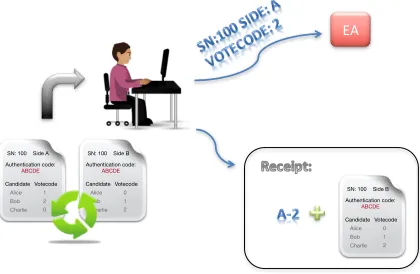
Having obtained the voting card, the voterV`can cast her vote once the election starts. To cast a vote, V` randomly selects a side to use, saySide-A. She looks up the votecode of her intended candidate inAside of the voting card, say
2. She then inputs her authentication code to a VSD; after authentication, she utilizes the VSD to send the side and votecode, A-2 to the EA. At the end of vote casting, V` keeps the unused side, i.e., Side-Bof her voting card and the submitted message, A-2 as the receipt, denoted as α`. (cf. Fig. 6, below.)
SN: 100 Authentication code:
ABCDE
Side A
Alice Bob
Candidate Votecode
1 2 Charlie 0
SN: 100 Authentication code:
ABCDE
Side B
Alice Bob
Candidate Votecode
0 1 Charlie 2
EA
SN: 100 21839 Yes 47485 No
SN: 100 Authentication code:
ABCDE
Side A
Alice Bob
Candidate Votecode
1 2 Charlie 0
SN: 100 Authentication code:
ABCDE
Side B
Alice Bob
Candidate Votecode
0 1 Charlie 2
FIGURE6: Vote Casting.
4.4 Election tally
After the election ends, the EA marks Column VII on the BB according to the received votes. For` ∈ {1, . . . , n}, define the voter’s coin b` = 0 if Side-A was used and b` = 1 otherwise. Consider all the voters’ coinsB := (b1, . . . , bn) as the Σ protocol challenge of the CP proofs. The EA completes the third moves of the CP proofs, denoted as
Σ(2)` , corresponding to the marked vector commitments for the side of the voting card that was used. For the unused side of the voting card, the EA opens all the corresponding vector commitments, denoted asD`. The EA postsΣ
(2)
` and
D`to the BB.
For each cast ballot B`, the EA performs cyclic right shift on the corresponding vector commitment according to the submitted votecode. Note that the resulting vector commitment, denoted as C`0, should only contain1 at the
j`-th coordinate, where thej`-th candidate is the intended choice of voter V`. LetV be the set of all the voters who cast a vote. For allV` ∈ V, the EA entry-wise multipliesC`0, obtaining a vector commitment of the final tally, denoted as E. (Cf. Section 2.3, above.) The EA then posts the de-commitment ofEto the BB, openingEto the election tally
T := (t1, . . . , tm), wheretj represents the number of votes for thej-th candidate.
4.5 Auditing
The voter V` can use her ASD to audit the election w.r.t. the BB information and her receiptα`. More specifically, she checks
• The annotated Column VII content is consistent with
the side and votecode she submitted.
• The opened vector commitment in Column VI is consistent with the unused side of her voting card. More precisely, let u be the opening of the vector commitment. If we apply cyclic right shift tou ac-cording to the printed votecode (cf. Fig. 4, above) for thej-th candidate, then the resulting opening is the unit vectorej.
Moreover,V`or any third-party auditor can use an ASD to check the following on the BB:
• All the CP proofs and commitment openings are valid.
• The announced tally is consistent with the
decom-mitment ofE.
5
SECURITY
5.1 E2E verifiability
In this section, we demonstrate the E2E verifiability that our system achieves under the security model in Section 3.2. We stress that our E2E verifiability theorem holds information theoretically in the standard model.
Before stating the theorem, we list the plausible attacks against the verifiability of our system, describing their ef-fectiveness and detection probability at a high level. For simplicity, we exclude all the trivial attacks that the ad-versary may follow, i.e. the ones that will be detected with certainty (e.g. malformed or unreadable election transcript). Therefore, the meaningful types of attack that an adversary may launch against our system are the following:
Invalid encoding attack: the adversary creates an
option-encoding commitment to some invalid value, i.e. a non-unit vector that does not encode a legit-imate candidate selection (e.g., multiple votes for some specific candidate). This attack can be pre-vented by the soundness of the CP protocol, except from the negligible soundness error. The proof veri-fication is done via a trusted ASD.
Voting card attack: the information in an honest
[image:6.612.67.277.413.550.2]respective audit data committed in the BB, e.g., the votecode and candidate correspondence is altered. The tally deviation achieved from this type of attack is at most 1, by switching the voter’s vote. The probability of detection is1/2, as the voter chooses to audit using the inconsistent voting card side with probability1/2.
Clash attack[14]: the adversary instructs y honest
voters to point at the same BB location, by pro-viding them with voting cards indexed under the same serial number. Thus it createsy−1empty BB location that it can associate them with injected votes its choice. During auditing, all y voters verify the correct counting of their votes by auditing the same information on the BB and hence, miss the injected votes that produce the tally deviation. The deviation achieved by this type of attack isy−1, whereas the probability of detection is1−2−(y−1). This is because the attack succeeds only when allyvoters choose the same voting card side to vote with, which happens with2/2y= 2−(y−1)
probability.
Remark 2. It can be easily shown that the above list ex-hausts all possible attack strategies against our system in our threat model; in the case where all ballot information is tabulated using all valid commitments in the BB without being deleted or replaced, the adversary can only perform a combination of voting card attacks and clash attacks on the honest votes. If no such combination occurs, then all honestly cast votes are in correct (yet unknown) one-to-one correspondence with the BB audit data, hence by the perfect binding property of the ElGamal commitment scheme, the opening of the homomorphic tally matches the intended result.
Theorem 1. The e-voting system described in Section 4 achieves
achieves E2E verifiability for at least θ honest voters and tally
deviationδ, with error2−θ+ 2−δ.
Proof:LetAbe an adversary against the E2E verifiability of
our system that allows at least θ voters to be honest and audit while it causes tally deviation at leastδ. Consider the following two cases:
Case 1. Assume that A performs at least one invalid encoding attack. Each of the honest voters contributes 1 bit of entropy by her coin flipping, thus the generated challenge for the CP proofs will have at leastθbits of min-entropy. By Proposition 1, the soundness error of each CP proof is2−θ, hence the probability thatAsucceeds is bounded by2−θ.
Case 2.IfAperforms no invalid encoding attack. Then, all cast votes are legitimate, therefore the adversarial ones will produce an acceptable partial resultR∗ ∈Zmincluded in the election resultR thatA announces. By Definition 1, we have that
d1(Rh+R∗, R)≥δ ,
where andRhis partial result derived by the vote intention of the honest voters. Therefore, we have that
d1(Rh, R−R∗)≥δ ,
where nowR−R∗is the partial result produced by homo-morphically tallying all the honest ballots thatA(acting as
a malicious EA) marked for counting. The latter suggests that at leastδhonest votes where altered via combinations of voting card attacks and clash attacks. In the attacks description, we showed that when performing voting card attacks or clash attacks, the increase of tally deviation by1
implies a drop of success probability for by1/2. Therefore, by combinations of these two attacks,Ahas no more than
2−δ
probability to achieve tally deviation at leastδ.
By taking the disjunction of the two cases,A’s strategy has no more than2−θ+ 2−δ success probability.
5.2 Voter privacy
In the following theorem, we show how the voting card format, generation and distribution, as well as the security of the applied cryptographic tools serve to protect the voter privacy of our system.
Theorem 2. Assume there exists a constantc,0 < c <1such
that for any adversaryArunning in 2λc-time cannot break the
hiding property of the underlying ElGamal commitment scheme. The e-voting system described in Section 4 achieves privacy for
at mosttcorrupted voters for anyt=λc0
for any constant0<
c0 < c.
Proof:Recall that the voting cards are delivered to the voters
via some secure untappable channels. Therefore, when the EA is honest, the adversary does not know the link between votecodes and candidates. Hence, the adversary gains no information about honest voters’ choices by eavesdropping their cast votecodes.
In addition, the voters are able to lie about their views, consistently with the passive coercion resistance property. Specifically, since the voting cards are not authenticated, they merely display a correspondence between the candi-dates and integers from 0 tom−1 that can be generated and printed by any party. Thus, the voting cards can be faked and provide no proof of how the voter has voted.
As a result, the system’s components that the voter pri-vacy adversary is left to attack, is its cryptographic payload, i.e. the ElGamal commitments and the CP proofs. The CP proofs, used for ballot validity, reveal no information about the intended vote associated with the ballot, due to the HVZK property. Besides, the ElGamal commitments, play-ing the role of electronic envelopes, do not leak information about the enclosed candidate, due to the hiding property. It is easy to show that any adversaryAcan break the the hiding assumption of the ElGamal commitment with less than2λc
time if she can break privacy fort= 2λc0
.
6
OUR SYSTEM IN THE REAL-WORLD
The proposed e-voting system has been fully implemented and applied in the following use cases.
1) In a pilot experiment during the European Elections in May 2014 (747 participants), testing the usability and people’s trust in the system.
100 101 102 103 10−7
10−6 10−5 10−4 10−3 10−2 10−1 100
Total min entropyhθ
Err
or
pr
obability
p= 1/4 p= 1/8 p= 1/16
FIGURE 7: E2E verifiability error bound w.r.t. total min entropy hθ, for tally deviation δ = 100and auditing par-ticipation ratep= 1/4,1/8,1/16.
10−4 10−3 10−2 10−30
10−23 10−16 10−9 10−2
δ/n
Err
or
pr
obability
n= 10000 n= 50000 n= 100000
FIGURE 8: E2E verifiability error bound w.r.t. normal-ized tally deviation δ/n for at least n/2 honest vot-ers with parametvot-ers h = 0.234, p = 2.8%, and n = 10000,50000,100000voters.
3) As the fundamental component of the platform that will support the electronic democratic procedures of the General Confederation of Workers of Greece (GSEE), one of the largest work unions in Greece.
In the following subsections, we provide an overview of the implementation design and comment on the importance of the human factor in the system’s security along with real-world evaluation from the two pilot experiments.
6.1 Distributing the EA
In our security model, we consider the EA as a single entity that is malicious in the verifiability game and honest in the privacy game. In practice one may want to distribute the EA to a number of “sub-authorities” that collectively implement the EA functionality to improve the resiliency of the privacy property. Our notion of voter privacy can be easily extended to allow corrupted sub-authorities in the same way that the adversary controls corrupted voters. In the real-world implementation of our system, we distribute the EA to a setup authority, a vote collector and a set of trustees T1, . . . , Tk. During the election setup phase, the
setup authority prepares all the ballots and voting cards. After that, the setup authority distribute its distributes its private state as kshares toT1, . . . , Tk via averifiable secret
sharing scheme. This allows the trustees to jointly open the
tally and complete the necessary CP proofs at the end of the election. When setup is finished, the working tape of the setup authority is destroyed and the election run is privacy-preserving, as long as at least one trustee is not corrupted.
Thanks to this design, our systems achieves (a) E2E verifiability in an all-malicious setting and (b) voter privacy as long as at least one trustee remains honest.
6.2 Humans as a source of randomness
For simplicity in our security analysis, we assumed that all honest voters that engage in an election run with our system will (i) flip a fair coin and (ii) always verify the election. In this idealized setting, at leastθhonest voters generate at leastθbits of entropy that implies the2−θ+2−δerror bound in E2E verifibiality proven in Theorem 1. Nonetheless, in a real-world execution one can not expect such an idealized human behavior. To approximate an actual election setting, we have to made the following relaxations:
1) The voters flip biased coins that have min entropy at leasth≤1.
2) The voters will perform audit with some probability at leastp≤1.
By the properties of binomial distribution and without proceeding to technical details, we can show that the E2E verifiability error is now
2−hθ+
1−p 2
δ
(1)
for anyp≤1/2(which is what we could expect in the real-world). Clearly the error in Eq. (1) is upper bounded by
2−θ+ 2−δ, for the special ideal case whereh=p= 1. In Fig. 7, we provide the error bound w.r.t. total min entropyhθfor tally deviationδ= 100and various values of
p. Note that if we normalize tally deviation per the number of voters, sayn= 10000,100000,1000000, the deviation is
δ/n= 1%,0.1%,0.01%respectively. Hence, the impact of an attack with a certain success probability diminishes rapidly as we move towards large (national) scale elections.
From the data collected by our pilot experiments we deduced that the voters were choosing to use side A to vote with probability≈85%. If, for simplicity, we treat the voters’ behavior uniformly (this can be argued assuming the adversary does not hold any history of every individual’s behavior), then the latter implies min entropy per voter of h = −log(max{0.85,0.15}) ≈ 0.234. In addition, the ratio of participants that audited the bulletin board was
p = 2.8%. In Fig. 8, we plot the probability error for the specific valuesh, pw.r.t. normalized tally deviationδ/nand various electorate sizes, given that the majority of voters is honest (otherwise, clearly, the adversary can completely manipulate the result). We observe that even in this pes-simistic scenario, the probability that the election integrity is violated beyondδ/n= 1%is below<10−6forn= 100000
(note that the same probability error holds forδ= 0.1%and
REFERENCES
[1] A. Kiayias, T. Zacharias, and B. Zhang, “End-to-end verifiable elec-tions in the standard model,” inEUROCRYPT 2015 Proceedings, Part II, ser. LNCS, vol. 9057. Springer, 2015, pp. 468–498. [2] B. Adida, “Helios: Web-based open-audit voting,” inUSENIX 2008
Proceedings. USENIX Association, 2008, pp. 335–348.
[3] F. Zag ´orski, R. Carback, D. Chaum, J. Clark, A. Essex, and P. L. Vora, “Remotegrity: Design and use of an end-to-end verifiable remote voting system,” inACNS 2013 Proceedings, ser. LNCS, vol. 7954. Springer, 2013, pp. 441–457.
[4] D. Chaum, R. Carback, J. Clark, A. Essex, S. Popoveniuc, R. L. Rivest, P. Y. A. Ryan, E. Shen, A. T. Sherman, and P. L. Vora, “Scantegrity II: end-to-end verifiability by voters of optical scan elections through confirmation codes,”IEEE Transactions on Infor-mation Forensics and Security, vol. 4, no. 4, pp. 611–627, 2009. [5] C. Baum, I. Damg˚ard, and C. Orlandi, “Publicly auditable secure
multi-party computation,” inSCN 2014 Proceedings, ser. LNCS, vol. 8642. Springer, 2014, pp. 175–196.
[6] B. Barak, R. Canetti, Y. Lindell, R. Pass, and T. Rabin, “Secure com-putation without authentication,” inCRYPTO 2005, Proceedings, ser. LNCS, vol. 3621. Springer, 2005, pp. 361–377.
[7] D. Chaum, “Surevote: Technical overview,” inProceedings of the Workshop on Trustworthy Elections, ser. WOTE, Aug. 2001. [8] J. C. Benaloh, “Secret sharing homomorphisms: Keeping shares of
a secret sharing,” inCRYPTO 1986 Proceedings, ser. LNCS, vol. 263. Springer, 1987, pp. 251–260.
[9] J. D. Cohen and M. J. Fischer, “A robust and verifiable crypto-graphically secure election scheme (extended abstract),” inFOCS 1985 Proceedings. IEEE Computer Society, 1985, pp. 372–382. [10] R. Cramer, R. Gennaro, and B. Schoenmakers, “A secure and
optimally efficient multi-authority election scheme,”ETT, vol. 8, no. 5, pp. 481–490, 1997.
[11] J. Benaloh, “Simple verifiable elections,” ser. USENIX EVT 2006 Proceedings. USENIX Association, 2006, pp. 5–5.
[12] D. Chaum, A. Essex, R. Carback, J. Clark, S. Popoveniuc, A. T. Sherman, and P. L. Vora, “Scantegrity: End-to-end voter-verifiable optical-scan voting,”IEEE Security & Privacy Proceedings, vol. 6, no. 3, pp. 40–46, 2008.
[13] D. Chaum and T. P. Pedersen, “Wallet databases with observers,” inCRYPTO 1992 Proceedings, ser. LNCS, vol. 740. Springer, 1993, pp. 89–105.