Symbiotic Attention Management in
the Context of Internet of Things
Shahram Jalaliniya
Malmö University IoTaP Research Center [email protected]
Diako Mardanbegi
Lancaster University
Thomas Pederson
Malmö University IoTaP Research Center [email protected]
Highlighting information/object
Hiding information/object
Unavoidable stimuli Subtle
stimuli
Subliminal cueing for highlighting
Change blindness for highlighting
Highlighting in augmented
reality
Diminished Reality
Human Perceivability
Subliminal cueing for distracting
Change blindness for
hiding
System functionalities
Presenting at the Periphery of attention
Self-mitigated
[image:1.792.178.417.258.475.2]interruption
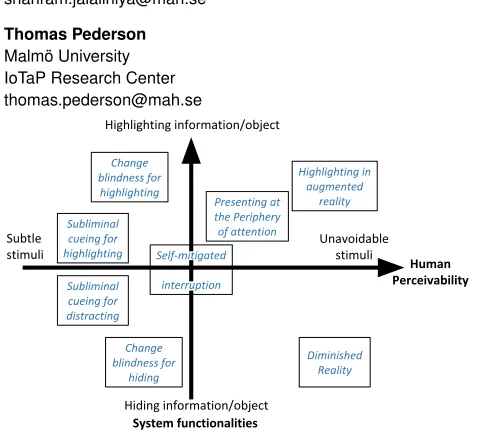
Figure 1:Symbiotic attention management quadrant.
Paste the appropriate copyright statement here. ACM now supports three different copyright statements:
• ACM copyright: ACM holds the copyright on the work. This is the historical approach.
• License: The author(s) retain copyright, but ACM receives an exclusive publication license.
• Open Access: The author(s) wish to pay for the work to be open access. The additional fee must be paid to ACM.
This text field is large enough to hold the appropriate release statement assuming it is single spaced in a sans-serif 7 point font.
Every submission will be assigned their own unique DOI string to be included here.
Abstract
In this position paper we stress the need for considering the nature of human attention when designing future poten-tially interruptive IoT and propose to let IoT devices share attention-related data and collaborate on the task of draw-ing human attention in order to achieve higher quality at-tention management with less overall system resources. Finally, we categorize some existing strategies for drawing people’s attention according to a simple symbiotic (human-machine) attention management framework.
Author Keywords
Eye tracking; Attention-aware systems; Internet of Things; smart environment
ACM Classification Keywords
H.5.m [Information interfaces and presentation (e.g., HCI)]: Miscellaneous
Introduction
an aggressive lion attacking from the left, a warrior from a competing tribe from the right, or a rock falling down from a mountain hitting us in the head. While our attention mech-anism still today is somewhat uselessly on its toes for such "Savannah events" and gradually prepares our bodies for action (e.g increasing adrenalin flow in case of danger), it fails miserably in coping with notifications that appear from perceptibly nowhere such as mobile phone call signals.
In this position paper we explore system design strategies for helping our biological attention mechanism deal with modern day interruptions. We adopt the widespread as-sumption amongst context-aware system designers that by better identifying the right time, place, and modality, smart IoT environments could potentially transmit more informa-tion (i.e. notificainforma-tions about the status of otherwise imper-ceivable processes) to human agents without significantly disturbing ongoing tasks. Some of the inspiration for our ap-proach comes from recent attempts to design for peripheral interaction [2].
Need for syncing and sharing attention information
We argue that to actually produce "graceful interruptions"
and even more if we want to go further into actually
direct-inghuman attention, we need to make our smart
environ-ments aware of the current focus and attention level of the target human agent(s). We see eye tracking as a starting point for future more advanced sensing and modeling ap-proaches of human attention. In this position paper we discuss how IoT components could potentially share in-formation about human agents’ attention in order to gain qualitative advantages collectively (in this way, we don’t need to completely fill our environments with expensive and carefully calibrated eye tracking devices), and we also dis-cuss the need for an artificial attention management more in sync with how our biological attention mechanism seems
to work. In the end of the paper we present a quadrant in-tended to inspire discussion on the workshop with regards to possible system design strategies for offering attention management in smart environments.
Human Visual Attention
The human brain processes an immense amount of infor-mation originating from body-external phenomena that is perceived by our senses (vision, auditory, olfactory, etc.) as well as from higher-level cognitive processes (our wishes, emotions, intentions) each second of our life. It has been estimated that around 95 percent of this brain processing is completely unconscious [8]. Furthermore, it is widely ac-cepted that there is a regulatory mechanism, an "attention" mechanism, which selects among these many unconscious processes and lifts one or a few of them to our conscious awareness at a given point in time. The exact nature of this mechanism, and how it combines higher-level intentions with lower-level external stimuli to direct our conscious fo-cused attention is still debated among psychologists. It is clear however, that human attention mechanism is affected by, and affect, the visual perception system: Eye move-ments in everyday life both form an important source of information to the attention mechanism for deciding where to focus our attention (the bottom-up information flow), as well as an indicator of what our current intentions are (the top-down information flow).
By tracking eye fixations in the environment that surrounds a given human agent, a computer system could, in theory, get an indication of what entities in that environment that matters to that human agent, in that moment.
Tracking Attention using Eye-Contact Sensors
pre-calibrated eye tracking units in the environment or some computationally intensive computer vision algorithms when using head-mounted gaze tracking. We believe that the idea of using eye contact sensors similar to the one imple-mented in [13, 14] could be a better and more affordable solution for obtaining knowledge about user’s attention in a smart environment. Compared to eye tracking solutions that estimate the user’s gaze in her/his field-of-view, an eye contact sensor is meant to only provide a binary output indi-cating whether the user is looking at a specific area in their field-of-view or not. Distributed and connected eye-contact sensors could provide a pervasive interaction solution with-out any need for continuously monitoring the user’s exact gaze point or what she/he is actually looking at in the envi-ronment. This could considerably optimize the computation which is more friendly for IoT-based infrastructures.
Distributing eye-contact sensors in the scene could also ad-dress some of the privacy issues that are associated with obtaining gaze data and eye information. Moreover, us-ing eye contact sensors instead of remote or mobile gaze trackers enables us to move the smart objects in the envi-ronment without tagging and tracking the objects. In such smart environments, objects can communicate eye contact data with each other (as part of a bigger sensor network) or send it to the cloud in real-time. Subtly monitoring human agents’ visual attention and their intention via distributed (visually) attention-aware objects could be a promising ap-proach for improving future context models in the field of Context Aware Systems.
Although gaze information can be successfully used for supporting explicit control of devices around us ([10, 15, 1, 11]), many of our everyday interactions could also be facili-tated by a system that more subtly monitors our natural eye movements (attentive user interfaces [9]). Different passive
interaction strategies could be imagined in an attention-aware smart environment either when eye contact sensing objects are viewed as standalone and self contained ob-jects or when they work in a co-operative scenario as part of a bigger infrastructure.
Changing state upon eye contact or eye leave
Smith et al. [14] proposed a number of interaction principles for using eye contact sensors for direct interaction with in-dividual objects. Two main examples are when eye contact sensing objects could change their state upon direct eye contact (e.g. light goes ON after looking), or of particular in-terest, when the eye contact sensing object reacts upon eye leave (e.g TV pauses the movie when user looks away from screen).
Providing context
Eye contact can open up a communication channel through which the user can interact with the objects using other modalities such as speech, or other control devices. Here, user’s attention provides context for an action by making the smart object stand by and ready for receiving commands (e.g. a voice command) from other modalities [14].
Activity Assistance
very challenging to design and most likely to fail unless de-vices collaborate in both sensing visual attention, attracting visual attention (discussed in the next section of this pa-per), and collaborative coordination as to when and by what device this is done. By analyzing duration of users visual attention to a particular objects, the system could potentially identify whether the user needs supportive information in relation to a given device or not. In daily routine activities e.g. cooking, we usually follow a relatively fixed procedure. For some people with mental illnesses such as dementia, it is often not easy to remember even such routine pro-cedures. In such cases, attention analysis could facilitate automatic recognition of the intended activity, detection of potentially missing steps, and providing supportive informa-tion.
An example scenario of subtle highlighting:
A person is reading a book at home. According to the sched-ule of the person, she needs to call her dentist to book a time in 10 minutes. For avoid-ing an unwanted interruption, the system should be able to direct her attention towards the phone in a subtle way. The person and the phone are located in two different rooms; therefore to direct her attention from the book to the phone, several smart objects need to cooperate. First, the light located in her field of view flashes quickly (below the supraliminal threshold) but the user misses the first flash. Since the light is equipped with an eye contact sensor, it repeats flashing until the user looks at the light. The light communicates the eye contact with the TV. Then the TV tries to draw user’s attention to the phone by displaying a visual cue. When she walks towards the TV, the phone is in her field of view and the phone reminds her to call the dentist.
Controlling Human Attention
The human brain is sometimes actually regarded to have several attention mechanisms but we will regard them as one in this discussion and focus on attention in relation to what is often called working memory. The working mem-ory is highly volatile and contains basically everything we are consciously aware of at a given point in time: a handful selected long term memory items plus a handful selected current perceptions [7]. Any call for human attention (such as a notification from an interactive device) will alter the cur-rent composition of items in the working memory. It is obvi-ous, then, that the better our artificial interruptive systems are at guessing the content of working memory of a given human agent, the better they will be in performing graceful interruption. But the fact is that we don’t need to stop at just
monitoringattention (working memory) - we could just as
well try to more preciselyinfluenceits contentsin
symbio-siswith the existing biological attention mechanism in the
brain. This is our vision and what follows is a first attempt define some strategies for doing exactly this.
Symbiotic attention management strategies
In a smart environment with distributed interactive devices, each device can potentially initiate an interactive dialogue with a human agent. If the interaction request is not rele-vant to the task at hand it can be considered an unwanted interruption. One of the main goals of an artificial attention management mechanism would be to mitigate unwanted interruptions and also to assure that relevant notifications are perceived at the right moment. In short, such a
mech-anism shouldsuppress or hideirrelevant information (e.g.
[17]) andhighlightrelevant notifications (e.g. [3]). For
ex-ample, if a human agent is not looking at a relevant smart device, the artificial attention management mechanism that tracks the human agent’s eyes could highlight the smart device or somehow direct the visual attention towards the relevant smart object by e.g. flashing lights in the environ-ment or proving visual cues on a head-mounted display if the person is wearing an augmented-reality head-mounted display.
Similar approaches to subtle notification can be taken to distract visual attention away from irrelevant pieces of
in-formation. Thishighlightingandhidingcan be made
ex-tremelysubtleor completelyunavoidable(impossible to
not notice) or something inbetween. By placing different types of attention control methods along the perceivabil-ity and highlight/hide dimensions, we get a quadrant (Fig. 1) which illustrates design alternatives for attention man-agement in IoT-enabled smart environments. The vertical axis of the quadrant represents different strategies for arti-ficial attention management available to system designers (system functionalities). The horizontal axis (perceivability) represent characteristics of human perception which we as system designers cannot affect.
in the workshop about how to design different artificial at-tention management mechanisms in relation to humans’ biological attention system. To illustrate the potential ben-efits of the proposed quadrant for this purpose, we briefly review some previous work in the light of it:
JULY–SEPTEMBER 2015 PERVASIV E computing 23
systems we aim to design are closer to the user’s body and mind than classical personal computing devices have ever been. Inspired by these
findings, we propose an information
flow model that considers the percep-tion, cognipercep-tion, and action of human agents while (unlike in more classical HCI models) dealing with conscious and unconscious cognition separately. This lets us take a more holistic view of the role of WPAs, making it evi-dent that the explicit interaction be-tween WPAs and users occurs in an information-rich context, in which our brains process much more than we traditionally model as system de-signers. It also lets us start speculat-ing about functionalities that WPAs could offer that interface directly with the unconscious part of our cognitive processes, something that is undoubt-edly still hard to implement in prac-tice, even if successful attempts have indeed been made.5
Although this article’s main focus is our egocentric approach to the design of WPAs inspired by modern cognitive science, we also discuss our experiences deploying the framework in the hospi-tal domain and our initial WPA proto-type for orthopedic surgeons based on the Google Glass platform.
Egocentric Interaction
Both system designers and users in-creasingly face a new HCI paradigm that redefines the relationship be-tween the human, computer system, and world: an egocentric interaction paradigm.6 This paradigm extends and modifies the classical user-cen-tered approach in HCI7 on several points:
rSituatedness acknowledges the pri-macy of the agents’ current bodily situation at each point in time in guiding and constraining agents’ behavior.
rAttention to the complete local en-vironment emphasizes the need to consider the entire environment,
not just a single targeted artifact or system.
rThe proximity principle assumes that proximity plays a fundamen-tal role in determining what can be done, what events signify, and what agents are up to.
rChangeability of the environment and of the agents’ relationship with the environment takes into account agents’ more or less constant body movements, including the head, hands, and sensing organs.
rThe physical-virtual equity principle
pays equal attention to interaction with both virtual (digital) objects (classical HCI) and physical objects (classical ergonomics). The term “egocentric” signals that it is the body and mind of a specific individ-ual that (literally) acts as the center of reference, so all modeling is anchored to this individual’s body and mind in this interaction paradigm. The term is analogously used in psychology and virtual reality to denote the conceptual and spatial frames of reference that hu-mans by necessity rely on when think-ing and actthink-ing in the world and when collaborating with others.8
Action and Perception Instead of Input and Output
In the egocentric interaction paradigm, the modeled individual must be viewed as an agent that can move about in a mixed-reality environment (an environ-ment consisting of both directly acces-sible everyday “real” entities and vir-tual/digital objects accessed through mediating digital devices), not as a user performing a dialogue with a com-puter. Adopting the physical-virtual equity principle, we suggest substitut-ing the concepts of (device) input and output with (human agent) action and perception.
The New “Desktop”
To facilitate the design of egocentric interaction systems such as the WPAs we focus on here, we developed a situ-ative space model (SSM) to capture what a specific human agent can per-ceive and not perper-ceive, reach and not reach, at any given moment in time (see Figure 1). This model is for the emerging egocentric interaction para-digm what the virtual desktop is for the PC/WIMP (window, icon, menu, pointing device) interaction paradigm: more or less everything of interest to a
World space Perception space Action space Recognizable set Examinable set Selected set Manipulated set
Figure 1. The situative space model (SSM).9 We developed the SSM to capture what a specific human agent can perceive and not perceive, reach and not reach, at any given moment in time. In particular, the perception space is the space around the agent that can be perceived at each moment. The action space is the space around the agent that is currently accessible to the agent’s physical actions.
Figure 2: Precise tracking of available nearby stimuli
generators:Systems intended to
generate stimuli that lie in the spectrum between unconsciously noticeable and consciously noticeable would probably be facilitated by having precise spatial understanding of available actuators (e.g. visual displays and loudspeakers) in the visual and aural fields of view of the human agent. A human body-centric model similar to this figure suggested by [12] could help us categorize nearby objects with regards to human perception and action capabilities.
1. Subtle highlighting:perhaps the most subtle way of di-recting attention is subliminal cueing [5]. Aranyi et. al. [5] have shown the significant effect of subliminal stimuli on se-lection behavior of users in a virtual environments. Another slightly less subtle way of presenting a notification or high-lighting a physical object in the human agent’s field of view is to make use of the change blindness phenomenon [16]. In this method, the notification is displayed during the eyes’ fast movements (saccades) resulting in a delayed percep-tion due to the temporary blindness during saccades [16]. A third approach is to present the notification or highlight an object at the periphery of the user’s attention, as
inves-tigated inperipheral interaction[6, 2]. As Figure 1 shows
the perceivability of the message in each method deter-mines how close to the extreme left side of the quadrant that method is located. We think all of these techniques could benefit from a network of attention-aware smart ob-jects as discussed earlier in this paper.
2. Unavoidable highlighting:unavoidable notification (e.g. sound notifications) are the most dominant way of notifying users in smartphones, smart watches, and desktop com-puters. An example of unavoidable highlighting physical objects is the Attention Funnel system [3] that uses aug-mented reality user interface to direct the visual attention of a user towards a particular object in the environment.
3. Subtle hiding:attention control is not always about no-tifying users. Sometimes it is beneficial to hide irrelevant information. We notice any significant change in our field of view. One subtle way of hiding objects/information is to
use the change blindness phenomenon [16] by e.g. remov-ing irrelevant information from a near-eye display durremov-ing saccades. Another approach to hide an irrelevant notifi-cation is to adjust the intensity of the stimuli based on the importance of the message tuned to how cognitively busy
the recipient is. This approach (self-mitigated interruption
[4]) probably constitutes the best example of a symbiotic combination of artificial biological attention management. It would also be possible to use subliminal cues similar to [5] for distracting users’ attention from irrelevant informa-tion/object(s).
4. Unavoidable hiding:diminished reality(e.g. [17]) refers to hiding objects by superimposing the background tex-ture on the object’s image and is one of the classical ap-proaches to visually remove physical object from real world.
Conclusions
While IoT is considered to be an ecology of interruptive computing devices, embedding eye contact sensor into the smart things seems to be an efficient way of designing attention-aware systems on the IoT platform. In this paper, we proposed a quadrant (Figure 1) including two important dimensions for integrating artificial attention control systems with our biological attention mechanism: one dimension ex-plains perceivability of the stimuli from human point of view while the other dimension ranges system functionalities from hiding to highlighting information/objects. We used our proposed quadrant as a conceptual framework to review some of the previous attempts to control human attention.
REFERENCES
1. Kevin Purdy Alastair G. Gale. 2007.The ergonomics of
attention responsive technology. Full research report.
3. Frank Biocca, Arthur Tang, Charles Owen, and Fan Xiao. 2006. Attention Funnel: Omnidirectional 3D Cursor for Mobile Augmented Reality Platforms. In
Proc. of CHI ’06. ACM, New York, NY, USA,
1115–1122.DOI:
http://dx.doi.org/10.1145/1124772.1124939
4. Frank Bolton, Shahram Jalaliniya, and Thomas Pederson. 2015. A Wrist-Worn Thermohaptic Device
for Graceful Interruption.Interaction Design &
Architecture Journal26 (2015), 39–54.
5. Gabor et. al. 2014. Subliminal Cueing of Selection
Behavior in a Virtual Environment.Presence:
Teleoperators and Virtual Environments23, 1 (2014),
33–50.DOI:
http://dx.doi.org/10.1162/PRES_a_00167
6. Doris Hausen. 2014. Peripheral Interaction - Exploring the Design Space, PhD Thesis. (2014).
7. Jeff Johnson. 2014.Designing with the Mind in Mind,
Second Edition: Simple Guide to Understanding User Interface Design Guidelines(2nd ed.). Morgan Kaufmann Publishers Inc., San Francisco, CA, USA.
8. G. Lakoff and M. Johnson. 1999.Philosophy in the
Flesh: The Embodied Mind and Its Challenge to Western Thought. Basic Books.
https://books.google.nl/books?id=KbqxnX3_uc0C
9. Päivi Majaranta and Andreas Bulling. 2014. Eye tracking and eye-based human–computer interaction. InAdvances in Physiological Computing. Springer, 39–65.
10. Diako Mardanbegi, Dan Witzner Hansen, and Thomas Pederson. 2012. Eye-based head gestures. In
Proceedings of the symposium on eye tracking research and applications. ACM, 139–146.
11. Petr Novak, O. Stepankova, M. Uller, L. Novakova, and P. Moc. 2009. Home and Environment Control.
COGAIN 2009 Proceedings. Lyngby: Technical University of Denmark(2009), 35â ˘A ¸S38.
12. Thomas Pederson, Lars-Erik Janlert, and Dipak Surie. 2011. A Situative Space Model for Mobile
Mixed-Reality Computing.IEEE pervasive computing
10, 4 (2011), 73–83.
13. Jeffrey S Shell, Roel Vertegaal, and Alexander W Skaburskis. 2003. EyePliances: attention-seeking
devices that respond to visual attention. InCHI’03
extended abstracts on Human factors in computing systems. ACM, 770–771.
14. John D Smith, Roel Vertegaal, and Changuk Sohn. 2005. ViewPointer: lightweight calibration-free eye
tracking for ubiquitous handsfree deixis. InProceedings
of the 18th annual ACM symposium on User interface software and technology. ACM, 53–61.
15. Eduardo Velloso, Markus Wirth, Christian Weichel, Augusto Esteves, and Hans Gellersen. 2016.
AmbiGaze: Direct Control of Ambient Devices by Gaze. InProceedings of the 2016 ACM Conference on DIS
’16. ACM, 812–817.
16. Mélodie Vidal, David H. Nguyen, and Kent Lyons. 2014. Looking at or Through?: Using Eye Tracking to Infer Attention Location for Wearable Transparent Displays. InProc. of ISWC ’14. ACM, New York, NY, USA,
87–90.DOI:
http://dx.doi.org/10.1145/2634317.2634344
17. Siavash Zokai, Julien Esteve, Yakup Genc, and Nassir Navab. 2003. Multiview paraperspective projection
model for diminished reality. InMixed and Augmented