MECHANIZED UREA TREATMENT OF WHEAT STRAW (PART II: MODIFICATION OF SMALL
RECTANGULAR BALER AND EVALUATION OF TREATED STRAW)
1*
Younesi Alamouti, M. and
1
Agricultural Engineering Research Institute, Agricultural Research Education and Extension Organization
2
Animal Science Research Institute, Agricultural Research Education and Extension Organization (AREEO),
ARTICLE INFO ABSTRACT
The conventional urea treatment of cereal straw process is a laborious, tedious and time
task. It is essential to facilitate or eliminate some of these operations by using machine. For this purpose, the small rectangular baler model 349
mechanical urea treatment systems. Based on the calculation, the required mechanisms were made and installed. The machine performance was evaluated in the farm condition by treating the straw mechanically. The nutrit
treated in conventional method. The experiments showed that there is no significant difference between two methods of treatment. Machine capacity is about 2 ton/hr and the usual (me tractors can be used for this purpose.
Copyright © 2015 Younesi Alamouti, M. and Zahedifar, M.
permits unrestricted use, distribution, and reproduction in any medium, provided the original work is properly cited.
INTRODUCTION
Straw is the most abundant of all agricultural residues. In general, straw is used for burning, composting, papermaking and animal husbandry. The main component of straw is fiber, including cellulose and hemicelluloses. Some cellulose and hemicelluloses are bound to lignin and resistant to microbial attack. Cereal straws are an important feed resourc
many developing countries and despite of its low digestibility, a significant amount is fed to ruminants. Treating consists of physical, chemical or biological processes which allow modification of the physical and chemical properties of the lignified walls of the forages so as to render them more accessible to the rumen's microorganisms and hence, more
digestible (Guo et al., 2002). There are three broad categories
of treatment: physical, biological and chemical. In fact, except for mowing, physical treatments are too onerous and their execution requires availability of complex machinery. As regards biological treatments, these still remain technically delicate to put into practice (Chenost and Kayouli, 1997)
*Corresponding author: Younesi Alamouti, M.
Agricultural Engineering Research Institute, Agricultural Research Education and Extension Organization (AREEO),
ISSN: 0975-833X
Article History:
Received 05th May, 2015
Received in revised form
05th June, 2015
Accepted 29th July, 2015
Published online 21st August,2015
Key words:
Urea treatment, Mechanical treatment, Wheat straw, Bale.
Citation: Younesi Alamouti, M. and Zahedifar, M.,
rectangular baler and evaluation of treated straw)
RESEARCH ARTICLE
MECHANIZED UREA TREATMENT OF WHEAT STRAW (PART II: MODIFICATION OF SMALL
RECTANGULAR BALER AND EVALUATION OF TREATED STRAW)
Younesi Alamouti, M. and
2Zahedifar, M.
Agricultural Engineering Research Institute, Agricultural Research Education and Extension Organization
(AREEO), Karaj, Iran
Animal Science Research Institute, Agricultural Research Education and Extension Organization (AREEO),
Karaj, Iran
ABSTRACT
The conventional urea treatment of cereal straw process is a laborious, tedious and time
task. It is essential to facilitate or eliminate some of these operations by using machine. For this purpose, the small rectangular baler model 349-T was selected for optimizing and setting up the mechanical urea treatment systems. Based on the calculation, the required mechanisms were made and installed. The machine performance was evaluated in the farm condition by treating the straw mechanically. The nutritional value of treated straw was measured and compared with the straw that treated in conventional method. The experiments showed that there is no significant difference between two methods of treatment. Machine capacity is about 2 ton/hr and the usual (me tractors can be used for this purpose.
Younesi Alamouti, M. and Zahedifar, M.This is an open access article distributed under the Creative Commons Att use, distribution, and reproduction in any medium, provided the original work is properly cited.
Straw is the most abundant of all agricultural residues. In composting, papermaking and animal husbandry. The main component of straw is fiber, including cellulose and hemicelluloses. Some cellulose and hemicelluloses are bound to lignin and resistant to microbial attack. Cereal straws are an important feed resource in Iran and many developing countries and despite of its low digestibility, a significant amount is fed to ruminants. Treating consists of physical, chemical or biological processes which allow modification of the physical and chemical properties of the lignified walls of the forages so as to render them more accessible to the rumen's microorganisms and hence, more ., 2002). There are three broad categories of treatment: physical, biological and chemical. In fact, except hysical treatments are too onerous and their execution requires availability of complex machinery. As regards biological treatments, these still remain technically
(Chenost and Kayouli, 1997).
Agricultural Engineering Research Institute, Agricultural Research Education and Extension Organization (AREEO), Karaj, Iran
Chemical treatment using Naoh and ammonia either in anhydrous or aqueous forms has been practiced in developed countries to improve the nutritive value of straws (Han 1983 and Sundstol and Coxworth, 1984). Ammonia treatment improves the digestibility of straw and low quality forages. Ammoniation usually increases digestibility by 20 percent and CP content up to 1-2 times. It can also improve palatability and consumption rate. The total nutritional value can be doubled. The sources of ammonia to treat straw include anhydrous ammonia, urea, ammonium bicarbonate and aqueous ammonia. Straw treatment with anhydrous a
expensive equipment. Furthermore, anhydrous ammonia is not well suited for private farmers because of its dangers (Guo
et al., 2002). Urea can be an inexpensive source of ammonia for the treatment of straws. Treating str
need complex equipment and the sealing conditions are not as strict as with anhydrous ammonia. Urea can be transported conveniently at normal temperature and pressure and it is harmless to humans. The use of urea as a source of ammoni one of the best alternatives for treating straw in developing countries. Urea dosage needed to treat straw may vary a lot. The recommended dosage is 4
(Jackson, 1978; Dolberg et al
1982; Imbrahim and Pearce, 1983).
International Journal of Current Research
Vol. 7, Issue, 08, pp.18871-18875, August, 2015
INTERNATIONAL
Younesi Alamouti, M. and Zahedifar, M., 2015. “Mechanized urea treatment of wheat straw (Part II: Modification of small luation of treated straw)”, International Journal of Current Research, 7, (8), 18871
MECHANIZED UREA TREATMENT OF WHEAT STRAW (PART II: MODIFICATION OF SMALL
RECTANGULAR BALER AND EVALUATION OF TREATED STRAW)
Agricultural Engineering Research Institute, Agricultural Research Education and Extension Organization
Animal Science Research Institute, Agricultural Research Education and Extension Organization (AREEO),
The conventional urea treatment of cereal straw process is a laborious, tedious and time-consuming task. It is essential to facilitate or eliminate some of these operations by using machine. For this ected for optimizing and setting up the mechanical urea treatment systems. Based on the calculation, the required mechanisms were made and installed. The machine performance was evaluated in the farm condition by treating the straw ional value of treated straw was measured and compared with the straw that treated in conventional method. The experiments showed that there is no significant difference between two methods of treatment. Machine capacity is about 2 ton/hr and the usual (medium)
is an open access article distributed under the Creative Commons Attribution License, which
Chemical treatment using Naoh and ammonia either in anhydrous or aqueous forms has been practiced in developed
tries to improve the nutritive value of straws (Han et al.,
1983 and Sundstol and Coxworth, 1984). Ammonia treatment improves the digestibility of straw and low quality forages. Ammoniation usually increases digestibility by 20 percent and 2 times. It can also improve palatability and consumption rate. The total nutritional value can be doubled. The sources of ammonia to treat straw include anhydrous ammonia, urea, ammonium bicarbonate and aqueous ammonia. Straw treatment with anhydrous ammonia is requires some expensive equipment. Furthermore, anhydrous ammonia is not well suited for private farmers because of its dangers (Guo
., 2002). Urea can be an inexpensive source of ammonia for the treatment of straws. Treating straw with urea does not need complex equipment and the sealing conditions are not as strict as with anhydrous ammonia. Urea can be transported conveniently at normal temperature and pressure and it is harmless to humans. The use of urea as a source of ammonia is one of the best alternatives for treating straw in developing countries. Urea dosage needed to treat straw may vary a lot. The recommended dosage is 4-5 percent urea on DM basis
et al., 1981; Jayasuriya and Perera, 1983).
INTERNATIONAL JOURNAL OF CURRENT RESEARCH
Conventional urea treatment consists of spraying urea solution onto the dry mass of forage and covering the treated straw with materials available locally, so as to form a hermetic seal. Practical conditions affecting successful treatment include the presence of ureas, the application rate of urea, moisture content, ambient temperature and the length of the treatment period, sealing condition and the quality of the forage to be treated. In practice 50 liters of water added to every 100 kg of forage. There is no problem if the amount of water added varies within the range of 40 to 80 liters. The final moisture content should never be greater than 50%. Treatment time varies inversely with temperature. More than four weeks are needed at a temperature of 5-15°C, but only one week at >30°C (Chenost and Kayouli, 1997).
At present, the conventional methods that used for ammonia treatment of straw in Iran, includes stack and silo methods and has done on the straw that collected form the field (Raisianzade
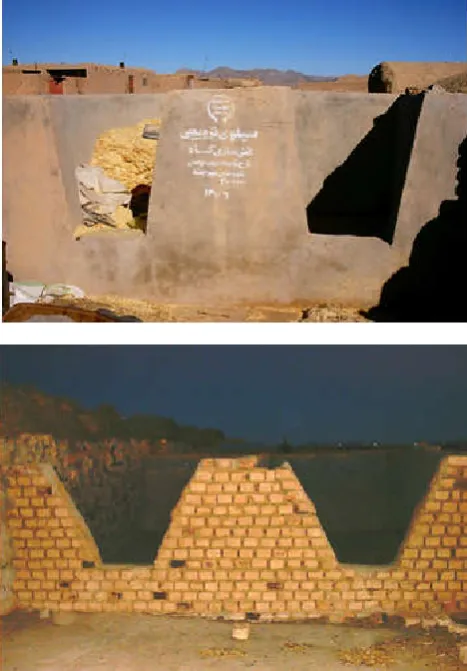
[image:2.595.47.281.402.738.2]et al. 2005). The procedure for the stack method is as follows: First, an area is selected with an elevated, dry and even surface. This area is covered with plastic sheet and loose straw is stacked on it. About 5 kg of urea are dissolved in 50 liters of water for every 100 kg of dry straw. The urea solution is sprayed into straw layer by layer, whilst the stack is constructed. Then the whole stack will be cover with a second and much wider plastic sheet, making sure that coverage is the best possible. Surface silo constructed with cement (Figure 1), also has been used for urea treatment of straw (loose form of chopped or long straw).
Figure 1. A kind of silo which used for urea treatment (Iran)
The size of silo is depended on animal type and quantity. One
Silo of 2 m3 can hold 300 kg of wheat straw. In this method,
straw is chopped and then urea is added to water and stirred to completely dissolve it. Normally, 5 kg urea and 40-60 kg water is used for 100 kg dry matter of straw. Next, the urea solution is sprayed repeatedly over the straw. Before loading the silo, straw can be spread in an open area to facilitate uniformity in spray application. While straw is added to the silo, each layer will be compacted till the silo is full, and then it is covered with plastic film.
At present a substantial quantity of straws is wasted or poorly utilized in Iran. The conventional urea treatment process is a laborious, tedious and time-consuming task and is not used by farmer. The treatment process involves a number of laborious and tedious tasks such as handling and mixing of large quantities of straw. It is essential to facilitate or eliminate some
of these operations by using machine (Raisianzade et al. 2005).
Low-density (<100 kg/m3) cube baler is used to collect and
compress hay or straw in Iran. It makes bales from the straw windrow left by the combine and it is powered from the power take-off shaft (P.T.O.) of the tractor. The straw windrow is lifted from the ground by a pick-up reel having spring teeth and transferred continuously to a conveying and feeding mechanism as the baler moves forward along the windrow. Therefore, one possible way for mechanized urea treatments of straw in this condition is, to spray the urea solution on straw when it is harvested from the field.
The objectives of this research are: 1) modification and installation of spraying systems on small rectangular baler on the base of former studies (part I) and 2) evaluating the modified baler by comparing the mechanized urea treated straw with conventional method and determining the machine capacity for this method.
MATERIALS AND METHODS
The small rectangular baler model 349-T was selected for installing the spraying systems and making baler as a Cereal Straw Urea Treatment Machine (CSUTM). Modification and installation of spraying systems on small rectangular baler has done on the base of former studies (Part I: Determination of Wetting Properties of Wheat Straw). The systems consist of: a pump, a urea solution tank, a regulator and 20 flat fan nozzles. Then the required power, required flaw rates and pump type, frame and tank (container) capacity were selected in the basis of former studies (Part I). By installing these parts on baler, the Cereal Straw Urea Treatment Machine (CSUTM) was formed (Figure 2). The CSUTM performance was checked in the farm condition and malfunction was corrected. The feed (amount of straw per meter) and baling rate (tractor speed) were measured in order to find an optimal urea solution that should be sprayed. Five percent of urea solution was obtained and the tank filled with it. The nozzles flow rates were adjusted and CSUTM connected to the power take-off shaft of tractor (P.T.O.), for preparing Mechanized Urea Treated Straw (MUTS). The tractor moved in windrow straw (pishtaz variety) left by the combine and the MUTS bales were formed. After initial 5 bales, 3 MUTS bales were collected for determination of moisture content and some nutritional value.
Figure 2. Cereal Straw Urea Treatment Machine (CSUTM)
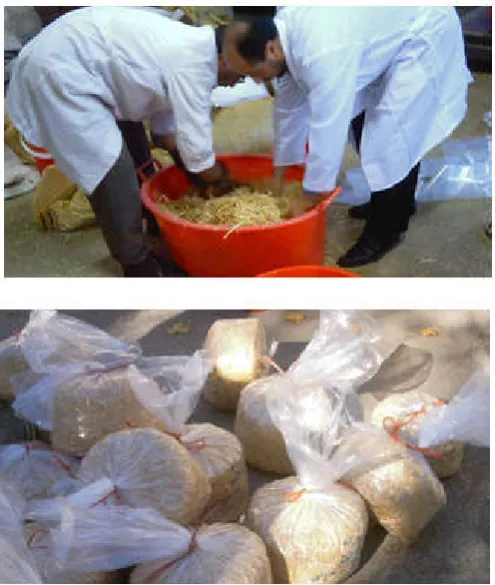
The later three selected MUTS were lie under plastic film in farm condition for one month in summer (Figure 4). At the same time the conventional method was used for treating chopped straw with 100 cc water and 5 g urea for every 100 g dry straw. The straw was chopped to about 2 cm long and then the urea solution applied on it and was fully stirred. Treated straw, then placed in PVC bags and put it under plastic sheet near the MUTS bale stack for one month (Figure 3 and 4). Dry matter (DM), ash, neutral detergent fiber (NDF), acid detergent fiber (ADF), acid detergent lignin (ADL), dry matter digestibility (DMD), crude protein (CP), organic matter digestibility (OMD) of treated and untreated straw samples have been determined and the obtained data were analyzed.
[image:3.595.310.557.52.240.2]Figure 3. Conventional method which used for urea treatment of chopped straw
Figure 4. Mechanized treated straw in plastic sheet
RESULTS
The nutritional values and digestibility of straw samples were showed in Table 1 and 2. The dry matter content of untreated straw was 92.03, which reached to 49.93 and 47.25 in two methods. Also, the value of DMD changed from 30.00 in untreated straws increased to 44.63 and 42.29 in conventional and mechanized methods respectively (Table 1). The differences between two methods were not significant (P<0.05). The mean value of crude protein of untreated straws was 1.52, which increased to 4.53 and 3.81 percentages in two methods.
DISCUSSION
[image:3.595.38.286.429.722.2]conventional method is done by hand in laboratory and small scale (Figure 3).
Conclusions
There is no significant difference between DMD of treated
straw in two methods (conventional and mechanized) treatment.
The system (CSUTM) has the capabilities of work in farm
condition.
The current tractor (medium tractors) can be used for
making nutrition and baling the straw with CSUTM.
These data analyzed from the results of this experiment and more research and details are required to evaluate the performance of machine and this method of treatment. With Installing spray systems on a conveying and feeding mechanism of cube baler, straw can be collected, treated and compressed simultaneously. The handling task could be minimized substantially, and the mixing task could be eliminated altogether if urea solution were applied into the straw in this method. For this purpose, the rectangular baler model 349-T was selected to optimize and setup the mechanical treatment systems. The objective of this paper is: Treating straw with urea solution by Cereal Straw Urea
Treatment Machine (CSUTM) and evaluating the system
by comparing the treated straw with conventional methods (Figure 3).
REFERENCES
Alibes, X. J. M. and Munoz, F. 1992. Chemical treatment of
lignocellulosic residues with urea. Animal Feed Science and
Technology, 38:319- 333.
Chenost, M. and Kayouli, C., 1997. Roughage utilization in warm climates. FAO Animal Production and Health Paper 135. Rome.
Cloete, S. W. P. and Kritzinger, N. M. 1984. A laboratory assessment of various treatment conditions affecting the ammoniation of wheat straw by urea 1. The effect of
temperature moisture level and treatment period. South
African Journal of Animal Science, 14:55-58
Cottyn, B. G. and De Boever, J. L. 1988. Upgrading of straw
by ammoniation. Animal Feed Science and Technology,
21:287-294.
Coxworth, E., Kernan, J., Nicholson, H. and Champlin, R. 1977. Improving the feeding value of straw for ruminant animals. Chapter in "On- farm waste utilization for feed-opportunities and profits for livestock producers". Published by Agricultural Economics Research Council of Canada.
Dias, D.A., Silva, A.A. and Sundstol, F. 1986. Urea as a source of ammonia for improving the nutritive value of wheat
straw. Animal Feed Science and Technology, 14: 67-79.
Dolberg, F., Saadullah, M., Haque, M. and Ahmed, R. 1981. Storage of urea- treated straw using indigenous material.
World Animal Review, 38:37-41.
Guo Tingshuang, Yang Zhenhal and Zhang Zhishan, 1993. New base of ruminants production in China cropping area. In “Proceedings of the International Conference on Increasing Livestock Production through Utilization of Local Resources” Beijing. 18–22 october, 1993, 1–13. Hadjipanayiotou, M. 1982. The effect of ammoniation using
urea on the intake and nutritive value of chopped barley
straw. Grass and Forage Science, 37:89-93
Hadjipanayiotou, M., Verhaeghe, L., Labban, L. M., Shurbaji, A., Kronfoleh, A. R., Al-Wadi, M., Amin, M., Naigm, T., El Said, H. and Al Haress, A. K. 1993. Feeding ensiled
poultry excreta to ruminant animals in Syria. Livestock
Research for Rural Development, Volume 5, Number 1: 30-38.
Imbrahim, M. C. N. and Pearce, G. R. 1983. The effect of urease enzyme on treatment time and the nutritive value of
straw treated with ammonia as urea. Animal Feed Science
and Technology, 8:271-281
Jackson, M.G. 1978. Treating straw for animal feeding. FAO Animal Production and Health Paper 10.
Jayasuriya, M. C. N. and Perera, H. G. D. 1982. Urea-treatment of rice straw to improve its nutritive value for ruminants.
Agricultural Wastes, 4:143-150.
Jayasuriya, M.C.N. 1985. Potential for the better utilization crop residues agro – industrial by products in animal feeding in Indian subcontinent. FAO. Animal Production and Health Paper, 50: 37-50
Kristensen, V. F. 1984. Straw in practical rations for cattle with special reference to developed countries In: Straw and other fibrous by-products as feed (Editors: F Sundstol and E Owen). Elsevier, Amsterdam, Oxford, New York, Tokyo, pp 431-453
[image:4.595.72.520.78.130.2]rectangular baler and evaluation of treated straw)
Table 1. Comparing nutritional values of wheat straw with treated straw
Methods of treatment DM Ash CP CF NDF ADF ADL
Untreated straw 92.03 a 7.03 a 1.52 a 43.53 b 79.66 b 47.93 c 6.06 b
Conventional 49.93 b 6.30 a 4.53 c 47.03 a 80.93 b 50.80 b 7.66 a
Mechanized (CSUTM) 47.25 b 6.40 a 3.81 b 47.09 a 82.00 a 53.40 a 7.46 a
Table 2. Comparing digestibility of wheat straw with treated straw
Methods of treatment DMD OMD DOMD
Untreated straw 30.00 b 27.64 c 25.92 c
Conventional 42.29 a 43.84 a 41.08 a
[image:4.595.125.467.159.213.2]MAFF, 1975. Ministry of Agriculture, Fisheries and Food. Technical Bulletin 33 Energy Allowances and Feeding Systems for Ruminants, London: HMSO
Promma, S., Tuikampee, S., Vidhyakorn, S. and Ratnavanija, A. 1983. A study on feeding beef cattle with treated rice straw. Proceedings of the 21st Annual Conference of Animal Science Section, Kasetsart University, Chiang Mai, Thailand
Raisianzade, M., Faizi, R., Abbasi, A. and Monazami, H. 2005. Acceptability of urea treating straw project by sheep breeders in Khorasan province. In: Proceedings 2nd conferences of sheep and goat. Animal Science Research Institute, Ministry of Jahad-e Agriculture, Karaj, Iran.
Sundstol, F. and Coxworth, E. M. 1984. Ammonia treatment In: Straw and other fibrous by-products as feed (Editors: F Sundstol and E Owen) Elsevier, Amsterdam, Oxford, New York, Tokyo, pp 196-247
Sundstol, F., Coxworth, E. and Mowat, D. N. 1978. Improving the nutritive value of straw and other low-quality roughages
by treatment with ammonia. World Animal Review,
26:13-21
Wanapat, U., Sundstol, F. and Garmo, T. H. 1985. A comparison of alkali treatment methods to improve the
nutritive value of straw. I. Digestibility and
metabolizability. Animal Feed Science.