Structural Evolution of a Precambrian Segment: Example
of the Paleoproterozoic Formations of the Mako Belt
(Eastern Senegal, West Africa)
Mahamadane Diene1*, Mamadou Gueye1*, Dinna Pathé Diallo2, Abdoulaye Dia2 1
Institut des Sciences de la Terre, Université Cheikh Anta Diop, Dakar, Senegal 2
Departement de Géologie, Université Cheikh Anta Diop, Dakar, Senegal Email: *[email protected], *[email protected]
Received November 15,2011; revised December 26, 2011; accepted January 28, 2012
ABSTRACT
The western part of the Kedougou Kenieba Inlier is located in the West African Craton. It consists of paleoproterozoic NE-trending elongate belts (subprovinces) of metavolcanic and granitic rocks that alternate with metasedimentary belts. Major linear fault such as the MTZ which also approximate a north-easterly trend form the eastern boundaries. The field observations and geophysics analyses were completed by a microscopic study. Based on these data we define across this region four lithostructural domains from east to west. The western domain is structurally complex. The rocks of this domain have been subjected to a complex history of polyphase deformation and metamorphism. The structural analyse allow us to distinguished three deformation events. The deformation results in the formation of D1 thrust tectonic and D2 and D3 transcurrent tectonic. The structural evolution of the Mako Belt is characterized by deformation dominated by the intrusion of large TTG batholiths (D1) followed by basins formation and transpression accommodating oblique convergence and collision (D2 and D3). The change from thrusting (D1 deformation to transcurrent motion (D2 and D3) is recorded in the marginal basin of the central domain and in Tinkoto pull apart basin. The timing of these basins indi- cates a diachronous evolution. Deformation styles within the basin are compatible with a dextral transpression which terminated at ca 2090 Ma. Small extensional basins formed over the rocks of the Mako Belt are filled with continental detrital sedimentary rocks that show weak foliation and active felsic volcanism. We suggest that the sinistral transpres- sive tectonic associated with oblique subduction may have generated the pull-apart basin and subaqueous volcanism. In part these features are now related to terrain accretion, thrusting and strike slip movement during oblique convergence. The inversion of the large scale structural evolution from thrusting to strike slip is common to modern orogenies.
Keywords: Kedougou Kenieba Inlier; Paleoproterozoic; Transpression; Mako Belt; Oblique Convergence; Collision; Thrusting; Transcurrent
1. Introduction
Paleoproterozoic orogenic belts are the product of defor- mation, metamorphism, and plutonism. Compilation of structural data with petrologic and geochronological in- formations is essential to unravel their evolution. Various studies on these granite-greenstone terrains of the West African Craton (WAC), using geochemical and isotopic data have been carried out in the last decade (Bassot [1], Dia [2], Abouchami et al., [3], Boher et al., [4], Ndiaye et al., [5], Dia et al., [6], Pawlig et al., [7], Gueye et al., [8]). However the structural data and their role in the evolution of the Paleoproterozoic orogenic belts are still quite scarce in WAC, particularly in Senegal.
Knowledge of the timing of structural evolution of vol- cano-plutonic belts is fundamental for the understanding
of the tectonic evolution of paleoproterozoic terrains of the WAC.
The aim of this paper is to constrain the structural evo- lution of the volcanic and plutonic belts of the Kedou- gou Kenieba Inlier (KKI) particularly the Mako Belt (MB) which lies at the western margin of the KKI.
We present a new interpretation of the paleoprotero- zoic tectonic evolution of the Mako Belt integrating geo- physical data with detailed geological studies.
2. Geological Setting
2.1. The KedougouKenieba Inlier (KKI)
The lower Proterozoic KKI (Figure 1) lies between the Taoudeni basin in the east and the senegalo-mauritanian basin in the West. It is composed of NE-trending elon- gate belts of metavolcanic and granitic rocks that alter- nate with metasedimentary belts.
Figure 1. The Birimianterrane of the West African Craton (WAC) with the position of the Kedougou-Kenieba Inlier (KKI). Geological map of Kedougou-Kenieba inlier. Modified after Peucat et al., 2005, Bassot, 1966; Ledru et al., 1989.
In the KKI two supergroups are represented (Bassot, [1]):
In the west the Makosupergroup of submarine volca- nics, pyroclastics and plutonic rocks
In the east the Diale-Dalemasupergroup consisting of metasediments with intermediate volcanics and hy- byssal rocks.
The KKI features a series of NE-SW trending faults with alternating high and low strain zones. Bertrand et al., [9] recognized the polycyclic character of the tectonic evolution and place the Mako supergroup at the base (lower Birimian). Milesi et al., [10] and Ledru et al., [11] agree on the polycyclic character. The classical lithology was revised by the application of geochemical data (Bassot [1], Dia [2], Abouchami et al., [3], Pawlig et al, [7]) which puts the volcanic series in a stratigraphically lower position in reference to Archean greenstone belts
assemblage which are apparently very similar.
The tectonic evolution of the KKI isnot completely documented, but three major tectonic events called D1 and D2 - D3 have been defined (Milési et al., [12]; Ledru et al., [11]). The major D1 tectonic episode, which occur- red around 2112 Ma to 2100 Ma (Feybesse et al., [13] and [14]), is attributed to collisional tectonics between archean and proterozoic domains. This phase was consi- dered to be one of the principal criteria for distinguishing B1 (Lover Birimian affected by thrusting D1) from B2 (Upper Birimian affected by only two later phases trans- current deformations D2 and D3). It was associated to deformation dominated by the intrusion of large batho- liths.
been 40 Ma (Feybesse et al., [13]). The D2 phase was interpreted as transcurrent deformation along a network of ductile shear zones (Milesi et al., [12], Ledru et al., [15]) and corresponds to transpression accommodating the emplacement of the Laminia Kaourou Plutonic com- plex (LKPC) (Gueye, [16]). It has been long postulated that the elongated shape of most of the intrusions was due to syntectonic emplacement in relation with the ac- tivity of the shear zones (Pons [17], Gueye et al. [18]). Two geodynamic environments for the Birimiantholeiitic rocks have been proposed, either an intra-oceanic island- arc setting (Zonou [19]; Dia [2]; Sylvester and Attoh [20], Ama-Salah et al. [21], Pawlig et al. [7]) or an oceanic plateau setting (Abouchami et al. [3]; Boher et al. [4]; Pouclet et al. [22]).
2.2. The Mako Belt (MB)
The paleoproterozoic Mako Belt lies at the western mar- gin of the KKI. The belt consists of greenschist to lower amphibolite facies sedimentary and volcanic successions and associated granitic and mafic intrusions. The granite plutons, including the Diombalou pluton in the north, the Layered Plutonic Complex and the Laminia Kaourou Plu-tonic Complex in the west, the Falombo and Bouroum- bourou plutons in the centre and the Tinkoto pluton in the south are composed mainly of deformed I-type gran- ites and undeformed leucogranites. Mafic intrusions con- sists of gabbros and dolerites most of which have been metamorphosed to greenschist and amphibolite facies al- though igneous texture (ophitic texture) are preserved. Available geochronological data show that most of the sediments and volcanic successions and granite in the MB formed in the period 2200 - 2000 Ma and were me- tamorphosed and deformed at 2100 Ma based on the bio- tite 40 Ar/39 Ar age of 2100 Ma from the Badon granite, interpreted as a metamorphic age (Gueye et al, [8]). A post tectonic rhyolite that intrude the upper sequence of the MB yields a Pb/Pb zircon age of 2056 Ma, which provides a minimum age for the belt.
The Mako belt has a dominant NE-SW structural trend, which deflects to an N-S direction in the north. The sha- pe of the NE-trending greenstone belts is at least in part controlled by a network of anatomising N to NE-trending lineaments and shear zones. These form the boundaries of the rock units and divide it into corridor or domains. The major terrain boundary is defined as fault zone. Two main episodes of volcanism have been recognized in the Belt:
An older succession consisting of pillow basalts;
A younger succession consisting of massive volcanic rocks.
The older contain interlayered komatiite and tholeiitic and high-Mg basalts. Pillowed and massive basalts are interlayered with co-magmatic layered mafic sills. Green- stone succession to the east of the belt contains interlay-
ered tholeiites with associated volcaniclastic rocks. The calcalkaline volcanic sequences range from basalts to rh- yolites, although predominantly andesites and dacites.
Granitoids in Mako Belt fall into one of three catego- ries: gneissic and intrusive complexes (Sandikounda and Badon), diapiric (syntectonic) plutons of variable compo- sition Diombalou, Bouroumbourou, Falombo), late gran- itic plutons and rhyolite (Tinkoto, Mamakono).
Gneissic complexes and batholith which are dominan- tly tonalitictrondhjemite and granodiorite so-called TTG suite compose most of preserved paleoproterozoic crust. Most granite and felsic volcanics are genetically related. Detailed studies (Dia et al., [6]; Pawlig et al., [7]) of the geochemistry of the Mako belt have demonstrated that the plutons are calcalkaline and metaluminous. Pb-Pb zircon age determination (Gueye et al., [8]) gives an age range between 2200 and 2070 and indicates the absence of older crustal material.
3. Structural and Kinematic Analysis within
the Mako Belt: New Results
Regional deformation in the KKI is diffusely accommo- dated by ductile to ductile-brittle strike slip shear-zones, lateral thrusts and isoclinal folds along the Mako Belt. Deformation within the Mako Belt is found to be strong- ly partitioned into shear zones, which are unevenly distri- buted across the area. Sinistral strike-slip fault systems in the MB, with the NE-SW and N-S trending Main Trans- current Zone (MTZ) and LeobaMoussala faults (LMFZ) respectively, are the most noteworthy features dominate. These fault zones accommodate strain localization and are responsible for complex fold interference patterns and are also associated with the emplacement of granitic plutons. They separate blocks with distinct structural-metamorphic histories. Many authors have suggested a genetic relation- ship between faults (or shear zones) and magmatism (Gue- ye et al. [18], Pons [17]).
Figure 2. Foliation trajectories within the Mako Belt. (MTZ: main transcurrent zone; SSZ: Sabodala shear zone; BNZS: Ba-don-Niéniéko shear zone; YTZ: Yaaka transcurrent zone; LMSZ: Léoba-Moussala shear zone).
[image:4.595.119.481.459.707.2]3.1. The Main Tectonic Events
Three principal episodes of ductile to semi-ductile ebur- nean deformation have been recognized in the studiedarea. Macro-, meso- and microstructures within the belt can be described in terms of D1, D2 and D3 deformational epi- sodes.
3.1.1. The D1 Phase
The oldest deformation structures (D1) are preserved in xenoliths within the undeformed parts of the Sandikoun- da Layered Complex, the second oldest recognised intru- sive component of the Mako Belt. In this area, thrusting SE-verging deformation took place and is characterized by a series of imbricate banded gneisses, volcaniclastics and volcanic rocks dipping 40˚NW, with asymmetric folds. Thrusting is post dated by the emplacement of the Sandikounda Layered Plutonic complex (SLPC), placing a tight constraint of 2160 - 2140 Ma (Dia et al., [6]).
The preservation of flat lying thrusts in greenstone belts is rare because thrusts are commonly refolded into tight upright orientations due to subsequent shortening.
Features suggesting that the Sandikounda Fault is a thrust, are well developed in the Tonkoutou area. Dip pa- rallel stretching lineations are present. Schematic geolo- gical cross-section NW-SE in this area (Figure 4), shows a stacking of units to high grade metamorphism formed by amphibolo-gneiss, on weakly metamorphic units formed by the metabasalts, the volcaniclastic and layered pluto- nic complex. The relationship between the foliation and lineation, as well as recumbent folds, shows a thrust cha- racter with a SE-verging which would have affected the lithological stack in this sector of Sandikounda.
This style characterizes a thrust deformation and is ob- servable in this sector of Sandikounda.
However, some features of this thrusting, were affected by subsequent phases of deformation but also by the phe- nomena affecting migmatization amphibolites which are due probably by the large heat flow accompanying the introduction of the layered plutonic complex.
[image:5.595.139.460.364.710.2]The reverse component of movement, deduced from the juxtaposition of higher grade metamorphic rocks over lower-grade metamorphic rocks changes the structural interpretation of the area.
3.1.2. The D2 Phase
The NW-SE compression event, which we will name D2 in accordance with the classical terminology (Milési et al., [12]; Ledru et al., [11]; Feybesse et al., [13]), is un- doubtedly responsible for the map scale structures. N to NE-trending structures developed in the shear zone dur- ing D2 as the result of sinistral shear, are partially affec- ted by late deformation. The D2 phase is characterized by a NE-SW to N-S subvertical foliation associated with assymmetric folds and astretching lineation parallel to the axial planes of the fold. The stretching lineation plun- ges gently (subhorizontal) or more steeply in the strike- slip fault.
The D2 structures have been interpreted as the result of eburnean NW-SE horizontal shortening in a transpressive regime under amphibolite facies condition (Gueye [16]).
The predominantly transpressional regime represents a major change in tectonic style in the Mako Belt. Steep sinistral strike slip shear zones were produced during this
D2 transpressional stage.
3.1.2.1. Transcurrent Faults
The north east trending faults: example of the Main Tran- scurrent Zone (MTZ)
The 125 km wide MTZ (Figure 5) of SE Senegal and Mali formed as a result of transcurrent motion between two major crustal blocks namely Mako and Diale-Dale- ma. Previously this shear zone was considered to be a continuous lineament but our recent structural studies show that it is divided into northern and southern bran- ches. Ductile deformation is reflected in tight folding with steeply dipping foliation.
[image:6.595.94.501.324.711.2]Numerous structural signatures (shear sense indicators) were identified along the strike of the MTZ, ranging from dextral strike slip in the southern segment (Figures 6(b)-(c)) of the fault zone to sinistral strike slip in the Malian part (Figure 6(a)). The fault is composed of bands of higher shear strain alternating with lower strain domains.
Figure 6. Photographs in vertical section and photomicrographs showing some example of shear sense indicators such as ob-served along the MTZ and the LMFZ. (a) S-shaped fold which affects the mylonitic foliation of the MTZ; (b) and (c): Sedi-mentary units of the MTZ displaying delta-shape structure that indicate sinistral sense of movement; (d) and (e) Mica fish and delta-shaped clast indicating sinistral sense of movement along the LMFZ.
3.1.2.2. North-South-Trending Faults: Example of the Leoba Moussala Fault Zone (LMFZ)
The LMFZ (Figure 5) represent a major N-trending shear zone located in the central zone of the Belt. It is charac- terized by the development of sinistraltranscurrent shear sense indicators (Figures 6(d)-(e)) (e.g. Gueye [16]). The fault features a wide deformation zone with a perva- sive subvertical mylonitic fabric and a subhorizontal stre- tching lineation. Shear sense indicators indicate sinistral sense of movement.
The stretching lineation, which developed in coarsely clastic rocks, has a pronounced oblate geometry, indicat- ing significant flattening strains. The geometrical rela-
tionship between the shear sense indicators and stretch- ing lineation is generally interpreted to be the product of transpressional shear, a regime of shear zone boundary parallel transcurrent movement accompanied by a large amount of shear-zone-normal stretching. The timing of the shear movement within the LMFZ is constrained by the crystallization of the Kaourou monzogranite at 2130 Ma (Gueye [16]).
3.1.3. The Late Phase D3
greenschist facies shears with consistently west-plunging stretching lineations. Locally D3 produces minor asymme- tric Z folds. D3 asymmetric fold axes tend to be collinear with the D2 stretching lineation. Brittle-ductile to brittle structures, including the dominantly 060˚ - 070˚-trending crenulation cleavage, kink sets and dextral –070˚ - 080˚- trending faults and asymmetric folds overprint the above dextral greenschist facies shear but fit the same NW-SE compressional framework. We interpret the structures to have developed during one continuous phase of NW-SE compression and oblique convergence. Absolute age con- straints for this phase are not available, but it postdates the intrusion of the Mamakono, Tinkoto and Saraya plu- tons (age range between 2080 and 2070 Ma).
4. Tectonic Subdivisions of the Mako Belt
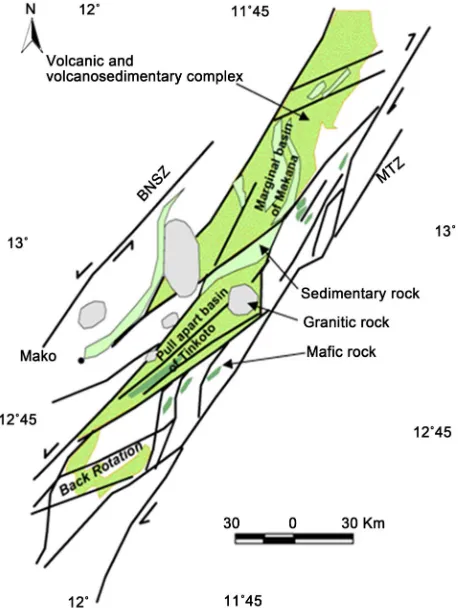
Recent works provide a significant amount of new struc- tural metamorphic, geochemical and geochronological data constraining the geodynamic evolution of the Mako belt (Bassot [1], Dia [2], Abouchami et al., [3], Pawlig et al., [7]). We propose a new definition of the lithotectonic units and distinguish from west to east: many basaltic segments are distinguished in the plutonic-volcanic com-plex and correspond to the Sandikounda, the Sabodala and the Mako segments; marginal basins and pull-apart basins (Figure 7).
4.1. The Plutonic-Volcanic Complex
It forms a narrow band of magmatic and metamorphic rocks. It is best exposed within the Badon-Sandikounda area. The meta-lavas range in composition from basalt to rhyolite but are dominated by dacite and andesite in the southern domains. The volcanic, volcanoclastic sequence is intruded by various dykes, sills of trondhjemites and metagabbros. Metamorphic conditions grade from greens- chistfacies in the southern part of the domain to amphi- bolite and granulite facies and local anatexis in the San- dikounda area (Gueye et al., [18]).
Sandikounda Segment
The Sandikounda segment is considered to be an oceanic arc island composed of tholeiitic basalts overlain by a ma- fic-to-felsic volcanic calc alkaline sequence. Maficultra- mafic massive, pillowed and volcanoclastic rocks are hi- ghly strained.
[image:8.595.100.499.410.716.2]The western margin is a fault contact against uplifted basaltic basement, whereas the eastern margin is a fault. The eastern margin is more structurally complex and linea- tion and folds are indicative of two fold sets at high angles. Clast elongation in the volcanoclastic rocks of the San- dikounda area in the footwall also have NW plunges, the- reby suggesting that folds in the hanging wall have been
rotated. Total X/Z strain states calculated from rounded volcanic elements range from 4:2 in the hanging wall volcanoclastics. These features are indicative of thrusting of the gneiss over the volcanic succession.
4.2. The Marginal Basins
These basins occupy a marginal position with respect to the plutonic-volcanic complexes and are filled by turbid- ites derived from volcanic-volcanoclastic rocks. They are composed of volcanic, volcanoclastic sequences intruded by abundant plutonic rocks. The metavolcanics of these basins are dominated by intermediate to felsic rocks. They are characterized by breccia and coarse pyroclastics sequence, which grade into finer grained tuff and epi- clatites interlayered with cherts and carbonates. Closure of the basins accommodates the emplacement of the cal- calkaline plutons (Bouroumbourou and Diombalou). Me- tamorphism is characterized by widespread greenschist to amphibolite facies conditions with local anatexis near the plutons. Crystallization of andalusite porphyroblasts is limited to graphitic sequence in the vicinity of the Bouroumbourou pluton. The low pressure and intermedi- ate temperature metamorphism suggested by this assem- blage are consistent with widespread contact metamor- phism related to intrusion of plutonic rocks.
However, we have some sedimentary units dominated by the flysch of the Sonkounkou formation. The schists of the Soreto formation consist of flysch-like sediment- tary sequences characterized by folded rhythmic alterna- tions of graded greywackes-sandstone and tuff layers.
The basins were mainly filled with minor greywacke and flysch-type sediments containing minor intercalations of basic and acid volcanic rocks. The basins are thus in- terpreted as flysch (foreland basins).
4.3. The Pull-Apart Basins
We found these basins to the north (Diombalou Basin) and the south (Tinkoto basin)
4.3.1. Diombalou Basin
The Diombalou Basin is a lozenge shaped basin deline- ated by faults. From the base to the top the sedimentary pile is made of arkosic sandstones including larges lenses of conglomerates, sandstone and shale, lava and pyroclas- tic flow are interbeded in the lower part of the pile. Most of the lavas are andesities. A few lavas are andesitic da- cites. All the formations were affected by upright folding and shearing along NE-SW transcurent shear zone corri- dors. Some small pluton of biotite granite intruded the deeper part of the basin, while a huge batholith of leu- cogranite was emplaced on the western side.
Thermal metamorphism of the peliticshales produced hornfels at the granite contact and staurolite and kyani-
teschists in the neighbouring zone. Volcanic andesitic ac- tivity is coeval with basin formation (Fouldé).
4.3.2. Tinkoto Basin
Within the Tinkoto area (Figure 8), sedimentary rocks for- med a lozenge shaped entity delineated by faults. Pull- apart basin developed within calk-alkaline magmatism and metamorphism localized within the fault zone. This was followed by a phase of compression. The Tinkoto basin was interpreted as a sinistral fault wedge basin, a type of pull-apart structure formed along the western fault splay of the MTZ. The Tinkoto basin was initiated after the accretion of the volcanic rocks of the marginal basins. It was initiated before 2070 Ma as indicated by the age of the Tinkoto pluton.
[image:9.595.310.539.393.697.2]The southern domain to the Mako belt, consists of bi- modal mafic and felsic volcanic rocks erupted during ma- jor cycles of volcanism. Intrusion of the younger grano- diorite caused local amphibolite facies contact metamor- phism that overprints nearby the volcanic complex. Ad- ditional dikes and sills, ranging from gabbro to quartz diorite, occur throughout the domain. The main structural elements in the southern domain are dominantly N-S to NNE-SSW and NW-SE oriented synvolcanic and later reactivated faults.
5. Tectonic Significance
The tectonic evolution of the Paleoproterozoic Mako Belt in the West African Craton is explained by a various struc- tural elements in the four domains. Concerning the previ- ous tectonic structures, the D1 event should be compati- ble with thickening processes. In this tectonic context, high-temperature low pressure metamorphism conditions and huge amounts of granite should be present. As in other Paleoproterozoic regions, the geodynamic signifi- cance of this horizontal tectonic structure can be attribu- ted to lithospheric convergence in a plate tectonic setting (e.g. Feybesse et al., 2006).
The D2 bulk strain pattern is clearly related to a tran- spressional regime during bulk horizontal shortening of heated crust. This transpression, contemporaneous with amphibolite facies conditions, resulted in a strain parti- tioning between the anastomosing shear zone network in the volcanic plutonic complex and the folded marginal domain.
The dome-and-marginal basin domains are folded un- der a pure shear-dominated strain regime, whereas the shear zones show a component of the simple shear regime.
Inside the shear zones the strain also varies, from sim- ple to pure shear, depending on their positions in space. The vertical shear zone separate this two domains, record- ing different pressure conditions. These regional pressure differences, controlled by kilometric tectonic structures, are compatible with exhumation during compression under a transpressive regime (D2 strain pattern). The amount of
uplift that juxtaposes contrasted metamorphic domains was controlled by the D2 strain gradient.
This hypothesis is confirmed by the strain gradient in- creases in domains from west to east.
Towards the end of the Paleoproterozoic it is proposed that there was a change in the pattern of crustal growth such that new crust was added as long narrow belts of accretionary complexes along the margins of the older plu- tonic volcanic complex.
6. Discussion and Conclusions
Makobasin-Volcanism and Tectonics: Correlation between Oblique Convergence, Basin Formation and Magmatism
An apparent correlation between plutonism, oblique con- vergence and associated strike slip faulting observed in the study area suggest that D2 faulting was responsible for the basin formation. Basin subsidence, submarine vol- canism and plutonic activity occurred in close spatial and temporal relationship within the Mako volcano-plutonic arc during the paleoproterozoic oblique convergence, in- dicating that sinistral transpression was the trigger of pull- apart basin formation and magmatism. Aligned syntec- tonic granitic intrusions and small pull-apart basins indi- cate local transtensional structures concurring with the bulk transpressional regime.
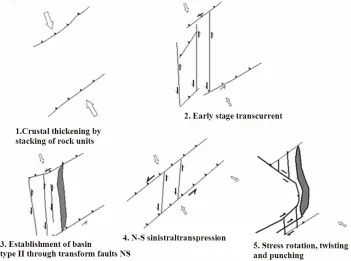
[image:10.595.124.475.449.710.2]The structural evolution of the Mako Belt (Figure 9) is characterized by:
D1 thrust tectonism causing crustal thickening. This deformation was accompagnied by the intrusion of large TTG batholiths.
Followed by transpression accommodating oblique convergence and collision (D2).
Progressive burial of the sedimentary basins occurs in the northern part of the belt and is followed by extru- sion of the Bouroumbourou area.
An early phase of south-eastward thrusting followed by a compressionnal NS phase, the whole being fol- lowed by a late phase of extension. The broad zone in the Sandikounda area records a progressive deforma-tion sequence that includes early compressional struc- tures modified by sinistral transpression. The rheologi- cally rigid segments deflected deformation and was domed, rotated and boudinaged because of its resis- tance to compression. The partitioning of the struc- tures in the domains is further dependent upon rheol- ogy difference. The volcanic activity was initiated im- mediately after the rapid bloc uplift of the pillow lavas and become widespread all over the belt providing sub aerial lava flows and pyroclastics products. Deformation styles within the basin are compatible with a dextral transpression which terminated at ca 2090. Small extensional basin formed over the rocks of the Mako Belt. The basins are filled with continental detrital sedimentary rocks that show weak foliation and active felsic volcanism.
The transpressive shear zone may result from oblique convergence of the volcanic Mako domain and sediment- tary Dalema domain following an early phase of thrust- ing.
Some transcurrent shear zones of the KKI display dex- tral displacements. These are the Mako Kanoumering Shear Zone. This opposite shear sense can be explained by ob- lique convergence. These occur along releasing bends, and are related to E-W, NE-SW and NW-SE-trending fault. The thrust signature was either synchronous or late with respect to the emplacement of these phases.
This interpretation is in agreement with mechanisms related to oblique convergence, the later being typically resolved into a strongly orthogonal compressionnal com- ponent at the strike slip component.
The inversion of the large scale structural evolution from thrusting to strike slip is common to modern orogenies. The east-west shear zones either initiated as late thrust faults that were reactivated as dextral strike-slip faults, or are dextral transpression zones which accommodated the oblique convergence of the volcanic domain. Strain par- titioning into transcurrent deformation along the Leoba- Moussala shear zone and NE–SW oriented shortening in the marginal basins, is consistent with a sinistral transpres- sional regime during the second phase of deformation. Transcurrent deformation continued during cooling of the entire belt, giving rise to the localized low-temperature
mylonite.
The proposed structural evolution of the MB is con-sistent with the models of Feybesse et al., [14] and Lom- po [23], for the eburnean orogeny. These authors recog- nize three phases of deformation D1, D2 and D3. Our in- terpretation led us to define an early D1 tectonism, is in agreement with Milési et al. [24]; Allibone et al. [25], who also recognize the existence of an early event D1 in Eburnean orogeny. In this, we differ from the interpreta- tion of some authors (Eisenlohr and Hirdes, [26]; Blen-kinsop et al., [27]) who propose that all Eburnean struc-tures are related to single event may correspond to our D2 and D3 phases.
The crustal shortening with Southeast directed is re- lated to a NW-SE compression. This is in agreement with Blenkinsop et al., [27]; Vidal and Alric [28]; Allibone et al. [29], who note that all Eburnean structures are related to a NW-SE compression.
Regionally significant sinistrallytranspressive deforma- tion at ca 2140 Ma was accompanied by intracrustal me- lting, migmatization and granitoid emplacement. We sug- gest that the sinistral transpressive tectonic associated with oblique subduction may have generated basins and suba- queous volcanism. Our interpretation follows that of Van- derhaeghe et al., [30], who note that the Transamazo- nian orogeny was marked by oblique convergence char- acterized by the development of pull-apart basins and marginal basins.
REFERENCES
[1] J. P. Bassot, “Le Complexe Volcanoplutonique Calco Alcalin de la Rivière Daléma (Est du Sénégal): Discussion de la Signification Géodynamique Dans le Cadre de l’Orogenèse Eburnéenne (Protérozoïque Inférieur),” Jour- nal of African Earth Sciences, Vol. 6, No. 4, 1987, p. 25. [2] A. Dia, “Caractères et Significations Des Complexes
Magmatiques et Métamorphiques du Secteur de Sandi- kounda-Laminia (Nord de la Boutonnière de Kédougou, est du Sénégal ). Un Modèle Géodynamique du Birimien d’Afrique de l’Ouest,” Thèse d’Etat, Dakar, 1988. [3] W. Abouchami, M. Boher, A. Michard and F. Albarede,
“A Major 2.1 Ga Event of Mafic Magmatism in West Af-rica: An Early Stage of Crustal Accretion,” Journal of Geophysical Research, Vol. 95, No. B11, 1990, pp. 17605-17629. doi:10.1029/JB095iB11p17605
[4] M. Boher, A. Michard, F. Albarede, M. Rossi and J. P. Milési, “Crustal Growth in West Africa at 2.1 Ga,” Jour-nal Of Geophysical Research, Vol. 97, No. B1, 1992, pp. 345-369. doi:10.1029/91JB01640
[5] P. M. Ndiaye, A. Dia, A. Vialette, D. P. Diallo, P. M. Ngom, M. Sylla and S. Wade, “Les Granitoïdes du Pro- térozoïde Inférieur du Supergroupe de Dialé-Daléma. Données Pétrographiques, Géochimiques et Géochrono- logiques Nouvelles,” CIFEG, Publication Occasionnelle, Paris, 1993.
Constraints on the Age and Formation of a Paleoprotero-zoic Volcanic Arc Complex in the Kedougou Inlier, East-ern Senegal, West Africa,” Journal of African Earth Sciences, Vol. 24, No. 3, 1997, pp. 197-213.
doi:10.1016/S0899-5362(97)00038-9
[7] S. Pawlig, M. Gueye, R. Klischies, S. Schwars, K. Wemmer and S. Siegesmud, “Geochemical and Sr-Nd Isotopic Data on the Birimian of the Kedougou-Kenieba Inlier (Eastern Senegal): Implications on the Palaeopro-terozoic Evolution of the West African Craton,” South African Journal of Geology, Vol. 109, No. 3, 2006, pp. 411-427.
[8] M. Gueye, S. Siegesmund, K. Wemmer, S. Pawlig, M. Drobe, N. Nolte and P. Layer, “New Evidences for an Early Birimianevolutionin the West African Craton: An Example from the Kédougou-Kénieba Inlier, Southeast Senegal,” South African Journal of Geology, Vol. 110, No. 4, 2007, pp. 511-534.
doi:10.2113/gssajg.110.4.511
[9] J. M. Bertrand, A. Dia, E. Dioh and J. P. Bassot, Réflexions sur la Structure Interne du Craton Ouest -Africain au Sénégal Oriental et des Confins Guinéo- Maliens,” Comptes Rendus de l’Académie des Sciences, Vol. 309, 1989, pp. 751-756.
[10] J. P. Milési, M. Diallo, J. L. Feybesse, E. Keïta, P. Ledru, C. Vichon and A. Dommanget, “Caractérisation Litho- structurale de Deux Ensembles Successifs dans les séries Birimiennes de la Boutonniére de Kédougou (Mali- Sénégal) et du Niandan (Guinée): Implications Gîtolo- giques,” CIFEG, Publication Occasionnelle, 1986, pp. 113-121.
[11] P. Ledru, J. Pons, J. P. Milési, A. Dommanget, V. Johan, M. Diallo and C. Vinchon, “Tectonique Transcurrente et Evolution Polycyclique dans le Birimien, Protérozoïque Inférieur, du Sénégal-Mali (Afrique de l’Ouest),” Comptes Rendus de l’Académie des Sciences, Vol. 308, 1989, pp. 117-122.
[12] J. P. Milési, J. L. Feybesse, P. Ledru, A. Dommanget, M. F. Ouedraogo, E. Marcoux, A. Prost, C. Vinchon, J. P. Sylvain, V. Johan, M. Tegyey, J. Y. Calvez and P. Lagny, “Les Minéralisations Aurifères de l’Afrique de l’Ouest: Leurs Relations avec l’Evolution Lithostructurale au Pro- térozoïque Inférieur,” Chronique de la Recherche Minière, Vol. 497, 1989, pp. 3-98.
[13] J. L. Feybesse, J. P. Milési, Y. Johan, et al., “La Limite Archéen-Protérozoïque d’Afrique de l’Ouest: Un Zone de Chevauchement Antérieure à l’Accident de Sassandra; l’Exemple des Régions d’Odienné et de Touba (Côte d’Ivoire),” Comptes Rendus de l’Académie des Sciences, Vol. 309, 1989, pp. 1847-1853.
[14] J. L. Feybesse, M. Billa, C. Guerrot, E. Duguey, J. L. Lescuyer, J. P. Milési and V. Bouchot, “The Paleopro-terozoic Ghanaian Province: Geodynamic Model and Ore Controls, Including Regional Stress Modelling,” Pre-cambrian Research, Vol. 149, No. 3-4, 2006, pp. 149-196. doi:10.1016/j.precamres.2006.06.003
[15] P. Ledru, J. Pons, J. P. Milésie, J. L. Feybesse and V. Johan, “Transcurrent Tectonics and Polycyclic Evolution in the Lower Proterozoïc of Senegal-Mali,” Precambrian
Research, Vol. 30, 1991, pp. 337-354.
[16] M. Guèye, “Transcurrent Fault Propagation and Grani-toïdeplutonism during Lower Proterozoictranspression (SE Sénégal),” Zeitschrift der Deutschen Geologischen Gesellschaft, Vol. 152, No. 24, 2001, pp. 175-198. [17] J. Pons, P. Barbey, D. Dupuis and J. M. Leger,
“Mecha-nisms of Plutonemplacement and Structural Evolution of a 2.1 Ga Juvenile Continentalcrust: The Birimian of Southwestern Niger,” Precambrian Research, Vol. 70, No. 3-4, 1995, pp. 281-301.
doi:10.1016/0301-9268(94)00048-V
[18] M. Gueye, P. M. Ngom, M. Diène, Y. Thiam, S. Sieges-mund, K. Wemmer and S. Pawlig, “Intrusive Rocks and Tectono-Metamorphic Evolution of the Mako Paleopro-terozoic Belt (Eastern Senegal, West Africa),” Journal of African Earth Sciences, Vol. 50, No. 2-4, 2008, pp. 88- 110. doi:10.1016/j.jafrearsci.2007.09.013
[19] S. Zounou, “Les Fonnations Leptyno-Amphibolitiques et le Complexe Volcanique et Volcano-Sédimentaire du Pro- térozoïque Inférieur de Bouroum-Nord (Burkina-Faso- Afrique de l’Ouest). Etude Pétrographique, Géochimique, Approche Pétrogénétique et Evolution Géodynamique,” Thèse d’Etat, University Nancy l, 1987.
[20] P. J. Sylvester and K. Attoh, “Lithostratigraphy and Composition of 2.1 Ga Greenstone Belts of the West Af-ricanCraton and Their Bearing on Crustal Evolution and theArchean-Proterozoic Boundary,” Journal of Geology, Vol. 100, No. 4, 1992, pp. 377-393. doi:10.1086/629593
[21] I. Ama-Salah, J. P. Liégeois and A. Pouclet, “Evolution d’un Arc Insulaire Océanique Birimien Précoce au Liptako Nigérien (Sirba): Géologie, Géochronologie et Géochimie,” Journal of African Earth Sciences, Vol. 22, 1996, pp. 235-254.
[22] A. Pouclet, M. Vidal, C. Delor, Y. Siméon and G. Alric, “Le Volcanisme Birimien du Nord-Est de la Côte d’Ivoire, Mise en Evidence de Deux Phases Volca-Tectoniques Distinctes dans l’Evolution Géodynamique du Paléo- protérozoïque,” Bulletin de la Société Géologique de France, Vol. 167, 1996, pp. 529-541.
[23] M. Lompo, “Geodynamic Evolution of the 2.25-2.0 Ga-Palaeoproterozoic Magmatic Rocks in the Man-Leo Shield of the West African Craton. A Model of Subsi-dence of an Oceanic Plateau,” Geological Society, Lon-don, Special Publications, Vol. 323, 2009, pp. 231-254. [24] J. P. Milési, P. Ledru, P. Ankrah, V. Johan, E. Marcoux
and Ch. Vinchon, “The Metallogenic Relationship be-tween Birimian and Tarkwaian Gold Deposits in Ghana,”
Mineralium Deposita, Vol. 26, 1991, pp. 228-238. [25] A. Allibone, J. Teasdale, G. Cameron, M. Etheridge, P.
Uttley, A. Soboh, J. Appiah-Kubi, A. Adanu, R. Arthur, J. Mamphey, B. Odoom, J. Zuta, A. Tsikata, F. Pataye and S. Famiyeh, “Timing and Structural Controls on Gold Mineralization at the Bogosa Gold Mine, Ghana, West Africa,” Economic Geology, Vol. 97, 2002, pp. 949-969. [26] B. N. Eisenlohr and W. Hirdes, “The Structural Deve-
[27] T. Blenkinsop, A. Schmidt Mumm, R. Kumi and S. Sangmor, “Structural Geology of the Ashanti Gold Mine,”
Geologisches Jahrbuch, Vol. 100, 1994, pp. 131-153. [28] M. Vidal and G. Alric, “The Paleoproterozoic (Birimian)
of Haute-Comoé in the West African Craton, Ivory Coast: A Transtensional Back-Arc Basin,” Precambrian Re-search, Vol. 65, No. 1-4, 1994, pp. 207-229.
doi:10.1016/0301-9268(94)90106-6
[29] A. Allibone, T. C. McCuaig, D. Harris, M. Etheridge, S. Munroe, D. Byrne, J. Amanor and W. Gyapong, “Str-
uctural Controls on Gold Mineralization at the Ashanti Gold Mine, Obuassi, Ghana,” Society of Economic Geo- logists Special Publication, 2002, pp. 65-93.