Systemic thrombin generation by glucose
Morad Mohrez*, Hani Harb, Anja Spies, Harald Renz, Thomas W. Stief
Institute of Laboratory Medicine and Pathobiochemistry, University Hospital of Marburg, Marburg, Germany;
*Corresponding Author: [email protected]
Received 27 September 2011; revised 27 October 2011; accepted 14 November 2011
ABSTRACT
Background: Systemic thrombin activity (F2a),
i.e. thrombin protected and transported by 2- macroglobulin, is a new biomarker for the acti- vation state of coagulation in vivo. F2a > 120% of normal diagnoses a pathologic disseminated intravascular coagulation (PIC) in humans, ei- ther acute or chronic. Since glucose triggers intrinsic coagulation, the present work aimed to quantify systemic thrombin generation induced by glucose in vivo in mice. Material and Methods: Balb/c mice were i.p. injected with different con- centrations of glucose (0 - 0.3 mmoles). After 0 - 3 h EDTA-blood was withdrawn, centrifuged, and the plasma was stabilized 1 + 1 with 2.5 M ar- ginine, pH 8.6, and analyzed for systemically circulating F2a (that is F2a·α2M). The F2a·α2M
activity in mice without glucose injection was defined as 100% of murine norm. Results: 1 h after i.p. injection 0.1 - 0.3 mmoles glucose re- sulted in about 1.4 fold increase of plasmatic glucose and in about 2.5 fold increase of sys- temic F2a activity. At the 45 min time interval between i.p. injection of 0.038 mmoles glucose and blood withdrawing an approximately 1.5fold increase of plasma glucose caused a 4fold in- crease in systemic F2a. Discussion: When sys- temic F2a reaches 120% of the normal, the normal human intravascular coagulation (NIC) turns to the pre-phase of pathologic plasmatic intravascular coagulation (PIC-0 also defined as pre-PIC). At 150% systemic F2a, the PIC-0 changes to PIC-1 which is the common patho- logic plasmatic intravascular coagulation (typi- cal PIC). At 200% systemic F2a, PIC-1 changes to PIC-2 (consumption PIC). The present assay technique seems to be suitable in judging the coagulation activation state of any mammalian blood. Diabetic patients should be monitored for the new biomarker systemic F2a similarly as for the old biomarker glycated hemoglobin (HbA1c).
The target systemic F2a range should be NIC,
preferably around 100% of normal.
Keywords: Thrombin; Glucose; Intrinsic; Coagulation; Systemic F2a
1. INTRODUCTION
Thrombin is an important serine protease of human blood that cleaves substrates after basic residues, mainly after arginine. Thrombin participates in different bio- logical phenomena, such as hemostasis, thrombosis, in- flammation, and cell proliferation [1,2]. Thrombin (fac- tor 2a = F2a) is the key enzyme of mammalian blood coagulation with important functions, such as conversion of fibrinogen to fibrin, feedback amplification of coagu- lation via F5a and F8a, and activation of platelets. Thrombin is formed by the cleavage of two peptide bonds in prothrombin (F2) by F10a [3]. F10a binds F5a to form the “prothrombinase complex” that activates prothrombin (F2) to thrombin (F2a). The F10-ase and the prothrombinase complexes are easily formed on nega- tively charged phospholipids, e.g. of the outer membrane of activated platelets [4].
Glucose, C6H12O6 or H-(C=O)-(CHOH)5-H, is a mo-
nosaccharide, with five hydroxyl (OH) groups and one aldehyde group along its six-carbon backbone. Nega- tively or delta-negatively charged groups can trigger in- trinsic F2a generation, possibly by folding of F12 into F12a [5,6]. Glucose triggers the contact phase of human coagulation both in vitro and in vivo [7,8]. Albumin,
glycerol, and plasma supplemented with glucose resulted in increased generation of F12a and of F2a in vitro [9-
11].
which are important generators of TF. Upon inflam- mation, mesangial cells seem to produce large amounts of TF and of F5 [17,18].
2. MATERIAL AND METHODS
2.1. MiceMale and female Balb/c mice, 6 - 8 weeks old (aver- age weight 25 g), were obtained from Harlan Winkel- mann (Borchen, Germany). Mice were housed under optimal conditions (6 mice per cage) in a 12/12 hour light/dark cycle with food and water available ad libitum.
Mice were randomly distributed into treatment and con- trol groups. Mice (n = 2 or 3) received intraperitoneally (i.p.) different amounts of glucose or for control they
received 0.9% NaCl. EDTA-blood was withdrawn from the mice at different time points (0, 5, 30, 45, 60, 90, or 180 minutes) using intracardiac or vena cava puncture to avoid coagulation activation. All experimental proce- dures were approved by the local animal ethics commit- tee and met German and international guidelines.
2.2. EDTA-Concentration
2.6 ml polypropylene monovettes containing 2.6*1.6 = 4.16 mg sterile K3-EDTA (ethylene diamine tetra acetic
acid, tripotassium salt) from Sarstedt (Nümbrecht, Ger- many) were filled with 130 µl 0.9% NaCl of drug qual- ity, to obtain a K3-EDTA solution of 32 mg/ml. 50 µl of
this K3-EDTA-solution was given to a polypropylene
syringe and 300 µl of murine blood were drawn. The final K3-EDTA-concentration in murine blood was 4.6
mg/ml. This concentration was preferred to 2.3 mg/ml [19] because additional EDTA does not disturb the sys- temic F2a test but might improve anticoagulation in complicated blood drawings.
2.3. Assay for Circulating Thrombin Activity (Systemic F2a) in Murine Blood
The freshly drawn 4.6 mg/ml EDTA-blood of treated mice (usually n = 3 for each glucose amount) in 1 ml polypropylene cups was centrifuged for 8 min at 3500 rpm (2200 g; 23˚C). For control, the blood of untreated mice (n = 3) was also anticoagulated with 4.6 mg/ml EDTA. After centrifugation, 35 µl of the EDTA-plasma were mixed with 35 µl 2.6 M arginine (pH 8.6) (Sigma, Deisenhofen, Germany) in polystyrene half area wells (Greiner, Frickenhausen, Germany; article nr. 675101). 35 µl of 0 mM (turbidity control) or 1 mM (main reac- tion) chromogenic thrombin substrate (CHG-Ala-Arg- pNA Pentapharm, Basel, Switzerland) in 1.25 M arginine (pH 8.7) were added. The increase in absorbance mea- sured at 405 nm (A405nm/t) was determined at each time
point at 37˚C by a microtiter plate photometer with a 1
mA resolution (Tecan Sunrise, Crailsheim, Germany). The A/t values of the turbidity control were subtracted from the A/t values of the main chromogenic reaction.
2.4. Determination of Glucose Concentrations in Mice Plasma
Glucose in EDTA-plasma of mice was determined enzymatically, using the D-Glucose/D-Fructose determi- nation kit from Boehringer Mannheim-R-Biopharm Roche (article nr. 10 139 106 035). The principle of the method is hexokinase-mediated phosphorylation of glu- cose to glucose-6-phosphat (G-6-P), followed by G-6-P dehydrogenase—mediated oxidation of G-6-P into glu- conate-6-phosphate and generation of NADPH, that is monitored at 340 nm (Warburg reaction). 5 µl EDTA- plasma were incubated in polystyrene F-wells (NUNC, Wiesbaden, Germany; article nr. 446140) with 100 µl reagent 1 (64 mg NADP, 160 mg ATP, magnesium sul- phate, triethanolamine, pH 7.6 in 27 ml H2O), 2 µl re-
agent 2 (≈200 U hexokinase, ≈100 U G-6-P dehydro- genase in 0.7 ml) and 100 µl H2O for 15 min at 23˚C.
The specific increase of absorbance at 340 nm, deter- mined by a microtiter plate photometer (Tecan Sunrise), was approximatly 200 mA for the 0.5 g/l (50 mg/dl = 2.78 mM) glucose standard.
2.5. Statistical Analysis
The test group was compared with the control group, using the X2 test [20]. A p-value of less than 0.05 was
considered as significant.
3. RESULTS AND DISCUSSION
First, to determine the effect of glucose on systemic F2a activity, balb/c mice were divided into 4 groups (1 control and 3 treated groups). The control group was injected i.p with 0.9% NaCl while the 3 treated groups
were i.p. treated with 300 µl of 0.25, 0.5 or 1 M glucose.
The blood was withdrawn 0.5 and 1h post injection from vena cava.
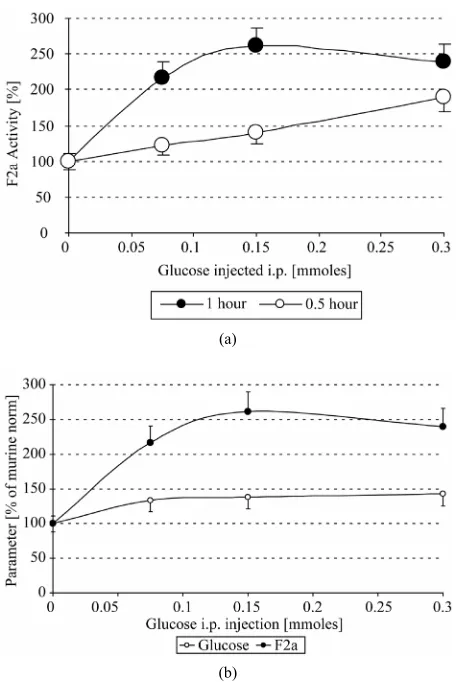
As seen in Figure 1(a), systemic F2a activity in- creased significantly time and dose dependently. 1 h after
i.p. injection 0.1 - 0.3 mmoles glucose resulted in about
1.4 fold increase of plasmatic glucose and in about 2.5 fold increase of systemic F2a activity (Figure 1(b)). This implies a continuous systemic generation of thrombin over time parallel to the increase of plasmatic glucose.
In another experiment the mice were i.p. injected with
(a)
[image:3.595.58.286.81.422.2](b)
Figure 1. In vivo thrombin generation by glucose; Mice were
i.p. injected with 300 µl 0 - 1 M glucose. After 0.5, 1 h EDTA-blood was withdrawn, centrifuged, the plasma stabilized 1 + 1 with 2.5 M arginine, pH 8.6, and analyzed for systemic thrombin (F2a) activity (Figure 1(a)). The plasmatic glucose
concentrations (O) that change systemic F2a activity (●) are shown in Figure 1(b) (after 1 h). Mice with 0 mg glucose i.p.
injected were the control mice (100 % of murine norm F2a = 583 % of human norm F2a [6]; 100% of murine norm glucose = 110 mg/dl = 6.1 mM; mean values).
resulted in approximately 1.4 and 1.9 fold systemic thrombin activity, respectively (Figure 2).
Even glucose amounts of much less than 0.1 mmoles
i.p. resulted in a significant increase of systemic F2a. So
we chose a glucose amount of 300 µl 0.125 M = 0.038 mmoles, that has a clear but still not too pronounced ac- tion on systemic thrombin generation: here an increase of the plasmatic glucose of about 1.5 fold could resulted in about 4fold increased systemic thrombin activity, de- pending on the time interval between glucose i.p. injec-
tion and blood drawing. We found that the optimal time interval to withdraw blood was after about 45 min that reflected best the action of glucose on systemic thrombin activity (Figure 3). The body might downregulate the systemic thrombin activity by inhibition of F2a genera- tion or by enhanced (hepatocytes-mediated [8]) clearance
Figure 2. In vivo thrombin generation by glucose. Mice were i.p
injected with 300 µl glucose (0 - 1 M). After 0.5 h EDTA-blood was withdrawn, centrifuged and the plasma stabilized with 1 + 1 with 2.5 M arginine (pH 8,6) and analyzed for systemic throm-bin (F2a) activity. Mice treated with NaCl were the control mice. In a repeated experiment we found 0.05/124 and 0.1/143 (x/y).
Figure 3. In vivo thrombin generation by glucose. Mice were
i.p. injected with 300 µl 0.125 M = 0.038 mmoles glucose. After 0 - 3 h EDTA-blood was withdrawn, centrifuged, the plasma stabilized 1+1 with 2.5 M arginine, pH 8.6, and ana-lyzed for systemic thrombin (F2a) activity. Mice with 0 mg glucose injected i.p. were the control mice.
of activated clotting factors. So the systemic thrombin activity decreased after 90 min and returned almost to normal after 180 min.
[image:3.595.310.536.84.221.2] [image:3.595.309.537.299.490.2]In human pathophysiology, when the concentration of systemic F2a reaches 120% of the normal, the normal human intravascular coagulation (NIC) changes to the pre-phase of pathologic plasmatic intravascular coagula- tion (PIC-0 also defined as pre-PIC). At 150% systemic F2a, the PIC-0 changes to PIC-1 which is the common pathologic plasmatic intravascular coagulation (Typical PIC). At 200% systemic F2a, PIC-1 changes to (PIC-2) the advanced pathologic plasmatic intravascular coagu- lation (consumption PIC) [21-24].
The pathophysiologic situation might be more pro- nounced in diabetic patients with liver insufficiency, where any increase in blood glucose might result in an increase not only in kallikrein but also in F2a leading to critical concentrations of circulating micro-thrombi.
Therefore, it should be good to monitor systemic F2a in diabetic patients (comparable to the old biomarker glycated hemoglobin (HbA1c)) to avoid complications
arising from the increased systemic F2a. The target range of systemic F2a is NIC, that should be as close to the 100% of normal value as possible. If the values are higher than the normal range, the close-to-physiologic anticoagulant low-molecular-weight-heparin (LMWH) should be used to lower them.
The present study shows that glucose itself can in- crease in vivo thrombin generation. The present assay
technique seems to be suitable in judging the coagulation activation state in any mammalian blood [19,23,24].
REFERENCES
[1] Stubbs, M.T. and Bode, W. (1995) The clot thickens: Clues provided by thrombin structure. Trends in Bio- chemical Sciences, 20, 23-28.
doi:10.1016/S0968-0004(00)88945-8
[2] Guillin, M.C., Bezeaud, A., Bouton, M.C. and Jandrot- Perrus, M. (1995) Thrombin specificity. Thrombosis and Haemostasis, 74, 129-133.
[3] Furie, B. and Furie, B.C. (1992) Molecular and cellular biology of blood coagulation. New England Journal of Medicine, 326, 800-806.
doi:10.1056/NEJM199203193261205
[4] Montoro-García, S., Shantsila, E., Marín, F., Blann, A. and Lip, G.Y. (2011) Circulating microparticles: New in-sights into the biochemical basis of microparticle release and activity. Basic Research in Cardiology, 106, 911-923.
doi:10.1007/s00395-011-0198-4
[5] Stief, T.W. (2010) Thrombin generation by the amino acid glycine. Hemostasis Laboratory, 3, 129-133.
[6] Stief, T.W. and Mohrez M. (2011) Thrombin generation by valproate. Hemostasis Laboratory, 4, 101-144.
[7] Stief, T.W. (2012) Glucose activates the early phase of intrinsic coagulation. Hemostasis Laboratory, 5, 67-81.
[8] Stief, T.W. and Mohrez, M. (2012) Glucose activates human intrinsic coagulation in vivo. Hemostasis Labora-
tory, 5, 83-89.
[9] Stief, T.W. (2011) Factor 12 activation in two purified systems. Hemostasis Laboratory, 4, 385-408.
[10] Stief, T.W. (2011) Zn2+, hexane, or glucose activate factor
12 and/or prekallikrein in two purified systems. Hemo- stasis Laboratory, 4, 409-426.
[11] Stief, T.W. (2012) Zn2+, hexane, valproate, or glucose in
two purified systems of F12-PK-HMWK. Hemostasis Laboratory, 5, 35-50.
[12] Hu, T. and Desai, J.P. (2004) Soft-tissue material proper-ties under large deformation: Strain rate effect. Proceed-ings of the 26th Annual International Conference of the IEEE EMBS, San Francisco, 2758-2761.
[13] Liu, N., Mori, N., Iehara, N., Uemura, K., Fukastu, A., Kita, T., Matsuda, M. and Ono, T. (2007) Soluble fibrin formation in the mesangial area of IgA nephropathy. Clinical and Experimental Nephrology, 11, 71-76.
doi:10.1007/s10157-006-0457-0
[14] Nomura, K., Liu, N., Nagai, K., Hasegawa, T., Kobayashi, I., Nogaki, F., Tanaka, M., Arai, H., Fukatsu, A., Kita, T. and Ono, T. (2007) Roles of coagulation pathway and factor Xa in rat mesangioproliferative glomerulonephritis. Laboratory Investigation, 87, 150-160.
doi:10.1038/labinvest.3700502
[15] Frank, R.D., Schabbauer, G., Holscher, T., Sato, Y., Ten- cati, M., Pawlinski, R. and Mackman, N. (2005) The synthetic pentasaccharide fondaparinux reduces coagula- tion, inflammation and neutrophil accumulation in kidney ischemia-reperfusion injury. Journal of Thrombosis and Haemostasis, 3, 531-540.
doi:10.1111/j.1538-7836.2005.01188.x
[16] Ayaka, S., Natsuko, Y.H., Fan, B., Toshiaki, M., Hajime, M. and Takahiko, O. (2011) Roles of Coagulation Path- way and Factor Xa in the Progression of Diabetic Neph- ropathy in db/db Mice. Biological & Pharmaceutical Bulletin, 34, 824-830. doi:10.1248/bpb.34.824
[17] Wiggins, R.C., Njoku, N. and Sedor, J.R. (1990) Tissue factor production by cultured rat mesangial cells. Stimu-lation by TNF alpha and lipopolysaccharide. Kidney In-ternational, 37, 1281-1285. doi:10.1038/ki.1990.112
[18] Ono, T., Liu, N., Kasuno, K., Kusano, H., Nogaki, F., Kamata, T., Suyama, K., Muso, E. and Sasayama, S. (2001) Coagulation process proceeds on cultured human mesangial cells via expression of factor V. Kidney Inter-national, 60, 1009-1017.
doi:10.1046/j.1523-1755.2001.0600031009.x
[19] Mohrez, M., Alrifai, M. and Stief, T.W. (2011) Systemic thrombin generation by valproate. Hemostasis Labora- tory, 4, 427-438.
[20] Stief, T.W. (2007) The fibrinogen antigenic turbidimetric assay (FIATA). The X2 test: The corrected chi-square
comparison against the control-mean. Clinical and Ap-plied Thrombosis/Hemostasis, 13, 73-100.
http://cat.sagepub.com/content/13/1/73
[22] Stief, T.W. (2006) Specific determination of plasmatic thrombin activity. Clinical and Applied Thrombosis/He- mostasis, 12, 324-329.
doi:10.1177/1076029606291381
[23] Stief, T.W. (2008) The laboratory diagnosis of the pre-
phase of pathologic disseminated intravascular coagula- tion. Hemostasis Laboratory, 1, 3-19.