Implementation of an open-source customizable minimization
program for allocation of patients to parallel groups in clinical
trials
Mahmoud Saghaei1, Sara Saghaei2
1Department of Anesthesia, Isfahan University of Medical Sciences, Isfahan, Iran; 2School of Computing Science, Simon Fraser University, Vancouver, Canada.
Email: [email protected]
Received 23 July 2011; revised 30 August 2011; accepted 10 October 2011.
ABSTRACT
Current minimization programs do not permit full control over different aspects of minimization algo- rithm such as distance or probability measures and may not allow for unequal allocation ratios. This ar- ticle describes the implementation of “MinimPy” an open-source minimization program in Python pro- gramming language, which provides full customize- tion of minimization features. MinimPy supports na- ive and biased coin minimization together with vari- ous new and classic distance measures. Data syncing is provided to facilitate minimization of multi-center trial over the network. MinimPy can easily be modi- fied to fit special needs of clinical trials and in par- ticular change it to a pure web application, though it currently supports network syncing of data in multi- center trials using network repositories.
Keywords: Clinical Trial; Allocation Methods;
Ran-domization; Minimization; Unequal Group Allocation; Biased Coin Minimization; Network Synchronization of Data
1. INTRODUCTION
According to the last version of Consolidated Standards of Reporting Trials (CONSORT) [1], the method of sub- ject allocation to treatment groups in use must be clearly stated and the details of the sequence generation must be specified. Different methods of patients allocation have been advocated, of which the randomization methods have gained wide acceptance and is used in the majori- ties of clinical trials due to its relative simplicity and availability of software programs customizable to dif- ferent randomization protocols [2]. Randomization meth- ods although prevent selection bias and ensure the non- predictability of treatment assignments, may result in
significant imbalances in patients factors specially with smaller sample sizes [3]. Resulting imbalances may re- duce the validity of data analysis or necessitate complex statistical analysis to overcome the factors imbalances. Different stratification and minimization techniques may be used to balance levels of prognostic factors among treatment groups. However minimization methods seem to provide more acceptable results compared to stratify- cation [4]. Minimization is based on techniques that make the imbalance among patients’ factors as low as possible and make the treatment groups more compara- ble to one another, with respect to basal patients’ factors. In pure minimization subject allocations are completely deterministic and therefore may be predictable by the research team if the next patient’s factors’ levels are known, which in turn violates the principle of alloca- tions’ blindness. To overcome this pitfall, some compo- nents of randomization have been included in minimize- tion algorithms, which reduces the chance of prediction, by giving higher allocation probabilities to interventions selected in favor of reducing total imbalance. Therefore the minimization algorithm can be viewed as a dynamic allocation method in which each allocation is influenced by the current state of overall treatment balances.
Initial description and methods of minimization were introduced independently by Taves [5] in 1974 and Po- cock and Simon [6] in 1975. Subsequent investigators presented numerous contributions to the original algo- rithms and described different features of minimization methods [7-10].
in the presence of unequal allocation ratios for different treatment groups.
In recent years some web based software have been developed to facilitate the allocation of patients in clini- cal trials based on minimization methods. The first minimization program “Minim” a free MS-DOS appli- cation although allows some control over minimization aspects, is a command line program; Hence its applica- tion limited to expert users [11]. Also its source is not available and there is no documentation of its algorithm. “MagMin,” a Browser/Server closed source system based on the method of Pocock and Simon, was developed as a multi-center system which uses standard deviation as the distance measure [12]. However, users of this programs have limited choice over different aspects of minimiza- tion model such as distance or probability measures. It may also not allow for unequal allocation ratios. This article describes the implementation of “MinimPy” an open-source desktop minimization program written in python programming language with complete customi- zation of minimization features.
2. DEVELOPMENT
2.1. Allocation Probability
The first subject is allocated randomly to one of treat- ment groups. Allocation of subsequent patients involves hypothetical stepwise allocation of each subject to every treatment group and computation of the imbalance score corresponding to each allocation. Produced imbalance scores will be compared and subject will be allocated to the group corresponding to the least imbalance score (preferred treatment). To include an element of ran- domization, usually the subject is allocated to the pre- ferred treatment with a higher probability denoted as PH,
and to other groups (non-preferred treatment) with lower probabilities referred to as PL. Depending on the method
of minimization PH and PL may or may not be affected
by the allocation ratios (i.e. unequal group sizes). In the
simple form (naive minimization) the probabilities are not affected by allocation ratios and the same PH is used
for all treatment groups when they are selected as the preferred treatments. Probabilities of the non-preferred treatments are estimated equal to one another as PL =
(1 – PH)/(n – 1), and the allocation ratios are only used to
correct counts of factor levels during calculation of im- balance scores. However, it sounds logical to assign higher probabilities to treatments with higher allocation ratios, which is the method proposed by Han and co- workers [13], known as the biased-coin minimization. A base PH (PHb) is used for the group with the lowest allo-
cation ratio when that group is selected as the preferred treatment. The PH for other groups (PHi) when selected
as the preferred treatments are calculated as a function of
PH and allocation ratios (r1, r2,, rn) [13]:
1 1 1 1 n k
Hi n H
k r k i
P P
r k b
b (1)PL for the non-preferred group, i, when group j is the
preferred treatment (Pli{j=H}) and i ≠ j is calculated as
[13]:
1 1 i
Hj Li j H nk
r
P P
r k j
(2)2.2. Imbalance Score
At each round of allocation, imbalance scores are calcu- lated as a function of current allocations after the new case is hypothetically allocated to each treatment group. Different distance measures including range, variance, standard deviation have been used for calculation of im- balance scores [6]. Marginal balance proposed by Han and co-workers [13] tend to minimize more accurately when treatment groups are not equal in size. For each factor level marginal balance is calculated as a function of the adjusted number of patients at that level for each treatment group:
1 1 1 1 1 n n i j i j iM n i a a b n a
(3) Other distance measures are implemented in the pro- gram as documented previously and used widely in other applications too. At the start of the trial user can choose from among different methods as explained in the im- plementation section.2.3. Program Interface
Python [14] programming language was used to imple- ment the model and the interface of the minimization program. A simple model structure was defined to hold different features of a minimization instance. These in- clude:
Allocations: Current state of trial allocations;
Probability measure: simple probability assignment or biased coin minimization;
Distance measure: Range, SD, variance or marginal balance used to calculate imbalance scores;
PHb: High probability for the group with the lowest allocation ratio when selected as the preferred treat- ment;
Variables weight: The weight assigned to each prog- nostic factor;
each group, denoting the share of each group in the total sample size.
A minimization class was implemented to integrate different calculations of minimization algorithm. This class uses the model structure defined above for instant- tiation. Various features of minimization algorithm were calculated in this class including:
Calculation of probability assignments: a table of high and low probabilities were constructed as a function of allocation ratios, taking into account the value of PHb. Formula (1) and (2) are used for this purpose, in the case of the biased coin minimization;
Calculation of the distance measures for the selected minimization model;
Functions for handling tie conditions (when groups’ imbalance scores are tied).
The program uses Python’s random module to provide randomization component of minimization model which uses Mersenne Twister [15] as its core generator. How- ever the user can select alternate random number gen- erator provided by the operating system (/dev/urandom on Unix or CryptGenRandom on Windows). Subversion (SVN) protocol [16] with its Python binding [17] is used for synchronization of data among trial centers using various plain and encrypted authenticated connection protocols (http, https, svn, svn + ssh, etc.).
3. APPLICATION
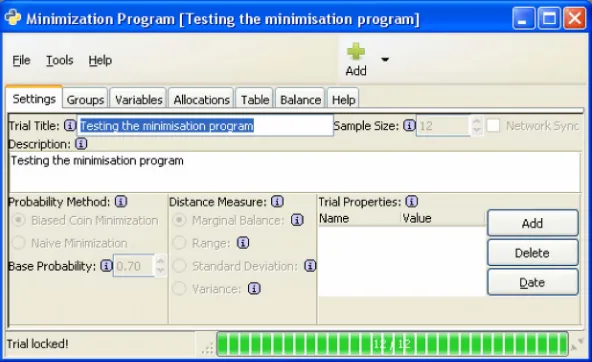
After launching MinimPy the main program window will appear (Figure 1). This window is composed of the
following tabs:
Settings: Different aspects of trial and minimization model are configured here.
Groups: An interface to define each group. For each group a label and an allocation ratio is specified.
Variables: Different prognostic factors and their levels
are specified here.
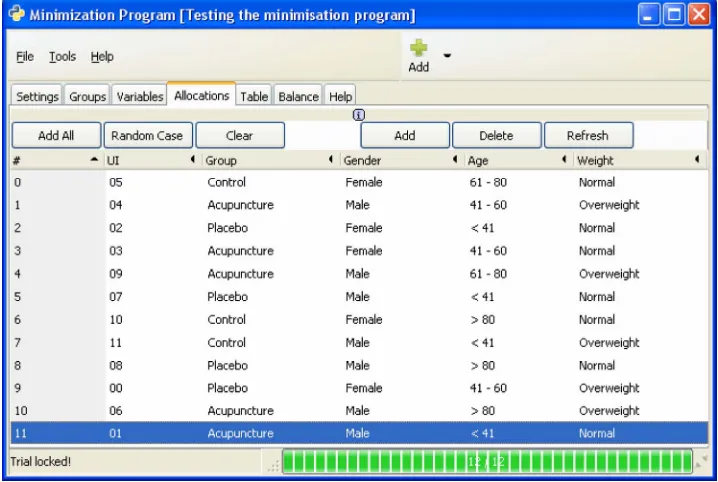
Allocations: A menu driven interface for selecting levels of different prognostic factors, to minimize the subject into trial. A table shows all currently allocated of the trial (Figure 2). Export and import functional-
ities are provided using plain text files with optional subjects. A unique random numerical identifier is as- signed to each allocated subject to facilitate blinding export of SPSS syntax file to generate the data in SPSS program.
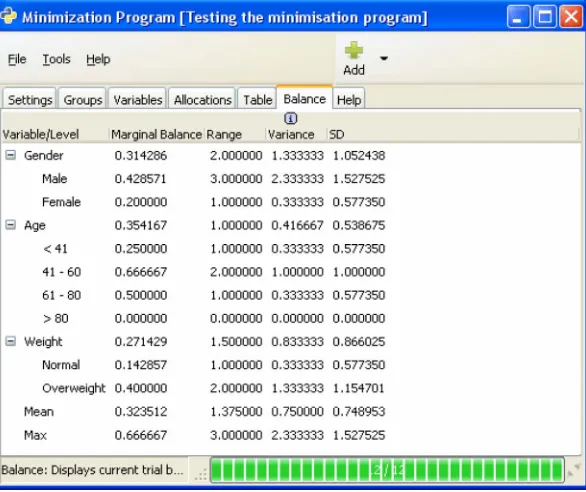
Table: A frequency table displaying counts, at each level of the prognostic factors for each group (Figure 3). Balance: A table showing measures of group, level or
total balance for the current state of the trial (Figure 4). There are buttons for adding and deleting groups and
variables, and their settings can be modified directly in the displayed table. Frequency table of allocations also can be modified and saved as a pre-load of mini- mization at the time of initialization. This is particu- larly useful when importing allocations between dif- ferent minimization systems.
The program flows in two phases.
3.1. Setup Phase
[image:3.595.150.446.523.704.2]In this phase different trial settings can be set. These include trial title and description, sample size, method of probability assignment, imbalance score, groups, vari- ables and extra trial settings. This phase terminates when the trial is saved or a previously saved one is loaded, which leads to the trial lock and start of the allocation phase. No further changes in trial settings is possible hereafter. Depending on the nature of the trial, the pro- gram may be used in either pure desktop mode or as a desktop application with network synchronization of data among trial centers. Registration with an SVN com- patible central repository is necessary for using network
Figure 2. Allocations tab showing subjects allocated.
synchronization mode. There are many free and pay- perservice SVN repositories available on the Internet.
3.2. Allocation Phase
In this phase subjects are allocated to treatment groups using the selected minimization model. No aspects of trial settings can be changed in this phase except for the title, the description and the extra properties. Last allo- cated patient can be deallocated if any error happened in setting factor levels. If no patient is allocated, trial can be unlocked and returned to setup phase. To facilitate close examination of the minimization results produced by MinimPy, an optional research mode can be enabled to provided mass production and minimization of simu- lated cases.
4. DISCUSSION
Minimization methods for allocation of subjects to treatments in a trial involves intense calculations which are hardly carried out without the use of computer pro- grams. Non-predictability features of novel minimization algorithms are comparable to those seen in randomiza- tion methods with the extra advantage of balancing dif- ferent prognostic factors across treatment groups. So- phisticated calculation may be used to account for con- ditions of unequal groups. Classic minimization methods only account for allocation ratios when calculating im- balance score. The minimization program presented in this article has the option of the biased coin minimize- tion as described by Han and co-workers [13]. Computa- tional complexities of advanced minimization algorithms
necessitates close inspection and optimization of pro- gram code by developers with statistical background. Open-source development provides an environment which enables developers to examine the code and contribute to the development of an ideal and efficient minimization program. Using Python programming language which has an easy to read syntax through formated code blocks, further enhances the transparency of program logic. MinimPy has straight forward interface functions which make it easy for an ordinary user to use. All calculations were performed using python programming languages which is very strong for statistical and mathematical application. It is an interpreted language and easy to learn by non-technicals as well. Since the python can be used for both desktop and web applications, MinimPy code can easily be modified to a pure web service appli- cation suitable for multi-center trials. However MinimPy provides network synchronization of data as needed in a typical multi-center clinical trial. Although MinimPy feathers network synchronization over free or proprie-tary repositories, the task is not easy enough to be un-dertaken by non-technical users. Therefore usage of MinimPy for multi-center trials necessitates the avail-ability of technical supports for setting a public/private repository to be used by the users of the program in dif-ferent centers.
5. AVAILABILITY AND REQUIREMENT
5.1. Public Access
Figure 3. Table tab showing counts of factors levels across different groups.
Figure 4. Balance tab showing current trial balance as four different measures for each variable, level and for the whole trial.
terms at: http://www.gnu.org/copyleft/gpl.html Latest stable version can be downloaded from sourceforge at:
http://minimpy.sourceforge.net The latest developmental version can be checked out from the code repository as: svn export https://minimpy.svn.sourceforge.net/svnroot/ minimpy minimpy or downloaded as: http://minimpy. svn.sourceforge.net/viewvc/minimpy/?view=tar
5.2. Programing Language
Python 2.6 or 2.7 (http://python.org/download/) Higher versions are not compatible with PyGTK. PyGTK 2.x. The version must be matched against the installed py- thon version.
5.3. Other Requirements
Windows users need to install GTK+ libraries and GTK
binding for python.as listed below:
GTK+: http://www.gtk.org/index.php PyGTK 2.x: http://www.pygtk.org/
PyCairo: http://ftp.gnome.org/pub/GNOME/binaries/ win32/pycairo/
PyGObject: http://ftp.gnome.org/pub/GNOME/binaries/ win32/pygobject/
Subversion http://subversion.tigris.org/
PySVN, Python binding for subversion http://pysvn. tigris.org/
To facilitate the installation of these requirements for Windows users it is recommended to install python 2.7 (http://python.org/ftp/python/2.7.1/python-2.7.1.msi) first, and then the so called all-in-one package for PyGTK and the related libraries. The latter can be downloaded from:
[image:5.595.152.445.247.493.2]2.22/pygtk-all-in-one-2.22.5.win32-py2.7.msi
Finally download and install SVN and PySVN which is needed for network synchronization of data. Under Windows and MAC OS X, installation of PySVN will install SVN too, so users of these operating systems do not need separate SVN package installation.
Generally Linux users do not need these libraries and bindings, because they are already included in most Linux distributions. For other platforms please consult the related documentation regarding downloading, in- stallation and running of python and GTK application.
After installation of these requirements (Windows) sim- ply download MinimPy as a compressed file and extract it in you hard drive. Under windows you can run the application by double clicking the “minimpy.pyw” file in the extracted folder. You can make a desktop shortcut for this file for convenience.
REFERENCES
[1] Schulz, K.F., Altman, D.G. and Moher, D. (2010) CON-SORT 2010 Statement: Updated guidelines for reporting parallel group randomized trials. Annals of Internal Medicine, 152, 1-8.
[2] Directory of randomization software and service. (2011). http://www-users.york.ac.uk/~mb55/guide/randsery.htm. [3] Lachin, J.M. (1988) Statistical properties of
randomiza-tion in clinical trials. Controlled Clinical Trials, 9, 289- 311. doi:10.1016/0197-2456(88)90045-1
[4] Kernan, W.N., Viscoli, C.M., Makuch, R.W., Brass, L.M. and Horwitz, R.I. (1999) Stratified randomization for clinical trials. Journal of Clinical Epidemiology, 52, 19- 26. doi:10.1016/S0895-4356(98)00138-3
[5] Taves, D.R. (1974) Minimization: A new method of as-signing patients to treatment and control groups. Clinical Pharmacology & Therapeutics, 15, 443-453.
[6] Pocock, S.J. and Simon, R. (1975) Sequential treatment assignment with balancing for prognostic factors in the
controlled clinical trial. Biometrics, 31, 103-115. doi:10.2307/2529712
[7] Scott, N.W., McPherson, G.C., Ramsay, C.R., Campbell MK. (2002) The method of minimization for allocation to clinical trials: A review. Controlled Clinical Trials, 23, 662-674. doi:10.1016/S0197-2456(02)00242-8
[8] McEntegart, D.J. (2003) The pursuit of balance using stratified and dynamic randomization techniques: An overview. Drug Information Journal, 37, 293-308. [9] Halpern, J. and Brown, B.W.Jr. (1986) Sequential
treat-ment allocation procedures in clinical trials with particu-lar attention to the analysis of results for the biased coin design.Statistics in Medicine, 5, 211-229.
doi:10.1002/sim.4780050303
[10] Lachin, J.M., Matts, J.P. and Wei, L.J. (1988) Randomi-zation in clinical trials: Conclusions and recommenda-tions. Controlled Clinical Trials, 9, 365-374.
doi:10.1016/0197-2456(88)90049-9
[11] Minim: Allocation by minimisation in clinical trials, 2004.
http://www-users.york.ac.uk/~mb55/guide/minim.htm. [12] Cai, H.W., Xia, J.L., Gao, D.H. and Cao, X.M. (2010)
Implementation and experience of a web-based alloca-tion system with Pocock and Simon’s minimizaalloca-tion me- thods.Contemporary Clinical Trials, Vol. 31, No. 6, 2010, pp. 510-513. doi:10.1016/j.cct.2010.07.009
[13] Han, B., Enas, N.H. and McEntegart, D.J. (2009) Ran-domization by minimization for unbalanced treatment allocation. Statistics in Medicine, 28, 3329-3346. doi:10.1002/sim.3710
[14] Python Programming Language Official Website. (2011). http://www.python.org/.
[15] Matsumoto, M. and Nishimura, T. (1998) Mersenne twister: A 623-dimensionally equidistributed uniform pseudo- random number generator. ACM Transactions on Modeling and Computer Simulation, 8, 3-30.
doi:10.1145/272991.272995 [16] Subversion.tigris.org. (2011).
http://subversion.tigris.org/
[17] Pysvn.tigris.org. (2011). http://pysvn.tigris.org/
Abbreviations and Acronyms
PH = preferred treatment; PL = non-preferred treatment;
PHb = base PH used for the group with the lowest alloca-
tion ratio as the preferred treatment;
PHi = PH for groups with higher allocation ratios as the
preferred treatment;
r1, r2,, rn = Allocation ratios for groups 1 to n; bM = Marginal balance;
ai = adjusted number of patients present in a factor level