ISSN Print: 2164-3164
DOI: 10.4236/ojce.2018.84038 Dec. 25, 2018 533 Open Journal of Civil Engineering
Sixth Scale Model Studies of Masonry Arch Rib
Behaviour at Different Eccentricities
Abbagana Mohammed
1*, T. G. Hughes
21Department of Civil Engineering, Abubakar Tafawa Balewa University, Bauchi, Nigeria 2School of Engineering, Cardiff University, Cardiff, UK
Abstract
This paper reports a validation study involving sixth scale masonry model to replicate prototype tests carried out on five unit high masonry prisms. In or-der to test the applicability of small masonry models to real life problems, an investigation into masonry behaviour relevant to the serviceability require-ment of masonry arch bridges was chosen as prototype test to validate the small scale masonry tests. Only representative masonry specimens were con-sidered in the study; this corresponded to parts of an arch ring in a complete masonry arch. Two mortar designations; designation iv and designation v were used. These weak mortars tend to conform better to existing old struc-tures. Loads were applied at four eccentricities of 0, 5, 9, and 14 mm from the centre of the specimens. This corresponds to e/d ratios of 0, 0.14, 0.25, and 0.39, where e is the eccentricity of the load and d the length of the transverse section of the specimens. The result shows that validation study corresponds with prototype study for low eccentricities; therefore, strength enhancement is seen over the concentric compressive strength. However, this does not ap-ply at higher eccentricities as specimens were noticed to fail by elastic insta-bility characterised by tension debonding of the top mortar joint.
Keywords
Masonry, Arch Bridge, Prototype, Eccentricity
1. Introduction
In order to test the applicability of small masonry models to real life problems, an investigation by Roberts et al. [1] into masonry behaviour relevant to the ser-viceability requirement of masonry arch bridges was chosen as prototype test to validate the small scale masonry tests by Mohammed [2].
How to cite this paper: Mohammed, A. and Hughes, T.G. (2018) Sixth Scale Model Studies of Masonry Arch Rib Behaviour at Different Eccentricities. Open Journal of Civil Engineering, 8, 533-543.
https://doi.org/10.4236/ojce.2018.84038
Received: August 30, 2018 Accepted: December 22, 2018 Published: December 25, 2018
Copyright © 2018 by authors and Scientific Research Publishing Inc. This work is licensed under the Creative Commons Attribution International License (CC BY 4.0).
DOI: 10.4236/ojce.2018.84038 534 Open Journal of Civil Engineering In masonry arches, the arch barrel, which is the main structural component, carries the applied load principally through the induced axial compressive thrust. However, as traffic moves over the bridge, the arch barrel may also be subjected to significantly reversed bending and shear forces. This may result in the arch barrel being subjected to considerable cyclic stress ranges, which could affect the use of the bridge adversely [3].
Recently there has been interest in the establishment of serviceability limits for masonry bridges, BD 21/97 [4] and Boothby et al. [5]. In BD 21/97 (1997), it is suggested that the service load should be limited to 50% of the predicted ulti-mate load. This conclusion is based on the results of numerous large and full scale tests, which show that the load deflection response of masonry arch bridges remains approximately linear up to 50% of the ultimate load. However, because of the uncertainties in the material properties of masonry due to environmental effects, theoretical predictions of the ultimate loads of masonry arch bridges are usually not reliable [3].
In masonry arches the compressive force will generally be eccentric and in approaching failure; the force on some units will be highly eccentric and these forces will generally be concentrated on a small part of the surface area of the unit and form a so called hinge [6]. Various prototype studies [7] [8] have shown that the compressive stress at failure under eccentric loading is greater than under axial loading and further enhancement to the apparent compressive strength has been established under highly concentrated loads by other studies [6] [9].
Therefore, the main objective of the application study was to investigate the effect of eccentric concentrated loading on sixth scale masonry with a view to comparing it to the prototype study by using static tests as a tool for the under-standing of the overall behaviour of masonry arches.
2. Materials and Methods
2.1. Masonry Specimens
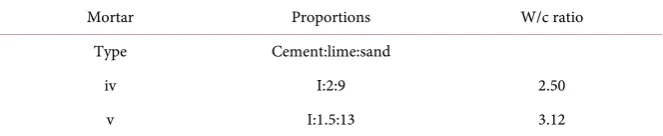
Only representative masonry specimens were considered in the study, this cor-responded to parts of an arch ring in a complete masonry arch. For the purpose of this study a five unit high, sixth scale masonry specimen as shown in Figure 1 was used. Two mortar designations; designation iv and designation v were used. These weak mortars tend to conform better to existing old structures. The pro-portions of the constituent elements used in the mortar are as given in BS 5628 [10] and the dry mass proportions in BS 4551 [11] were used and are shown in Table 1. All mortars were made using HST 95 sand. All the specimens were al-lowed to cure normally in the laboratory after preparation and tested at or shortly after 28 days of curing.
DOI: 10.4236/ojce.2018.84038 535 Open Journal of Civil Engineering
[image:3.595.207.539.393.461.2]Figure 1. Dimensions of specimens in mm.
Table 1. Mortar proportions.
Mortar Proportions W/c ratio Type Cement:lime:sand
iv I:2:9 2.50
v I:1.5:13 3.12
2.2. Tests
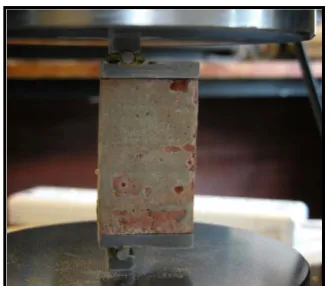
Testing was carried in a 20 kN capacity testing machine under constant rate of displacement of 0.25 mm/min. Load was applied via an arrangement of 6 mm steel plates and 6mm steel bars as shown in Figure 1. The specimens were also supported on similar arrangement of plates and bars as used in applying the loads in order to ensure uniform eccentricity from the centre of the specimens. Loads were applied at four eccentricities of 0, 5, 9, and 14 mm from the centre of the specimens. This corresponds to e/d ratios of 0, 0.14, 0.25, and 0.39, where e is the eccentricity of the load and d the length of the transverse section of the spe-cimens as defined in Figure 1. Test set up for the e/d ratio = 0.25 is shown in Figure 2.
2.3. Calculation
DOI: 10.4236/ojce.2018.84038 536 Open Journal of Civil Engineering
Figure 2. Set up of model test at an eccentricity of 0.25.
Figure 3. Assumed stress distributions for eccentric loading (a) no tension (b) linear
cracked.
stress fm is given by (1)
2 6
m P Pe
f
bd bd
= +
(1)
where P is the applied compressive force and bd is the loaded cross-section area (width × depth).
When the eccentricity of load is beyond the middle third of the cross-section the cracked triangular stress block in Figure 3(b) was assumed. For this distri-bution, equilibrium of external and internal forces entails that Equations (2) and (3) applies
2
m
f bh=P (2)
2 2 3
m
f bh d h − =Pe
(3)
Substituting for P in (3) gives (4) and (5)
3 2 d
h= −e
(4) 2
m P
f bh
[image:4.595.209.538.246.387.2]DOI: 10.4236/ojce.2018.84038 537 Open Journal of Civil Engineering The cracked triangular no tension distribution was chosen for this solution because it gave an upper bound solution rather than the cracked parabolic no tension distribution (not presented here).
3. Discussion of Results
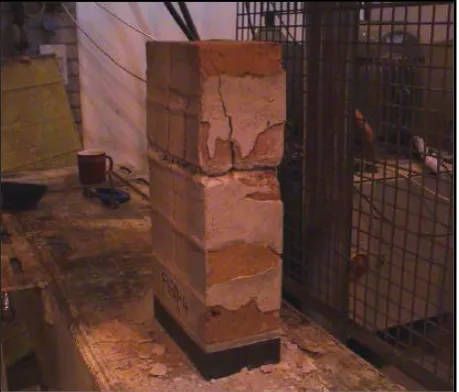
[image:5.595.259.489.295.491.2]In the prototype test failure of the specimens was initiated by crushing and squeezing of the mortar from the mortar joints followed by vertical splitting of the bricks as shown in Figure 4.
[image:5.595.228.522.519.699.2]Figure 5 and Figure 6 show the variation of compressive strength with load eccentricity for mortar designation v. Both of the figures show that the compres-sive strength is increased as the eccentricity is increased in line with findings by most authors, notably Page and Hendry [12] who have even suggested design rules for concentrated loads with varying eccentricities on masonry. The reason for the enhancement as suggested by Drysdale and Hamid [7] is due to the strain
Figure 4. Typical failure pattern in prototype tests.
DOI: 10.4236/ojce.2018.84038 538 Open Journal of Civil Engineering gradient effect on the compressive strength. They argued that the gradient of vertical compression strain across a brick due to eccentricity of a load will be accompanied by a corresponding tensile strain gradient in the lateral direction. But because the tensile strength of masonry units are affected by strain gradient (as shown by the greater flexural tensile strength in comparison to the direct axi-al tensile strength), they concluded that the apparent compressive strength should be higher for eccentrically loaded brickwork.
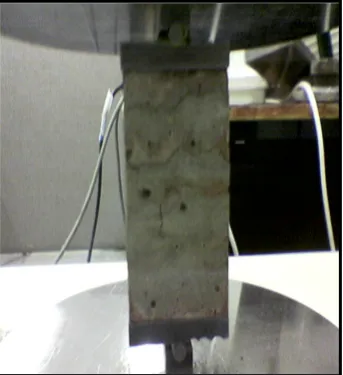
[image:6.595.233.516.307.476.2]Typical failure of the specimens in the model study was usually characterised by vertical splitting cracks under the load point as well as at the sides of the spe-cimens. This was followed by crushing of the loaded point in some cases. Figure 7 shows a typical failure in one of the tests. In the case of the specimens with e/d of 0.39 there were cases in which tension debonding was noticeable at the edge furthest from the load point just before failure, in specimens made with both de-signation iv and dede-signation v mortar. Figure 8 shows the debonding on the tensile side in one of the tests. This type of failure represents an elastic instability
Figure 6. Variation of compressive strength with e/d ratio for prototype test 2.
[image:6.595.288.460.506.694.2]DOI: 10.4236/ojce.2018.84038 539 Open Journal of Civil Engineering
Figure 8. Bond failure in top bed joint of model specimen at e/d of 0.39.
characterised by debonding on the tensile side for loads with high eccentricity according Sahlin [13].
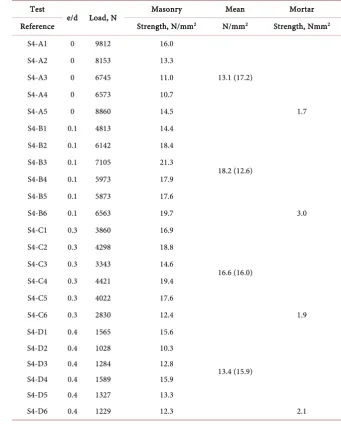
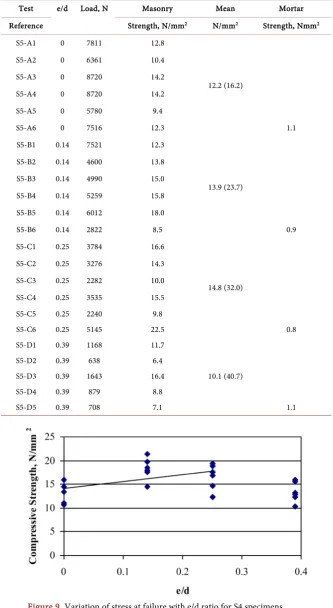
The results as tabulated in Table 2 and Table 3 for tests using mortar desig-nations iv (test; S4) and v (test; S5) show a mixed picture as seen in Figure 9 and Figure 10, which show the variation of maximum compressive strength with e/d ratio for tests using mortar designations iv and v, respectively. In Figure 9, it is seen that there is an initial increase in strength from the point of zero eccentric-ity to point e/d = 0.14. Followed by a decrease in strength from this point up to the last point e/d = 0.39. While in Figure 10, there is an increase in strength from the point of zero eccentricity up to the point e/d = 0.25 before decreasing at the last point e/d = 0.39. Therefore, as seen from the trend lines in both figures there is only a marginal increase in compressive strength as the eccentricity is increased for the eccentricities considered (neglecting e/d = 0.39). But the actual compressive strength in the model tests was higher because of the higher model unit compressive strength, which is about 57% higher than the prototype unit strength.
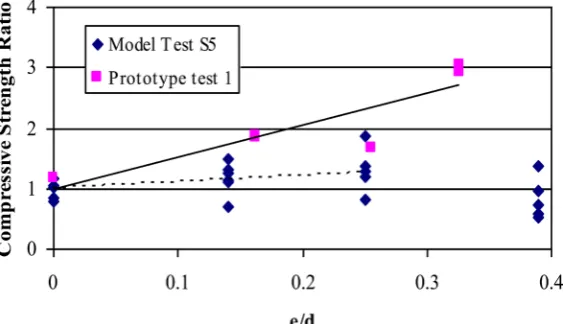
DOI: 10.4236/ojce.2018.84038 540 Open Journal of Civil Engineering The reason for the greater enhancement in the prototype over the model scale is not certain, but it could to be due to the elastic instability characterised by the cracking on the tension side of the model specimens before material failure in the units. But since the geometries of the test specimens and load eccentricities for the prototype and model tests are similar, the expectation was for a compa-rable enhancement factor in the model test. It therefore seems that there is better agreement between the failure mechanics of prototype and model specimens in axial compression than in eccentric loading. This may be because it is difficult to model mortar at very small scales because of the thinness of the joints. Because as reported by Mohammed et al. [14] effects with regards to joint thickness are difficult to model at sixth scale. The reason for this is not certain but it offers a possible area of further investigation in the future.
Table 2. Test results for specimens made with designation iv mortar, S4, with COV in
brackets.
Test
e/d Load, N Masonry Mean Mortar Reference Strength, N/mm2 N/mm2 Strength, Nmm2
S4-A1 0 9812 16.0
13.1 (17.2) S4-A2 0 8153 13.3
S4-A3 0 6745 11.0 S4-A4 0 6573 10.7
S4-A5 0 8860 14.5 1.7
S4-B1 0.1 4813 14.4
18.2 (12.6) S4-B2 0.1 6142 18.4
S4-B3 0.1 7105 21.3 S4-B4 0.1 5973 17.9 S4-B5 0.1 5873 17.6
S4-B6 0.1 6563 19.7 3.0
S4-C1 0.3 3860 16.9
16.6 (16.0) S4-C2 0.3 4298 18.8
S4-C3 0.3 3343 14.6 S4-C4 0.3 4421 19.4 S4-C5 0.3 4022 17.6
S4-C6 0.3 2830 12.4 1.9
S4-D1 0.4 1565 15.6
13.4 (15.9) S4-D2 0.4 1028 10.3
S4-D3 0.4 1284 12.8 S4-D4 0.4 1589 15.9 S4-D5 0.4 1327 13.3
[image:8.595.195.537.293.725.2]DOI: 10.4236/ojce.2018.84038 541 Open Journal of Civil Engineering
Table 3. Test results for specimens made with designation v mortar, S5, with COV in
brackets.
Test e/d Load, N Masonry Mean Mortar Reference Strength, N/mm2 N/mm2 Strength, Nmm2
S5-A1 0 7811 12.8
12.2 (16.2) S5-A2 0 6361 10.4
S5-A3 0 8720 14.2 S5-A4 0 8720 14.2 S5-A5 0 5780 9.4
S5-A6 0 7516 12.3 1.1
S5-B1 0.14 7521 12.3
13.9 (23.7) S5-B2 0.14 4600 13.8
S5-B3 0.14 4990 15.0 S5-B4 0.14 5259 15.8 S5-B5 0.14 6012 18.0
S5-B6 0.14 2822 8.5 0.9
S5-C1 0.25 3784 16.6
14.8 (32.0) S5-C2 0.25 3276 14.3
S5-C3 0.25 2282 10.0 S5-C4 0.25 3535 15.5 S5-C5 0.25 2240 9.8
S5-C6 0.25 5145 22.5 0.8
S5-D1 0.39 1168 11.7
10.1 (40.7) S5-D2 0.39 638 6.4
S5-D3 0.39 1643 16.4 S5-D4 0.39 879 8.8
[image:9.595.203.542.100.698.2]S5-D5 0.39 708 7.1 1.1
[image:9.595.206.540.102.711.2]DOI: 10.4236/ojce.2018.84038 542 Open Journal of Civil Engineering
Figure 10. Variation of compressive strength with e/d ratio for S5 specimens.
Figure 11. Comparison of the effect of eccentricity in prototype and model test.
4. Conclusion
The application study somewhat agrees with the prototype study for low eccen-tricities; therefore, strength enhancement is seen over the concentric compres-sive strength. However, this does not apply at higher eccentricities as specimens were noticed to fail by elastic instability characterised by tension debonding of the top mortar joint.
Conflicts of Interest
The authors declare no conflicts of interest regarding the publication of this pa-per.
References
[1] Roberts, T.M, Hughes, T.G. and Dandamudi, V.R. (2004) Progressive Damage to Masonry Arch Bridges Caused by Repeated Traffic Loading—Phase 2. Cardiff Uni-versity, Cardiff.
[2] Mohammed, A. and Hughes, T.G. (2011) Prototype and Model Masonry Behaviour under Different Loading Conditions. Materials and Structures,44, 53-65.
[image:10.595.233.515.256.418.2]DOI: 10.4236/ojce.2018.84038 543 Open Journal of Civil Engineering
[3] Roberts, T.M., Hughes, T.G. and Goutis, G. (2003) Progessive Damage to Masonry arch Bridges Caused by Repeated Traffic Loading. Cardiff University, Cardiff. [4] Department of Transport (1997) BD 21/97 Design Manual for Roads and Bridges.
Vol. 3: Sect 4: Part 3: The Assessment of Highway Bridges and Structures. [5] Boothby, T.E, Domalik, D.E. and Dalal, V.A., (1998) Service Load Response of
Ma-sonry Arch Bridges. Journal of Structural Engineering, 124, 17-23.
https://doi.org/10.1061/(ASCE)0733-9445(1998)124:1(17)
[6] Hendry, A.W. (1990) Masonry Properties for Assessing Arch Bridges. Transport and Road Research Laboratory.
[7] Drysdale, R.C. and Hamid, A.A. (1982) Effect of Eccentricity on the Compressive Strength of Brickwork. Journal of British Ceramic Society, 30,140-48.
[8] Martinez, J.L, Martin-Caro, J.A. and Leon, J. (2004) Masonry Compressive Strength Enhancement under Eccentric Axial Load. Arch Bridges IV, Barcelona.
[9] Arora, S.K. (1988) Performance of Masonry Walls under Concentrated Load. Pro-ceedings of the British Masonry Society,No. 2, London.
[10] British Standards Institution (1995) Code of Practice for Use of Masonry: Part 2: Structural Use of Unreinforced Masonry. B.S.I, BS 5628, London.
[11] British Standards Institution (1998) Part 1: Methods of Testing Mortars, Screeds and Plasters. 1998, B.S.I, BS 4551, London.
[12] Page, A.W. and Hendry, A.W. (1988) Design rules for Concentrated Loads on Ma-sonry. The Structural Engineer, 66, 273-281.
[13] Sahlin, S. (1971) Structural Masonry. Prentice-Hall, Upper Saddle River.