BACTERIOLOGICAL CHARACTERISTICS AND STABILIZATION OF SEWAGE SLUDGE SUBJECTED
TO DIFFERENT HYGIENIZATION PROCESSES
*,1
Amilton Alves Filho,
21
Alirio Coromoto Daboin Maldona
1
Federal University of Uberlândia, Brazil
2Professor at the Institute of Agricultural Sciences, Federal
3
Tecnica Administrative Federal University of Uberlândia, Brazil
ARTICLE INFO ABSTRACT
This study aimed
acid and alkaline media during different hygienization periods given the total content of volatile solids, total solids, temperature, pH and total coliforms in sewage sludge. The experimental design process used was randomized blocks in a 5x3 +1 factorial schem
factor being made up of disinfectant products (260 mg L Ammonium Compounds
sodium hypochlorite and pure days and T
lime at 30 dag kg
standard, has raised total solid content, reduced volatile solid content and lowered foul odor emissions.
standard required by Brazilian environmental legislation.
by weight of dry mass can be used as a way to disenfect sweage sludge, concerning bacteriological content and stabilization. The other d
reducing total coliforms or volatile organic compounds.
Copyright©2016, Amilton Alves Filho et al. This is an open access article distributed under the Creative Commons Att unrestricted use, distribution, and reproduction in any medium, provided the original work is properly cited.
INTRODUCTION
Sewage sludge is a product of wastewater treatment system and contains high levels of organic matter in addition to macro and micronutrients which are essential to plants (Quintana
et al., 2011). According to Pires et al. (2008), the reuse of
wastes in agriculture is the most interesting option from social, economic and envinronmental point of view.
solely disposal of sewage sludge in landfill, accepted nowadays by organs which integrates National Environment System (SISNAMA) in Brazil, does not eliminate its potential to cause pathologies or environmental contamination, more than postpones an environmental problem to a near future. To Andrade et al. (2006) biosolid agricultur
an alternative to minimize the problem of waste sludge final
*Corresponding author: Amilton Alves Filho,
Federal University of Uberlândia, Brazil.
ISSN: 0975-833X
Article History:
Received 03rd May, 2016
Received in revised form 20th June, 2016
Accepted 19th July, 2016
Published online 31st August,2016
Key words:
Micro-organism, Biosolids, Sanitation waste, Sewage.
Citation: Amilton Alves Filho, Reginaldo de Camargo, Regina Maria Quintão Lana, Alirio Coromoto Daboin Maldona
and Roberto Terumi Atarassi, 2016. “Bacteriological characteristics and stabilization of sewage sludge subjected to different Hygienization processes International Journal of Current Research, 8, (08), 36802
RESEARCH ARTICLE
BACTERIOLOGICAL CHARACTERISTICS AND STABILIZATION OF SEWAGE SLUDGE SUBJECTED
TO DIFFERENT HYGIENIZATION PROCESSES
2
Reginaldo de Camargo,
2Regina Maria Quintão Lana
Alirio Coromoto Daboin Maldonado,
3Marcia Regina Moraes and
2Roberto Terumi Atarassi
Federal University of Uberlândia, Brazil
Professor at the Institute of Agricultural Sciences, Federal University of Uberlândia, Brazil
Tecnica Administrative Federal University of Uberlândia, Brazil
ABSTRACT
This study aimed to evaluate the efficiency of solar radiation, combined with chemical treatment in and alkaline media during different hygienization periods given the total content of volatile solids, total solids, temperature, pH and total coliforms in sewage sludge. The experimental design process used was randomized blocks in a 5x3 +1 factorial schem
factor being made up of disinfectant products (260 mg L-1 peracetic acid, 2400 mg L
Ammonium Compounds, lime equivalent to 30% of the dry mass of the sewage sludge, 2500 mg L sodium hypochlorite and pure sludge) and subplot factor being treatment period (T
days and T3= 21 days), plus an additional treatment made up of pure sludge at zero time.
lime at 30 dag kg-1 has reduced levels of total coliforms to acceptable limits by environmental
standard, has raised total solid content, reduced volatile solid content and lowered foul odor emissions. Solar radiation itself was not able to reduce the amount of total coliform
standard required by Brazilian environmental legislation. Hydrated lime in the ratio of 30% dag by weight of dry mass can be used as a way to disenfect sweage sludge, concerning bacteriological content and stabilization. The other disinfectant products did not perform the same efficiency on reducing total coliforms or volatile organic compounds.
is an open access article distributed under the Creative Commons Att use, distribution, and reproduction in any medium, provided the original work is properly cited.
Sewage sludge is a product of wastewater treatment system and contains high levels of organic matter in addition to macro and micronutrients which are essential to plants (Quintana
. (2008), the reuse of wastes in agriculture is the most interesting option from social, economic and envinronmental point of view. However, the solely disposal of sewage sludge in landfill, accepted ch integrates National Environment System (SISNAMA) in Brazil, does not eliminate its potential to cause pathologies or environmental contamination, more than postpones an environmental problem to a near future. To
. (2006) biosolid agricultural recycling is an alternative to minimize the problem of waste sludge final
disposal, as well to prevent possible hostile effects to environment, taking the preservation of natural resources into account and seeeking, at the same time, agronomic benefits. Nascimento et al. (2014) and Samaras
that use of sewage sludge on agricultural land is a matter of concern due to the larger concentrations of heavy metals, pathogenic agents and a handful of synthetic organic compounds. The five groups of pathogenic microorganisms which may be present in sewage sludge are: helminths, protozoa, fungi, viruses and bacteria (Costa
According to Jordão and Pessôa (2005), the presence of pathogenic agents together with microorganisms in sewage sludge is a direct reflection of the health profile from people who contribute with wastewater system.
characterization, resolution 375/2006 from CONAMA (National Council of the Environment) lists bacteria as belonging to the group of total coliforms, with the group of bacteria being used as bacteriological indicator in sewage sludge agricultural reuse (Brazil, 20
International Journal of Current Research
Vol. 8, Issue, 08, pp.36802-36808, August, 2016
INTERNATIONAL
Amilton Alves Filho, Reginaldo de Camargo, Regina Maria Quintão Lana, Alirio Coromoto Daboin Maldona
Bacteriological characteristics and stabilization of sewage sludge subjected to different Hygienization processes 36802-36808.
BACTERIOLOGICAL CHARACTERISTICS AND STABILIZATION OF SEWAGE SLUDGE SUBJECTED
Regina Maria Quintão Lana,
Roberto Terumi Atarassi
University of Uberlândia, Brazil
Tecnica Administrative Federal University of Uberlândia, Brazil
solar radiation, combined with chemical treatment in and alkaline media during different hygienization periods given the total content of volatile solids, total solids, temperature, pH and total coliforms in sewage sludge. The experimental design process used was randomized blocks in a 5x3 +1 factorial scheme, with four replications, with plot
peracetic acid, 2400 mg L-1 Quaternary
lime equivalent to 30% of the dry mass of the sewage sludge, 2500 mg L-1
) and subplot factor being treatment period (T1= 7 days, T2= 14
= 21 days), plus an additional treatment made up of pure sludge at zero time. Hydrated has reduced levels of total coliforms to acceptable limits by environmental standard, has raised total solid content, reduced volatile solid content and lowered foul odor Solar radiation itself was not able to reduce the amount of total coliforms to an acceptable
Hydrated lime in the ratio of 30% dagkg-1
by weight of dry mass can be used as a way to disenfect sweage sludge, concerning bacteriological isinfectant products did not perform the same efficiency on
is an open access article distributed under the Creative Commons Attribution License, which permits
disposal, as well to prevent possible hostile effects to environment, taking the preservation of natural resources into account and seeeking, at the same time, agronomic benefits. . (2014) and Samaras et al. (2007) reported that use of sewage sludge on agricultural land is a matter of to the larger concentrations of heavy metals, pathogenic agents and a handful of synthetic organic compounds. The five groups of pathogenic microorganisms which may be present in sewage sludge are: helminths, protozoa, fungi, viruses and bacteria (Costa and Costa, 2011). According to Jordão and Pessôa (2005), the presence of pathogenic agents together with microorganisms in sewage sludge is a direct reflection of the health profile from people who contribute with wastewater system. To the bacterial erization, resolution 375/2006 from CONAMA (National Council of the Environment) lists bacteria as belonging to the group of total coliforms, with the group of bacteria being used as bacteriological indicator in sewage sludge agricultural reuse (Brazil, 2006).
INTERNATIONAL JOURNAL OF CURRENT RESEARCH
The raw sewage sludge, that is, untreated, is rich in pathogenic microorganisms easily putrescible, thus, releases foul-smelling odors. The biodegradable fraction from organic matter in the sludge, also known as total volatile solids, must be stabilised with the purpose of reducing the risk of putrefaction and pathogenic concentration. Stabilization is the process by which sewage sludge meant for agriculture ceases to present potential to generate odors and vectors attractiveness, even when humidified again (Brasil, 2006). Various ways are applied to warrant the hygienization and the framework for legal limits of resolution 375/2006 from CONAMA, such as: composting, solarization, vermicomposting, liming, chemical treatment with acetic acid, peracetic acid, sodium hypochlorite and quaternary ammonium salts (Nascimento et al., 2014; Barros et al., 2011; Barros et al., 2006; Ruan et al., 2014 e Samaras et al., 2007). To Farzadkia; Bazrafshan (2014) sludge
stabilization with hydrated lime is accomplished when sludge’s pH raises to above 12.0. According to Samaras et al. (2007), liming to stabilize sewage sludge is broadly used in many countries, but its usage depends on avaiability, costs and the period needed to the stabilization of sludge. In this sense, other kind of materials to hygienization of sweage sludge can be considered. To Sypula et al. (2013) one effective method to improve hygienic state of sweage sludge is solar drying it, for pathogenic bacteria are extremely sensitive to moisture loss. The same way, solar radiation, specifically ultraviolet radiation, is well known for its bactericidal effect (Pinto et al., 2001). However, given brazilian conditions, there is few information on solar radiation real’s capacity, by itself or combined with other methods, to eliminate pathogenic microorganisms in sewage sludge. This work’s objective was to evaluate the efficiency of solar radiation, combined with chemical treatment in acid and alkaline media during different hygienization periods given the total content of volatile solids, total solids, temperature, pH and total coliforms in sewage sludge
MATERIALS AND METHODS
The experiment was performed at the Glória Experimental Farm of the Federal University of Uberlândia (UFU), in Uberlândia, MG, from 7 August to 27 August, 2013. The local climate is classified as Aw, according to Koppen classification, with a dry season (from may to september) and a wet one (from october to april). The sewage sludge used was extracted from an anaerobic reactor UASB type (Upflow Anaerobic Sewage Sludge Blanket) belonging to Uberabinha Sewage Treatment Plant of DMAE - Department of Water and Waste water, located in Uberlândia, MG. The sludge is from domestic sources after passing through a dewatering process by adding cationic polymers (FeCl3) and centrifuging to a moisture level of 71.21 and 28.79% dry matter. The experimental design was a randomized block in a factorial 5×3+1, with four replications of factor plots consisting of disinfectant products (260 mg L-1 peracetic acid, 2400 mg L-1 quaternary ammonium compounds, hydrated lime equivalent to 30% of the dry mass of the sewage sludge, 2500 mg L-1 sodium hypochlorite, and pure sludge) and subplot factor being treatment period (T1= 7
days, T2= 14 days and T3= 21 days), plus an additional
[image:2.595.302.564.86.147.2]treatment made up of pure sludge at zero time (initial quality), in a total of 64 subplots (Table 01).
Table 1. Treatments used in the sewage sludge hygienization process and their concentrations at 7, 14 and 21 days
Treatments Chemical concentration
Sludge + peracetic acid 260 mg L-1
Sludge + Quaternary compounds of amonium1 2400 mg L-1
Sludge + Hydrated lime 30% of sludge dry matter
Sludge + Sodium hypochlorite 2500 mg L-1
Pure sludge without chemical -
1/ Dicetyl ammonium chloride, alkyl amido propyl chloride, dimethylbenzyl
ammonium, alcohol and water.
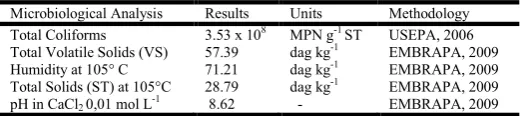
The experiment plots consisted of metal boxes of 0.30 × 0.23 × 1.0 meters on pedestals in order to eliminate as much interference from the ground such as humidity and temperature as possible. Each chemical treatment with peracetic acid, sodium hypochlorite, quaternary ammonium compounds and hydrated lime, also pure sludge, was blended in a mixer for three minutes. In each metal box, corresponding to one experimental unit (plot), were put 30 kg of the mixture, containing sewage sludge and hygienization material, including treatment related only to pure sludge, in a total of 0.1 m³ m-2 sludge per box. Instruments to measure temperature were implanted in each box at a depth of 5,0 cm into the sludge mass and at 40 cm from the end of the receptacle. Data were stored in a datalogger, model CR 1000 (Campbell Scientific®), calibrated to record temperatures at 30 minutes intervals daily throughout the experimental period. Into each block, consisting of five boxes, a 5.0 mm transparent glass was applied in order to enable a greenhouse effect inside each unit and to avoid moisture, such as rainfall, from external environment. A ribbon was placed between the glass and the boxes to prevent the entrance of air and moisture. An autoclaved spatula was used to collect each sample. Within each plot, four sub-samples were collected at different depths of the sludge, from surface to the bottom of the box. The analysis of total coliforms, total volatile solids, humidity (105°C) and pH were carried out in the Environmental Microbiology Laboratory of the Federal University of Uberlândia. To the analysis of total coliforms it was used the technique of multiple pipes, recommended by the United States Environmental Protection Agency for sludge analysis (USEPA, 2006). Concerning the volatile solids (VS), moisture, total solids and pH, the methodology used was the one recommended by EMBRAPA (Brazilian Agricultural Research Corporation) (2009), Table 02.
Table 2. Physical and bacteriological characteristics of sweage
sludge1
Microbiological Analysis Results Units Methodology
Total Coliforms 3.53 x 10⁸ MPN g-1 ST USEPA, 2006
Total Volatile Solids (VS) 57.39 dag kg-1 EMBRAPA, 2009
Humidity at 105° C 71.21 dag kg-1 EMBRAPA, 2009
Total Solids (ST) at 105°C 28.79 dag kg-1 EMBRAPA, 2009
pH in CaCl2 0,01 mol L-1 8.62 - EMBRAPA, 2009
MPN: Most Probable Number. 1/ Analysis perfomed at soil analysis laboratory of
the Institute of Agricultural Sciences - Federal University of Uberlândia.
[image:2.595.303.564.601.659.2]The averages were still compared to the additional treatment by the Dunnet test, applying a 0.05 level of significance.
RESULTS AND DISCUSSION
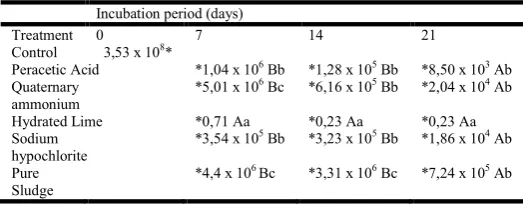
[image:3.595.31.293.192.294.2]The average concentration of total coliforms in the sewage sludge before cleaning was 3.53 x 10⁸ MPN g-1 ST, which is within the range related by Bonini et al., (2010) (Table 3).
Table 3. Total coliforms in (MPN) g-1 TS, due to their submission
to different processes of treatment and evaluation time
Incubation period (days)
Treatment 0 7 14 21
Control 3,53 x 10⁸*
Peracetic Acid *1,04 x 106 Bb *1,28 x 105 Bb *8,50 x 103 Ab
Quaternary ammonium
*5,01 x 106 Bc *6,16 x 105 Bb *2,04 x 104 Ab
Hydrated Lime *0,71 Aa *0,23 Aa *0,23 Aa
Sodium hypochlorite
*3,54 x 105 Bb *3,23 x 105 Bb *1,86 x 104 Ab
Pure Sludge
*4,4 x 106 Bc *3,31 x 106 Bc *7,24 x 105 Ab
Means followed by the same lower case letters in the (Scott-Knott) column and the same capital letters in the (Tukey) column did not differ at the 5% significance level. * Significant at 5% by the Dunnett test.
Hydrated lime (Ca (OH)2), when added to sewage sludge in a
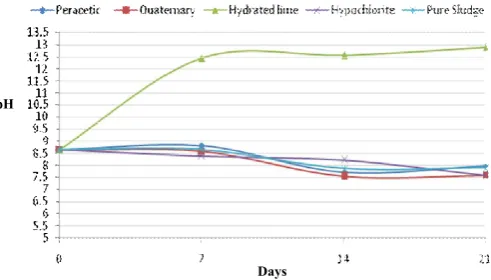
proportion of 30 dag kg-1 of its dry mass, raised the pH to higher than 12.0 throughout the whole 21 days period. In this condition, ions from NH4+ are deprotonated producing NH3
(ammonia) which acts into the process of elimination of total coliforms. The reduction in the concentration of coliforms from 3.53 x 10⁸ MPN g-1 of Total Solids to 0.71 MPN g-1 Total Solids has taken place seven days after the addition into the sewage sludge (Table 3 and 4). Matos et al. (2012) reveal that liming process raises pH to values close to 12 and eliminates most of the pathogens present in the residue. Arthurson (2008) mentions that maintaining pH above 12.00 for 2 hours is enough to eliminate bacteria from coliforms group in the sewage sludge mainly due to elevation of pH and production of NH3. The concentration of total coliforms in
sewage sludge on 14 and on 21 days was unchaged with values of 0.23 MPN g-1 of Total Solids, respectively (Table 3). No significant change was observed in the treatment with hydrated lime on the reduction of total coliforms between periods of seven (07), fourteen (14) and twenty one (21) days. After a great reduction in the average concentration of total coliforms in the limed sludge during seven days, no regrowth was observed at 14 and 21 days. In the external environment, microorganisms require na intermediate host to multiply. Results indicate that a severe reduction on the concentration of total coliforms may have happened before 7 days of treatment, suggesting the conduction of new studies with shorter periods of treatment. Quaternary ammonium salts produced no efficient reduction in total coliforms. The average concentration of total coliforms on 21 days after mixing quaternary ammonium salts to sewage sludge was 2.4 x 10⁴ MPN g-1 TS. Brazilian environmental legislation mentions that the higher concentration of bacteria belonging to the group of total coliforms in sweage sludge must be less than 103 MPN g-1
In the model of subdivided plots for pH attribute, a significant change was verified between main treatments (limed sludge and homogenized sludge with peracetic acid, quaternary ammonium salts, sodium hypochlorite and pure sludge) when averages were compared by Scott-Knott Test, highlighting accented effect among secondary treatments (times) to pH parameter; there was no interaction between main factor and secondary factor concerning the analyzed parameter (Fig. 01). In figure 01 it is possible to verify that, in the beginning, sludge presented pH 8.65. Once the experiment was initiated, limed sludge has raised pH to levels superior to 12.00, but there was no significant change between evaluated treatments, thus, adding hygienization means (peracetic acid, quaternary ammonium salts and sodium hypochlorite) did not modify sewage sludge’s pH. However, limed slugde presented better averages with pH above 12.00 throughout experimental cycle. The average values of pH registered during the experimental period are presented in figure 01. Limed sludge has scored the higher pH averages with values above 12.0 at 7, 14 and 21 days. Materials treated with peracetic acid, quaternary ammonium salts, sodium hypochlorite and the pure sludge have not presented great variations on pH levels at 7, 14 and 21 days, registering average values between 7.56 and 8.82, what indicates that the applied means did not alter sewage sludge’s pH level.
Figure 1. Potential of Hydrogen (pH) of sewage sludge subjected to different hygienization processes in periods of 7, 14 and 21 days
Throughout the research, normal temperature conditions, pure sludge temperature, temperature from sludge mixed with hygienization products and solar radiation and also concentration of total coliforms subjected only to solar radiation were monitored. The higher temperature values in hygienized sludge and pure sludge were registered on 08/07/2013, with averages from 23.92ºC to 30.43 ºC. Average external environment temperature was 20.39ºC during evaluation period, with the highest value, 22.89ºC, on 08/25/2013, and lowest, 14.97 ºC, on 08/16/2013 (Fig. 2).
During measurements, external average temperature was 5.01 ºC lower than the temperature from the mass of
hygienized sludge, contributing to the reduce of 2.7 logarithmic units during the period ot 21 days, but it was not sufficient to decrease the level of total coliforms to values below 103 MPN g-1 TS, which is the acceptable value for agricultural reuse of sludge concerning bacteriological characterization by Brazilian environmental legislation. Similar results are reported in studies from Mathiouclaris et al.
[image:4.595.38.284.357.497.2](2009) as they affirm that a sludge subjected to solar drying has reduced levels of bacteria from the group of total coliforms in 2.3 logarithmic units.
Figure 2. Temperature of sewage sludge homogenized with hygienization products and room temperature
Bux et al. (2001), while studing the hygienization of sewage sludge with solar energy obtained a decrease of 3 log10 of E.coli during a cycle of 21 days. Sypula et al. (2013) have
worked with solar radiation on hygienization of sewage sludge during a cycle of 28 days and observed a great variability in the levels of insolation with values between 19.5 W/m² and 299.7 W/m², verifying also that there was a decrease in levels of total coliforms from 1.83 X 10⁶ MPN g-1 TS to 4.0 X 10⁴ MPN g-1 TS, values considered to be unsuitable for agricultural reuse of sewage sludge concerning bacteriological characterization. The adding of hygienization products had no influence on the temperature of sewage sludge mass and the variations that occurred during the evaluation period are from variations of ambient temperature and of local conditions as well. Lethal temperature for bacteria from the group of total coliforms is 55 ºC for 60 minutes (Tchobanoglus et al., 1993). Arthurson (2008) has mentioned that raising temperature to 70 °C for, at least, 1 hour, eliminates the majority of pathogenic agents in sewage sludge.
The low temperature registered in the mass of the sludge during experimental period is a result of the time of the year and local metrological conditions. The current study was carried out in a tropical region during winter, when prevail middle thermal index with variations from 20ºC and 24ºC and middle rainfall index of 10 mm and 50 mm. In these conditions, elimination of total coliforms to acceptable limits by brazilian legislation was not achieved. It is necessary additional treatment of sludge subjected to insolation to meet parameters stated by brazilian environmental standard to recycling sludge for agriculture. Salihoglu et al. (2007) has recommended liming as an additional treatment to sewage sludge subjected to solar drying. The distribution of solar radition registered during the experiment has presented small variability and oscillated from 18.27 Mj m-2 day-1 (211.45 W/m2) to 23.44 Mj m-2 day-1 (271.29 W/m2), (Fig. 03).
pH
Ultraviolet rays have been shown to have bastericidal effect, however, it was not capable, alone, to reduce total coliforms to levels below limits of detection. Mathioudakis et al. (2009) have related that sewage sludge subjected to solar drying was not hygienized, despite going through a great amount of insolation from 950 W/m2 to 1000 W/m2.
[image:5.595.44.273.183.353.2]After 21 days of the beginning of the process, sludge still presented a high concentration of total coliforms with average values of 5.85 logarithmic units (Fig. 03).
Figure 3. Concentration of total coliforms in pure sludge subjected to solar radiation. TC: Total Coliforms in Log (X + 10)
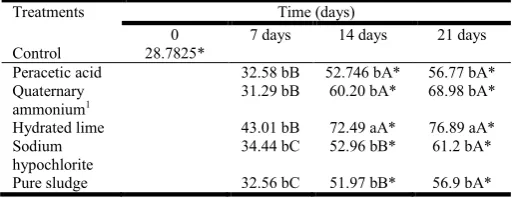
The exposure of pure sludge to a 0.1 m³ m-2 layer of solar radiation forces microorganisms to unfavorable proliferation and survival conditions. Beyond environmental factors, such as temperature, humidity and insolation, microorganisms present in the mass of sewage sludge have to compete with each other. Thus, it is expected that a higher time of exposure and a higher level of insolation result in a significant decrease in levels of total coliforms in seweage sludge. Total solid (TS) content has presented significant interaction between main factor (treatment) and secondary factor (time) (Table 04). The reduction in average content of humidity and increase in total solid content is enhanced by the time of exposure to solar rays to all evaluated treatments. Similar results are reported by (Andreoli et al., 2001). The better time to the reduction in levels of humidity and increase in level of total solids to all evaluated treatments was at 21 days after the beginning of the experiment.
Table 4. Total Solids of sewage sludge
Treatments Time (days)
0 7 days 14 days 21 days
Control 28.7825*
Peracetic acid 32.58 bB 52.746 bA* 56.77 bA*
Quaternary
ammonium1
31.29 bB 60.20 bA* 68.98 bA*
Hydrated lime 43.01 bB 72.49 aA* 76.89 aA*
Sodium hypochlorite
34.44 bC 52.96 bB* 61.2 bA*
Pure sludge 32.56 bC 51.97 bB* 56.9 bA*
Means followed by the same lower case letters in the (Scott-Knott) column and the same capital letters in the (Tukey)
column did not differ at the 5% significance level.* Significant at 5% by the Dunnett test. 1= Dicetyl ammonium chloride, alkyl amido propyl chloride, dimethyl benzyl ammonium and water.
At 14 and 21 days after the beginning of the experiment it was observed that hydrated lime, applied in a quantity equal to 30% of the weight of the dry matter of the sludge, has presented contents of 72.49 dag kg kg-1 and 76.89 dag kg-1 of total solids respectively, which are higher than other hygienization means evaluated. The increase in total solids content occurs due to the reduction in humidity content by the adding of solids from hydrated lime itself and also by the precipitation of solids dissolved in sewage sludge, turning the sludge easier to handle. Similar results are reported in studies fromr (Bina et al., 2004; Samaras et al., 2008; Arthurson, 2008 e Farzadkia; Bazrafshan, 2014).
Knowledge of the amount of total volatile solids in sewage sludge is very important to evaluate its biological stability. Non-stabilized sludge presents strong foul odor being attractive to vectors and, therefore, is inappropriate for agricultural use. Volatile solids (VS) contents have presented differences between evaluated treatments, but there were no differences for times and for interactions between main factor and secondary factor.
[image:5.595.322.542.431.540.2]It was observed that limed sludge has presented the lower contents of total volatile solids 35.,58 dag kg-1,even lower than additional treatment which was 57,39 dag kg-1 (Table 05).
Table 5. Total Volatile Solids (VS) in sewage sludge
Time in days Total Volatile Solids (VS)
Control 57.39 dag kg-1NS
7 days 53.45 dag kg-1NS
14 days 52.38 dag kg-1NS
21 days 53.24 dag kg-1NS
Treatments
Peracetic acid 57.08 dag kg-1 B
Quaternary ammonium1 55.99 dag kg-1 B
Hydrated lime 35.58 dag kg-1 A*
Sodium hypochlorite 56.89 dag kg-1 B
Pure sludge 58.30 dag kg-1 B
Means followed by the same lower case letters in the (Scott-Knott) column and the same capital letters in the (Tukey) column did not differ at the 5% significance level. * Significant at 5% by the Dunnett test. NS = Non-significant 1= Dicetyl ammonium chloride, alkyl amido propyl chloride, dimethyl benzyl ammonium and water.
[image:5.595.34.291.624.723.2]resulting in a sludge with less unfriendly odors. The decrease of volatile organics with liming was also reported in works from Samaras et al., (2008). The addition of Ca (OH)2 has
raised mean pH of untreated sewage sludge from 8.65 to mean values above 12.0 during the 21 days cycle. Mingnotte (2001) has mentioned that sludge stabilization is achieved when the pH from sewage sludge is kept with values above 12.0 for at least 2 hours.
Conclusion
Limed sludge, with a quantity equal to 30% of the weight of the dry matter of the sludge, has provided the highest levels of pH due to its accented alkalinity, has reduced the concentration of total coliforms in more than 99.99%, decreased the concentration of total volatile solids in 38% and has increased the content of total solids, being appropriate to the hygienization of sludge concerning its bacteriological characterization and stabilization. The temperature increase provided by solar radiation was not enough, by itself, to reduce the level of total coliforms to values below 103 MPN g-1 TS, demanding additional treatments in order to achieve a complete hygienization according to the brazilian environmental legislation. Peracetic acid, quaternary ammonium compounds and sodium hypochlorite have not reduced the concentration of total coliforms to levels lower than 103 MPN g-1 TS due to the low humidity content of the sludge, what hampers the contact of the antimicrobial agent and microorganisms present in the sludge.
REFERENCES
Aisse MN, Coraucci Filho, Andrade Neto, Jur GD, Lapolli FR, Melo HNS, Piveli RP, Lucca SJ 2003. Chlorination and Dechlorination. In: Gonçalves RF (Coord.). Purification of waste water. Prosab Project, Rio de Janeiro: Abes/RJ 4:113-168.
Andrade CA, Oliveira C, Cerri CC. Degradation kinetics of biosolids organic matter after soil application and its relationship with initial chemical composition 2006. Bragantia, Campinas, 65, n.4, p. 659 – 688.
Andreoli CV, Lara AI, Fernandes, F 2001. Biosolids recycling: Turning problems into solutions. 2 ed. Curitiba: Sanepar, Finep. P. 80.
Arthurson, V. Proper Sanitization of Sewage Sludge: Critical Issue for a Sustainable Society. Minirevieew. Applied and Environmental Microbiology, Sept. 2008, p. 5267-5275. Barros IT, Andreoli CV, Souza Junior IG, Costa ACS.
Agronomic evaluation of biosolids treated by different chemical methods for cultivation of maize. 2011. Brazilian Magazine of Environmental and Agricultural Engineering. v. 15, n. 6, p. 630-638.
Barros IT, Costa ACS, Andreoli CV. Evaluation of anaerobic sewage sludge hygienization by acid and alkaline treatment 2006. Sanare – Technical Magazine from Sanepar, Curitiba, v. 24, p.61-69.
Bina, B, Molahedian H, Kord I. The Effect of Lime Stabilization on the Microbiological Quality of Sewage Sludge. Iranian J Env Health Sci Eng. N.1, pp. 34-38, 2004.
Bonini CSB, Alves MC, Arruda OG, Bonini Neto A. Brachiaria producion in degradated recovering by the use of sewage sludge and mineral fertilization (2010). Brazilian Journal of Biosystems Engineering, Tupã-SP, September-December, V.4, n.3 , p.166-174
Brazil 2006. National Council on the Environment (CONAMA). President of the National Environmental Council. Ministry of the Environment. Resolution, n. 375 of August 29, 2006. Official Gazette, Brasilia (DF), 2006. August 30. Section N. 167, Section 1, pp. 141-146.
Bux M, Baumann R, Philipp W, Conrad T, Mühlbauer W. Class – A by solar drying recent experiences in europe. Proceedings of the Water Environment Federations. Session 41 though session 50, 309, 2001.
Cony AV, Zocche AT. Broiler Management Guide (2004). In: Mendes AA, Naas IA, Macari M. Broiler breeder production. Campinas: Facta. 8: 117 – 136.
Costa AN (org.), Costa AFS (org.). Handbook for the agriculture use and disposal of sewage sludge in Espírito Santo. Vitória: Incaper, 2011. p. 126.
EMBRAPA (Brazilian Agricultural Research Corporation) (2009). Guide for chemical analyzes of soils, plants and fertilizers, 2 ed. Brasília, DF: EMBRAPA Information Technology. p. 627.
Farzadkia M, Bazrafshan E. Lime Stabilization of Waste Activated Sludge. Heath Scope, 2014 August; 3 (1); 16035. Ferreira DF (2008). Program for analysis and educational
statistics. Symp. J. Lavras 6:36-41.
Fraser JAL, Godfree AF, Jones F. Use of peracetic acid in operational sewage sludge disposal to pasture. Water, Science and Technology, v.17, p.451-466, 1984.
Jordão EP, Pessôa CA. Domestic sewer treatment. 4. ed. Rio de Janeiro, 2005. p. 932
Kuana S. L. Cleaning and disinfection of poultry plants. In: Júnior AB, Silva EM, Fábio JDI, Sesti L, Zuanaze MAA. Poultry diseases. 2ª ed. Campinas: Facta, 2009. p. 1.104 Lengert HP. Disinfection and sterilization. Final paper
(specialization) - Trabalho de conclusão de curso (especialização) – Army Medical School. Specialization Program in complementary application to military sciences, Rio de Janeiro, 2008, f.38.
Mathioudakis VL, Kapagiannidis AG, Athanasoulia E, Diamantis VI, Melidis P, Aivasidis A. Extended Dewatering of Sewage Sludge in solar drying plants. Desalimation, 248, (1-3), 733, 2009.
Matos MP, Matos AT. Dose of hydrated lime and chemical characteristics of domestic sewage sludge subjected to liming. Engineering in Agriculture, Viçosa-MG, V.20, n. 4, July/August, 2012.
Mignotte B. The Effect Liming on the Microbiological Quality of Urban Sludge. Wat Sci Tech, 43 (12): 195 -200, 2001. Nascimento AL, Sampaio RA, Cruz SF, Junio GRZ, Barbosa
CF, Fernandes LA. Heavy metals in sunflowers fertilized with sewage sludge subjected to different stabilization processes. Brazilian Magazine of Environmental and Agricultural Engineering, v.18, n.7, p.694-699, 2014. Pires AMM, Matiazzo ME. Viability evaluation of residue
Quintana NRG, Carmo MS, Melo WJ. Sewage sludge as a fertilizer: Agricultural productivity and economic profitability. (2011) Tupã-SP, Nucleus, V.8. n.1
Ruan T, Song S, Wang T, Liu R, Lin Y, Jiang G. Identification and composition of emerging quaternary ammonium compounds in municipal sewage sludge in China. Environ Sci Technol. 2014 Apr 15;48(8):4289-97.
Salihoglu NK, Pinarli V, Salihoglu G. Solar drying in sludge management in turkey. Renew. Energ. 32, 1661, 2007. Samaras P, Papadimitrious CA, Haritou I, Zouboulis AI.
Investigation of sewage sludge stabilization potential by the addition of fly ash and lime. Journal of Hazardous Materials 154 (2008) 1052–1059.
Silva FS, Azevedo CAV 2002. Version of the computer program ASSISTAT for the Windows operating system. J.
Agro-Ind. Prod., 4(1):71-78
Sypuła M, Paluszak Z, Ligocka A, Skowron K. Effects of spring season solar drying process on sanitation indicators in sewage sludge and potential as a method for fertilizer production. Ann Agric Environ Med. 2013; 20(1): 8-12. Tchobanoglous G, Theisen H, Vigil S 1993. Integrated Solid
Waste Manegement – Engeneering Prinples and Management Issues. Ed. McGraw Hill. New York, USA. p. 978.
USEPA 2006. United States Environmental Protection Agency. Method 1681: Fecal Coliforms in Sewage Sewage Sludge (Biosolids) by Multiple- Tube Fermentation using A-1 medium. Office of Water, EPA-821-R-06-013, Washigton, DC 20460, July, 2006, 45 pp.