ACADEMIC COURSE FILE MADE EASY
New Horizon College of Engineering, Electrical & Electronics Engineering Department, Outer Ring Road,
Near Marathalli, Bellandur
ARTICLE INFO ABSTRACT
Roles implemented faculty
academic file. The important document in any CF are, lesson plan (LP), continuous internal evaluation (CIE), CIE analysis (CIE
documents are essential from students and faculties perspective. The time required of documents
knowledge/
Copyright © 2017, Mohan. This is an open access distribution, and reproduction in any medium, provided
INTRODUCTION
Teaching is challenging career in today's world. As the semester starts, academic calendar of events (ACE) & time table (TT) is prepared and circulated among all teaching staffs. A faculty has to plan his/her lecture based on ACE and TT, tabulation of planed dates for a particular topic wrt minimum classes for a course, defined in syllabus. The next important document to be maintained by a faculty is CIE mark list, which has to analysis based on criteria tabulated in Table 1. It's the responsibility of faculty to know the reason behind, student being absent and student who scored between 00
gives a list of slow learners which helps to understand the reasons for their performance and proper action plan can be taken. Action plan to be taken based on the problems noted with respective students, which is maintained under CAPA after each CIE. From this document one can analysis the improvement of student in CIE. Once TT in excel format is circulated to all faculties, they can check their total classes available during the semester based on ACE. If the minimum number of classes required for a course (theory or laboratory) is not meet, they can plan for extra classes before the commencement of classes and note the same dates in LP. In Bhavishya file one has to, first enter the course code and section allotted. In response to course code, it displays respective course name, course coordinator (faculty handling the subject), combined Id, allotted section, respective student
*Corresponding author: Mohan B. S.
New Horizon College of Engineering, Electrical & Electronics Engineering Department, Outer Ring Road, Near Marathalli, Bellandur Main Road, Bengaluru, Karnataka 560103, India.
ISSN: 0975-833X
Vol.
Article History:
Received 13th September, 2017 Received in revised form 23rd October, 2017
Accepted 20th November, 2017 Published online 31st December, 2017
Citation: Mohan B. S. 2017. “Academic course file made easy
Key words:
Lesson plan, Internal Marks, Average, CAPA, Academic file, CF.
RESEARCH ARTICLE
ACADEMIC COURSE FILE MADE EASY
*Mohan, B. S.
New Horizon College of Engineering, Electrical & Electronics Engineering Department, Outer Ring Road,
Near Marathalli, Bellandur Main Road, Bengaluru, Karnataka 560103, India
ABSTRACT
and responsibility of any teaching fraternity is changing implemented in delivering a lecture from black board to smart board faculty has to prepare and maintain a set of documents which are compiled
academic file. The important document in any CF are, lesson plan (LP), continuous internal evaluation (CIE), CIE analysis (CIE-A), corrective action and preventive action (CAPA). These documents are essential from students and faculties perspective. The time required
of documents can be reduced and a faculty can utilize his/her time to enhance their knowledge/skills/address to student's issues.
article distributed under the Creative Commons Attribution License, the original work is properly cited.
Teaching is challenging career in today's world. As the semester starts, academic calendar of events (ACE) & time-table (TT) is prepared and circulated among all teaching staffs. A faculty has to plan his/her lecture based on ACE and TT, ed dates for a particular topic wrt minimum classes for a course, defined in syllabus. The next important document to be maintained by a faculty is CIE mark list, which has to analysis based on criteria tabulated in Table 1. It's the lty to know the reason behind, student being absent and student who scored between 00-11. This gives a list of slow learners which helps to understand the reasons for their performance and proper action plan can be he problems noted with respective students, which is maintained under CAPA after each CIE. From this document one can analysis the improvement of student in CIE. Once TT in excel format is circulated to all faculties, they can check their total classes ilable during the semester based on ACE. If the minimum number of classes required for a course (theory or laboratory) is not meet, they can plan for extra classes before the commencement of classes and note the same dates in LP. In to, first enter the course code and section allotted. In response to course code, it displays respective course name, course coordinator (faculty handling the subject), combined Id, allotted section, respective student
New Horizon College of Engineering, Electrical & Electronics Engineering Department, Outer Ring Road, Near Marathalli, Bellandur Main Road,
name and university seat number (USN) will be displayed which can be saved by a faculty. Here, CIE (I, II & III), assignment and quiz marks can be entered and list will be generated for CIE-A and CAPA for all three CIE. Time required for calculation in CIE
students under CAPA will be zero, as marks for r is entered the file will generate data for CIE
this paper at first a brief introduction is given about course file and documents to be maintained with each faculty. Second section, availability of total classes per course i.e. t
laboratory classes. Third section, user enters course code and section, based on TT respected course name, course coordinator will be updated. Student names and university seat number (USN) will be pulled from student list file as per section. Fourth section, after entering in file for each CIE /Internals (maximum of 3), CIE analyses will be carried out and displayed in next sheet of same file. For each CIE, CAPA also will be generated in third sheet. CIE
prescribed format, thus user
[image:1.595.367.501.718.791.2]documentation. Future scope or possible updation is discussed in fifth section. Conclusion under sixth section.
Table 1. Criteria to tabulate in CIE
Criteria
Student scored between
Pass percentage
International Journal of Current Research
Vol. 9, Issue, 12, pp.63193-63197, December, 2017
Academic course file made easy”, International Journal of Current Research, 9, (12), 631
New Horizon College of Engineering, Electrical & Electronics Engineering Department, Outer Ring Road,
Main Road, Bengaluru, Karnataka 560103, India
ing from time to time. Change is in delivering a lecture from black board to smart board for students. In this process, a has to prepare and maintain a set of documents which are compiled as course file (CF) or academic file. The important document in any CF are, lesson plan (LP), continuous internal A), corrective action and preventive action (CAPA). These documents are essential from students and faculties perspective. The time required for the preparation can utilize his/her time to enhance their
License, which permits unrestricted use,
name and university seat number (USN) will be displayed a faculty. Here, CIE (I, II & III), assignment and quiz marks can be entered and list will be A and CAPA for all three CIE. Time required for calculation in CIE-A and preparing the list of students under CAPA will be zero, as marks for respected CIE is entered the file will generate data for CIE-A and CAPA. In this paper at first a brief introduction is given about course file and documents to be maintained with each faculty. Second section, availability of total classes per course i.e. theory or laboratory classes. Third section, user enters course code and section, based on TT respected course name, course coordinator will be updated. Student names and university seat number (USN) will be pulled from student list file as per rth section, after entering in file for each CIE /Internals (maximum of 3), CIE analyses will be carried out and displayed in next sheet of same file. For each CIE, CAPA also will be generated in third sheet. CIE-A and CAPA is prescribed format, thus user can take printout for documentation. Future scope or possible updation is discussed in fifth section. Conclusion under sixth section.
Criteria to tabulate in CIE-A
Absentees Present Student scored between 00-11
12-20 21-30
INTERNATIONAL JOURNAL OF CURRENT RESEARCH
Total Class Available per Course
At first one has to select respected semester and section.
According to given ACE, department secretary will delete non working day, such as holidays & Sunday. This file is named as Bhavishya will be circulated among faculty to record CIE marks. In response the file generates CIE-A, CAPA and calculates the number of working weekdays, for ODD semester during Academic Year 2016-2017, total working weekdays are tabulated in Table 2:
Table 2. Total working weekdays as per ACCE
Weekday Total week days Value Monday 11 A1 Tuesday 14 A2 Wednesday 12 A3 Thursday 11 A4 Friday 09 A5 Saturday 04 A6
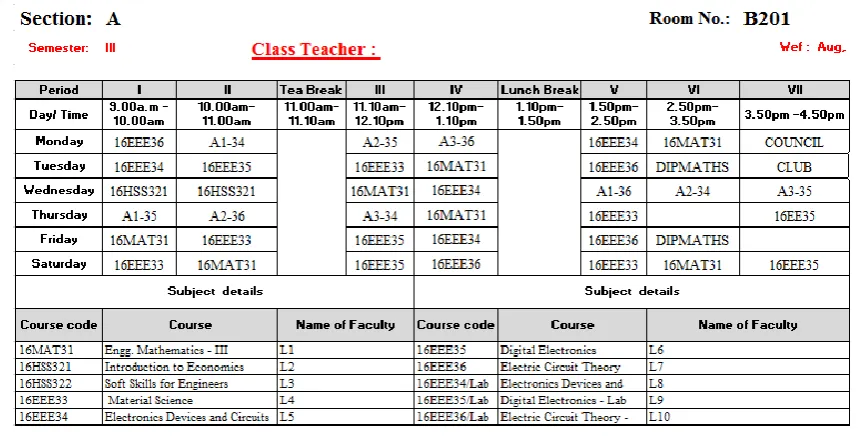
Department time-table semester vise is prepared in excel format which contains below data:
Section, semester, class teacher, room number, class and lab details, subject code, subject names and name of faculties wrt subjects as shown in Fig.1
Total number of classes for each subject per day is calculated, value = B1 (for Monday)
The total classes available for a subject for a week day, say Monday, B1 * A1. Similarly total classes for all the weekdays are calculated as shown in Fig.2.
Adding the total weekday class, it gives the number of classes that would be available for one subject, C (Michael Alexander et al., 2014)
∗
Where, n = week day; i= Total no of working weekday
Fig.2 Showing surplus or shortage of classes per course.
Total classes that a faculty should conduct, D
The number of classes calculated are either surplus or shortage is calculate, C - D.
[image:2.595.85.516.390.610.2] Surpluses classes would be positive and shortage classes would be negative.
[image:2.595.57.547.634.785.2]Fig.1. Time Table with required detail for 2016-2017
At first user has to select odd/even semester (time-table has values for odd semester only). The data in time-table of odd semester should be entered for III, IV and VII semester. The user can select any one semester from the "form control list box" and respected section (A & B section). User should enter the total number of classes (Theory and Laboratory) that any faculty should conduct. Based on user selection of semester and section, the course name and number of classes available for conducting theory and laboratory will be calculated. In the next row, user can see the details for a particular course, like shortage or surpluses of classes based on total number of classes to be conducted. HOD/Individual Faculty/ Time-Table coordinator can check for a set time-table which all courses have either shortage or surpluses of classes and respective corrective actions can be implement before the commencement of semester like,
• Time-table coordinator, redesign time-table. • Faculty planning for extra classes.
• Mutual swapping of classes etc
User can easily see the difference between surpluses and shortage. Shortage for any course, the cell in shortage/Extra row will be highlighted in RED color else blue color for surpluses. Thus, making the analysis easy for uses as shown below in Fig.3. Fig.3 shows the shortage classes highlighted with red color dynamically for theory only, the same is applied
for laboratory too but not shown here (Michael Alexander et al., 2014; John Walkenbach, 2013; Bernd Held, 2010).
Fig.3. Shortage/ Surpluses classes highlighted dymanically for courses
Bhavishya file
User has to save this file for one particular course and section. It has seven sheets in it, namely, CIEMarks, CIE Analysis, CAPA, Level of Achievement, CIE-1, CIE-2 and CIE-3. Users has to enter course code, for example 16EEE36, in response it will fetch data for respected course coordinator, course name from TT. From class list it will fetch 3rd semester student list provided users has entered his/her section (A or B). This file will be used to store data for one 16EEE36 course and section B (assuming user selection as section B). Similar for the same course but for section B, he/she have to create another file. Thus, avoiding ambiguity. Below fig.4 shows for a course code 16EEE36 and section A.
Fig.4. File saved for course 16EEE36, section A
CIE sheet
There are three CIE sheets for first, second and third respectively. Fig.5 shows CIE-1 sheet, where column data pulled based on semester and section. User has to enter the maximum marks for each question. In this sheet (and CIE-II & III) a limit of 10 questions has been set with each question can have maximum of 4 sub questions. At first user has to set the maximum limit set for each sub/questions as shown in fig.6. Fig.5 shows data for two students, one can notice an error message here because maximum value set is 7.5 Marks. For the student "Aakarsh Sagar", in error column, it says error in first row, "Error-1A". Question paper template is set for CIE; answer any one from each section, maximum of two sections. Each section has two questions, and each question has maximum of four subsections. If the question paper template changes, one has to change the formula to calculate average for respective CIE. Thus student's mark for each CIE is stored for each course.
Fig.5. CIE-1 sheet for 2 students only
Fig.7. CIE Analysis sheet for section A
Fig.8. Random CAPA for CIE-1 before hiding blank rows
CIE mark for each student is reflected in "CIEMarks" sheet in respective column for each CIE. CIE-A for each CIE and stored in separate sheet known as "CIE Analysis" as shown in Fig.7 for first CIE. In this sheet the data for course name, course code, name of staff & semester are reflected from the users entered course code. For academic year, user has to set his/her system date correctly. User has to enter the CIE date for their respective course. One can observe in Fig.7, after user entered CIE-1 marks, here it calculates total attended, absent, marks between 0 - 11 (failed), 12 - 20 (passed) and 21 - 30 (scored). Thus it calculates pass percentage of respected CIE. CAPA for each CIE has to be recorded. Student who has failed in a course, his/her reason has to be known so that proper actions can be taken to improve his/her result in upcoming CIE-2. Fig.8 shows a random CAPA for CIE-1. Null value (blank rows) is passed if a student has cleared the course. In Fig.8, the data for CIE Test-1 (which CIE test), semester, course name, course code, name of faculty are filled based user entered course code in first sheet. Once CIE-2 marks is entered in CIE-II sheet, CIE Analysis is calculated and its CAPA. Thus in the fourth row of fig.8, it changes CIR Test -1 to CIE Test - 2 and as user enters CIE-3 marks, it changes to CIE Test - 3. After each CIE user has to enter the marks, the file would calculate respected CIE-A and CAPA. User can take printout of respective CAPA to understand and note down the reason for their poor performance. In doing so currently user has to hide blank rows and manually enter serial numbers as shown in Fig.9.
Fig.9. Random CAPA for CIE-1 after hiding blank rows
Future Scope
The file is created for one particular department which is tried with electrical department only, this can be done for other department provided department name, course name, course code, students & faculty list are known. Question paper template can be dynamic as per users. The null row can be removed & create a list of students. The attendance details of the SL students can be displayed & the performance in the exam can be fetched for better analysis of students.
Conclusion
be planned prior to commencement of classes if shortage (can also see which other course has surpluses) and plan for LP. When he/she enters the course code, section and semester, the file reflects with user name, course name, and class list. This file has to be saved based on section. Assuming the faculty would follow the set question paper template as discussed in section 4. CIE-A and CAPA will be reflected and they can take printout of CIE-A and CAPA respectively for all CIE.
REFERENCES
101 ready to use Excel Formulas by Michael Alexander & Dick Kusleika, John Wiley & Sons, 14-Jul-2014.
Bernd Held, Microsoft Excel Functions & Formulas, Wordware Publishing, Inc., 25-Oct-2010.
John Walkenbach, Excel 2013 Formulas, John Wiley & Sons, 13-Mar-2013.