With 3 text-figura Printed in Great Britain
SINGLE-SESSION LEARNING BY OCTOPUSES
BY M. J. WELLS
Department of Zoology, University of Cambridge AND J. Z. YOUNG
Department of Anatomy, University College London {Received 1 July 1970)
INTRODUCTION
In order to study the mechanisms of learning it is desirable to evolve techniques for evaluating long-lasting changes brought about by single events in the lives of animals. Techniques for the study of 'one-trial learning' are well known for vertebrates, but tend to involve learning not to perform some act that is followed by punishment. One-trial learning opens up the possibility of investigating the effects of electroconvulsive shock, spreading depression, anaesthetics, drugs and so on on the establishment of long lasting records in the central nervous systems.
It would be useful to repeat and expand these experiments using an invertebrate preparation and if possible non-aversive situations. The octopus, because it learns well under a variety of conditions (see Young, 1964), is an obvious choice.
The possibility of experiments with this animal has the added attraction that in Octopus we think we know, within rather narrow limits, where the changes associated with long-term learning are likely to be taking place. In touch learning the probable site can be narrowed down to the region of the subfrontal/posterior buccal lobes from the forward end of the supraoesophageal part of the brain in a region of about 500 /4m3, which will still determine correct performance in tactile discrimination experiments when reduced to a few tens of thousands of cells (Wells, 1959; Wells & Young, 1965). The present report is an account of preliminary experiments which show that it is possible to detect the long-term consequences of small numbers of trials in which octopuses are given training to recognize objects by touch.
METHODS
Octopus vulgaris Cuvier of 150-350 g from the Bay of Naples were used in all experiments, which were carried out during the summer of 1969. Individuals were kept in tanks after capture until they attacked and ate crabs regularly and promptly when these were dropped into their tanks. They were then blinded by cutting the optic nerves under 3 % urethane anaesthesia and thereafter fed upon pieces of fish presented by touching the piece against one of the arms.
or of others like them. They were given 2, 8, 32 or 60 training trials. At each trial one of the spheres was presented by lowering it on a line until it touched one of the arms of the octopus. Presented gently in this manner, the objects were invariably grasped with the suckers, and, at the start of training, almost invariably passed under the inter-brachial web to the mouth. This 'positive' response was rewarded for one of the objects to be discriminated (the 'positive' object) and punished for the other (the 'negative' object). Rewards were pieces of fish, presented on the end of a wire probe and touched against an arm, punishments were 9 V a.c. electric shocks, given by touching the octopus with a pair of electrodes. The test object was jerked away from the animal immediately after the reward or punishment had been given. If the octopus rejected a test object by thrusting it away, it was neither rewarded nor punished. If the animal grasped the object, but did nothing further for 30 s, the object was pulled away and the response scored as a rejection. Trials were 5 min apart, with the excep-tion that about half of the animals trained for 60 trials had trials at ten min intervals. The difference made no detectable difference to performance either in the initial training sessions or in subsequent retention tests and has been ignored in Figs. 1 and 3 and in the tables.
After 2, 8, 32 or 60 trials (that is, 1,4, 16 or 30 with each of the two-test spheres) training ceased. The animals were left for 48 h, being fed with pieces of fish night and morning. On the second day the animals were given a series of 60 tests with the spheres used in training. On this occasion there were no rewards and no punishments. Trials were at 5 min intervals as before. Most animals began their retention tests by taking all of the objects presented, ex-negative as well as ex-positive. As tests pro-ceeded, positive responses to the test spheres became less frequent. Animals that had learned to discriminate during the training period showed the effects of their training by rejecting the ex-negative objects more often than the ex-positive. Eventually, positive responses cease altogether, though this normally requires many more than the standard 60 trials given.
This method often enables one to detect the effect of short runs of training trials on individual animals. It has the advantage that it progressively reduces the proportion of objects taken so that sooner or later the animal accepts only half of the spheres presented. At this level of response, any tendency to discriminate between the two spheres will be revealed.
Animals with brain lesions had parts of the central supraoesophageal brain removed at the same time as their optic nerves were cut. The lesions made were subsequently assessed from serial sections.
RESULTS
Animals without brain lesions
Single-session learning by octopuses 781
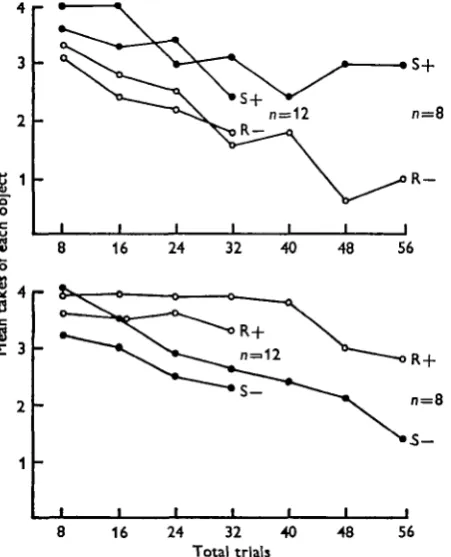
Few of the octopuses trained for eight trials or less showed any signs of learning to discriminate in the course of their initial training; only occasional individuals rejected the last of the four negative objects presented in the eight-trial training sessions. With sessions of 32 or 60 trials it was possible to detect some effect of training in the majority of animals despite the high level of take, which tends to mask any capacity to discriminate under these conditions (Fig. 1). Seven out of the 16 animals trained for 60 trials took more than 75 % of all the objects presented, and three of them took 95 % rejecting^the spheres less than four times in 60 trials.
4 r
o
1 4
S
r 3
2
1
n=8
16 24 32 40 48 56
16 24 32 40 Total trials
[image:3.451.116.342.177.456.2]48 56
Fig. 1. Results of training to distinguish between rough and smooth Perspex spheres for 32 or 60 trials. In each case 0 shows responses to the smooth sphere, O to the rough. The most obvious effect of training is to reduce the overall level of take. Table 1 which covers the subsequent scores of these animals in retention tests includes a further six animals trained for 32 trials in four sessions of eight trials. Training in this way does not significantly affect performance in retention tests, but it does somewhat elevate the level of take (to 77 %). Scores from these six animals have not therefore been included in this figure, which is based only on animals trained in a single session of trials at 5 or 10 min intervals.
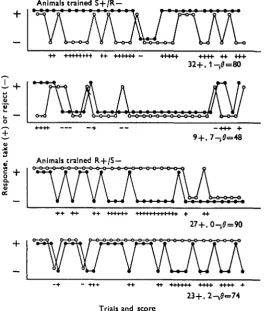
end of 60 tests. Others began to discriminate early in the test series and continued to do so, with little change in the level of take, until the end of the 60 tests. Yet others took all (or nearly all) of the spheres presented. Some typical examples are given in Fig. 2.
Animals trained S+/R— » « • « »_« » «
+ + I I I M i l I +•(•
32+, 1-,0=80
9 + , 7-.0=48
3
0 +
Q. 8
Animals trained R+/S —
27+, O-,0=9O
23 + , Trials and score
Fig. 2. Typical results from extinction tests carried out with control animals trained for 3a trials (16+ , 16 —) 2 days before. 9, Shows responses to the smooth sphere ; O, to the rough. Tests with the two spheres alternated, beginning always with the sphere used as positive object in training. Method of scoring, gee text.
In this situation (as indeed in assessing discrimination in any training experiment involving successive rather than simultaneous presentation) one must devise some means of comparing performance that eliminates, so far as is possible, the effect of fluctuations in response level. A crude 'percentage correct' score is almost useless, as is any comparison based on the length of runs of successful trials, or the number of trials required to attain any given standard. One needs a means of comparing the capacity to discriminate that is independent of the level of take.
Single-session learning by octopuses 783
occasions at which the sign of response changed, from take to reject, or vice versa since the preceding trial. Thus, for example, a sequence testing performance 2 d after training to take rough and reject smooth is scored as follows:
Object presented in test R S R S R S R S R S Animals' responses ( + takes, + + + — — + — + — —
- , rejects)
Occasions when the sign of . . + . + + + + . response changed
Score; change was correct . . . + . — — — — .
+ , or incorrect —
In this sequence the octopus made one correct and four incorrect changes in response to the test objects. In a series of 60 tests an animal could make a maximum score of 59 correct changes, assuming that it took all the positives and rejected all the negatives. The ratio of correct to all changes yields a probability of correct response for the animal concerned; in the example cited P = 0*20 (for some further examples see Fig. 2). The variance of this probability will, of course, depend upon its magnitude and on the number of changes on which it is based. The effect of the former can be largely removed by transforming the proportion of successes by a quantity 8 when 6 = sin~1^jP. The distribution of 8 approximates to the normal distribution rather better than does P and has a variance which depends only on the number of observations on which it is based. A weighted analysis of variance can be then carried out.
The results of tests following 2, 8, 32 and 60 training trials are compared in these terms in Fig. 3 and Table 1: the scores made by individuals trained for 32 or 60 trials are included in Tables 3 and 2 respectively. Scores made following training with the smooth object positive tended to be higher than those made with the rough positive and in a few instances (2 in Table 2) octopuses trained with R + actually made per-verse scores in retention tests. This is in accordance with the known preference for smooth objects found in blinded but otherwise unoperated octopuses (Wells & Young, 1968). The difference does not reach the 5% level of significance in the present instance (Table 1).
From Fig. 3 and Table 1 it can be seen at once that training for eight or more trials produces significant changes in behaviour in tests run 2 days later. Even two trials produce a shift in the expected direction, but the difference is not significant at any acceptable level. The difference between two trials and eight trials is significant (/ = 3-0, P = < 0-05) as is (though at a slightly lower level) the difference between 8 and 32 trials (t = 2-3, P = < 0-05); the difference between 32 and 60 trials is not significant (Table 1).
Brain lesions and single-session learning
The effect of two classes of lesion were tested. In the first of these the median superior frontal and/or vertical lobes were removed. In the second, the median inferior frontal lobe was removed.
in this region reduce the apparent ' preference' for smooth objects noted in section 2 above, a result that is again in accordance with the earlier findings of Wells & Young (1968) in a more extensive series of extinction tests made with untrained animals. In the series summarized in Table 2 the collective score (6) of the group trained R+ was 67-8, as against 59-9 by the octopuses trained S + . The variance is very high, however, some of the animals made very few changes in response—and the difference is not significant.
Table 1. Mean scores in retention tests
(6 runs from o to 90, with 45 the chance score. Details of individual performance for
animals trained for 32 and 60 trials are given in Tables 2 and 3). Number of
training Direction of trials training
2 S + R + 8 S + R + 32 S +
R+ 60 S + R +
Comparison
6 8 Trials -6 2 trials 6 32 Trials—0 8 trials
S + - R + (all trials)
Number of animals
4 S
12 12
14 16
0
0
0
0
Number of changes in response
68 69 207 212
37a
320
204
150
Standard error of Difference difference
18-8 9'3 265
6-3
4 0 15-1
Mean score 0
42-1 677 6S-i
7 8 0
73-3 80-5 72-3
t
3 0 2-3 1-8
Combined mean score and
standard error 47-6 ±5-5 66-4±3-i 757 ±2-4 76-4 ±3-4
P
< 005 < 0-05 > 005
In their 60 training trials the 11 animals with lesions together made 58% correct responses; 16 control animals made 63% correct. The two scores are significantly different at the P = < 0-05 level (x2 = 4-95). In each series half of the animals were trained with the smooth and half with the rough sphere as positive object (5R + , 6S + for the animals with lesions). Their overall level of take, 65 % positive responses for the animals with lesions and 71 % for the controls, was similar. The two groups were thus subjected to the same amount of training in terms of rewards and punishments as well as in terms of the total number of trials given. This is important since past experience has shown that animals with brain lesions are liable to gain more experience than their controls in this sort of experiment by taking objects presented at a higher proportion of trials, a performance that could conceal differences in the effectiveness of training (see Wells & Young, 1969).
In retention tests following their training the animals with brain lesions again scored more poorly than controls, and again the difference is significant (t = 2-2, P = < 0-05). Details of the performance of individual octopuses are given, together with details of their performance in training, in Table 2. Their performance as a group is compared with that of controls in Fig. 3.
Single-session learning by octopuses
Table 2. The performance of control animals compared with the
performance of octopuses with damage to the vertical I superior frontal lobe system (S + and R + show the direction of training, n shows the number of changes in the sign of response, and 0 the score of each individual in retention tests. In BiimmariziTig the lesions % NMSF shows the proportion removed from the median superior frontal lobe, % NV the proportion removed of the vertical lobe, % tract the proportion of the tract joining the two (100% here separates the vertical lobe from its input from MSF). MIF Ham, = median inferior frontal damaged.)
Controls Animals with brain lesions 1 n 33 5 5 i 47 19 29 15 IS — — — S +
e
9 0 9 0 82 82 77 75 75 75 — — — 80-5 n 43 16 4 29 1 0 15 15 18 — — — ±3'4 Retention R + 0 9 0 9 0 9 0 8 0 7 3 69 35 32 — — — 72-3 tests S + n 1 2 7 35 6 38 4 — — — — — 59'9 0 9 0 7S 66 SS 47 45 — — — — — 63-R + n — — — — — — 34 8 9 3 1 9 67-8 9 ±47 0 — — — — — — 8 2 7 0 62 SS 49Details of lesion
85 % NMSF, MIF dam. 75% NV
45% NMSF, 100% NV 95 % NMSF, MIF dam. 90% NMSF, 90% NV
100% NV
50% NMSF, 100% NV 50% NMSF, 90% tract
MIF dam.
25 % NV, 85 % tract 80% NMSF, 90% tract 85 % NMSF, 100% tract
Mean and standard error
6, as Table 1
Score in initial training for 60 t
4 + 6 -27 + 33 —
8+ 9 -27 + 32— 2S + I S 29 + 3 0 28 + 2 2 33 + 1 8
16 + 9 25 + 1 9 28 + 1 8
-5 8 %
correct, cf. controls
6 3 %
correct
Difference 12-5 ±5-8, t = 2-2, P = < 0-05.
cells, which has proved to be the only part of the supraoesophageal brain essential to touch learning. Without it octopuses fail to learn however long training is continued (Wells, 1959; Wells & Young, 1965). The median inferior frontal contains many crossing bundles and may be a region responsible for ensuring that information received through any one of the eight arms of the octopus is distributed throughout the touch-learning system. It is the main source of tactile input to the subfrontal lobe (Young, 1970).
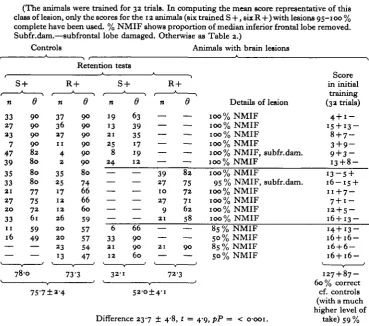
Removal of this part leads to a marked change in preference. After the operation octopuses will take the rough Perspex ball more readily than the smooth. A consequence of this is that animals trained on S + /R— tend to receive more shocks and fewer rewards than those trained in the 'preferred' direction R + / S —. This reduces the proportion of objects taken so that octopuses trained in the S + /R — direction get less experience of the consequences of taking the spheres than those trained in R + /S —. Of the 12 animals having lesions that were complete or very nearly so (95-100% median inferior frontal lobe removal, see Table 3) the six trained with R + took the test spheres at 63 %, while six trained with S + took the spheres at only 48 % of all trials. This imbalance means that one must be wary of attempting to arrive at a mean score representing the effect of training derived in the usual manner by summing the
scores made by equal numbers of animals trained in two alternative directions. The R + animals would be expected to make a ' discriminant' score without training. Their contribution to the mean score will tend to produce a false impression of learned discrimination unless balanced by scores derived from a roughly equal number of takes by the animals trained S + / R - . This means that it is impossible to prove that these animals learned at all from the results of the single session of 32 training trials. The scores made in the ' difficult' direction (S + /R - ) , 52 takes of smooth and 41 takes of rough, do not differ significantly from chance or indeed from the 'expected' distri-bution of 458:48 R that may be derived from the untrained scores of animals with similar lesions tested in 1967 (see Wells & Young, 1968).
9 0 T
32
Training trials
Fig. 3. Summary of the performance of octopuses in extinction teats carried out % days after training for the stated number of trials. The score is in terms of 6 (see text) which runs from o to 90 ( = 100% correct). Control animals (#) have an untrained preference for the smooth sphere which is not eliminated by this amount of training. Lesions such as removal of the vertical (and/or superior frontal) lobes (NV animals) reduce this preference, which is reversed by excision of the median inferior frontal lobe (NMIF animals). Details of individual per-formance and lesions made, see Tables 2 and 3.
Single-session learning by octopuses 787
Table 3. The effects of removing the median inferior frontal lobe
(The animals were trained for 32 trials. In computing the mean score representative of this class of lesion, only the scores for the 12 animals (six trained S + , sixR + ) with lesions 95-100 % complete have been used. % NMIF shows proportion of median inferior frontal lobe removed. Subfr.dam.—subfrontal lobe damaged. Otherwise as Table 2.)
Controls Animnla with brain lesions
n 33 27 33 7 47 39 35 33 2 1 27 2 0 33 11 16 — — s+
e
9 0 9 0 9 0 9 0 82 80 80 80 77 75 7 2 61 59 49 — — 78-0 75' n 37 36 27 1 1 4 2 35 25 17 1 2 1 2 26 2 0 2 0 23 13 7 ±2-4 Retention tests R + 6 9 0 9 0 9 0 9 0 9 0 9 0 80 74 66 66 60 59 57 57 54 47 73-3 S + n 19 13 2 1 25 8 24 — — — — — — 6 33 2 1 1 2 32-1e
63 39 35 17 19 1 2 — — — — — — 66 9 0 9 0 6 0 t n — — — — — — 39 2 7 1 0 2 7 9 2 1 — — 2 1 — 52-o±4-iDifference 23-7 ±4 R+ 0 — — — — — — 82 75 72 7 i 6 2 58 — — 9 0 — 72-3
v%, t =
Details of lesion 100% NMIF 100% NMIF 100% NMIF 100% NMIF
100% NMIF, subfr.dam. 100% NMIF
100% NMIF
95 % NMIF, aubfr.dam. 100% NMIF
100% NMIF 100% NMIF 100% NMIF 85 % NMIF 50% NMIF 85 % NMIF 50% NMIF
4-9, pP = < o-ooi.
Score in initial
training (32 trials)
4 + 1 15 + 1 3
-8 + 7
3 + 9 9 + 3 13 + 8 -13-5 + 16-15 +
11+77 + 1
12 + 5 1 6 + 1 3 1 4 + 1 3
1 6 + 1 6 16 + 6 1 6 + 1 6 127 + 8 7 -60% correct cf. controls (with a much higher level of
take) 59% DISCUSSION
The results summarized above show that it is possible to detect the long-term effect of small numbers of discrimination training trials in unrewarded tests carried out 2 days after training. The main reason why these effects are not always apparent in the course of the training itself is that rewards and punishment induce short-lasting fluctuations in response level that are of very large magnitude compared with the relatively long-term changes brought about by the training. In visual experiments these effects have been measured by showing a vertical rectangle to unblinded octopuses. The propor-tion of attacks made by untrained animals rose dramatically from 25 % to more than 75 % after feeding. The effect lasted for 2-3 h, and had disappeared altogether 6 h later. In a similar series, the effect of a single electric shock was investigated. Again, there was an abrupt change in the probability of attack which lasted for several hours (Young, i960). Similar fluctuations can be expected, superimposed on the initially smaller but cumulative effects of pairing rewards or punishment with specific situa-tions in all training experiments that involve successive presentation (see Wells, 1967). Where the number of training trials is small, it is likely that the temporary swings in response brought about by rewards and punishment will entirely mask cumulative changes in responses to the stimuli used in training.
The use of unrewarded retention tests avoids these problems and the method of scoring described above minimizes the difficulty associated with retention tests due to variations in the rate of extinction from one animal to the next. The tests show that measurable differences in response towards two objects to be discriminated can be produced in small groups of octopuses by as few as four trials with each.
It seems likely that the amount of experience could be still further reduced; the effect of four trials only (two with each of the very similar spheres used) was not in-vestigated in the present series, but the differences in effect of two and eight trials is large, and even two trials would appear to swing responses in the direction of discrimination.
The validity of the method as a means of checking whether or not learning has taken place is confirmed by the results of experiments made with animals having lesions that are known to affect touch learning. Octopuses with their vertical lobes removed and octopuses with damage to the inferior frontal system both made more than the usual proportion of errors in the unrewarded retention tests. We know from previous work (Wells, 1965; Sanders, 1970) that the errors made by octopuses with their vertical lobes removed are unlikely to be due to 'forgetting' (failure of retention or 'read-out') since animals with similar lesions trained to specified criteria perform as well as controls in retention tests conducted weeks or months later. The fact that it is still possible to train octopuses to discriminate using trials spread out over a period of days (Wells & Young, 1969) suggests that the same is true of median inferior frontal lesions. The clear implication is that training, trial for trial, had relatively little long-term effect on the animals with brain lesions, a finding that is in accordance with much earlier work on touch learning (Wells & Young, 1969).
We are grateful to the Director and Staff of the Zoological Station at Naples for the facilities that made this work possible. The work was supported by grants from the Science Research Council of Great Britain (M.J.W. and J.Z.Y.) and the European Office of Aerospace Research, OAR, U.S. Air Force (J.Z.Y). We are par-ticularly grateful to Mr Eurof Walters of the A.R.C. statistics unit in the Department of Agricultural Science, Cambridge, for suggesting the means of assessing the results of retention tests that was adopted for these data.
REFERENCES
SANDERS, G. F. (1970). Retention tests following vertical lobe removal. (In preparation.) WELLS, M. J. (1959). A touch-learning centre in Octopus. J. exp. Biol. 36, 590—612.
WELLS, M. J. (1965). The vertical lobe and touch learning in the octopus. J. exp. Biol. 42, 233-55. WELLS, M. J. (1967). Sensitisation and evolution of associative learning. Symp. Neurobiol. of
Inverte-brates. 391-411. Hungarian Acad. Sci.
WELLS, M. J. & YOUNG, J. Z. (1965). Split-brain preparations and touch learning in the octopus, y. exp.
Biol. 43, 565-79.
WELLS, M. J. & YOUNG, J. Z. (1968). Changes in textural preferences in Octopus after lesions. J. exp.
Biol. 49, 401—12.
WELLS, M. J. & YOUNG, J. Z. (1969). Learning at different rates of training in the octopus. Anim. Behav. 17,406-15.
YOUNG, J. Z. (i960). Unit processes in the formation of representations in the memory of Octopus. Proc.
Roy. Soc. Land. B. 153, 18-46.