RES EA RCH P RO P O SAL MAS TE R TH ES IS
The Influence of Collaborative Norms on Knowledge Seeking
Behaviour in Communities of Practice among Dutch Housing
Associations.
Master Thesis Jorn van der Poel
The Influence of Collaborative Norms on Knowledge Seeking
Behaviour in Communities of Practice among Dutch Housing
Associations.
Place and date
Tilburg, June 25th 2010Author
J.G.A. van der Poel
Programme Industrial Engineering and Management School of Management and Governance Student number 0041866
Email [email protected]
Graduation committee
Dr. R.M. Mueller
Department University of Twente, School of Management and Governance
Dr. A.B.J.M Wijnhoven
Department University of Twente, School of Management and Governance
Company supervisors
M.Sc. J.H.M.M Boers
Department WonenBreburg, Chief Operations Officer
Ing. B. Buitendijk
Department WonenBreburg, Manager Information and Automation
PO box 217 J. van Oisterwijkstraat 35
ABSTRACT
In the Dutch housing sector, housing associations face increasingly complex challenges such as the credit crunch, legal requirements, sustainable energy projects and an increasing social responsibility. In general, the housing associations do not compete with each other which creates many knowledge exchange opportunities. The preferred and common method for them to engage in cooperation, joint research projects and knowledge exchange is to participate in communities of practice (CoP). As a result, many communities of practice exist. Some are focused on functional areas and have a very homogeneous knowledge base, while others focus on achieving economies of scale, reducing risks and sharing capabilities. The second type of community has a very heterogeneous base with actors from different backgrounds and different jobs and hierarchy levels. Most CoP’s operate using a ‘linking pin’ structure where one actor participates on behalf of an organization or a department. In practice, however not every CoP is successful and the knowledge diffusion between the housing associations is not as expected. Due to the economic climate, they now look for opportunities to cut back on costs or increase the benefits from the CoP.
Literature has focused on why people contribute knowledge to (virtual) communities of practice, this understanding is necessary but not sufficient to predict knowledge exchange, CoP emergence and development. We propose that especially in a linking pin structure it is critical for the benefits from participation and the development of CoP’s that actors seek knowledge from other actors in the social networks in which they participate.
Therefore, we study what CoP’s, organizations, and managers can do to encourage their actors to seek for their knowledge more frequently from experts in their CoP (which we measure with our dependent variable, Sourcing Frequency). We focus specifically on the knowledge seeking dyad, drawing on social network, organizational learning, planned behaviour and knowledge exchange theory. Based on a cross-sectional survey of 138 professionals, active in two different CoP’s, who work at 78 different housing associations, multiple regression analysis is applied to test our hypotheses.
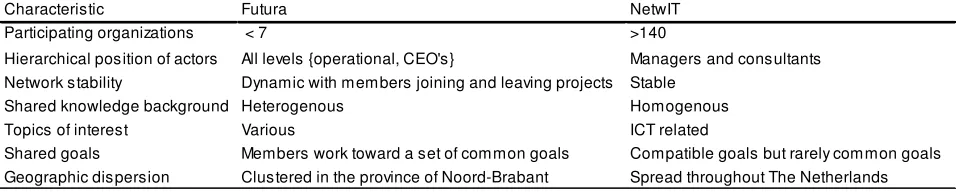
In contrast to our expectations we find that knowledge seeking behaviour is contingent on the structural composition of the CoP. Agents base their knowledge seeking decisions on perceived social risks (i.e. accessibility and future obligations) and the visibility of knowledge in dynamic social networks with heterogeneous shared knowledge bases. Moreover, in stable social networks with homogeneous shared knowledge bases (e.g. ICT specialists) the salient factors that influence knowledge seeking are the perceived value of knowledge and the awareness of other actors’ expertise.
Additionally, we find that collaborative norms do not have a direct effect in any of the two CoP’s, our data indicate that collaborative norms are subordinate to direct encouragement by manager. These findings are highly relevant for both future research on knowledge seeking as well as the daily management of CoP’s and people who participate in CoP’s.
T A B L E O F C O N T E N T S
ABSTRACT ... V
PREFACE ... VII
1. INTRODUCTION ... -1
-1.1 Motivation for this study ... 1
-1.2 Research setting ... 2
-1.3 Goal and contributions of the research ... 3
-1.4 Research perspective ... 5
-1.5 Outline of the thesis structure ... 6
-2. THEORETICAL BACKGROUND ... -7
-2.1 Design of literature study ... 7
-2.2 The dependent variable ... 9
-2.3 Relevant terms and synonyms ... 11
-2.4 Independent variables used to synthesize literature... 14
-2.5 Synthesis of the literature ... 18
-2.6 Discussion of the literature review results ... 20
-3. THEORETICAL MODEL AND HYPOTHESES ... -23
-3.1 Assumptions and hypotheses ... 23
-3.2 Outline of the theoretical model ... 29
-4. RESEARCH METHODOLOGY... -30
-4.1 Research method Selection ... 30
-4.2 Research design ... 32
-4.3 Selection of sample and population ... 34
-4.4 Operationalisation of constructs ... 36
-4.5 Instrument development process ... 38
-5. DATA ANALYSIS ... -42
-5.1 Analysis of response ... 42
-5.2 Assessing reliability and validity ... 43
-5.3 Testing assumptions ... 47
-5.4 Testing hypothesis... 50
-6. CONCLUSION ... -59
-6.1 Discussion ... 59
-6.2 Conclusions ... 61
-6.3 Implications for practice ... 64
-6.4 Implications for literature ... 65
-6.5 Limitations and further research ... 66
-REFERENCES ... -69
-APPENDIX A:LITERATURE REVIEW PAPERS SECOND SWEEP ... -76
-APPENDIX B:INTERVIEWS FOR PROBLEM DESCRIPTION ... -78
-APPENDIX C:SURVEY INSTRUMENT – ENGLISH ... -79
-APPENDIX D:SURVEY INSTRUMENT – DUTCH ... -81
-APPENDIX E:COMPANY PROFILE – WONENBREBURG ... -83
-APPENDIX F:TOP 50 IS JOURNALS ... -84
-APPENDIX G:RESIDUAL ANALYSIS ... -85
-APPENDIX H:CONFIRMATORY FACTOR ANALYSIS ... -87
-PREFACE
This thesis is the last milestone in my studies Industrial Engineering and Management. It has been a great research project and it is to be seen if I will ever have such support and liberty to do a similar project again. Therefore, I want to thank all the people who facilitated me in my research. Firstly, the people at WonenBreburg, in particular Jan-Hein Boers and Bas Buitendijk who offered me the opportunity to do my research at their organization. They put a lot of trust in me and allowed me to do as I saw fit while facilitating in every possible means. Furthermore, they have been great discussion partners, which sharpened my focus, they also opened many doors to other people and organizations, which has been a great help.
Secondly, the people from NetwIT and Futura, specifically Peter Baetsen, Joop Schoppens, and Leen Spaans who gave me full support and promoted my research within their communities.
Thirdly, I would like to thank my university supervisors, Roland Mueller and Fons Wijnhoven who have shown interest in my research throughout the entire process. I really appreciate their input, they have taken the role of consultant and have helped me especially in improving the research quality. Their style of coaching with tight deadlines and ambitious demands for quality has been good for me as it gave me confidence and motivation.
Special thanks go to Jeroen Cras for being a great discussion partner during in the last phases of my research. Moreover, my friends Koen Buisman and Danny Wemmenhove deserve my gratitude for their input during my research, especially in the data analysis phase, our discussions helped me to interpret results and deal with the statistical complications. Last, but not least, I would like to thank my parents, for their unconditional faith and support of me. Especially Sophie Nelissen, my mother, earns a deep thanks from me for her role as editor of my thesis.
This leaves me with nothing more to say than that I hope you will enjoy reading and will be able to find the knowledge you seek from my thesis. If you have any questions or comments, please do not hesitate to contact me, I will be happy to assist you!
Best regards,
1.
INTRODUCTION
“All men by nature desire knowledge”
- Aristotle, Metaphysics
1.1MOTIVATION FOR THIS STUDY
Ever shortening product life cycles and accelerating rates of technological change create greater needs to transfer technology and knowledge more effectively across organizational boundaries (Gopalakrishnan and Santoro, 2004). In the early 90s researchers noted that this trend of accelerating technology creation and change would increase the importance of knowledge sharing (Badaracco, 1991; Nonaka, 1994). Today this appears to be an accurate prediction when we look at the top 20 of most cited papers within the Business, Management and Accounting field over the last 5 years (Topcited.com). In this top, four out of the twenty papers are on the topic of knowledge sharing which makes it a dominant topic. Business and managers improve traditional ways of knowledge sharing (e.g. meetings and memos) between people and organizations with new knowledge management interventions such as (electronic) communities and networks of practice, knowledge repositories and knowledge management systems. Scholars from various disciplines study how knowledge is exchanged in social networks and knowledge management systems (e.g. von Hippel, 1994; Szulanski, 1996; Hansen, 1999; Cross and Sproull, 2004; Levin and Cross, 2004; Inkpen and Tsang, 2005;). Researchers focus on the supply-side (i.e. the contribution of knowledge and information) of social networks often drawing on social exchange theory. Therefore, scientists have improved understanding why and how people contribute knowledge to these repositories, virtual communities and management systems (e.g. Davenport and Prusak, 1998; Bock et al., 2005; Kankanhalli et al., 2005; Müller, 2005; Wasko and Faraj, 2005; Cabrera et al. 2006) However, the demand-side (i.e. the search for knowledge, information and expertise) of social networks is studied by considerably less people, even though literature acknowledges barriers to knowledge seeking. Researchers who study knowledge seeking acknowledge this gap in literature and call for further research on knowledge and information seeking (Markus, 2001; Borgatti and Cross, 2003; Gray and Meister, 2004; Xu et al. 2006; He and Wei, 2009). We conclude from our systemic literature review of 30 papers that this call is justified. Therefore, we address the need for comprehensive theory on motivations and barriers that affect individual’s decisions to seek knowledge in this paper.
Does it matter that researchers show little interest in the demand-side of knowledge sharing?
identify and select new knowledge (Granovetter, 1973). To stimulate and support knowledge seeking, managers need appropriate tools and infrastructure. However, due to scant understanding of what knowledge seekers’ motivations and barriers are, tools and management interventions are not optimally aligned with the actual needs of the knowledge seekers.
In literature the accepted paradigm is that social networks benefit organizations, although their value often has to be assessed in non traditional ways (e.g. assessing anecdotes of actors instead of immediate financial returns). A Community of Practice (CoP) is a specific form of a social network, it consists of self selected members with a purpose to develop members’ capabilities. Wenger and Snyder (2000) state the following organizational benefits: “communities of practice can drive strategy, generate new lines of business, solve problems, promote the spread of best practices, develop people’s professional skills, and help companies recruit and retain talent” (p. 140). Social capital theory shows that the value of these social networks is not limited to participating individuals but can be regarded as a public good, (Kostova and Roth, 2003; Inkpen and Tsang, 2005). Organizations rely on the network connections at dyadic level for knowledge exchange across organizational boundaries, which is essential to innovation and learning capabilities of an organization (Nooteboom 2000). This concept is elementary in the general theory of social capital, the value of capital which relationships provide (Nahapiet and Goshal, 1998; Adler and Kwon, 2002). The idea that whom a person is connected to, and how these contacts are connected to each other, enable people to access resources that ultimately lead them to such things as better jobs and faster promotions (Burt, 1992). In an organizational context, social capital (the network of social ties) increases the number of ‘good ideas’ access to opportunities that may otherwise be unavailable (Adler and Kwon, 2002; Koka and Presscot, 2002; Burt, 2004).Therefore, we intend to provide managers with guidelines which allow them to provide the infrastructure, employ the appropriate tools and motivate the knowledge seekers effectively. This will assist them in cultivating their social networks and sustain them over time, benefiting not only the actors but the organizations in the network at large.
1.2 RESEARCH SETTING
associations have merged over the last ten years, communities of practice exist for all departments and multiple third party organizations have been founded (KENCES, KEI, Corpovenista, Futura) to exchange knowledge and develop expertise on specific themes or levels (local, regional, national and even international).
In the Netherlands housing associations own 2,4 million rental units which house approximately 6 million people (Total population in the Netherlands is 16.6 million). The housing association sector exists of 455 housing associations employing 28 000 employees (Aedes, 2009). Our study is facilitated and sponsored by WonenBreburg, one of the larger housing associations in the Netherlands servicing the region Breda and Tilburg in the south of the Netherlands. WonenBreburg is organized in three business units, one for Breda, one for Tilburg and a staff division (e.g. Board, Finance, ICT, Operations). WonenBreburg owns approximately 30,000 rental units and employs 400 FTE. For a more detailed company profile see appendix A.
WonenBreburg participates in many social networks and strategic alliances, on department level in many separate communities of practice and on organizational level in all national initiatives with various purposes such as KENCES (student housing) AeDex (financial benchmark) KEI (network organization and knowledge broker on topics of urban renewal, international orientation) and Futura (network organization founded by 7 housing associations in the southern province of the Netherlands).
These inter-organizational initiatives enable organizations to share risks, create synergies and build on jointly shared capabilities. The housing associations are thus challenged to create synergies in the resources under their control. They manage to do so with varying success, at WonenBreburg two critical cases exist, the DEE (i.e. enterprise wide project on sustainable housing and decentralized energy exploitation) and purchase (i.e. joint purchasing and procurement with other Futura housing associations). Joint purchase is the most successful project which was hosted by Futura while DEE is an example of a project that greatly exceeded budgets and planning. WonenBreburg ran the DEE project independently and the lack of expertise and poor risk management resulted in serious problems. WonenBreburg wants to prevent project failures like the DEE happening again and is looking for opportunities to stimulate and support their employees to search for knowledge, expertise, advice and opinions within their communities of practice.
1.3 GOAL AND CONTRIBUTIONS OF THE RESEARCH
This research addresses gaps in literature on knowledge seeking and provides practical implications for the development and effective support of social networks. In this research we consider dyadic knowledge seeking in communities of practice among housing associations in the Netherlands. We consider knowledge seeking as an activity to identify and acquire expertise, experience, insights and opinions by engaging in dialogue with individual people (q.v. section 2.2).
1) Collect empirical evidence on the motivations and barriers for person-to-person knowledge seeking behaviour of individuals in a social network context.
To our best knowledge, no prior research has studied the knowledge seeking dyad in social networks across organizational borders. Practical concerns of communities of practice exist for managers who wish to cultivate the social networks (cf. Wenger and Snyder, 2000). Which tools and information systems should they use, do the existing tools meet the requirements to support knowledge seeking and if not, what should they look like? In an inter-organizational context the ownership and responsibility of the tools and information systems are interesting problems, how do these affect knowledge seekers? Therefore, our second research goal is:
2) Propose guidelines for the design of information services which support knowledge seeking behaviour effectively.
However in order to sustain and develop communities of practice, managers and network organizations will need to do more than merely provide the tools. They will have to encourage desired behaviour of actors and deal with challenges and barriers. Managers need to be aware that knowledge seekers and knowledge users are important for the development of these social networks. Their strategies and interventions should not solely be designed to stimulate contributing behaviour; instead they should also encourage seeking behaviour. Therefore, our third research goal is:
3) Provide managers with recommendations for effective interventions and strategies that stimulate knowledge seeking in communities of practice across organizational boundaries.
In particular we are interested in how social norms influence knowledge seeking behaviour. Social norms are standards of behaviour that are typical of, or accepted within, a particular group or society (Oxford University Press, 2005) (q.v. section 2.4). Prior research (e.g. Taylor & Todd, 1995; Venkatesh et al., 2003; Gopalakrishnan and Santoro, 2004; Kankanhalli et al., 2005) finds that social norms, or comparable variables (e.g. pro-sharing norms and collaborative norms), have significant effects on knowledge sharing, usage of information systems and knowledge contribution. However, there is still no consensus on how they moderate independent variables and if the norms have a direct effect on knowledge seeking behaviour as well. Kankanhalli et al., (2005) define pro-sharing norms as “the prevalence of norms that are intended to facilitate knowledge sharing in the organization” (p.123). Bock et al. (2006) study the influence of social norms on knowledge seeking behaviour and define the relevant norms as collaborative norms. Collaborative norms narrow to the norms of teamwork and cooperation (Goodman and Darr, 1998; Bock et al., 2006) while pro sharing norms also include willingness to value and respond to diversity, openness to conflicting views, and tolerance of failure.
With the special interest in collaborative norms in mind, we formulate the following research question to reach our research goals:
1.4 RESEARCH PERSPECTIVE
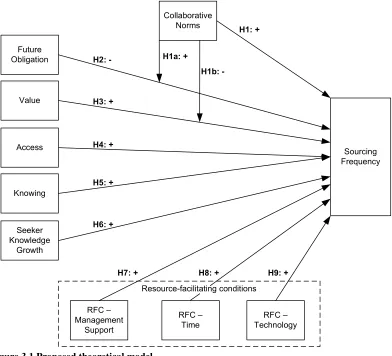
Human behaviour, social norms and social networks are broad concepts that can be studied from multiple perspectives. We choose to study the knowledge seeking dyad from the perspective of the knowledge seeker. We model the perceptions and attitudes of the knowledge seeker as determinants of the Sourcing Frequency. This approach allows us to assess the relative importance of different characteristics of the seeker (e.g. feelings of future obligation) and how the seeker’s behaviour is moderated by the contextual factors (e.g. collaborative norms) within the same analytical framework.
To place our research in the existing body of theory we use the framework proposed by Cross and Sproull (2004). They propose that “a dyadic model of knowledge seeking should include characteristics of the knowledge seeker, the knowledge source, and the relationship between the seeker and the source”, (p.452). Their framework covers Nahapiet and Goshal’s (1998) three social capital dimensions: structural (i.e. network configuration and ties), cognitive (i.e. shared goals and shared culture) and relational (i.e. social judgement of competence and risk) (cf. Inkpen and Tsang, 2005). We adapt the framework in a graphical representation that also provides an overview of which aspects have been addressed by previous research (Figure 1.1). Cross and Sproull (2004) study characteristic of the seeker, source and the relationship between them in their research on actionable knowledge (i.e. knowledge directed at making progress on relatively short-term projects). However, Cross and Sproull (2004) acknowledge that the knowledge seeking dyad still needs a lot of research. In contrast to Cross and Sproull (2004) we choose to focus on a specific part of the knowledge seeking dyad, the relationship between the seeker and the source, from the perspective of the knowledge seeker. It is this relationship that is moderated by attitude, social norms and organizational influences and affects the individuals involved.
Antecedents of knowledge seeking
In 1983, Ashford and Cummings (1983) developed a cost-benefit model for feedback seeking based on expectancy theory (Vroom, 1964). This model conceptualizes information seeking as a process of uncertainty reduction, and focuses on the balance between anticipated benefits, both intrinsic and extrinsic, and the expected costs of obtaining the information. The Ashford and Cummings (1983) model has been the accepted paradigm within the information seeking literature until social network research (e.g. Burt, 1992; Hansen, 1999) organizational learning (e.g. Grant, 1996; Davenport and Prusak, 1998) and IS (e.g. Alavi and Leidner, 1999; Markus, 2001) studied knowledge exchange. The new insights proved that the cost-benefit perspective is too narrow to capture the external influences, relational characteristics and the different forms of knowledge that are exchanged by various communication means.
Social relationships in a network
Figure 1.1 research perspective on the knowledge seeking dyad seeking, adapted from Cross and Sproull (2004)
1.5 OUTLINE OF THE THESIS STRUCTURE
2.
THEORETICAL BACKGROUND
This chapter provides a structured review of the current body of knowledge on knowledge seeking. In the first section we outline our literature review method. Subsequently we propose our dependent variable (DV) and provide a cognitive map to show how the dependent variable is related to and distinct from other variables used in literature. In section 2.3 we clarify how we will define and use frequently used terms and synonyms in theory on social networks and knowledge exchange. Thereafter we will provide succinct cognitive maps of independent variables (IV) which we will use as scope for our literature study. We conclude the chapter with a synthesize of literature (Table 2.1) and a discussion of the literature review results (section 2.6).
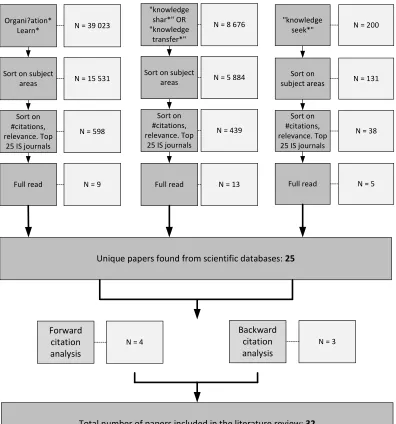
2.1 DESIGN OF LITERATURE STUDY
Organi?ation* Learn*
Sort on subject areas
Sort on #citations, relevance. Top
25 IS journals
Full read
N = 39 023
N = 15 531
N = 598
N = 9
"knowledge shar*" OR "knowledge
transfer*"
Sort on subject areas
Sort on #citations, relevance. Top
25 IS journals
Full read
N = 8 676
N = 5 884
N = 439
N = 13
"knowledge seek*" Sort on subject areas Sort on #citations, relevance. Top
25 IS journals
Full read
N = 200
N = 131
N = 38
N = 5
Unique papers found from scientific databases: 25
Total number of papers included in the literature review: 32 Forward
citation analysis
N = 4
Backward citation analysis
[image:16.595.122.518.76.500.2]N = 3
Figure 2.1 outline of our literature search method
Note1: results kept in a specific stage is presented in the light grey boxes “N=” Note2 : selection criterion for subject areas: Social Sciences & Humanities
Literature study interest and scope
2.2 THE DEPENDENT VARIABLE
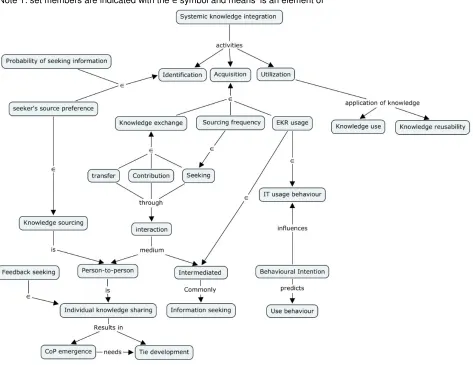
The dependent variable in our study is Sourcing Frequency, the frequency with which individuals contact other people in the community of practice to access expertise, experience, insights and opinions (cf. Xu et al., 2010). It is a variable introduced by Xu et al. (2010) as a measurement for task and social information seeking on a dyadic level. We explicate the origin and relation with other (dependent) variables, used in literature, in Figure 2.2.
Knowledge seeking
Knowledge seeking is the search for knowledge sources needed for a problem or task. If we look at knowledge sharing as an exchange activity, we can distinguish two roles, supply and demand. The knowledge suppliers contribute their knowledge and experience to communities, virtual environments and answer knowledge questions. On the demand-side there are people with knowledge questions, people who seek knowledge from these communities and information services. In our research we do not consider documents and codified knowledge which is not readily available in repositories. Instead we focus on the search for knowledge that is embedded in experience, seeking expertise and experts. According to the Theory on Systemic Knowledge Integration (KI) Kraaijenbrink (2006), knowledge seeking is initiated by the recipient of knowledge and. We restrict ourselves to the sourcing behaviour, the identification and acquisition of knowledge which are the first two KI activities, we do not consider the actual utilization and application of knowledge by the knowledge seeker. However, we do recognize that this last stage is critical for the effective transfer of knowledge. Thus, we refer to knowledge seeking as an activity to identify and acquire expertise, experience, insights and opinions by engaging in dialogue with individual people (cf. section 1.4). Our scope of knowledge seeking is comparable with the frequently cited definition formulated by Hansen (1999) knowledge search is the “looking for and identifying useful knowledge in an organization” p. 84 (Hansen, 1999).
Why is Sourcing Frequency the most appropriate measurement of knowledge seeking?
Because knowledge exchange and more specifically, knowledge seeking behaviour is commonly measured by its frequency of occurrence (e.g. Borgatti and Cross, 2003; Bock et al., 2006; He and Wei, 2009; Xu et al 2009). By studying how often an actor engages in such behaviour, researchers can say something about the characteristics of the seeker, the source and their relationship that affect the behaviour. Sourcing Frequency is derived from the concept of knowledge sourcing which is studied in the organizational learning discipline as a predictor of individual learning outcomes (e.g. Gray and Meister, 2004; Gray and Meister, 2006). On a dyadic level it refers to the “ .. intentional individual efforts to locate and access others’ expertise, experience, insights, and opinions by engaging in dialogue with individual employees” (p.144) (Gray and Meister, 2006).
Sourcing Frequency reflects the intensity (i.e. frequency of exchange) of the relation between actors and therefore fits well with other dependent variables which have been used in previous studies to assess knowledge seeking behaviour. The frequency of information and knowledge exchange between actors is an important measurement in social network research (cf. tie strength), organizational learning (cf. knowledge sourcing) and research on knowledge sharing within the IS field (cf. EKR usage).
and become stronger. Van Baalen studies knowledge. Van Baalen et al. (2005) show with a study on innovative agricultural projects that bridging structural holes contributes to the emergence of a Network of Practice (NoP).The development and usage of ties thus implies the emergence of social networks.
[image:18.595.82.555.370.735.2]Sourcing Frequency is related to the usage construct widely used in IS literature (Davis et al., 1989; Delone and Mclean, 1992;Taylor and Todd, 1995; Seddon et al., 1999; Legris et al., 2003; Venkatesh et al. 2003). In this sense usage reflects the frequency with which users use an information system. Bock et al. (2006) translate usage to the knowledge management field and show how knowledge seeking intentions influence their dependent variable ‘Usage of an EKR’ to find sources. In Figure 2.3 we show how the commonly used variables in this context are interlinked.
Figure 2.2 high-level concept map of scientific domains relevant to knowledge seeking
Note 1: set members are indicated with the ∈ symbol and means ‘is an element of’
2.3 RELEVANT TERMS AND SYNONYMS
What is knowledge and what are its relevant characteristics for the knowledge seeker? In essence the type of knowledge and its medium are the characteristics that influence the exchange process. In the first place there is a difference between information and knowledge. Information are facts or details about something or somebody. Knowledge is more complex, it is the understanding and skills that one gains through education or experience. Gray and Meister (2004) illustrate how the process of obtaining information differs from obtaining knowledge. Facts are available through multiple paths including direct learning behaviour such as observation, learning by doing and experimentation while knowledge is only obtainable from a person with experience and insight (Gray and Meister, 2004). We will distinguish knowledge and information following Gray and Meister (2006), we regard knowledge as the product of human thinking and facts as representations of reality.
Knowledge
We identified knowledge as a product of human thinking to articulate how it differs from information. But what is it exactly and what types of knowledge exist? A widely accepted definition of knowledge ”.. is a justified true belief based on information” (Nonaka, 1994). Grant (1996) states that knowledge is a key strategic organizational resource and according to the knowledge-based view (Grant, 1996) it is an organization’s principal function to create, integrate and apply knowledge. Sustainable competitive advantages and performance differences are the result of an organization’s unique knowledge base. Knowledge exists in different forms, traditionally literature distinguishes two dimensions, explicit (articulated, codified in symbolic form or natural language) and tacit (experiences, know-how) knowledge. More recent studies study distinguish different forms of knowledge on a more detailed level. E.g. Cross and Sproull (2004) study five components (solutions, referrals, problem reformulation, validation and legitimation) of actionable knowledge (i.e. knowledge directed at making progress on relatively short-term projects).
Wijnhoven et al. (2009) classify knowledge into four types, following a linguistic analysis by Mingers (2008):
1) Propositional knowledge: is ‘to know that x’, and may be the result of direct
perception of the receipt of messages by communication. This is commonly called ‘information’ (Wijnhoven et al., 2009).
2) Experiential knowledge: is ‘to know x’ via personal experiences.
3) Performative knowledge: is ‘to know how to do x’, and is embodied knowledge
gained by learning, training, and personal experience.
4) Epistemological knowledge: is ‘to know why x’ gained by formal methods of
discovery, as in science, and codified in a (formal) language.
Knowledge sourcing
Brokerage
Brokerage of information or knowledge is an intermediation process among people across groups. An actor that occupies a central network position creates a brokerage position, enabling it to locate relevant information or knowledge and exchange it within the social network (Burt, 1992). This is also called information arbitrage. “Previous research shows that an active broker (in a coordinated or spontaneous way) helps to create the indirect linkages among members of an emerging network” (Van Baalen, 2005). “New ideas emerge from selecting and synthesizing across structural holes. People whose networks bridge the structural holes between groups have earlier access to a broader diversity of information and have experience in translating information across groups.” (Burt, 2004)
Knowledge use: application or acquisition?
Knowledge use refers to a specific knowledge activity. Kraaijenbrink (2006) proposes a model on knowledge integration which consists of three knowledge activities. In this theory, systemic knowledge integration is a process which consists of three stages, identification, acquisition and utilization. Kraaijenbrink (2006) classifies knowledge use as a ‘utilization’ activity by the recipient actor, it is considered an application activity.
Information service
“Information services are services that facilitate the exchange of information goods with or without transforming these goods” p.93 (Wijnhoven and Kraaijenbrink, 2008). The purpose of information services is to make relevant and useful information accessible. Information services can be equipment-based (e.g., automated services) as well as people-based (e.g., consulting services). Technological innovations lead to an increase of equipment-based information services, offering a broad range of opportunities to identify, select and acquire information.
Social capital
Inkpen and Tsang (2005) define social capital as “the aggregate of resources embedded within, available through, and derived from the network of relationships possessed by an individual or organization”. Based on literature review on social capital in three different types of strategic networks, Inkpen and Tsang (2005) conclude that individual social capital forms the basis of organizational social capital. This is congruent with the findings of Adler and Kwon (2002), as they note that social ties are a fundamental aspect of social capital, because social capital transactions rely on opportunities created by an actor’s network of ties.
Social networks:
“A social network can be defined as a patterned organization of a collection of actors and their relationships” (van Baalen et al. 2005). Social networks support knowledge exchange between individuals who have a common practice (Wasko and Faraj, 2005). “The collection of actors would contain more than two actors to be defined as a network. A network can be viewed as a social exchange structure with its own governance structure and patterns of interaction in which flows of resources between independent units (or individuals) take place” (van Baalen et al., 2005). Van Baalen et al. (2005) suggest that both CoP and NoP, are particular forms of social networks.
Community of Practice (CoP)
of practice, joint sense-making and problem solving enhances the formation of strong interpersonal ties and creates norms of direct reciprocity within a small community” (Wasko and Faraj, 2005).
Network of Practice (NoP)
“Networks of Practice can have an enormous reach. There is relatively little reciprocity across NoP’s as the members do not interact directly. NoP’s are loosely coupled systems that hardly initiate collective action and produce little knowledge” (van Baalen et al., 2005). ”Networks of practice often coordinate through third parties such as professional associations, or exchange knowledge through conferences and publications such as specialized newsletters” (Xu et al., 2010).
Tie
Tie refers to a social relation of some strength between persons or organizations. In our research we will mainly focus on the between-person ties. Granovetter (1973) published on the strength of weak ties (i.e. relationships with a low interaction frequency), he showed that weak ties create access to new knowledge. Strong ties among cliques have more homogeneous opinions, which reduces the amount of new information and unique insights. Hansen (1999) measures tie strength between two subunits with frequency and closeness scores. Hansen (1999) defines such inter-unit relation, as a “Regularly occurring informal contact between groups of people from different operating units in an organization” (p. 83). Through membership of a network and the resulting repeated and enduring exchange relationships, the potential for knowledge acquisition by the network members is created (Inkpen and Tsang, 2005). Social networks benefit from interrelationships of individuals, especially the boundary spanners (i.e. actors in a brokerage position)(Tushman, 1977). Boundary spanners are people whose networks bridge the structural holes between groups, they have earlier access to a broader diversity of information and have experience in translating information across groups (Burt, 2004). Van Baalen et al. (2005) show with a study on innovative agricultural projects that bridging structural holes contributes to the emergence of a Network of Practice (NoP).
Network centrality
Network centrality is an actor’s position in the network. In-degree centrality is the most suitable measure to capture an actor’s information or knowledge access. The higher a unit's in-degree centrality, the more knowledge sources the unit has (Tsai, 2001). While the number of relations increases access to external knowledge, a centralized positionwithin an overall pattern of relationships determines whether such knowledge can be used beneficially (van Wijk et al., 2008).
Stickiness of information
Stickiness of information is introduced by Von Hippel (1994). It refers to the incremental expenditure required to transfer a unit of information to a specified locus in a form usable by a given information seeker. If the cost of moving information is low, the information stickiness is low and vice versa. The theory of stickiness is that these costs of bringing information and problem-solving capabilities together inhibit the flow of information.
Structural capital
Structural holes
“When people focus on activities inside their own group which creates holes in the information flow between groups, or more simply structural holes” (Burt, 2004).
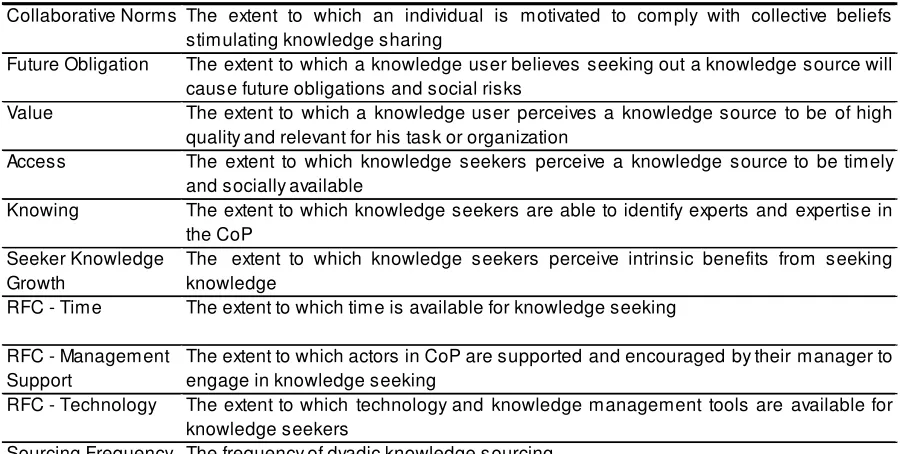
2.4 INDEPENDENT VARIABLES USED TO SYNTHESIZE LITERATURE
In this section, we define the theoretical concepts which we use to systemically synthesize the literature. The concepts provide a high level framework to compare the theories from different research domains. Authors define similar phenomena differently or study them within another research context and from other perspectives.
Value
In our paper we consider value as a concept with two dimensions, source quality and the content relevance. On the quality dimension value refers to the perceived characteristics of a knowledge source. Value is used as a construct by social network research to predict information seeking probability (Borgatti and Cross, 2003). They define value as the perceived quality of the knowledge and skills of the person sought out in relation to the problem. In this definition quality of knowledge is the extent to which a source is believed to possess accurate and useful knowledge (Morrison and Vancouver, 2000). Braganza et al. (2009) find that quality of the knowledge source has a direct effect on the task performance. Their study, an in-depth case analysis of an intranet-based knowledge management system, shows that the quality is determined by the reliability of the knowledge source, at a dyadic level. This validity and reliability of content is what Xu and Kim (2006) name information quality. We recognize that the usefulness of knowledge is closely related to the relevance of the content for a knowledge seeker’s job or task. Lane and Lubatkin (1998) find a similar relationship on organizational level. They define value as the importance of knowledge for an organization’s own operations.
In the IS field, relevancy is commonly measured with the construct of perceived usefulness. This construct is used to indicate how users perceive the value of the IT artefact in performing their task (Davis et al., 1989; Taylor and Todd, 1995; Kulkarni et al., 2006). Perceived usefulness - in the context of knowledge sharing - is defined as the belief that results from an Electronic Knowledge Repository (EKR) or Knowledge Management System (KMS) will enhance their work performance (Venkatesh et al. 2003; Bock et al., 2006; He and Wei, 2009). The similarity between the aforementioned concepts is that individual knowledge workers need to evaluate their knowledge source on content quality and accuracy and relevance for their task, their work performance or their firm’s operations.
Access
relationship between strong ties and effective knowledge transfer.Unfortunately they do not report on the results of the variable. Xu and Tan (2006) distinguish two elements of accessibility at a dyadic level, physical proximity and scheduling difficulty. Scheduling difficulty refers to the timeliness of response and social accessibility of the knowledge source. Borgatti and Cross (2003) state that cultural issues and collaborative norms influence access through status or by power inhering in positions of formal authority or informal structure.
The access of documents, repositories and codified information is comparable to the perceived ease of use concept which is widely used in IS literature (Davis et al. 1989; Venkatesh et al., 2003; Bock et al., 2006). Perceived ease of use is an important predicting variable for the usage of IS systems (Venkatesh et al., 2003; Legris et al., 2003). Bock et al. (2006) adapted perceived ease of use to EKRs and found support for the relationship between knowledge seeking behaviour and accessibility of the EKR. Cabrera et al. (2006) consider the availability of a KMS as the degree of usability or user friendliness of the user interfaces, and on whatever practical difficulties may exist to access the necessary computer technology or communication connections. Markus (2001) discusses access of knowledge sources from the perspective of a knowledge seeker or reuser. She states that knowledge reuse involves access to experts, not access to codified expertise. The KMS has a mediating role for the identification and selection of experts. Her definition of access includes both access to experts and access to expertise. To summarize, access is a characteristic of the knowledge source which can be observed along the dimension of availability (physical, social and timely) or usability (perceived ease of use).
Knowing
Knowing is defined by Borgatti and Cross (2003) as the awareness of another person’s expertise on a current problem or opportunity. Similarly to the distinction made by Markus (2001) between expertise and experts, Braganza et al. (2009) highlight the importance of identifying existing expertise (yellow pages) and secondly to identify subject matter experts (people).With a qualitative study at a large oil company Braganza et al. (2009) identify 13 significant attributes for the creation, mobilization and diffusion of organizational knowledge. Xu and Kim (2006) define information seeking as a staged process during which the knowledge seeker develops a better awareness of his knowledge needs, and his relevance judgment becomes stricter. They do not address the concept knowing specifically, but they do recognize the uncertainty of the information seeker.
Markus (2001) states that for shared work practitioners, the type of knowledge reusers who are active in communities of practice, location and selection are problematic. Her concept of
knowing includes both the identification of experts in a subject matter and documentary knowledge sources as well as the knowledge of who "authored" knowledge contributions necessary to assess quality.
Cost
needed to search for knowledge. Markus (2001) proposes effort as an inhibitor to produce and use knowledge. This perspective fits with the literature on technology acceptance. Effort expectancy is a significant predictor of the intention to use technology (Venkatesh et al., 2003; Legris et al. 2003). Bock et al. (2006) focus on the perceived costs of future obligation. Future obligation is the cost impact on the relationship between actors, the expectation of seekers that they will be in debt to a certain extent with the person sought out. This focus matches with the findings of Borgatti and Cross (2003) who state that cost of access increasingly refers to relational energy instead of resources. Expenses of relational energy involve social risk which refers to the embarrassment, loss of face, and revelation of incompetence associated with asking another person for information (Xu and Tan, 2006). That is an actor must believe that seeking information is not too costly in terms of either interpersonal risks or obligations incurred (Wasko and Faraj, 2000; Borgatti and Cross 2003). To summarize the independent variable cost can have multiple dimensions, perceived costs of knowledge exchange (effort, costs of opportunity, transaction and outcome, search costs) or future obligation (social risk and reciprocity).
Self-efficacy
Self-efficacy is a characteristic of the knowledge seeker, in literature it is commonly used as a cause or barrier to perform a certain task or engage in behaviour. In the context of knowledge seeking this is a complex variable, as self-efficacy can also be the result of knowledge seeking. In such scenario, a knowledge seeker is strengthened in his self-efficacy as a result of experience, advice or insights of the knowledge source. Self-efficacy is the belief in one’s capabilities to organize and execute the courses of action required to produce given goals (Bandura, 1997). Bock et al. (2006) describe self-efficacy as follows: “It is a form of self-evaluation that influences decisions of behaviour, the amount of effort and persistence put forth when faced with obstacles, and finally, the mastery of the behaviour” (p. 361). Kankanhalli et al. (2005) adapt the concept to the context of EKRs, they define self-efficacy as the confidence in one's ability to provide knowledge that is valuable to the organization via EKR. He and Wei (2009) define self-efficacy as the judgment of one's ability to use a technology to accomplish a particular job or task. Cabrera et al. (2006) analyse a trend in recent research to investigate self-efficacy beyond the specified requirements of jobs and instead include proactive interpersonal and integrative tasks beyond technical requirements. This new form of self-efficacy is what they name role breadth self-efficacy (RBSE)( Cabrera et al., 2006). RBSE has been designed to measure an employee’s self-efficacy within ‘a flexible, self-directed, and interpersonally effective workforce’ (Parker, 1998) and is hypothesized to be an indicator of employees’ inclinations to proactively engage in organizational goal-related behaviours within jobs with broadly defined roles (Parker, 1998). To summarize, self-efficacy is often seen as a cause, but can also be the result of behaviour. The variable has one dimension, the belief in one’s capabilities, but it can extend beyond a specific task to organizational goals and role-breadth performance.
Seeker knowledge growth
seeking knowledge results in learning and personal access to new knowledge or innovations. Bock et al. (2006) link seeker knowledge growthto the motivation for knowledge seekers to obtain knowledge from EKRs. Seekers are more likely to use the EKRs if they expect to increase their expertise when they obtain knowledge from EKRs. To summarize, seeker knowledge growth has two dimensions, the intrinsic benefit expectation and the intrinsic motivation to learn and develop new expertise.
Resource-facilitating conditions
Facilitating conditions are an aggregate of various organizational conditions such as management support, training, time and availability of technology. The variable reflects the availability of resources needed to engage in a behaviour (Taylor and Todd, 1995). Legris et al. (2003) define resource-facilitating conditions (RFC) to explain and predict use of information systems. They refer to RFC as resource-related objective factors in the environment to promote technology usage in various contexts. Venkatesh et al. (2003) provide empirical evidence that the facilitating conditions (resources and skills) have a significant effect on IS usage. Bock et al. (2006) adopt RFC to knowledge seeking behaviour in EKRs. In their model they identify resources which are likely to facilitate knowledge seeking behaviour and include time, availability of technology, training, and management support. In their set of resources they extend beyond technology and include training and management support. Also Cabrera et al. (2006) acknowledge that as knowledge will be volunteered and exchanged, sharing behaviour cannot be facilitated with technology alone. Although they do not specify which other facilitating conditions they expect to be at play and conclude that there is no consensus in literature on the specific variables or management practices. Thus we observe that facilitating conditions are nearly always an aggregate variable of several management practices and resources. This is also apparent in a more recent study on knowledge sharing by He and Wei (2009). They do not make their
facilitating conditions variable explicit and consider it on abstract level as ‘training and resources’. To operationalise the construct theyadopt the measures for facilitating conditions from Venkatesh et al. (2003). Kulkarni et al. (2006) are more explicit about organizational support, they distinguish supervisor, co-worker, leadership and incentives. Supervisor and co-worker support is a subjective measure of the extent of encouragement provided to and experienced by a knowledge worker in sharing/using solutions to work-related problems, openness of communication, opportunity for face-to-face and electronic meetings to share/use knowledge (Kulkarni et al., 2006). Leadership is a subjective measure of commitment to knowledge management by the top levels of management, exhibited via understanding of the role of knowledge management in business, strategy, and goals set with respect to KM.
Reciprocity
Reciprocity is a situation in which two people, countries, etc. provide the same help or advantages to each other (Oxford University Press, 2005). In the context of knowledge seeking reciprocity involves two people or groups who agree to help each other or behave in the same way to each other (Bock et al., 2005). Reciprocity is a key extrinsic benefit identified in social exchange theory and will therefore be included in the scope of literature review.
Social norms
dimension of social capital. Norms are deeply embedded in organizational culture, according to Taylor and Todd (1995) in referent groups (e.g. peers and superiors) since their expectation may differ. The effects of social norms is also found in a knowledge sharing context (Müller, 2005). Kankanhalli et al. (2005) define specific norms for knowledge sharing, pro-sharing norms (PSNM). These are norms intended to facilitate knowledge sharing in the organization. Bock et al. (2006) translate the pro-sharing norms to a knowledge seeking context. They call them collaborative norms which are narrower than the
pro-sharing norms, in that pro-sharing norms also include willingness to value and respond to diversity, openness to conflicting views, and tolerance of failure, in addition to the collaborative norms of teamwork and cooperation(Bock et al., 2006). One of the variables in the theory of planned behaviour which predicts intention to perform an action (Azjen and Fishbein, 1980) is the subjective norm. Which are the pressures perceived by the individual from the immediate social environment towards an action. Subjective norms result from the people’s normative beliefs and their individual motivation to comply with those beliefs. People will be more inclined to perform a certain behaviour if they feel that important referent individuals are likely to approve and even applaud such behaviour (Cabrera et al., 2006). He and Wei (2009) focus on the effects of social relationships that facilitate collective action or are a barrier to knowledge transfer. They identify three aspects of social relationship that are particularly contributory to knowledge sharing: trust, norms, and tie strength.
Usage
Usage is actual behaviour of the knowledge seeker, he uses social relations, EKRs information services or applies knowledge. Tie usage reflects the intensity of the dyadic relation between actors (Hansen, 1999; Burt, 2004). Tie usage also implies the emergence of social networks (van Baalen et al., 2005; Nebus, 2006). The usage intensity of knowledge sources is indicated as Sourcing Frequency (Xu et al., 2010). In this study we will define knowledge source usage following Hansen (1999) and Kraaijenbrink (2006); it is the identifying, looking for and acquisition of knowledge from a source. The application, or transfer of knowledge is not included in this view for reasons of simplicity. Nor is the rate of utilization implied by the Sourcing Frequency as the transfer of knowledge from one actor to another depends on many factors such as the type of knowledge, interpretation of knowledge, stickiness of knowledge and the differences in context ( Hansen, 1999; Nooteboom, 2000; Burt, 2004; van Baalen et al., 2005). Usage as a construct in IS success theory reflects the intensity with which users use an information system (Delone and Mclean, 1992; Seddon et al., 1999). Bock et al (2006) transfer usage to the knowledge management field choosing it as their dependent variable ‘Usage of an EKR’ to find sources. In this context ‘usage’ corresponds to a knowledge identification and acquisition activity defined by Kraaijenbrink (2006).
2.5 SYNTHESIS OF THE LITERATURE
From Table 2.1 we observe that nine papers have a dependent variable related to information or knowledge seeking. These papers generally have a relatively low explanatory power, Gray and Meister (2004) find an R2 of 17.1% for knowledge sourcing behaviour while He and Wei (2009) formulate a model on information seeking which explains 23% of the variance. Bock et al. (2006) find a reasonable explanatory power of 42% but their model is more complex, studying also the influence of social norms, future obligation and resource-facilitating conditions. The graphical presentation (Figure 2.2) of the existing theories related to knowledge seeking make it easy to see how literature finds support or rejects the effects of the independent variables within our scope. Using this analysis we intend to identify a robust set of independent variables which explain and predict a better percentage of the variance in Sourcing Frequency.
Table 2.1 overview of results of 32 academic papers included in our literature review a
For some papers we abbreviated the authors to improve readability b
Figure 2.3 (p. 10) outlines how the different dependent variables are related
Authors\Conceptsa C o s t V a lu e A c c e s s K n o w in g S e e k e r k n o w le d g e g ro w th R e s o u rc e -f a c il it a ti n g c o n d it io n s S o c ia l n o rm s S e lf -e ff ic a c y R e c ip ro c it y U s a g e
Dependent Variableb
Focus Adler and Kwon (2002)* + + + Value of social capital both Ashford (1983)* - + + Feedback seeking seek van Baalen (2005) ** + n.s. Emergence of Network of Practice SNA Bock et al. (2005) + + Intention to share knowledge cont Bock et al. (2006) - + n.s. + + + + Usage of EKR for knowledge seeking seek Borgatti & Cross (2003) n.s. + + + Probability of seeking information seek Braganza (2009)** + + + Benefits of managing knowledge seek
Burt (2004) + + Idea value SNA
Cabrera et al.(2006) + + + + + + Individual knowledge sharing both Cross & Sproull (2004) + + Actionable knowledge seek Lane & Lubatkin (1998) + + Interorganizational learning AbCa Grant (1996)* + Knowledge integration
Gray & Meister (2004) + + Knowledge sourcing seek Gopalakrishnan (2004) + knowledge trans fer activities
Hansen (1999) + + n.s. Project completion time SNA He & Wei (2009) + n.s. + n.s. Continued knowledge sharing both Inkpen & Tsang (2005) * + + Knowledge transfer SNA Kankanhalli et al. (2005) - + + + EKR usage cont Kraaijenbrink (2006) + + + + Systemic knowledge integration both Koka & Prescott (2002) + Social capital SNA Kulkarni et al.(2006) + + + Knowledge use both Levin & Cross (2004) + + Receipt of useful knowledge SNA Marks (2008) + Knowledge sharing cont Markus (2001) ** - + + + + + + Knowledge reusability both Morrison (2000) - + + Information seeking across sources seek Taylor & Todd (1995) + + + + IT usage behaviour
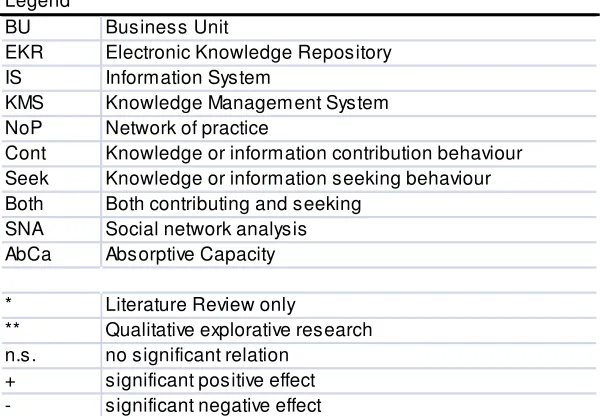
Table 2.2 legend of literature review Table 2.1
2.6 DISCUSSION OF THE LITERATURE REVIEW RESULTS
In this section we discuss the results of the literature review. Which concepts are applicable in theory about knowledge seeking and which are not? Is there a kernel theory on knowledge seeking and what elements are essential in such kernel theory? This assists in developing the constructs for our theoretical model and finding nuances in existing theories.
Perception
Several of the independent variables we studied are about the perception of a seeker. E.g. a high score on access means that the seeker perceives the source to be very accessible. Therefore it is important to realise how these perceptions are influenced beyond factual observations. Borgatti and Cross (2003) state that at a dyadic level perceptions of value of another person are formed through direct interactions, observation and or third-party commentary.
Cost
The literature is not unanimous on the influence of costs on knowledge exchange in interpersonal relations. Seven papers study costs or a dimension of cost (e.g. future obligations), 3 papers find the effect of costs insignificant while 3 other papers find significant direct effects and one paper (Markus, 2001) hypothesizes a negative direct effect of codification effort (opportunity cost). The three papers find a significant causal relationship with usage behaviour in a context of intermediated sharing, studies on person-to-person knowledge exchange find costs to be insignificant. Interesting though, is the significant negative effect of future obligation on usage of EKRs to seek knowledge under conditions of weak collaborative norms (Bock et al., 2006). There is no competition for the usage of this knowledge and there is no direct social contact between seeker and source. Therefore we expect relational costs to be relevant for person-to-person knowledge seeking behaviour as well.
Value
Literature is unanimous on the perception of value. Although different definitions are used it is clear that perceived benefits, perceived usefulness or performance expectations have significant direct positive effects on all dependent variables studied, including knowledge
Legend
BU Business Unit
EKR Electronic Knowledge Repository
IS Information System
KMS Knowledge Management System
NoP Network of practice
Cont Knowledge or information contribution behaviour Seek Knowledge or information seeking behaviour Both Both contributing and seeking
SNA Social network analysis
AbCa Absorptive Capacity
* Literature Review only
** Qualitative explorative research n.s. no significant relation
+ significant positive effect
seeking behaviour such as Sourcing Frequency and information seeking (Borgatti and Cross, 2003; Xu et al., 2010) .
Access
Twenty of the studies we reviewed find access to have a significant direct effect. Although in some papers access is only under specific conditions significant and in yet other studies access is weakly significant or only elements of their access construct are significant. The one exception is the study of Bock et al. (2006), they find perceived ease of use to be insignificant to usage of the EKR. They explain this finding by explicating that their sample consisted of ‘respondents who were considerably familiar with IT’ (Bock et al., 2006). An important observation is that the physical component of access, proximity, is insignificant in nearly all papers we studied. We conclude that access is a key construct in social network studies.
An extra conclusion from the literature review is that social network research focuses on network ties as enabler of access to knowledge sources (Granovetter, 1973; Hansen, 1999; Tsai, 2001; van Baalen et al., 2005).Tie strength and structural holes in networks can be used to predict access to knowledge sources. Weak ties increase the access to new knowledge sources and can bridge structural holes, while strong ties negatively influence the ability to search knowledge (Levin and Cross, 2004). However strong ties improve the relationship between the recipient and the source which is necessary for knowledge transfer and exchange of actionable knowledge (Hansen, 1999; Cross and Sproull, 2004).
Knowing
In all of the nine studies in which knowing or a similar independent variable is studied, it is found to have a significant positive direct effect. In studies which were focused on structural holes and social network analysis, knowing is a key aspect which allows the boundary spanner to identify knowledge sources in his network.
Seeker Knowledge Growth
Four out of five studies which consider seeker knowledge growth, find significant positive effects on their dependent variable. Research on knowledge sourcing (Gray and Meister, 2004) shows that learning orientation has significant direct effects on knowledge sourcing and learning outcomes. Learning orientation is a seeker’s belief that his own skills and abilities can be improved, and thus he "persists, escalates effort, engages in solution-oriented self-instruction, and reports enjoying the challenge" p.826(Gray and Meister, 2004). Consistent with their belief that competence can be improved, such individuals are more likely to consult with co-workers to improve their knowledge, skills, and abilities(Gray and Meister, 2004). Bock et al., (2006) find that Seeker Knowledge Growth also has a direct effect on EKR usage. However, He and Wei (2009) do not find a significant effect for seeker knowledge growth on seeking belief. In their theory seeking belief has a direct effect on seeking intentions. Based on the relatively low number of papers that consider seeker knowledge growth in the different contexts, we conclude that the understanding of intrinsic motivation of knowledge seeker’s is low and still insufficient empirical evidence is available despite its potential relevance.
Resource facilitating conditions
concept of facilitating conditions, nor is there consensus on which organizational aspects are included in the construct facilitating conditions. Venkatesh et al., (2003) reason that facilitating conditions are insignificant when effort expectancy is included in the theory. They argue that the effect of facilitating conditions is mainly based on IT infrastructure, which is also captured with effort expectancy and thus RFC are redundant in studies which consider effort expectancy. This reasoning only holds when IT infrastructure is a core concept within the facilitating conditions construct. We argue that facilitating conditions have to be studied in detail to improve understanding of the concept.
Social Norms
Social norms are studied in 10 of our reviewed papers, the definitions and context vary and cover topics in a spectrum which has relational and social capital on the one end, and perceived task benefits on the other end. All studies conclude that social norms, pro-sharing norms or collaborative norms have at least a moderating effect. Bock et al. (2006) find that norms of collaboration and cooperation not only have a direct influence on knowledge seeking from an EKR, ‘they also moderate the relationship between certain costs (future obligation) or benefits (perceived usefulness) and EKR use’ (Bock et al., 2006). Therefore we conclude that collaborative norms are an essential in a kernel theory on knowledge seeking.
Reciprocity
Seven studies consider reciprocity, two of these find a direct positive significant effect. Both of these papers that find reciprocity significant focus on knowledge contribution. In five studies researchers find reciprocity to be insignificant. Important to observe is that pro-social norms are relevant. Of the two papers which find evidence for reciprocity, Kankanhalli et al. (2005) find that reciprocity is only significant under conditions of weak social norms. In the papers we reviewed we did not find evidence which indicates that reciprocity has an effect on knowledge seeking behaviour. Therefore reciprocity will not be included in our theoretical model.
Self Efficacy
Four authors study efficacy. One these four studies (Venkatesh et al., 2003) finds self-efficacy to be insignificantly related to behavioural intention. They validate their hypothesis that Self-efficacy is fully mediated by perceived ease of use and has no direct effect on intention above and beyond effort expectancy. Two of the studies (Bock et al., 2006; Cabrera et al. 2006;) which cover self-efficacy in knowledge seeking do not cover the effort aspect, which accordingly to our study can be classified as an accessibility perception. In our model we consider the perceived ease of use of knowledge sources along dimensions of availability, timeliness and social accessibility. Following previous research (Venkatesh et al. 2000; Venkatesh et al., 2003; He and Wei, 2009) we will therefore not consider self-efficacy.
Usage