M
ASTER
T
HESIS
B
USINESS
A
DMINISTRATION
F
INANCIAL TRACK
A new way to process and store back office data allowing an increase in findability that results in an improved and less time-‐consuming process.
BART VOORTMAN
S1017489
SUPERVISOR WENSINK & PARTNERS
P. WENSINK
SUPERVISOR UNIVERSITY OF TWENTE
IR. H. KROON
SUPERVISOR (2) UNIVERSITY OF TWENTE
Management summary
This study is performed in a relatively small company called Wensink &
Partners. This company provides financial advice in pension services, financial planning and helps her customers with other financial of fiscal issues. Wensink & Partners has to store allot of data due to legal obligations and the main platform to store all that data is the Livedrive. This is an external and online hard disk that is used by all employees to store and process data. The data in the Livedrive has never been stored on a uniform way. This problem was long no topic of interest due to the fact that this company consisted for a long time out of only two employees. But due to an increase in personnel and data the problem was exposed. New employees did not know where they could find the necessary information or did not know where to store data in the Livedrive. This caused that employees often had to follow a very time consuming process when performing tasks for customers. To solve this problem the following research question was composed:
On which uniform and standardized way can the data of Wensink & Partners be processed and stored allowing an increase in findability that will result in an improved and less time-‐consuming process?
To answer this question first the folders in the current mapping of the Livedrive were analysed. With all the analyses a first version of the mapping for the Livedrive is produced. This first version will be discussed in order to find
bottlenecks and eventual problems and after all those discussions a final version of the Livedrive will be provided tot Wensink & Partners. This study provided a new mapping with guidelines that will allow every employee of Wensink & Partners to store and process the data uniform and standardized. This new mapping can be found in appendix (O, P and Q). The provided mapping will allow employees of Wensink & Partners to benefit from the new uniform and
standardized way to store data. The advice that can be provided to the management of Wensink & Partners can be summarized as follows:
• Use the new mapping of the Livedrive to store and process the data in the
Livedrive.
• This mapping is only applicable for the Livedrive and not for other ways
of storing data.
• Be precise and use the instructions and guidelines every time a document
is saved on the Livedrive.
• Let every new employee get familiar with the new mapping of the
Livedrive before work is performed.
Table of Contents
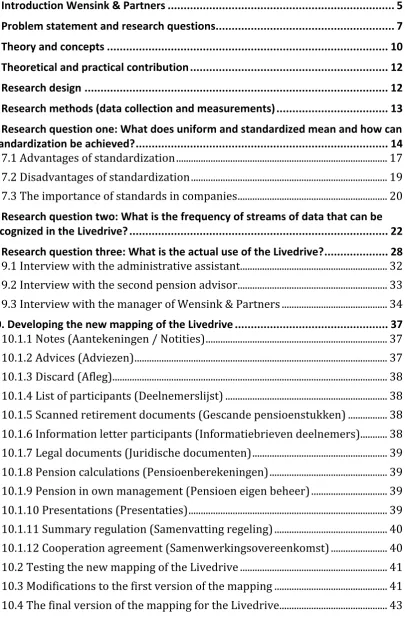
1. Introduction Wensink & Partners ... 5
2. Problem statement and research questions ... 7
3. Theory and concepts ... 10
4. Theoretical and practical contribution ... 12
5. Research design ... 12
6. Research methods (data collection and measurements) ... 13
7. Research question one: What does uniform and standardized mean and how can standardization be achieved? ... 14
7.1 Advantages of standardization ... 17
7.2 Disadvantages of standardization ... 19
7.3 The importance of standards in companies ... 20
8. Research question two: What is the frequency of streams of data that can be recognized in the Livedrive? ... 22
9. Research question three: What is the actual use of the Livedrive? ... 28
9.1 Interview with the administrative assistant ... 32
9.2 Interview with the second pension advisor ... 33
9.3 Interview with the manager of Wensink & Partners ... 34
10. Developing the new mapping of the Livedrive ... 37
10.1.1 Notes (Aantekeningen / Notities) ... 37
10.1.2 Advices (Adviezen) ... 37
10.1.3 Discard (Afleg) ... 38
10.1.4 List of participants (Deelnemerslijst) ... 38
10.1.5 Scanned retirement documents (Gescande pensioenstukken) ... 38
10.1.6 Information letter participants (Informatiebrieven deelnemers) ... 38
10.1.7 Legal documents (Juridische documenten) ... 39
10.1.8 Pension calculations (Pensioenberekeningen) ... 39
10.1.9 Pension in own management (Pensioen eigen beheer) ... 39
10.1.10 Presentations (Presentaties) ... 39
10.1.11 Summary regulation (Samenvatting regeling) ... 40
10.1.12 Cooperation agreement (Samenwerkingsovereenkomst) ... 40
10.2 Testing the new mapping of the Livedrive ... 41
10.3 Modifications to the first version of the mapping ... 41
10.4 The final version of the mapping for the Livedrive ... 43
[image:3.595.101.507.120.741.2]11. Robustness of the new mapping for the Livedrive ... 46
11.1 Major risks of standardization ... 46
12. Limitations and future research ... 48
13. Recommendations ... 49
13.1 Answering the main research question ... 50
Reverences ... 51
Appendix A: Interview with the manager of Wensink & Partners ... 54
Appendix C: Schematic administration task of Wensink & Partners ... 61
Appendix D: Folder analysis of five representative clients ... 62
Appendix E: Main folder analysis of all folders used in the Livedrive ... 63
Appendix F: Results of the subfolders placed in one table ... 65
Appendix G: Analysis of the usage of the Livedrive of the administrative assistant66 Appendix H: Analysis of the usage of the Livedrive of the second pension advisor 68 Appendix I: Analysis of the usage of the Livedrive of the manager ... 70
Appendix J: Interview with administrative assistant 02-‐03-‐2015 ... 71
Appendix K: Interview with the second pension adviser 03-‐03-‐2015 ... 76
Appendix L: Interview with the first pension adviser and manager Peter Wensink 05-‐03-‐2015 ... 80
Appendix M: First version of the design for the Livedrive ... 87
Appendix N: Handout with the new design (first version) ... 92
Appendix O: Instructions for the new design ... 93
Appendix P: Final version of the mapping for the Livedrive ... 104
Appendix Q: Final version of the new mapping of the Livedrive (hand-‐out version) ... 108
1. Introduction Wensink & Partners
This master thesis research will be performed at a relatively small company called Wensink & Partners. At the time this research started Wensink & Partners consisted out of four employees (not all FTE). This company is located in
Wierden, the Netherlands, and provides businesses and professionally interested people with advice and direction in financial decisions1. The company provides
financial advice in the pension services, financial planning and helps her customers with other financial or fiscal issues. The company was founded in 2001 and aimed their business during the start-‐up phase at the discontent that was present in the financial world. At that time, the business model of companies active in the financial market consisted out of getting provisions from insurers or mortgage lenders when financial products were purchased. This phenomenon is also known as commissions. Because of the commissions, most financial advisors advised their customers to buy a financial product such as a life insurance, a mortgage, term insurances or savings policy (appendix A, line 15-‐24). The founders of Wensink & Partners took a sceptical view at this business model; in their opinion this way of doing business was not objective and fair. Therefore the business model of Wensink & Partners was totally different. Customers of
Wensink & Partners pay for the advice that is obtained, even if no financial product is acquired. According to Wensink & Partners this business model assures an objective and fair advice. In 2001 this business model was seen as an extremely innovative breakthrough2. Nevertheless a problem aroused when
Wensink & Partners could not attract customers, since financial advice was free of charge at the competitors of Wensink & Partners, not many individuals were willing to pay for their financial advice. That is why the operations shifted to pension services, because in big contracts, where a company and not an individual is customer, clients were willing to pay for advice (appendix A, line 28-‐46).
In order to get a better view of the company the production process will be discussed below. The production process consists roughly out of two major tasks (advising and administration) and a view subtasks (appendix B and C). The first major task is advising; this task consists out of advising employers about a second pillar pension product (in Dutch: tweedepijler pensioenproduct) of an insurer. This falls under the scope of the Law on financial monitoring (in Dutch: Wet financieel toezicht) (‘Wft’) (AFM, 2009). According to the Dutch Authority Financial Markets (AFM) seventy-‐five percent of pension advices to medium and small enterprises were insufficient. That is the reason why the Dutch Authority Financial Markets published the “Leidraad tweedepijler pensioenadvisering” with guidelines for advising3. This is why employees of Wensink & Partners need
to follow certain steps in advising; these steps are (1) inventory, (2) analyse, (3) advise and (4) provide aftercare (appendix B). Following these steps will
enhance the advisory process. According to the Wft, following these steps also
1 http://www.wensinkvandaag.nl/wensink/ 2 http://www.wensinkvandaag.nl/wensink/ 3 http://www.afm.nl/professionals/afm-‐
contains that the advisory process is reproducible. The financial service provider has to be able to demonstrate that the steps were followed correctly; this implies that all relevant data that is gathered during the advising trajectory has to be stored and kept for at least ten years (AFM, 2009). The storing of this
information will be the main topic of this research.
The second major task of Wensink & Partners is administration. The purpose of this task is to pass and check the mutations, to subscribe and unsubscribe employees, answering questions from the employer, answering questions from the employees, keeping up with law and regulations and attending employers if regulations or laws change (appendix A, line 109-‐115; appendix C). The
production process thus roughly consists out of an advising and an
administrating task. The administration task is the largest because advising occurs only with the creation and/or modification of the regulation, while the administration occurs constantly. Next to the two abovementioned major tasks, a view subtasks are present. The subtasks within Wensink & Partners can vary from solving pension problems, divorces, value transfers, answering questions from the tax authorities or resolving a lack of clarity in relation to an insurer. These subtasks are also referred to as solving tasks and are not always related to pension problems.
2. Problem statement and research questions
In the abovementioned paragraph is described that the administration task can be seen as the most prominent task within Wensink & Partners. Performing this task implies a lot of correspondence and transferring of information between customers, Wensink & Partners and insurers. This will result in large streams of data between the abovementioned parties, all of which must be stored because of the legally required storage of data (AFM, 2009). These streams of data and the storage of those streams will be of great importance in this research.
More than two years ago, all e-‐mail correspondence was stored in Outlook accounts of the different employees and within Outlook several folders were created for each customer. Subject did not specify these folders; the
correspondence was only specified by the company name. As the
correspondence and the number of customers increased, the amount of e-‐mails increased simultaneously. The amount of e-‐mails inside the folders increased in some cases up to 1000 and that was without the sent mail (appendix A, line 190-‐ 196). When customers asked questions or needed some of the mailed
information, employees of Wensink & Partners had to search in a big pile of data; this task was obviously very time-‐consuming. This way of answering and helping customers was at that time seen as very inefficient and therefore Wensink & Partners acquired a CRM system two years ago, called BaseNet4. CRM stands for
‘customer relationship management’. The main reason to acquire this system was the option to increase the findability of the data. With BaseNet employees of Wensink & Partners are able to search on project, name, a point, a comma, a date or a time (appendix A, line 200-‐202). Wensink & Partners wants to be able to retrieve the required data on a quick and efficient way to enhance and accelerate the production process. Therefore the time consuming task of searching needs to be reduced or eliminated.
There are several ways to store and process the retrieved data, take for example online storage in a so-‐called ‘cloud’ or the ‘old-‐fashioned’ way of storing data hardcopy. Within Wensink & Partners three ways of storing are used; (1) in BaseNet, (2) in a Livedrive5 and (3) hardcopy files. As mentioned before, BaseNet
is a CRM system that organizes and stores all correspondence between Wensink & Partners, customers and insurers. The Livedrive is an external and online hard disk that transfers and stores data between the different computers used by the employees. Using the Livedrive also ensures a backup of all the stored files on the different computers. The third way of storing is in hardcopy files, these files are stored at the location of the company in Wierden. The hardcopy files are often also available on the Livedrive, but the hardcopy files are used to perform calculations and are used when Wensink & Partners visits customers because this way of performing business is often faster than searching for digitalized files according to the manager of Wensink & Partners. According to the manager of Wensink & Partners it could be an option to store all data on BaseNet and quit the Livedrive and hardcopy files, but this system is initially not intended for
storage and it would also increase the dependency (appendix A, line 210-‐213). Currently all correspondence is stored in BaseNet, but to decrease the
dependency, once in a while all correspondence data will be transferred to the Livedrive. As previously mentioned, BaseNet ensures that all correspondence data is stored and processed on a clear and correct way whereby employees are able to find the needed information quicker and more efficient. By purchasing this system employees spend less time searching in the files and can work more efficient. But BaseNet is not the main platform to store the data, so allot of the data is still not efficiently stored. So in short, BaseNet can be seen as a valuable investment because retrieving of stored e-‐mails can be performed with less effort. But this investment is not sufficient for all data that is stored at and by Wensink & Partners; therefore this research will be performed.
According to the manager of Wensink & Partners the Livedrive is the main platform to store the data of Wensink & Partners because of the safety of this system6. The data in the Livedrive has never been stored on a uniform way,
every employee has access to this platform and every employee stores data in their own way. For a long time this ‘problem’ was neglected, because Peter Wensink was the only pension adviser at Wensink & Partners. The manager was able to recall the needed information without searching for a long time, but through the new Wft and the permit requirement Wensink & Partners grew fast in a short period of time7. Next to the increase in customers also a new pension
adviser was added to the team in March 2014, and on that moment the problem was exposed (appendix A, line 61-‐67). How and where could the needed
information to provide answers to customers be found? In the current mapping of the Livedrive employees have to spend a lot of time to find the necessary data. Therefore the goal of this research is finding a uniform and standardised way of storing the back office data in the Livedrive so that all employees of Wensink & Partners are able to find the needed information efficiently. This leads to the following research question:
On which uniform and standardized way can the data of Wensink & Partners be processed and stored allowing an increase in findability that will result in an improved and less time-‐consuming process?
To answer this question, it is of great importance to know what the constructs uniform and standardized mean and to which extend it can be achieved within the company. Further, it is important to know which data needs to be stored more uniform and standardized. After analysing the current data streams a new model can be created to improve the findability of data for Wensink & Partners. This study is therefore aimed at providing Wensink & Partners with a new mapping for the Livedrive that will ensure that the findability of data will be increased. This storing and processing will be delineated to the options for the Livedrive in order to focus this research. The Livedrive is the preferred way of
6 http://www.livedrive.com/ForBusiness
7 http://www.afm.nl/nl/professionals/afm-‐voor/adviseurs-‐
storing data because of the safety of this system8. It is also necessary to define
the construct findability. Findability refers to the ability to deliver content and documents related to organizational processes (Harper, 2013, p. 5). Frappaolo
and Keldsen(2008, p. 4)state “findability is the art and science of making content
findable”. So to improve the findability of the data in the Livedrive, the content has to
be made findable.To support answering the main research question a view sub
questions are composed:
-‐ What does uniform and standardized mean and how can standardization be achieved?
-‐ What is the frequency of streams of data that can be recognized in the Livedrive?
-‐ What is the actual use of the Livedrive?
After answering all the questions an assessment of the potential possibilities will be given so that the manager of Wensink & Partners is able to make a reasoned decision. Also, a new mapping of the Livedrive will be provided to enable employees of Wensink & Partners to store data on the Livedrive on a uniform and standardized way. Next to this, also a list with recommendations will be given to the manager. Because of the focus on this company the generalizability of this research will be low, but this is explicitly chosen in order to be useful in practice for this specific company (Wensink & Partners). Despite the low generalizability, the findings of this research might be applicable to
organizations with the same kind of data streams, but that might be a topic for future research.
3. Theory and concepts
The last decennia globalization, individualization of customer needs and technological change increased the complexity companies have to face (Gepp, Steinmann, Vollmar, & Voigt, 2012, p. 1). According to (Ranganathan & Campbell, 2007, p. 38) complexity can be described as: “a measure of how understandable a system is and how difficult it is to perform tasks in the system.” Companies have to deal with this increasing complexity. Standardization is a tool to manage complexity (Gepp, Steinmann, Vollmar, & Voigt, 2012, p. 1). According to Alstyne et al. (1995, p. 276) complexity can be seen as a barrier for companies to
perform their business, but standards are able to decrease these barriers. Next to managing the complexity, companies want to improve their businesses and business process standardization is an often-‐discussed approach to increase and improve the performance of companies (Schäfermeyer, Rosenkranz, & Holten, 2012, p. 261); (Davenport, 2005, p. 102).
During the industrial revolution, standardization received increasing attention (Russel, 2005, p. 248). The term standardization is widely accepted and used but through the large and complex body of literature on standardization different meanings and synonyms are used (Gepp, Steinmann, Vollmar, & Voigt, 2012, p. 1). According to Gepp et al. (2012, p. 1) three research fields within
standardization can be distinguished. These fields are product standardization, process standardization and service standardization.
[image:10.595.92.487.417.715.2]
After 2000 the attention to process standardization has strongly increased in literature as can be seen in the abovementioned table (see table 1). Previously the attention was aimed at product standardization but the last decennia attention to process standardization increased rapidly (Gepp, Steinmann, Vollmar, & Voigt, 2012, p. 3); (see table 1). Despite the increasing attention to process standardization, there remains a lack of managerial implications. It is clear that standardization is of great and increasing importance, but it remains unclear how companies can achieve process standardization. Therefore, in this study, emphasis will be placed on the managerial implications of process standardization. This is also the reason why in this research emphasis is on the specific company Wensink & Partners that might lead to a problem with the generalizability.
There are several methods to increase process performance, thereof is
standardisation one option (Swaminathan, 2001, p. 130); (Lillrank, 2003, p. 215). Standardization brings several advantages. The general advantages that are recognized in literature are; increasing operative process performance, cost savings, increasing profit due to efficiency, transparency and controllability, quality improvements, cost degression, degreasing risks and a shorter time-‐to-‐ market (Schäfermeyer, Rosenkranz, & Holten, 2012, p. 261); (Wüllenweber, Beimborn, Weitzel , & König, 2008, p. 213). These advantages will be extensively discussed in this paper. Due to these obvious advantages, companies increasingly seek to achieve operational excellence by standardising processes (Davenport, 2005, p. 103). In order to be able to discuss standardisation extensively other possible options to increase process performance will not be discussed.
Next to the standardization of the process, ownership of the data that needs to be processed seems to be an important factor as well. Alstyne et al. (1995, p. 268) indicate that ownership of the data is an important factor to assure the quality of the data. Therefore ownership of data will be taken into account when a new design will be developed. Alstyne et al. (1995, p. 274) states that systems perform badly if the group that is responsible for the local operations does not own the data it uses. If local groups own the data they use, it would motivate them to populate the database with more accurate and timely data (Alstyne, Brynjolfsson, & Madnick, 1995, p. 274). So ownership of the data will be of great importance when developing a new process design for Wensink & Partners. And because of the features of the Livedrive this important factor can be achieved.
4. Theoretical and practical contribution
So with this research a practical contribution will be given in the form of a uniform and standardized working method for Wensink & Partners. After this research Wensink & Partners should be able to work more efficient with the new provided mapping of the Livedrive. This study is aimed at improving the
efficiency of the work process of Wensink & Partners by delivering a uniform and standardized working process. The theoretical contribution of this research can be found in the fact that after this research managerial implications can be given. In literature, process standardisation receives increasing attention, but there is a lack of managerial implications and actions for managers. Therefore this study might be a contribution to increase the attention to managerial implications.
5. Research design
Because this study will deliver a new way of processing data, in the form of a new mapping for the Livedrive, this study is called a design study. A common disadvantage of a design study is the fact that researchers are not able to test if the new design is working properly. In order to cope with this problem, the first version of the new mapping for the Livedrive will be thoroughly tested by the different employees on different customers. By testing the usability of the new design, Wensink & Partners should be able to find applicable mapping for the Livedrive that is suitable for this company and the demand that is requested by customers and employees of Wensink & Partners. Babbie (2007) distinguished four types of research designs; the experiment, a longitudinal study, a cross-‐ sectional study and a case study. In this research the last two mentioned
research designs (cross-‐sectional and case study) will be used. A cross-‐sectional research design consists out of observing a sample, a cross section, a population or a phenomenon on a certain moment in time (Babbie, 2007, p. 106). This research design will be used to analyse different ways to store data that are mentioned in literature. The second research design that will be used in this study is a case study. A case study is a study where emphasis is on a single event of a social phenomenon, for example an organization (Babbie, 2007, p. 309). This study will be used to analyse the current work process of Wensink & Partners. This is of great importance for creating a uniform and standardised work design. To achieve this, the administration task of Wensink & Partners will be analysed. The unit of analysis is in this case the company Wensink & Partners. Because of the relatively small organization hundred percent of the company staff can be included in this research. By interviewing all employees of Wensink & Partners the reliability of this research will be increased. As mentioned below, several methods will be used to gather the data needed for this research.
6. Research methods (data collection and measurements)
According to Babbie (2007, p. 115) every research method has strong and weak points, and certain concepts are more suitable for certain methods. That is why in this research more research methods will be used; a combination of research methods is capable of reducing the weaknesses of the different methods.
According to Babbie (2007, p. 116) the best research design consists out of multiple research methods. First, this research will use interviews at Wensink & Partners. Because of the relatively small organization it will be an option to interview every single employee of this company. The interviews will be
recorded and documented so it can be used in this research. The interviews can be seen as a qualitative field research (Babbie, 2007, p. 318). The disadvantage of interviews is that is gives a snapshot of a certain moment, which is why this research will use multiple in-‐depth interviews to reduce this disadvantage. Further, a quantitative survey will be given to the employees of Wensink & Partners to find out what questions are asked by customers, which of the data is need to answer these questions and where that specific data can be found. Following this method it becomes clear what data is often needed and what data is less important. This quantitative research will gather this data for two weeks. The data that is used most frequently will be obtained easier in the new design. Next to the gathering of data, observations are also of great importance in this research. The greatest advantage of performing a field research is the ability to perform observations (Babbie, 2007, p. 324). While performing the research I will be able to observe the daily activities at Wensink & Partners. According to Babbie (The Practice of Social Research, 2007, p. 324) it is vital to make full and accurate notes when interviews or observations are performed. So in order to be able to observe correctly and efficiently all observations will be documented.
After all the data gathering a first version of the new mapping for the Livedrive will be produced. This first version will be tested with several customer folders and discussed by all employees of Wensink & Partners. By performing this testing and analysing period, this design study is able to analyse if the new mapping will work for Wensink & Partners. After the testing period and all the analyses from the employees and the manager, a final version of the mapping will be provided. The following steps will be performed to get the final result:
• Problem statement • Analysis of the problem
• Designing the first version to solve the problem • Discuss and analyse the first version
• Modification of the first version • Final version
7. Research question one: What does uniform and
standardized mean and how can standardization be
achieved?
According to Michelberger, Mutschler and Reichert (2012, p. 260) enterprises have to face a continuously increasing amount of data. At Wensink & Partners, employees also have to cope with this increasing amount of data (appendix J, K and L). The increasing amount of data makes it difficult for employees to identify and access the needed information to perform the tasks (Michelberger,
Mutschler, & Reichert, A Context Framework for Process-‐oriented Information Logistics, 2012, p. 260). The information that is needed for performing business tasks is called “process information” and is described as the information that supports process participants when working on business processes
(Michelberger, Mutschler, & Reichert, A Context Framework for Process-‐oriented Information Logistics, 2012, p. 260). The problem that occurs is that the process information is handled separately from the business process. This is also the case for Wensink & Partners; the process information that is stored on the Livedrive is an important supporting factor for performing business tasks. However, the Livedrive is not directly coupled with the business tasks and is in addition also used by all the employees of Wensink & Partners. This makes it even harder to support the business tasks with the process information. Standardization might be helpful to solve this problem with the process information (Gepp, Steinmann, Vollmar, & Voigt, 2012, p. 1); (Hjelm & Long, Standards, Strategy and Wireless Network Planning , 2001, p. 50).
In order to improve the process of Wensink & Partners with standardization, it is important to know what standardization is. Therefore, in this chapter,
standardization will be discussed; what definitions are mentioned, what advantages and benefits are discussed in literature, what disadvantages and drawbacks are discussed in literature.
First the definitions mentioned in literature will be discussed in order to get a better understanding of the construct standardization. Standardization in general receives increasing attention literature (Gepp, Steinmann, Vollmar, & Voigt, 2012, p. 1); (see table 1). This will ensure that the relevance of this research will be high. Ass mentioned in the introduction, the large body of literature on standardization is leading to different meanings in literature and current language. It is therefore of great importance to have a clear
understanding of this construct, it also has to be clear to Wensink & Partners what standardization actually is to avoid misunderstandings and to match the expectations.
Because of the large amount of definitions used in literature, a short summary of the definitions will be given below. Standardization is described by (EN, 2007, p. 35) as follows:
“Activity of establishing, with regard to actual or potential problems, provisions for common and repeated use, aimed at the achievement of the optimum degree of order in a given context”. It improves “the suitability of products, processes and services for their intended purposes, prevention of barriers to trade and facilitation of technological cooperation”. The object of standardization can be a product, a process or a service.
It is important to note that in the abovementioned definition ‘repeated use’ is mentioned. Wensink & Partners is searching for a method that enables them to increase the findability of data and thereby increasing the efficiency of the employees. Repeated use refers to this way of working. Another definition that can be found in literature, is described as follows by Münstermann, Eckhardt & Weitzel (2010, p. 31):
“Standards are documents, established by consensus and approved by a recognized body that provides, for common and repeated use, rules, guidelines or characteristics for activities or their results, aimed at the achievement of the optimum degree of order in a given context.”
Münstermann, Eckhardt & Weitzel (2010, p. 31) also mention repeated use. Next to the repeated use, rules and guidelines are needed to achieve standards.
Another definition that can be found in literature is:
“Standardization refers to the consistent use of methodologies, procedures, tools, and techniques specified above the level of individual projects.”
Leung (2001, p. 29) mentions the word ‘consistent use’ that can be compared with ‘repeated use’ used by (EN, 2007, p. 35) and (Münstermann, Eckhardt, & Weitzel, 2010, p. 31); this also ensures that the data that is stored in the Livedrive is stored consistent in order to be able to retrieve the stored data efficiently. Next to the abovementioned definitions Hjelm & Long (2001, p. 54) give the main objective of standardization:
“The main objective of standardization is to ensure that products can be connected and that services are interoperable”.
So it can be concluded that standardization refers to a consistent and repeated use of activities that support the business process of products, processes or services and is achieved by rules and guidelines. This also answers the second part of this research question. The question: “How can standardization be achieved?” This question is answered in the article of Münstermann, Eckhardt & Weitzel (2010, p. 31) and is supported by the other articles. A standard
Nevertheless, it is important to note that standardization requires substantial standardization efforts; these efforts take place in the form of time, money and other resources. It is important to note this to the employees of Wensink & Partners. In order to achieve successful standardization efforts need to be made.
Moreover, it is important to note that according to Gepp, Steinmann, Vollmar & Voigt (2012, p. 1), standardization research can be divided in three
subcategories. The mentioned categories are; product standardization, process standardization and finally service standardization, these subcategories are also mentioned in definitions of standardization. Product standardization is the process of setting uniform characteristics for a particular good so that the product can be produced in large quantities leading to economies of scale, process standardization will be discussed below and for service standardization is difficult because of the intangibility and perishability of services, therefore the authors refer to the financial service market because they are a pioneer in service standardization (Gepp, Steinmann, Vollmar, & Voigt, 2012, pp. 1-‐2). In this research emphasis will be placed on process standardization and as
described in the introduction increasing attention is provided to this topic (see table 1).
Process standardization is described as follows:
“The unification of business processes and the underlying actions within an organization in order to “facilitate communications about how the business operates, to enable handoffs across process boundaries in terms of
information, and to improve collaboration and develop comparative measures of process performance” (Gepp, Steinmann, Vollmar, & Voigt, 2012, p. 2)
The objective of process standardization is to specify transparent and uniform process activities across the organization or value chain and across firm boundaries (Wüllenweber, Beimborn, Weitzel , & König, 2008, p. 213). The intention is to create a time-‐, cost-‐, and quality-‐optimal way of achieving the business process’ goal 926 (Muenstermann, Von Stetten, Laumer, & Exkhardt, 2010, p. 926). This is also what Wensink & Partners wants as described by the manager of the company in appendix (A).
Another definition of process standardization will be mentioned below:
“Process standardization is the unification of variants of a given business process performance (Muenstermann, Von Stetten, Laumer, & Exkhardt, 2010, p. 926).”
Schäfenmeyer and Rosenkranz (2011, p. 5) combined the two-‐abovementioned definitions and that resulted in the following definition:
“Process standardization is the unification of variants of a given business process by aligning the variants against an archetype process that results in transparent and uniform process activities specified in standard operating procedures which are obligatory to all actors in an organization in order to create a time-‐, cost-‐ and quality optimal way of achieving the business process’ goal.”
So it can be concluded that process standardization assists in a transparent and uniform process of activities in order to create a time-‐, cost-‐ and quality optimal way of achieving the business process’ goal. This is also exactly what Wensink & Partners is looking for (appendix A, line 206 – 214). Next to this definition Gepp, Steinmann, Vollmar & Voigt (2012, p. 3) add the focus of process
standardization:
“Process standardization is focussed on realizing a uniform and transparent process landscape”
It is important to note that according to Gepp, Steinmann Vollmar and Voight (2012, p. 3) two forms of process standardization can be described. The forms are intra-‐company, were standardization is preformed within an organisation, and inter-‐company were standardization is performed across companies. In this study only the intra-‐company form of process standardization will be discussed because the Livedrive is part of this specific organisation, and there will be no direct alignment with other organisations.
7.1 Advantages of standardization
In order to be able to recommend standardization to Wensink & Partners it is of great importance to know what the benefits and drawbacks of standardization are. In this chapter the benefits will be discussed and the chapter below will discuss the drawbacks. In literature allot of benefits of standardization are mentioned; a short summary of those benefits will be given below.
When all selected articles are compared, some “main” benefits can be found. These often-‐mentioned benefits are; increased business performance, costs savings, increasing profits, transparency and controllability, quality
improvements and decreasing risks. First of all the process performance of companies can be increased by using standardization (Anupindi, Chopra, Deshmukh, Van Mieghem, & Zemel, 2006) (Münstermann, Eckhardt, & Weitzel, 2010) (Schäfenmeyer & Rosenkranz, 2011, p. 2). Companies often seek for ways to improve their process performance and standardization is an often-‐discussed option to achieve this. According to Schäfermeyer, Rosenkranz & Roland Holand (2012, p. 261) business process performance is often increased by business process standardization.
The business process performance can be increased through adding standards that remove operator discretion, ambiguity and opportunities for making
mistakes (Anupindi, Chopra, Deshmukh, Van Mieghem, & Zemel, 2006, p. 274). It is important to note that most benefits relate to each other.
Another benefit that can be achieved by standardization is a decrease in costs. According to (Hjelm & Long, 2001, p. 54) standardization reduces development costs and leads to economies of scale. In addition, standardization is a common approach in industry to achieve cost-‐savings and a shorter time-‐to-‐market (Gepp, Steinmann, Vollmar, & Voigt, 2012, p. 3) (Avansino , Goldin, Risley , Waldhausen , & Sawin, 2013, p. 1845) (Canales, 2014, p. 1) (Muenstermann, Von Stetten, Laumer, & Exkhardt, 2010) (Wüllenweber, Beimborn, Weitzel , & König, 2008). Standardization may lead to a decrease in flow times, lower inventories and higher throughput (Anupindi, Chopra, Deshmukh, Van Mieghem, & Zemel, 2006, p. 276). These benefits will result in a decrease in costs. Economies of scale are an important factor that enables cost-‐savings. With standardization
organizations are able to produce relatively more with less costs. In addition, standardization leads to a less complex exchange of goods and services between business units as well as external customers, suppliers and partners. So that through the increased process efficiency reduction of transaction costs can be achieved (Muenstermann & Weitzel, 2008). So, after this study Wensink & Partners should be able to reduce the costs through a higher efficiency.
This efficiency will also lead to an increase in profits. This benefit is closely related to the cost savings advantage. Standardization will ensure that the right process information in the right format and quality will be delivered to the right person (Michelberger, Mutschler, & Reichert, 2012, p. 260). And that will enable employees of Wensink & Partners to work more efficiently, and that will lead to a possible increase in profits. Next to the abovementioned advantages,
standardization also increases the transparency and controllability of the process by decreasing complexity (Wüllenweber, Beimborn, Weitzel , & König, 2008). This will enable employees to improve quality and decrease risks
(Münstermann, Eckhardt, & Weitzel, 2010) (Gepp, Steinmann, Vollmar, & Voigt, 2012). These advantages may also lead to cost savings and eventually in
increased profits.
Finally it is important to note that according to Canales (2014, p. 1)
organizations are not able to work without a set of rules. Rules are the formal representation of organizational routines and store knowledge and capabilities of the organization (Canales, 2014, p. 2). These rules can be maintained by standardization and therefore Wensink & Partners would benefit if the back office process will be standardized. This will be discussed in detail after the disadvantages of standardization.
7.2 Disadvantages of standardization
Although it seems that standardization only delivers benefits, also drawbacks of standardization are mentioned. The drawbacks of standardization might be even more important to mention than the benefits. The disadvantages of
standardization should be limited in order to benefit from the advantages of standardization. So in order to achieve the abovementioned benefits, the drawbacks need to be excluded or limited.
First of all it is important to note that standardization of processes is not effortless. In order to achieve standardization resources like time, money and employees need to be available. A problem occurs when these resources are limited (Schäfermeyer, Rosenkranz, & Holten, 2012, p. 2). Standardization is a costly, time-‐consuming and energy-‐consuming process that should not be underestimated. It is important to note that standardization will require a change in behaviour of the employees, and that will lead to resistance. This problem needs to be mentioned to the manager of Wensink & Partners so he is able to cope with this problem.
Another important and often mentioned problem with standards is the fact that standards are often not developed in a monolithic approach, but rather
independently and by different groups (Kosanke & De Meer, 2001, p. 56). When this occurs, the benefits of standardization will strongly decrease. In this study the standardization process will not be performed independently because this paper will be the first step to standardization. After this paper, a consultation will be organized to achieve the sought standardization. By performing
standardization on this way, the abovementioned drawback will be neglected.
As mentioned before, setting rules is crucial for an organization (Canales, 2014, p. 2). New rules often entail assumptions and those assumptions might limit the benefits of the process standardization. Canales (2014, p. 3) states that it is crucial to use the correct assumptions, because a fault assumption might result in counterproductive and unfair result. To eliminate this drawback, a thorough analysis of the Livedrive and work process will be made to ensure the
assumptions that are made are correct.
Finally, Hammer and Stanton (1999, p. 114) mention that a choice between standardization and diversification has to be made. Diversification allows organizations to serve different kind of customers and standardization may decrease that ability. However, because the Livedrive of Wensink & Partners is a back office storing system, the ability to serve different kind of customers will not be obstructed. Thereby this drawback will be applicable for Wensink & Partners.
7.3 The importance of standards in companies
After giving the benefits and drawbacks of standardization it is important to mention why standards are important. In this chapter the importance of standards in organization will be mentioned.
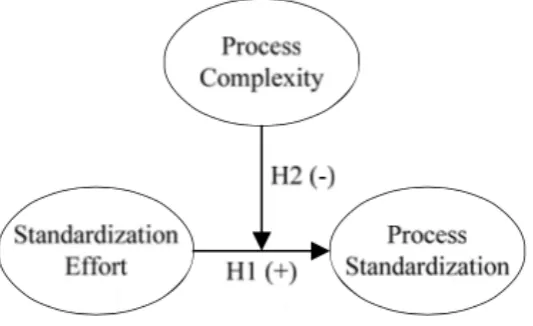
According to Kosanke & Meer (2001, p. 56) companies are becoming more complex systems where the importance of information, data and knowledge is increasing strongly. This is also the case for Wensink & Partners; the data that is stored and used in the Livedrive is of great importance for the company. Next to the importance of the data, the bulk of data causes growing complexity. And this complexity causes problems as mentioned in the introduction. According to Gepp, Steinmann, Vollmar and Voight (2012, p. 3) standardization is a common approach in industry to manage complexity. This is supported by (Schäfenmeyer & Rosenkranz, 2011, p. 3) according to these authors, process complexity has a moderating role on the relation between standardization effort and process standardization, and therefore has effect on the standardization effect.
Figure 1: Schafermeyer and Rosenkranz (2011, p. 4)
In order to improve the process standardization the complexity of the Livedrive has to be decreased. By decreasing this complexity, the standardization effort then no longer needs to be so big. Therefore this study is aimed at providing a standard mapping of the Livedrive and thereby decrease the complexity.
[image:20.595.107.374.322.485.2]