
Citizens' perceptions of governmental responsibilities
43
0
0
Full text
(2) Abstract Since 2015, a shift in the division of governmental responsibilities has taken place in the social care domain in the Netherlands. In this decentralization process, several tasks have been delegated from the national government to the municipalities. This paper aims to analyze and explain the correctness of the perceptions of citizens, in regards to the division of responsibilities among the three main layers of government, as identified in the 2018 “Lokaal Kiezersonderzoek” survey. This data set consists of 2643 cases, for which a multiple regression analysis is used to determine the hypotheses. The main research question of this paper is: „To which extent are citizens‘ perceptions of the responsibilities of the various layers of government correct, and which factors explain the level of correctness?“ Furthermore, the focus in this paper will be put on the social care domain, because of the aforementioned shift in governmental responsibilities. It is therefore interesting to find out if the correctness of citizens‘ perceptions of the division of governmental responsibilities in the social care domain has shifted from 2016 to 2018, and if so, which factors can explain this shift. Ultimately, a very limited effect has been found on the mainly incorrect perceptions Dutch citizens hold. Keywords: decentralization, perceptions, the Netherlands, local politics. 2.
(3) Table of Contents 1. 2. 3. 4. 5. 6.. Introduction……………………………………………………………………... 4 Theory……………………………………………………………………………. 5 Operationalization………………………………………………………………. 11 Results……………………………………………………………………………. 18 Conclusion……………………………………………………………………….. 39 Literature………………………………………………………………………... 42. 3.
(4) 1. Introduction In this research paper, I want to address the extent to which citizens‘ perceptions of the division of responsibilities of the various layers of government are correct, and which factors explain this level of correctness. Since 2015, various tasks in the social care domain have been shifted, from the national government to the municipality, in a decentralization process in the Netherlands. Through of this decentralization process, the Dutch municipalities have become responsible for providing certain tasks, which formerly belonged to the national government, such as providing for youth care, employment and income, and providing care for the long-lasting sick and the elderly. Besides this shift of responsibilities in the social care domain, a shift has taken place in the decision-making process itself. Citizens in the Netherlands, and in the other parts of Western Europe, have substantially increased their influence in the decision-making process (Michels & De Graaf, 2010). This can be seen in the increasing amount of local initiatives and participatory projects, which are manifestations of citizen involvement (Jansen, et al., 2018), representing the shift to citizen participation in both civic and political contexts, which relates to a general trend of decentralization, manifested in the social domain in the Netherlands. Furthermore, the amount of actors in the policy process have grown, while „governments notice citizens‘ increasingly critical and even disaffected attitude towards government and its performance (Van de Wijdeven & Geurtz, 2010); (Putnam, 2000).“ Combining this apparent shift to a ‘disaffected attitude’ with the changing division of responsibilities in the social care domain, the result could possibly be a knowledge gap between the layer of government that is held accountable by citizens, and the layer of government that actually is accountable. While the responsibilities of the different layers of government have shifted in the last years to a more decentralized system, it is yet unclear if the citizens who, some more often than others, have to deal with the governmental institutions, know what these institutions are actually responsible for. Explaining why citizens know which institution or layer of government is responsible for what specific task is key in understanding citizens‘ behavior and possible dissatisfaction with the government. Especially in the Netherlands, where citizens‘ trust in the government is relatively low, in particular the trust in societal and political institutions (Dekker, van der Meer, Schyns, & Steenvoorden, 2008). How do citizens look towards the various institutions and layers of government, which layer of government is responsible for what domain, are the perceptions of the citizens adequate, and which factors explain the reasons why their perception of whom is responsible is adequate? In which ways do these perceptions of responsibilities come about? Such questions have not been dealt with in the past, at least not extensively in the social care domain in the Netherlands. Therefore, these questions will be investigated in this research and a better understanding of these particular questions will be achieved through this paper. The research question is „To which extent are citizens‘ perceptions of the responsibilities of the various layers of government correct, and which factors explain the level of correctness?“ The research question will be answered by shaping the theory on the research topic. Secondly, this theory provides the underpinnings for the hypotheses, and these will be tested in the multiple regression analysis. Third, through testing these hypotheses, possible correlations between factors and the correctness of perceptions will be identified, so that the relationship between the various factors and the ‚correctness‘ variable can be correctly predicted. Fourth, conclusions will be established and the research questions will be answered. 4.
(5) 2. Theory In order for citizens to know which layer of government is responsible for which task, they need to have the correct knowledge on this issue. Perception, as a concept, can be considered to be a source of knowledge, which thus is a key part of perception (Rock, 1985). The more and better knowledge a certain individual has, the better he will be able to correctly perceive the division of governmental responsibilities. Therefore, the main focus in the theory section will be on the ways to achieve more and better knowledge about the division of governmental responsibilities. Building on the existing literature regarding the phenomenon of knowledge, and exploring a number of ways to achieve more and better knowledge, several hypothetical relationships can be theoretically underpinned. Firstly, the theory on knowledge and the different ways to achieve knowledge will be explored. Then, hypotheses will come forth from the theory. These hypotheses will then be tested through a regression analysis and they will either be accepted or rejected. Since the focus of this study is the correctness of citizens‘ perceptions, the dependent variable of this research is the correctness of citizens‘ perceptions of governmental responsibilities. The underlying question is if citizens are able to correctly state which layer of government is responsible for what domain. This question is particularly important, because not knowing which layer of government is responsible for what domain leads to an issue of accountability. Citizens would, in such a case, not be able to make the correct decisions and to shape realistic expectations, because they hold the wrong layers of government accountable for the performances in a particular domain. Thus, tensions can rise between the citizens and a particular layer of government. For example, tensions have recently been growing between citizens and the municipality in the asylum domain, with one of the notorious examples in the Netherlands being the riots in Geldermalsen, where locals were „throwing fireworks to the boardroom“ of the municipality (NRC Handelsblad, 2015). The inhabitants of this municipality started rioting, because the municipality of Geldermalsen wanted to allocate an azc (asylum centrum) to approximately 1.500 people, in a town of 11.000 inhabitants. While the council of the municipality, including the mayor, have received several threats from the inhabitants, the municipality itself is not responsible for determining the amount of asylum seekers that can apply for asylum. Therefore, it might be possible that the local citizens have held the wrong layer of government accountable. This is why it is of great importance to investigate the possible lacking correctness of citizens‘ perceptions of the responsibility of the layers of government. Before the explanations behind the accountability issue can be explored, it must be first determined if the citizens of the Netherlands hold the right layer of government accountable for the various domains. If it is determined in the analysis, for example, that the citizens of the Netherlands do actually hold the right layer of government accountable, then the significance of the other questions, dealing with the causes of possible incorrect perceptions, has become irrelevant. Therefore, the first subquestion is „To which extent citizens have a correct perception of the division of responsibilities?“. This first subquestion deals with the adequacy of citizens‘ perceptions. It is expected that citizens do not have the correct perceptions of the division of responsibilities among the various layers of government, since that would mean citizens are perfectly informed, which would certainly be a rare occasion.. 5.
(6) Besides the question of the extent in which the perceptions of citizens are correct, the aim of this paper is to find out what factors explains this correctness of the perceptions of Dutch citizens. Discovering some of the explanatory factors behind the correctness of citizens‘ perceptions can help shape future governmental policies, in order for them to be more effective than they are at the moment. If it turns out that, for example, that a Dutch citizen who reads more newspapers is more likely to have the correct perceptions of the division of governmental responsibilities, then governmental policies could be shaped to address the part of the Dutch citizens that do not read newspapers. Therefore, the second subquestion is concerned with explaining the correctness of citizens‘ perceptions by testing three independent variables to the dependent variable. The correctness of perceptions relates to the knowledge people have, since the better and more correct the knowledge, the better the perceptions of the citizens are. The three independent variables are all related to the concept of knowledge, and thus three ways to gain knowledge, which are part of the aforementioned survey, can be distinguished. First, one way through which citizens can gain or improve their knowledge, is through reading. If reading is indeed a source of knowledge, it is expected that reading increases knowledge, and thus improves the correctness of perceptions of the citizens. In the context of this survey, reading specifically refers to reading newspapers. However, reading can be considered to be a general source of knowledge, since newspapers are not the only thing which can be read. The relationship between reading newspapers (the type of newspaper and if they read about local problems) and the correctness of citizens‘ perceptions of governmental responsibilities is expected to positive, since one can assume that newspapers provide its readers of the knowledge about the current circumstances and developments in the Netherlands and in the world. That is the reason why people read newspapers, and why they are called „newspapers“. Therefore, there is at least a difference in the correctness of perceptions expected regarding the amount of newspaper that is read. Van Woudenberg argues that reading „isn’t coextensive with attending to testimony, nor with just seeing words and sentences“ (van Woudenberg, 2018). It means that it is neither of both, but another way of achieving knowledge in general. The Dutch newspapers have reported extensively on the decentralization in the social care domain. These include large newspapers such as the Volkskrant, NRC Handelsblad, Het Parool, De Telegraaf, AD, and so on. Readers of these newspapers have probably once or more read articles about the decentralization process in the social care domain. Thus, these readers are expected to have more and better knowledge about the decentralization process, and thus they are expected to have more correct perceptions of the division of governmental responsibilities. However, the knowledge a citizen receives from reading a newspaper also depends on the manner in which he reads a newspaper. The knowledge and perceptions that readers achieve from reading newspapers, can come in two ways, through the transmissive and generative function of newspapers. Transmission faculties, as defined (Sosa, 1991) are those that lead from beliefs to beliefs, which means a particular newspaper is spreading a belief or an interpretation in order for its readers to consider this belief or interpretation, while the latter, generation faculties, are those that lead to beliefs but not from beliefs, which means that a particular newspaper can just state coldhearted facts, which generates beliefs in the reader. For example, by reading about the government wanting to improve the correctness of citizens‘ perceptions, the belief that a wrong perception is something to be combatted, is transmitted to the reader. However, 6.
(7) a newspaper could also publish statistics on citizens‘ perceptions, showing that too many citizens have a wrong idea about the division of governmental responsibilities. Without establishing a judgment by themselves, the reader can however generate a judgment or belief about this statistic. Therefore, reading is both a transmissive and a generative source of knowledge. However, this poses also a problem. If newspapers want their readers to have the correct perceptions of the division of responsibilities among the various layers of government, then that is not always possible, since newspapers cannot fully influence the generative source that they are responsible for. Therefore, it is interesting to find out if reading newspapers influences the correctness of perceptions of the Dutch citizens, or that the generative faculty of newspapers contributes to readers generating the wrong perceptions. If the latter were to be true, reading newspapers would lead to less correct perceptions of the division of governmental responsibilities, instead of more correct perceptions. While reading is a distinct source, however, it is not considered to be a unique source of achieving knowledge. Information that is displayed in newspapers, could also have been spread through television programme’s, for example, or it could have been spread by telling other citizens about the current developments. Nevertheless, newspapers still collect and present knowledge, so that it is more easily accessible for the readers. However, according to Van Woudenberg, in some instances reading is a unique source, but that depends „on the sort of text that the words one is reading belong to“. Thus, he argues that reading is „both transmissive and generative, non-basic, once not essential, but currently essential for many people, and sometimes unique“ (van Woudenberg, 2018). Only using the variable ‚reading newspapers‘ might seem like a limitation, as there are many other ways in which people can gain knowledge through reading other than newspapers, such as watching television, or engaging in discussions, but these other ways were not included in the surveys. These are ways of achieving knowledge such as talking about politics or governance. Thus, reading is the first way in which people can gain knowledge which has been identified. Considering the theorized effect of reading newspapers, it is hypothesized that reading newspapers will have a positive effect on the correctness of citizens‘ perceptions of the division of governmental responsibilities. Hypothesis 1: Reading newspapers does improve the correctness of citizens‘ perceptions of the division of governmental responsibilities. The second way through which people can gain knowledge is through gaining experience. The more experience people generally have, the better they are able to rely on themselves and to know which decisions have led to success in the past. People who have more experience with the social domain, since they are employed in this field, or since they are regularly in contact with certain persons or organizations within the social care domain, will be better able to perceive the division of responsibilities in this domain correctly, than someone who has never been in contact with the social care domain. Consequently, the benefits of experience are also relatable to engaging in citizen initiatives. If one has participated in a (local) citizen initiative, they have shown their willingness to cooperate with their neighbors. Furthermore, it signifies their involvement in local governance and decision-making. Moreover, they have gathered experience from participating, which increases their knowledge about, in the 7.
(8) instance of local citizen initiatives, local politics. Therefore, it is hypothesized that citizen participation has a positive effect on the correctness of citizens‘ perceptions of the division of governmental responsibilities. Engagement in local citizen initiatives is expected to affect the correctness of perceptions of the division of governmental responsibilities, because participation gives citizens an increased (sense of) responsibility, a greater sense of unity and cooperation with people within their local community. Moreover it is said to improve the citizen’s civic skills. This in turn increases the legitimacy of the decision-making process (Michels & De Graaf, 2010). Furthermore, since citizens‘ voices are more often heard by the government (Putnam, 2000), they would probably know better who is responsible for which domain, since voicing ones opinion about issues can only effectively be done in when it is voiced to the particular government that is responsible for a particular domain. Engagement in (local) citizen initiatives is one of three ways of local engagement, the other ones being voting and participating in physical or online local politics (Jansen, et al., 2018). However, engaging in a citizen initiative is not the most popular form of local engagement. Eight percent of Dutch citizens have been active in a citizen initiative in the past five years (Jansen, et al., 2018). This means that participation in local initiatives is just one indicator of local engagement, but it is still interesting to find out if engagement in a local initiative has an influence on the correctness of citizens‘ perceptions of governmental responsibilities. Engagement in citizen initiatives is a more recent phenomenon than voting in local elections, which it why engagement in citizen initiatives is included as a independent variable. Since engaging in citizen initiatives is a way to achieve more and better knowledge about the division of responsibilities, it is expected that active engagement in local citizen initiatives projects in this context increases the correctness of citizens‘ perceptions of governmental responsibilities. Considering the dataset the information will be drawn from, this participation relates to respondents engaging in citizen initiatives in the past five years. Hypothesis 2: Engaging in citizen initiative will improve the correctness of citizens‘ perceptions Thirdly, another way through which knowledge can be gained is by attending or having attended education. The purpose of education is to bring knowledge from the teacher to the student. This knowledge can range from cold-hearted facts to controversial interpretations and abstractions. Nevertheless, if someone attends a certain level of education, this person is expected to have gained knowledge about certain topics in this period, compared to the person who does not attend education. Although the person who does not attend education can increase his knowledge via other means, this would probably not be that relevant to make the effect of education on the knowledge of an individual insignificant. Thus, it is hypothesized that the higher the level of education a person has attended, the better they are able to know how the responsibilities are delegated among the various layers of government and therefore they are able to make better estimations of the division of responsibilities, which will make their expectations more realistic. The purpose of education is „to develop the capacity to act and judge within the space of reasons“ (Hinchliffe, 2017), while others consider the purpose of education to „cultivate certain attributes of mind (effective thinking, communication, ethical judgment“ (Hinchliffe, 2017). There are also more pragmatic defined purposes of education, such as education being meant „to graduate good citizens who have the necessary skills demanded in the marketplace and the capacity to enjoy contemporary society“ 8.
(9) (Campbell, 2008). If one considers the purpose of education to be to develop skills of the mind, or to fit in the marketplace, either way it is expected that one’s perceptions of governmental responsibilities would improve. For improving skills of the mind means to better understand the world. In the latter defined purpose of education. aiming for fitting in the marketplace might not necessarily improve a citizen‘s correctness of perceptions of governmental responsibilities, but it nevertheless improves a citizen‘s skills in order to fit into the marketplace. Moreover, to fit into the marketplace, one needs to have the correct knowledge about the marketplace and about who is responsible for what domain, which will lead to an increased correctness of perceptions of the division of governmental responsibilities. The level of education is expected to have a positive effect on the correctness of citizens‘ perceptions. The higher the level of education, the better the chance he or she has a position high up in government and business, thus the more likely his or her perceptions of the division of responsibilities are correct. Moreover, in order to get a position high up in society, it usually requires years of education for it to be possible. Someone who only finished his primary education will probably never be able receive high-ranked positions in the government. Generally spoken, of course, since there are always outliers. Generally, it is expected that a higher level of education is positively influencing the general knowledge of individual citizens, and it will thus positively influence their correctness of perceptions of the division of governmental responsibilities. Hypothesis 3: The higher the level of education, the better the correctness of citizens‘ perceptions. As of January 1st, 2015, the WMO (Social Support Act), Jeugdzorg (Youth Care) and the Participatiewet (Participation Act) have been decentralized. Whereas the national government used to be responsible for „youth care, employment and income, and taking care of the longlasting sick and elderly (Pommer & Boelhouwer, 2016), these tasks have now been delegated to the municipalities, the local level. Reasons driving this decentralization process vary from adjusting policy to „local priorities and policy preferences“ (Boogers & Voerman, 2010); (Costa-Font & Greer, 2013) to implement a cut in governmental spending, which will result in a 2,3 billion euro save (Zorgwijzer, 2014), to making a return possible to the „caring society“, in which the key players in providing social care are informal caregivers, who are commonly known as ‚mantelzorgers‘ in the Netherlands (Kelders, et al., 2016). This shift of the latter, would „demand that care responsibilities are divided differently between the government, local authorities and citizens“ (Kelders, et al., 2016). Since this decentralization process has taken place in the last five years, do citizens of the Netherlands know that the national government is not mainly responsible for these tasks anymore, but that instead the local government has become responsible for providing the aforementioned tasks? This is a relevant question, since flaws and failures in performing these tasks could wrongfully be assigned to the national government, instead of the actual responsible layer of government, which has become the municipality. Moreover, since two surveys were conducted, including a question on the responsibility of these tasks in both surveys, it is possible to find out if the correctness of citizens‘ perceptions on the responsibility for social care has changed in 2018, compared to the earlier survey of 2016. In 2016, the decentralization of governmental 9.
(10) responsibilities has only taken place for two years. In 2018, two years later, this decentralization has taken place for three to four years. Therefore, it could be possible that citizens, in these few years, have increased the correctness of their perceptions regarding the division of governmental responsibilities in the social care domain. Thus it is expected that in 2018, citizens were giving the local government a higher rating of responsibility for providing social care, while it is expected that the average rating of responsibility for providing social care of the national government has decreased since 2016. Thus, the correctness of perceptions of governmental responsibilities in the social domain is expected to be improved from 2016 to 2018. Furthermore, the aim is to find out which independent variables can explain a possible change in the correctness of perceptions from 2016 to 2018. Since it is expected that the independent variables have an influence on the correctness of perceptions in 2018, it is also expected that they have an influence on the hypothetical change in the correctness of perceptions. Hypothesis 4: The correctness of perceptions of governmental responsibilities in the social domain is improved from 2016 to 2018 Hypothesis 5: The independent variables explain the change in correctness of perceptions from 2016 to 2018 RESEARCH QUESTION The research question is „To which extent are citizens‘ perceptions of the responsibilities of the various layers of government correct, and which factors explain the level of correctness?“ SUBQUESTIONS “To which extent do citizens have the correct perceptions of the division of responsibilities?” “To what extent do the level of education, engagement in a citizen initiative, and reading newspapers influence the correctness of citizens’ perceptions regarding the responsibilities of the various layers of government?” “Has the correctness of perceptions of governmental responsibilities in the social domain been improved from 2016 to 2018 and what factors explain it?”. 10.
(11) 3. Operationalization 3.1 Research Design The aim of the research is to discover whether citizens‘ perceptions of the division of responsibilities are correct, to find factors which explain the correctness of citizens‘ perceptions of governmental responsibilities, and to find out if the correctness of citizens’ perceptions has improved in the social domain since 2016. In order to test the five hypotheses, a cross-sectional research design will be applied. Other research designs such as a classic experiment and a longitudal study are ruled out, since there are only two points in time of measurement, which are the years 2016 and 2018, when the LISS panel surveys were conducted. Regarding the first three hypotheses and their regression analyses, there is just one point in time of measurement, which is the year 2018. Therefore, using a classical experiment does not make sense, since there is no pre- and post-testing involved in these first two regression analyses. The same is true for a longitudal research design, a research design in which variables are observed over time. Since there is one point in time of measurement, a longitudal research design is also ruled out. Therefore, a cross-sectional research design is chosen. This cross-sectional design „involves observations of a sample, or cross section, of a population or phenomenon that are made at one point in time (Babbie, 2013).“ The first question, dealing with the correctness of perceptions, only relies on the 2018 survey, since the goal of this question is to find out if citizens perceptions‘ are correct, and not yet to discover a trend in a two-year period. This investigation of a possible trend is only conducted in the third research question, by applying a regression analysis in order to find out if people have a better perception of the division of governmental responsibilities in 2018 compared to 2016. It is possible and feasible to compare them, since the 2016 and 2018 surveys rely on the same respondents. This question of a possible difference in the correctness of perception between 2016 and 2018 is included as the third subquestion of this study. The main research question can be answered by looking at the different characteristics attributed to citizens, such as their level of education, if and the type of newspapers they read, and their engagement in citizen initiatives in the past five years. 3.2 Threats to Validity There are certain potential threats that can make the research unreliable. For example, third variables could influence the relationship between the independent and the dependent variable. The level of education can, for example, have an significant effect on the level of citizen participation, since people with lower education levels are often underrepresented in citizen initiatives (Jansen, et al., 2018). While 6-8% of the people who are in the lower four categories of the level of education (CBS categorization) have engaged in a citizen initiative in the past five years, 11% of the people in the higher two categories of the level of education did so. The level of education might therefore have an influence on engagement in a citizen initiative. In the assessment, the different variations of validity and reliability will be drawn from „The Practice of Social Research“ (Babbie, 2013). First, Babbie identifies the face validity of the concepts, which he defines as „that quality of an indicator that makes it seem a reasonable 11.
(12) measure of some variable“ (Babbie, 2013). Thus, this type of validity is secured, since the questions that will be used as indicators for ‚citizens‘ perceptions‘ are adequate measurements of this concept. This is also true with the various factors that could explain it that will be explored. The level of education, as it is operationalized in the 2016 and 2018 LISS Panel surveys, are categorizing Dutch citizens into six categories, which correspond with the Dutch education system. It also seems to make sense that the types of newspapers that is being red by the respondents is a good indicator if someone reads newspapers. Moreover, engaging in a citizen initiative in the past five years seems to be a reasonable indicator of engagement in a citizen initiative. Second, Babbie identifies a type of validity named criterion-related validity, which means „the degree to which a measure relates to some external criterion“ (Babbie, 2013). The third type of validity, namely content validity, is defined as „the degree to which a measure covers the range of meanings included within a concept“ (Babbie, 2013). This type of validity is guaranteed, since the questions that are connected to the hypothesized factors do resemble these factors. The variable level of education is, in the Dutch context, covering the range of meanings, since it is operationalized through using the survey question asking respondents in which of the six categories of the level of education they fit. Engagement in a citizen initiative in the past five years covers only the past five years of citizen engagement, while reading newspapers in this paper just covers the range of the four types of newspapers included in the survey. 3.3 Case Selection and Sampling This research will draw its data from the „Lokaal Kiezersondersoek 2018“, which is a survey conducted by the Stichting Kiezersonderzoek Nederland, in which „local voter behavior and opinions about local policies“ are measured (LISS Panel, 2019). In this survey, which was conducted just after the municipal elections in the Netherlands, 3.380 household members were selected. Of those 3.380 did 2.704 respond, with 2.652 (79% of 3.380) of them completing the survey. Therefore, the 2.652 will be used in this study and the population consequently is 2.652 respondents. These 2.652 respondents were drawn from the sample „‚Participants LKO 2016‘, plus a refreshment sample of panel members 18 years and older“ (Oudejans, 2018). This survey was presented to the LISS panel, which exists of 5000 households spread over the Netherlands. The units of analysis are chosen by CentERdata and the Centraal Bureau voor de Statistiek (CBS). Therefore, the cases that are selected for this research were already selected by these institutions. It is not possible to apply for the LISS panel yourself, you would have to wait for an invitation. In this way, a bias through an overrepresentation of politically and civically active individuals is prevented. The technique for selecting cases that is applied here is through randomization (LISS Panel, 2019) for which the Centraal Bureau voor de Statistiek (CBS) is responsible. Randomization makes sense, because there is a large number of respondents, „so that the laws of probability sampling apply“ (Babbie, 2013). The large number of respondents and the randomized selection process furthermore improve the external validity of this research. The research findings are generalizable to the citizens of the Netherlands, but they might not be to other countries, as the unit of analysis are Dutch citizens. This could also not be the case, since the respondents were selected by representativeness of the Dutch population, and not by representativeness of the population of the European Union, or a particular municipality in the Netherlands. 3.4 Operationalisation 12.
(13) Almost of the data that is used in the analysis is from the quantitative „Lokaal Kiezersonderzoek 2018 Nameting“ survey data set, and from the „Lokaal Kiezersonderzoek 2016 Nameting“ survey data set, both of them have been completed by the LISS Panel. The data from the survey is combined with own data on the responsibility of the layers of government. As it has been previously mentioned, the data that will be used in order to answer the research question and the several subquestions has already been collected by the LISS panel in the 2018 Lokaal Kiezersonderzoek survey. The independent variables in the subquestions are ‚reading newspapers‘, ‚engaging in citizen initiatives‘ and ,level of education‘. The first independent variable will be operationalized through survey question 33„Which type of newspaper do you read?“ to which the answers are either „No“ with the value 0, and „Yes“, with the value 1. The four statements that are part of this question, to which respondents can respond with a „No“ with the value 0, and „Yes“, with the value 1, „Paid national newspapers“, „Free national newspaper (Metro)“, „Paid regional or local newspapers“, and „Free regional or local newspapers (house-to-house newspapers). These four statements are computed into one variable: „reading newspapers“. If someone answers „Yes“, the value will increase by 1, which makes the maximum value of this ‚reading newspapers‘ variable ‚4‘. Since the 2016 and 2018 LISS Panel surveys distinguish between different types of newspapers, reading qualitative newspapers could possibly have a more positive influence on the correctness of perceptions of the division of responsibilities among the various layers of government than reading than reading local newspapers, or newspapers of a lesser quality could have. Thus, the quality of a paid national newspaper could be higher than the quality of the free regional newspaper. Nevertheless, being subscribed to and reading more kind of newspapers is expected to improve the correctness. The second independent variable ‚Engagement in citizen initiatives‘, is operationalized through the survey question 13.1 „Have you been involved in a citizen initiative with others in the past five years in your neighborhood?“ with the answers „Yes“ and „No“. Since the variable used to be coded such that answering „Yes“ would give a value of 1, while answering „No“ would give a value of 2. The latter is therefore recoded to value 0. Next, the independent variable ‚level of education‘ will be operationalized through „Highest level of education with certificate“, including a six-point measurement scale, with the categories being ranked from low to high on the scale of education. In the Netherlands, there are six CBS (Central Bureau for Statistics) defined categories of the level of education. These are from low-ranked to high-ranked: primary education, vmbo, havo/vwo, mbo, hbo and wo. Roughly translated, the vmbo means ‚preparatory secondary vocational education‘, havo/vwo means ‚higher general secondary education / pre-university education‘, mbo means ‚intermediate vocational education‘, hbo means ‚higher vocational education‘, and lastly, wo means ‚university education‘. After these variables are operationalized, there are three independent variables created, which will be used in the regression analysis to explain the dependent variable, correctness of perceptions‘: reading newspapers, engagement in citizen initiatives, and level of education. 13.
(14) 3.5 Dependent variable The dependent variable in all the subquestions, and in the main research question, „correctness of perceptions“, has been operationalized in multiple ways. In the regression analysis, the dependent variable will be split into the four domains that are included in the survey. These are the asylum domain, the social welfare domain, the pension domain, and the social care domain. The other two domains, namely the train transport domain and crimecombat domain, have been excluded, since they are not of interest in this paper, because the focus has been put on the social domain. The four domains that are included, are relatable to this topic of social care, the fourth domain being the social care domain, and therefore included in the domains that are part of the dependent variable ‚correctness of perceptions‘. The survey questions that are included in the dependent variable, are: 23.1: „To which extent do you hold the following three governments responsible for dealing with the amount of refugees that applies for asylum in the Netherlands?“, 23.4 „To which extent do you hold the following three governments responsible for the pension system?“, 23.5 „To which extent do you hold the following three governments responsible for the care for the youth, the long-term sick, and the elderly?“, 23.6 „To which extent do you hold the following three governments responsible for social welfare?“ The dependent variable will then again be split into the three levels of government, so that there is a dependent variable of „correctness of perceptions of the responsibility of the national or local government or the European Union for determining the amount of refugees that can apply for asylum.“, a dependent variable of „correctness of perceptions of the national or local government or the European Union for providing social welfare“, the third one being „correctness of perceptions of the national or local government or the European Union for managing the pension system“, and lastly, „correctness of perceptions of the national or local government or the European Union for providing social care.“ Thus, there are, per domain, each time nine relationships analyzed, for the three independent variables are tested to the correctness of perceptions regarding the three layers of government, which means that a total of thirty-six relationships is analyzed within the four domains together. Secondly, the dependent variable ‚correctness of perceptions‘ will become a comparison variable, in which the same survey questions are included, but with the same questions from 2016 added. Thus, the third research question can be answered by looking at the difference between the respondent’s correctness of perceptions of the division of governmental responsibilities in 2018 compared to 2016. It has been chosen to focus on the fourth domain, the social care domain, only, since this is the domain in which a decentralization process has taken place in the past five years. Therefore, investigating a possible difference in this domain is of more interest. This variable will be coded by first computing the ‚correctness‘ variables for each layer of government in each domain, and then they will be computed into a ‚comparison‘ variable with the same computed variable from 2016. In the regression analysis, the dependent variable will become the ‚correctness‘ variable, instead of just a ‚perception‘ variable. This will be done by calculating the actual values, and then comparing the actual value of responsibility of each layer of government in each domain to the perceptions of the respondents. By calculating the absolute value, the score an individual respondent has given to a layer of government is transformed into a score of to 14.
(15) what extent this individual is distanced in his perception of the governmental responsibilities from the actual score of responsibility. If a respondent assigns a rating of 8 to the national government, while the actual rating of responsibility should be a 9, or a 7, that respondent will have a score of 1 in the new ‚correctness‘ variable. In determining the scores of each layer of government, the actual responsible layer of government is determined by using data from the national government, or the institutions involved. In assigning an actual rating to each layer of government for the particular domain, several things are taken into account. A layer of government might be perfectly accountable for one domain or another, it will not receive a rating of 10 out of 10, since the other layers of government do play some role in each of the four domains. If a layer of government is responsible, it will receive a 9 out of 10 in the rating of responsibility. In order to determine the actual values, documents and articles from the responsible institutions have been collected and they will serve as the underpinnings for the actual score. In determining the amount of refugees that can apply for asylum, the national government is mainly responsible. According to the Rijksoverheid, the COA (Central Organ Asylum) is responsible for, in cooperation with the municipalities, deciding where refugees are to be housed (Rijksoverheid, 2019). However, which migrants or refugees, and the amount of refugees that can apply for asylum, are determined by the national government. A refugee or asylum seeker has to apply for asylum at the AC (application center) of the Immigration and Naturalization services (IND). The AVIM (Department Alience Police) is responsible for registering the refugees, and thereafter the Immigration and Naturalization services (IND) determine if the asylum seeker is granted asylum. Since the Immigration and Naturalization services are part of the responsibility of the national government, the national government is mainly held accountable for determining the amount of refugees that can apply for asylum in the Netherlands (COA, 2019). That is why the national government received an actual estimated rating of 9 out of 10, while the European Union received a rating of 9 out of 10, and the local government a rating of 4 out of 10. The reason why the European Union got an 4 out of 10, is that one has to take into account the redistribution plan of the European Union, in which the Netherlands is obliged to grant asylum status to a certain number of refugees, while the local government was given a rating of 4 out of 10, because it is not responsible for determining the number, but it is responsible for allocating housing for asylum-granted refugees. Second, the responsibility for assigning social welfare is of the national and the local government. The Dutch Ministry of Social Affairs and Employment is the main institution responsible within the national government. However, in order to receive social welfare, a citizen has to apply for it at the local government or via the website werk.nl, which is part of the UWV (Uitvoeringsinstituut Werknemersverzekeringen), which is a governmental institution on the level of the national government. The social welfare norm is determined by the national government. This is the maximum amount of money which a person who applies for social welfare can get (Rijksoverheid, 2019). Since there is a responsibility for both the national government and the municipality, both are given a rating of responsibility of 9. The European Union is not responsible for assigning social welfare and therefore receives a rating of responsibility of 1 out of 10.. 15.
(16) In the third domain, the national government is solely responsible for managing the pension system. Although it actually are the pension funds, the pension system itself is regulated by the national government. The pension system is regulated through the Pensioenwet (Pension Legislation) (Overheid.nl, 2006). Despite calls for an European Union-governed central pension system, the European Union is currently not responsible for managing the pension system. Nor the municipality is responsible for managing it. The national government is given a rating of 9, the local government a rating of 1, and the European Union a rating of 3 out of 10, because of the aforementioned call for a European pension system. The last domain is the most interesting of all domains and the focus of this paper and the third subquestion. In 2014, the Dutch government decided to partially decentralize the responsibilities in providing social care, allocating a greater responsibility for providing social care to the municipalities. The municipalities have thus become responsible for the ‚De Wet maatschappelijke ondersteuning‘ (Wmo), and the ‚De nieuwe Jeugdwet‘ (Zorgwijzer, 2014). The national government is still responsible for the ‚De Wet langdurige zorg‘ (Wlz), while the particular care insurance companies are responsible for the ‚De Zorgverzekeringswet‘ (Zvw). The goal of this decentralization process is to cut governmental spending, which will result in a saving of 3,4 billion euro’s. This cut is implemented, because the costs of social care have risen very strongly in the past years (Zorgwijzer, 2014). Thus, a part of the responsibilities of the national government has been shifted to the local government, and informal caretakers. This change in governmental responsibilities has just recently happened and therefore it is interesting to find out if the respondents in the survey still hold the national government as the key player responsible, and if there is a difference between those who read newspapers, between those of different levels of education, and between those who have or have not participated in citizen initiatives. A 5 out of 10 is given to the national government, while the local government received an 9 out of 10 and the European Union a 1 out of 10. The four established hypotheses will be analyzed through performing a regression analysis on the relationship between the independent variables and the correctness of perceptions in each single domain. After this analysis is performed, it will be determined if the hypotheses are accepted or rejected. The significance level that will be used in the regression analysis is 0,05, which means that a maximum risk of 5% that there actually is no difference in a relation is established. If a relationship has a significance level above 5% then the risk is too high, and therefore the relationship is nog significant. On the contrary, if a significance level is lower than 5%, then the risk is lower than 5% and the relationship will be considered to be significant. The standardized coefficients of the analyzed relationships will only be included if their significance levels are below 5%. Thus, the standardized coefficient will be used, since the independent and dependent variables have a different number of categories in their scales. The standardized coefficient will show in which direction the relationship goes, so if it is weak or strong, negative or positive. Based on this standardized coefficient, the effect of the independent variable is determined, and then conclusions will follow. In order to answer the research question „To which extent are citizens‘ perceptions of the responsibilities of the various layers of government correct, and which factors explain the level of correctness?“, a regression analysis will be used to find out whether the aforementioned research question can be answered. It will become apparent if there is a correlation between the independent variable (factors, represented by the three independent 16.
(17) variables in the subquestions) and the dependent variable (correctness of citizens‘ perceptions, which is split into four domains). The results of this regression analysis, which will be the correlation between the independent and dependent variables, will determine if the proposed hypotheses are either accepted or rejected by the analysis. These results will determine the conclusions in regard to the research question and the subquestions.. 17.
(18) 4. Results Analyses – answers to the question For each of the four domains, that is the asylum domain, the social welfare domain, the pension domain and the social care domain, a score, ranging from 0 to 10 regarding responsibility is assigned to them. The descriptives of each domain are given, to show what the average rating of responsibility is given to the three levels of government, namely the national government, the local government (the municipality, and the European Union. In order to answer the second research question, the regression analysis regarding the effect of the independent variables (level of education, engagement in citizen initiatives, and reading newspapers), on the dependent variable (correctness of perceptions) will be split up into four domains. First, the domain regarding the responsibility for determining the amount of refugees that can apply for asylum will be analyzed. In section 4.4, the second domain, namely the responsibility for assigning social welfare will be analyzed. Thirdly, the domain of the pension system and, lastly, the most important domain, namely the domain of social care will be analyzed. After these four sections have been analyzed, the results will be considered in sections 4.6, 4.7, and 4.8, where the three independent variables will be split, each one analyzed in one section, so that the second research question can be analyzed and answered. In section 4.9, the third research question will be analyzed, which is concerning the difference between the surveys of 2016 and 2018 in regards to the correctness of perception of the division of responsibilities in the social care domain. 4.1 The correct perceptions In the operationalization section, it has been explained which layers of government are responsible for the four domains on which this analysis will be focused. Through calculating the individual distance from the ‚perfect‘ correctness rating, it will become known if the citizens have correct perceptions of the division of governmental responsibilities. First, the asylum domain will be investigated, and thereafter the social welfare domain, the pension domain, and finally the social care domain. 4.1.1 Asylum Most people hold the European Union and the national government responsible for the amount of asylum seekers. In reality, the national government is responsible for the number of refugees that can apply for asylum. However, the Netherlands is, through the Schengen Zone and the European asylum system, dependent on other EU-member states. Municipalities are only responsible for assigning residency to asylum seekers, and not for the amount of refugees applying for asylum. Therefore, the national government receives a rating of 9, the European Union a rating of 4, and the local government a rating of 4. It is noteworthy that the average rating of responsibility the respondents assigned to the local government, the municipality in this case, was a 7, which means the respondents, on average, hold the municipality quite accountable for the amount of refugees that apply for asylum. This, although the municipality does not decide on the amount. Their task is to allocate housing, which means they are not (primarily) responsible, despite the amount of respondents holding them accountable. An explanation could be that the municipality has become the face of asylum in the Netherlands, 18.
(19) where consultation evenings for local residents, who were likely to see an asylum center being placed in their neighborhood, were organized by the municipalities. Thus, the municipality could have become the face of asylum, despite them only being responsible for allocating housing, and not for deciding what amount of refugees is able to apply for asylum. Considering the role the European Union has played in the refugee crisis and the so-called redistribution plan, it is logical that the respondents would consider the European Union to have responsibility in this domain. These kind of images the citizens have of the different layers of government and their responsibility in, for example, the refugee crisis, might drastically influence their perception of the actual division of responsibilities. Thus, some layer of government might play a great role in the refugee crisis, but might nonetheless not be responsible for determining the number of asylum seekers. What is of interest in this analysis, is to check the average mean of the respondents. This is the mean of the respondents of a particular question regarding their perception of the responsibility of the national or local government or the European Union in a certain domain. While the respondents gave an average rating responsibility of 8,39 to the national government, 6,47 to the local government, and 7,94 to the European Union, they were more correct on the responsibility of the national government and the European Union, while they were less correct in the rating of responsibility of the local government in determining the amount of refugees that can apply for asylum. The mean of the correctness variable is also the lowest for the national government, with a mean of 1,40. The European Union has a mean of 4,25. The local government, however, has a mean of 3,40. The respondents hold the European Union accountable for determining the amount of refugees that can apply for asylum, while it is not the main layer of government which is responsible for it. Although the national government received the highest rating of responsibility, and thus respondents were quite correct in their perception of the responsibility of the national government, they were not so regarding the municipality and the European Union. The ranking of the respondents, from most responsible to least responsible is: national government – European Union – local government, which is the correct ranking. Perceptions 8,39 National 6,47 Local 7,94 European Union Table 1: Perceptions in the asylum domain. Actual 9 4 4. Correctness 1,40 3,20 4,25. 4.1.2 Social welfare In assigning social welfare, the national government is mainly responsible. A rating of 9 was given to the national government, and the mean of the respondents’ perceptions is 7,96. The correctness variable of the local government in this domain was set at 9, while the respondents gave an average rating of 7,50, so the correctness variable was 1,96. Again, the average of the respondents‘ rating is quite close to the estimated actual average. The third layer of government, the European Union, got an average rating of 4,68, while the actual 19.
(20) rating was set on 1, which gives a correctness variable of 4,01. The respondents, on average and rounded up, gave the correct ratings to the specific layers of government. The average score on the correctness variable is 1,63 for the national government, 1,96 for the local government, and 4,01 for the European Union. Therefore, the citizens were on average the closest to the correct perception regarding the responsibility of the national and local governments in assigning social welfare, while they were on average less correct regarding the European Union. The ranking from most responsible to least responsible is: national government – local government – European Union. Although the national and the local government were given the same actual rating of responsibility, they are close to each other (7,96 and 7,50). Therefore, the ranking is quite correct. Perceptions Actual 7,96 9 National 7,50 9 Local 4,68 1 European Union Table 2: Perceptions in the social welfare domain. Correctness 1,63 1,96 4,01. 4.1.3 Pension system Regarding the division of responsibilities in the pension system, it is expected that the national government will get the highest average rating by the respondents. The rating that was given by them is 8,41, while the estimated actual rating was 9. The local government, in this case the municipalities of the Netherlands, and the European Union, are not responsible for the pension system. It turned out the respondents correctly estimated the rating of responsibility of both, compared to the average rating of the national government. The local government got an average rating of 4,47, while the European Union got an average rating of 5,10. The estimated actual ratings of these were a 1 for the local government, and a 1 for the European Union. Nevertheless, the respondents, on average, correctly estimated the hierarchy of responsibility in this domain, with the national government far exceeding the local government and the European Union in the average rating of responsibility. However, they were most correct in their perception of responsibility of the national government, while being less correct in their rating of responsibility of the local government and the European Union. The mean of the correctness variable of the national government is the lowest, namely 1,39, while the ones of the local government and the European Union respectively are 3,84 and 3,28. Ranked from the most responsible to the least responsible layer of government: national government – European Union – local government. This ranking is, like the ranking of the asylum domain, correct. Perceptions 8,41 National 4,47 Local 5,10 European Union Table 3: Perceptions in the pension domain. Actual 9 1 3. Correctness 1,39 3,84 3,28. 20.
(21) 4.1.4 Social care This is probably the most troubling domain, because of the recent decentralization process. Before the decentralization of social care in 2014, the national government was the responsible layer of government, and it would therefore have received the highest average rating of responsibility in 2014. What is interesting, is to find out if the respondents have correctly identified the shift of authority in this domain from the national to the local level, and thus have given the local government the highest rating of responsibility. However, the average given rating for the national government is actually higher than the one of the local government, it being 8,07 for the national government compared to the 7,79 which the local government has received. The estimated actual ratings were a 5 for the national government, and an 9 for the local government. The mean of the European Union is 5,36, while the estimated actual rating for the European Union was a 1. Thus, the respondents do not have the correct perception of the changed division of responsibilities in the social care domain. Moreover, the mean of the correctness variable of the national government is 3,36, while the means of the correctness variables of the local government and the European Union were 1,70 and 4,58. Thus, citizens had the most correct rating of correctness regarding the level of the local government, while this was less the case with the national government and the European Union. Considering that the mean of the rating of responsibility of the national government is still higher than the rating of responsibility for the local government in 2018, the change in governmental responsibilities in the social care domain is still poorly perceived by the citizens of the Netherlands, as they still hold the national government accountable. The ranking of the layers of government by responsibility is: national government – local government – European Union. This is an incorrect ranking, as the local government is the responsible layer of government in the social care domain. Perceptions 8,07 National 7,79 Local 5,36 European Union Table 4: Perceptions in the social care domain. Actual 5 9 1. Correctness 3,36 1,70 4,58. 4.1.5 Correctness of perceptions Regarding the four domains of responsibility, the respondents from the 2018 survey did not once reach a mean of correctness of perceptions which was within a score of 1 from correctness. They did, however, quite accurately estimate the ranking of the layers of government in the extent to which they are responsible for each domain, with the notable exception of the fourth one, the social care domain. Nevertheless, especially in the social welfare domain, the average ratings given by the respondents were close to the actual rating of responsibility. The only problematic domain has been the one which has witnessed a change in the division of responsibility in the last five years, namely the social care domain. The respondents did not, on average, correctly perceive the new division of responsibilities, but instead showed a mean of the rating of responsibility which could possibly be characterizing a transition period, in which a part of the respondents still consider the formerly responsible layer of government to still be responsible, while other respondents could be well informed about this new division of responsibilities. The local government did 21.
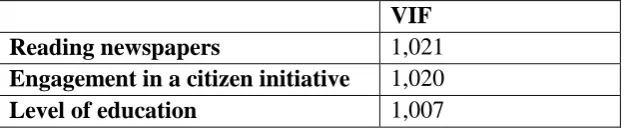
(22) not use to be responsible for providing social care, but they already received a mean rating of responsibility which was almost 8. 4.2 Asylum As it has been stated before, the national government is particularly responsible for determining the amount of refugees that can apply for asylum in the Netherlands. Although the local government is often seen as the layer of government responsible for asylum seekers, this is true in so far as they are responsible for allocating housing, in cooperation with the COA. They are, however|, not responsible for determining the amount of refugees that can apply for asylum, as the respondents have been asked in the 2016 and 2018 surveys. The European Union is partially responsible, because of the redistribution plan that is formulated on the level of the European Union, and because of certain agreements between European Union member states. In order to test whether the multiple regression analysis can be applied, the three independent variables were tested for multicollinearity. For there to be a collinearity between independent variables, the VIF score needs to be <1 or it should exceed 10. The multicollinearity scores of reading newspapers, engagement in a citizen initiative in the past five years, and the level of education, are respectively 1,020, 1,020, and 1,007. Therefore, there has been no multicollinearity found between the independent variables.. Reading newspapers Engagement in a citizen initiative Level of education Table 5: Multicollinearity. VIF 1,021 1,020 1,007. First, the reading newspapers, engagement in citizen initiatives and the level of education are tested to the correctness of perceptions of the responsibility of the national government in the asylum domain. Since the independent variables and the dependent variable, the correctness of perceptions, have a different number of categories, the unstandardized coefficients will be neglected, and instead the standardized coefficient will be used to determine the effect of the independent variables on the dependent variable. There is a significant relationship found with the independent variable reading newspapers. The standardized coefficient on the level of the European Union is -0,080. Thus, the higher the level of education a person has attended, the more likely he is going to have the correct perceptions of the responsibility of the national government in this domain. While there has not been found a significant relationship between the correctness of perception and engaging in citizen initiatives on the level of the national government, the higher the level of education, the higher the rating of responsibility to the national government. There is a beta-coefficient of -0,123 between the correctness of perception of the responsibility of the national government in the amount of refugees that applies for asylum, and the level of education, according to CBS categories. The significance level of the relationship is 0,000, which is lower than 0,05, and therefore significant. Since the 22.
(23) standardized coefficient is -0,123, this means that the higher the level of education, the more likely this person is going to have the correct perceptions of the responsibility of the national government in determining the amount of refugees that can apply for asylum in the Netherlands.. Table 6: National government and the asylum domain The correctness of perceptions of the local government for determining the amount of refugees that can apply for asylum is tested with the independent variables. The significance levels of all the three independent variables is exceeding 0,05 and therefore they are insignificant.. Table 7: Local government and the asylum domain In testing the independent variables with the correctness of perceptions regarding the responsibility of the European Union for asylum seekers, there has been just one significant relationship found. Reading newspapers has a significance level of 0,027, which is below the limit of 0,05. The beta coefficient of the relationship between the level of education and correctness of perceptions of the responsibility of the European Union is 0,046. Since this coefficient is positive, a person who reads newspapers is going to be further from score 0. Therefore, if a person reads a newspaper, he is less likely to be correct in his perception of the 23.
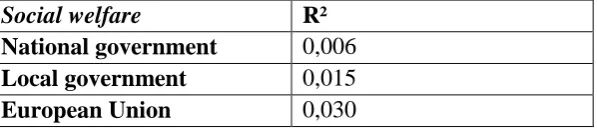
(24) responsibility of the European Union for determining the amount of refugees that can apply for asylum in the Netherlands. The significance level of the relation between the correctness of perceptions on the level of the European Union and the level of education is 0,547, which is exceeding 0,05 and therefore insignificant. The significance level of engaging in a citizen initiative is 0,051, which is just a bit larger than 0,05 and therefore not significant.. Table 8: European Union and the asylum domain Asylum R² 0,023 National government 0,003 Local government 0,003 European Union Table 9: R² in the asylum domain In the asylum domain, the R squares are very small, which means that the independent variables explain a tiny part of the variability of the correctness of citizens‘ perceptions in the asylum domain. 4.3 Social welfare Both the national government and the local government, which is the municipality, are responsible for providing social welfare to the citizens of the Netherlands. It is expected that these two layers of government would get the highest rating of responsibility from the respondents, while the European Union would get the lowest rating of responsibility. The layer of government that is responsible for assigning social welfare to Dutch citizens, who have applied for social welfare, is the Dutch Ministry of Social Affairs and Employment. One can apply for social welfare through the municipality one is registered in. However, the municipality is not responsible for assigning social welfare to citizens. Therefore, the national government and the local government are held accountable for assigning social welfare. First, the independent variables are is tested with the correctness of perceptions of the responsibility of the national government for assigning social welfare. The significance level of the amount of newspapers that is read is 0,001, which makes the beta coefficient significant. The significance level of engaging in a citizen initiative is 0,741, and therefore too 24.
(25) large, while the significance level of the level of education is 0,024 and therefore a bit larger than the amount of newspapers read, but still significant. The standardized coefficient of reading newspapers is -0,066, while the standardized coefficients of the level of education is 0,046. Thus, that means that the higher the level of education, the more likely a person has the correct perception of the responsibility of the national government in assigning social welfare. Furthermore, if a citizen reads newspapers, he is more likely to have the correct perceptions in this domain.. Table 10: National government and the social welfare domain When testing the independent variables to the correctness of perceptions of the responsibility of the local government in assigning social welfare, the significance levels of engagement in a citizen initiative and the level of education are respectively 0,727 and 0,329, which are above 0,05, and therefore not significant enough. Only the independent variable ‚reading newspapers‘ has a significance level which is 0,000, and therefore significant. The coefficient of this relationship is -0,126 , which means that if the respondents have been reading newspapers, they are more likely to have the correct perception on the responsibility of the local government in assigning social welfare. Therefore, reading newspapers has a positive effect on the correctness of perceptions of the responsibility of the local government for providing social welfare.. 25.
(26) Table 11: Local government and the social welfare domain The independent variables were also tested with the correctness of perception of the responsibility of the European Union in assigning social welfare. After using the regression analysis to test the relationships, two of them turned out to be significant. The significance level of the level of education is 0,000, while the significance level of engagement in a citizen initiative is 0,037, and the significance level of reading newspapers 0,062. The standardized coefficient of engagement in a citizen initiative is 0,044. Thus if a person has engaged in a citizen initiative in the past five years, he is less likely to have the correct perceptions of the responsibility of the European Union for providing social welfare. The standardized coefficient of the level of education is -0,169, and thus the higher the level of education, the more likely a person has the correct perceptions of the responsibility of the European Union for providing social welfare.. Table 12: European Union and the social welfare domain. 26.
(27) Social welfare R² 0,006 National government 0,015 Local government 0,030 European Union Table 13: R² in the social welfare domain In the social welfare domain, the R squares are really small, which means that the independent variables explain a small part of the variability of the correctness of perceptions in the social welfare domain. 4.4 Pension System The pension system is administered by national pension funds, which are part of the national government. Therefore, the national government is regarded as the responsible layer of government in the pension domain. Despite calls for an EU-organized pension system, the European Union is currently not responsible for organizing and managing the pension system. First, the three independent variables are tested with the correctness of perceptions of the responsibility of the national government. for managing the pension system. Regarding the three independent variables, the level of education, engaging in a citizen initiative in the past five years, and reading newspapers, significant relationships between the correctness of perception of responsibility of the national government in the pension system and the three independent variables have been found in two of the independent variables. First, the significance level of the relation between the correctness of perception of the national government and reading newspapers is 0,282, thus exceeding 0,05. Regarding engagement in a citizen initiative in the past five years, the significance level is 0,731. The significance level of the level of education is, however, 0,000, and therefore it is a significant relationship. The standardized coefficient is -0,124, which means that the higher the level of education, the more likely a person’s perceptions on the responsibility of the national government for managing the pension system are correct.. Table 14: National government and the pension domain. 27.
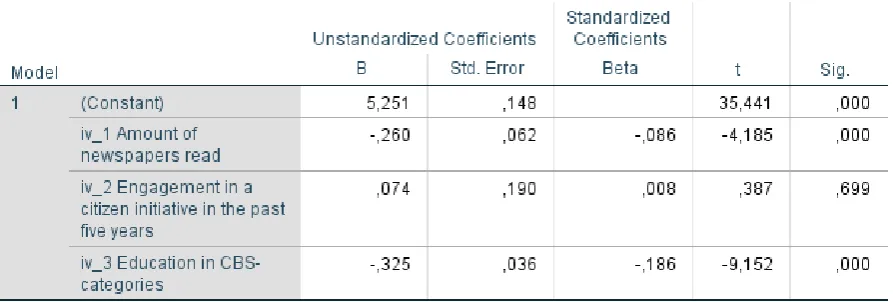
(28) When testing the independent variables to the correctness of perceptions of the responsibility of the local government regarding the pension system, there have been two significant relationships found. The significance levels of reading newspapers and the level of education are both 0,000, while the significance level of engagement in a citizen initiative is 0,699. The standardized coefficient of reading newspapers is -0,085, while the standardized coefficient of the level of education is -0,186. Therefore, if a person reads newspapers, that person is more likely to have the correct perceptions of the responsibility of the local government in managing the pension system. Furthermore, the higher the level of education, the more correct the perceptions.. Table 15: Local government and the pension domain Investigating a possible relationship between the independent variables and the correctness of perceptions of the responsibility of the European Union in this domain, two significant relationships have been found. The significance level of reading newspapers, engagement in a citizen initiative, and the level of education, are 0,865, 0,020, and 0,000. The standardized coefficient of engagement in a citizen initiative is 0,049, and the one of the level of education is -0,139, which means that the higher the level of education, the more likely a person has the correct perceptions of the responsibility of the European Union in managing the pension system, but if a person has engaged in a citizen initiative, he is less likely to have the correct perceptions.. 28.
Figure



+7




Outline
Related documents
This set comprises publication output indicators such as (1) the share in the world total, (2) subject-based publication profiles, (3) citation-based indicators like journal-
Other readings (not required): Pearson, Neil D., 2002, Risk Budgeting: Portfolio Problem Solving With Value-at-Risk (New York: John Wiley & Sons), Chapters 11, 12, and 13;
In the simplest scheme based on the boolean model for retrieval, we retrieve the documents that have occurrences of both good and teacher.. Such
Such a collegiate cul- ture, like honors cultures everywhere, is best achieved by open and trusting relationships of the students with each other and the instructor, discussions
Considering a range of tax and benefit systems, particularly those having benefit taper rates whereby some benefits are received by income groups other than those at the bottom of
Thus, holding job requirements constant at a particular level (and therefore holding actual qualifications constant at the same level, since equation 4 is estimated only
01-Oct-2018 Version 17 Changed Overview, Standard Features, Preconfigured Models, Configuration Information, Core Options, Additional Options, and Memory sections were updated.
from the Blues Brothers Movie Think Big Band Arranged by Philippe Marillia Vocal (Aretha) Aretha F ranklin Ted White Think f.. Think Think Think you think think
