M
ASTERT
HESISTowards Updatable Smart Contracts
Author:
F.W.C. BLOO
Supervisors:
Dr.ir. J.M. MOONEN
Dr. N. SIKKEL
(University of Twente)
F.H. TANMSc MISM
(Northwave B.V.)
Business Information Technology - Track: Business Analytics Faculty of Electrical Engineering, Mathematics and Computer Science
Abstract
In recent years, research institutes and other organisations have shown an in-creased interest in blockchain technology. A blockchain is a distributed append-only database that ensures a high degree of availability, integrity, and transparency. Multiple blockchain implementations, for example Ethereum, support the storage and execution of executable code, called smart contracts. Smart contracts on the Ethereum blockchain are public and can become the target of an attack. The Decen-tralised Autonomous Organisation and the Parity Multisig Wallets both became the victim of an attack and lost respectively $50 million and $150 million. Due to the immutability of smart contracts, security updates and new functionalities can cur-rently not be implemented. This poses a major risk for organisations that want to adopt secure smart contracts. From this, the main goal of the study is derived: to investigate whether a smart contract can be updated in a decentralised manner.
We adopt a Design Science approach to create an updatable smart contract. A solution design involves a technical aspect to bypass the immutability of a smart contract and a decision-making process to reach a consensus on an update amongst the (anonymous) participants. This thesis presents a design that bypasses the im-mutability by adopting a proxy smart contract which redirects incoming calls to the most recent version of the smart contract. The decision-making process that we present, is extracted from four illustrative case studies. The aim for each of these case studies is to a develop decision-making process that provides each participant a fair stake. In this study, a fair stake is implemented as the value at risk: the stake in the process is relative to the value stored on the smart contract. The motivation for this approach is that participants who store assets with a high value on the smart contract can lose more value in case of a breach, and are thus more concerned. As the results show, the applicability and feasibility of this concept are limited for smart contracts. First, it is not applicable when the value at risk cannot be determined, which is the case when it stores unique objects (i.e. non-fungible tokens). Second, boundary cases can occur because centralisation of the voting power cannot be prevented in all sit-uations. Third, participants might lack knowledge of the programming language in order to make a well-informed decision. Last, the decision-making process is time consuming. Additional limitations as a result of the technical implementation are: (I) The big bang adoption of an update might result in invalid transactions. (II) The update requires one block downtime. (III) The source code of an update must be publicly visible. (IV) A hard fork might result in conflicting instances. The results are validated by means of interviews with four industry experts.
iii
Acknowledgements
Contents
Abstract ii
Acknowledgements iii
1 Introduction 1
1.1 Introduction . . . 1
1.2 Problem Statement . . . 2
1.3 Research Questions . . . 3
1.4 Research Design . . . 3
1.4.1 Literature Studies . . . 4
1.5 Scope . . . 4
1.6 Structure of the Report . . . 5
2 Blockchain Technology 7 2.1 Blockchain . . . 7
2.1.1 Blockchain Concept . . . 7
2.1.2 Transactions and Accounts . . . 8
2.1.3 Blockchain Types . . . 10
2.1.4 (De)centralisation . . . 10
2.1.5 Key Characteristics Blockchain . . . 12
2.2 Distributed Consensus . . . 12
2.2.1 Proof of Work . . . 13
2.2.2 Proof of Stake . . . 13
2.2.3 Delegated Proof of Stake . . . 13
2.2.4 Other Consensus Algorithms . . . 14
2.3 Security . . . 14
2.3.1 Double-Spending (Race Attack) . . . 14
2.3.2 Finney Attack . . . 15
2.3.3 Vector 76 (One-Confirmation Attack) . . . 15
2.3.4 >50% Hash Power . . . 15
2.3.5 Selfish Mining (Block Discarding) . . . 16
2.3.6 Block Withholding . . . 16
2.3.7 Fork After Withholding Attack . . . 16
2.3.8 Misbehaviour Attacks . . . 16
2.3.9 Usage Risks . . . 17
3 Smart Contracts 18 3.1 Smart Contract Concept . . . 18
3.2 The Ethereum Smart Contract . . . 19
3.2.1 Solidity . . . 19
3.2.2 Ethereum Virtual Machine . . . 20
3.2.3 Ethereum Transaction . . . 21
v
3.2.5 Operational Code . . . 23
3.2.6 Oracles . . . 24
3.3 Use Cases . . . 24
3.3.1 Escrow Services . . . 24
3.3.2 Digital Tokens . . . 25
3.3.3 Energy Sector . . . 25
3.3.4 Internet of Things . . . 26
4 Smart Contract Vulnerabilities 27 4.1 Smart Contract Vulnerabilities . . . 27
4.1.1 Transaction-ordering Dependence . . . 28
4.1.2 Re-entrancy . . . 29
4.1.3 Tx.origin Versus Msg.sender . . . 30
4.2 Smart Contract Vulnerability Scanners . . . 30
4.2.1 Oyente . . . 31
4.2.2 Maian . . . 32
4.3 Smart Contract Security Recommendations . . . 32
5 Existing Solution Designs 36 5.1 Manual Register . . . 36
5.2 Proxy . . . 37
5.3 Limitations of Existing Designs . . . 38
5.4 Blockchain Protocol Upgrades . . . 38
6 Design Requirements 40 6.1 Functional Requirements . . . 40
6.2 Non-Functional Requirements . . . 41
7 Case Studies Decision-Making Process 43 7.1 Case: Escrow Service . . . 43
7.1.1 Case Context . . . 43
7.1.2 Voting System Design . . . 44
7.1.3 Limitations . . . 45
7.2 Case: Non-Fungible Token Asset Registry . . . 45
7.2.1 Case Context . . . 45
7.2.2 Voting System Design . . . 45
7.2.3 Limitations . . . 47
7.3 Case: Fungible Token Initial Coin Offering . . . 48
7.3.1 Case Context . . . 48
7.3.2 Voting System Design . . . 48
7.3.3 Limitations . . . 51
7.4 Case: Fungible Token Energy Trading . . . 51
7.4.1 Case Context . . . 51
7.4.2 Voting System Design . . . 52
7.4.3 Limitations . . . 52
7.5 Findings . . . 53
8 Solution Design 55 8.1 Generalised Decision-Making Process Model . . . 55
8.2 Technical Design . . . 57
8.2.1 Proxy Smart Contract . . . 57
8.3.1 Costs Proxy . . . 61
8.3.2 Costs Data Storage . . . 61
8.3.3 Costs Voting . . . 62
8.4 Limitations . . . 62
8.4.1 Decision-Making Process . . . 62
8.4.2 Adoption Strategy . . . 63
8.4.3 Downtime . . . 63
8.4.4 Update Publicly Visible . . . 63
8.4.5 Hard Fork . . . 64
8.5 Verification of Requirements . . . 64
8.6 Validation . . . 67
8.6.1 Validation Results . . . 67
9 Conclusion and Future Work 69 9.1 Conclusion . . . 69
9.2 Contribution . . . 71
9.3 Discussion . . . 72
9.4 Limitations . . . 73
9.5 Future Research . . . 74
vii
List of Figures
1.1 Research deliverables . . . 6
2.1 Simplified chain of blocks . . . 8
2.2 Simplified state transition Ethereum . . . 8
2.3 Simplified chain of blocks with Merkle tree . . . 9
2.4 Centralisation, decentralisation and distributed networks . . . 11
5.1 Manual register smart contract update mechanism . . . 36
5.2 Proxy smart contract update mechanism . . . 37
7.1 Process flow of a voting system for an escrow service . . . 44
7.2 Process flow of a voting system for an asset registry . . . 46
7.3 Process flow of a voting system for an ICO . . . 50
8.1 Generalised decision-making process . . . 56
8.2 Overview smart contract update mechanism . . . 57
A.1 Average Gas price . . . 82
List of Tables
2.1 Comparison of blockchain types . . . 11
3.1 Fields in an Ethereum transaction . . . 22
4.1 Smart contract vulnerabilities by ConsenSys Diligence . . . 28
4.2 Taxonomy of smart contract vulnerabilities and severity . . . 29
4.3 Results analysis Oyente . . . 31
4.4 Correctness analysis Oyente . . . 31
4.5 Results analysis Maian . . . 32
4.6 Security recommendations smart contracts . . . 33
7.1 Overview of limitations found in case studies . . . 54
8.1 Memory layout example . . . 59
8.2 Comparison of transaction gas consumption of proxy . . . 61
8.3 Comparison of transaction gas consumption of data storage . . . 62
ix
List of Abbreviations
ABI ApplicationBinaryInterface
BIP BitcoinImprovementProposal
DAO DecentralisedAutonomousOrganisation
dApp decentralisedApplication
ERC EthereumRequest forComments
EVM EthereumVirtualMachine
ICO InitialCoinOffering
IoT InternetofThings
PoS ProofofStake
Chapter 1
Introduction
1.1
Introduction
In recent years, blockchain has emerged as an innovative technology with the po-tential to change the way society, politics and businesses interact. The technology is evolving at a high pace and is far beyond its first application in the crypto cur-rency Bitcoin. Blockchains can be thought of as append-only transactional databases, distributed over a decentralised peer-to-peer network, thereby facilitating trust-less transactions without the need for a trusted third party. Participants are not required to trust each other to interact: the transactions are verified by a set of algorithms, without the interference of a human or a central authority. A blockchain, sometimes referred to as a distributed ledger, ensures a high degree of availability and integrity of the stored data; tampering with data is nearly impossible.
A feature of interest that a number of blockchain platforms started adopting is the support for executable code. The storage and execution of executable code on top of a blockchain allows to develop a wide range of decentralised applications (dApps). The executable code, hereinafter referred to as a smart contract, is a soft-ware protocol that is designed to enforce, facilitate and verify traditional contracts in a digital manner. Its design allows for the automatic execution of transactions without any interference from the outside world. The integrity and availability of smart contracts are ensured as they are stored and executed on top of a blockchain, hence transactions executed by smart contracts are traceable and irreversible.
A smart contract runs autonomous on a blockchain and becomes nearly impossi-ble to alter once it is deployed, the code is considered immutaimpossi-ble. The immutability provides a key element for the digitalisation of traditional contracts but is consid-ered a double-edged sword. There is no method to implement a solution for a defect in a smart contract, the defect is irreversible and permanent. Considering that a com-pelling number of crypto currencies are operated by smart contracts, such a feature is appealing.
Chapter 1. Introduction 2
this incident was a misconfiguration in a single smart contract that acted as a li-brary to the wallets (Parity Technologies, 2017). The malicious user was able to gain access to specific functions of the smart contract, after which the user called the self-destruct function (Etherscan, 2017a,b). All types of crypto currencies stored on the Parity Multisig wallets got locked forever. In a statement of the organisation behind the Parity Multisig wallets, it was confirmed that a total amount of 513,774.16 Ether, with a total value of $150 million at that time, was stored on these wallets.
1.2
Problem Statement
A common characteristic of the DAO and Parity Multisig wallet attacks, as described in the previous section, is that both attacks exploited vulnerabilities of Ethereum smart contracts. This seems to be the tip of an iceberg. A recent study that analysed deployed smart contracts on the Ethereum blockchain on four different types of vul-nerabilities, showed that 8,833 out of the 19,366 analysed smart contracts contain at least one of the vulnerabilities (Luu et al., 2016). Another study that analysed smart contracts for other types of vulnerabilities concluded that 4,905 Ether, worth $2.6 million, is stored on vulnerable smart contracts (Nikolic et al., 2018).
The maturity of smart contracts is not yet at the desired level; the slightest mis-take in the code can have disastrous implications. The incidents from the previous section indicate that even experienced developers face difficulties to write secure code. Organisations aiming to adopt smart contracts need to understand the associ-ated risks for a successful and secure implementation.
From a security perspective, the immutability of a smart contract ensures organ-isations that, given a state, a smart contract will behave in a consistent manner; no one is able to alter the code or to interfere with its execution. At the same time, the immutability results in the fact that the functionality provided by the smart contract cannot be changed and that solutions to patch security vulnerabilities can thus not be implemented. The importance of smart contract security has gained attention from academics in light of the recent attacks. Studies to date tend to focus on de-scribing and detecting security vulnerabilities rather than providing secure smart contract development methods. Furthermore, these studies fail to provide methods to patch vulnerabilities found in deployed smart contracts.
1.3
Research Questions
The objective of this is to investigate whether smart contracts can be updated in a de-centralised manner. The answer to the main research question should be a validated artefact.
Research Question: How could smart contracts be updated in a decentralised manner?
The research question can be decomposed into the following subquestions. To-gether, the answers to these sub-questions form the answer to the main Research Question of this study.
Subquestion 1: What is the current state of the art of blockchain technology?
Subquestion 2: What is the current state of the art of smart contracts?
Subquestion 3: What are existing security vulnerabilities of smart contracts?
Subquestion 4: What are design requirements for smart contracts that can be updated in
a decentralised manner?
Subquestion 5: What is a design for smart contracts that can be updated in a
decen-tralised manner?
Subquestion 6: Does the designed artefact work as desired?
The results of this study contribute to the maturity of smart contracts and it provides organisations with a method to adopt smart contracts in a more secure manner. Ad-ditionally, this study presents an overview of existing vulnerabilities in smart con-tracts in order to equip developers and organisations with knowledge to mitigate these vulnerabilities.
1.4
Research Design
This study adopts the Design Science in Information Systems Research methodology by Hevner et al. (2004) in order to provide an answer to the main research question. While the goal of the study is to design an artefact, following this research method-ology will result in a better understanding of the problem domain and its solution. Wieringa (2014) provides a detailed description of applying design science method-ology in a research. A design science research can be seen as a cycle which is part of a larger cycle, the engineering cycle. Consequently, the design science cycle consists of the following tasks:
1. Problem investigation
2. Treatment design
3. Treatment validation
4. Treatment implementation
Chapter 1. Introduction 4
The starting point in the cycle is to get a complete understanding of the problem by identifying, describing and evaluating the problem. The goal is to “investigate an improvement problembeforean artefact is designed and when no requirements for an artefact have been identified yet” (Wieringa, 2014). The answers to the first three sub-questions will provide an understanding of the problem by giving an overview of the current state of the art of blockchain, smart contracts and its security vulnera-bilities.
Once the problem investigation is finished, existing treatments and necessary de-sign requirements for the artefact are researched. Following this, the artefact will be designed by means of a decision-making process design and a technical design. The decision-making process design allows to identify the opportunities and limitations that need to be considered for the technical design. The design for the decision-making process will be developed by generalising a model from four illustrative case studies.
After the artefact has been designed, it requires verification and validation to predict its behaviour when it is implemented in the context of the problem. The defined requirements for a solution design will be used as assessment criteria during the verification of the designed artefact. Interviews with experts will be conducted in order to validate the solution design. Due to practical reasons and time constraints, this thesis does not engage with a treatment implementation and implementation evaluation as specified in the design science cycle.
1.4.1 Literature Studies
Multiple literature studies will be conducted in order to answer the sub-questions of this study. The first step is to retrieve academic articles from the academic databases IEEE, ACM, Scopus and Web of Science. The articles found are first filtered based on the title, abstract and keywords, to determine their relevance for this study. The remaining articles after this selection are considered relevant and will be read in full detail. Next to reading the full text, this study adopts backward reference searching to find relevant articles identified by other researchers. These articles go through a similar selection as the articles initially found in the academic databases.
As the developments in blockchain technology and smart contracts advance at a high pace, the assumption that academic sources are not up to date with the newest developments is considered realistic. Therefore, non-academic sources will be consulted next to academic literature. After identifying literature from academic sources, non-academic online sources such as blog posts, Google search engine, and official documentation, are consulted in order to enrich information from academic sources. Although these sources are not validated by academic research, the trans-parent nature of blockchain allows to verify the information without requiring a comprehensive research.
1.5
Scope
blockchain that supports smart contracts. A recent study indicated that 1082 start-ups relied on the Ethereum blockchain and smart contracts to raise capital in 2017 (Fenu et al., 2018). At the time of writing, August 2018, 87.6% of the projects listed on Coinmarketcap run on the Ethereum blockchain (CoinMarketCap, 2018). As a result of solely focussing on the Ethereum blockchain, the solution design needs to consider the associated key characteristics of this type of blockchain. These key characteristics include a public environment and anonymous use.
Smart contracts for the Ethereum blockchain can be written in different program-ming languages (Ethereum Foundation, 2018j). Before being able to deploy smart contracts in one of these languages, they are first compiled to Ethereum Virtual Ma-chine (EVM) code, which is the actual code stored and executed on the Ethereum blockchain. Two low-level programming languages to write a smart contract are LLL and Serpent. The third and one of the most popular languages, due to its high-level approach, is Solidity. As a high-level language that directly compiles to EVM code and the strong similarities with JavaScript, Solidity is a popular language within the community. Numerous examples and an extensive documentation are available. It is therefore that this study will only consider the smart contracts programmed in Solidity. This does not imply that high-level concepts the designed artefact in this study cannot be applied to smart contracts in other languages or blockchain plat-forms.
The artefact that will be designed during this study will contain a technical el-ement and a governance elel-ement. The technical elel-ement is required to understand how the immutability of smart contracts can be bypassed and to understand the process of an update. The governance element is focussed on a decision-making process to reach a consensus on whether an update will be implemented or not. Although both elements will be heavily studied, this thesis will not provide a full proof-of-concept implementation. Instead, this thesis provides code examples of the key elements of an implementation.
1.6
Structure of the Report
Chapter 1. Introduction 6
State of the art of blockchain
(Chapter 2)
State of the art of smart contracts
(Chapter 3)
Smart contract vulnerabilities
(Chapter 4)
Requirements (Chapter 6)
Artefact design (Chapter 8)
Artefact validation (Chapter 8) Existing solution
designs (Chapter 5)
Case studies decision-making
process (Chapter 7)
Chapter 2
Blockchain Technology
Introduction
This chapter presents an overview of the current state of the art of blockchain tech-nology and provides an answer to the first sub-question of this thesis:
1. What is the current state of the art of blockchain technology?
In order to find relevant papers for this study, the search query: "Blockchain AND
technology AND foundational" was used to retrieve relevant articles. The additional
condition “AND foundational” was added to narrow the scope of results, for the rea-son that the search query “blockchain AND technology” results in a list of articles which mention blockchain and technology only once, for example as a potential solution.
First, the concepts of blockchain technology and key characteristics are intro-duced along with the different types of blockchains. This is followed by a detailed description of the processing of transactions and consensus mechanisms. The last section of this chapter is focussed on the security of blockchain based systems.
2.1
Blockchain
2.1.1 Blockchain Concept
In 2008, Satoshi Nakamoto, whose real identity is still unknown, published a white paper about the core functionality and core principles for a peer-to-peer payment network that eliminates financial institutions (Nakamoto, 2008). The idea for a dig-ital currency, as presented by Nakamoto, is not entirely new. Before Bitcoin marked the start of digital currencies, there were multiple projects that aimed at doing the same thing, hence not all technology behind Bitcoin not is completely new. How-ever, Nakamoto was the first one able to solve one of the major issues in a peer-to-peer payment network: double-spending. As digital copies of a digital currency are easy to make, a peer-to-peer payment network needs effective methods to prevent double-spending. According to Tschorsch and Scheuermann (2016), Nakamoto clev-erly combined decades of research in a creative and sophisticated manner in order to create a digital currency using a blockchain.
Chapter 2. Blockchain Technology 8
Hash Block Header: 000012fa9b... Block #149 Header
Hash Previous Block: 000015783b...
Timestamp: 1521033510
Transactions:
Hash Block Header: 0000ae8bbc... Block #150 Header
Previous block: 000012fa9b...
Timestamp: 1521034610
Hash Block Header: 0000b9015c... Block #151 Header
Previous block: 0000ae8bbc...
Timestamp: 1521035564
Merkle Root Hash
Transactions:
Merkle Root Hash
Transactions:
Merkle Root Hash
Block #149 Transactions Block #150 Transactions Block #151Transactions
FIGURE2.1: Simplified chain of blocks
a timestamp. By “linking” each new block to the previous block, a chain of blocks is created, hence this technology is called blockchain.
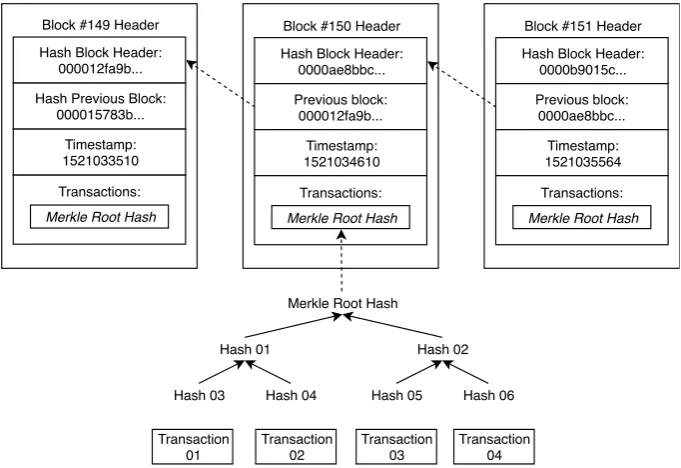
Figure 2.1 shows a simplified representation of the information in a block and the link to the previous block. As can be seen, each block contains the hash of the block header of the previous block and hash of its own header, which is necessary to ensure the integrity of the data in a block. If the content of a block in the blockchain is altered, the hash of the block header will become invalid, subsequently the hashes of all succeeding blocks also become invalid. For example, if one alters the data of
Block #149in Figure 2.1, the hash (Proof of Work) becomes invalid. The hash of the
block needs to be recalculated to become a valid hash again. However, this means that the hash of all succeeding blocks also needs to be recalculated as they become invalid due to the chaining mechanism.
Bitcoin, Ethereum, and the other blockchains can be viewed as a transaction-based state machine (Ethereum Foundation, 2018j). In the starting state, called the genesis state, transactions are executed to transit to a new state. The state can include different kinds of information such as account balances and reputation. Each state is a valid state, e.g. if a balance of an account is increased, that exact same amount should be deducted from another account. Figure 2.2 shows a simplified view of a state transition. State Address 01: 15 Ether Address 02: 10 Ether State' Address 01: 5 Ether Address 02: 20 Ether From: Address 01
To: Address 02
Value: 10 Transaction
FIGURE2.2: Simplified state transition Ethereum
2.1.2 Transactions and Accounts
[image:18.595.109.462.79.256.2] [image:18.595.130.446.565.660.2]without expensive hardware should be able to work with the ledger. However, sav-ing all transaction data results in an extremely large blockchain in terms of file size. When the number of transactions stored on the blockchain increases, smaller com-puters will not have sufficient storage to save all data. Consequently, a client with a smaller computer will not be able to validate if his transactions were included in a block. Therefore, blockchains save Merkle trees of transactions (Bitcoin Project, 2018c).
A Merkle tree, sometimes referred to as Hash tree, is a concept in which every leaf at the lowest levels contains the hash of a piece of data, in blockchain often a transaction. Each leaf in a higher level of the tree consists of the hashes of its two children, eventually leading to one hash at the highest node in the tree. The Merkle tree allows for quick verifiability of data stored in the tree. In blockchain, it is used to determine whether a received block is undamaged and unaltered by a dishonest peer.
A client with a less powerful computer does not need to save the complete blockchain, instead, he only needs to save the block headers. In order to verify whether the transaction of the client is included in a block, the client downloads the list of transactions included in the block from a peer with the full blockchain, af-ter which he computes the Merkle tree. This allows the client to validate whether the transaction was included in a block without the need to save the complete blockchain. Figure 2.3 shows a simplified version of how transactions are saved using a Merkle tree. The hash of each transaction is paired with the hash of another transaction in the same block.
Hash Block Header: 000012fa9b... Block #149 Header
Hash Previous Block: 000015783b...
Timestamp: 1521033510
Transactions:
Hash Block Header: 0000ae8bbc... Block #150 Header
Previous block: 000012fa9b...
Timestamp: 1521034610
Hash Block Header: 0000b9015c... Block #151 Header
Previous block: 0000ae8bbc...
Timestamp: 1521035564
Merkle Root Hash
Transactions:
Merkle Root Hash
Transactions:
Merkle Root Hash
Merkle Root Hash
Hash 01
Hash 03 Hash 04
Hash 02
Hash 05 Hash 06
Transaction 01 Transaction 02 Transaction 03 Transaction 04
FIGURE2.3: Simplified chain of blocks with Merkle tree
[image:19.595.116.457.399.633.2]Chapter 2. Blockchain Technology 10
signature is used by other users and nodes in the network to verify that the trans-action is sent by someone that is in possession of the private key that belongs to the public key. This verification uses an algorithmic function that takes the transaction, digital signature and public key of the sender as input and returns a boolean output whether the digital signature is authentic.
2.1.3 Blockchain Types
A number of publications describe different types of blockchains, however, the cat-egorisation of the types is often conflicting. Peters and Panayi (2016) describe the differences between the types by looking at two aspects. The first aspect makes a distinction between whether authorisation is required to join the network as a node or not (permissioned versus permissionless). The second aspect makes a distinction between whether the data on the blockchain is publicly accessible or not (public ver-sus private). In another study, only two different types of blockchain are described: permissionless and permissioned (Androulaki et al., 2018). In their publication An-droulaki et al. also use the term public for permissionless blockchain, however, this is not the same type as described in Peters and Panayi (2016).
The differences between the types of blockchain are more nuanced, since there are more factors that differentiate blockchains from each other. On a high level, blockchains can be used in a public, private or consortium context (Lin and Liao, 2017):
Public: Everyone is able to view, verify and create transactions without
reveal-ing their true personal identity. Additionally, everyone is allowed to participate in the consensus making process. Examples of public blockchains are Bitcoin and Ethereum.
Private: In contrast to public blockchains, private blockchains do require
authenti-cation. There is an authority in place that controls who has the rights to view, verify and create transactions, and who can contribute to the consensus making process. As a consequence, private blockchains require participants to reveal their identity to a certain extent.
Consortium: A consortium blockchain combines features of public and private
blockchains and can be used in business to business projects. Data on the consor-tium blockchain can either be public or private. The consorconsor-tium blockchain also enables the entities that participate to decide whether everyone is allowed to run a node or that only selected group of entities is privileged.
Zheng et al. (2017) compared public, private and consortium blockchain by looking at five different properties. The results of this comparison are shown in Table 2.1. As can be seen, the authors included the distinctions that are described by Androulaki et al. and Peters and Panayi. Additionally, the authors considered the properties: immutability, efficiency, and centralisation, which will be discussed in section 2.1.5.
2.1.4 (De)centralisation
TABLE2.1: Comparison of blockchain types (Zheng et al., 2017)
Property Public Blockchain Consortium Blockchain Private Blockchain
Consensus determination All miners Selected set of nodes One organisation
Read permission Public Could be public or restricted
Could be public or restricted
Immutability Nearly impossible
to tamper Could be tampered Could be tampered
Efficiency Low High High
Centralisation No Partial Yes
Consensus process Permissionless Permissioned Permissioned
been a topic of academic research for a long time. Figure 2.4 shows an overview of these networks which was originally published by Tranter et al. in 1964. The definition of (de)centralisation can be explained across three axes when considering the term in blockchains (Buterin, 2017). The term (de)centralisation should not be considered as binary, it rather should be considered on a continuous axis.
Architectural (de)centralisation defines (de)centralisation as the number of
phys-ical computers of which the system is made up. A decentralised system tolerates a higher number of failing computers in comparison with a centralised system.
Political (de)centralisation defines (de)centralisation as the number of individuals
or organisations that control the system. Decentralised systems are controlled by more individuals or organisations in comparison with centralised systems.
Logical (de)centralisation defines (de)centralisation as the level to which the
in-terface and data structures are maintained as a monolithic object. Decentralised sys-tems operate as independent syssys-tems when the system is cut in half.
FIGURE2.4: (a) Centralised (b) Decentralised (c) Distributed (Tranter
Chapter 2. Blockchain Technology 12
2.1.5 Key Characteristics Blockchain
An extensive study on blockchain technology, architecture, consensus and trends was performed by Zheng et al. (2017). In their paper they describe the following key characteristics of blockchain:
Decentralisation: In traditional transaction-based systems, transactions are
pro-cessed and validated by a central authority such as a bank. Such a third party is not needed in blockchain as all transactions are processed by all the nodes in the net-work. Together, these nodes maintain the integrity and availability of the data. As a blockchain network consists of many nodes, it can be assumed that it has a high degree of availability. Distributed Denial of Service and Denial of Service attacks will consequently need much more resources to get all the individual nodes in the network down.
Persistence: Once a transaction is stored on a blockchain, it becomes nearly
impos-sible to alter or delete it. All nodes in the network observe each other to ensure the integrity of the stored records. As a result of the chain of hashes, as explained in sec-tion 2.1.1, an attacker would need to have a large amount of computasec-tional resources at his disposal to be able to alter records. He would not only need to calculate the valid hash of the block that he altered, but also of all the subsequent blocks.
Anonymity: The addresses that are used by users to send and receive
transac-tions are generated by a cryptographic function. Consequently, the addresses do not contain any personal information about the user, allowing them to interact anony-mously on the blockchain.
Auditability: The transactions in a blockchain are visible by anyone with access to
the network. It allows the participants to retrieve a full audit trail of the transactions.
The confidentiality of a transaction is desirable in a financial system. It should be noted that although anonymity is a characteristic of blockchain technology, confi-dentiality is not ensured. The anonymity is based on the key pairs that are used au-thorise a transaction, however, the results of multiple studies indicate that in some blockchains the addresses can be traced back to an individual (Biryukov et al., 2014; Barcelo, 2014).
Considering the key characteristics of blockchain technology, the technology can be applied in numerous fields to make the exchange of value fairer and more trans-parent.
2.2
Distributed Consensus
Saving a transaction in a peer-to-peer network is challenging. As more peers join the network, the propagation time of a transaction in the network increases. With a digital currency, this allows a dishonest user to spend his money multiple times. Imagine that a dishonest user first spends money atshop A. Before he received a confirmation of the payment, the dishonest user quickly spends the same money at
shop B. As there is a high chance that this transaction will be processed by another
about the transaction of the dishonest user atshop A due to the propagation time. The peers then need to reach consensus over which transaction was first.
There are multiple algorithms available to reach a distributed consensus in a net-work, each one of these has its own advantages and disadvantages. The consensus algorithms determine which node in the network may forge the next new block. Be-low four different algorithms will be discussed, these are Proof of Work (PoW), Proof of Stake (PoS), and Delegated Proof of Stake.
2.2.1 Proof of Work
The Bitcoin project makes use of a PoW algorithm to reach a consensus (Bitcoin Project, 2018d). The PoW algorithm lets nodes, which are called miners, calculate hashes of block headers. For every calculation of a hash, the miners use a different nonce in order to obtain a different hash. A nonce is an arbitrary number that is added to the input of the hash function. The node that is able to calculate a hash that starts with a predefined number of zeros, is selected by the PoW algorithm to mine the block. This predefined number of zeros is a method for the algorithm to adjust the difficulty. The time between finding the correct hash and corresponding nonce becomes lower as more miners with computational power join the network. To compensate for this, the PoW algorithm increases the difficulty by requiring a higher number of leading zeros for the correct hash. Once a miner is able to calcu-late a hash of the block that complies with the requirement, the miner broadcasts the solution and corresponding hash to all other miners in the network. The other miners validate whether the block is valid and the combination of the hash and the nonce indeed complies with the requirement. After that, the miners add the block to their own local blockchain, and the process starts all over again. As calculating hashes requires a significant amount of computational resources, this algorithm is not energy efficient.
2.2.2 Proof of Stake
The PoS algorithm is used by a number of different blockchains, and in the future also by Ethereum (Buterin, 2018). The PoS algorithm selects the node that is allowed to add the next block to the blockchain by a combination of randomisation and stake, or by coin age. The nodes participate in a lottery where the chance of winning is proportional with the stake of a node. This means that nodes are required to stake coins to get a chance to add a new block to the blockchain. As this does not require as much as computational resources as the PoW algorithm, it is more energy efficient. A downside of the PoS algorithm is that it is inexpensive for nodes to vote for different versions of the blockchain because the nodes have nothing to lose. Hence, this might result in situations in which no consensus can be achieved.
2.2.3 Delegated Proof of Stake
Chapter 2. Blockchain Technology 14
2.2.4 Other Consensus Algorithms
Apart from the aforementioned algorithms, there are many more different algo-rithms to be found, examples include:
• Tendermint
• Practical Byzantine Fault Tolerance
• Ripple
• Proof of Space
• Proof of Time
• Directed Acyclic Graph
• Proof of Authority
Each consensus algorithm has its own advantages and disadvantages. Per blockchain project, one should choose the most suitable and appropriate type based on the spe-cific situation.
2.3
Security
As the price of a Bitcoin has increased significantly since its creation, it has become a potential target for attackers. Since Bitcoin makes use of an uncontrolled and de-centralised environment, it is hard for attackers to steal or to commit fraud with the transactions. Any change or action of fraud can be traced and is visible for all other people in the network. In recent years, a number of studies have analysed the se-curity of specific aspects of the Bitcoin system, however, more research is needed to make blockchain technology more mature (Matsuo, 2017). Kiayias and Panagio-takos provided a formal analysis of the Bitcoin backbone protocol by investigating the trade-off between the process speed of transactions and provable security (Ki-ayias and Panagiotakos, 2015). Conti et al. (2017) published a comprehensive survey on the security and privacy issues of Bitcoin. They discuss the current state of the art of attacks on transactions and user security in the blockchain, as well as the effi-ciency of solutions to mitigate these attacks. Although the survey is mainly focussed on the security and privacy aspects of the Bitcoin system, the results will for a large part also apply on the many alternative crypto currencies that use Bitcoin and its proof of work protocol as a basis. Below each vulnerability as found by Conti et al. on Bitcoin and the consensus protocol will be discussed shortly.
2.3.1 Double-Spending (Race Attack)
results indicate that the security of transactions can only be ensured when a ver-ification time of tens of minutes can be tolerated. Karame and Androulaki (2012) suggest a modification for the Bitcoin implementation to be able to accurately de-tect double-spending attacks. Preventing the spreading of inaccurate information in the network is not a Bitcoin-specific problem, Lamport et al. (1982) described a similar problem called Byzantine Generals Problem back in 1982. Although Bitcoin is actually a clever solution to the Byzantine Generals problem, not everyone agrees that it is a complete solution (Garay et al., 2015). Without the Proof of Work concept introduced in Bitcoin, the network would be vulnerable to pseudospoofing (Sybil) attacks. A pseudospoofing attack is an attack in which multiple identities are forged in a system (Schreiber and Alexandre, 1974; Douceur, 2002).
2.3.2 Finney Attack
A Finney attack can be seen as a different flavour of a double-spending attack. Finney, the person who received the first Bitcoin transaction from Nakamoto, de-scribes an attack in which the attacker mines a block with a transaction from address
Ato addressB, both owned by the attacker (Finney, 2011). Before broadcasting the mined block to other nodes in the network, the attacker performs a transaction from addressAwith a merchant who accepts 0 confirmation transactions. The merchant will wait a few seconds before accepting the transaction to prevent double-spending. Once the merchant agrees with the transaction, the attacker broadcasts his mined block to other nodes. This makes the transaction with the merchant invalid, hence the merchant will not receive any coins at all. A widely used method to prevent this attack from the merchant’s perspective is to always wait for multiple confirmations, i.e. multiple mined blocks after the block with the transaction.
2.3.3 Vector 76 (One-Confirmation Attack)
The Vector 76 attack, also referred to as the one-confirmation attack, is a hypotheti-cal attack that combines the Finney attack with a double-spending attack (Bitcointalk Forum, 2011). In this attack, the attacker mines a block including his own transac-tion, which he did not send to the transaction pool. Once the attacker mined the block, he does not broadcast it to other nodes, instead, he waits till another miner mines the next block. When the next block is announced, the attacker quickly sends his own pre-mined block nodes close to an exchange. At the same time, the at-tacker requests a withdrawal from the output address that he included in his own pre-mined block. As there is a confirmation for the coins on that output address, the exchange will allow the withdrawal. At this moment in time, there will be two chains, one with a block of the attacker and one with the regular block. If the chain with the block of the attacker does not survive the validation of other nodes, the block will become valid. However, since the attacker already did a withdrawal from the exchange, the exchange will end up with a loss of coins. Again, a method to prevent these kinds of attacks is to wait for more confirmations.
2.3.4
>
50% Hash PowerChapter 2. Blockchain Technology 16
miners are obliged to follow. The other miners are required to follow otherwise their blocks will be marked as invalid, withholding them from receiving any rewards at all (Kroll et al., 2013). Other consensus algorithms such as proof of stake and proof of activity try to overcome these hash power attacks for chains using the proof of work algorithm (Bentov et al., 2014; King and Nadal, 2012).
2.3.5 Selfish Mining (Block Discarding)
To perform a selfish mining attack, a dishonest miner keeps a mined block private for some time before broadcasting it to the public (Eyal and Sirer, 2014). This creates a temporarily private chain for the dishonest miner meanwhile the honest miners are still working on the main chain. After a few minutes, just before the next block is announced by honest miners, the dishonest miner broadcasts his found block. The honest miners will validate this block, add it to the main chain, and they will start to mine on the new main chain. In the meantime, the dishonest miner was already able to mine on the new main chain for a couple of minutes because he already had the last block. Vitalik Buterin, the person who proposed the idea of Ethereum late 2013, suggested in November 2013 that selfish mining is not worth to worry about as the higher-level economics makes this kind attacks unwanted for the attackers themselves (Buterin, 2013).
2.3.6 Block Withholding
Miners are often organised in pools to solve the proof of work puzzle together and to share the rewards. A block withholding attack takes place in these mining pools and takes advantage of the others in the pool (Bag et al., 2017). The attacker, in this case a participant in the mining pool, constantly sends the results from the proof of work puzzle to the pool administrator. However, the results of the proof of work puzzle are not complete, they are only partial. In this way, the attacker tries to let the administrator think that he is utilising his computing resources for the pool without actually doing that. Hence, the attacker receives an unfair reward for utilising his resources.
2.3.7 Fork After Withholding Attack
Similar to the block withholding attack, the attacker submits a full proof of work to the pool administrator only when another new block is found and broadcast to the network (Kwon et al., 2017). If the pool administrator accepts the proof of work, there will be two different chains (forks). The other participants in the Bitcoin net-work then have to choose one of the chains. If the chain of the attacker is selected, the pool, including the attacker, receives a reward. This type of block withholding attacks can also be executed on multiple pools, which can increase the rewards for the attacker with 56%. The participants could keep on mining on different chains, this is called hard forking.
2.3.8 Misbehaviour Attacks
These misbehaviour attacks are:
1. Bribery attacks
2. Refund attacks
3. Punitive and Feather forking
4. Transaction malleability
5. Wallet theft
6. Time jacking
7. DDoS
8. Eclipse (netsplit)
9. Tampering
10. Routing attacks
11. Deanonymisation
A description, the primary targets, adverse effects and possible countermeasures for these kinds of attacks are provided by Conti et al. (2017).
2.3.9 Usage Risks
In order to create a transaction in a blockchain network, the sender needs to sign the transaction with his private key. By doing this, all the miners in the network are able to verify that it is a legitimate transaction, i.e. the creator of the transaction has access to the account. This also means that the private key should be kept private, otherwise other people will be able to sign a transaction. If the owner of an address lost the private key, he cannot access his account any more.
18
Chapter 3
Smart Contracts
Introduction
This chapter presents the results of the study on the current state of the art of smart contracts, and provides an answer to the second sub-question of this study:
2. What is the current state of the art of smart contracts?
In order to provide an answer to the sub-question, this thesis adopts a desk re-search methodology. Preliminary rere-search towards smart contracts indicated that smart contracts are not yet the topic of research in academic literature, although, vulnerabilities and vulnerabilities scanners for smart contracts are studied to a cer-tain extent. The desk research relies on the yellow paper of Ethereum to outline the structure of the current state of smart contracts. Additional sources such as the Ethereum documentation, Solidity documentation and other websites are consulted to retrieve detailed information and examples.
This chapter starts with a general description of the concept of smart contracts, after which it describes the Ethereum smart contracts in detail. To provide more context on the added value of smart contracts, the chapter finishes with a non-exhaustive description of use cases.
3.1
Smart Contract Concept
Smart contracts are software programs that are executed on a blockchain and facili-tate agreements between mutually distrusting actors. The term smart contract was coined by Nick Szabo in 1996 (Szabo, 1996). As Szabo describes, a contract is a con-ventional method to formalise promises and is one of the building blocks of the free market economy. Companies rely heavily on their contracts with other businesses to provide their services and to keep up with their promises. The principles of con-tracts can also be applied to the digital world. This led Szabo to present the idea of smart contracts:
“The basic idea of smart contracts is that many kinds of contractual clauses (such as liens, bonding, delineation of property rights, etc.) can be embedded in the hardware and software we deal with, in such a way as to make breach of contract expensive (if desired, sometimes prohibitively so) for the breacher.”(Szabo, 1996)
contracts, the program code of a smart contract becomes immutable once it is stored on the blockchain. The correctness of the execution is ensured by the blockchain; tampering with the execution of the program and its results is nearly impossible.
The basic concept of smart contracts is supported by multiple blockchains, for example, by the Bitcoin blockchain (Bitcoin Project, 2018a). In the white paper of Ethereum, it is argued that Bitcoin has several limitations for contracts, such as the lack of Turing-completeness (Ethereum Foundation, 2018j). Turing-completeness refers to the set of computational operations that is supported by a programming language and, in this context, a blockchain. For instance, Bitcoin does not provide support to run a loop in a smart contract, in order to avoid infinite loops during the execution of a smart contract. After the limitations of scripts for Bitcoin were iden-tified, the founders of Ethereum implemented a programming language that avoids the limitations of Bitcoin. To date, Ethereum is the most prominent and well-known blockchain that supports smart contracts.
Gavin Wood, the Chief Technology Officer of the Ethereum Project, presented the initial technical description of Ethereum blockchain (Wood, 2014). In his paper, he describes the three key elements of Ethereum: blocks, states and transactions. More-over, he describes transaction execution, transaction payment, message call and the execution model. The Ethereum project is constantly evolving, the improvements are reflected in a yellow paper that is maintained on a Git repository (Ethereum Foundation, 2018c).
3.2
The Ethereum Smart Contract
3.2.1 Solidity
Smart contracts for the Ethereum blockchain can be written in different program-ming languages. For the sake of this study, only the programprogram-ming language Solidity is considered, as previously stated in the scope of this thesis (section 1.5). Solidity is a high-level programming language specifically targeted at writing code that compiles Ethereum Virtual Machine (EVM) code (Ethereum Foundation, 2018a). EVM code is the code that is stored and executed by nodes in the Ethereum network (Ethereum Foundation, 2018j). The syntax of Solidity overlaps with the JavaScript syntax, which makes it for many developers trivial to understand. The documentation of Solidity describes the language as:
“Solidity is a contract-oriented, high-level language for implementing smart contracts. It was influenced by C++, Python and JavaScript and is designed to target the Ethereum Vir-tual Machine (EVM). Solidity is statically typed, supports inheritance, libraries and complex
Chapter 3. Smart Contracts 20
1 p r a g m a s o l i d i t y ^ 0 . 4 . 2 3 ;
2
3 c o n t r a c t S i m p l e S t o r a g e {
4 u i n t s t o r e d D a t a ;
5
6 f u n c t i o n set (u i n t x ) p u b l i c {
7 s t o r e d D a t a = x ;
8 }
9
10 f u n c t i o n get () p u b l i c c o n s t a n t r e t u r n s (u i n t) {
11 r e t u r n s t o r e D a t a ;
12 }
13 }
LISTING3.1: Contract written in Solidity
An example of a smart contract written in Solidity is given in Listing 3.1. The ex-ample shows a single contract class calledSimpleStoragethat introduces two meth-ods: set() andget(). This contract, as provided by the Solidity documentation, allows to store and retrieve an integer on the blockchain. Although this example is an actual smart contract, it actually functions as a simple and straightforward pro-gram and is not really useful in practice. That being said, Solidity is capable of more advanced computations and structures, for instance, inheritance of contract classes and payable methods. A payable method is a function that contains the modifier
payable, it allows the function to receive Ether, the digital currency that is used on the Ethereum blockchain. The contract class above could be inherited by another contract class, which would give the contract class access to theset() andget()
methods. Detailed examples of a decentralised auction and safe purchasing are pre-sented in the Solidity documentation (Ethereum Foundation, 2018k).
3.2.2 Ethereum Virtual Machine
To deploy a smart contract written Solidity, first, the source code is compiled to EVM code (Ethereum Foundation, 2018k). The EVM code contains all the necessary com-putations to execute the contracts; inherited contract classes are thus included in the EVM code. The source code of theSimpleStoragesmart contract from Listing 3.1 is compiled to:
608060405234801561001057600080fd5b5060df8061001f6000396000f300608060405 2600436106049576000357c010000000000000000000000000000000000000000000000 0000000000900463ffffffff16806360fe47b114604e5780636d4ce63c146078575b600 080fd5b348015605957600080fd5b506076600480360381019080803590602001909291 9050505060a0565b005b348015608357600080fd5b50608a60aa565b604051808281526 0200191505060405180910390f35b8060008190555050565b600080549050905600a165 627a7a72305820e484bdb4cb178a6c0c5b95a0c2eee2775f79fb007d438689aa13cb73d 99fbef50029
Smart contracts can be used to transfer money, consequently, participants need to be sure that the smart contracts do what they supposedly should do. An issue here is that the EVM code is not human readable, making it impossible for participants to validate the contents of a smart contract. Etherscan (2018a) launched a platform that allows developers of smart contracts to upload the source code. The platform compiles the source code to EVM code and verifies whether the source code matches with the smart contract on the blockchain. On one hand, publishing source code can be useful, for example, to gain more trust of participants, on the other hand, it is also a risk due to the fact that it is showing the functions of a smart contract. It provides malicious users with the necessary information, such as function names, to exploit a smart contract.
3.2.3 Ethereum Transaction
Ethereum can be viewed as a transaction-based state machine in which the world state is a mapping between addresses and account states; transactions are executed to alter the current state (Wood, 2014). These transactions are used to transfer money, to deploy a smart contract, and to invoke methods of a smart contract.
Table 3.1 presents an overview of the fields that an Ethereum transaction con-tains. A transaction can be used to deploy a new smart contract by providing EVM code to thedata and/orinitfield of a transaction. EVM code provided via theinit
field is only executed during contract deployment and is immediately discarded af-terwards. The code provided via thedata field is deployed on the blockchain and gets its own 256-bit address that can be used to interact with the smart contract. The address can either be used to send money to the smart contract or to invoke a method of the smart contract.
As Table 3.1 shows, the person or smart contract that initiates a transaction needs to provide agasLimit, this number can be seen as fuel for the transaction. By charg-ing a fee for the execution of a transaction, abuse of the network by floodcharg-ing it with transactions becomes expensive (Atzei et al., 2017). The miner of a block receives all the gas that is paid for the individual transactions in that specific block as a reward. All unconsumed gas after a transaction is processed is sent back to the transaction initiator, hence it is calledgasLimit. In case that processing the transaction exceeds thegasLimit, the transaction will be halted, and the state will be reverted to its initial state. The total costs of a transaction are composed of the following four compo-nents:
1. Base transaction fee (21,000 gas)
2. Cost for every zero byte of data or code for a transaction
3. Cost for every non-zero byte of data or code for a transaction
4. Execution costs
Thus, the total amount of gas that is required for a transaction is based on the data and computations that are needed to process the transaction: a simple transfer of balances is consumes less gas than executing a complex smart contract. The price for which gas will be bought is provided by the sender via thegasPrice field in a transaction. The value in this field states the price of one gas in Wei: 1018 Wei is
equal to 1 Ether. While considering that the miner of a block receives the gas of all the transaction in the block mined by him, it is expected that transactions with a
Chapter 3. Smart Contracts 22
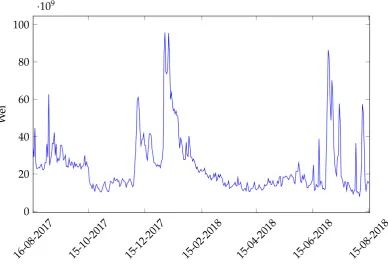
market; it increases when the demand to process transactions grows. Figure A.1 in Appendix A shows thegasPriceof mined transactions between August 16th2017 and August 15th2018.
TABLE3.1: Fields in an Ethereum transaction (Wood and Ethereum Foundation, 2018)
Field Description
nonce A scalar value equal to the number of transactions sent by the sender; formallyTn.
gasPrice A scalar value equal to the number of Wei to be paid per unit ofgas for all computation costs incurred as a result of the execution of this transaction; formally
Tp.
gasLimit A scalar value equal to the maximum amount of gas that should be used in executing this transaction. This is paid up-front before any computation is done and may not be increased later; formallyTg.
to The 160-bit address of the message call’s recipient or, for a contract creation transaction,∅, used here to de-note the only member ofB0; formallyTt.
value Values corresponding to the signature of the tion and used to determine the sender of the transac-tion; formallyTw,TrandTs.
v, r, s Three scalar values corresponding to the signature of the transaction and used to determine the sender of the transaction.
data (op-tional)
An unlimited size byte array specifying the input data of the message call, formallyTd.
init (op-tional)
An unlimited size byte array specifying the EVM-code for the account initialisation procedure, for-mallyTi.
3.2.4 Interacting with a Smart Contract
To invoke a method from a smart contract, one includes the method identifier and arguments in the data field of a transaction. The method identifier can be com-puted by taking the first four bytes of the SHA3 hash of the signature of the func-tion (Ethereum Foundafunc-tion, 2018b). Smart contracts can contain a fallback funcfunc-tion, which is implemented as an unnamed function, that will be triggered when a non-existing function is invoked. The fallback function does not take any arguments and has by default no return value.
1 [
2 {
3 " c o n s t a n t ": f a l s e,
4 " i n p u t s ": [
5 {
6 " name ": " x ",
7 " type ": " uint2 5 6"
8 }
9 ],
10 " name ": " set ",
11 " o u t p u t s ": [ ],
12 " p a y a b l e ": f a l s e,
13 " s t a t e M u t a b i l i t y ": " n o n p a y a b l e ",
14 " type ": " f u n c t i o n "
15 },
16 {
17 " c o n s t a n t ": true,
18 " i n p u t s ": [ ],
19 " name ": " get ",
20 " o u t p u t s ": [
21 {
22 " name ": "",
23 " type ": " uint2 5 6"
24 }
25 ],
26 " p a y a b l e ": f a l s e,
27 " s t a t e M u t a b i l i t y ": " view ",
28 " type ": " f u n c t i o n "
29 }
30 ]
LISTING3.2: The ABI of the Smart Contract from Listing 3.1
3.2.5 Operational Code
Only the EVM code of a smart contract is stored on the Ethereum blockchain. EVM code is hard to understand for human beings, making it nearly impossible to de-termine the execution path that is followed by a smart contract. An alternative for this is to translate the EVM code to operational code, which describes all low-level computations that are executed in a smart contract in a more human-readable rep-resentation. Ethereum Foundation (2017); Wood (2014) provide references for the hexadecimal codes for these low-level operations, and the amount ofgasused for each operation. A snippet of the operational code of the EVM code in section 3.2.2 is:
Chapter 3. Smart Contracts 24
The operational code allows to compute all possible states in which a smart con-tract can be. With the use of dedicated tools e.g. Mythril, a visualisation of all the possible states can be generated (ConsenSys Diligence, 2018a). An in-depth descrip-tion of Mythril and an alternative is provided in secdescrip-tion 4.2.
3.2.6 Oracles
Smart contracts are designed to interact with the outside world on a limited basis, only in case a smart contract is deployed, or a transaction is sent to a smart contract. An oracle is the bridge between blockchain and the outside world and allows to get external data onto the blockchain (Clack et al., 2016). Although it can be argued that a direct call from a smart contract to an outside located interface is supported by default, the traffic that will be generated by all the nodes to the interface might result in high response times or non-responding interfaces. Moreover, each node in the network might receive different results. For instance, an external service that is used to retrieve a random number between 1 and 100 will send different outcomes to each node. An oracle relies on a centralised service to perform the call to the external interface and to store the results on the blockchain (Oraclize Limited, 2018a). While the centralised service only performs a single request, each node will get the same return value from the oracle and the external interface will not be flooded with requests. A disadvantage of an oracle service is its centralisation, the oracle service provider could interfere with the execution. Oraclize Limited solved this challenge by implementing a proof of authenticity, using TLSNotary, to provide evidence that they did not interfere with the request or its result (Oraclize Limited, 2018b).
3.3
Use Cases
A growing body of literature investigates use cases of smart contracts. The results indicate that a smart contract provides value for a wide range of sectors. Idelberger et al. (2016) state that use cases of smart contracts include escrow services, savings and digital tokens in the banking sector, decentralised markets in the trading sec-tor, and administration of royalties in the music industry. A study by Frantz and Nowostawski (2016) suggests that smart contracts can be used for voting, crowd-funding, asset management and workflow management. Two domains that received significant interest from academics are the energy sector and Internet of Things (IoT). The energy sector can improve its efficiency and transparency by adopting smart contracts (Knirsch et al., 2018; Kounelis et al., 2017; Hahn et al., 2017; Lamers, 2018). In IoT, smart contracts can be implemented to enhance the level of security of the devices. (Banafa, 2017; Christidis and Devetsikiotis, 2016; Kshetri, 2017b; Bahga and Madisetti, 2016; Kshetri, 2017a).
This section touches upon use cases for smart contracts in digital tokens, escrow services, energy sector and IoT. It should be noted that the presented list of use cases in this section is non-exhaustive.
3.3.1 Escrow Services
be designed such that the assets are released after certain conditions are met by both parties. Frantz and Nowostawski (2016) and Ethereum Foundation (2018h) provide examples of smart contracts specifically designed to replace an escrow agent.
Current implementations of escrow smart contracts do not support the exchange of physical assets. A major challenge to digitalise the exchange of physical assets is to link the physical assets to a digital object. Although this is challenging, there are platforms that started supporting the exchange of physical assets, such as Propy (Prnewswire, 2018). Propy is a blockchain-based platform that enables users to buy and sell real estate in a digital manner. Start-ups, such as VeChain, aim to solve these challenges by implementing NFC-tags in physical assets (VeChain, 2018).
3.3.2 Digital Tokens
In recent years, it has become a prevailing method for start-ups in the blockchain sec-tor to raise capital by launching an initial coin offering (ICO). A study by Fenu et al. (2018) showed that 1082 start-ups raised a total capital between 30 and 40 billion US by means of an ICO in 2017. During an ICO, a start-up raises money by selling digital tokens using smart contracts. Catalini and Gans (2018) suggest that an ICO provides a better price discovery and that an ICO enables a start-up to attract more investors without giving each of them the rights that are typically associated with equity. Digital tokens can be categorised as either fungible or non-fungible tokens.
Fungible Tokens
Fungible tokens are digital tokens that are interchangeable and thus have the same value. An analogy of this concept is can be made with a one Euro coin: a one Euro coin can be exchanged with any other one Euro coin, it does not change anything for the holder. The ERC-20 standard was introduced to enable the re-use of this concept across different kinds of dApps (Vogelsteller et al., 2018).
Non-fungible Tokens
Non-fungible tokens are digital tokens that represent unique objects and are not in-terchangeable. An analogy of this concept are educational certificates: although each educational certificate is a certificate, the certificates do not have the same value. To enable the re-use of non-fungible tokens, the ERC-721 standard was introduced (En-triken et al., 2018).
3.3.3 Energy Sector
Chapter 3. Smart Contracts 26
2017). The researchers deployed a smart contract that automatically issued new dig-ital tokens for energy producers every time that the energy producer releases energy to the grid. The energy producers, such as households with solar panels, receive dig-ital tokens linearly with the amount of energy that they produce. A similar research was done by Hahn et al. (2017), however, they put more emphasis on the auction side of such smart grid systems. The researchers demonstrated the implementation of an auction that contains the key features and data to manage the energy auction process. This concept is also described in the master thesis by Lamers (2018).
3.3.4 Internet of Things
There is a considerable volume of published studies describing the role of smart con-tracts in IoT. Christidis and Devetsikiotis (2016) present a use case for smart concon-tracts in asset tracking with IoT. As the authors describe, a supply chain process involves a number of different stakeholders. Each stakeholder usually maintains their own database to keep track of the assets. Whenever a stakeholder sends an update about the asset, the other stakeholders update their own databases. The researchers de-scribe how IoT-enabled devices and smart contracts can improve the efficiency of the asset tracking process. By placing an IoT-enabled device on the asset, the asset itself can start broadcasting updates: “when the shipping carrier reaches the destination port, they send a signed message to a predetermined and agreed-upon smart contract to allow everyone on the chain to know that the container is now at point C. Since the transaction is signed, it acts as a cryptographically verifiable receipt of the shipping company’s claim that the container has reached the destination port. The receiver at the port posts to same smart contract to confirm that” (Christidis and Devetsikiotis, 2016).
Bahga and Madisetti (2016) elaborate on a blockchain platform for industrial manufacturing IoT device that deploys smart contracts. The Blockchain Platform for Industrial Internet of Things lets devices connect with the blockchain that uses smart contracts to facilitate the agreement between service consumers and manufac-turing resources. According to the authors, this platform can be used for:
(i) On-demand manufacturing
(ii) Smart diagnostics & machine maintenance
(iii) Traceability
(iv) Supply chain tracking
(v) Product certification
(vi) Consumer-to-machine & machine-to-machine transactions
(vii) Tracking supplier identity & reputation
(viii) Registry of assets & inventory