University of Warwick institutional repository: http://go.warwick.ac.uk/wrap
This paper is made available online in accordance with publisher policies. Please scroll down to view the document itself. Please refer to the repository record for this item and our policy information available from the repository home page for further information.
To see the final version of this paper please visit the publisher’s website. Access to the published version may require a subscription.
Author(s): D. Sanvitto, F. M. Marchetti, M. H. Szymańska, G. Tosi, M. Baudisch, F. P. Laussy, D. N. Krizhanovskii, M. S. Skolnick, L.
Marrucci, A. Lemaître, J. Bloch, C. Tejedor and L. Viña
Article Title: Persistent currents and quantized vortices in a polariton superfluid
Year of publication: 2010 Link to published article:
http://dx.doi.org/10.1038/NPHYS1668
Persistent currents and quantised vortices in a polariton
superfluid
D. Sanvitto,1,∗ F. M. Marchetti,2,† M. H. Szyma´nska,3 G. Tosi,1
M. Baudisch,1 F. P. Laussy,4 D. N. Krizhanovskii,5 M. S. Skolnick,5
L. Marrucci,6 A. Lemaˆıtre,7 J. Bloch,7 C. Tejedor,2 and L. Vi˜na1
1Departamento de F´ısica de Materiales,
Universidad Aut´onoma de Madrid, Madrid 28049, Spain
2Departamento de F´ısica Te´orica de la Materia Condensada,
Universidad Aut´onoma de Madrid, Madrid 28049, Spain
3Department of Physics, University of Warwick, Coventry, CV4 7AL, UK
4School of Physics and Astronomy,
University of Southampton, Southampton, SO17 1BJ, UK
5Department of Physics and Astronomy,
University of Sheffield, Sheffield, S3 7RH, UK
6Dipartimento di Scienze Fisiche, Universit`a di
Napoli Federico II and CNR-SPIN, Napoli, Italy
7LPN/CNRS, Route de Nozay, 91460, Marcoussis, France
(Dated: January 18, 2011)
After the discovery of zero viscosity in liquid helium, other fundamental
prop-erties of the superfluidity phenomenon have been revealed. One of them,
irrota-tional flow, gives rise to quantised vortices and persistent currents. Those are the
landmarks of superfluidity in its modern understanding. Recently, a new variety
of dissipationless fluid behaviour has been found in microcavities under optical
parametric regime. Here we report the observation of metastable persistent
po-lariton superflows sustaining a quantised angular momentum, m, after applying
a 2 ps pulsed probe carrying a vortex state. We observe a transfer of angular
momentum to the condensate steady state, which sustains vorticity for as long
as it can be tracked. Furthermore, we study the stability of quantised vortices
with m = 2. The experiments are analysed via a generalised two-component
Gross-Pitaevskii equation. These results, aside from demonstrating the
con-trol of metastable persistent currents, show the peculiar superfluid character of
non-equilibrium polariton condensates.
Polariton superfluid phases out of equilibrium
One route to inject polaritons into a microcavity is by non-resonant (incoherent) pumping. For incoherent pumping, polaritons have been shown to enter, within their short lifetime, a macroscopically coherent BEC phase [1, 5, 6]. However, the unusual form of the excitation spectrum—diffusive at small momenta—hinders the fulfilling of the Landau criterion and puts under debate the possibility of dissipationless superflow in incoherently pumped po-lariton systems [7–9]. Because of the non-equilibrium nature of the popo-lariton condensate in an inhomogeneous system, there are spontaneous supercurrents that may carry polaritons from gain to loss dominated regions. This can give rise to spontaneous formation of de-terministic vortices, that do not necessarily imply superfluidity [4, 10]. Another peculiarity of polariton systems is to be found in their polarization, giving rise to a nomenclature of half-vortices [11, 12].
Generation of persistent currents
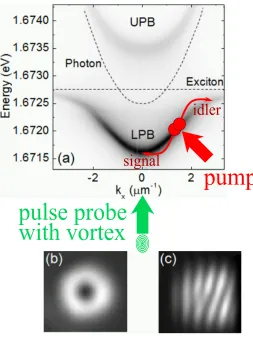
In our experiment, the vortex is excited by a pulsed probe resonant with the signal (see Fig. 1) lasting only 2 ps. In other words, we stir the polariton superfluid only for a short time and observe its long lived rotation with a quantum of angular momentum on a time scale almost 70 times longer than the duration of the pulse (see Figs. 2 and 3). Although there is a similarity with rotating trapped gases, the effect for driven, non-equilibrium systems shows a richer phenomenology as will be described in the rest of this paper. Beside, a characteristic of vortices with higher winding numbermis the tendency to coherently split into many vortices ofm= 1 [21]. To study the stability properties of vortices in polariton condensates, we have injected a vortex with m= 2 and observed its evolution (see Fig. 4). Surprisingly, we found three different behaviours depending on the initial condition. In cases for which the vortex is imprinted into the signal steady state, one topological charge is always expelled out of the condensate (Fig. 4 (g-i)). On the other hand, when the vortex is not imprinted in the steady state but lasts only as long as the perturbation of the signal, we observe either a stable vortex of m = 2 when the probe carrying the vortex is at small momentum, resulting in a static (or slowly moving) vortex and slow supercurrents, or a splitting in two vortices of m = 1 when the vortex is injected with a probe at higher momentum. In the latter case, the vortex is moving faster than when it does not split, but still slower than the supercurrents of the condensate. Instability of doubly quantised vortices in a BEC has been observed in several systems [21], but there are only a few examples of their stability, such as in superconductors in the presence of pinning forces [22] or in a multicomponent order parameter superfluid such as3He-A [23]. In ultra-cold atomic gases, stable free m= 2 vortices have been theoretically predicted for some range of densities and interaction strengths [24]. However, they have been observed only in a toroidal pinning potential with an external optical plug [20], and demonstrated to split soon after the plug has been removed. The stability of m = 2 static vortex in polariton systems provides an additional experimental realization.
FIG. 1: Lower (LPB) and upper polariton branch (UPB) dispersions together with the schematic
representation of the TOPO excitation (a). Resonantly pumping the LPB initiates, above
thresh-old, stimulated scattering to a signal close to zero momentum and an idler at higher momentum.
The m= 1 Laguerre-Gauss beam resonant with the signal (b) is used as a weak pulsed triggering
probe to stir the superfluid. The corresponding interference image is shown in panel (c).
a superfluid can exhibit infinitely lived circulating flow in a dissipative environment once the external drive is turned off. In order to demonstrate persistence of the vortex angular momentum, we detect the phase pattern generated by making interfere the polariton signal with an expanded and flipped spatial region far from the vortex core (where the phase is approximately constant) in a Michelson interferometer. A fork-like dislocation with a difference of m arms corresponds to phase winding by 2πm around the vortex core (see lower panel of Fig. 1).
Vortex dynamics
Using a streak camera we can follow the evolution in time of the vortex generated by the pulsed probe. Time intervals of 4 ps are used to reconstruct 2D images of the signal state after the perturbation has arrived. Every picture is the result of an average over many shots, all taken at the same time and same conditions. In order to separate the contribution of the signal from that of the pump, we filter, both in theory and experiments, the signal images in momentum space in a cone around k= 0 of approximately ±7◦. At time tpb, the pulsed laser probe is shined on the sample. Its general effect is to enhance the polariton signal emission by a factor that ranges, depending on the experiment, between a few percent to more than 100 % with a delay of 10 ps after the pulse arrival time. At first a strong gain given by the presence of the probe creates an extra population on top of the OPO signal (called TOPO polaritons) before the OPO signal is re-established. We follow the evolution of the transient state and monitor how the probe affects the condensate in its steady state. We find that the original steady state can be recovered but also, more interestingly, that different stable solutions are possible.
-10 0 10 20 -5 0 5 10 15 Y ( m)
X ( m)
20 40 60 80 100 120 140 -300 -250 -200 -150 -100 -50 0 50 In te n s ity ( a rb . u n its) Time (ps)
20 40 60 80 100 120 140 -300 -250 -200 -150 -100 -50 0 50 100 6mW 5mW 0,25mW 0,1mW In te n s ity ( a rb . u n its) Time (ps) x x x x x x x x
(b) (c) (d)
(f) (g) (h)
(i) (j) (k)
(a)
[image:8.612.90.503.83.427.2](e)
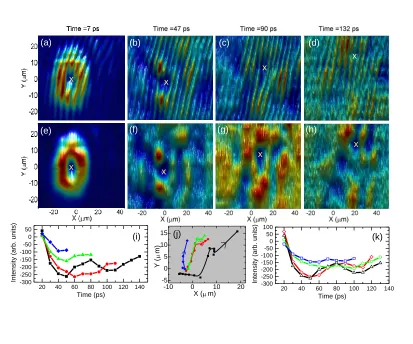
FIG. 2: Time evolution of the polariton signal after a weak pulsed probe with a vortex of m= 1
has been excited (a-h). The interference images (a-d) are obtained by overlapping the vortex with a
small expanded region of the same image far from the vortex core, where the phase is constant. The
time origin is taken when the extra population has reached 80% of its maximum value. To better
reveal the effect of the imprinting of the vortex into the condensate steady state of the signal, the
contribution of the unperturbed polariton signal (in absence of the probe pulse) is subtracted from
all data. The depth of the vortex core and its position as a function of time for 4 different pump
powers (65 mW, blue diamonds, 100 mW, green triangles, 200 mW red circles, 300 mW, black
squares)—all above the OPO threshold (50 mW)—is shown in (i) and (j) respectively. The effect
of probe power—0.15µW in blue squares, 0.33µW in green circles, 6.65µW in black triangles,
polaritons, only under very high pump power and at specific points in the sample is the vorticity also passed to the steady state of the OPO signal. This not only demonstrates that polariton condensates show unperturbed rotation, but also that a vortex is another stable solution of the final steady state. This is a clear demonstration of superfluid behaviour in the non-equilibrium polariton OPO system. These effects are visible in the real space images through the ‘toroidal shape’ of the polariton emission at early times, and the presence of a fork dislocation in the interference images at all times. The latter show that the spatial phase relation remains constant and with full contrast all over a wide area, even for times much longer than the signal coherence time, as measured by detecting the decay of interference-fringe contrast when delaying the signal and the reference (see Fig. 6 in the supplementary material). This means that even when polaritons have lost any phase relation in time, their angular momentum is still conserved.
After the vortex is imprinted into the OPO signal, we can observe the vortex core slowly drifting to the right and then upwards changing in shape and moving with different velocities. The drift is due to the fact that the vortex core is naturally inclined to undergo a random walk and eventually either remains permanently trapped in the condensate or is expelled from the edges (see the following theory and Ref. [25]). However, due to the presence of local defects [26], which tend to influence the motion of the vortex, the path followed by the vortex core recurs at each repetition of the experiment. For this reason we are able to track its movement that otherwise would be washed out by the experimental averaging.
fluid to accommodate a vortex at low intensities has also been predicted for incoherently pumped polariton condensates [25]. However, once the transfer is achieved, the probe power does not change significantly the duration and depth of the vortex in the steady state. An alternative interpretation of the short vortex lifetime, for low excitation powers, could be attributed to dissipation when the average angular velocity is higher than some critical velocity–leading to the onset of macroscopic drag forces (like recently discussed for non-resonant pumping in Ref. [9]). Therefore, taking the difference between opposite momenta across the vortex core, we have obtained the average angular velocity to be ∼ 0.2 µm/ps. This value sets a lower bound for the critical velocity, which depends on polariton densities and, for small pumping powers, could be the cause of short lasting times for the polariton vorticity.
The sequence in Fig. 2 demonstrates that the vortex remains steady as a persisting metastable state for times much longer than the extra population created by the probe pulse and eventually gets imprinted in the steady state of the OPO signal. This is revealed by the strong contrast of the fork in the interference images for as long as the core remains within the condensate area. In the opposite scenario—dissipation of angular momentum as for classical fluids—the interference images would show low contrast in the vortex core region, indicating a mixture of the population which has undergone dissipation and the one still carrying the quantised angular momentum.
In our experiments we have measured an average size of the core radius between 4 and 5 µm. This is in good agreement with a theoretical estimate of the healing length ξ '
π/√2mLPδE, where mLP is the lower polariton mass and δE is the lower polariton blue-shift, determined by the polariton-polariton interaction strength.
Numerical simulations
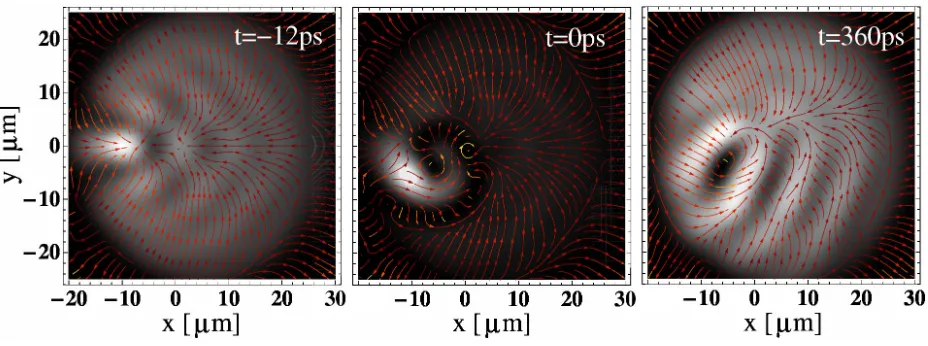
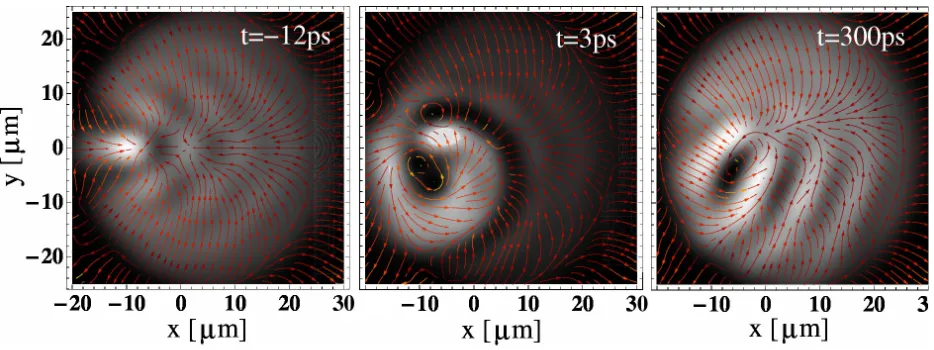
FIG. 3: Numerical simulations of the time evolution of the OPO signal before and after the arrival
(t = 0) of a pulsed probe carrying an m = 1 vortex resonant with the signal momentum and
energy, for pumping strength fp = 1.24fp(th) above OPO threshold. The images of the signal are
obtained by momentum filtering in a cone of around±7◦. The pulse carrying the vortex generates
a gain which fades out after about 10 ps leaving an m= 1 vortex imprinted into the signal. The
vortex experiences a transient time of around 30 ps before settling into a metastable solution. The
supercurrents are plotted in the frame of the signal by subtracting the kof the signal.
signal anymore. Thus the results of the theoretical simulations are in excellent qualitative agreement with the experimental observations.
Doubly quantised vortices
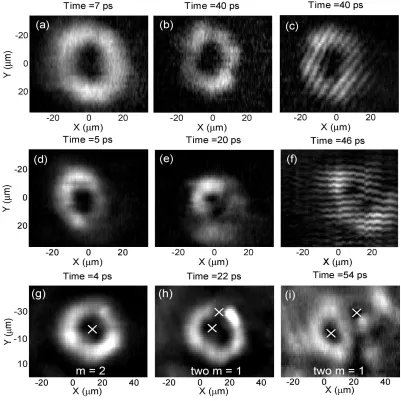
A second experiment is aimed at investigating the stability of doubly quantised vortices in different regimes. We perform both experiments and numerical simulations in conditions similar to the ones previously described, but now considering a pulsed probe carrying a doubly quantised vortex m = 2. We demonstrate three distinctive behaviours (see Fig. 4) by repeating the experiments under different conditions. For cases in which the vortex lasts as long as the TOPO population is present, we observe that when the vortex is excited on a static signal centered at k= 0, it does not split within its lifetime [Fig. 4 (a-c)]. However, exciting the signal with a finite momentum, thus making it moving inside the pump spot, we observe the doubly quantised vortex splitting into two singly quantised vortices, as shown in Fig. 4 (d-f).
Our theoretical analysis gives the same result: a TOPO vortex (below the OPO threshold) is stable when it is either at rest or moves below a critical velocity, and splits otherwise (see Fig. 5). In order to explain this result, we have analysed the supercurrents characterizing the signal. We found that, below threshold, these supercurrents are a superposition of the vortex currents with a net current corresponding exactly to the momentum kpb at which the probe has been injected. In addition, we have evaluated the group velocity vg at which the triggered signal (carrying the vortex) moves in real space. We found that vg increases linearly with kpb up to a critical value, kcrpb, and sublinearly above. Therefore, we expect that in the frame of the moving vortex, there is no net current in the linear regime, while, in the sublinear regime, the vortex feels a net current which causes it to split (see Fig. 5). Indeed, we observe that the m = 2 vortex splits exactly when is injected at or above kcrpb. Note that a TOPO signal is a decaying state, therefore them = 2 vortex can be stable only within its lifetime.
FIG. 4: Time evolution of a m = 2 vortex TOPO signal excited close to zero momentum, k= 0,
(a-c) for which neither motion nor splitting of the vortex could be detected. However for a signal
atks pointing to the right (d-f), we can detect the m= 2 vortex both moving and splitting into
two single quantisedm= 1 vortices. In the last panel of the first two rows we plot the interference
images corresponding to a late time. In both experiments the vortex is only present in the TOPO
population. On the contrary, when the vortex is imprinted into the OPO state, then the situation is
as shown in the images (g-i). Here the splitting appears immediately after the angular momentum
FIG. 5: Calculated TOPO signal emission for a m = 2 triggering probe atkpb = 0.1µm−1 <kcrpb
(first row) and atkpb= 0.7µm−1>kcrpb (second row) at the arrival of the probe (t= 0) and 42 ps
after. The supercurrents are plotted in the frame of the group velocity of the moving vortex. In
the second row, the net current felt by the m= 2 vortex causes it to split.
in the signal is complex and thus a stationary vortex will always feel a net current. This is the reason why above OPO we always observe splitting of the m= 2 vortex.
Acknowledgements
Cambridge, UK) for the use of computer resources. Requests should be addressed to D.S. for experimental details and to F.M.M. for theoretical matters.
Author contributions
D.S., G.T. and M.B. carried out the experiments. F.M.M. and M.H.S. performed the theoretical simulations. L.M. provided the holograms for getting vortex excitation and A.L. and J.B. fabricated the samples. All the authors analysed the results, discussed the underlying physics and contributed to the manuscript.
METHODS
Experiments
The sample studied is aλ/2 AlAs microcavity with a 20 nm GaAs quantum well placed at the antinode of the cavity electromagnetic field. The cavity is formed by two high reflective Bragg mirrors of 25 pairs at the bottom and 15.5 on the top of the structure. The pump is obtained with a cw Ti-Sapphire laser, resonantly exciting the LPB close to the inflection point at 9◦. The spot size is of ≈100 µm.
The experiments are performed at a cryogenic temperature of 10 K and using a very high numerical aperture lens (0.6) so that the sample could be accessed by angles as large as 25◦ and the photoluminescence (PL) can be simultaneously collected from the signal state in the near as well as the far field. The PL was collected through a 0.5 m spectrometer into a streak camera, working in synchroscan mode, with 4 ps time resolution, allowing for energy—as well as time-resolved—images. In order to reach high time resolution, all the images where obtained by filtering the signal in the far field without spectrally resolving the emission of the OPO states. Differently from our TOPO experiment [28], here we excite and trigger with the probe at the signal state in a pumping regime above threshold.
the vortex state. In this latter case the probe is arriving on the sample with a finite angle, between one or two degrees, so that the vortex can have a finite velocity showing splitting of them = 2 state. The probe is focussed in a region of ≈25µm having a power set to be below the intensity of the signal. Moreover, considering the wide energy spread given by its fast duration (2 ps) the amount of power getting into the cavity is estimated to be between 1/10 and 1/5 of the signal emission. Every picture is the result of an average over many shots, as single shot measurements would give a too low signal to noise ratio.
A realization of optically transferring orbital angular momentum to atomic BECs, using Laguerre-Gauss beams, as in our experiments, was performed using a two-photon stimulated Raman process [19]. m = 2 were generated in a BEC of sodium atoms but its stability was not analysed.
Theory
The dynamics of amplitudes and phases of TOPO is analysed using two-component Gross-Pitaevskii equation with external pumping and decay for the coupled cavity and exciton fields ψC,X(r, t) (~= 1):
i∂t ψX ψC =
ωX −iκX +gX|ψX|2 ΩR/2
ΩR/2 ωC −iκC
ψX ψC + 0
Fp+Fpb
. (1)
Since the exciton mass is four orders of magnitude larger than the photon mass, we neglect the excitonic dispersion and assume a quadratic dispersion for the cavity photon, ωC =
ωC(0)− ∇2/2mC. The fields decay with ratesκC,X. ΩRis the photon-exciton coupling. The cavity field is driven by an external cw pump field,
Fp(r, t) = fpe
−|r−rp|2
2σp2 ei(kp·r−ωpt) ,
while the probe is a Laguerre-Gaussian pulsed beam,
Fpb(r, t)'fpb|r−rpb|me
−|r−rpb|2
2σ2
pb eimϕ(r)e
−(t−tpb)2
2σ2
t ei(kpb·r−ωpbt) , (2)
producing a vortex atrpbwith winding numberm. The exciton repulsive interaction strength
We take mC = 2.3×10⁻⁵m0 and a Rabi splitting ΩR = 4.4 meV determined experi-mentally. In the regime of our experiments, we can neglect the saturation of the dipole coupling [29]. We choose the pumping angle kp, the energy of the pump ωp and the pump profile as the experimental ones.
SUPPLEMENTARY MATERIAL
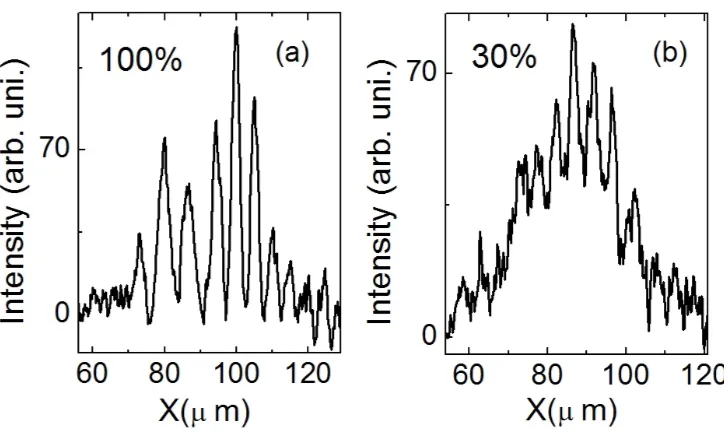
FIG. 6: Intensity of interference fringes (arbitrary units) of the polariton emission after arrival of
the probe pulse. The two images are taken at different delay times between the polariton signal
and its mirrored counterpart: (a) 0 ps and (b) 55 ps time delay.
In Fig. 6 we show the intensity of the interference fringes of the vortex with m = 1 (Fig. 2 of the main text) obtained with the Michelson interferometer but at different time delays between the two arms. Immediately after the probe has arrived, and at zero delay, the fringes exhibits a visibility close to 100%, while it reduces to 30% for a delay of 55 ps. However the interferences of the vortex core of Fig. 2—taken always at zero delay time—do not show any degradation of the visibility even for more than 100 ps after the probe has arrived, demonstrating the persistence of the polariton vorticity.
FIG. 7: Calculated time evolution of the OPO signal emission for am= 2 triggering probe before
the arrival of the probe att= 0 and after, showing the splitting of the imprinted doubly quantised
vortex, the expulsion from the signal of onem= 1 vortex and the stabilisation of the otherm= 1
[image:19.612.74.539.370.545.2]vortex into the signal. The supercurrents are plotted in the frame of the signal like in the Fig. 3.
FIG. 8: Calculated time evolution of the OPO signal emission for a m= 2 triggering probe as in
Fig. 7 but for smaller spatial size of the signal showing that the qualitative behaviour of doubly
quantised vortices remains the same for smaller signals.
∗ Electronic address: [email protected]
[1] Kasprzak, J. et al. Bose-Einstein condensation of exciton polaritons. Nature 443, 409–414
(2006).
[2] Weisbuch, C., Nishioka, M., Ishikawa, A. & Arakawa, Y. Observation of the coupled
exciton-photon mode splitting in a semiconductor quantum microcavity. Phys. Rev. Lett. 69, 3314–
3317 (1992).
[3] Keeling, J., Marchetti, F. M., Szyma´nska, M. H. & Littlewood, P. B. Collective coherence in
planar semiconductor microcavities. Semicond. Sci. Technol.22, R1–R26 (2006).
[4] Keeling, J. & Berloff, N. G. Going with the flow. Nature 457, 273–274 (2009).
[5] Balili, R., Hartwell, V., Snoke, D., Pfeiffer, L. & West, K. Bose-Einstein condensation of
microcavity polaritons in a trap. Science 316, 1007–1010 (2007).
[6] Lai, C. W. et al. Coherent zero-state and π-state in an exciton-polariton condensate array.
Nature 450, 529–532 (2007).
[7] Szyma´nska, M. H., Keeling, J. & Littlewood, P. B. Nonquilibrium quantum condensation in
an incoherently pumped dissipative system. Phys. Rev. Lett.96, 230602 (2006).
[8] Wouters, M. & Carusotto, I. Excitations in a nonequilibrium Bose-Einstein condensate of
exciton polaritons. Phys. Rev. Lett.99, 140402 (2007).
[9] Wouters, M. & Carusotto, I. Are non-equilibrium Bose-Einstein condensates superfluid?
(2010). Cond-mat/1001.0660.
[10] Lagoudakis, K. G. et al. Quantised vortices in an exciton-polariton fluid. Nature Physics 4,
706–710 (2008).
[11] Rubo, Y. G. Half vortices in exciton polariton condensates. Phys. Rev. Lett. 99, 106401
(2007).
[12] Lagoudakis, K. G. et al. Observation of half-quantum vortices in an exciton-polariton
con-densate. Science 326, 974–976 (2009).
[13] Amo, A.et al. Collective fluid dynamics of a polariton condensate in a semiconductor
micro-cavity. Nature 457, 291–295 (2009).
[14] Amo, A. et al. Superfluidity of polaritons in semiconductor microcavities. Nat. Phys. 5,
805–810 (2009).
[15] Stevenson, R. M. et al. Continuous wave observation of massive polariton redistribution by
stimulated scattering in semiconductor microcavities. Phys. Rev. Lett. 85, 3680–3683 (2000).
[17] Dholakia, K., Simpson, N. B., Padgett, M. J. & Allen, L. Secind harmonic generation and
the orbital angular momentum of light. Phys. Rev. A 54, R3742–R3745 (1996).
[18] Martinelli, M., Huguenin, J. A. O., Nussenzveig, P. & Khuory, A. Z. Orbital angular
momen-tum exchange in an optical parametric oscillator. Phys. Rev. B 70, 013812 (2004).
[19] Andersen, M. F. et al. Quantized rotation of atoms from photons with orbital angular
mo-mentum. Phys. Rev. Lett.97, 170406 (2006).
[20] Ryu, C.et al. Observation of persistent flow of a Bose-Einstein condensate in a toroidal trap.
Phys. Rev. Lett. 99, 260401 (2007).
[21] Shin, Y.et al. Dynamical instability of a doubly quantized vortex in a Bose-Einstein
conden-sate. Phys. Rev. Lett. 93, 160406 (2004).
[22] Baert, M., Metlushko, V. V., Jonckheere, R., Moshchalkov, V. V. & Bruynseraede, Y.
Com-posite flux-line lattices stabilized in superconducting films by a regular array of artificial
defects. Phys. Rev. Lett.74, 3269–3272 (1995).
[23] Blaauwgeers, R. et al. Double-quantum vortex in superfluid 3He-A. Nature 404, 471–473
(2000).
[24] M¨ott¨onen, M., Mizushima, T., Isoshima, T., Salomaa, M. M. & Machida, K. Splitting of a
doubly quantized vortex through intertwining in Bose-Einstein condensates. Phys. Rev. A68,
023611 (2003).
[25] Wouters, M. & Savona, V. Creation and detection of vortices in polariton condensates (2009).
Cond-mat/0904.2966.
[26] Sanvitto, D. et al. Spatial structure and stability of the macroscopically occupied polariton
state in the microcavity optical parametric oscillator. Phys. Rev. B 73, 241308 (2006).
[27] Whittaker, D. Vortices in the microcavity optical parametric oscillator. Superlatt. and
Mi-crostruct. 41, 297–300 (2007).
[28] Ballarini, D.et al. Observation of long-lived polariton states in semiconductor microcavities
across the parametric threshold. Phys. Rev. Lett.102, 056402 (2009).
[29] Ciuti, C., P.Schwendimann & Quattropani, A. Theory of polariton parametric interactions in