University of Warwick institutional repository: http://go.warwick.ac.uk/wrap
A Thesis Submitted for the Degree of PhD at the University of Warwick
http://go.warwick.ac.uk/wrap/49056
This thesis is made available online and is protected by original copyright. Please scroll down to view the document itself.
Patterns of Stent Purchasing in a Collaborative
Procurement Organisation
by
Joseph David James McCabe
A thesis submitted in partial fulfilment of the requirements for the
degree of Doctor of Philosophy
University of Warwick, Warwick Business School
Table of Contents
Table of Contents ...i
Table of Figures ... vii
Table of Tables...x
Table of Tables...x
Acknowledgements ... xiii
Declaration ... xiv
Abstract ...xv
1 Introduction...1
1.1 Overview ... 1
1.2 Background to the Research... 2
1.3 Objectives of the Research... 4
1.4 Contribution of the Research ... 5
1.5 Research Questions ... 7
1.6 Methodology ... 7
1.7 Structure of the Thesis ... 10
2 Buying Behaviour in Collaborative Procurement Organisations...14
2.1 Introduction... 14
2.2 Collaborative Procurement... 17
2.2.1 Motivation for Collaborative Purchasing...19
2.2.2 Critical Success Factors for Collaborative Purchasing ...21
2.3 Concepts of Loyalty ... 23
2.3.1 Purchasing Behaviour within the Buying Organisation...27
2.4 Quantitative Models of Organisational Behaviour ... 35
2.4.1 Econometric Models ...37
2.4.2 Empirical Generalisations ...40
2.4.3 Model Selection ...57
2.5 Summary ... 62
3 Research Methodology...65
3.1 Introduction... 65
3.2 Empirical then Theoretical... 66
3.3 Epistemological Location of the Research... 67
3.3.1 EtT as a Research Programme ...68
3.3.2 Plurality of Method – A Rich Picture ...69
3.3.3 Progression of Scientific Discovery...72
3.3.4 Empirical Testing...72
3.4 Research Study Design ... 74
3.4.1 Data Sources...75
3.4.2 Sample Frame...80
3.4.3 Data Analysis ...83
3.4.4 Fitting the Model...85
3.4.5 Using the Model...95
3.5 Qualitative Analysis ... 113
3.6 Summary ... 114
4 Procurement in the National Health Service...116
4.1 Introduction... 116
4.2 NHS Structure ... 117
4.2.2 NHS Trusts...119
4.2.3 Foundation Trusts...120
4.2.4 Regulation ...121
4.3 Purchasing and Supply in the NHS... 121
4.3.1 Structure ...122
4.3.2 Collaborative Purchasing in the NHS ...125
4.3.3 Procurement Decision-Making in the NHS ...127
4.3.4 Constraints Facing NHS Procurement ...128
4.4 Stent Purchases in the NHS... 130
4.5 Summary ... 132
5 Pilot Study - Modelling Stent Procurement in a Single NHS Trust...134
5.1 Introduction... 134
5.2 Description of the Data ... 135
5.2.1 Purchases by Requisitioner ...135
5.2.2 Purchases by Supplier ...137
5.2.3 Summary Statistics...140
5.3 Data Analysis and Interpretation... 141
5.3.1 Sample Frame...141
5.3.2 Purchase Distributions ...142
5.3.3 Penetration Growth ...146
5.3.4 Share of Category Requirements ...147
5.3.5 Sole Buyers ...149
5.4 Discussion ... 150
5.4.1 Dirichlet Assumptions...151
5.4.3 Managerial Implications...153
5.4.4 Buyer Repertoires...154
5.5 Summary ... 155
6 Modelling Ureteral Stent Procurement in a Collaborative Purchasing Hub...156
6.1 Introduction... 156
6.2 Description of the Data ... 158
6.2.1 Purchases by Requisitioner ...158
6.2.2 Purchases by Supplier ...161
6.2.3 Summary Statistics...164
6.3 Data Analysis and Interpretation... 165
6.3.1 Sample Frame...165
6.3.2 Purchase Distributions ...166
6.3.3 Penetration Growth ...170
6.3.4 Share of Category Requirements ...174
6.3.5 Duplication of Purchases...177
6.4 Discussion ... 179
6.4.1 Dirichlet Assumptions...180
6.4.2 Theoretical Implications...181
6.4.3 Managerial Implications...184
6.5 Summary ... 188
7 Modelling Coronary Stent Procurement in a Collaborative Purchasing Hub...190
7.1 Introduction... 190
7.2.1 Purchases by Requisitioner ...192
7.2.2 Purchases by Supplier ...196
7.2.3 Summary Statistics...200
7.3 Data Analysis and Interpretation... 204
7.3.1 Sample Frame...204
7.3.2 Purchase Distributions ...204
7.3.3 Penetration Growth ...209
7.3.4 Share of Category Requirements ...218
7.3.5 Proportion of Sole Buyers...222
7.3.6 Duplication of Purchase ...224
7.4 Qualitative Analysis ... 226
7.4.1 Buyer Experience and Commitment ...226
7.4.2 Relationship between Buyers and Suppliers ...228
7.4.3 Nature of the Purchasing Intervention ...229
7.5 Discussion ... 231
7.5.1 Dirichlet Assumptions...231
7.5.2 Theoretical Implications...232
7.5.3 Managerial Implications...236
7.6 Summary ... 239
8 Research Implications and Suggestions for Further Research...241
8.1 Introduction... 241
8.2 Theoretical Implications... 242
8.2.1 Extension of the NBD-Dirichlet Empirical Generalisation ...243
8.2.3 Stochastic Modelling and Industrial Networks – Complementary
Views of Organisational Behaviour...250
8.3 Managerial Implications... 252
8.3.1 Buyer Repertoires...253
8.3.2 Supplier Loyalty...254
8.3.3 Practical Applications of the NBD-Dirichlet Model in Purchasing and Supply Management...255
8.4 Limitations and Suggestions for Further Research ... 261
8.4.1 Differentiated Replication...263
8.4.2 Extended Case Research ...265
8.5 Summary ... 267
9 Conclusions...269
9.1 Introduction... 269
9.2 Research Objectives ... 269
9.3 Research Findings ... 270
9.4 Contribution ... 272
9.5 Summary ... 274
Appendix A Stochastic Modelling and Industrial Networks - Complementary Views of Organisational Buyer Behaviour ...276
Appendix B Abbreviations and Notation ...303
Appendix C Interview Questions and Transcript ...305
Table of Figures
Figure 2.1 Taxonomy of organisation buying research (Barclay, 1992)... 16
Figure 2.2 Loyalty conditions (Dick & Basu, 1994) ... 24
Figure 3.1 Distributional assumptions of the NBD-Dirichlet... 82
Figure 3.2 Table of Dirichlet proportions... 97
Figure 3.3 Matrix of Duplication proportions ... 107
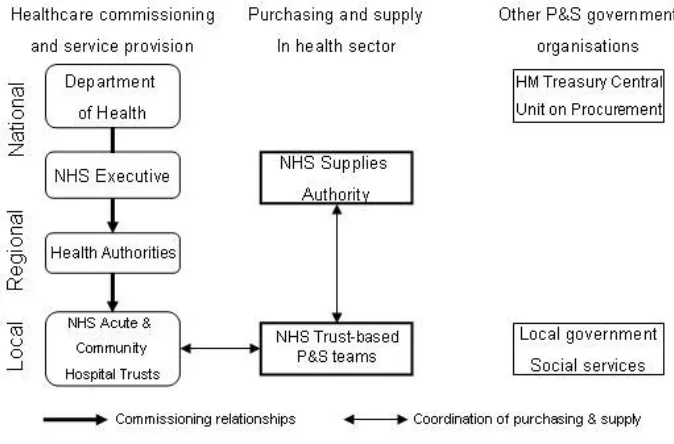
Figure 4.1 Structure of English National Health Service ... 118
Figure 4.2 Structure of NHS Purchasing & Supply 1997-1998 (Harland et al, 2007) ... 122
Figure 4.3 Structure of NHS Purchasing & Supply 2002-2003 (Harland et al, 2007) ... 123
Figure 4.4 Structure of NHS Purchasing & Supply 2007-2009 ... 124
Figure 4.5 Structure of NHS Purchasing & Supply 2010- ... 125
Figure 4.6 TAXUS® Express2™ Atom™ Paclitaxel-Eluting Coronary Stent System ... 130
Figure 5.1 Stent purchases by requisitioner... 136
Figure 5.2 Weekly market share by supplier... 138
Figure 5.3 Average weekly purchase frequency by supplier... 139
Figure 5.4 Expected and observed distribution of purchases (Medtronic)... 143
Figure 5.5 Expected and observed distribution of purchases (Boston) ... 144
Figure 5.6 Expected and observed distribution of purchases (Abbott) ... 144
Figure 5.7 Expected and observed distribution of purchases (Others)... 145
Figure 5.8 Expected and observed distribution of purchases for product category (Any) ... 145
Figure 6.2 Ureteral stent purchases by low frequency requisitioner ... 159
Figure 6.3 Monthly market share by supplier... 162
Figure 6.4 Monthly purchase frequency by supplier... 162
Figure 6.5 Expected and observed distribution of purchases (Boston) 2006 – 2008 ... 168
Figure 6.6 Expected and observed distribution of purchases (Cook) 2006 – 2008 ... 169
Figure 6.7 Expected and observed distribution of purchases (Others) 2006 – 2008 ... 169
Figure 6.8 Expected and observed distribution of purchases for product category (Any) 2006 – 2008 ... 170
Figure 7.1 Coronary stent purchases by requisitioner ... 193
Figure 7.2 Monthly market share by supplier... 198
Figure 7.3 Monthly purchase frequency by supplier... 198
Figure 7.4 Expected and observed distribution of purchases (Boston) 2006 – 2008 ... 206
Figure 7.5 Expected and observed distribution of purchases (Medtronic) 2006 – 2008... 206
Figure 7.6 Expected and observed distribution of purchases (Abbott) 2006 – 2008 ... 207
Figure 7.7 Expected and observed distribution of purchases (J&J) 2006 – 2008 ... 207
Figure 7.9 Expected and observed distribution of purchases for product category
Table of Tables
Table 3.1 Purchaser orders by category (single hospital trust) ... 79
Table 3.2 Weekly purchases by buyer ... 83
Table 3.3 Summary statistics (average two weekly)... 86
Table 3.4 Calculated NBD parameters... 88
Table 3.5 Calculated proportion of population buying the category n times... 91
Table 3.6 Summary of iterations to determine S for Abbott... 93
Table 3.7 Dirichlet parameters for pilot data ... 94
Table 3.8 Comparison of calculated S parameters for pilot data ... 95
Table 3.9 Section of Dirichlet proportions matrix (Abbott)... 99
Table 3.10 Penetration growth ... 100
Table 3.11 Purchase frequency in different time periods... 100
Table 3.12 Light and heavy purchasers... 101
Table 3.13 Repeat purchasing ... 103
Table 3.14 Share of category requirements (2 week)... 106
Table 3.15 Proportion of buyers of a particular supplier who only buy from that supplier... 106
Table 3.16 Average purchase frequency of sole buyers... 107
Table 3.17 Percentage of overall population buying from a pair of suppliers .... 108
Table 3.18 Percentage of buyers of one supplier who also buy from another .... 108
Table 3.19 Duplication of Purchase Coefficients... 109
Table 3.20 Selection of Goodness of Fit measures used in Dirichlet studies ... 112
Table 5.1 Weekly purchases by requisitioner ... 137
Table 5.2 Coronary stent purchases by supplier ... 138
Table 5.4 Comparison between observed and predicted distribution of purchases
... 142
Table 5.5 Observed and theoretical performance measures... 146
Table 5.6 Share of category requirements... 148
Table 5.7 Sole Buying... 149
Table 5.8 Observed duplication of purchase... 150
Table 6.1 Purchases by requisitioner (2006 – 2008)... 160
Table 6.2 Ureteral stent purchases by supplier ... 161
Table 6.3 Dirichlet predictions (average six months, first six months) ... 163
Table 6.4 Dirichlet predictions (3 year) ... 163
Table 6.5 Summary statistics 2006 - 2008 ... 165
Table 6.6 Comparison between observed and predicted distribution of purchases ... 166
Table 6.7 Observed and theoretical performance measures (12 week analysis period) ... 171
Table 6.8 Observed and theoretical performance measures, heavy purchasers (12 week analysis period)... 172
Table 6.9 Observed and theoretical performance measures, light purchasers (12 week analysis period)... 173
Table 6.10 Share of Category Requirements ... 176
Table 6.11 Observed duplication of purchase (entire buying population)... 178
Table 6.12 Observed duplication of purchase (heavy purchasing segment)... 179
Table 7.1 Cost Centre choice sets (2006 – 2008)... 194
Table 7.2 Purchases by requisitioner (2006 – 2008)... 196
Table 7.4 Dirichlet predictions (average 6 months, first six months)... 200
Table 7.5 Dirichlet predictions (3 year) ... 200
Table 7.6 Summary statistics 2006 - 2008 ... 202
Table 7.7 Comparison between observed and predicted distribution of purchases ... 205
Table 7.8 Observed and expected performance measures (6 month) ... 211
Table 7.9 Comparison of goodness of fit between full buying population, heavy segment and light segment... 213
Table 7.10 Observed and theoretical performance measures, heavy purchasers 214 Table 7.11 Observed and theoretical performance measures, light purchasers .. 215
Table 7.12 Average order quantity per purchase occasion ... 217
Table 7.13 Share of Category Requirements ... 219
Table 7.14 Proportion of sole buyers ... 223
Table 7.15 Observed duplication of purchase (entire buying population)... 225
Table 8.1 Simulated 12 week performance measures (ureteral stents) with 2008 market shares... 259
Table 8.2 Simulated 12 week performance measures (ureteral stents) with new supplier... 259
Acknowledgements
I give thanks to God whose grace and blessings have sustained me through the highs
and lows of this long journey.
I would like to acknowledge the assistance and support provided by my supervisors,
Dr Scott Dacko and Professor Philip Stern. Their advice has often been challenging
but always valuable and rewarding. I thank both of them for their confidence, their
unwavering patience and their generosity with their time and knowledge.
This research has depended on access to data within the National Health Service. I
am indebted to Samantha Forrest and Darren McVee and their colleagues in the NHS
for their assistance in securing access and in acquiring the necessary data for the
research, without which the research would not have been possible.
My family has been a constant support throughout the PhD process, in particular my
wife Ann. Her love and friendship have been unceasing and her encouragement has
helped me through to completion of my PhD. My two daughters, Sophie and
Rebecca, have been more patient than I could ever have imagined and I look forward
to spending more time with them. I would also like to thank my sister-in-law, Linda,
whose typing skills have been most helpful. Finally I would like to thank my mother
Lorna, who has always encouraged and supported me in whatever I have done.
Declaration
This is to declare that:
I am responsible for the work submitted in this thesis.
This work has been written by me.
All verbatim extracts have been distinguished and sources specifically
acknowledged.
During the preparation of this thesis, two conference presentations and one
journal paper were prepared as listed below. The remaining parts of the thesis
are unpublished.
McCabe, J., (2006), ‘Capital Equipment Purchasing: A Stochastic Model of Industrial
Buying Behavior’, Presented at the Doctoral Colloquium of the Annual Conference of
the Academy of Marketing Science, San Antonio TX, 2006.
McCabe, J., (2006), ‘Stochastic Modelling and Industrial Networks – Complementary
Views of Organisational Buyer Behaviour’, Presented at the Doctoral Colloquium of
the Annual Conference of the Academy of Marketing, London, 2006.
McCabe, J. and Stern, P., (2009), ‘Stochastic Modelling and Industrial Networks -
Complementary Views of Organisational Buyer Behavior’, Journal of the Academy of
Marketing Science, 37 (2): 204-214.
This work has not previously been submitted within a degree programme at this
or any other institution.
Abstract
Leveraging purchasing power through collaborative purchasing arrangements is widely used to deliver efficiency savings in public procurement. The success of such arrangements requires the purchasing behaviours of individual members of the collaborative organisation to change in order to realise the benefits of lower prices. However the actual purchasing behaviours of organisations within a collaborative purchasing arrangement have not been widely researched.
The research uses a stationary stochastic model of buyer behaviour, the
NBD-Dirichlet, to describe and predict the purchasing behaviours of buyers of coronary and ureteral stents in a collaborative purchasing organisation in the English National Health Service. The three year analysis period is a period of major change for each category, the result of supplier promotional activity in the ureteral stent case and purchasing management activity in the case of the coronary stents.
Deviations between the observed patterns of behaviour and the model predictions point to violations of the basic Dirichlet requirements of stationary markets and lack of partitioning. In both the ureteral and coronary stent cases the research identifies a segment of frequent purchasers whose behaviour differs from the rest of the
population. The impact of framework agreements in restricting the purchasing
repertoire of buyers is also identified as a deviation from typical purchasing patterns.
Both interventions result in changes to established loyalty patterns, whereby the initial high observed levels of loyalty towards particular suppliers are replaced by a greater willingness to purchase from alternative suppliers. The data analysis also provides preliminary evidence for purchase deceleration as buyers defer purchases during a negotiation period in anticipation of improved pricing.
1
Introduction
1.1
Overview
This research aims to describe, model and predict purchasing behaviours of
member organisations in a collaborative public procurement environment.
Collaborative procurement is seen by governments as a way of reducing
purchase costs and delivering value for taxpayer’s money. Increased supplier
leverage results in price reductions and transaction costs can be reduced by
pooling resources. However these cost savings usually decline year on year as
the opportunities for improvement diminish (Johnson, 1999). The delivery of
further savings requires product standardisation and vendor rationalisation
(Chapman et al, 1998), and for purchasers to change their behaviours concerning
supplier choice.
The importance of purchasing behaviour in achieving the goals of collaborative
procurement indicates a need for further research in this area. The collaborative
procurement literature is focused on describing, defining and theoretically
modelling cooperative purchasing. It addresses the motivation for collaboration,
the structures of collaborative procurement organisations, the evolution of these
structures and the conditions for successful collaborative procurement.
However there is a relative lack of research into how member organisations in
collaborative purchasing arrangements actually purchase and the effect of
membership of a purchasing group on members’ purchasing behaviours, in
This research therefore seeks to identify to what extent members of collaborative
procurement organisations exhibit regular patterns of buyer behaviour. An
established steady state stochastic model of consumer buyer behaviour, the
NBD-Dirichlet, is used to describe and predict the observed buyer behaviour in
order to assess the impact of collaborative purchasing arrangements on the
buying behaviour of member organisations.
1.2
Background to the Research
“Collaboration and saving taxpayer's money has never been so important. The current economic climate means that public spending is
coming under increased pressure and scrutiny with all parts of the public sector expected to work together and contribute to significant procurement
savings now and in the future.”
(Office of Government Commerce, 2010)
Collaborative procurement is seen by central government as a key mechanism to
achieve efficiency targets (Gershon, 2004; Bakker & Walker, 2008).
Aggregating demand to increase purchased volumes can improve leverage with
suppliers and deliver short term price reductions as well as reducing transaction
costs by pooling supplier management activities. Members of collaborative
procurement organisations also gain access to resources and capability that they
may not be able to access on their own and also benefit from improved
marketplace information (Essig, 2000; Bakker et al, 2006a). Financial savings
of up to 20% per year through transaction cost reductions, access to expertise
and leveraging demand have been reported from English local government
Delivered cost savings tend to decline as the procurement organisation matures
and the opportunities for supplier leverage diminish (Johnson, 1999). Longer
term savings require buyers to change their purchase behaviours in order to
benefit from supplier rationalisation and product standardisation (Chapman et al,
1998). As the managing director of a purchasing consortium notes “Most people
who do joint purchasing focus too much on negotiating discounts. They need to
control the whole process and concentrate on behaviour management …
otherwise we cannot move purchases from one vendor to another” (reported in
Cohen, 2002, p.29).
Much of the research into collaborative purchasing organisations has attempted
“to explain, predict and understand behaviour concerning the intent, purpose and
actual use of cooperatives in procurement” (McCue & Prier, 2006, p. 46). The
literature addresses why organisations pool their purchasing requirements, how
they pool these requirements (the structure and form of purchasing consortia),
how these consortia develop and the factors critical to the successful
implementation of collaborative procurement. Among the critical success
factors are the commitment and compliance of member organisations to the
requirements of the collaborative organisation, usually in terms of enforced
contracts involving minimum spend targets with particular suppliers. Failure to
comply with these targets can result in the imposition of punitive penalties
(Elhauge, 2002; Nollet & Beaulieu, 2005).
When the control of member behaviours is not coercive but relies on the
commitment of the members, the challenge for the purchasing manager is to
encouraging the use of new or alternative suppliers or discouraging the use of
others. To do this effectively, they need to understand the buying behaviours of
the member organisations in order to identify current loyalty patterns. For
example, a high incidence of members buying from a single supplier, so-called
sole loyalty, can result in a localised lack of competition such that suppliers may
become complacent and there is an increased risk of supply chain disruption.
An understanding of the current behavioural patterns can help the purchasing
manager to determine to what extent buyer behaviour can be changed, to design
intervention strategies and to ensure the sustainability of such interventions by
monitoring progress and compliance.
There has been no research into purchasers’ buying behaviour in collaborative
procurement organisations, either to establish whether any regular patterns can
be identified or to assess any changes in behaviour before and after a purchasing
invention, for example a supplier development initiative or implementation of
preferred supplier framework agreements. It is against this background that the
aims and objectives of the research were developed.
1.3
Objectives of the Research
This research addresses the gap in the purchasing literature by analysing and
modelling purchase behaviours in a collaborative procurement organisation.
The research has three main objectives:
i. To determine if organisational buyers in a collaborative purchasing
organisation exhibit regular patterns of purchase behaviour in terms
ii. If such patterns exist, to model the observed behaviours using an
established model of buyer behaviour, the NBD-Dirichlet and to use
this model to assess the impact of the collaborative purchasing
arrangements on observed buyer behaviours,
iii. To provide purchasing managers with metrics and benchmarks to
assess and monitor buyer behaviour.
1.4
Contribution of the Research
The collaborative purchasing literature is mainly concerned with the motivation
for the use of collaborative purchasing arrangements (Tella & Virolainen, 2005),
the structure and form of purchasing consortia (Bakker et al, 2006a), the
evolution of collaborative purchasing organisations (Laing & Cotton, 1997) and
the critical success factors that influence the successful implementation of
collaborative procurement (Schotanus et al, 2010). However there is a lack of
research that describes and explains how organisations in collaborative
purchasing groups actually behave.
In addition, the NBD-Dirichlet literature has primarily been concerned with fast
moving consumer goods with few applications in organisational purchasing
behaviour (Uncles & Ehrenberg, 1990; Bowman & Lele-Pingle, 1997; Pickford
& Goodhardt, 2000). Although concerned with buying behaviour in
organisations, these studies have all featured independent organisations that are
not operating within the constraints of a collaborative purchasing framework.
This research contributes to the understanding of organisational markets by
describing and explaining patterns of purchasing behaviour in a collaborative
NBD-Dirichlet has been used in a purchasing and supply chain context. The impact of
framework agreements on restricting buyer purchasing repertoires and in
changing established loyalty patterns is observed and discussed.
The research is a substantial extension of the NBD-Dirichlet model into a new
situation. The complex conditions of collaborative public procurement in a
regulated surgical supplies market represent a differentiated replication, further
extending the generalisability of the NBD-Dirichlet model of buyer behaviour.
The research also makes a contribution to marketing and purchasing theory by
arguing that stochastic modelling of buyer behaviour and the
markets-as-networks tradition of the Industrial Marketing and Purchasing (IMP) group of
researchers have much in common and can be complementary approaches to the
study of organisational marketing and purchasing behaviour.
For marketing and purchasing professionals, the research provides an
understanding of public procurement market structures. The model provides
norms and benchmarks of such measures as the extent of sole loyalty (the
proportion of purchasers who use one supplier only) and the rate that these
solely loyal purchasers actually buy. Such benchmarks can be used to assess the
effectiveness of procurement policies, for example the implementation of
framework agreements, supplier development or supplier rationalisation.
Loyalty metrics such as Share of Category Requirements can highlight the
extent of supplier competition and identify if any suppliers are enjoying
“excess” loyalty. If preferred supplier or framework agreements are
implemented, the same loyalty measures can be monitored to see if the
used by purchasers of a particular supplier (using duplication of purchase
tabulations), credible alternatives can be identified for supplier development.
By the same token highly duplicated suppliers which are purchased mainly by
buyers who fulfil most of their category requirements with other suppliers are
potential candidates for supplier rationalisation.
1.5
Research Questions
The objectives of the research give rise to three research questions:
i. Do organisational buyers in a collaborative purchasing organisation
exhibit regular patterns of purchase behaviour in terms of purchase
incidence and supplier choice?
ii. Can the NBD-Dirichlet accurately describe and predict the observed
purchasing behaviours?
iii. Can the NBD-Dirichlet theoretical predictions provide benchmarks
for purchasing managers to assess and monitor interventions to bring
about sustainable changes in buyer behaviour?
1.6
Methodology
The research is a differentiated replication of the NBD-Dirichlet model of buyer
behaviour. Under the Empirical then Theoretical (EtT) approach, empirical
regularities or patterns prompt the establishment of empirically grounded theory.
The theory is tested more widely under different conditions to extend its
generalisability and develop it conceptually (Ehrenberg, 1994). Previous
research has located the epistemology of replication and empirical generalisation
as a Lakatosian research programme (Stern, 1994), based on sophisticated
Sophisticated methodological falsification holds that empirical testing alone is
necessary but not sufficient for the refutation of a theory. Falsification can only
occur with the emergence of better theories. Research within the research
programme thus proceeds according to a “positive heuristic”, a set of guiding
research questions and theoretical forms. Within the research programme,
theories can be disproved but not proved and the refutation of a single theory is
not sufficient for rejection of the entire programme. The Lakatosian perspective
recognises that science is a creative process, occurring within the context of a
research programme established by the norms, beliefs and values of the
scientific community. It demands consistency within the guiding principles of
the research programme as a means of preserving scientific rationality although
it makes no claim for the objectivity or “truth” of science.
In the EtT approach (Ehrenberg, 1994) theory is tested more widely under
different conditions to extend the generalisability of the theory and develop it
conceptually. The cycle of replication and conceptual theory development
creates the “guiding questions” that shape a positive heuristic in a Lakatosian
research programme. The theory is judged not by how well it fits a single
instance but by how generalisable it is over a range of different circumstances
(Ehrenberg, 1995). The essence of replication is to find “significant sameness”
across many sets of data, preferably covering a wide range of conditions
(Barwise, 1995). Conditions that are not described by the theory do not
represent a refutation of the theory but rather establish boundary conditions for
application of the theory. If such situations are repeatable then new theory may
Data for the current research is collected from a Collaborative Purchasing Hub
in the English National Health Service (NHS). Collaborative procurement is
relatively mature in the NHS and aggregation of data from individual purchasing
organisations is well established. Exploratory discussions and analysis of pilot
data from a single NHS hospital trust identified coronary stents as a suitable
category for analysis. Coronary stents represent a significant expenditure for the
NHS and have been the subject of purchasing interventions in both the single
trust and the collaborative hub. The pilot study also established data
requirements and data availability for the research and served to test proof of
principle for the subsequent longitudinal study. This covers a three year period
during which a set of framework agreements for coronary stent supply were
discussed, negotiated and implemented. The dynamic development of the
market structure during this period is observed and modelled. Purchasing
patterns for ureteral stents are also analysed. This category has not been the
subject of any purchasing interventions and acts as a control against which to
compare performance in the coronary stent category.
The research employs an established stationary model of buyer behaviour, the
NBD-Dirichlet to describe and predict the observed patterns of purchasing
behaviour. By building on theory that is already proven, the research contributes
to the Dirichlet research programme and is more likely to generate findings that
are generalisable over a range of purchasing situations and purchase categories
than an isolated study that is specific to a single data set. The NBD-Dirichlet is
an extremely parsimonious model, requiring only data that is readily available
from purchase order or accounts payable systems. Although a steady state
snapshots that track the changes in purchasing patterns over a period of time.
The method used to determine the Dirichlet parameters follows the method set
out in Ehrenberg (1988) and Goodhardt et al (1984) and coded in the BUYER
software package (Uncles, 1989).
Interviews are conducted with two purchasing professionals involved in the
coronary stent intervention in order to share the findings of the statistical
analysis and to confirm the observed purchasing patterns. The interviews
provide context and background to aid the interpretation of the observed
purchasing patterns.
1.7
Structure of the Thesis
The thesis is divided into eight chapters with supporting appendices and
references. Chapter 1 discusses the background to the research, its aims and
objectives and its contribution to theory and practice.
Chapter 2 reviews the extant literature in organisational marketing and
purchasing, in particular that which considers purchasing in collaborative
procurement organisations and conceptualisations of purchasing behaviour and
loyalty. These include relational models such as the IMP approach, econometric
models and stochastic models such as the NBD-Dirichlet. The generalisability,
practical use and track record of the methods are compared.
The methodology for the research is developed in Chapter 3. This discusses the
epistemological approach for the research. The chapter proceeds to describe the
data required for the analysis, the data sources and the methods used to analyse
model, the use of the model to predict repeat purchasing behaviour patterns and
the goodness of fit tests used to assess the fit of the predicted behaviours to the
observed behaviours are discussed. The pilot data is used in worked examples
to demonstrate the operationalisation of the NBD-Dirichlet model.
Chapter 4 describes the purchasing organisation in the NHS and the role of the
Collaborative Purchasing Hub in delivering best value in purchasing for the
trusts within it. The chapter highlights the tensions that exist between the design
and specification of clinical solutions and their sourcing. It explains why stent
purchases within the NHS is a suitable case to analyse in the context of the
research objectives
Chapter 5 presents the results of the pilot study carried out on data collected
from a single NHS hospital trust. The chapter presents a description of the data,
the fitting of the model and the use of the model to predict purchasing behaviour
in subsequent periods. The analysis shows that even with a relatively short
analysis period, the NBD-Dirichlet describes supplier performance measures
such as penetration, purchase frequency and share of category requirements with
good accuracy. A heavy (high frequency) purchasing segment is identified and
shown to purchase from a restricted set of suppliers, demonstrating the operation
of preferred supplier framework agreements. The pilot study identifies coronary
stents as a suitable category for analysis and demonstrates that stent purchasing
patterns in a single hospital over a limited time period can be modelled using the
NBD-Dirichlet. This provides a sound basis for extension of the analysis to the
more complex longitudinal study of the purchasing patterns in the collaborative
Chapter 6 deals with a longitudinal analysis of ureteral stent purchases in a
collaborative procurement hub. This category has had no purchasing
management intervention and provides an opportunity to compare performance
against the coronary stent category which has had some intervention. A
description of the data set is followed by the parameterisation of the model and
testing for goodness of fit. It is shown that the NBD-Dirichlet is able to
satisfactorily describe and predict the observed purchasing behaviours. The
model provides behaviour benchmarks against which the observed behaviours
are assessed. There is a major change in the relative market positions of the two
dominant suppliers during the analysis period, a change attributed to supplier
activity. Deviations between the observed behavioural patterns and those
predicted by the model are explained by the existence of a high purchase
frequency (heavy purchasers) segment and a low purchase frequency segment
(light purchasers) with distinctive and different purchasing behaviours.
Chapter 7 presents and discusses the analysis of the coronary stent category.
The 2006 – 2008 data set covers the formalisation of a major purchasing
intervention in a negotiated set of framework agreements in September 2008. It
is shown that the NBD-Dirichlet can provide satisfactory predictions of
observed purchasing behaviour, including a change in loyalty behaviours
immediately after implementation of the framework agreements. A marked
reduction in purchase activity during the period immediately preceding the
implementation of the frameworks is observed and may be evidence of
Chapter 8 draws together the findings of the research and reviews to what extent
the research questions have been met. The chapter presents the theoretical
contributions of the research and discusses the managerial implications of the
findings. The limitations of the research and recommendations for future
research are discussed.
The thesis concludes with the presentation of the appendices and references.
Appendix A contains a methodological paper published during the research,
“Stochastic modelling and industrial networks - complementary views of
organisational buyer behaviour”. Appendix B presents a summary of the
abbreviations and notation used throughout the thesis.
The next chapter considers the extant literature in organisational marketing and
purchasing, including purchasing in collaborative procurement organisations and
2
Buying Behaviour in Collaborative Procurement
Organisations
2.1
Introduction
Recent years have seen a marked increase in the attention given to collaborative
or cooperative purchasing arrangements in the purchasing and supply literature.
Much of this literature has set out to describe, define and theoretically model
cooperative purchasing – “to explain, predict and understand behaviour
concerning the intent, purpose and actual use of cooperatives in procurement”
(McCue & Prier, 2006, p. 46). The literature addresses the motivation for the
use of collaborative purchasing arrangements, the structure and form of
purchasing consortia, the evolutionary development of such consortia and
factors critical to the successful implementation of collaborative procurement.
While aggregated demand can increase leverage with suppliers and deliver short
term price reductions, longer term savings will accrue from supplier
rationalisation and product standardisation (Chapman et al, 1998). This requires
less focus on negotiating discounts and more focus on behaviour management in
order to change the current patterns of supplier choice and get best value from
any negotiated purchase frameworks (reported in Cohen, 2002, p.29).
Even the savings from aggregated demand can be lost if members of the
purchasing group fail to purchase contracted volumes from particular suppliers
(Doucette, 1997). Compliance, commitment and effective monitoring are
(Doucette, 1997; Rokkan & Buvik, 2003; Harland et al, 2007), yet nothing in the
collaborative purchasing literature addresses the way in which member
organisations actually purchase and how their purchasing behaviours change
when they respond to procurement initiatives within a purchasing consortium.
There is however a wide body of organisational buying behaviour literature in
both the purchasing and supply chain literature and the marketing literature that
does provide insights into purchasing behaviours and in particular the notion of
supplier loyalty. Compliance within a collaborative purchasing organisation
means loyalty to the group rather than a particular supplier. The extent to which
member organisations stay loyal to their incumbent suppliers rather than
adopting new suppliers promoted by the consortium should be a measure of
success for the collaborative procurement organisation.
The literature review will proceed with an overview of the collaborative
procurement literature in order to locate the research question within the
knowledge base. A brief overview of concepts of loyalty in organisational
purchasing will follow. The literature relevant to loyalty and repeat
purchasing in business markets will be discussed using the taxonomy
proposed by Barclay (1992) which makes the distinction between research
that focuses on a single (usually the buying) organisation and research that
considers buyer/seller interactions. As can be seen in Figure 2.1 below,
Barclay’s second dimension considers organisational buying within either
Organisational Focus
Intra Inter
Within a decision
A decision within the buying organisation
(Cell 1)
A discrete buyer/seller transaction
(Cell 2) Decision
Process Focus
Over a series of decisions
A series of related decisions within the buying organisation
(Cell 3)
Buyer/seller relationship (Cell 4)
Figure 2.1 Taxonomy of organisation buying research (Barclay, 1992)
By definition, the analysis of repeat purchasing involves successive
decision points. In this context the distinction between single decisions
and a series of related decisions is less useful than the intra / inter
dimension. The earliest models of organisational buyer behaviour
recognised that even a single purchase event required multiple decisions to
“identify, evaluate and choose” (Webster & Wind, 1972) and that the
event would be influenced by the “satisfaction with past buying
experiences” (Sheth, 1973).
Consequently the following discussion adopts the organisational focus
dimension of this framework to present an overview of the organisational
buying behaviour literature. In the “intra” category the review will
consider how loyalty and repeat purchasing behaviour within purchasing
organisations has been conceptualised. In the “inter” category the focus
will be on the interactions between organisations and will consider the
the growing literature on relationship marketing and cooperative
purchasing arrangements.
The review proceeds with a review of quantitative modelling approaches
in buyer behaviour including econometric models of attitudinal and
contingent loyalty and stochastic models of behavioural loyalty. This
includes an extended review of the NBD-Dirichlet model of buyer
behaviour.
The review of the literature will locate the research question within the
existing knowledge base, showing how the research will contribute to the
understanding of purchasing behaviours in collaborative purchasing
organisations and to the broader buyer behaviour literature.
2.2
Collaborative Procurement
Collaborative procurement involves two or more organisations at the same or
similar position in the supply chain, coming together, formally or informally, to
aggregate purchasing volumes and share information or resources. The
objective is to gain procurement advantages over and above those that could be
obtained if each organisation acted alone (Hendrick, 1997; Schotanus & Telgen,
2007). Membership of a collaborative procurement organisation is typically
expected to deliver improved effectiveness (enhanced capability through pooling
of knowledge and access to resources) and improved efficiency (through
increased leverage over suppliers, reduced transaction costs and better access to
markets) (Tella & Virolainen, 2005; Bakker et al, 2006a). This approach should
collaboration is vertical (between buyer and supplier) rather than horizontal
(between buyers) (Patterson et al, 1999).
Collaborative procurement arrangements (also referred to as cooperative
purchasing, group purchasing, pooled purchasing or consortium purchasing) are
particularly popular in the public sector (Essig, 2000) and have been used in UK
local government since 1957 (Murray et al, 2008). In recent years their use has
become more widespread, largely as a response to a central government
efficiency review in which collaborative procurement is seen as a key
mechanism to achieve efficiency targets (Gershon, 2004; Bakker & Walker,
2008). Although private sector purchasing consortia are becoming more
important, participation rates among private sector companies are reported to be
25% or below (Hendrick, 1997; Vigoroso, 1998; Tella & Virolainen, 2005).
The reluctance of the private sector to make more use of collaborative
purchasing arrangements has been attributed to anti-trust issues, concerns over
disclosure of confidential information and a perception that collaboration would
not deliver any improvements to the firm’s existing supplier agreements
(Hendrick, 1997). In addition, public sector organisations do not generally
compete with one another, there is often mutual trust and shared objectives,
similar organisational culture and common external pressures, notably central
government efficiency targets (Schotanus & Telgen, 2007).
Increased adoption of collaborative purchasing in practice has been
accompanied by an increase in the academic literature on the use of
collaborative purchasing groups. A theoretical framework has been developed,
agency theory, network theory and game theory (Schotanus & Telgen, 2007;
Tella & Virolainen, 2005). Schotanus and Telgen (2007) present a
comprehensive literature review of the field as part of their attempt to develop a
typology for purchasing groups. They categorise collaborative procurement
research in five areas:
- motivation (advantages and disadvantages of cooperative
purchasing)
- forms of collaborative purchasing (coordination structure /
typology)
- evolution (development) of purchasing groups over time
- critical success factors (enablers and barriers)
- formation of purchasing groups in electronic markets.
The literature includes interpretive and descriptive accounts of collaborative
purchasing group formation and operation (Laing & Cotton, 1997) and
normative models of optimum group structure based on a range of factors
including member characteristics (range of sizes, geographical spread,
homogeneity of requirements, procurement maturity), the size of the group (i.e.
the number of members), the degree of maturity of the collaboration initiative
and the intensity of cooperation and scope of group activities (Bakker et al,
2006a). Empirical research predominates, using both case study and survey
methodologies to describe and explain cooperative procurement behaviour.
2.2.1
Motivation for Collaborative Purchasing
Cost savings are usually cited as the main motivation for joining a collaborative
been identified as a factor (Tella & Virolainen, 2005). Individual organisations
that lack the knowledge, resources or capabilities to operate effectively in the
supply market may collaborate to improve effectiveness (Bakker et al, 2006a).
Savings of between 10% and 30% are reported to be generated by purchasing
groups (Hendrick, 1997; Vigoroso, 1998; Johnson, 1999; Nollet & Beaulieu,
2005) although very few studies report actual savings. Cost savings are
delivered along the dimensions proposed by Anderson and Katz (1998) – “Buy
for Less, Buy Better and Consume Better”. “Buy for Less” savings (i.e. lower
purchase prices) are achieved through aggregating purchases to realise
economies of scale and increased leverage over suppliers. “Buy Better” savings
result from reduced transaction costs as activities such as bidding, supplier
evaluation, negotiation and contract management are carried out at group level
rather than by individual buyers (Essig, 2000; Murray et al, 2008). In some
cases reduced transaction costs have been delivered through staff reductions
(Johnson, 1999). “Consume Better” savings are expected to come from supplier
rationalisation and product standardisation. Although these factors can be more
powerful than scale in delivering savings, they are problematic to deliver,
especially in a healthcare context where clinicians have considerable power and
autonomy in product specification and procurement decisions (Chapman et al,
1998; Cox et al, 2005). Restricting the autonomy of expert specifiers to choose
suppliers requires a change in behaviours (Cohen, 2002) and for the members of
the purchasing group to remain committed to the new behavioural patterns
This commitment can be achieved through enforced contracts (Cleverley &
Nutt, 1984), punitive penalties or forfeiture of loyalty rebates if members do not
meet contracted minimum percentage performance targets, which may involve
purchasing more than 90% of requirements for a category from a single supplier
(Elhauge, 2002; Nollet & Beaulieu, 2003) or monitoring of compliance (Rokkan
& Buvik, 2003). Maverick purchasing, opportunism and other forms of
non-compliance are a problem in many collaborative purchasing agreements,
particularly when the information infrastructure does not allow adequate
monitoring (Harland et al, 2007).
As changes to purchasing patterns are important mechanisms in the delivery of
sustainable cost savings from collaborative purchasing, it is important to
understand how members purchase both before and after participation in a
purchasing consortium. However, there has been no research into purchasing
patterns in collaborative purchasing organisations to determine how members
buy and what they buy, either to inform supply base interventions or to monitor
the outcomes of such interventions.
2.2.2
Critical Success Factors for Collaborative Purchasing
The factors that contribute to successful collaborative purchasing arrangements
include trust between the group members, formality of the group, uniformity of
the group members, common objectives, communication between group
members, enforcement of cooperation, influence of group members, allocation
of gains and costs, cooperation of group members and commitment and internal
support (Schotanus et al, 2010). In some studies these are identified as enablers
address issues such as governance, form, group dynamics and communications
within the group, there is a strong thread of commitment, compliance, cohesion
and trust – of loyalty to the group that transcends loyalty to a particular supplier
or group of suppliers (Cleverley & Nutt, 1984; Doucette, 1997; Cohen, 2002;
Nollet & Beaulieu, 2003; Rokkan & Buvik, 2003; Nollet & Beaulieu, 2005;
Bakker & Walker, 2008).
There is an acknowledged lack of consensus as to what constitutes success in a
purchasing group, with various measures such as longevity, contribution to the
underlying competitive advantage of the member organisations or financial
performance (Schotanus et al, 2010). In their study of critical success factors,
Schotanus et al. (2010) use as a measure of success the extent to which members
of the purchasing group perceive that their group is successful. Others measures
of success employed include discounted cash flow (i.e. cost savings net of
consortium costs) (Essig, 2000), cost savings and return on consortium
“investment” (Hendrick, 1997) and price paid for products bought through the
consortium (Cleverley & Nutt, 1984).
Following on from the previous section, if changes to purchasing behaviours are
important elements in the sustainable delivery of cost savings, a further measure
of success could be the extent to which the organisational purchasing patterns
are changed as a result of the collaboration. As before, assessing the extent of
the change requires an understanding of the members’ purchasing behaviours,
including supplier loyalty and how buyers spread their purchases of a category
loyalty dynamics of particular markets operate in collaborative purchasing
arrangements or how they change after entry into a purchasing consortium.
2.3
Concepts of Loyalty
“What they call their loyalty, and their fidelity, I call either their lethargy of
custom or their lack of imagination.”
(Oscar Wilde, The Picture of Dorian Gray) Jarvis and Wilcox (1977) echo Wilde when they draw a distinction between
“true vendor loyalty” and “simply repeat purchase behaviour”. In addition to
issues of definition (loyalty to technology, product class, manufacturer’s brand,
distribution channel or individual) (Cunningham & Kettlewood, 1976; Morris &
Holman, 1988) and of extent (does “loyal” refer to those customers who only
buy from a single supplier or allow for those who divide their loyalty?) (Yim &
Kannan, 1999), there is a philosophical distinction between those who perceive
loyalty as an attitudinal antecedent of repeat purchasing and those who see
loyalty as a behavioural outcome of repeat purchasing (Morris & Holman, 1988;
Uncles & Laurent, 1997). From the purchasing and supply perspective, the
question is one of strategic sourcing – to source from a single supplier or
multiple suppliers (Owens Swift & Coe, 1994; Quayle, 2001)
In this context, Uncles et al (2003) identify three conceptualisations of loyalty:
(a) Attitudinal – loyalty driven by a disposition to continuing buying from
the same supplier
(b) Behavioural – loyalty as observed in historic purchasing patterns
Jacoby (1971) defines loyalty as “the overt act of selective repeat purchasing
based on evaluative psychological decision processes” and views repeat
purchase behaviour as a necessary but not sufficient condition for loyalty. This
implies that attitudes should be stable, enduring and deterministic. However, it
has been shown that the attitudinal beliefs held by consumers towards suppliers
(or brands, as much of the research in this area has been in consumer markets)
can be rather volatile, perhaps because they are not very deeply held or because
they are a consequence of average purchase behaviour (Dall'Olmo Riley et al,
1997). Rather than “the more they like it, the more they will buy it” (Baldinger
& Rubinson, 1997) this would appear to be a case of “I use it, therefore I like it”
(Ehrenberg, 1997).
Repeat purchasing may occur in the absence of any positive attitude towards a
supplier where customers may be “trapped” by high switching costs or
“purchased” through promotional pricing or reward programmes (Seth et al,
2005). It has also been noted that repeat purchase behaviour may be habitual,
occurring in the absence of a psychological commitment to the vendor (Jarvis &
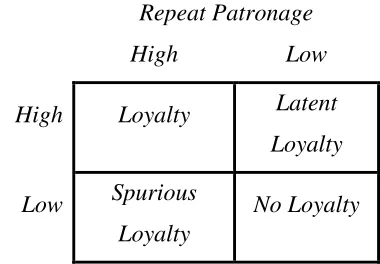
Wilcox, 1977). Dick and Basu (1994) argue that loyalty combines both
attitudinal and behavioural elements and identify four specific conditions as
described in Figure 2.2 below.
Repeat Patronage
High Low
High Loyalty Latent Loyalty Relative Attitude
Low Spurious Loyalty
[image:41.595.287.477.611.743.2]No Loyalty
Loyalty is not a concept that features highly in the purchasing literature except
to the extent that supply chain collaboration implies deepening relationships
between buyers and a small number of suppliers (Patterson et al, 1999;
Emberson & Storey, 2006; Vereecke & Muylle, 2006). Such relationships are
often conceptualised as long-lasting (Hakansson & Wootz, 1979) but empirical
evidence suggests that there may be high levels of turnover in the buyer’s
portfolio of relationships (Gadde & Mattsson, 1987; Dubois et al, 2003; Kamp,
2005). Portfolio models of purchasing encourage buyers to avoid becoming
dependent on individual suppliers (Kraljic, 1983). The literature distinguishes
between sole sourcing (where there is only one supplier to choose from), single
sourcing (where a choice is made to only buy from one supplier), dual sourcing
(two suppliers) and multiple sourcing. Single sourcing can deliver higher
quality and lower total costs but may expose the buyer to a greater risk of supply
chain disruption (Burke et al, 2007). Dual or multiple sourcing can spread risk
but at the expense of higher coordination costs. A buyer may choose to satisfy
most category requirements from a single supplier, just buying enough from the
others to keep the relationship going (Costantino & Pellegrino, 2010). Although
single sourcing is often presented as the result of a rational decision-making
process, embedded costs, earned trust and idiosyncratic routines established
through repeat interaction and buyer’s organisational inertia can result in de
facto single sourcing (Li et al, 2006).
It is often assumed that a high level of source loyalty is the norm in
organisational markets (Jarvis & Wilcox, 1977; Hakansson & Wootz, 1979).
relationship implies loyalty) and in most conceptual models of buyer behaviour
one of the attribute variables is previous experience or satisfaction with the
supplier (Reichheld & Sasser, 1990). The assumed stability is perhaps one
reason why there has been little empirical research into actual patterns of
organisational purchase behaviour (Gadde & Mattsson, 1987). Such research
often shows dynamic behaviour with a cyclical linkage between relationship
strength and relationship performance (Autry & Golicic, 2010) but has not
addressed what is purchased and from which suppliers.
In consumer research, panel data has been used to study the patterns of repeat
purchase behaviour and model these patterns stochastically. Loyalty is
measured in terms of actual purchase behaviour. Such studies have shown that
the extent of brand loyalty can vary widely and that a high degree of loyalty is
not necessarily a good thing as solely loyal customers tend to be less frequent
purchasers than those with divided loyalties (Norman et al, 2005). Sharp et al.
(2002) note the distinction between repertoire markets, where consumers satisfy
their requirements from a repertoire of brands, and subscription markets where
high levels of source loyalty are the norm. The few empirical studies carried out
in organisational markets have shown similar patterns of repeat purchasing,
mainly in fast moving industrial goods and services such as aviation fuel
(Uncles & Ehrenberg, 1990), ready mixed cement (Pickford & Goodhardt, 2000)
and financial exchange services (Bowman & Lele-Pingle, 1997).
Uncles & Ehrenberg (1990) analysed a selection of aviation fuel contracts held
by airlines across different locations (airports). The analysis was static in that it
in time and did not take into account any repeat purchasing. Patterns of split
loyalty, few 100% loyal buyers and no segmentation were observed. Similar
patterns are observed in foreign exchange services (Bowman & Lele-Pingle,
1997) using survey data from corporations using financial services. The model
over-predicts penetration with demand concentrated in a small number of heavy
purchasers. Some non-stationarity is also observed such that when the Dirichlet
model is parameterised using 1990 data it does not give accurate predictions for
1991 observed data. The ready mixed concrete study (Pickford & Goodhardt,
2000) uses survey methodologies to collect recall based purchase histories
(previous three months) and Juster scale based purchase likelihoods (next three
months). These purchasing records were then used to operationalise the
Dirichlet model. The analysis demonstrated regular patterns of split loyalty with
the only major deviation being an under-estimation of penetration (and
over-estimation of purchase frequency) for the market leading supplier.
2.3.1
Purchasing Behaviour within the Buying Organisation
Much of the intra-organisational literature focuses on attitudinal and contingent
loyalty (Bubb & van Rest, 1973; Jarvis & Wilcox, 1977; Dick & Basu, 1994).
Wind (1970) identified the following four sets of variables to be determinants of
source loyalty: product/service attributes (price, quality); buyer’s past
experience with suppliers; buyer’s organisational constraints (policy,
organisational objectives); factors that simplify the buyer’s work.
The earliest examples of research into organisational purchasing behaviour built
on existing consumer behaviour research to develop conceptual models of the
Sheth, 1973). While not explicitly focused on repeat purchasing or loyalty,
these conceptual models addressed the phases of the buying process, the nature
of the buying centre and the tasks carried out by the buying centre and the
decision making processes used in organisational purchasing (Moller, 1985).
Robinson et al. (1967) proposed three categories of buying situation to describe
heterogeneity in this aspect of organisational purchasing. Their “straight rebuy,
modified rebuy and new task” classification addresses the issues of repeat
purchasing in routine and non-routine contexts. It recognises the role played by
uncertainty in purchasing decisions and how purchasing organisations respond
to this uncertainty in terms of buyer search behaviour, information needs and
decision processes. Sheth (1973) and Webster and Wind (1972) also note the
importance of routine and the type of purchase as a moderator of purchasing
decisions. The nature of the product has also been used as a basis for
classification (Lehmann & O'Shaughnessy, 1974) with four categories
identified: routine order products; procedural problem products; performance
problem products; political problem products. The assumption is that product
attributes will be valued differently by the organisational buyer depending on the
categorisation of the product. Similar contingency models have been proposed
in the purchasing and supply literature including portfolio models that categorise
purchase situations and propose purchasing strategies based on dimensions such
as the importance of purchasing and the complexity of the supply market
(Kraljic, 1983) or the specific investments made by both buyer and supplier into
Uncertainty and risk reduction is identified by other authors as contributing to
repeat purchasing and the establishment of long-term relationships (Sheth, 1973;
Vyas & Woodside, 1984). Jarvis and Wilcox (1977) argue that most repeat
purchase behaviour is determined by organisational constraints: the cost of
evaluating new vendors, uncertainty reduction, perceived absence of choice and
“automatic” repurchasing. From the purchasing perspective such constraints
lead to purchasing interventions to reduce the number of suppliers employed and
strengthen the relationships with the remaining suppliers (Hahn et al, 1986;
Krause & Ellram, 1997; Ogden, 2006).
The integrated models of Webster & Wind (1972) and Sheth (1973) both
conceptualise the organisational purchasing process in terms of exogenous
(situational or environmental) factors and characteristics of the purchasing
organisation, the decision making unit (buying centre) and the individuals that
make up the buying centre. In each case the buyer’s previous experiences with
the supplier were noted as key factors influencing subsequent decisions. Other
factors that have been identified as determinants of loyalty include satisfaction
(Preis, 2003; Spiteri & Dion, 2004), involvement and brand equity (Bennett et
al, 2005).
More recent research stresses the importance of long term relationships in
organisational marketing (Doyle, 1995; Sheth, 2002). With the exception of the
IMP Group of researchers (see next section), the marketing literature has
generally regarded these relationships from the perspective of either supplier or
buyer, with the relationship as “just a development within the marketing mix
approach” (Mattsson, 1997). Satisfaction, service quality, relationship building
1992; Pine et al, 1995; Bennett et al, 2005). Relationship quality as measured by
perceived service quality, commitment, trust and satisfaction has been proposed
as a predictor of loyalty in organisational purchasing (Rauyruen & Miller, 2007).
The purchasing and supply chain literature also emphasises the importance of
long term collaborative relationships (Patterson et al, 1999; Emberson & Storey,
2006; Vereecke & Muylle, 2006).
Several studies have related future purchasing behaviour to past purchasing
behaviour and suggest that the extent to which previous purchases influence
future purchases may be due to constraints such as market structure (lack of
suitable suppliers), adaptation to a specific supplier (switching costs), bounded
rationality, technological heterogeneity, buying process centralisation or high
personal involvement (Heide & Weiss, 1995; Soderlund et al, 2001;
Yanamandram & White, 2006). High levels of buyer inertia have been observed
(Hakansson & Wootz, 1979; Li et al, 2006) and it has been noted that
relationships “may endure despite deterioration of service/product and/or despite
monumental, even catastrophic, mistakes by suppliers” (Young & Denize,
1995). Attempts have been made to relate buyer behaviour to dimensions such
as longevity and quality of relationship as measured by constructs such as buyer
attentiveness, buyer dependence and flexibility (Bonner & Calantone, 2005).
These attitudinal and contingent models are often criticised for their lack of
parsimony (Choffray & Lilien, 1978), difficulties in operationalising the
concepts and variables involved (Campbell, 1985), the underlying assumption of
rationality in professional purchasing (Smith & Taylor, 1985) and for their focus