Running head: THE RELATION OF PERSONALITY WITH NETWORK CENTRALITY
Extraversion and Agreeableness and the relation with Network Centrality in a Changing Network Ruud van Tilborg
University of Twente
Author note:
Ruud van Tilborg, Faculty of Behavioural, Management and Social Sciences, University of Twente First supervisor:
Msc. Stijn de Laat, Behavioural, Management and Social Sciences, University of Twente Second supervisor:
THE RELATION OF PERSONALITY WITH NETWORK CENTRALITY 1
Table of contents
Foreword 2
Abstract 3
1. Introduction 4
1.1 Social networks 5
1.2 Personality and network centrality 8
1.3 Personality traits 9
1.4 Time in research 10
1.4.1 The relation between Extraversion and network centrality 11 1.4.2 The relation between Agreeableness and network centrality 12
1.5 Research question 13
2. Method 14
2.1 Participants 14
2.2 Design 14
2.3 Materials 15
2.4 Procedure 17
3. Results 18
3.1 Preliminary analyses 18
3.2 Extraversion, Agreeableness and network centrality 19
3.2.1 The average network centrality 19
3.2.2 Deviation of network centrality 19
4. Discussion 24
5. Reference list 27
THE RELATION OF PERSONALITY WITH NETWORK CENTRALITY 2
Foreword
THE RELATION OF PERSONALITY WITH NETWORK CENTRALITY 3
Abstract
Previous studies have examined the relation between personality and network centrality. Studies on the relation between personality and network centrality have mostly viewed social networks from a static perspective, while research should focus more on changes in networks and how these are predicted from information on personality traits. Especially Extraversion and Agreeableness seem to be personality traits that are related to network centrality. Therefore the following research question was posed: How do Extraversion and Agreeableness relate to a changing network centrality? Network centrality was measured by analyzing degree centrality, betweenness centrality, and closeness centrality. Extraversion and Agreeableness were both predicted to positively influence network centrality over time. In this study, 266 people divided over 53 teams participated in an escape room. The participants solved puzzles wearing sociometric badges that measured face to face contact with others in their network, and filled in a personality questionnaire based on the HEXACO model. Using multiple regression analysis the influence of Agreeableness and Extraversion on network centrality over time was measured. In the end, no significant relation of Agreeableness and Extraversion with a changing network centrality was found for all three centrality measures. The reason for this may be that the task orientated environment was not suitable for the activation of Extraversion and Agreeableness.
THE RELATION OF PERSONALITY WITH NETWORK CENTRALITY 4
1. Introduction
The focus of research on organisations has changed over the last decades. Changes in the needs of the environment of organisations have caused a shift from work organised around individual jobs towards team-based work structures (Lawler, Mohrman, & Ledford, 1995; Mathieu, Kukenberger, Innocenzo, & Reilly, 2015). The success of an organisation often depends on how teams work together and how teams persistently perform well (Mathieu et al., 2015).
Teams are viewed as social networks (Liu & Ipe, 2010; Neubert & Taggar, 2004). These social networks describe the relationship between groups of individuals and give insight into the resources individuals have access to, because of their membership within the group (Hawe, Webster, & Shiell, 2004). For employees, this offers the opportunity to improve individual outcomes such as influence and performance (Regts & Molleman, 2016). These employees may also obtain certain positions within the network that provide opportunity, as these positions may provide them access to useful career opportunities, knowledge, and psychosocial support (Fang et al., 2015). For instance Wu, Yeh, and Hung (2012) state that employees with a central position in a social network can more easily obtain knowledge from their coworkers, which they can use to achieve better work performance.
A relevant factor for an individual's position in social networks can be personality. The reason for this is that social networks are interpersonal phenomena (Landis, 2016). To elaborate, the differences between individuals may influence the use and benefits of social networks. For example, a person with a high level of extraversion and neuroticism may be less able to benefit from a central network position (Regts and Molleman, 2016). More research within this field is needed because there has not been enough focus of social network research on the antecedents of social networks. Especially the differences between individuals have not been taken into account enough (Liu & Ipe, 2010). Research on personality and positions within networks should, however, be more focused on changes within social networks over time. Roe (2008) reviewed 139 articles in the field of applied psychology and compared them on their use of time within literature. He states that the temporal aspect of behaviour is neglected too often within research. Landis (2016) also claimed that behaviour is not static and that the influence of personality on the change of social networks is an area ripe for future research.
THE RELATION OF PERSONALITY WITH NETWORK CENTRALITY 5
1.1 Social networks
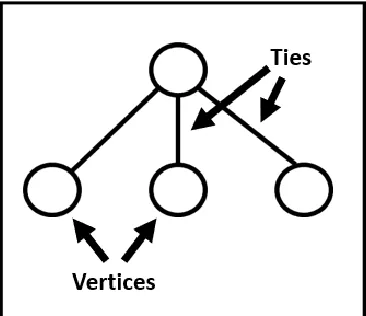
[image:6.612.71.254.314.472.2]There have been many studies on social networks over the years which show that being part of a social network can be beneficial for individuals (Regts & Molleman, 2016). Social networks can be seen as social worlds, which are formed by different individuals who have shared meanings, purposes, knowledge, understandings, and identities, which affect how and whom they interact with (Crossley, 2010). Another view is that they are a set of social entities with some relationships or interactions between them (Tabassum, Pereira, Fernandes & Gama, 2018). In this study, a social network mostly represents the view of social networks as social entities with relationships and interactions, because the focus will be on individuals and their interactions. Social networks consist of vertices, also named nodes. They are the social entities or actors in the social network (Tabassum et al., 2018). These vertices are connected to each other through edges, also named ties (Tabassum et al., 2018; Wasserman & Faust, 1994). In this study, the terms vertex and tie are used to describe these network features (see Figure 1).
Figure 1. Vertices and ties within a social network
THE RELATION OF PERSONALITY WITH NETWORK CENTRALITY 6
These structural positions are usually studied by using either network centrality measures or a local clustering coefficient (Tabassum et al., 2018). While a local clustering coefficient focuses only on indirect connections like how neighbours of an individual are connected to each other, network centrality focuses also on the direct connections of the node (Tabassum et al., 2018). In this study, the focus will be on network centrality because we want to study the behaviour that is directly related to the individual in order to draw conclusions on when and how people connect.
Network centrality
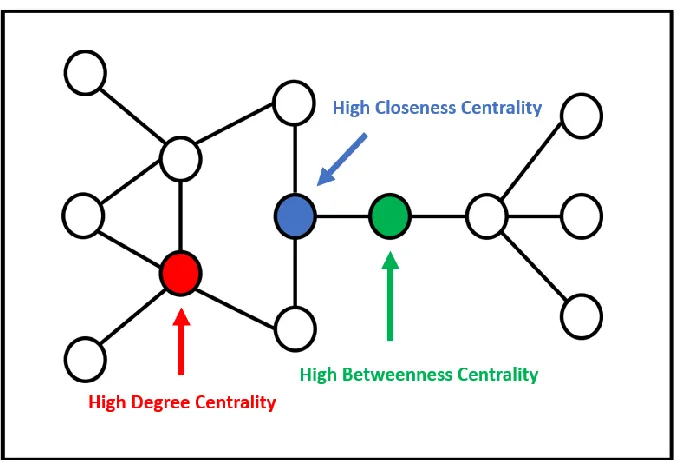
[image:7.612.70.409.441.671.2]Network centrality is an important measure to determine the position of an individual within a network. It can be regarded as the extent of the connections one has with others in the social network, in which a large number of connections means a more central position (Wichmann, Karter, & Kaufmann, 2015; Landis, 2016). It has also been viewed as a measure of how closely an individual belongs to a group (Liu & Ipe, 2010). The overlapping factor within these definitions seems to be the way an individual is connected to others within the social network. Therefore within this study, the following definition for centrality will be used: the extent to which an individual is embedded within a social network. This embeddedness of an individual within a social network can be viewed in several ways. Within social network research three common measures of centrality are discussed (Katz, Lazer, Arrow, & Contractor, 2004; Sarker, Ahuja, Sarker, & Kirkeby, 2011). The three types of centrality (see Figure 2) are defined below, and their value as a measurement for network centrality will be discussed.
THE RELATION OF PERSONALITY WITH NETWORK CENTRALITY 7
The first measure, degree centrality, is a simple count of the number of connections an individual has (Freeman, 1979; Susskind & Odom-Reed, 2016). Degree centrality has been the most used measure of centrality within research. This is because it represents the number of network connections an individual has, which is relatively easy to count (Landis, 2016). Several studies have provided information about the meaning of degree centrality. For instance, the number of connections an individual has is an indicator of the involvement a person has in a team or network (Liu & Ipe, 2010). Furthermore, it is related to social capital as it emphasises forming new relations to achieve interpersonal relationships (Rana & Allen, 2015). Also, a high level of degree centrality for an individual makes him more likely to stay in his job as the individual is more integrated into the network (Feeley, 2000). Susskind and Odom-reed (2016) provided a different insight towards degree centrality, as they stated that a high level of degree centrality develops larger networks with more ties. However, while the number of ties increases those networks tend to have weaker ties, which can lead to a lower cohesion within the network. Concluding, degree centrality can be regarded as an easy and good predictor of network centrality because it shows the connections an individual has and being directly connected to others is a clear way of being embedded within the network. However, since the cohesion within the network of the individual can be lower, connections may not be as strong as they seem.
The second measure for network centrality is betweenness centrality. Betweenness centrality measures to what extent a person stands between other people within the network. It can be measured as the percentage or number of shortest paths that pass through a node (Landis, 2016; Tabassum et al., 2018). This measure represents individuals within a network in a different way than degree centrality. Namely, betweenness centrality involves indirect ties, whereas degree centrality involves solely direct ties (Landis, 2016; Mehra, Killduff, & Brass, 2001). Also, betweenness centrality is based largely on brokerage theories, where the individual is brokering the relationship between two people (Burt, 1995; Rana & Allen, 2015). Susskind and Odom-Reed (2016) elaborate that betweenness centrality reflects the position within the social network that controls or mediates flows of information for other social network members. So it not only represents the direct connections an individual has, but also gives information about others within the network and how they share their information with the individual. Therefore betweenness centrality as a measure can help identify those who play an important role in how policy outcomes are reached in organisational settings (Christopoulos & Ingold, 2015). To summarise betweenness centrality gives a different insight into network centrality compared to degree centrality, as it represents how well a person is being informed about what is going on within the network.
THE RELATION OF PERSONALITY WITH NETWORK CENTRALITY 8
(Freeman, 1979; Wu et al., 2012). Closeness centrality considers all ties in the social network, and high closeness can not only be reached through direct ties, but also through relatively short indirect ties (Pachayappan & Vankatesakumar, 2018). Closeness centrality has been viewed in different ways. First of all, somebody with a high closeness centrality can be seen as a witness, as in this role the person has everybody close and therefore can observe things better (Missaoui, Negre, Anggraini, & Vaillancourt, 2013). Another way of viewing closeness centrality is that it represents the independence of an individual. A low closeness centrality hereby means that the individual relies on others in the network to receive information (Pachayappan & Vankatesakumar, 2018). Furthermore, closeness centrality can represent how fast a person has access to information of others in the network (Pachayappan & Vankatesakumar, 2018). While there are several views on closeness centrality, the basic idea is that people with high scores on closeness have a higher reachability, because they connect faster with the others (Freeman, 1979; Rana & Allen, 2015). This suggests that a person with a high closeness centrality may be faster informed about what is going on in the network. To summarise, it seems that closeness centrality is mostly linked to bidirectional reachability and therefore the speed of information sharing.
Although the three centrality measures are different from each other, they still are strongly connected (Feeley, 2000). It is logical that someone who has more connections (degree centrality) is closer to others in the network (closeness centrality) and therefore may be between more pairs of individuals (betweenness centrality) in a network (Feeley, 2000). Therefore it is expected that the three types of centrality correlate strongly with each other when they are measured. It is not very clear which of these three centrality measures best represents network centrality as a whole, as they all provide a different view of an individual's position in a network.
1.2 Personality and network centrality
Personality has been described in several ways within literature. Gibb (1940) reviewed the literature to find a definition and described that in 1940 already 66 definitions of personality were known. According to Warren and Carmichael (1930), personality is the entire mental organisation of a human being at any stage of his development. It embraces every phase of human character: intellect, temperament, skill, morality, and every attitude that has been built up in the course of one’s life. More recently Saucier (2008) stated that there is no single definition in use, but personality is usually either defined as a set of attributes (such as emotions or behaviours) characterising an individual, or as the underlying system that generates the set of attributes.
THE RELATION OF PERSONALITY WITH NETWORK CENTRALITY 9
individual personality and network centrality has been researched with the Big Five model of personality (Regts & Molleman, 2016; Fang et al., 2015). This Big Five model consists of the following traits: Extraversion, Openness to experience, Conscientiousness, Agreeableness, and Emotional Stability. Personality has also been measured using the HEXACO model (Dinger et al., 2015), which describes six traits, i.e. Honesty-Humility, Emotionality, Extraversion, Agreeableness, Conscientiousness, and Openness to Experience.
These models are very much alike but do have some differences. For example, the HEXACO model includes an extra personality trait called Honesty-Humility. Also, the measurement of the personality traits Emotionality and Agreeableness in HEXACO is a rotated variant of Agreeableness and Emotional stability in the Big Five model (de Vries & Born, 2013). This means that in the HEXACO model Agreeableness is a combination of Big Five trait Agreeableness and Emotional Stability, and refers to social interpersonal aspects. Furthermore, Emotionality as described in the HEXACO model, is a combination of Big Five traits Agreeableness and Neuroticism, where it focuses on emotional interpersonal aspects (Dinger et al., 2015; de Vries, Ashton & Lee, 2009).
The importance of personality for network centrality seems to be best studied by focusing on the HEXACO model. This model is chosen because, compared to Agreeableness in the Big Five, in the HEXACO model Agreeableness focuses more on social interpersonal aspects (de Vries & Born, 2013). Especially these interpersonal aspects seem relevant for network centrality of an individual within a social network, as these interpersonal aspects may relate to the way people are connected. This will be elaborated in the next paragraph.
1.3 Personality traits
The personality traits in the HEXACO model are used to investigate the personality of an individual. These personality traits investigate different parts of the personality and are therefore also in different ways related to the centrality of an individual. For example, the personality traits Emotionality, Agreeableness and Honesty-Humility are viewed as expressions of Altruism versus Antagonism, while Extraversion, Conscientiousness, and Openness to Experience are seen as expressions of Interaction or Engagement (Ashton, Lee & de Vries, 2014; de Vries & Born, 2013).
THE RELATION OF PERSONALITY WITH NETWORK CENTRALITY 10
because Extraversion is viewed as the degree to which people like to put effort into social activities and interactions (de Vries, Ashton, & Lee, 2009). Specific characteristics of Extraversion are Social Self-Esteem, Social Boldness, Sociability, Liveliness (de Vries & Born, 2013). Self-esteem represents to which extent an individual believes he is liked. Social boldness represents whether an individual takes initiative and connects easily with others in the group. Sociability represents whether somebody likes to be with others and liveliness represents how enthusiast or cheerful an individual generally is (de Vries & Born, 2013).
Agreeableness embodies a willingness to cooperate with others, but also a gentle approach towards it. Graziano and Eisenberg (1997) reviewed studies over the 20th century towards Agreeableness and found that it is best described as being kind, considerate, likeable, cooperative and helpful. In recent studies, these characteristics are still apparent, but they are described as the tendency to be flexible, forgiving, gentle and patient (Ashton et al., 2014; Dinger et al., 2015; Fang et al., 2015). Flexibility represents the willingness to compromise and cooperate with others, forgivingness represents a willingness to feel trust and liking toward people who may have caused someone harm, gentleness represents the tendency to be mild and lenient when dealing with others and patience represents how calm an individual tends to be (Ashton et al., 2014). These two personality traits seem to be well connected to network centrality as they best reflect behaviours that influence the way people interact.
1.4 Time in research
THE RELATION OF PERSONALITY WITH NETWORK CENTRALITY 11
1.4.1 The relation between Extraversion and network centrality
In most studies, it is found that individuals with higher Extraversion tend to have a higher network centrality (Casciaro, 1998; Pollet, Roberts & Dunbar, 2011; Totterdell, Holman & Hukin, 2008). The reason for this can be that extraverts are better at building up a social network over time as they have more social skills (Roberts, Wilson, Fedurek, & Dunbar, 2008). More specifically, extraverts ask for advice and help others, which leads to more connections (Roberts et al., 2008). Another reason could be that individuals who are less shy and more sociable have a higher number of social relationships as they have more ease to connect with others (Asendorpf & Wilpers, 1998). This was also supported by Molho, Roberts, de Vries, and Pollet (2016) but they were looking specifically at faster network growth among adolescents and young adults. As Extraverts have more ease to connect with others, it can be expected that they have more direct connections and therefore especially a higher degree centrality. The studies mainly focused on network size, which represents the direct connections and is therefore similar to degree centrality.
This positive relation between Extraversion and network centrality was also expected in two other studies, however, was not supported by their results. In the study by Roberts et al. (2008), it was found that once controlled for age, the link between Extraversion and the size of an individual's’ network seems less significant. Their explanation was that not only age but other factors also have a large influence on network size, and the sample they used was more heterogeneous, while other studies focused more on certain subpopulations. Also, Klein, Lim, Saltz, and Mayer (2004) did not find an effect of Extraversion on network centrality. They stated that the effect of Extraversion on network centrality might also rely on duration and the size of the social network. It seems that other factors might also influence the relation between extraversion and network centrality, so it is important this will be taken into account when performing a study.
THE RELATION OF PERSONALITY WITH NETWORK CENTRALITY 12
therefore they do not feel the need to keep engaged. Individuals who are less sociable will have moments they engage with each other, but more than people who are sociable have moments they do not engage. Therefore, unsociable people can be expected to have more deviation in network centrality. Lastly, liveliness also seems to be related to deviation in network centrality. People who have high scores on liveness have more enthusiasm, optimism, and energy (Rolison et al., 2013). Individuals with these characteristics tend to persist in interaction, while individuals with less liveliness may stop interacting for a while because they don’t have the energy or enthusiasm. Therefore, it is expected that people who are more lively stay connected to other network members, while for less lively people the number of connections with others might deviate more.
In general, it seems that people with higher Extraversion are more active in connecting and staying connected, as they are more sociable and have more energy and enthusiasm, while people who score low on Extraversion will less feel the need to stay connected and therefore are expected to have more deviation in network centrality. As these specific characteristics of an Extravert are about direct interactions and engagement with people, it is expected to be most related to closeness and degree centrality.
1.4.2 The relation between Agreeableness and network centrality
Agreeableness seems to be related to the network centrality of an individual. For instance, agreeable people are often faster selected as friend, and therefore have larger friendship networks (Zhu, Woo, Porter & Brzezinski, 2013). Furthermore, agreeable individuals intend to strive for the good of the community, which makes them more likely to execute actions with the purpose of being accepted by others (Liu & Ipe, 2010). This leads to supportive and cooperative relationships which help them develop a central position within their network (Liu & Ipe, 2010). These cooperative relationships consist of a bidirectional desire to connect. This desire may lead to a higher closeness centrality as the reachability might increase when people are looking for each other, instead of a one-way desire to connect. Totterdell et al. (2008) did not find a significant relation between Agreeableness and network centrality, but as it was not the main focus of the study they did not further look into the reasons for this lack of effect. Therefore, it is not exactly clear why no significant effect was found. In general, it seems to be expected that a higher Agreeableness leads to higher network centrality since agreeable people build cooperative relationships.
THE RELATION OF PERSONALITY WITH NETWORK CENTRALITY 13
network centrality. Flexibility can also have an influence on the deviation of network centrality. Flexibility represents the willingness to adapt (Ashton et al., 2014) so it could be expected that flexible individuals are faster integrated with other people within their network, because they adapt easier to other people. Individuals with low flexibility will take more time to get integrated into the group. They also may have a hard time adapting in the future to new changes within the group. Therefore, people with low flexibility may not only take more time before being connected to others in the network, but also may have a harder time staying connected to others in the network. It can be expected that their network centrality will deviate more. To conclude, a higher Agreeableness is expected to lead to lower deviation of network centrality as agreeable people are more willing to connect and adapt easier and therefore tend to stay connected.
1.5 Research question
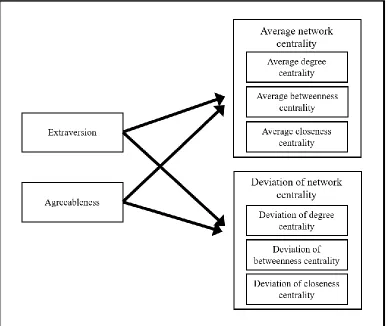
[image:14.612.72.460.356.682.2]In order to guide the research, the following question will be posed: How do Extraversion and Agreeableness relate to a changing network centrality? The relations that will be studied to get a proper answer to the questions are displayed in Figure 3.
THE RELATION OF PERSONALITY WITH NETWORK CENTRALITY 14
With the analyses of paragraph 1.4 the following four hypotheses were formulated: H1: There is a positive relation between Extraversion and the average network centrality. H2: There is a positive relation between Agreeableness and the average network centrality. H3: Extraversion is expected to be negatively related towards deviation in network centrality. H4: Agreeableness is expected to be negatively related towards deviation in network centrality.
Network centrality will be divided into three types of centrality called degree centrality, betweenness centrality, and closeness centrality. An explorative study will be performed to see what differences there are between these three approaches of studying network centrality. The goal is to see in what way they represent network centrality, so how they represent the extent to which an individual is embedded within a social network.
2. Method
2.1 Participants
In total 320 people divided over 63 groups participated in this study. Simple random sampling was used as participants had already registered themselves for the escape rooms, before all being asked to participate in the research. However, due to several reasons, participants had to be excluded. All groups with less than four or with more than eight people were excluded. Some people had the badges on, but their badges did not register the data so they were also excluded. In the end, the sample consisted of 266 people divided over 53 teams. They were 165 Dutch male (62%) and 101 Dutch female (38%) participants with an average age of 28.05 years old (range = 18-73 years). The participants knew the people in their group on average for 76.57 months (= approximately six years). The focus of the research was to measure social networks, so only groups of at least four people were included. The largest group to participate consisted of seven people. If an individual did not want to participate, the whole group was excluded from the study. However, all participants stayed in the escape room till the end and gave their consent to use the gathered data.
2.2 Design
THE RELATION OF PERSONALITY WITH NETWORK CENTRALITY 15
measured using questions from the HEXACO-SPI questionnaire, which has shown to have adequate psychometric characteristics (de Vries & Born, 2013).
2.3 Materials
Escape rooms
The study took place at two different locations within three different escape rooms, which were Roomescape Enschede who had two rooms and a temporary escape room that was developed by students of the University of Twente. Roomescape Enschede is a profit organisation with two rooms for two different teams and the teams have 60 minutes to escape. The temporary room at the University of Twente had no profit purposes and teams used two separate rooms with 45 minutes to escape. There were several puzzles. For example, some of the puzzles of the escape rooms consisted of finding number combinations in order to open locks. To open these locks with the combinations, mathematical exercises had to be calculated or numbers had to be matched with letters.
Questionnaire
The participants filled in a questionnaire of 48 items (see Appendix 2). The questionnaire was asked in the Dutch language. The first 10 questions regarded personal information such as age, gender, educational level and how long group members knew each other. Four of these items were used as a control variable to see whether they influence the relation between Agreeableness and Extraversion on the one hand, and network centrality on the other hand. Age and gender were used as a control variable. Also, the question ‘hoe lang bent u al onderdeel van deze groep mensen?’ which indicated how long the participant was already part of the group before the experiment, was used as control variable. In this study, this question will be referred to as the ‘Length of relationship.’ It was measured by the number of months participants knew each other. The last control variable wat escape room experience, which was measured by question ‘Heeft u al eerder een escape room gespeeld, zo ja hoe vaak?’. The results were divided into two groups of people who had experience with escape rooms, and people who did not have experience with escape rooms.
THE RELATION OF PERSONALITY WITH NETWORK CENTRALITY 16
In order to correctly measure the Extraversion scale, 16 items were included in the questionnaire (α =0.81). An example of a question in the questionnaire was: ‘Ik houd me in een groep op de achtergrond,’ which roughly translates as: ‘I stay in the background when I am in a group.’
Due to a clerical error, one of the 16 items on the Agreeableness scale had to be deleted. Therefore the Agreeableness scale was measured using 15 items (α =0.71). An example of the scale is: ‘Zelfs als ik slecht behandeld word blijf ik kalm’, which roughly translates as ‘Even when I am treated badly I stay calm.’
Sociometric badges
THE RELATION OF PERSONALITY WITH NETWORK CENTRALITY 17
centrality, average betweenness centrality, and average closeness centrality. Next, the deviation of the three types of centrality was calculated. This was also taken across all average network centrality scores of the 120-second networks. This resulted in one score for each participant on the deviation in degree centrality, betweenness centrality, and closeness centrality.
The earlier mentioned time interval of 120 seconds was chosen because a too large interval would result into saturation, meaning everybody would be in contact with each other. But a too small time interval would result in too little saturation meaning few to none people are in contact. This would be a problem for measuring closeness centrality, as it can’t be measured for disconnected graphs. The interval was specifically chosen after analysing different length intervals between 10 seconds and 10 minutes, and this had revealed that the best balance between too much and too little saturation was at 120 seconds.
Degree centrality was calculated as a count of all network connections the participant had within the network. Betweenness centrality was calculated as the number of shortest paths that pass through a node within the network. Closeness centrality was calculated as the shortest path from an individual towards all separate other individuals within the network. In networks with more participants, the scores on degree centrality and betweenness centrality were higher since a participant has more people it can connect with. Therefore a correction on network size was performed by dividing the scores by the number of people in the network, and after that multiplying it with the average group size which was 5.02. The scores of degree centrality and betweenness centrality were between 0 and 5.02. The scores of closeness centrality were between 0 and 1. A lower score on all measures meant that the participant had a lower network centrality, and a higher score meant a higher network centrality.
To analyse the relation between Agreeableness and Extraversion and the three types of network centrality, multiple regression analyses were performed in SPSS. In all multiple regression analyses control variables age, gender, length of relationship and escape room experience were included to see whether they influenced the outcomes.
2.4 Procedure
THE RELATION OF PERSONALITY WITH NETWORK CENTRALITY 18
write down their real name on these forms. Participants were asked whether they would like a visualisation of their own data from the badges, which would be sent to them by e-mail several days after the research. Before the participants entered the room, they received the sociometric badge and put it around their neck and under their shirt. After that, the participants entered the room with the time starting when the door was locked. They were also offered the possibility to ask for hints by a walky-talky or electronic tablet. They were informed that they were monitored by cameras that were present in the room, in order to provide these hints. This made it possible for researchers to score their effectiveness with scoring sheets. Furthermore, the teams received information during playtime on how much time was left. Finally, when participants escaped the room or were out of time, they were asked to hand in the badge and go to another room to fill in the personality questionnaire. After the questionnaire was handed in, the participants were finished.
3. Results
3.1 Preliminary analyses
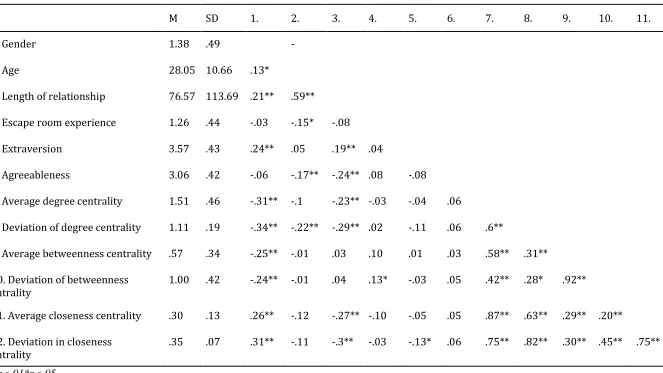
A correlational analysis was conducted for all continuous variables in the study and displayed with their mean and standard deviation (see Table 1). For both personality traits, a relation towards network centrality was predicted, but only a weak significant correlation was found between Extraversion and the deviation in closeness centrality r = -.13, p = .03. For Extraversion the correlations were with average degree centrality r = -.04, p = .52, average betweenness centrality r = .08, p = .89, and average closeness centrality r = -.05, p = .38, deviation in degree centrality r = -.11, p = .06, and deviation in betweenness centrality r = -.03, p =
THE RELATION OF PERSONALITY WITH NETWORK CENTRALITY 19
3.2 Extraversion, Agreeableness and network centrality
Six multiple regressions were performed to analyse the relation between Extraversion and Agreeableness with network centrality over time. For all analyses normality was confirmed and the test for equal variance showed the criteria were met. In the analyses also the control variables age, gender, length of relationship, and escape room experience were included.
3.2.1 The average network centrality
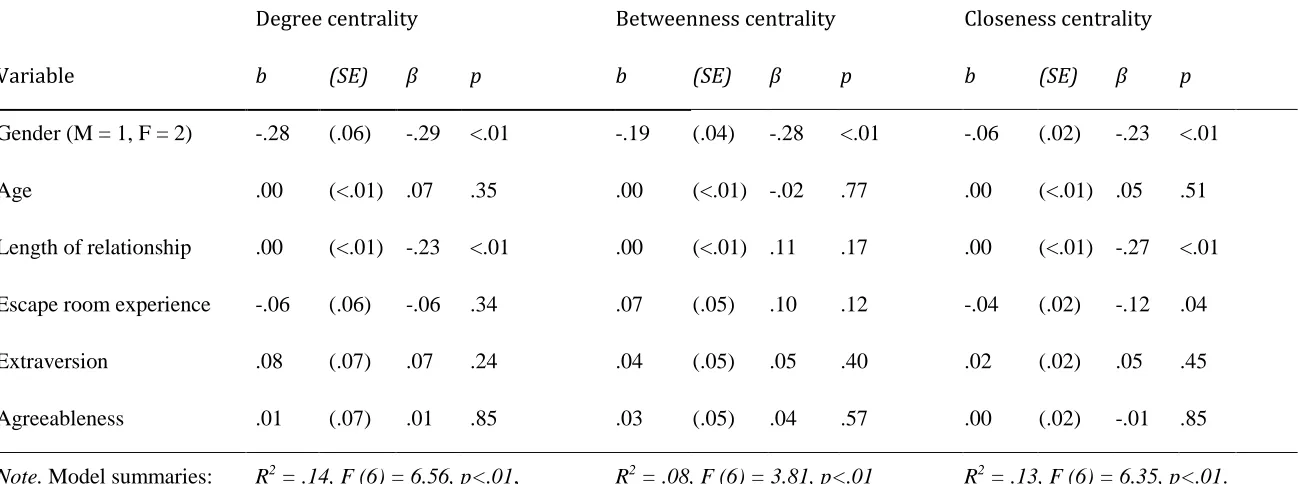
Multiple regression analyses for the relation of Extraversion and Agreeableness to the average degree, betweenness and closeness centrality were conducted (see Table 2). For all three multiple regression analyses the significance of the model was tested and for the average degree centrality R2 = .14, F(6) = 6.56, p < .01, average betweenness centrality R2=.08, F(6)=3.81, p<0.01, and average closeness centrality R2 = .13, F(6) = 6.35, p < .01 the models were significant. Looking at the relation between Extraversion and the average degree centrality β = .07, p = .24, average betweenness centrality β = .05, p = .40, and average closeness centrality β = .05, p = .45, it can be concluded that no significant effect was found. The analysis of the relation between Agreeableness and the average degree centrality β = .01, p = .85, average betweenness centrality β = .04, p = .57, and average closeness centrality β = -.01, p = .85, also showed no significant effect. Therefore a higher score on Extraversion or Agreeableness did not result in a difference in the average degree, betweenness or closeness centrality. The three network centrality measures, however, were all three related to gender. The analyses showed that gender had a negative effect on the average degree centrality β = -.29, p < .01, betweenness centrality β = -.01, p < .01, and closeness centrality β = -.01, p < .01. This means that women proved to have a significantly lower score for all three types of average network centrality compared to men. Also length of relationship showed to have a significant negative effect on the average degree centrality β = -.23, p < .01, and average betweenness centrality β = -.27, p < .01. It showed no significant effect on the average closeness centrality β = 0.11, p = .17. This means that participants who knew the others in the network for a longer time had a significantly lower average degree centrality and average betweenness centrality.
3.2.2 Deviation of network centrality
THE RELATION OF PERSONALITY WITH NETWORK CENTRALITY 20
THE RELATION OF PERSONALITY WITH NETWORK CENTRALITY 21
Table 1
Summary of correlations, means, and standard deviations for all continuous variables in the model (N=266)
M SD 1. 2. 3. 4. 5. 6. 7. 8. 9. 10. 11.
1. Gender 1.38 .49 -
2. Age 28.05 10.66 .13*
3. Length of relationship 76.57 113.69 .21** .59**
4. Escape room experience 1.26 .44 -.03 -.15* -.08
5. Extraversion 3.57 .43 .24** .05 .19** .04
6. Agreeableness 3.06 .42 -.06 -.17** -.24** .08 -.08
7. Average degree centrality 1.51 .46 -.31** -.1 -.23** -.03 -.04 .06
8. Deviation of degree centrality 1.11 .19 -.34** -.22** -.29** .02 -.11 .06 .6**
9. Average betweenness centrality .57 .34 -.25** -.01 .03 .10 .01 .03 .58** .31** 10. Deviation of betweenness
centrality
1.00 .42 -.24** -.01 .04 .13* -.03 .05 .42** .28* .92**
11. Average closeness centrality .30 .13 .26** -.12 -.27** -.10 -.05 .05 .87** .63** .29** .20** 12. Deviation in closeness
centrality
.35 .07 .31** -.11 -.3** -.03 -.13* .06 .75** .82** .30** .45** .75**
**p<.01*p<.05
THE RELATION OF PERSONALITY WITH NETWORK CENTRALITY 22
Table 2
Regression analysis of the relation of Extraversion and Agreeableness with average network centrality over time with control variables (N=266) Degree centrality Betweenness centrality Closeness centrality
Variable b (SE) β p b (SE) β p b (SE) β p
Gender (M = 1, F = 2) -.28 (.06) -.29 <.01 -.19 (.04) -.28 <.01 -.06 (.02) -.23 <.01
Age .00 (<.01) .07 .35 .00 (<.01) -.02 .77 .00 (<.01) .05 .51
Length of relationship .00 (<.01) -.23 <.01 .00 (<.01) .11 .17 .00 (<.01) -.27 <.01
Escape room experience -.06 (.06) -.06 .34 .07 (.05) .10 .12 -.04 (.02) -.12 .04
Extraversion .08 (.07) .07 .24 .04 (.05) .05 .40 .02 (.02) .05 .45
Agreeableness .01 (.07) .01 .85 .03 (.05) .04 .57 .00 (.02) -.01 .85
THE RELATION OF PERSONALITY WITH NETWORK CENTRALITY 23
Table 3
Regression analysis of the relation of Extraversion and Agreeableness with the deviation of network centrality over time with control variables (N=266)
Degree centrality Betweenness centrality Closeness centrality
Variable b (SE) β p b (SE) Β p b (SE) β p
Gender (M = 1, F =2) -.11 (.02) -.29 <.01 -.22 (.06) -.25 <.01 -.04 (.01) -.26 <.01
Age .00 (<.01) -.07 .35 .00 (<.01) -.02 .78 .00 (<.01) .10 .19
Length of relationship .00 (<.01) -.19 .01 .00 (.00) .13 .11 .00 (<.01) -.31 <.01
Escape room experience -.01 (.03) -.02 .73 .12 (.06) .13 .04 -.01 (.01) -.05 .41
Extraversion .00 (.03) -.01 .94 .01 (.06) .01 .93 .00 (.01) -.01 .83
Agreeableness -.01 (.03) -.01 .85 .05 (.06) .05 .45 .00 (.01) -.01 .85
THE RELATION OF PERSONALITY WITH NETWORK CENTRALITY 24
4. Discussion
THE RELATION OF PERSONALITY WITH NETWORK CENTRALITY 25
relationship was on average around six years, which means it can be expected there have been interactions in the months before the study. It seems possible that introverts in the study were showing more extraverted behaviour because of this setting.
Agreeableness and Extraversion did not seem to be good predictors of network centrality, but gender and the length of relationships with others did show a relation to network centrality. Gender related to all three types of centrality, because it was found that men tend to have higher network centrality and deviation in network centrality than women. Individuals that knew the social network members for a longer time, had lower degree centrality and closeness centrality scores. This may have been because people who are longer acquainted need less communication to explain themselves.
Also exploratively the concepts of degree, betweenness and closeness centrality were studied to see what their differences were and how they represented network centrality. The three measures had very similar results. All three measures of network centrality were not significantly related to Agreeableness and Extraversion, as was earlier mentioned, but degree, betweenness and closeness centrality did correlate significantly with each other. Feeley (2000) mentioned it is logical that someone who has more connections (degree centrality) is closer to others in the network (closeness centrality) and therefore might be between more pairs of individuals (betweenness centrality) in a network. This statement seemed to be supported by the results. The only difference that appeared very clearly was that the length of relationship of participants significantly influenced degree and closeness centrality, but did not influence betweenness centrality. This means that people who knew each other longer did not specifically stand more often between two others on their shortest path of connection, while they had significantly less reachability (closeness centrality) and fewer connections (degree centrality). This seems not to be directly related towards being embedded in the network (network centrality). The difference may be because degree centrality is about forming new relations to achieve interpersonal relationships (Rana & Allen, 2015). It may have been that this need to make new relations was higher for people who knew each other not as long, and this automatically leads to being closer to others in the network. It seems different degree and closeness centrality scores did not mean participants were more or less embedded within a network, as the change in degree and closeness centrality was due to the length of the relationship people had.
THE RELATION OF PERSONALITY WITH NETWORK CENTRALITY 26
source bias and attribution effects, and questionnaires to measure behaviour can be subject to the influence of respondents’ attitudes (Kim et al., 2010). Another contribution of the study can be the focus on network centrality in a changing network by measuring several time intervals. Most studies regarding personality and social networks viewed networks from a more static perspective (Landis, 2016). This means that in studies a personality trait is compared with one measurement for network centrality. In this study, the information on personality traits was used to predict network centrality in a changing network by taking multiple measurements to see what over this period the average and deviation of network centrality were.
While this study seems to contribute to existing literature, there are also some limitations of this study. A limitation may be that deviation of network centrality did not give information about patterns in behaviour. Deviation of network centrality in this study focused on random deviation from the average, while these deviations may have been caused by a development over time. For instance, an individual could have real low centrality in the start which gradually gets higher. The study did not provide insight into these patterns. A second limitation may be, that this study focuses on interactions by looking at proximity, which does not give information about why people interact. The proximity measure was face to face interaction by infrared sensors. These infrared detections do not say anything about what the reason is that individuals connect. Is this based on friendship or is it task-orientated? In future research, a qualitative measure may give a different insight into how personality relates to the position in a social network. For instance, during interactions, somebody’s intention may be to be gentle, or he may be trying to focus on the task. A qualitative measure may help making this distinction. The real benefit of applying qualitative analysis here would be that these interactions can be studied in depth and that this is difficult to attain in quantitative research design (Musteen, 2016).
THE RELATION OF PERSONALITY WITH NETWORK CENTRALITY 27
5. Reference list
Asendorpf, J. B., & Wilpers, S. (1998). Personality effects on social relationships. Journal of personality and social psychology, 74(6), 15-31.
Ashton, M. C., Lee, K., & De Vries, R. E. (2014). The HEXACO Honesty-Humility,
Agreeableness, and Emotionality factors: A review of research and theory. Personality and Social Psychology Review, 18(2), 139-152.
Burt, R. S. (1995). Structural holes: The social structure of competition. United States of America: Harvard University Press.
Cabrera-Quiros, L., Gedik, E., & Hung, H. (2016). Estimating self-assessed personality from
body movements and proximity in crowded mingling scenarios. In Proceedings of the 18th ACM International Conference on Multimodal Interaction (pp. 238-242). ACM.
Casciaro, T. (1998). Seeing things clearly: Social structure, personality, and accuracy in social network perception. Social Networks, 20(4), 331–351. doi:10.1016/S0378-8733(98)00008-2 Christopoulos, D., & Ingold, K. (2015). Exceptional or just well connected? Political entrepreneurs and
brokers in policy making. European Political Science Review, 7(3), 475-498.
Crossley, N. (2010). The social world of the network. Combining qualitative and quantitative elements in social network analysis. Sociologica, 4(1), 1-34.
De Vries, R. E., Ashton, M. C., & Lee, K. (2009). De zes belangrijkste persoonlijkheidsdimensies
en de HEXACO Persoonlijkheidsvragenlijst [The six most important personality dimensions and the HEXACO Personality Inventory]. Gedrag & Organisatie, 22, 208–250
De Vries, R. E., & Born, M. T. (2013). De Vereenvoudigde HEXACO
Persoonlijkheidsvragenlijst en een additioneel interstitieel Proactiviteitsfacet. Gedrag & Organisatie, 26(2), 223-45.
Dinger, F. C., Dickhäuser, O., Hilbig, B. E., Müller, E., Steinmayr, R., & Wirthwein, L. (2015).
From basic personality to motivation : Relating the HEXACO factors to achievement goals. Learning and Individual Differences, 40, 1–8. https://doi.org/10.1016/j.lindif.2015.03.023
Fang, R., Landis, B., Zhang, Z., Anderson, M. H., Shaw, J.D., Kilduff, M. (2015). Integrating
Personality and Social Networks : A Meta-Analysis of Personality, Network Position, and Work Outcomes in Organizations, Organization Science. https://doi.org/10.1287/orsc.2015.0972
Feeley, T. H. (2000). Testing a communication network model of employee turnover based on centrality. Journal of Applied Communication Research, 28, 262-277.
THE RELATION OF PERSONALITY WITH NETWORK CENTRALITY 28
Personality and Social Psychology, 97(6), 1097-1114. Doi:10.1037/a0016786
Freeman, L. C. (1979). Centrality in social networks: Conceptual clarification. Social Networks, 2, 215-239.
Gibb, C. A. (1940). The definition of personality. Australasian Journal of Psychology and Philosophy, 18, 246-254, DOI: 10.1080/00048404008541156
Graziano, W. G., & Eisenberg, N. (1997). Agreeableness: A dimension of personality. In Hogan, R., Johnson, J. M., Johnson, J. A., & Briggs, S. R. (Eds.), Handbook of personality psychology (pp.
795-824). San Diego: Elsevier.
Hawe, P., Webster, C., & Shiell, A. (2004). A glossary of terms for navigating the field of social network analysis, J Epidemiol Community Health, 58, 971-975. doi:10.1136/jech.2003.014530 Katz, N., Lazer, D., Arrow, H., & Contractor, N. (2004). Network theory and small groups. Small
Group Research, 35, 307-332.
Kim, T., McFee, E., Olguin, D. O., Waber, B., & Pentland, A. (2012). Sociometric badges: Using
sensor technology to capture new forms of collaboration. Journal of Organizational Behavior, 33(3), 412-427.
Klein, K. J., Lim, B.C., Saltz, J. L., & Mayer, D. M. (2004). How Do they Get there? An
examination of the antecedents of centrality in team networks. The Academy of Management Journal, 47(6), 952. doi:10.2307/20159634
Landis, B. (2016). Personality and social networks in organizations : A review and future
directions. Journal of organizational behavior, 121, 107–121. https://doi.org/10.1002/job Lawler, E. E., Mohrman, S. A., & Ledford, G. E. (1995). Creating high performance
organizations: Practices and results of employee involvement and Total Quality Management in
Fortune 1000 companies. San Francisco: Jossey-Bass.
Liu, Y., & Ipe, M. (2010). How Do They Become Nodes ? Revisiting Team Member Network Centrality, The Journal of Psychology, 144, 243-258, DOI:10.1080/00223981003648260 Mathieu, J. E., Kukenberger, M. R., Innocenzo, L. D., & Reilly, G. (2015). Modeling Reciprocal
Team Cohesion Performance Relationships, as Impacted by Shared Leadership and Members’ Competence, Journal of applied psychology, 100(3), 713–734.
Mehra, A., Kilduff, M., & Brass, D. J. (2001). The social networks of high and low self-monitors: Implications for workplace performance. Administrative science quarterly, 46(1), 121-146. Missaoui, R., Negre, E., Anggraini, D., & Vaillancourt, J. (2013). Social network restructuring after a
THE RELATION OF PERSONALITY WITH NETWORK CENTRALITY 29
personality (HEXACO) and their associations with network layer size and emotional closeness to network members. Personality and individual differences, 99, 144-148.
Musteen, M. (2016). Behavioral factors in offshoring decisions: A qualitative analysis. Journal of Business Research, 69(9), 3439-3446.
Neubert, M. J., & Taggar, S. (2004). Pathways to informal leadership : The moderating role of
gender on the relationship of individual differences and team member network centrality to informal leadership emergence, Elsevier, 15, 175–194. https://doi.org/10.1016/j.leaqua.2004.02.006
Olguín, D. O., & Pentland, A. S. (2008). Social sensors for automatic data collection. AMCIS 2008 Proceedings, 171.
Pachayappan, M., & Venkatesakumar, R. (2018). A Graph Theory Based Systematic Literature Network Analysis. Theoretical Economics Letters, 8(05), 960.
Pollet, T. V., Roberts, S. G. B., & Dunbar, R. I. M. (2011). Extraverts have larger social network layers. Journal of Individual Differences, 32(3), 161–169. doi:10.1027/1614-0001/a000048 Rana, S., & Allen, N. E. (2015). Centrality measures to identify key stakeholders in Family Violence
Councils. Psychosocial Intervention, 24(3), 167-176.
Regts, G., & Molleman, E. (2016). The moderating influence of personality on individual outcomes of social networks, (August). https://doi.org/10.1111/joop.12147
Roberts, S., Wilson, R., Fedurek, P., & Dunbar, R. (2008). Individual differences and personal
social network size and structure. Personality and Individual Differences, 44(4), 954–964. doi:10.1016/j.paid.2007.10.033
Roe, R. A. (2008). Time in Applied Psychology The Study of “What Happens” Rather Than
“What Is,” European Psychologist, 13(1), 37–52. https://doi.org/10.1027/1016-9040.13.1.37 Rolison, J. J., Hanoch, Y., & Gummerum, M. (2013). Characteristics of offenders: The HEXACO model
of personality as a framework for studying offenders’ personality. The Journal of Forensic
Psychiatry & Psychology, 24(1), 71-82.
Sarker, S., Ahuja, M., Sarker, S., & Kirkeby, S. (2011). The role of communication and trust in
global virtual teams: A social network perspective. Journal of Management Information Systems, 28, 273-309.
Saucier, G. (2008). Measures of the personality factors found recurrently in human lexicons. The
SAGE handbook of personality theory and assessment: Personality measurement and testing, 2, 29-54.
Selfhout, M., Burk, W., Branje, S., Denissen, J., Van Aken, M., & Meeus, W. (2010). Emerging late adolescent friendship networks and Big Five personality traits: A social network
THE RELATION OF PERSONALITY WITH NETWORK CENTRALITY 30
Susskind, A. M., & Odom-reed, P. R. (2016). Team Member’s Centrality, Cohesion, Conflict,
and Performance in Multi-University Geographically Distributed Project Teams. https://doi.org/10.1177/0093650215626972
Tabassum, S., Pereira, F. S., Fernandes, S., & Gama, J. (2018). Social network analysis: An overview. Wiley Interdisciplinary Reviews: Data Mining and Knowledge Discovery, 8(5).
Tett, R. P., & Burnett, D. D. (2003). A personality trait-based interactionist model of job performance. Journal of Applied psychology, 88(3), 500.
Tett, R. P., & Guterman, H. A. (2000). Situation trait relevance, trait expression, and cross-situational consistency: Testing a principle of trait activation. Journal of Research in Personality, 34(4), 397- 423.
Totterdell, P., Holman, D., & Hukin, A. (2008). Social networkers: Measuring and examining individual differences in propensity to connect with others. Social networks, 30(4), 283-296. Warren, H. C., & Carmichael, L., Elements of human psychology (Rev. Ed.; Boston, MA:
Houghton Mifflin, 1930), p. 333/Cited in Allport, Pattern & growth in personality (1937/1961, p.36).
Wasserman, S., & Faust, K. (1994). Social network analysis: Methods and applications (Vol. 8). Cambridge University Press.
Watson, D., & Clark, L. A. (1997). Extraversion and its positive emotional core In Hogan, R., Johnson, J. M., Johnson, J. A., & Briggs, S. R. (Eds.), Handbook of personality psychology, (pp. 767-793). San Diego: Elsevier.
Wichmann, B. K., Carter, C. R., & Kaufmann, L. (2015). How to Become Central in an Informal
Social Network : An Investigation of the Antecedents to Network Centrality in an Environmental SCM Initiative. Journal of Business Logistics 36(1), 102–119. https://doi.org/10.1111/jbl.12079 Wu, W., Yeh, R., & Hung, H. (2012). Knowledge sharing and work performance: A network
perspective. Social Behavior and Personality, 40(229), 1113–1120.
Zheng, X., Le, Y., Chan, A. P., Hu, Y., & Li, Y. (2016). Review of the application of social network analysis (SNA) in construction project management research. International journal of project management, 34(7), 1214-1225.
THE RELATION OF PERSONALITY WITH NETWORK CENTRALITY 31
6. Appendices
Appendix 1
THE RELATION OF PERSONALITY WITH NETWORK CENTRALITY 32
Appendix 2
Questionnaire for participants
Beste escape room deelnemer,
Dit is een korte vragenlijst waarin we aan alle deelnemers aan deze escape room een aantal vragen stellen over kenmerken van het team en hun ervaring in de escape room.
Wat vragen we van u?
• Het duurt ongeveer 5-10 minuten om de vragenlijst in te vullen. • Vul deze vragenlijst zo eerlijk mogelijk in zonder hulp van anderen.
• Sta niet te lang stil bij elke vraag en antwoord het eerste wat bij u opkomt. Meestal is het antwoord waar u het eerst aan denkt het antwoord dat het best past bij uw mening.
• Het kan voorkomen dat bepaalde vragen op elkaar lijken maar dit is vereist voor de
nauwkeurigheid van de vragenlijst. Het is voor ons dus wel van belang dat u op alle vragen antwoord geeft.
Vrijwillige deelname
Het is voor het onderzoek erg belangrijk dat zoveel mogelijk deelnemers deze vragenlijst zo volledig mogelijk invullen. Meewerken aan dit onderzoek gebeurt echter op vrijwillige basis; u kunt op elk gewenste moment stoppen met de medewerking.
Privacy
Uw persoonsgegevens en antwoorden worden uitsluitend ten behoeve van het onderzoek gebruikt en anoniem verwerkt. De uitkomsten van het onderzoek zullen nooit terug te herleiden zijn naar individuele deelnemers. We zullen bijvoorbeeld alleen de gemiddelde eindscores rapporteren en niet uw individuele antwoorden.
U kunt nu beginnen met het beantwoorden van de vragen.
Hartelijk dank voor uw deelname,
THE RELATION OF PERSONALITY WITH NETWORK CENTRALITY 33
Vraag 1: Wat is uw geslacht?
• Man
• Vrouw
Vraag 2: Wat is uw leeftijd? ___________________________________
Vraag 3: Wat is uw hoogst genoten opleidingsniveau?
• Geen
• Basisonderwijs
• Lager beroepsonderwijs (LBO)
• Middelbaar algemeen voorbereidend onderwijs (VMBO)
• Hoger algemeen voorbereidend, wetenschappelijk onderwijs (HAVO, VWO)
• Middelbaar beroepsonderwijs (MBO)
• Hoger beroepsonderwijs (HBO)
• Wetenschappelijk onderwijs (WO)
Vraag 4: Wat is uw huidige beroep of opleiding?
___________________________________________________________
Vraag 5: Met wie bent u naar deze escape room gekomen?
• Vrienden
• Collega’s
• Bekenden
• Familie
• Anders, namelijk _______________________________________
Vraag 6: Hoe lang bent u al onderdeel van deze groep mensen? ____________ jaar en _________________ maanden.
Vraag 7: Hoe vaak heeft u in deze groepssamenstelling het afgelopen jaar activiteiten ondernomen?
• Alleen voor vandaag (1e keer)
• Enkele keren per jaar
• Iedere maand
• Iedere week
• Iedere dag
Vraag 8: Heeft u al eerder een escape room gespeeld, zo ja hoe vaak?
• Nee
• Ja Aantal: ___________________________________
Vraag 9: Heeft u deze escape room al eens gespeeld?
• Ja
• Nee
THE RELATION OF PERSONALITY WITH NETWORK CENTRALITY 34
• Nee
• Ja Aantal glazen: _____________________________
De volgende stellingen gaan over hoe u zichzelf als persoon over het algemeen ziet.
Helemaal mee oneens
Mee oneens
Neutraal Mee
eens
Helemaal mee eens
1. Ik blijf onaardig tegen iemand
die gemeen was. • • • • •
2. Mensen mogen mij graag. • • • • •
3. Ik geef vaak kritiek. • • • • •
4. Ik houd me in een groep op de
achtergrond. • • • • •
5. Ik pas mijn mening aan die van
anderen aan. • • • • •
6. Ik werk liever alleen dan met
anderen. • • • • •
7. Ik reageer soms erg fel als iets
tegenzit. • • • • •
8. Ik heb altijd zin in het leven. • • • • •
9. Ik vertrouw anderen weer snel
nadat ze mij bedrogen hebben. • • • • •
10. Niemand vindt mij leuk. • • • • •
11. Ik leg gemakkelijk contact met
vreemden. • • • • •
12. Ik ben vaak ongerust dat er
iets misgaat. • • • • •
13. Ik geef gemakkelijk anderen
THE RELATION OF PERSONALITY WITH NETWORK CENTRALITY 35
14. Ik ben het liefst in m’n eentje. • • • • •
Helemaal mee oneens
Mee
oneens Neutraal eens Mee Helemaal mee eens
15. Ik ben zelden kwaad op
iemand. • • • • •
16. Ik ben vaak somber. • • • • •
17. Ik ben lang op mijn hoede bij mensen die mij kwaad hebben
gedaan. • • • • •
18. Niemand wil graag met mij
praten. • • • • •
19. Ik reageer negatief als iemand
fouten maakt. • • • • •
20. Ik ben vaak de woordvoerder
van een groep. • • • • •
21. Het is moeilijk mijn ideeën te
veranderen. • • • • •
22. Ik ga het liefst met veel
mensen om. • • • • •
23. Zelfs als ik slecht behandeld
word, blijf ik kalm. • • • • •
24. Ik ben over het algemeen
vrolijk. • • • • •
25. Ik ben goed van vertrouwen. • • • • •
26. Ik denk dat veel mensen mij
onaardig vinden. • • • • •
27. Ik laat het direct merken als ik
THE RELATION OF PERSONALITY WITH NETWORK CENTRALITY 36
28. Ik voel me slecht op mijn
gemak in een onbekende groep. • • • • •
Helemaal mee oneens
Mee
oneens Neutraal eens Mee Helemaal mee eens
29. Ik ben het snel met anderen
eens. • • • • •
30. Ik praat graag met anderen. • • • • •
31. Mensen hebben mij wel eens
woedend gezien. • • • • •
32. Ik ben zelden opgewekt. • • • • •
De volgende stellingen gaan over het team waarmee u net de escape room heeft gespeeld.
Helemaa l mee oneens
Mee oneens
Neutraal Mee
eens
Helemaal mee eens
1. Er is veel vertrouwen tussen de
groepsleden van mijn groep. • • • • •
2. Leden van mijn groep werken
samen als een team. • • • • •
3. De leden van mijn groep zijn
coöperatief met elkaar. • • • • •
4. Mijn groepsleden weten dat ze op
elkaar kunnen rekenen. • • • • •
5. De leden van mijn groep komen
voor elkaar op. • • • • •
6. De leden van mijn groep zien elkaar
als vrienden. • • • • •