Health Technology Assessment
NIHR HTA programme
www.hta.ac.uk
February 2010
DOI: 10.3310/hta14110Clinical effectiveness and cost-effectiveness
of continuous subcutaneous insulin infusion
for diabetes: systematic review and
economic evaluation
E Cummins, P Royle, A Snaith, A Greene,
L Robertson, L McIntyre and N Waugh
List of abbreviations
Executive summary Background Methods Results Pregnancy
Industry submission Perspective of pump users Costs
Cost-effectiveness Patient selection Implementation Uncertainties Research needs Conclusions
Chapter 1 Introduction Diabetes
Complications of diabetes
Intensified insulin therapy and better control of T1DM Treatment of T2DM with insulin
Hypoglycaemia in T1DM Hypoglycaemia in T2DM The dawn phenomenon Quality of life
Indications for CSII
The 2003 National Institute for Health and Clinical Excellence guidance The last HTA report
Use of CSII in the UK
Insulin Pumps Working Group report Questions for this review
Chapter 2
Systematic review of clinical effectiveness Research questions
CSII versus best MDI
CSII versus analogue MDI – quantity of research available Quality of included trials
Results
New studies of CSII against NPH-based MDI in T1DM Pregnancy and insulin pumps
Observational studies reporting data before and after the initiation of CSII Other evidence
Chapter 3
The industry submission Clinical effectiveness
Cost-effectiveness Summary
Appendix 7
Treatment costs
Appendix 8
Information supplied by INPUT on the range and costs of pumps currently available within the UK
Appendix 9
Cost-effectiveness simulations – assumptions used
Appendix 10
Results of cost-effectiveness simulations
Appendix 11
Patient perspectives methodology
Appendix 12
Insulin pump patient contract
Health Technology Assessment reports published to date
An electronic version of this title, in Adobe Acrobat format, is available for downloading free of charge for personal use from the HTA website (www.hta.ac.uk). A fully searchable DVD is also available (see below). Printed copies of HTA journal series issues cost £20 each (post and packing free in the UK) to both public and private sector purchasers from our despatch agents.
Non-UK purchasers will have to pay a small fee for post and packing. For European countries the cost is £2 per issue and for the rest of the world £3 per issue.
How to order:
– fax (with credit card details)
– post (with credit card details or cheque) – phone during office hours (credit card only).
Additionally the HTA website allows you to either print out your order or download a blank order form.
Contact details are as follows: Synergie UK (HTA Department) Digital House, The Loddon Centre Wade Road
Basingstoke Hants RG24 8QW
Email: [email protected]
Tel: 0845 812 4000 – ask for ‘HTA Payment Services’ (out-of-hours answer-phone service)
Fax: 0845 812 4001 – put ‘HTA Order’ on the fax header
Payment methods Paying by cheque
If you pay by cheque, the cheque must be in pounds sterling, made payable to University of Southampton and drawn on a bank with a UK address.
Paying by credit card
You can order using your credit card by phone, fax or post.
Subscriptions
NHS libraries can subscribe free of charge. Public libraries can subscribe at a reduced cost of £100 for each volume (normally comprising 40–50 titles). The commercial subscription rate is £400 per volume (addresses within the UK) and £600 per volume (addresses outside the UK). Please see our website for details. Subscriptions can be purchased only for the current or forthcoming volume.
How do I get a copy of HTA on DVD?
Please use the form on the HTA website (www.hta.ac.uk/htacd/index.shtml). HTA on DVD is currently free of charge worldwide.
diabetes: systematic review and
economic evaluation
E Cummins, P Royle, A Snaith, A Greene,
L Robertson, L McIntyre and N Waugh*
The Aberdeen HTA Group, University of Aberdeen, Aberdeen, UK
*Corresponding author
Published February 2010
DOI: 10.3310/hta14110This report should be referenced as follows:
Cummins E, Royle P, Snaith A, Greene A, Robertson L, McIntyre L, et al. Clinical effectiveness and cost-effectiveness of continuous subcutaneous insulin infusion for diabetes: systematic review and economic evaluation. Health Technol Assess 2010;14(11).
and treat disease, and improve rehabilitation and long-term care.
The research findings from the HTA programme directly influence decision-making bodies such as the National Institute for Health and Clinical Excellence (NICE) and the National Screening Committee (NSC). HTA findings also help to improve the quality of clinical practice in the NHS indirectly in that they form a key component of the ‘National Knowledge Service’.
The HTA programme is needs led in that it fills gaps in the evidence needed by the NHS. There are three routes to the start of projects.
First is the commissioned route. Suggestions for research are actively sought from people working in the NHS, from the public and consumer groups and from professional bodies such as royal colleges and NHS trusts. These suggestions are carefully prioritised by panels of independent experts (including NHS service users). The HTA programme then commissions the research by competitive tender.
Second, the HTA programme provides grants for clinical trials for researchers who identify research questions. These are assessed for importance to patients and the NHS, and scientific rigour.
Third, through its Technology Assessment Report (TAR) call-off contract, the HTA programme
commissions bespoke reports, principally for NICE, but also for other policy-makers. TARs bring together evidence on the value of specific technologies.
Some HTA research projects, including TARs, may take only months, others need several years. They can cost from as little as £40,000 to over £1 million, and may involve synthesising existing evidence, undertaking a trial, or other research collecting new data to answer a research problem.
The final reports from HTA projects are peer reviewed by a number of independent expert referees before publication in the widely read journal series Health Technology Assessment.
Criteria for inclusion in the HTA journal series
Reports are published in the HTA journal series if (1) they have resulted from work for the HTA programme, and (2) they are of a sufficiently high scientific quality as assessed by the referees and editors.
Reviews in Health Technology Assessment are termed ‘systematic’ when the account of the search, appraisal and synthesis methods (to minimise biases and random errors) would, in theory, permit the replication of the review by others.
The research reported in this issue of the journal was commissioned and funded by the HTA programme on behalf of NICE as project number 06/61/01. The protocol was agreed in March 2007. The assessment report began editorial review in August 2007 and was accepted for publication in November 2009. The authors have been wholly responsible for all data collection, analysis and interpretation, and for writing up their work. The HTA editors and publisher have tried to ensure the accuracy of the authors’ report and would like to thank the referees for their constructive comments on the draft document. However, they do not accept liability for damages or losses arising from material published in this report.
The views expressed in this publication are those of the authors and not necessarily those of the HTA programme or the Department of Health.
Editor-in-Chief: Professor Tom Walley CBE
Series Editors: Dr Martin Ashton-Key, Dr Aileen Clarke, Professor Chris Hyde,
Dr Tom Marshall, Dr John Powell, Dr Rob Riemsma and Professor Ken Stein
ISSN 1366-5278
© 2010 Queen’s Printer and Controller of HMSO
This journal may be freely reproduced for the purposes of private research and study and may be included in professional journals provided that suitable acknowledgement is made and the reproduction is not associated with any form of advertising.
Applications for commercial reproduction should be addressed to: NETSCC, Health Technology Assessment, Alpha House, University of Southampton Science Park, Southampton SO16 7NS, UK.
Published by Prepress Projects Ltd, Perth, Scotland (www.prepress-projects.co.uk), on behalf of NETSCC, HTA.
iii
Abstract
Clinical effectiveness and cost-effectiveness of
continuous subcutaneous insulin infusion for diabetes:
systematic review and economic evaluation
E Cummins, P Royle, A Snaith, A Greene, L Robertson, L McIntyre
and N Waugh*
The Aberdeen HTA Group, Aberdeen, UK
*Corresponding author
Background: The National Institute for Health and Clinical Excellence (NICE) was reviewing its previous guidance on continuous subcutaneous insulin infusion (CSII). The review provided an assessment of evidence which had been published since the previous NICE appraisal (TA 151) in 2007.
Objectives: To examine the clinical effectiveness and cost-effectiveness of using CSII to treat diabetes. To update the previous assessment report by reviewing evidence that has emerged since the last appraisal, and to take account of developments in alternative therapies, in particular the long-acting analogue insulins, which cause fewer problems with hypoglycaemia. Data sources: A systematic review of the literature and an economic evaluation were carried out. The bibliographic databases used were MEDLINE and EMBASE, 2002 to June 2007. The Cochrane Library (all sections), the Science Citation Index (for meeting abstracts only) and the website of the 2007 American Diabetes Association were also searched.
Review methods: The primary focus for type 1 diabetes mellitus (T1DM) was the comparison of CSII with multiple daily injection (MDI), based on the newer insulin analogues, but trials of neutral protamine Hagedorn (NPH)-based MDI that had been published since the last assessment were identified and described in brief. For type 2 diabetes mellitus (T2DM), all trials of MDI versus CSII were included, whether the long-acting insulin was analogue or not, because there was no evidence that analogue-based MDI was better than NPH-based MDI. Trials that were shorter than 12 weeks were excluded. Information on the patients’ perspectives was obtained from four sources: the submission from the pump users group – Insulin Pump Therapy (INPUT); interviews with parents of young children who were members of INPUT; some recent
studies; and from a summary of findings from the previous assessment report. Economic modelling used the Center for Outcomes Research (CORE) model, through an arrangement with the NICE and the pump manufacturers, whose submission also used the CORE model.
iv
with analogue-based MDI averages £1700. Most studies, assuming a reduction in HbA1c level of 1.2%, found CSII to be cost-effective.
Limitations: The most important weakness of the evidence was the very small number of randomised trials of CSII against the most modern forms of MDI, using analogue insulins.
Conclusions: Based on the totality of evidence, using observational studies to supplement the limited data from randomised trials against best MDI, CSII provides some advantages over MDI in T1DM for both children
and adults. However, there was no evidence that CSII is better than analogue-based MDI in T2DM or in pregnancy.
Further trials with larger numbers and longer
v
Contents
Glossary and list of abbreviations ... vii
Executive summary ... xi
1 Introduction ... 1
Diabetes ... 1
Complications of diabetes ... 4
Intensified insulin therapy and better control of T1DM ... 5
Treatment of T2DM with insulin ... 6
Hypoglycaemia in T1DM ... 6
Hypoglycaemia in T2DM ... 9
The dawn phenomenon ... 10
Quality of life ... 10
Indications for CSII ... 11
The 2003 National Institute for Health and Clinical Excellence guidance ... 11
The last HTA report ... 13
Use of CSII in the UK ... 13
Insulin Pumps Working Group report ... 14
Questions for this review ... 14
2 Systematic review of clinical effectiveness ... 17
Research questions ... 17
CSII versus best MDI ... 17
CSII versus analogue MDI – quantity of research available ... 18
Quality of included trials ... 19
Results ... 21
New studies of CSII against NPH-based MDI in T1DM ... 24
Pregnancy and insulin pumps ... 24
Observational studies reporting data before and after the initiation of CSII ... 28
Other evidence ... 52
3 The industry submission ... 57
Clinical effectiveness ... 57
Cost-effectiveness ... 58
Summary ... 64
4 Economics: CSII versus MDI ... 65
Patient preference and quality of life ... 65
Cost-effectiveness studies ... 71
Costs of CSII versus MDI ... 76
Cost-effectiveness modelling ... 79
5 Patient perspectives ... 91
The submission from INPUT ... 91
Understanding parents’ decisions to change from injections to pumps: A qualitative study of parents’ accounts of young children with T1DM ... 92
Summary of patient perspectives from last HTA report ... 102
Reasons for difficulty in obtaining CSII .... 102
6 Implementation ... 105
Education of patients ... 105
Barriers to implementation ... 105
Selection criteria for CSII ... 106
Contracts ... 108
7 Discussion ... 111
Statement of principal findings ... 111
Strengths and weakness in evidence ... 111
Research needs ... 112
Current research ... 114
Conclusion ... 115
Acknowledgments ... 117
References ... 119
Appendix 1 Summary of HTA report ... 133
Appendix 2 Selected meta-analyses from last assessment report ... 137
Appendix 3 Sources of information and search strategies used ... 141
Appendix 4 Characteristics of included trials of CSII versus best MDI ... 143
Type 1 diabetes ... 143
Type 2 diabetes ... 146
Appendix 5 Structure of the CORE model ... 157
Appendix 6 Sensitivity analyses within the industry submission ... 165
vi
Appendix 8 Information supplied by INPUT on the range and costs of pumps currently available within the UK ... 169
Appendix 9 Cost-effectiveness simulations – assumptions used ... 171
Appendix 10 Results of cost-effectiveness simulations ... 173
Appendix 11 Patient perspectives
methodology ... 179
Appendix 12 Insulin pump patient
contract ... 181
Health Technology Assessment reports published to date ... 183
Health Technology Assessment
vii Analogue insulins These are newer forms of
insulin, and there are two groups: (1) short-acting insulin (SA) analogues, such as aspart and lispro, that have a faster onset and shorter duration than soluble insulin, which confers theoretical advantages, as their action is closer to that of insulin produced by the pancreas; and (2) long-acting analogues, such as glargine and detemir, which last for longer than older basal insulins, such as neutral protamine Hagedorn (NPH), and, again, have advantages, such as less hypoglycaemia at night.
Basal insulin Insulin given to mimic the naturally occurring level in fasting states.
Carbohydrate Sugars (such as glucose, fructose, lactose, sucrose, etc.) or molecules composed of many sugar units (such as starch). Carbohydrates are important as a source of energy in living organisms. All carbohydrates are eventually broken down to the simple sugar glucose, which can then take part in energy-producing metabolic processes.
Continuous subcutaneous insulin infusion (CSII) Administration of insulin under the skin by a cannula connected to an insulin pump.
Dawn phenomenon The dawn phenomenon refers to rising blood glucose levels in the hours before breakfast, partly due to the effect of the previous day’s insulin wearing off, partly to rises in levels of other hormones, notably growth hormone. It can be a problem to manage because if the previous evening’s dose of insulin is increased, hypoglycaemia may occur during the night.
Diabetes mellitus Diabetes mellitus is a metabolic disorder resulting from a defect in insulin secretion, insulin action, or both. Insulin is secreted by specialised cells in the pancreas (pancreatic β-cells) in response to a rise in blood sugar levels. A consequence of this defect is chronic hyperglycaemia (i.e. elevated
levels of plasma glucose), with disturbances of carbohydrate, fat and protein metabolism. The two most common types of diabetes are type 1 diabetes mellitus (T1DM – see below) and type 2 diabetes mellitus (T2DM – see below). There are also other less common types of diabetes mellitus (see below). Individuals with any of these conditions are considered to be diabetic.
Type 1 diabetes mellitus (formerly ‘insulin-dependent diabetes mellitus’) T1DM is characterised by absolute, or nearly absolute, insulin deficiency, sudden onset of symptoms, severe elevation of blood glucose levels (hyperglycaemia), rapid acidification of the blood (see Ketoacidosis), and death unless treated with insulin. The disease may occur at any age, but onset in childhood or adolescence is most common. In most cases, T1DM is caused by the immune system attacking the cells in the pancreas that produce insulin (autoimmune destruction of pancreatic β-cells). Some signs of hyperglycaemia are a great thirst, a dry mouth and a need to urinate often.
Type 2 diabetes mellitus (formerly ‘non insulin-dependent diabetes mellitus’) T2DM is characterised by relative insulin deficiency. The pancreas generally retains some ability to produce insulin, but this is insufficient for the body’s needs, and the production of insulin usually falls progressively over time, so that insulin treatment is often required. Additionally, people with this type of diabetes are often resistant to the actions of insulin. Autoimmune destruction of pancreatic β-cells does not occur and ketoacidosis is rare. T2DM is usually of slow onset and the risk of developing the disease increases with age, obesity and lack of physical activity.
Diabetic foot Reduced sensation, ulcers and other impairments of the foot as a complication of diabetes, resulting from the disease causing impaired nerve function (neuropathy) and predisposing to vascular disease.
Glossary and list of abbreviations
Glossary
viii
Gestational diabetes Diabetes that appears during pregnancy and disappears after the birth of the baby.
Glucose Physiologically, one of the most important basic sugar (carbohydrate) units. For example, starch is composed of many units of glucose.
Hyperglycaemia Condition characterised by too high a level of glucose (sugar) in the blood, for example in cases when diabetes is out of control. It occurs when the body does not have enough insulin to turn glucose into energy, and/ or store it, or cannot use the insulin it does have.
Hypoglycaemia Abnormally low concentration of glucose in the blood, which can cause muscular weakness and inco-ordination, mental confusion and sweating. If severe it may lead to hypoglycaemic coma. Hypoglycaemia most commonly occurs in diabetes mellitus as a consequence of relative insulin excess from insulin injection or insulin secretagogue therapy, associated with insufficient intake of carbohydrate, excess energy expenditure, and/ or other blood glucose-lowering agents, such as alcohol. It is treated by administration of glucose or glucagon.
INPUT An organisation of patients, or their parents, who use CSII.
Insulin Hormone secreted by special cells of the pancreas (pancreatic β-cells) in response to blood glucose. It is involved in regulating blood glucose levels and promotes fuel storage.
Ketoacidosis Complication of diabetes resulting from critical insulin deficiency with presence of elevated blood ketones. In uncontrolled T1DM, in the absence of insulin, the body starts to break down fats for fuel. Ketone bodies are a metabolic by-product of fat metabolism and can be used as fuel by muscle and brain tissue. In diabetic ketoacidosis (DKA), ketone bodies accumulate
and elevated levels can be found in blood and urine, leading to a dangerous acidification of the blood.
Multiple daily injections The term used to describe an intensified form of insulin regimen based on a combination of one or two injections of long-acting (basal) insulin, with injections of short-acting insulin at mealtimes. The long-acting insulin can be the older NPH human insulin or the newer synthetic insulin analogues – glargine and detemir.
Nephropathy Disease of the kidney. In diabetic nephropathy, damage to the kidneys occurs as a consequence of hyperglycaemia (see above), which induces damage of blood vessels, leading to several phenomena, including impaired blood flow. Features include increased excretion of protein in the urine, increased blood pressure and declining kidney function. Severe diabetic nephropathy can lead to kidney failure and end-stage renal disease. Individuals with end-end-stage disease must rely on kidney dialysis, peritoneal dialysis or kidney transplantation to survive.
Neuropathy Damage to nerves. High blood glucose levels in longstanding poorly controlled diabetes can damage nerves. A complication of diabetes, in some forms of which neuropathy plays a role, is the diabetic foot (see above).
Pancreas Organ located behind the stomach. The exocrine pancreas secretes enzymes
important in digestion. The endocrine pancreas produces two hormones vital for carbohydrate metabolism – insulin and glucagon.
ix
AADE American Association of
Diabetes Educators
ADA American Diabetes Association
AETMIS Agence d’évaluation des technologies et des modes d’intervention en Santé
AUC area under the curve
BMI body mass index
BNF British National Formulary
CHF congestive heart failure
CHQ-CF87 The Child Health Questionnaire
CI confidence interval
CORE Center for Outcomes Research
CSII continuous subcutaneous
insulin infusion
CVA cerebrovascular accident
DAFNE Dose Adjustment for Normal
Eating
DCCT The Diabetes Control and
Complications Trial
DKA diabetic ketoacidosis
DoH Department of Health
DQoL Diabetes Quality of Life questionnaire
DQoLCTQ Diabetes Quality of Life Clinical Trial Questionnaire DQoL-Y Diabetes Quality of Life for
Youths questionnaire
DSN diabetes specialist nurse
DTSQ Diabetes Treatment
Satisfaction Questionnaire
EDIC Epidemiology of Diabetes
Interventions and Complications Research Group
EQ-5D European Quality of life–5 Dimensions questionnaire
GP general practitioner
HbA1c glycated haemoglobin
HTA Health Technology Assessment IAHS Institute of Applied Health
Sciences
ICER incremental cost-effectiveness ratio
ICT insulin conventional therapy
IHD ischaemic heart disease
INPUT Insulin Pump Therapy
(patient-led support group)
IIT intensive insulin therapy
IPTSQ Insulin Pump Therapy
Satisfaction Questionnaire
IQ intelligence quotient
ITT intention to treat
JDRF Juvenile Diabetes Research
Foundation
MAGE mean amplitude of glycaemic
excursions
MDI multiple daily injections
MI myocardial infarction
NICE National Institute for Health and Clinical Excellence
NIH National Institutes of Health
NPH neutral protamine Hagedorn
NS not significant
OR odds ratio
PCT Primary Care Trust
PSS Personal Social Services
QALY quality-adjusted life-year
RCT randomised controlled trial
ReBIP Review Body for
Interventional Procedures Programme
RR relative risk
SA short-acting
SD standard deviation
SDS standard deviation score
SE standard error
List of abbreviations
x
SED Self-Efficacy for Diabetes Scale
SEM standard error of the mean
SF-12 Short Form-12
SF-36 Short Form-36
SH severe hypoglycaemic
SSGCDY Scottish Study Group for the Care of Diabetes in the Young
T1DM type 1 diabetes mellitus
T2DM type 2 diabetes mellitus
TA Technology Appraisal
TAPQOL Preschool children Quality of Life questionnaire
TAR Technology Appraisal Report
UKPDS UK Prospective Diabetes
Study
YHPHO York and Humber Public
Health Observatory
xi
Background
Continuous subcutaneous insulin infusion (CSII) is a way of giving insulin. A small programmable pump with a reservoir of short-acting insulin is connected to a cannula under the skin by a narrow tube. The pump is set to deliver insulin at slow rates appropriate to the time of day, and can be adjusted by the user to accommodate reduced insulin needs during and after exercise, and to deliver a higher infusion rate to cover food intake. The rate can be changed at any time by the user. For example, mealtime doses are delivered by activation of a booster dose by the user.
Continuous subcutaneous insulin infusion provides a form of intensified insulin therapy, and is part of a system of self-care that also includes home testing of blood glucose, self-adjustment of insulin dose, and care with diet. It is an alternative to multiple daily injection (MDI) of a combination of long- and short-acting insulins, usually involving four or more injections per day.
In 2002, the National Institute for Health and Clinical Excellence (NICE) issued guidance on the use of CSII, recommending restricted use in people with type 1 diabetes mellitus (T1DM) who could not achieve good control on MDI without problems with severe hypoglycaemia. So the population of interest is people already on MDI, whose diabetes is not sufficiently well controlled – for whom control refers not only to lowering high blood glucose, but also to achieving that without blood glucose becoming too low.
It was not recommended in type 2 diabetes mellitus (T2DM). At that time, there were no randomised trials in children or in adults with T2DM. There was little evidence in diabetic pregnancies, and that which there was showed little difference from MDI. The guidance expected that only 1–2% of people with T1DM would become insulin pump users.
Continuous subcutaneous insulin infusion is used in around 1% of people with T1DM in the UK, much less than the 10–20% in comparable countries in Europe or North America.
The aim of this report was to update the previous assessment report by reviewing evidence that has emerged since the last appraisal, and to take account of developments in alternative therapies, in particular the long-acting analogue insulins, which cause fewer problems with hypoglycaemia. We also have increasingly tight glycaemic targets, and an increasingly educated patient population that wants to achieve these.
Methods
A systematic review of the literature and an economic evaluation were carried out. The bibliographic databases used were MEDLINE and EMBASE, from 2002 to June 2007. Earlier studies had been included in the assessment report for the previous NICE appraisal of CSII. The Cochrane Library (all sections), the Science Citation Index (for meeting abstracts only) and the website of the 2007 American Diabetes Association were also searched.
The primary focus in T1DM was on comparison of CSII with MDI, based on the newer insulin analogues, but, for completeness, trials of NPH-based MDI that had been published since the last assessment were identified and described in brief. In T2DM, all trials of MDI versus CSII were included, whether the long-acting insulin was analogue or not, because there was no evidence that analogue-based MDI was better than NPH-based MDI in T2DM.
Trials shorter than 12 weeks were excluded.
Some recent observational studies were reviewed for data on longer-term results, discontinuation rates and adverse events. Studies on quality of life were also included. Previous studies of the cost-effectiveness of CSII were reviewed.
xii
young children, in whom the use of CSII seemed to be increasing; some recent studies; and from a summary of findings from the previous assessment report.
Economic modelling used the Center for Outcomes Research (CORE) model, through an arrangement with NICE and the pump manufacturers, whose submission also used the CORE model.
Results
Number of studies
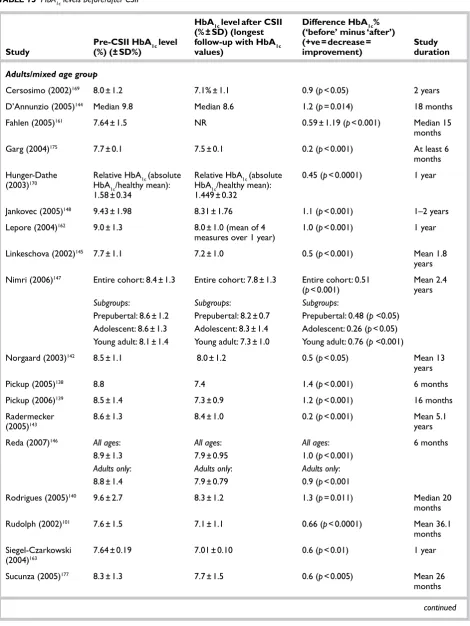
A total of 922 studies was found in literature searches, of which 557 were excluded from the abstracts alone, followed by another 291 after reading the full text. The 74 studies retained for analysis included eight randomised controlled trials (RCTs) of CSII versus analogue-based MDI in either T1DM or T2DM, eight new (since last NICE appraisal) RCTs of CSII versus NPH-based MDI in T1DM, 48 observational studies of CSII, six studies of CSII in pregnancy, and four systematic reviews.
In the last guidance, NICE commented on the absence of trials of CSII against analogue-based MDI in T1DM. Unfortunately, only four such trials have been carried out since then, and only two have been published in full, of which one was only a pilot. The trial in children had 32 participants, and those in adults had 10, 14 and 57 recruits, giving a total of 81 adults. They lasted from 16 weeks to 6 months, which is too short. They were too dissimilar for a meta-analysis to be carried out.
For the comparison of CSII versus MDI in T2DM, we found four studies with 296 patients. There were eight new trials of older forms of MDI against CSII in T1DM, with 500 patients, although over half came from one trial. There are many observational studies, mainly case series.
Clinical effectiveness
As reported in the previous assessment report, the benefits of CSII can include:
• Better control of blood glucose levels, as reflected in glycated haemoglobin (HbA1c), by reduction in swings in blood glucose levels, and in problems due to the dawn phenomenon. • Fewer problems with hypoglycaemic episodes,
of which severe incapacitating hypoglycaemia is most important.
• A reduction in insulin dose per day, thereby partly off-setting the cost of CSII.
• Quality of life, including a reduction in the chronic fear of severe hypoglycaemia. • More flexibility of lifestyle – no need to eat
at fixed intervals, more freedom of lifestyle, and easier to participate in social and physical activity.
These are dealt with, in turn, below.
Control of blood glucose
CSII versus analogue-based MDI in T1DM
• The one study in children and adolescents reported that HbA1c was reduced by 1% (p < 0.05). The usual minimum difference regarded as clinically significant is 0.5%. • The studies in adults found no difference in
HbA1c.
• The studies were of short duration, ranging from 16 weeks to 6 months.
CSII versus MDI in T2DM
• In T2DM, there was little evidence that CSII was better than analogue-based MDI. There was only one trial, in which there was no clinically significant difference in HbA1c. • Three trials compared CSII with NPH-based
MDI. One found no difference in HbA1c. The other reported reductions of 0.5% (clinically useful but not statistically significant in this study) and 0.9% (p < 0.03).
CSII versus NPH-based MDI in T1DM – new trials
• Of the eight new trials, three showed no difference in HbA1c; four showed differences which were not statistically significant (although one showed a clinically significant difference of 0.5%), and the last showed a larger and statistically significant difference of 0.84%. Some had very small numbers of patients. The largest trial had 272 patients; this was more than all the other trials put together.
Observational studies
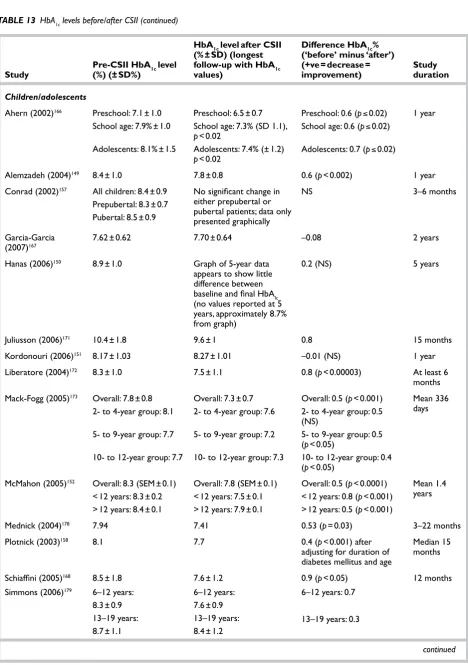
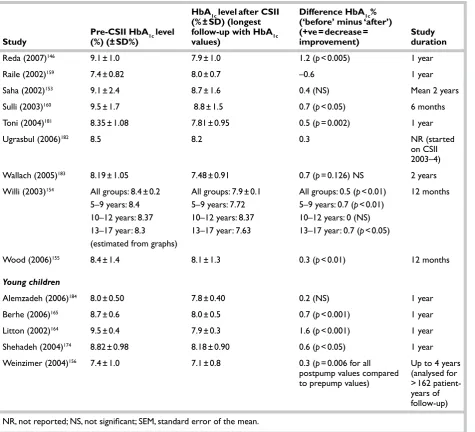
There are far more observational studies available now than there were at the last review. They need to be interpreted with caution due to the greater risk of bias. In general, they report greater improvements in HbA1c than reported in the trials. • In all 18 studies in adults, there were
reductions in HbA1c in adults and mixed age groups, ranging from 0.2% to 1.4%.
xiii 0.2% to 1.2%, and in 13 studies the reductions
were statistically significant.
• The five studies in young children (under 7 years) reported decreases of 0.2–1.6%, with these being statistically significant in all but one small study (only 14 patients – reduction 0.2%).
Hypoglycaemia
CSII versus analogue-based MDI in T1DM
• The trials in adults had too few patients, too short durations and too few severe hypoglycaemic episodes to be conclusive, but reported no significant differences in the frequency of severe hypoglycaemia.
• The trial in children reported a statistically significant drop in severe hypoglycaemia, but based on five episodes on MDI versus two on CSII.
CSII in T2DM
• None of the four trials reported a significant difference in hypoglycaemic episodes.
CSII versus NPH-based MDI in T1DM – new trials
Again, most trials had small numbers. Five trials had < 30 patients.
• The trials that reported the number of severe hypoglycaemic events usually found about half the rate with CSII than with MDI.
• The biggest trial (which had more patients than all the rest put together) reported annual rates of severe hypoglycaemia of 0.2 per patient-year on CSII and 0.5 on MDI.
Observational studies
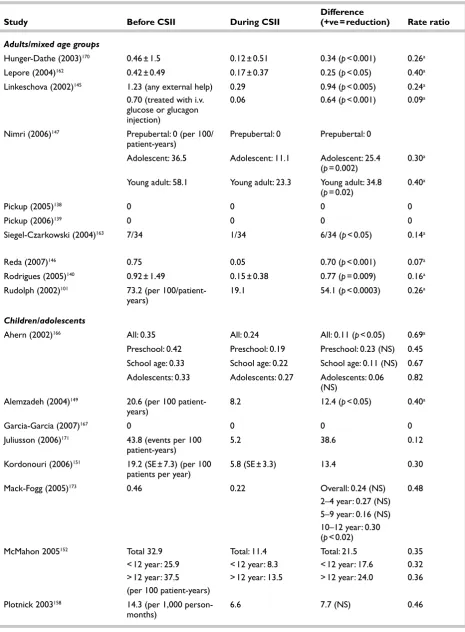
These reported considerable reductions in severe hypoglycaemia. This may reflect selection for CSII of people having particular problems with hypoglycaemia, but that would make them more applicable to routine care. Of 26 studies reporting comparable before/after data:
• 15 showed a statistically significant decrease in severe hypoglycaemic episodes
• five reported a statistically non-significant decrease
• three reported a decrease in episodes, but did not report significance levels
• three did not report any episodes.
Patient evidence
This came from the submission from INPUT, or from individual testimonies provided to NICE. Several patients reported that they had found that the onset of hypoglycaemia was much slower on CSII than MDI, giving them more time to take preventative action and avoid severe hypoglycaemic events.
Reduction in insulin dose
CSII versus analogue-based MDI in T1DM
The study in children reported a reduction, from 0.7 units/kg per day on CSII to 0.6 units/kg per day on MDI, but this was not statistically significant.
The only published trial in adults reported a significant drop by 24 weeks in the CSII group, from 0.7 units/kg per day before CSII to 0.4 units/kg per day after 24 weeks. The MDI group showed an insignificant rise, from 0.7 to 0.8 units/kg per day.
The studies available only as abstracts gave no details.
CSII in T2DM
No persisting differences in insulin dose were found.
Observational studies
Eight studies in adults, 11 in older children and adolescents, and two in younger children, reported comparable data. Six out of the eight adults studies reported a decrease in insulin dose, ranging from 2% to 27%. Of the 11 studies in older children and adolescents, 10 showed decreases varying in size from 3% to 32%, with most being statistically significant.
There were no significant changes in two studies in the youngest children.
Quality of life
CSII versus analogue-based MDI in T1DM
The two studies that reported quality of life outcomes found no differences, but had only 14 patients, followed up for 24 weeks, and 32 patients, followed up for 16 weeks.
CSII in T2DM
xiv
Observational studies
Bias in observational studies is more of a problem with questionnaire-based results than with
biochemical ones such as HbA1c, and all results must be treated with caution. Of 48 observational studies, only nine reported on quality of life aspects. Study numbers were small, with at most 35 patients.
One study in adult patients reported that they preferred CSII – another reported gains in quality of life.
In older children and adolescents, three out of four studies reported gains in various measures such as less worry, patient satisfaction, sleep quality, flexibility of mealtimes, better moods in children, and reduced impact of diabetes. But some reported initial worry, difficulties calculating insulin dose, and that it took from 6 weeks to 9 months to feel confident.
In children under 7 years, most families preferred CSII. In one study, parents reported quality of life gains; in another, children did not, but both had small numbers (15 and 14 children).
Other outcomes
Fifteen observational studies reported the frequency of diabetic ketoacidosis (DKA). None reported a statistically significant increase, but three reported statistically significant decreases.
The trials reported no difference in weight gain between CSII and MDI. Most of the observational studies reported no significant weight change before and after CSII.
Pregnancy
There were no new trials. Observational studies in general showed that CSII achieved similar glycaemic control to MDI. Maternal and fetal outcomes were similar. One study reported more DKA with CSII. A recently published Cochrane review noted that there was a dearth of good evidence.
Industry submission
The pump manufacturers submitted a joint submission. It used the CORE diabetes model. Three HbA1c scenarios were assessed, all for T1DM:
• a baseline HbA1c based on an unpublished meta-analysis of results from trials, with a reduction in CSII of 0.62%
• a higher baseline thought to be more representative of levels in the UK, with a reduction of 1.3%
• an intermediate scenario with a reduction of 0.95%.
All of these scenarios assumed a severe
hypoglycaemic episode rate of 15 per 100 person-years.
The submission concluded that CSII in T1DM was cost-effective if the drop in the level of HbA1c was 0.9% or more. Some assumptions favoured CSII, including the cost of hypoglycaemic episodes and the size of the reduction in insulin dose. The model also assumes that reductions in HbA1c levels with CSII are sustained. In other ways the industry submission may have underestimated the benefits, for example by not including hypoglycaemic mortality and not allowing for all the quality of life gains. However, some of the omissions are understandable, given that some gains, for example in flexibility of lifestyle or happiness of children, are not easily measurable, and do not fit easily into cost per quality-adjusted life-year (QALY) estimations.
There are only occasional deaths from
hypoglycaemia, but because they often occur in young people the number of life-years lost can be considerable.
The industry submission did not examine the economics of CSII in T2DM. In practice, CSII would be considered only in people with T2DM who had progressed to intensive insulin therapy, and would have a β-cell failure status not far off those with T1DM. Treatment group is more relevant than type of diabetes.
Perspective of pump users
The submission from INPUT emphasised the quality of life gains from CSII, as well as improved control and fewer hypoglycaemic episodes.
We carried out a small study by interviewing parents of 10 children aged 5–8 years. The following findings were included:
xv • They often found out about CSII from sources
other than their local diabetes service. • The benefits reported were much wider than
the outcomes studied in trials, and included improvements in behaviour and parental quality of life.
• There seem to be problems with diabetes care in schools, with MDI regimens being difficult to implement.
There is a marked discrepancy between the improvement in social quality of life reported by successful pump users, and the lack of convincing health-related quality of life gains reported in the trials. The quality of life gains are not just to pump users, but to their families. Several parents reported that it was difficult to be in employment when looking after primary school children with diabetes.
Costs
The main cost of CSII is for consumables, such as tubing and cannulas – about £1800–2000 per year. The cost of the pump, assuming 4-year life, adds another £430–720 per annum. The extra cost compared with analogue-based MDI averages £1700.
Cost-effectiveness
A review of existing studies found three full papers and eight abstracts examining the cost-effectiveness of CSII compared with MDI. Most use the CORE model, and most found CSII to be cost-effective. They assumed a reduction in HbA1c level of 1.2%; if CSII resulted in an improvement of only 0.5% then its cost-effectiveness was much poorer.
Modelling was carried out with varying
assumptions about improvement in HbA1c level, and reduction in severe hypoglycaemic episodes. With an improvement in HbA1c level of 0.9%, and a reduction in severe hypoglycaemic episodes of 50% (from a relatively low baseline severe hypoglycaemic event rate of 19 per 100 patient-years), the cost per QALY is about £38,000. If higher-baseline severe hypoglycaemia rates are used, the cost per QALY falls but only to about £36,500 because the CORE model is driven more by HbA1c level than by hypoglycaemia, and because the quality of life decrement from each hypoglycaemic event is of short duration.
The base case assumes an average age of 40 years at baseline. If we assume a younger starting age, of say 30 years, the cost per QALY falls to £34,000. The CORE model was not designed to run with children and so the results of CSII started in childhood have not been modelled.
If the reduction in level of HbA1c is assumed to be only 0.6% then the incremental cost-effectiveness ratio (ICER) rises to over £50,000. Conversely, if the reduction in HbA1c level is 1.4% then the cost per QALY falls to around £25,000.
A reduction in severe hypoglycaemic events can produce benefits in three ways. First, the immediate disbenefits at the time of the episode are avoided. Second, the chronic fear of a recurrence is reduced or relieved. Third, reduction in the fear of severe hypoglycaemia may allow more intensive therapy and lower HbA1c level, hence reducing future complications. The second aspect has major implications for the cost per QALY, which has not been factored into any of the above estimates. An annual quality of life increment of as little as 0.01 from reduced fear of hypoglycaemia would, because of the number of years of benefit, reduce the base-case cost per QALY to about £29,000. An annual increment of 0.03 would reduce it to about £21,000 per QALY.
Patient selection
Continuous subcutaneous insulin infusion is a form of intensive insulin treatment that requires commitment from patients, and is part of package of care and self-care, along with structured
education, home self-testing of blood glucose, adjustment of insulin dose, and attention to diet and physical activity.
Diabetes clinics that provide a specialist CSII service have developed ways of selecting patients who would be most suitable for CSII.
Implementation
xvi
Uncertainties
Some gains and losses in utility remain uncertain, or have not been quantified. These include:
• The fear of severe hypoglycaemia.
• The possibility of cognitive impairment due to severe hypoglycaemia in some children who become diabetic when very young.
• The non-health related benefits of CSII, such as greater flexibility of lifestyle, easier participation in social activities or school events/trips, happier children, less disruption to family routines, and, in mothers of young children with diabetes, less interrupted employment.
The costs per QALY in children have not been estimated.
Many of the trials are of short duration. It takes time to get the full benefit from CSII, for example by trying out different basal rate combinations, and so short trials may underestimate benefit.
Research needs
• The need identified by NICE at the first appraisal of CSII for adequate trials of CSII against analogue-based MDI has not been met. We need further trials, with larger numbers and longer durations, comparing CSII and optimised MDI in adults, adolescents and children. Duration is important because the maximum benefit from CSII may not be obtained for many months. Conversely, we need to know if initial benefits in HbA1c level are sustained.
• There should be a trial of CSII versus MDI with similar provision of structured education, such as the DAFNE package, in both arms. Without
such trials, we cannot be sure whether the benefits observed with CSII are due to the CSII itself, or to increased understanding of diabetes resulting from increased patient education. • Automated systems for monitoring blood
glucose levels are entering clinical practice, and there is potential to link with the insulin pumps.
• There is a need for a large trial involving pregnancy in women with pre-existing diabetes, which, in order to allow for using CSII to best effect, should start before conception.
• There should be a survey of difficulties of management of diabetes in schools.
• The present economic model assumes an adult population, and we need a model that would assess use in children to be developed.
Conclusions
Based on the totality of evidence, using
observational studies to supplement the limited data from randomised trials against best MDI, CSII provides some advantages over MDI in T1DM. For both children and adults, these are:
1. Better control of glucose levels as reflected by HbA1c level, with the size of improvement depending on the level before starting CSII. 2. Fewer problems with hypoglycaemia.
3. Quality of life gains, such as greater flexibility of lifestyle.
© 2010 Queen’s Printer and Controller of HMSO. All rights reserved.
1
Diabetes
There are two main types of diabetes mellitus (‘mellitus’ is used here to distinguish it from a rarer disease called ‘diabetes insipidus’, which is not relevant to this review).
Normal blood glucose control
Glucose is the primary source of fuel for cells in the body. Carbohydrate in food is metabolised to glucose within hours of ingestion, and is absorbed from the blood into cells for use as fuel. Uptake of glucose into cells is regulated by the hormone insulin, which is released from the pancreas in response to rising blood glucose levels. Insulin also regulates the use of glucose by cells, so if there is insufficient insulin, or if cells do not respond properly to insulin (insulin insensitivity or resistance), then glucose is not used efficiently by cells, in terms of either energy or storage.
Type 1 diabetes
In type 1 diabetes mellitus (T1DM), formerly known as ‘insulin-dependent diabetes’, all or nearly all of the β-cells in the pancreas, which
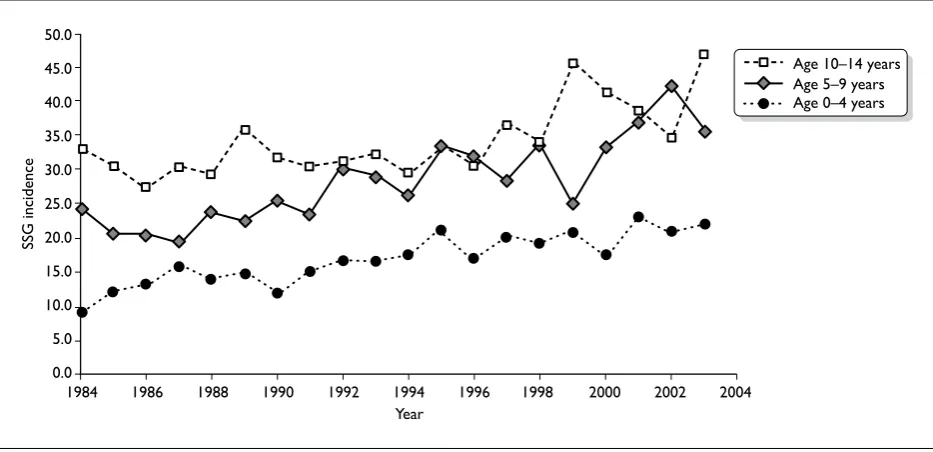
produce insulin, have been destroyed, usually by an autoimmune process. The cause is not known. People with T1DM have little or no ability to produce their own insulin, and would die without insulin, and so they have to inject insulin for the rest of their lives. T1DM usually starts in children or young adults, but it can have onset at any age. The incidence (number of new cases per year) has risen considerably over recent decades. Scottish data show that the rate in children has more than trebled over the last 30 years (Figure 1). The rise has been greater in the youngest age group, although absolute numbers are smaller.1
Similar rises have been reported from the Oxford region by Wilson et al. (2007).2 The incidence of
childhood diabetes (under the age of 15 years) rose from 17 per 100,000 in 1985–90 to 26.5 in 2003–4. The greatest increase was in the under-5s, in which the number who had diabetes by the age of 5 years rose fivefold.
Type 2 diabetes
Type 2 diabetes (T2DM), formerly known as ‘non-insulin-dependent diabetes’ or ‘maturity-onset diabetes’, comes on later in life than T1DM. It
Chapter 1
Introduction
Figure Number: 00.01.ai Title: 06-61-01 Proof Stage: 1
1984 0.0 5.0 10.0 15.0 20.0 25.0 30.0 35.0 40.0 45.0 50.0
1986 1988 1990 1992 1994 1996 1998 2000 2002 2004 Year
SSG incidence
[image:19.595.63.530.538.764.2]Age 10–14 years Age 5–9 years Age 0–4 years
2
used to be seen almost exclusively in people over 45 years old, and was associated with overweight or obesity, but with rising prevalence of obesity it is now increasingly being seen at younger ages and even in children. Some ethnic groups, such as South Asians, have earlier onsets. The York and Humber Public Health Observatory (YHPHO) website (a very useful compendium of data on diabetes) estimates that the total prevalence of T2DM in England is 4.3%, although this includes people with undiagnosed diabetes.3 [Some people
with T2DM, perhaps 20%, have no symptoms and do not know they have it. Hence the current debate on screening, which is covered by another Health Technology Assessment (HTA) report.4] The YHPHO
estimated that the total prevalence of diabetes would rise by 15% between 2001 and 2010, with a 6% increase due to the ageing population and a 9% increase due to increasing obesity.5
Type 2 diabetes usually starts with insulin
resistance, related to overweight, with the pancreas producing more insulin than usual to overcome the resistance. Over time, the pancreas fails to produce enough, insulin production falls, blood glucose rises further, and clinical diabetes ensues. In the UK Prospective Diabetes Study (UKPDS), patients’ insulin production had fallen to about 50% of normal at the time of diagnosis.6 Treatment
starts with lifestyle measures, diet, weight loss and exercise, and, if those fail, oral drugs are added. In most patients T2DM is a progressive disease and, over time, many patients will need insulin.7
The UKPDS showed that just over one-half of patients initially randomised to sulphonylureas (an oral drug that stimulates pancreatic insulin production) had to switch to insulin by 6 years.8 In
a population-based study in Tayside, Scotland, 6% of patients with T2DM started insulin each year.9
Most people with T2DM starting insulin nowadays probably start with a once-daily injection of a long-acting analogue, but, over time, some will progress to multiple daily injections (MDI) in order to achieve good control.
Data from other studies have shown that many patients with T2DM are on insulin therapy. The Lothian Audit reported that 32% of people with T2DM are on insulin [J. McKnight, presentation to Royal College of Physicians of Edinburgh (RCPE) conference, 2005, formerly on RCPE website].
Control, glycated haemoglobin
and insulin treatment
The term ‘control’ is a recurring one in diabetes. It refers principally to preventing blood glucose from becoming too high, but also applies to preventing it from becoming too low. High blood glucose is known as hyperglycaemia, whereas low blood glucose is called hypoglycaemia.
In the non-diabetic person, blood glucose is kept within a narrow normal range (about 4–5.6 mmol/l) through the action of insulin and other hormones. The pancreas releases a little insulin throughout the 24 hours (known as basal insulin – about 0.5–1 unit per hour in adults), but production of insulin is swiftly and markedly increased with meals, going up 5- to 10-fold in the first 30 minutes. If blood glucose falls too low, counter-regulatory hormones are released and nervous system mechanisms are activated to increase it again. A key aspect is that the brain is dependent on glucose for energy. If blood glucose falls too low, brain function is impaired, as will be described later.
Control of blood glucose is measured in three ways. First, blood glucose can be checked at any time by finger-pricking to produce a drop of blood, and testing it with a testing strip and blood glucose meter. This gives the glucose level at that time, but it may change quite rapidly after meals or either insulin or tablets. Second, longer-term control is measured by glycated haemoglobin (HbA1c) level, which reflects the average blood glucose level over 2–3 months. HbA1c has been a major advance in diabetes because by testing every 3 months, it gives an indication of how good control is. However, it provides an average and that can reflect very tight control with little fluctuation in glucose levels, or poorer control with considerable fluctuation. At the risk of considerable simplification, this can be illustrated by the averages of 4 and 8, and 2 and 10 – both equal 6. Third, new devices can now provide frequent automated testing of interstitial tissue glucose, calibrated to reflect plasma glucose, and known as ‘continuous blood glucose monitoring’. These devices are currently used more in research, but are coming into routine clinical practice in some clinics.
3 pancreas. Even the latest rapid-acting insulins can
neither achieve as rapid a rise after meals as the pancreas can, nor as rapid a fall. A key point is that natural pancreatic insulin release is regulated by the level of glucose in the blood in a way that injected insulin cannot be. A fall in blood glucose will switch off pancreatic insulin release but cannot affect injected insulin.
There are various forms of insulin, and various combinations, grouped by duration of action.
Short-acting (SA) insulin comes in three types:
• The oldest type is called ‘regular’ or ‘soluble’; we will refer to it as short-acting (SA) soluble because some long-acting analogues are also soluble.
• The next type is SA analogue insulin, with three varieties on the market – aspart, lispro and glulisine. SA soluble starts acting within an hour of injection, peaks at 2–4 hours, and has some effect for up to 8 hours. The SA analogues act a bit more quickly and do not last quite as long. They are therefore regarded as being closer in effect to pancreatic insulin than SA soluble insulin. However, a Cochrane review10 concluded that the advantages of
SA analogues over SA soluble were minor – very little difference (0.1%) in HbA1c or total hypoglycaemic episodes, a greater (50%) but not statistically significant reduction in severe hypoglycaemic (SH) episodes (‘hypos’) in adults, but not adolescents, when used in MDI, but a greater difference (0.2%) in HbA1c in patients on continuous subcutaneous insulin infusion (CSII). The improvement in HbA1c with SA analogues rather than SA soluble in CSII, was reported to be 0.26% in a meta-analysis based on the last assessment report for the National Institute for Health and Clinical Excellence (NICE),11 and patient preference
was also higher for analogues.
• The third type is inhaled insulin, appraised by NICE in 2006 [Technology Appraisal (TA) 113] but now withdrawn from the market by the manufacturers.12
Intermediate-acting insulins, such as neutral protamine Hagedorn (NPH) or isophane, start working in 1–2 hours, peak at about 6–10 hours, and have some effect for 16–18 hours. Unfortunately, the peaks may vary unpredictably
from injection to injection, and hence from day to day.
Short- and intermediate-acting insulins can be mixed in the same syringe, and can be given as a premixed version twice daily. This is known as ‘conventional’ insulin therapy. The newer long-acting analogue insulins – glargine and detemir – are longer acting than NPH and have a long steady action, being sometimes called ‘peak-less’.
In recent years, since the Diabetes Control and Complications Trial (DCCT)13 showed that good
control reduced the adverse effects of T1DM, there has been a move to more intensive insulin treatment. This consists of a combination of basal insulin using NPH (usually twice per day) or a long-acting analogue, with SA insulin at mealtimes, usually called ‘bolus’ insulin – hence the term ‘basal–bolus’ regimens. These can be given in two ways: by MDI or by CSII via insulin pumps.
History of continuous
subcutaneous insulin infusion
The first studies of CSII delivered via insulin pumps came from Guy’s Hospital, London, UK in 197814 and Yale, New Haven, CT, USA in 1979.15CSII uses a small programmable pump with a fine tube connected to a soft plastic cannula (introduced by needle), which goes into the subcutaneous tissue under the skin, often in the abdomen. The cannula is changed every 2–4 days. The aim of CSII is to try to approximate the insulin delivery profile more closely to the pattern of output behaviour of the normal pancreas, by providing continuously infused, low-volume basal insulin for fasting periods and the delivery of increased rate boluses to cover meals. Only SA (soluble or analogue) insulin is used.
Lenhard and Reeves (2001)16 reviewed the
4
(‘comparable or slightly superior to MDI’) and some in pregnancy, but that there was little good-quality evidence in children.
Pickup and Keen,17 who were the originators of
CSII, reviewed the history of, and evidence base for, CSII in 2002. They noted the considerable worldwide use of pumps (over 200,000 patients) and the disproportionately low UK use. They concluded that on CSII, blood glucose and HbA1c levels are similar or slightly lower than when using MDI, that hypoglycaemia is much less frequent, and that ketoacidosis occurs at the same rate. They concluded that the proportion of patients who would be suitable is relatively small. In a complementary paper, Pickup et al. (2002)18 carried
out a meta-analysis of randomised controlled trials (RCTs) comparing CSII with MDI. They found that HbA1c level was about 0.5% better on CSII, but found that few studies reported hypoglycaemic episodes; none appeared to report effect on quality of life. The CSII group needed 14% less insulin.
The previous UK HTA report has been mentioned already and its summary is shown in Appendix 1. The Agence d’Évaluation des Technologies et des Modes d’Intervention en Santé (AETMIS),19
Quebec, Canada, published a report in June 2005, comparing MDI with CSII. It concluded that CSII might be indicated for a limited, selected group of people with T1DM, and cited various selection criteria, including:
• inadequate glycaemic control despite a trial of intensive insulin therapy
• recurrent, unpredictable SH episodes, nocturnal hypoglycaemia or hypoglycaemic unawareness, causing incapacitating anxiety and affecting the quality of life
• morning hyperglycaemic episodes (morning blood glucose level of 8 mmol/l or more) • and for children, the above plus extreme
insulin sensitivity (under 20 units of insulin per day).
At the time the report was written, glargine was not available in Quebec, Canada.
It is always interesting to know what treatments clinicians with diabetes choose for themselves. A survey of the American Association of Diabetes Educators (AADE) and the American Diabetes Association (ADA) asked members if they had diabetes, and, if so, how they were treated.20 About
6.4% of members had diabetes, of whom 72% had T1DM. The survey found that 96% of those with
T1DM used an intensive insulin regimen, and that over one-half (60% of the AADE members with diabetes and 52% of the ADA ones) used an insulin pump.
Modern pumps
Modern pumps are small and lightweight compared with the early versions. The pumps are battery operated and hold enough insulin for several days, depending on daily need. The infusion rate can be programmed for both dose and timing. Different basal rates can be preset, for example overnight could be lower than during the day, or vice versa. Bolus boosts can be given starting just before meals (if analogue insulins are used), and infusion rates can be reduced during exercise. The newer pumps are more reliable21
and may have alarms for empty cartridges, low batteries, occlusion of tubing and faulty electronics, giving rise to less fear of undetected malfunction, which was a problem with some of the older pumps.
Complications of diabetes
Diabetes causes short- and long-term problems. The short-term ones include the acute metabolic upsets shown below.
• Diabetic ketoacidosis (DKA) Insufficiency of insulin, often at a time of incidental other illnesses when the body needs more than usual, leads to disordered metabolism, with the blood become more acidic than it should be (hence the ‘acidosis’) due to accumulation of ketones (hence the ‘keto’). DKA is a medical emergency and can be life threatening. Mortality nowadays is very low, from 0.15–0.31% in children in North America, the UK22 and India,23 but
higher, at 4%, in Danish adults.24 However, it
remains a serious threat.
5 convulsions (similar to an epileptic fit) or
death. In very young children with frequent or SH events there may be some impairment of intellectual function (see below).
The problems mentioned above refer to physical effects, but, as has been pointed out by Cryer (2006),25 there is also psychological morbidity: ‘At
the very least, an episode of hypoglycaemia is a nuisance and a distraction. It can be embarrassing and can cause social ostracism. The psychological morbidity of hypoglycaemia includes fear of hypoglycaemia, high levels of anxiety and low levels of overall happiness’.
The longer-term adverse consequences of diabetes have been traditionally known as ‘complications’, and are related to chronic hyperglycaemia. They include conditions due to damage to small blood vessels (microangiopathy) and larger ones (macrovascular disease):
• retinopathy a disease of the eyes, which, in the past, has been the most common cause of blindness in people of working age (macular degeneration is more common in the elderly)26
• nephropathy a disease of the kidneys, which is one of the most common causes of end-stage renal failure, leading to a need for renal dialysis or transplantation27
• ischaemic heart disease (IHD) due to disease of the coronary arteries. People with diabetes have an increased risk of IHD28–31
• stroke due to disease of the arteries to the brain – the risk is increased three- to fourfold in T1DM29
• amputations due to a combination of damage to nerves (neuropathy) and to arteries in the leg (for review see Boulton et al. 2005).32 A
Welsh study reported a relative risk (RR) for amputation of 32 in people with diabetes33
• neuropathy damage to the nervous system.
Intensified insulin therapy
and better control of T1DM
Conventional insulin treatment usually means twice-daily combination of a short-acting and an intermediate-acting insulin. Intensified insulin therapy (IIT) is a combination of more frequent doses of insulin, usually one injection of a long-acting insulin per day (sometimes two) andmealtime doses of SA insulin, together with regular self-monitoring of blood glucose, self-adjustment
of insulin dose, and care with diet. It requires commitment from an educated patient, and not all patients wish to move to intensified therapy. It is not just about taking insulin more often.
The DCCT in T1DM confirmed the benefits of intensified therapy, with MDI or insulin pumps, in achieving good control and thereby reducing the risk of complications.13 It confirmed the results
of smaller trials, summarised in the meta-analysis by Wang et al. (1993).34 Since the DCCT, there
has been increased emphasis on the importance of good control of blood glucose in reducing the risk of complications. The DCCT compared outcomes at an average follow-up of 6.5 years, between those randomised to intensive insulin treatment with MDI or CSII, and those randomised to conventional insulin regimens, usually two injections per day. In those who had no retinopathy (eye disease) at baseline, intensive therapy reduced the risk of retinopathy by 76% [95% confidence interval (CI) 62 to 85]: by 6 years, 7% of the intensive group and 26% of the conventional group had developed retinopathy.13 The gap
widened in later years.35 In those who had some
retinopathy at baseline, intensive therapy reduced progression by 54%, and reduced the need for laser photocoagulation therapy (a way of treating sight-threatening retinopathy) by 56%. Intensive therapy reduced the appearance of microalbuminuria, a marker for diabetic renal damage, by 39%.13
The reduction in retinopathy was related to the improvement in HbA1c, and applied across the whole range of HbA1c. So a 10% reduction in HbA1c gave a 39% decrease in retinopathy risk, whether the reduction was from 9.0% to 8.1% or from 8.0 to 7.2%.36 The retinopathy risk increased as the
HbA1c increased, so the absolute risk reductions would be different. (For example, drops from 40% to 20% and from 20% to 10% are both 50% relative reductions, but the former is a larger absolute reduction.)
The DCCT ended after 6.5 years, and the conventional group was advised to switch to intensive therapy. Within a year, the gap in HbA1c levels had narrowed from the 1.8% seen in the trial to 0.4%, and by 5 years there was no difference. But, at 7 years, the former intensive group continued to do better, for example with progression of retinopathy at about one-third of that of the former conventional group, despite identical HbA1c level.37 The reasons are not fully
6
get beyond a certain point, progression is not halted by improving glucose control. This is seen in nephropathy (renal disease), which once established, progresses even if very good control of blood glucose is achieved. One finding from the DCCT was that tight control was more effective if applied early in the disease.38
This phenomenon whereby early good control can reduce later complications, even if control worsens, has been called ‘metabolic memory’ by the DCCT/Epidemiology of Diabetes Interventions and Complications Research Group (EDIC) investigators.39 A recent review by Ihnat et al.
(2007)40 identified possible underlying biochemical
mechanisms through which this could occur. If, to use Ihnat’s words, ‘hyperglycaemia can leave an early imprint in cells of the vasculature and of target organs, favouring the future development of complications’, then there are implications for diabetes care. One is that as Ihnat et al. say, ‘the existence of the metabolic memory suggests that very early aggressive treatment of hyperglycaemia is mandatory’.
Since the DCCT, there has been a move to
intensified insulin regimens. A study of two cohorts of children in the USA by Svoren et al.,41 one
enrolled in 1977 and the other in 2002, found that the proportion on three or more injections per day or CSII, increased from 65% in the earlier cohort to 85% in the later one. HbA1c level dropped by 0.3% but the incidence of SH episodes and emergency room visits also dropped, by almost 50% and 25%, respectively.
Unfortunately, many patients with T1DM are poorly controlled, especially in childhood and adolescence. Two audits by the Scottish Study Group for the Care of Diabetes in the Young (SSGCDY) have examined control of hyperglycaemia as reflected by HbA1c level. The first audit, DIABAUD 2 (SSGCYD 2001),42 reported
that in 1997–99, the average HbA1c level was 9.1%. Only about 10% of children were achieving the current NICE guidelines target of 7.5% or less. Nearly all children were on two injections per day; only 2% were on intensive insulin regimens of four injections per day. The second audit, DIABAUD 3 (SSGCDY 2006),43 was carried out in 2002–4.
It found that mean HbA1c level had not changed (it was 9.2%) and again only 10% reached the NICE guideline target. The number of children on more than two injections per day had risen to 51% but almost all were on a three-injection
regimen, splitting the evening dose. MDI was still uncommon (2.3%) and pump use was rare.
The proportion of people with diabetes who have good control, as reflected by HbA1c level, has been increasing. The National Diabetes Audit 2004–5, reported in Diabetes UK’s State of the Nations 2006 report, found that in England 62% of people with diabetes reached the target of HbA1c level ≤ 7.4%; in Wales, 61% did.44 However, this means that 48% in
England did not. For children, 84% did not achieve the target in 2004–5. Unfortunately the data, based on returns from general practices, do not provide information for T1DM separately.
Treatment of T2DM with
insulin
As mentioned above, T2DM is usually a progressive disease, and about one-third of patients end up on insulin. There has been reluctance amongst both patients and clinicians to switch from oral agents to insulin in T2DM, because good control is still usually not achieved and because weight gain tends to follow insulin therapy.45,46 Many patients with
T2DM with poor control on oral agents remain on them for years before switching to insulin.47
This may be changing for several reasons: the new general practitioner (GP) contract with incentives for reaching HbA1c targets; the evidence on the benefits of tighter control; and the greater ease of switching to insulin with once-daily long-acting analogues. Gulliford et al. (2007)48 noted that the
impact of the Quality and Outcomes Framework target was seen in the proportions of patients whose HbA1c level was < 7.5%: 22% in 2000; 32% in 2001; 37% in 2002; and 57% in 2005.
For the purposes of this review, the relevant T2DM group is those who have progressed to the stage of needing intensive insulin therapy because of poor control and poor pancreatic β-cell function. Such therapy usually involves MDI, with a combination of long-acting insulin to provide a basal level of insulin throughout the 24 hours, supplemented with SA insulin at mealtimes.
Hypoglycaemia in T1DM
In the DCCT, intensification of insulin therapy was associated with a higher rate of hypoglycaemia.13,49