Improving the process of restocking sanitary
appliances using the Internet of Things
Author: Harmen Denekamp
University of Twente
P.O. Box 217, 7500AE Enschede
The Netherlands
ABSTRACT
This research aims to improve the process of restocking sanitary appliances using the
Internet of Things (IoT). Two sub-processes are identified: cleaning personnel
restocking sanitary appliances and the vendor restocking the inventory of clean towels
and soap flacons. Two problems for each of these sub-processes are identified. First,
restocking sanitary appliances is infrequent, which often results in full trash bins, empty
soap dispensers and empty towel dispensers. Second, because signals from cleaners on
the inventory levels are unreliable, it can result in empty or excessive inventories. To
address the problems, three IoT prototypes are made. For towel dispensers, soap
dispensers and trash bins. The result is an application on which cleaners can see the
state of the sanitary appliances and anticipate when they need to be restocked, reducing
the risk of empty appliances. The application can recognize when an appliance is
replaced, updating inventory levels in the order management system, so that
replacement orders can be based on real-time usage. The last step is the redesign of the
two sub-processes, for which a number of advantages are identified, compared to the
current process: vendor-managed inventory can take place without the involvement of
the customer; no more excessive inventories (which are costly); no more empty
inventories (thus no empty towel and soap dispensers); enable pay for usage instead of
fixed price; smaller inventory is needed to achieve same service level.
Graduation Committee members:
Prof. Dr. H. Schiele
F. Vos MSc.
Keywords
Internet of Things; vendor-managed inventory; sanitary appliances; restocking
Permission to make digital or hard copies of all or part of this work for personal or classroom use is granted without fee provided that copies are not made or distributed for profit or commercial advantage and that copies bear this notice and the full citation on the first page. To copy otherwise, or republish, to post on servers or to redistribute to lists, requires prior specific permission and/or a fee.
9th IBA Bachelor Thesis Conference, July 5th, 2017, Enschede, The Netherlands.
1.
INTRODUCTION
First, the role of Internet of Things (IoT) within Industry 4.0 will be discussed. Next, the motivation for the research and problem identification are stated, which lead to the main idea of the research. Then, it is shown how this research contributes to academic literature, which further shapes the research.
1.1
Industry 4.0 and Internet of Things
The first industrial revolution was mechanization, enabled by the invention of the steam engine. The second revolution was mass production, enabled by electricity. The third revolution was digitization, enabled by IT. Industry 4.0, the fourth revolution, has been initiated at the Hannover Fair1. Industry 4.0 is defined as machine-to-machine communication in cyber-physical systems (Schiele, 2016, p.1).
Cyber Physical Systems (CPS) are required before machine-to-machine communication is possible, because the communication is on cyber-level, while the machines are on physical level. Creating the connection between physical and cyber is exactly what IoT does. Therefore, IoT is a prerequisite for machine-to-machine communication. It enables machine-to-machine-to-machine-to-machine communication and thereby enables Industry 4.0. Jazdi (2014, p.3) have shown this, by creating a prototype that shows how CPS, through IoT, enables Industry 4.0.
1.2
Research motivation
Company A is a company that washes workwear, mats, and floor mops for companies. They are an industrial laundry. In 2010, they have implemented a redesign of their entire process and machinery. The current process is modern and automated: robotic storage, rails on the roof to transport everything that needs to be washed through the entire factory, a robot that walks on the floor to transport new clothes, to name a few examples. The company is a frontrunner on the subject of process optimization and automation. The revenue of Company A is growing in a shrinking market as a result of this. Being innovative, they have the desire to explore the possibilities of IoT.
Company B is currently replacing a part of the information systems at Company A. Company B is an IT consultancy company that develops business process-focused applications for customers. Being IT consultants, they want to be on the forefront of new developments in the field. This is the reason they want to explore the possibilities of IoT.
These two desires have led to this project: developing an IoT application for Company A. The relevance for Company A is to explore the possibilities and added value of IoT applications. The relevance for Company B is to explore what the added value of IoT can be for their customers, and how it works with the software they currently use.
1.3
Problem identification
The main problem is a knowledge problem and can be derived from the research motivation. Company A does not know what the added value of IoT can be for them and what the drawbacks are. Company B does not know how they can develop IoT. To solve these knowledge problems, an IoT prototype has been developed. Developing a prototype gives Company A insight in the potential added value and drawbacks of IoT and gives Company B insight in the development of IoT.
A brainstorm with the director of Company A and a programme manager of Company B has led to a concept for an IoT application: improving the process of restocking sanitary
1 http://blog.bosch-si.com/categories/manufacturing/2012/10/industry-4-0-germany-takes-first-steps-toward-the-next-industrial-revolution/
appliances. One part of the service of Company A is to supply soap dispensers and towel dispensers and the clean towels and soap flacons that go with them. Restocking sanitary appliances consists of two processes. First, the sanitary appliances are restocked by the cleaning service contracted by the customer of Company A. Second, the inventory of clean towels and soap flacons is maintained by Company A, which is a case of vendor-managed inventory.
The problem of the first process is that cleaners only check the status of towel dispensers, soap dispensers and trash bins when they clean the sanitary. This is infrequent, which often results in full trash bins, empty soap dispensers and empty towel dispensers. Everyone has encountered these problems sometime and knows these are frustrating. Companies do not want their employees and customers to experience these problems.
The problem of the second process is that replenishment orders are fixed. A cleaner has to signal a too low or too high inventory, communicate this to the company, who then communicate this to Company A. Then, Company A adjusts only the next replenishment order, while future orders remain the same. The result, and problem, is that a higher inventory is needed to achieve a sufficient service level. Additionally, the signal from cleaners can be too late, resulting in an empty inventory or an excessive inventory.
1.4
Academic relevance
Liu and Sun (2011) recommend a new information-sharing structure for vendor-managed inventory, based on IoT. Their research will be discussed in more detail in the theoretical background chapter. They state that IoT increases transparency, visibility, availability and improves level of coordination of the supply chain (p.1378). The first academic contribution of this research is to validate this claim, through the creation of an IoT prototype and creating a new vendor-managed inventory process, based on this prototype. Additionally, they state that to realize the center sharing structure, RFID is the main method, which is most appropriate to medium-sized and high-value parts. This because of the costs of RFID technology and practical possibility of using RFID. At this point, my research makes another contribution. Many inventories are not suited for RFID, for example when parts that are too small and many, which makes RFID too expensive or practically impossible. Another example is indivisible products, such as liquids. The second contribution is to show how IoT can be applied in these vendor-managed inventories, where RFID cannot be applied.
1.5
Research aim
The concept for the IoT application is to improve the process of restocking sanitary appliances, which problems have been identified. Thus, the main research question is:
How can the internet of things improve the process of restocking sanitary appliances?
2.
RESEARCH DESIGN
2.1
Research methodology
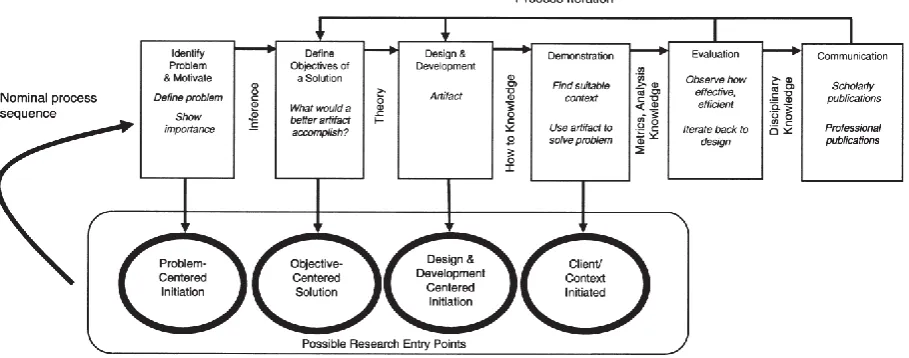
[image:3.595.65.520.188.367.2]To answer the main research question, an IoT prototype is created. That makes this research a design research. Design science describes the methodology used for design research. One of the main scholars in the field of design science is Peffers. Peffers et al. (2007) designed a methodology for design research, which provides a useful basis for this research.
Figure 1: DSRM process model (Peffers et al., 2007, p.54)
The model (Figure 1) consists of the following steps:
1. Problem identification and motivation: this step defines the research problem and is used to justify the value of a solution.
2. Define the objectives and solution: from the problem identification and motivation the objectives for a solution are inferred.
3. Design and develop: in this stage an artefact is developed. This start by determining its desired functionalities and architecture.
4. Demonstration and evaluation: a demonstration shows the artefact in a single act to prove it works. A more formal method is an evaluation.
5. Communication: the last step consists of communicating the outcome to relevant stakeholders.
2.2
Research questions
The research questions are derived from Peffers’ (2007, p.54) process model. His general approach is adjusted for this specific design research in the following sub-questions:
The first question corresponds to the problem identification and motivation step from the DSRM process model and has already been discussed in the introduction.
Q1. What is the central problem that led to the initiation of the project?
The second question corresponds to the define objectives and solution step and has already been discussed in the introduction. Q2. What is the solution aimed for to resolve the central
problem?
The third question corresponds to the design and develop step and will be answered in the prototype design chapter.
Q3. What are the technological options in the design and what is the best choice?
The fourth question corresponds to the demonstration and evaluation step and will be answered in the design evaluation chapter.
Q4. Which test method is used and does the prototype function as intended?
Once the prototype has been designed and evaluated, the main research question can be answered by redesigning the process of restocking sanitary appliances.
Q5. How can IoT improve the process of restocking sanitary appliances?
The last step from the DSRM process model is the communication. The communication is this thesis and a presentation for Company B.
2.3
Research approach
The research approach aims to answer the research questions in a logical and practical way, leading to the end result: a prototype, an improved process and a thesis.
Step 1 – problem identification. This step answers Q1. By brainstorming with the director of Company A and a programme manager of Company B, a problem is identified, which leads to a problem-centered initiation. Based on the problem, a literature review is done (step 2). The problem is central to the definition of objectives, which results in an objective-centered solution (step 3). The results of this step have are in the introduction of this thesis.
Step 2 – literature review. This step is to collect necessary background information: defining IoT, identifying types of applications and challenges. Additionally, some research is done as to what technological options are available. By doing this, possible solutions are identified (step 3), hardware and software choices can be made (step 4) and the design itself can be made (step 5). The identified challenges are to be addressed in the prototype design. The results are discussed in the theoretical background chapter, except for the technological options, which are used to make design choices (step 4).
which hardware and software is most suitable. The results discussed in the prototype design chapter.
Step 4 – design choices. This step answers Q3. Based on the literature review and the objectives, design choices are made. The result of this step are the design choices and a conceptual design, which are discussed in the prototype design section.
Step 5 – prototype design. This step is the realization of the design choices made. Steps are: wiring sensors with their microcontrollers; programming the microcontrollers; connecting them with the cloud; connecting the application with the cloud; creating the application itself. The scrum methodology is applied (Schwaber and Sutherland, 2012) in realizing these steps. The results are discussed in the prototype design chapter.
Step 6 – design evaluation. This step answers Q4. Once the prototype design is finished, it is ready to be tested. By testing, design flaws can be identified and solved, resulting in a proof of concept. Also, it is evaluated whether the design meets the customer requirements. The results are discussed in the design evaluation chapter.
Step 7 – redesigning the restocking process. This step answers Q5. Based on the prototype, a new process is designed and compared with the current process. Advantages and disadvantages are discussed, and claims from theory are validated.
Step 8 – writing report. This step consists of writing out the results of the previous steps. Once that is finished, a discussion of the results will be written, the answer to the main research question will be summarized and a critical reflection on this research will be done.
3.
THEORETICAL BACKGROUND
3.1
Introduction
The theoretical background is the basis to answer the research question. First, IoT is defined. Then, the applications of IoT are categorized, to help place this research in the broader IoT context. Third, the state of the art is described, which gives more context. Fourth, theory is discussed that applies specifically to this case of restocking sanitary appliances. Finally, to answer the main research question and make a fair assessment of the improvement to the process, it is necessary to assess the challenges of IoT. The identified challenges will be used to evaluate the prototype.
3.2
Definition of IoT
The first answer to question is: what exactly is IoT? Tan and Wang (2010, p.1) describe the internet of things as a global network infrastructure composed of numerous connected devices that rely on sensory, communication, networking, and information processing technologies. Besides viewing it as a global network infrastructure, it can also be viewed on a more individual level. McEwen and Cassimally (2014, p.11) define it as a formula: internet of things = physical object + controller, sensor, and actuators + internet. The physical layer is connected to the cyber layer, or internet, through controllers, sensors, and actuators:
1. A sensor detects the state of the physical object, of which a wide variety exist: vibration (piezo), distance (infrared), temperature, pressure resistors, and many more. 2. An actuator performs an action on the physical object.
Some examples are: hydraulic actuator (motion using
2
http://internetofeverything.cisco.com/sites/default/files/pdfs/Hamburg_Jurisdictio n_Profile_final.pdf
liquids), electric actuator (converts electrical energy into mechanical torque) and many more.
3. A controller sends and receives the data from the sensor to the internet of from the internet to the actuator. This consists of a processor, memory and a Wi-Fi module in its most basic form. Maybe the most well-known controller is the raspberry pi, often used in prototyping.
This definition of IoT is in other publications often mentioned as the architecture of IoT (Xu et al., 2014, p.2235; Jia et al., 2012, p.1282; Gubbi et al, 2013, p.1652). As more things are connected to the internet in this way, the first definition, a global network infrastructure composed of numerous connected devices, becomes a reality. However, we have not arrived at that point yet.
3.3
Applications of IoT
The second question to answer is: what are the types of applications of IoT? Chui et al. (2010, p.1) identified six distinct types of applications in two categories: information and analysis (1-3) and automation and control (4-6).
1. Tracking behavior: monitoring the behavior of persons, things, or data through space and time. Includes: inventory and supply chain monitoring and management.
2. Enhanced situational awareness: achieving real-time awareness of physical environment.
3. Sensor-driven decision analytics: assisting human decision making through deep analysis and data visualization. 4. Process optimization: automated control of closed
(self-contained) systems. Includes: continuous, precise adjustments in manufacturing lines.
5. Optimized resource consumption: control of consumption to optimize resources use across network.
6. Complex autonomous systems: automated control in open environments with great uncertainty.
3.4
State of the art
IoT applications are in an early stage. Miorandi et al. (2012, p.1511) summarized the most important developments in IoT back then. It consisted mainly of government-initiated research projects to stimulate IoT adoption, as IoT implementation was in its early stages and revolved mainly around the adoption of RFID technology (Kranenburg, 2008, p.16). Today, many business have started implementing IoT. DHL and Cisco (2015) have published a trend report, showcasing many IoT implementations in the transport sector, and mention a number of IoT applications that is being worked on. They identified three main areas: warehouse operations (p.14), freight transportation (p.18), and last-mile delivery (p.21). Each of these are then discussed in detail on the possible IoT applications, some of which are already implemented. Some examples are traffic monitoring in the Hamburg Port2, locating parts one production floor of Continental3, and monitoring of fork lifts4.
In their analysis of the state of the art of IoT through a survey, Patel et al. (2017, p.1) found that most industries had a small number of solutions with limited scale. The widespread deployment of IoT solutions across enterprises still seems far away, according to them. Furthermore, the focus is on simple IoT applications, such as tracking data and sending status alerts. Using the six types of applications (Chui et al., 2010, p.1), these are the types tracking behavior and enhanced situational awareness. The next step is to implement the other four types of
3 http://www.aeroscout.com/files/RFID-Journal-AeroScout-and-Continental-Tires-04-25-2012.pdf?1
IoT, to assist human decision making, optimize processes, optimize resource consumption, and create complex autonomous systems.
3.5
Vendor-managed inventory and IoT
One part of the process of restocking sanitary appliances is to maintain the inventory of soap flacons and clean towels, which is a case of vendor-managed inventory. At the moment, there is only one publication on the application of IoT vendor-managed inventory: “information flow control of vendor-managed inventory based on internet of things” Liu and Sun (2011). They analyze the impact of IoT on the information flow control of VMI through a comparison of the current process and the new process, which is based on IoT. In the traditional VMI, information sharing is a linear structure, of which the process can be seen in Figure 2. Information flow control of VMI based on IoT is a center sharing structure, as can be seen in Figure 3.
Figure 2. Traditional linear information-sharing structure. (Liu and Sun, 2011, p.451)
Figure 3. Center shaped information-sharing structure based on IoT. (Liu and Sun, 2011,p.453)
Liu and Sun state that the new structure, based on IoT, increases transparency, visibility, availability and improves level of coordination of the supply chain (p.453). As stated in the introduction, I will validate this claim by creating the old and new processes for the case of restocking sanitary appliances.
3.6
Challenges for the realization of IoT
3.6.1
Introduction
In literature, a wide variety of challenges for the further development and application of IoT exists. Some technical challenges are omitted: identification technology, architecture technology and network technology . The reason is that these challenges focus on the realization of a global network of connect things, which corresponds to the first definition of IoT. Instead, this research focuses on the second definition of IoT: a single case of IoT implementation. The challenges discussed below are chosen because they were commonly recognized as being major challenges by each of the papers that discuss challenges for IoT.
3.6.2
Security
Applications of IoT bring many advantages, but if it cannot ensure the security of sensitive and private information, the data gathered will leak. Security requires attention. As IoT becomes more widely adopted, more information will become available, which only increases the risk and consequences of leaks. If no good solution becomes available, the development of IoT will be restricted. Security is therefore vital to the adoption of IoT. (Jing and Vasilakos, 2014, p.2482; Atzori et al., 2010, p.2801)
Jing and Vasilakos (2014) wrote a paper specifically on the subject of the security of IoT. They identified three layers of IoT, their security issues and how these issues can be addressed (p.2483-2945). Because of the highly technical nature and detail of the solutions and the scope of this research, I cannot discuss them in detail. I will list the identified security risks, as these all require attention to ensure the security of IoT applications, because risks should not be ignored.
The perception layer consists of the sensors and the network that communicates with the transportation network.
1. Physical attacks of nodes. Because sensors are often left unattended for longer periods of time, they are vulnerable to physical attacks. Thereby, either data can be retrieved directly from the microcontroller or it can be destroyed. Solutions can either be of physical protection, monitoring or no protection at all.
2. Encryption. A trade-off is to be made between safety of encryption and computing power. Higher computing power requires more power consumption in general. 3. Routing protocols. Attacks on the routing protocol directly
leads to the collapse of the network. Therefore, it is crucial a secure and effective routing protocol is established. 4. Key management. The rotation of access keys is a
well-known security best practice, decreasing the impact of when a key is compromised. Especially when multiple IoT applications are created and connected, each having access keys, key management is an important aspect of security. 5. Trust management. Nodes in a WSN are fragile, thus easy
to be captured. When captured, a node can provide fake or faulty data, which then results in a faulty cooperation between nodes. Therefore, besides ensuring data validity through encryption, data should also be authenticated. Trust management mechanisms are required to solve these issues.
The transportation layer provides the connection between the perception layer and the application layer. Security issues here are not specific to IoT, but more general for networks, however are relevant for IoT.
[image:5.595.57.280.253.461.2] [image:5.595.60.275.511.683.2]To increase security in this respect, access control and network encryption are available. Some other access networks, such as ad hoc networks and 3G also have their own security issues, but are not relevant for this research. 2. Various attacks. Some examples are: DDoS, trojan horses,
viruses, spam, and many more. Because of the wide network that IoT is, or can be, it is vulnerable to these types of attacks. DDoS attack detection and prevention can be important, however there is currently no good solution to solve this problem. Intrusion detection mechanisms and authentication mechanisms can prevent these attacks.
The application layer uses sensor data as input to create the services intended by the application of IoT.
1. Access control. Cloud computing encrypts and backs up data, making it a target for hackers. Data is well-protected in most cloud applications, but a security breach can happen. Therefore, companies should consider what data to store in the cloud and what not.
2. Service interruption. With cloud computing, service interruptions can happen. However, most can be predicted, such as backing up data. A DDoS attack could lead to unpredictable service interruptions.
To conclude, the security requirements are different for every application. Therefore, each security issue has to be given different weight for different applications. Furthermore, the criticality of size, computational power, cost, and energy storage differ per application, which can open up or restrict security measures. It is important to consider all security threats for a new IoT project, because if the perception layer has received a lot of attention to ensure security, but the application layer is ignored, the security risks are still high.
3.6.3
Privacy
L. Atzori et al. (2010, p.2802) state that people will resist IoT as long as there is no public confidence that it will not cause serious threats to privacy. On the other side, according to the 2014 TRUSTe Internet of Things Privacy Index, only 22% of Internet users agreed that the benefits of smart devices outweighed any privacy concerns. According to Atzori et al. (2010, p.2802), privacy should be protected by ensuring that individuals can control which of their personal data is being collected, who is collecting such data, and when this is happening. Additionally, the personal data should only be used by authorized services by authorized providers. And finally, it should be stored only until it is strictly needed.
Lopez et al. (2017, p.47) expand on the concept of privacy and identify two main aspects: user-centric privacy and network-centric privacy. User-network-centric privacy issues come from the ability of sensors to collect sensitive information about individuals, which is what Atzori et al. (2010) discussed. The owner of the network is the privacy perpetrator in this case. He/she can use this sensitive information to profile and track users, for example. Network-centric privacy issues come from external attackers who want to get information. This is again divided in content-oriented privacy and context-content-oriented privacy. Content-content-oriented privacy issues are when an attacker attempts to gather sensitive information without permission. In addition to only observing data, the attacker can also attempt to modify the data by hacking an IoT device and sending fake data. Context-oriented privacy issues are that attackers may learn information not only from the contents of messages, but also from the features of the communications, including the size and number of messages being transmitted, the time and rate at which messages are being
sent, etcetera. This data can be used to gather information, such as the type of sensors, the type and precision of data being collected, the topology of the network, and more. This information is very difficult to hide.
IoT will enable new ways of data collection, mining, and provisioning, which leads to many more ways in which personal and sensitive information can and probably will be collected. One example are sensor networks, which collect data from you once you enter the area, which would make individual consent with regard to data collection almost impossible. Therefore, the privacy criteria as described, are at high risk. Privacy issues should be assessed for each of the aspects identified in this section, for each new IoT project separately, because each IoT application can have entirely different privacy issues.
3.6.4
Interoperability and standardization
In their publication “The internet of things: mapping the value beyond the hype” (2015, p.23), McKinsey stated that interoperability is required to capture 40% of the total value of IoT. The value of interoperability lies with the possibilities it opens up. Machine to machine communication, automated decision making, and controlling based on sensing to name a few. Miorandi et al. (2012, p.1654) state that without a standardized approach, all kinds of technology will be developed for a specific use, leading to the fragmentation of IoT. This then would become a major obstacle to the further adoption of IoT.
Standardization is thus crucial with regard to interoperability. In addition to this, standardization of data processing is also important for the future of IoT. To transport high volumes of raw data from various sources in complex networks, data compression and fusion are needed to reduce the data volume. (Jing and Vasilakos, 2014, p.2481)
For new IoT projects, added value of interconnectivity might already exist, or emerge in a later stage when other IoT applications are developed. Interconnectivity can be implemented right away, when useful applications are thought of. Otherwise, considerations should be made how the IoT application can connect with other systems in the future.
3.6.5
Data analytics
IoT generates high volumes of data and transmit this to analytical tools for humans to make decisions. In the same paper by McKinsey (2015, p.24) as mentioned before, they state an example where less than 1 percent of the data being generated by the 30,000 sensors on an offshore oil rig is currently used to make decisions. They argue that a lot of value can be captured by using more data, for example by using performance data for predictive maintenance and analyze workflows to optimize operating efficiency. This can be taken one step further, by embedding data analytics tools in IoT applications, real-time or automated decision making is enabled (Lee, 2015, p.434).
Only collecting data is not going to do anything. For IoT projects, it is important to consider how the data collected can be used most effectively and whether real-time or automated decision making can add more value. Data analytics tools are important to extract value from the data, so these have to be chosen carefully.
4.
PROTOTYPE DESIGN
4.1
Functional description and
requirements
Cleaners can see the state of all sanitary appliances in a dashboard that is easily accessible. Furthermore, cleaners receive a notification when a sanitary application reaches a critical state, and then restock the respective appliance. The dashboard makes checking manually abundant and helps anticipating when which appliance needs to be restocked. The notification ensures cleaners will not forget to restock, which ensures there will be no empty sanitary applications.
This project is of exploratory nature for Company A. They want to be ahead of other companies and for that reason want to explore the possibilities of IoT. For that reason, the customer requirements are not strict. Instead, the focus lies on what is possible with current day technology. The first requirement is the usage of IoT, because that is the area to be explored for both Company A and Company B. Also because there are no easier ways to monitor the stock of all sanitary appliances real-time in an application that is widely accessible. The second requirement is that the design can be installed on existing sanitary appliances, because replacing all of them is too expensive in comparison to the added value it brings. The third requirement is reliability, because the+ monitoring using sensors should be reliable enough to replace manual checking. The fourth requirement is that the dashboard should be easily accessible by all cleaners and notifications should be receivable on phones.
4.2
Prototype overview
An overview of the prototype design is shown in Figure 4. The
sanitary appliance is the physical object from which information is required. These are a towel dispenser, soap dispenser and trash bin in this case, from which the ‘fulness’ in real-time is needed. The sensor converts changes in the physical world into an electrical signal, a voltage. The microcontroller
converts the voltage into a digital signal, which are measures of the sanitary appliance, and sends this data to the cloud via WiFi. The microcontroller needs to be programmed to convert the signal into useful data and send it to the message broker. The
[image:7.595.311.542.72.204.2]message (or MQTT) broker receives the data from the microcontroller. For IoT, the MQTT protocol is commonly used, instead of the TCP/IP protocol, which is used for almost all internet services. The difference is that TCP/IP sends messages directly to the recipient on an IP address, while MQTT sends messages to one address, the message broker. Messages consist of a payload, which is the data, and a topic. Anyone who wants to receive specific data can subscribe to the respective topic. It is more efficient, reducing the need for processing power and energy consumption, and is for that reason the most commonly applied protocol for IoT. The application obtains messages from the message broker, by subscribing to the topics. Messages from each sanitary appliance are given a distinct topic, so that the application can handle them properly. The technological choices will now be discussed for each part of the prototype.
Figure 4. Overview of the prototype design.
[image:7.595.310.415.263.406.2]The towel dispenser prototype can be seen in Figure 5. The blue box in the front is the microcontroller. The sensor is under the wooden planks under the towel. The microcontroller is powered by a power bank, which is mounted on the right on the outside, so that it is easy to replace.
Figure 5. IoT prototype for the towel dispenser.
[image:7.595.310.495.482.616.2]The soap dispenser prototype can be seen in Figure 6. Again, the blue box is the microcontroller, and the power bank is mounted above it. The sensor goes through a hole in the back and is placed under the soap flacon.
Figure 6. IoT prototype for the soap dispenser.
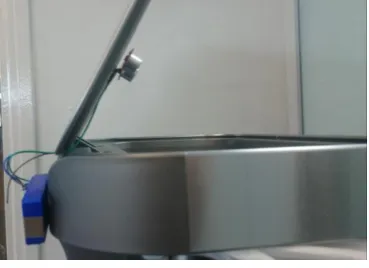
The trash bin prototype can be seen in Figure 7. The blue box on the left is the microcontroller, which is mounted on the side of the trash bin. The ultrasound sensor is mounted under the lid of the trash bin, to measure the distance. The battery cannot be seen in this picture, but is mounted right next to the microcontroller.
Figure 7. IoT prototype for the trash bin.
4.3
Sanitary appliance
The sanitary appliances chosen are a towel dispenser, a soap dispenser and a trash bin. The towel- and soap dispenser are products of Company A and a trash bin also needs restocking, thus is required to solve the problem of empty sanitary appliances. These three are the most commonly used sanitary appliances that need restocking.
4.4
Sensors
To choose sensors, a structured approach has been applied. The questions were answered for each of the sanitary appliances in the following order:
[image:7.595.59.281.608.658.2]Q2. What sensors can measure these physical changes? Q3. Can the sensors measure ‘fulness’ accurately? Q4. What is the cost of the sensor?
Now, these questions will be discussed for each sanitary appliance.
4.4.1
Towel dispenser
(Q1) The physical change is that the towel becomes smaller, and thus weigh less, as the towel is used. Also, mechanisms inside the towel dispenser rotate. (Q2) An infrared sensor can measure that the roll becomes smaller, by measuring distance from a fixed point to the center of the towel. A force sensitive resistor can measure the weight of the towel, by placing it underneath the towel. A reflective sensor can count the number of rotations the mechanism has made. (Q3) Because the increase in distance doesn’t increase linearly as the towel becomes smaller, it is difficult to know exactly how full the towel is, making it unsuitable. The weight is linearly related to the ‘fullness’, thus the force sensitive resistor is suitable. The number of rotations is linearly related to the ‘fulness’, however differs for every towel, as they can be wound up more tight or loose. This makes the measure of a reflective sensor somewhat unreliable, thus less suitable. That leaves the force sensitive resistor as the best option. (Q4) The cost of the force sensitive resistor is relatively high (8eu), sadly.
4.4.2
Soap dispenser
(Q1) The physical change when used is less soap in the flacon, which also makes it weigh less. Another change is that the dispenser is pressed to obtain soap. The flacon is transparent, and the soap is not, which means that it lets more light through as it becomes emptier. (Q2) For that reason, a photoresistor in combination with a led can show how much soap is left. The change is weight can be measured by a force sensitive resistor. The number of times the soap dispenser is used can be measured with a switch. (Q3) Because the soap flacon is flexible, it deforms as less soap is in it, which makes the photoresistor/led combination unreliable, thus unsuitable. The weight is linearly related to the ‘fulness’, thus the force sensitive resistor is suitable. Because the amount of soap is withdrawn with each press varies with the amount of pressure applied, the amount of presses is somewhat unreliable as a measure of fulness, making it less suitable. The force sensitive resistor is again the best option. (Q4) The cost is thereby also relatively high.
4.4.3
Trash bin
(Q1) The physical change is that the trash bag becomes fuller, thus the distance from the lid to the trash decreases. Another change is the weight of the bag. (Q2) To measure the weight, again a force sensitive sensor can be used. To measure the distance, an ultrasound sensor and an infrared sensor can be chosen. Both measure distance. (Q3) The weight depends on what is put inside the trash bag, making it an unreliable measure. An ultrasound sensor measures distance across a 30 degree angle, from 5cm to about 3m. The distance range suits all trash bins, and the angle helps measure distance of the irregular surface of the trash, making it very suitable. An infrared sensor has about the same distance range, however measures at a more specific point and requires a more smooth surface, making it unsuitable for this application. The ultrasound sensor is thus the best option. (Q4) An ultrasound sensor is about 2eu, which is an acceptable price.
4.5
Microcontroller
To choose a microcontroller, a number of criteria have been used. WiFi connectivity is the first, which enables the sending of data to the cloud and is suitable because sanitary appliances are
usually in an area with WiFi connection. Second, the microcontroller has to be able to connect with the chosen sensors. Third, the programming should be relatively simple, as there are only 6 weeks available to create the prototype and I have limited programming experience. Fourth, there should be a considerable knowledge base, as it helps in creating a successful prototype. Fifth, the costs shouldn’t be too high.
The alternatives were: an IoT dev kit (SensorTag), a RaspberryPi Zero W, and an esp8266. SensorTag comes with pre-attached sensors, is pre-programmed and has WiFi connectivity. However, the costs are relatively high (30eu) and there were no ultrasound and force sensitive resistor connected, making it unsuitable. The esp8266 is cheaper (13eu) and has a considerable knowledge base. Furthermore, it has GPIO pins to connect sensors by soldering. However, it needs to be programmed with LUA or Arduino, which is time consuming. The RaspberryPi is similarly priced to the esp8266 (12.50eu), has a very large knowledge base and GPIO pins to connect sensors similar to the esp8266. Another advantage is that Node-RED is available to make the programming much less time consuming. Thus, the RaspberryPi Zero W has been chosen for the prototype. The microcontroller used in the final product should be more sophisticated, especially have lower power consumption and be smaller. Thus, the esp8266 would be more suitable for a final product, but is simply too time consuming for this prototype.
The programming for the RaspberryPi Zero W is available in Appendix A, and can be imported using Node-RED. An overview of the programming in a flow chart is also shown there. In functional terms the RaspberryPi receives sensor data, modifies the data, calculates a percentage, and finally sends the value on a configurable interval to the cloud. In addition, it automatically recognizes when the appliance is restocked, setting a new starting point. It is assumed the end point (when restocking is needed) doesn’t change, once it is calibrated during the first boot, for the respective appliance. The percentage is calculated using these starting and end points.
4.6
Message Broker
The message broker is a cloud service, for which the choice was very easy. The cloud service chosen is Amazon Web Services IoT. It is chosen because it is the most used platform, it is easy to use, and compatible with RaspberryPi and Mendix. Furthermore, their security are best practices with regard to IoT. For example by enforcing TLS 1.2 encryption. AWS IoT has the best connectivity with the chosen application software, through a Mendix add-on created specifically for AWS IoT. A set of things, policies and certificates have been created so that the Things can send messages to the MQTT broker. An access key has been made for Mendix, so that the application can retrieve data from the broker in real-time.
4.7
Mendix application
subscription to the MQTT broker, an entity in the database and a data grid on the dashboard. Push notifications can be sent once a configurable threshold is reached, for example at 5%. The package to import the application can be found in Appendix B.
Figure 8. Mendix application dashboard.
4.8
Enterprise Resource Planning link
Because Company B is currently creating a new information system for Company A, it is not possible to create the link with the ERP system. However, Company B are experts at integrating their own Mendix applications with existing IT systems, such as SAP. An expert within Company B explained what would be the best way to link this IoT application with an ERP system.
First off, the connection points differ per ERP system, thus there is no one way to create the link. However, he stated it was best to do as much as possible in a Mendix application. More specifically, the Mendix applications Company B is currently developing for Company A manages replenishment orders. The way it would work is this:
1. IoT application recognizes when an appliance is restocked. 2. A message is sent from the IoT application to the order
management system, which is also a Mendix application. 3. The order management system determines when the order
should be sent and how large the order should be, and sends the order to the ERP system.
4. The ERP system executes the order.
This process shows that no change to the ERP is required if implementing the IoT solution. Only a change to the Mendix application in how it calculates the order size is required. Instead of the current fixed order size, it would be the current inventory level minus the agreed inventory level, which would be the addition of a simple microflow.
5.
DESIGN EVALUATION
5.1
Description of test method
The test method is the implementation of the prototypes in the sanitary appliances. These sanitary appliances are the same for all customers of Company A, thus test results are generalizable. The usage of sanitary appliances is reproduced. The only difference is to use the sanitary appliances more intensively, so testing does not take a week, but a day instead. For that reason, measurements are done more frequently, so that accuracy is contained. Instead of one measurement per fifteen minutes, a measure is made each five seconds. The different real-life scenarios to be tested are:
1. Stationary. This is when the sanitary appliance is left alone, not being used, which is most of the time.
2. In use. This is when the sanitary appliance is used, either by putting something in the trash bin, pulling a towel or pressing for some soap.
3.
Restocking. This is when cleaners restock the sanitary appliance, replacing the garbage bag, towel roll and soap flacon.No other scenarios should occur in real-life. For each of the sanitary appliances, data is gathered with the IoT application in each scenario.
5.2
Description and discussion of test results
5.2.1
Towel dispenser evaluation
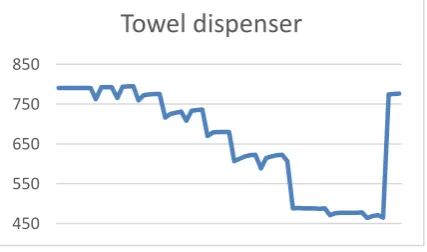
Scenario 1: it can be seen in Figure 9 that values are stable while not in use, which is as expected. Scenario 2: in the same figure, the values drop after using it, which is as expected. Scenario 3: the jump in the end is when a new towel roll is placed in the appliance. It jumps back to the original value, thus is consistent. It can be concluded that the towel dispenser prototype is able to measure the ‘fulness’ well in every scenario. In a real-life situation the values would be less volatile, due to less intensive usage and longer stationary periods.
Figure 9. Towel dispenser values over time.
5.2.2
Soap dispenser evaluation
Scenario 1: while stationary, the values increase a bit and then stabilize, as can be seen in Figure 10. This is due to soap relocating after usage and is no problem, because in real-life situations, the stationary periods are much longer. Scenario 2: in use, values drop a bit and then stabilize at a lower value, which is as expected. Scenario 3: because no new soap flacon was available, it has been tested with the same (almost empty) flacon. It behaves as expected, but jumps back to the previous value (50), instead of the initial value (450), because it was the same flacon. It can be concluded that the prototype functions well in every scenario.
450 550 650 750 850
[image:9.595.310.524.484.610.2]Figure 10. Soap dispenser values over time.
5.2.3
Trash bin evaluation
[image:10.595.54.275.355.492.2]Scenario 1: the values are stable while not in use, which is as expected. Scenario 2: the values drop as the trash bin is opened and then stabilize at a lower value, because the trash bin is fuller. Scenario 3: this scenario could not be tested, because the wire broke down after a few uses, and again after being repaired. Because scenario 1 and 2 work well, it is reasonable to assume scenario 3 also functions as intended. It can be concluded that the concept is proven, but the prototype cannot handle the movements of the trash bin. A final product can easily address this by being smaller and placing everything under the lid, instead of part under the lid and part on the side.
Figure 11. Trash bin values over time.
5.3
Customer requirements
The first requirement was to use IoT, which has been met. The second requirement was that the design can be installed on existing sanitary appliances, which has also been met. The third requirement was reliability. The tests have shown reliability, however real-life testing over a longer period using the final design has to be done to proof reliability. The fourth requirement was an accessible dashboard. The dashboard can be accessed on any pc or phone via the site iotsanitait.mxapps.io. Thus, it is easily accessible by everyone. It can be concluded that the customer requirements have been met.
5.4
Challenges for the realization of IoT
5.4.1
Security
The data of sanitary appliance usage is not sensitive, because it gives no information about individuals or information about the company. Therefore, security is not discussed here. The security of the IoT prototype is discussed in Appendix C. This discussion is highly relevant to other applications that do handle sensitive data, as the security of this prototype is very similar for other cases.
5.4.2
Privacy
The main privacy issue is that data is gathered about a group of people without their consent. The data is anonymous, it cannot
be linked to individuals. The difference with the current situation is that it is known per sanitary appliance how much it is used, instead of per company. People probably do not mind that Company A has this information. To solve the privacy issues, I suggest people are made aware of the data that is going to be gathered in advance. By doing this, individuals can control which personal data is collected, they know who is collecting it and when it is being collected. Furthermore, the data will only be used by authorized services, namely the supplier of sanitary appliances and the cleaners. Data should be deleted on a regular basis, because it should only be stored until it is strictly needed. By taking these actions, all privacy concerns from theory are addressed.
5.4.3
Interoperability and standardization
Company B’s core strength is integration using their own software (eMagiz), thus interoperability should be no problem. At Company A, Mendix applications are used, which can communicate automatically amongst each other. Interoperability is thereby enabled. The sensor data is in JSON format, which is common and straightforward, thus standardized.
5.4.4
Data analytics
Data analytics is not required for the primary function of this case, as data is only used to determine replenishment order size. However, additional information could be drawn from the sensors, such as whether cleaning personnel wastes soap, for example, by replacing too early. I choose to focus on the primary function in this research, but the possible added value of data analytics should receive more attention in a later stage.
6.
REDESIGNING THE PROCESS OF
RESTOCKING SANITARY APPLIANCES
This chapter answers the main research question: how can the internet of things improve the process of restocking sanitary appliances? As argued in the introduction, this process actually consists of two processes: the restocking of sanitary appliances directly and the restocking of the inventory of clean towels and full soap flacons. The second process is a case of vendor-managed inventory. For each of these, the current process will be mapped and a new process will be designed.
6.1
Restocking sanitary appliances
The process of restocking sanitary appliances is shown in Figure 12. It is a simple process, where cleaners check the sanitary appliance while cleaning the sanitary. If an appliance is (almost) empty, it will be restocked.
Figure 12. Current process of restocking sanitary appliances.
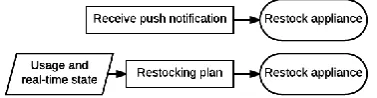
The new process of restocking sanitary appliances, based on IoT, is shown in Figure 13. It is even simpler than the current process. Instead of checking while cleaning, the appliances are continuously monitored. A push notification is sent to the cleaners at a critical level, who then restock the appliance. A second variation is possible, where based on a usage and the
real-0 100 200 300 400 500
Soap Dispenser
0 10 20 30 40 50
[image:10.595.318.533.551.592.2]time state of appliances, a plan is made on which appliance should be restocked when.
Figure 13. Two variations of new process based on IoT.
The first variation has a few advantages when compared with the current process. First, the appliances will be restocked at the perfect level, never having the frustrations of no soap, no towels or a full trash bin again. Additionally, cleaners do not have to bring clean towels and new soap flacons with them when cleaning sanitary. There is one disadvantage: smaller companies usually only have cleaners at specific moments during the week. In that case, push notification will often be received when cleaners are not at the location. For this reason, the second variation is proposed.
Based on usage and the real-times status, it can be predicted when an appliance will need restocking. For example, if cleaning is done once a week and 1/5 of a towel is used every week. Then, every towel dispenser that has a ‘fulness’ lower than 20% needs to be replaced to prevent being empty before the next time cleaning. Then, all appliances that are expected to need restocking before the next time cleaning can be restocked during the cleaning. The advantage of this process compared to the current process is that there is a much smaller chance of no soap, no towels or a full trash bin. Another advantages is that cleaners know beforehand which sanitary appliances will need restocking, and they can bring exact that amount of clean towels and soap flacons with them.
6.2
Vendor-managed inventory
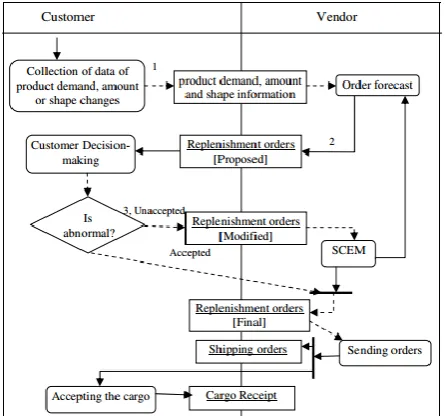
[image:11.595.60.249.99.148.2]The current vendor-managed inventory process can be seen in Figure 14. Company A is here the vendor, supplying soap flacons and clean towels to their customers. Together with the customer, Company A makes a prediction for demand, on the basis of which an order forecast is made in terms of frequency and amount. Then, SCEM places the replenishment orders on this frequency and amount. The process is similar to the generic model from theory. The difference with theory is that replenishment orders are placed without customer feedback, based on the initial order forecast. If a cleaner notices that the inventory is particularly low or high, the replenishment order is modified.
Figure 14. Linear shaped process for current vendor-managed inventory process of Company A.
The new vendor-managed inventory process, based on IoT, can be seen in Figure 15. The center shaped process from theory is based on a situation where IoT is implemented everywhere. In this case, IoT is only implemented to monitor the sanitary appliances. It is not applied in other parts of the process. For that reason, the second part of the process, starting at SCEM, is still linear.
Figure 15. Center shaped vendor-managed inventory process of Company A based on IoT.
Liu and Sun (2011) stated that the advantages of the center shaped process, compared to the linear process, were increases in transparency, visibility, availability and an improvement in the level of coordination of the supply chain. These claims are now assessed for this application.
Transparency and visibility is improved on three levels in the new process. First, the order forecast is now based on data from monitoring, instead of estimates by customers. Second, replenishment orders are now based on real-time usage, instead of based on a warning by an employee in case of too high or too low inventories. Third, the price in the contract is based on real-time usage, instead of being fixed and based entirely on the order forecast. Fluctuations in usage currently do not influence the price. Availability is improved, because instead of a warning by personnel in case of low inventories, replenishment orders are based directly on real-time usage. Personnel can forget to warn or a warning can come too late. In the new process, availability can be guaranteed, depending on inventory buffer size and order frequency. Coordination is improved, because only the vendor is now involved in the process. All data is supplied directly to the vendor via IoT, omitting the middle man: the customer. The customer only has to accept cargo.
Hereby, the theory by Liu and Sun (2011) has been validated and the advantage IoT brings to the restocking of sanitary appliances has been shown.
7.
CONCLUSION
In this conclusion, the answer to each research question will be summarized.
The problem that has led to the initiation of the project (Q1) is twofold, because two processes have been identified. First, restocking sanitary appliances is infrequent, which often results in full trash bins, empty soap dispensers and empty towel dispensers. Second, because signals from cleaners on the inventory levels are unreliable, it can result in empty or excessive inventories. The solution to resolve the problem (Q2) is an IoT prototype, consisting of a sensor, microcontroller, cloud service, and application. The technological choices (Q3) have been made, namely: RaspberryPi Zero W (microcontroller); force sensitive resistor (sensor for both dispensers); ultrasound (sensor for trash bin); AWS IoT (cloud service); Mendix (application software).
[image:11.595.56.290.560.661.2]process for vendor-managed inventory has been shown to yield the advantages that theory stated: increases in transparency, visibility, availability and coordination.
8.
DISCUSSION AND LIMITATIONS
8.1
Interpretation of results
The interpretation of the results will be a summary of the advantages, the cost and a final recommendation for Company A and Company B.
For customers, four advantages can be identified. First, customers only have to accept cargo and do not have to worry about inventory levels. Second, no more excessive inventories, which are costly. Third, no more empty inventories and sanitary appliance. Fourth, customers pay for what they actually use, instead of a fixed number based on an estimate. An advantage for the vendor is that a smaller inventory is needed to achieve the same service level, because replenishment orders are based on real-time status. Basing cost on actual usage instead of estimates can also be considered an advantage for the vendor.
The final cost consists of: sensor, microcontroller, printed circuit board, case for electronics, design, and installation. Furthermore, cloud service costs for the application and AWS IoT will depend on usage, but are low for small amounts of data, which is the case here. The costs cannot be estimated at this point, primarily because the demand is not known. The volume heavily impacts the cost. Production techniques and costs for the case for electronics depend on the volume and final design, which I cannot estimate now. A different microcontroller will be used that is more practical, as the RaspberryPi is only suitable for prototyping. It has to consume much less power, be smaller and cheaper, such as the ARM Cortex-M4F or esp8266. A very rough cost estimate would be between 4.50 and 23 euros, based only on the electronics.
What Cost (eu)
Sensor 25-86
Microcontroller 2 (esp82667) -10 (ARM Cortex M4F8)
Printed circuit board 0.50-5 (size/volume dependent9)
A real business case and conclusion on whether to implement the solution cannot be made at this stage, because it is only a prototype with the aim of exploring the possibilities.
Because of the low cost of towels and soap flacons, the low impact of an empty inventory and low variation in demand, the added value is relatively low. Therefore, I do not recommend the implementation for now, unless the cost can be lower than I estimated now. For more valuable goods, it is more important to decrease inventory levels. For more critical goods, it is more important to have a high service level. For higher demand variation, it is more important to be flexible and react in real-time. In those cases, the added value of IoT would be much higher, justifying the cost.
Thus, my recommendation for Company A and Company B is to aim at cases of vendor-managed inventory where the inventory value is higher, stock-outs are more critical, and demand variation is higher. The advantages of IoT for vendor-managed inventory have been shown and should be utilized for these cases. I have no doubt that many vendor-managed inventories will be managed using the internet of things in the future.
5 https://nl.aliexpress.com/item/1pcs-FSR402-Force-Sensitive-Resistor-0-5-inch-FSR-US-Original/32785359454.html
6 https://nl.aliexpress.com/item/1pcs-FSR402-Force-Sensitive-Resistor-0-5-inch-FSR-US-Original/32785359454.html
8.2
Limitations of research
It is important to weigh in the limitations when considering the outcomes of this research. The limitations will now be discussed one by one.
First, the prototype could not be tested in a real situation, because that would take weeks and the battery life is only one day. For that reason, the test results have been based on more intensive use over a short period, which is a threat to internal validity. However, because everything except the more intensive usage and shorter time span is the same, it is very unlikely that a real situation would disprove the concept.
Second, a prototype has been designed, which concept has been proven. However, the final design will be different. The first difference is a different microcontroller, which is cheaper, has less computing power and consumes less power. The second difference is a different power supply, which is smaller and suits the microcontroller. These are threats to the external validity, especially because the microcontroller has to be programmed differently. Given that many IoT applications have already been realized, which can survive months on a pair of AAA batteries, it is reasonable to assume the final design will succeed.
Third, the redesigned processes have not been tested in a real-life situation, because a time span of at least 2 weeks is needed to test them. Additionally, the testing of the processes would require temporary changes to the order management systems of Company A and the involvement of the cleaning company. These were not feasible in this 10-week research. The advantages and disadvantages for the process that have been identified in this research have been based on the prototype design (hardware and software), but have thus not been validated in a real-life situation.
8.3
Future research
Based on this research, I have two recommendations for future research.
First, IoT has only been applied to the first half of the vendor-managed inventory process. Additional case studies should be done where IoT is applied to the entire process, validating the complete center shaped structure. That way, additional advantages of IoT for vendor-managed inventory could be identified.
Second, the added value of IoT is lower in this case, because the inventory value is low and the impact of an empty inventory is low. Additional case studies should be done to identify cases where IoT adds more value to vendor-managed inventory. Cases where a high service level is required, demand variation is higher and minimizing inventory levels has a higher cost impact.
7 https://nl.aliexpress.com/item/ESP8266-Serial-WIFI-Wireless-Module-Wireless-Transceiver-The-Internet-of-Things/32220713885.html
8 https://www.digikey.com/products/en/integrated-circuits-ics/embedded-microcontrollers/685?k=arm%20cortex%20m4f
9.
REFERENCES
1. Liu, X., & Sun, Y. (2011). Information Flow Control of Vendor-Managed Inventory Based on Internet of Things. Communications in Computer and Information Science Advanced Research on Computer Science and Information Engineering, 448-454.
2. Peffers, K., Tuunanen, T., Rothenberger, M. A., & Chatterjee, S. (2007). A Design Science Research
Methodology for Information Systems Research. Journal of Management Information Systems, 24(3)
3. Schwaber, K., & Sutherland, J. V. (2012). Software in 30 days: how agile managers beat the odds, delight their customers, and leave competitors in the dust. Hoboken, NJ: John Wiley & Sons, Inc.
4. McEwen, A., & Cassimally, H. (2014). Designing the internet of things. Chichester, West Sussex: Wiley. 5. Michael Chui, Markus Löffler, and Roger Roberts. (2010,
March). The Internet of Things. Retrieved March 24, 2017, from http://www.mckinsey.com/industries/high-tech/our-insights/the-internet-of-things
6. AWS IoT. (n.d.). Retrieved March 24, 2017, from http://docs.aws.amazon.com/iot/latest/developerguide 7. Manyika, J et al., (2015). The internet of things: mapping
the value beyond the hype (Rep.). McKinsey Global Institute.
8. Jing, Q., Vasilakos, A. V., Wan, J., Lu, J., & Qiu, D. (2014). Security of the Internet of Things: perspectives and challenges. Wireless Networks, 20(8), 2481-2501. 9. Atzori, L., Iera, A., & Morabito, G. (2010). The Internet of
Things: A survey. Computer Networks, 54(15), 2787-2805.
10. Lee, I., & Lee, K. (2015). The Internet of Things (IoT): Applications, investments, and challenges for enterprises. Business Horizons, 58(4), 431-440
11.
Schiele, H. (2016). Industrie 4.0 in der Beschaffung.
WINGbusiness
.
12. Jazdi, N. (2014). Cyber physical systems in the context of Industry 4.0. 2014 IEEE International Conference on Automation, Quality and Testing, Robotics.
13. Tan, L., & Wang, N. (2010). Future internet: The Internet of Things. 2010 3rd International Conference on Advanced Computer Theory and Engineering (ICACTE). 14. Miorandi, D., Sicari, S., Pellegrini, F. D., & Chlamtac, I.
(2012). Internet of things: Vision, applications and research challenges. Ad Hoc Networks, 10(7), 1497-1516. 15. Kranenburg, R. V., & Dodson, S. (2008). The internet of
things: a critique of ambient technology and the all-seeing network of RFID. Amsterdam: Institute of Network Cultures.
16. Macaulay, J., Buckalew, L., & Chung, G. (2015). Internet of things in logistics (Rep.). Troisdorf: DHL Customer Solutions & Innovation.
17. Mark Patel, Jason Shangkuan, and Christopher Thomas. (n.d.). What's new with the Internet of Things? Retrieved June 29, 2017, from
http://www.mckinsey.com/industries/semiconductors/our-insights/whats-new-with-the-internet-of-things
18. Xu, L. D., He, W., & Li, S. (2014). Internet of Things in Industries: A Survey. IEEE Transactions on Industrial Informatics, 10(4), 2233-2243.
19. Jia, X., Feng, Q., Fan, T., & Lei, Q. (2012). RFID technology and its applications in Internet of Things (IoT). 2012 2nd International Conference on Consumer
Electronics, Communications and Networks (CECNet). 20. Gubbi, J., Buyya, R., Marusic, S., & Palaniswami, M.
(2013). Internet of Things (IoT): A vision, architectural elements, and future directions. Future Generation Computer Systems, 29(7), 1645-1660.