RFID-based Interactive Log Bag for Poor Memory Prevention
Muhammad Syukri Mohd Yazed
1,2and Farhanahani Mahmud
1,2*1Department of Electronics Engineering, Faculty of Electrical and Electronics Engineering, 2Cardiology and Physiome Analysis Research Laboratory,
Microelectronics and Nanotechnology Shamsuddin Research Centre (MiNT-SRC), Universiti of Tun Hussein Onn Malaysia (UTHM), 86400 Parit Raja, Batu Pahat, JOHOR.
1.
Introduction
Wireless technology has become an important part of our everyday life. Wireless is classified as unguided media because it does not have a fixed guidance for where the information can travel through. There are many types of wireless networks. For example, cellular networks, Bluetooth, ZigBee, Infrared, Wi-Fi, WiMAX, and also radio frequency networks [1, 2]. Nowadays, one of these wireless networks has given a new opportunity to all people. Radio frequency network or usually known as Radio Frequency Identification (RFID) has been widely used after the World War II end [3]. RFID is about identifying an object using radio frequency signal [2]. The developers of RFID technology as tracking item and security system make several of a new invention for example, in public applications like attendance list, Touch and Go (Touch N Go), and most of the smart card in shopping complex. Besides, in a hospital RFID has been applied to every section in hospitals, including blood bag and medical record management, precious medical equipment and emergency medical care tracking, discarded object management, resident health care monitoring, patient identification, and an entry access control [4].
People with a mild forgetfulness problem commonly have difficulty in carrying out everyday life. This problem is about the cognitive impairments from ones that are present at birth, such as Down’s syndrome, and Intellectual and Developmental Disabilities (IDD) to once that are acquire due to some form of traumatic brain
injury or illness such as Alzheimer’s disease, senile, or dementia [5, 6]. According to a survey conducted by Doris Padmini Selvaratnam from National University of Malaysia (UKM), the prevalence of Alzheimer’s Disease, which is the most common type of Dementia (memory disorders) in Malaysia is approximately 50,000 people with a total dependency ratio of elderly expected to increase from 12.1% (2010) to 16.5% (2020) [7]. This has led to the increase of responsibilities to family members in stressful roles of providing care for ailing family member [8, 9]. Thus, assistive technology will be very useful in order to help people who have the problems with memory in carrying out daily living activities [10], for an example using the RFID technology to help them remember things. Moreover, there are several people without the cognitive impairment also sometimes forget as they sometimes forget to bring their important things when travel due to a forgetfulness problem.
Therefore, this paper will describe a new approach to prevent the poor memory problem through a new invention of RFID applications; an interactive log bag with an LED display and a smart logging system for notification of the carried items. It is developed to assist the user to record login and logout items in the bag in order to recall the missing items to address the problems in left behind or forgotten items. It could be one of assistive technologies that have a potential to help people with memory disorders such as Dementia and Alzheimer’s disease to carry out daily living activities.
Abstract: People are sometimes forgotten about what they should do or what they need to bring. Poor memory problem that happened in people less than 40 years old is due to their attitudes that like to ignore things and carelessness. An Interactive Log Bag has been developed using Arduino Mega 2560 with Radio Frequency Identification (RFID) system to help people overcome the poor memory problem of bringing or keeping essential items in a bag before travelling or going to work. The bag will react to the user RFID-tagged objects for the items logging purpose. The logging items will be saved in the SD card and can be shown in Messenger Bag Android Application. An alert system by using strip RGB Light Emitting Diode (LED) will remind the users of the forgotten items. In addition, the list of items that are left behind or carried in the bag can be checked through an android application. This project will give an opportunity to the users to have a better life by overcoming one of the daily routine problems pertaining to the forgetfulness problem.
2.
Interactive Log Bag Development
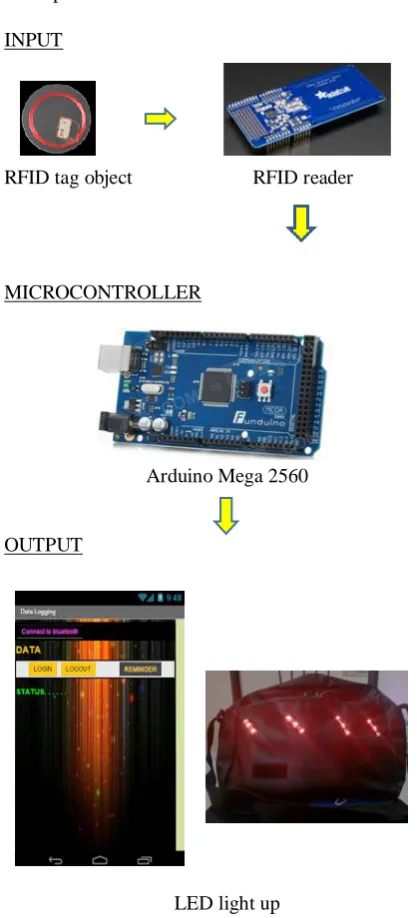
The development of interactive log bag is started with its prototype design. Fig. 1 shows the general block diagram of the interactive log bag consists of the input, controller, and output.
INPUT
RFID tag object RFID reader
MICROCONTROLLER
Arduino Mega 2560
OUTPUT
LED light up
Fig. 1 General block diagram of the RFID-based Interactive Log Bag
The bag used in this project is a sling-type canvas bag, with a dimension of 35cm x 25cm x 8 cm as shown in Fig. 2, while, Fig. 3 shows the electronic circuit for the RFID system placed inside a small box with a dimension of 17.5cm x 11cm x 4.5cm. Two separated power sources are used for the system operation with approximate maximum power of 2.5 W and 5 W used for Arduino processing unit and LED lighting, respectively.
Fig. 2 Dimension of the RFID-based Interactive Log Bag
Fig. 3 The built-in circuit for the RFID-based item detection and logging system
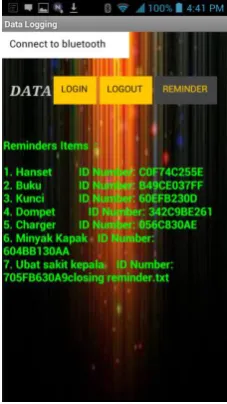
In order to develop the RFID based item detection and logging system in the interactive log bag, an Arduino integrated development environment (IDE) software is used and the Bluetooth-based Android application has been developed using the Massachusetts Institute of Technology (MIT) Application Inventor. This application was created to ease the user when using the device in order to display a login data, logout data, and a reminder file that are recorded in the SD card and let the user know their own important items that had been forgotten or missing. The display in the android application for the interactive log bag logging system is as shown in Fig. 4.
3.
Interactive Log Bag Operation
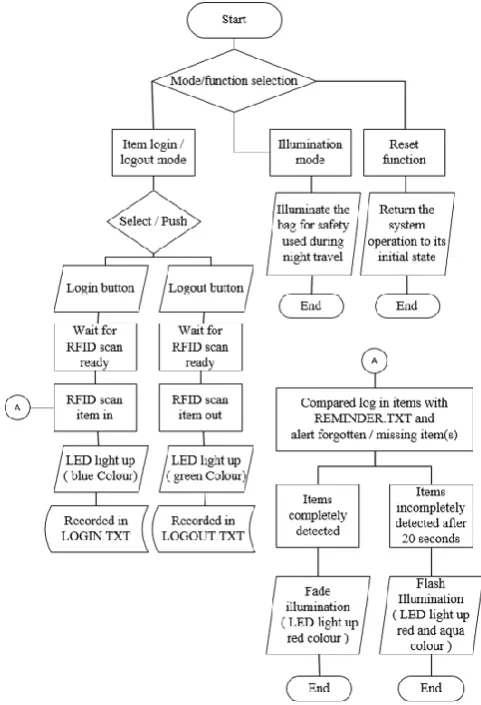
This subtopic will discuss on the operating system of the interactive log bag. Figure 5 shows the operational design block diagram of the RFID-based interactive log bag. According to Fig. 5, there are two major modes of operation developed in this system, which are item login/logout mode and illumination mode.
In the operation process of item login/logout mode, firstly, the user needs to select between the login and logout mode. According to the RFID system, the login and logout items will be detected by the RFID reader and the logging in and out information of item such as phone, matric card, key, and medicines will be recorded on the SD card through the RFID scanning. The blue LED will light up when the object is logged in and the green LED colour will light up when the object is logged out. Then, for the logged in and logged out items, the information will be recorded into a file named as “LOGIN.TXT” and “LOGOUT.TXT”, respectively.
Fig. 5 Block diagram of the RFID-based Interactive Log Bag operating system
During the log in process, each of the logged in items will be compared with the reminder list of items in the database and if the items are not completely scanned within 20 seconds after the last item scanned, an alert
system will remind the user that the important items is missing by flashing LED in red and aqua colour, alternately. It will continue to flash until the missing item is scanned in. Moreover, the user can check instantly the incomplete item in the smartphone through Android application where the data are sent using a Bluetooth communication.in the SD card. If the scan of items has completed, a fade illumination light will be appeared from the LED.
The second mode is the illumination mode. Through this mode an attractive LED, illumination will be displayed which could function not only as a safety light during day and night walking or cycling, but also could be used as an emotional healer through its pleasing LED flashing light effect. Meantime, the reset function is set in order to return the system operation to its initial state. Table I shows the description of each modes with the processes involved and the conditions occurred in the RFID-based item detection and logging system for the interactive log bag.
4.
Interactive Log Bag Reliability
A survey has been done to identify the needs of the log bag. This survey has been done on 47 of Microelectronics Fourth Year students, Universiti Tun Hussein Onn Malaysia (UTHM). From this survey, the outcome should tell whether this project is relevant or irrelevant for future invention. Most of the students having the same problem which is 89.4% of the students had experience in forgotten to bring their important items and only 10.6% of the students did not according from Fig. 6.
Fig. 6 Students experienced forgot to bring their important items
forget to bring along while travelling which only 4.3% of them is contrary.
Fig. 7 The frequent forget in a week
Fig. 8 The needs of an alternative product
From the survey, it shows that the students need an invention that can remind them about things that they forget to bring. Therefore, from the 47 BED’s students, three of them have been willing to cooperate to test this prototype product that will help them as a reminder companion while going to classes for a week.
Fig. 9 and Fig. 10, respectively illustrate the example login data and logout data displayed, stored in the SD card through the Android application for one of the three students. The application will display each of the item’s name, the login and logout time, date, and the number of the day in a week starting from Sunday to Saturday. Moreover, the application also provides the reminder data to give a reference to the user of the important items that has been listed as shown in Fig. 11.
Fig. 9 List of data for login item in Android application display
Fig. 10 List of data for logout item in Android application display
The feedbacks from the three students regarding this RFID-based Interactive Log Bag system have been recorded for further analysis. They agreed that this system helps them in reminding the forgotten item and overall, it has given them a satisfaction in having a bag that can remind them about the forgotten items to bring to the class. However, there are some improvements that should be done. Two of the students experienced in having a limited space for keeping items due to the installation of the circuit box in the bag that has taken some of the bag space. While, one of them having a problem with the RFID time respond when tagging the items, which took two to four seconds to respond with the RFID tag. Therefore, in order to improve the system performance, the RFID tagging time respond needs to be improvised and the physical size of the circuit box needs to be minimized to provide more space for the items.
5.
Summary
As a conclusion, the development of an RFID-based interactive log bag using Arduino Mega 2560 and Radio Frequency Identification (RFID) tag that is focused on to help people who occurred to be in a forgetfulness state has been successfully conducted and satisfied by the users. Furthermore, according to the survey conducted in the early stage of the research work, 95.7% of 47 respondents have given a feedback of the need to use an alternative product to help their poor memory problem. This has shown the need of the interactive log bag and will be a very convenient tool for the user.
This interactive log bag is able to detect the login items based on the listed items through the RFID detection system and alert the user of the forgotten item that should be brought in the bag by lighting up the LED. Furthermore, with its smart logging system, the user can check the information of login and logout items to further identify the things that are forgotten or missing. Besides, the log bag is designed with an attractive LED illumination mode that could be used as an emotional healer or as LED flashing night light for a safety precaution.
6.
Acknowledgement
I am grateful for the UTHM facilities to this project, especially facilities in Cardiology and Physiome Analysis Research Laboratory in MiNT-SRC UTHM.
References
[1] Emad Felemban, Mohsin Murad, Muhammad a. Manzoor, Adil A. Sheikh, “Demo: Modular Wireless
Technology Gateway,” IEEE International
Conference on Mobile Ad-Hoc and Sensor System, (2013).
[2] Telemedicine 2013/14, lecture notes distributed in Communication Networks at University Tun Hussein Onn Malaysia, on Semester1 2013/14.
[3] Jeremy Landit, 2009, “The History of RFID,” IEEE Potentials
[4] Zhen-Yu Wu, Tzer-Long Chen, Sung-Chiang Lin, Charlotte Wang, “A Secure RFID Authentication Scheme for Medicine Applications,” Seventh International Conference on Innovation Mobile and Internet Services in Ubiquitous Computing, (2013). [5] Matthew W. Brault. “Americans with Disabilities:
2010,” Current Population Report, vol. 423, (2012), pp. 1-24.
[6] Azlina Wati Nikmat, Graeme Hawthorne, and S.
Hassan Ahmad Al-Manshoor, “Dementia in
Malaysia: Issues and Challenges,” ASEAN Journal of Psychiatry, vol. 12(1), (2011), pp. 1-7.
[7] Selvaratnam DP, Tin PB, “Lifestyle of the elderly in rural and urban Malaysia,” Ann N Y Acad Sci.
(2007); 1114:317-25.
[8] Arokiasamy JT. “Malaysia's ageing population: challenges in the new millennium,” Medical Journal Malaysia. (1999); 54(4):429-32.
[9] Talley RC, Crews JE. “Framing the public health of caregiving.” Am J Public Health. (2007); 97(2):224-8.