[Hariharan * et al., 5(6): June, 2018]
ISSN: 234-5197
Impact Factor: 3.765
I
NTERNATIONAL
J
OURNALOF
R
ESEARCH
S
CIENCE&
M
ANAGEMENT
A STUDY ON INDIAN COMMODITY MARKET WITH SPECIAL REFERENCE TO
COMMODITY EXCHANGE
Hariharan.R* & Dr.B.A.Karunakara Reddy
*Research Scholar, Department of Commerce, AIMS Centre for Advanced Research
Centre,University of Mysore
Research Guide, Department of Commerce, AIMS Centre for Advanced Research Centre,University
of Mysore
DOI: 10.5281/zenodo.1285539
Keywords
:
Commodity, Commodity exchange, commodity market.Abstract
This study focuses on understanding the progressive growth in commodity market which has witnessed a remarkable change in the past decade. After liberalization there was a tremendous change in the commodity market. Indian futures commodity market has played a major role in financial market of India. Commodity market acts as leverage for hedging and speculation. Commodity market is also an alternative option for an investor who is not happy with equity market. Awareness level of commodity market has to be improved. Derivatives trading in India are currently permitted in 6 national and 16 regional level commodity specific exchanges.Derivative is becoming gradually a significant tool in commodity market for price discovery, hedging and speculation purpose for effective trading. This paper focuses on the organization structure, commodity exchange and its implication on the commodity market.
Introduction
In 2003 India was permitted to do commodity future trading. Commodity derivatives trading in India had phenomenal growth for major agricultural commodities. In the year 2007-08 Indian government imposed a temporary ban on certain commodity as a part of its anti-Inflationary measure. Indian commodity market has progressed 50 times in a period of 5 years i.e. from INR 665 billion in 2002 to INR 33,753 billion in 2007 registered a CAGR- Compounded Annual Growth Rate.
The exchanges are regulated by the Forward Market Commission. The commodity market has been segmented into two types as forwards, and futures only. Options contracts are not enforced in agricultural commodities in the market. The exchanges are offering online trading system to the investors.
The online systems provide the transparency process of market participants. Then agricultural commodities trading have also been included in the existing market system. Commodity
Future and forwards trading in commodity derivatives had a lot of restrictions imposed by the government which stunt the market growth but in recent times the market has made tremendous progress, which is the result of removing the Government protection on many commodities and allowing the market forces to play their role. Derivatives are a tool to hedge risk connected to price fluctuation. Derivative is been used for both in terms of trade volume and instruments used. Derivative market is expanding its domain massively in global financial and commodity market and supported by information technology. Basically derivative was identified as a tool for risk management but it extended its benefit as a good investment tool for the investors. It trades in standardized contracts in regulated commodity exchanges.
Review of literature
[Hariharan * et al., 5(6): June, 2018]
ISSN: 234-5197
Impact Factor: 3.765
I
NTERNATIONAL
J
OURNALOF
R
ESEARCH
S
CIENCE&
M
ANAGEMENT
Agarwal, N., &Kaur, G. (2010).Agricultural Commodity future trading and its implications.The paper focuses on the conceptual perspective of commodity future trading and its implication on the commodity market. The objectives of the paper are to study the growth of the commodity market in India and study the price volatility, efficiency and arbitrage opportunity of agricultural future commodity market.
Derivatives are becoming increasingly important in world market as a tool for risk management, price discovery, speculations and for efficient trading in market.These instruments can be used by traders to offset financial risks.They also provide a mechanism by which diverse and scattered opinions of future are collected which helps in revealing information about future cash market price through future market. This in turn helps in improving the market efficiency. The study shows that there is much scope in the Indian market as much has not been done in the country with respect to the agricultural commodity market.
Ahmad, S., & Jamshed, M. (2014).Nurturing Agriculture friendly Commodity Derivatives Marketing in India.
The market acts as a barometer to identify the status of reforms and to set a standard of achievements. In a broader perspective, the commodity derivatives market should not be limited only to facilitate price discovery and price risk management but also play a much larger role against the social institutional backdrop of a liberalized economic regime. A policy intervention for smooth and transparent functioning of the commodity exchanges and integrating them with the spot markets (at regional and state level) will meet the expectations. The study proposes to reshape the future market by adopting a producer centric sustainable growth model to compete in an international supply chain dynamics. The paper recommends a new trading platform to work in autopilot mode of integrated commodity market of international repute. To lead the economy towards inclusive growth an agriculture friendly commodity derivative market with PPP and ICT
adoption to win the trust of participants should be evolved through a total transformation in the process, governance, and legislation and regulation system.
Bhagwat, S., & Maravi, A. S.(2016).A Study of Commodity Market V/S Multi Commodity Exchange of India Limited (MCX).
The present study is conducted commodity market in India with special reference to Multi Commodity Exchange (MCX). The study is based on secondary data, which has been collected from commodity market and their publications, books related topics, magazines, reputed journals, research paper, new paper, and internet sources like commodity market bulletins, information from commodity exchanges,annual reports of Forward Markets Commission (FMC), and other publications. The various reports and records issues and maintained by the Government of India are also used in the study. The objectives of the study is to analyse the Development of Multi Commodity Exchange of India Limited and to analyse the Performance of Multi Commodity Exchange of India Limited.
Dummu, & Rao, T. (2009). Commodity Futures Markets in India: It’s Impact on Production and Prices.
The Indian economy has been witnessing a mini revolution in commodity derivatives market and risk management.In September 2005, the country had 3 national level electronic exchanges and 21 regional level exchanges for trading commodity derivatives. As many as eighty (80) commodities have been allowed for
derivatives trading.
India Needs Strategic Approaches
Improved technologies for higher and more profitable production and for the sustainable conservation of natural resources. Diversified farming systems that reduce risk and improve resource-use efficiency, leading to better returns to growers. Institutional, organizational, and policy reforms (FAO Report, 2007-08). The Central, State governments and other agencies should work together to develop and implement improved policies and developmental models to radically change and modernize Indian agriculture.
Jose, S. K. (2016). A study of mean reversion in Indian commodities market.
[Hariharan * et al., 5(6): June, 2018]
ISSN: 234-5197
Impact Factor: 3.765
I
NTERNATIONAL
J
OURNALOF
R
ESEARCH
S
CIENCE&
M
ANAGEMENT
Commodity Exchange (MCX) and National Commodities and Derivatives Exchange (NCDEX) are the data sources. Present study tries to explore various developments in the Indian commodity market. The strengthening of Forward Market Commission (FMC) and entrance multiple exchanges both on futures and spot exchange has brought in more depth and width to the market resulting in better price discovery in Indian commodities market. FMC are taking various initiatives in close association with the exchanges to bring in more farmers to the streamlined trading platform eliminating middle man. There is also lot of private initiatives like ITC’s e-Choupal in eliminating middlemen.
Objectives
i) To study the growth and organizational structure of Indian commodity market. ii) To study the commodity exchange performance, efficiency and price volatility.
Research methodology
The present study is based on conceptual perspective of commodity future trading and its effect on the commodity market. There is no tool applied due to turnover, values fluctuation from year to year. This paper is based on .secondary data gathered from various sources like journals, magazines, newspaper articles, online database like SSRN and others resources. The National commodity exchanges in India are NMCE, MCX, NCDEX, ICEX, ACE, and UCX were selected for the study.
Organization structure of indian commodity market
The Indian commodity market can be divide into 3 layers to control the functioning of commodity market.1st
and the top most layer consist the Government of India, 2nd layer or the mid layer consist of Forward market
commission which is now merged with SEBI (Securities and Exchange Board of India) and 3rd or bottom layer
[Hariharan * et al., 5(6): June, 2018]
ISSN: 234-5197
Impact Factor: 3.765
I
NTERNATIONAL
J
OURNALOF
R
ESEARCH
S
CIENCE&
M
ANAGEMENT
Structure of indian commodity market
Commodity exchanges in india
Commodity market is a market which involves buying and selling of Hard and soft commodities. Commodity market exists more than a century.India has experienced impressive progress in the commodity derivatives markets since 2003. After Government approval for operation of multiple exchanges, the exchange environment has become highly competitive market for product development and business strategies. Private sector initiatives, seeking to tap the potential value of agricultural trading, have become key promoters in this process.
There are 22 commodity futures exchanges out of which 6 are national and 16 are regional commodity exchange. Following are the 6 national commodity exchanges:
Indian Commodity Exchange Limited (ICEX)
Multi Commodity Exchange of India Ltd (MCX)
National Commodity & Derivatives Exchange Limited (NCDEX)
National Multi-Commodity Exchange of India Ltd (NMCE)
ACE Derivative and Commodity Exchange Ltd
[Hariharan * et al., 5(6): June, 2018]
ISSN: 234-5197
Impact Factor: 3.765
I
NTERNATIONAL
J
OURNALOF
R
ESEARCH
S
CIENCE&
M
ANAGEMENT
Large share of commodities are traded in future market. Following are the regional commodity exchanges:
Bikaner Commodity Exchange Ltd., Bikaner
Bombay Commodity Exchange Ltd., Vashi, Bombay
Chamber of commerce, Hapur
Central India Commerce Exchange Ltd. Gwalior
Cotton Association of India, Mumbai
East India Jute & Hussian Exchange Ltd. Kolkata
First Commodities Exchange of India Ltd., Kochi
Haryana Commodities Ltd., Sirsa
India Pepper & Spices Trade Association Kochin (IPSTA)
Meerut Agro Commodity Exchange Co. ltd. Meerut
National Board of Trade (NBOT), Indore
Rajkot Commodity Exchange Ltd., Rajkot
Rajdhani Oils & Oilseed Exchange ltd., Delhi
Surendranagar Cotton oil & Oilseeds Association Ltd., Surendranagar
Spices & Oilseeds Exchange Ltd. Sangli
Vijay Beopar Chamber Ltd., Muzaffarnagar
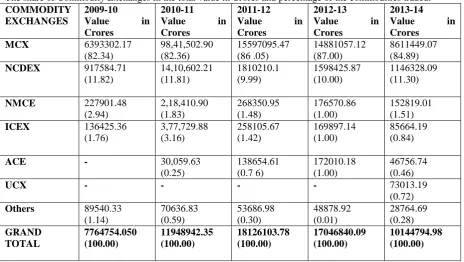
Table 1: Total Turnover of Commodity Exchanges- (2009-2010 to 2013-2014)
The share of Commodity Exchanges in the total value in Crores and percentage of the commodities traded.
COMMODITY EXCHANGES
2009-10 Value in Crores
2010-11 Value in Crores
2011-12 Value in Crores
2012-13 Value in Crores
2013-14 Value in Crores MCX 6393302.17 (82.34) 98,41,502.90 (82.36) 15597095.47 (86 .05) 14881057.12 (87.00) 8611449.07 (84.89) NCDEX 917584.71 (11.82) 14,10,602.21 (11.81) 1810210.1 (9.99) 1598425.87 (10.00) 1146328.09 (11.30) NMCE 227901.48 (2.94) 2,18,410.90 (1.83) 268350.95 (1.48) 176570.86 (1.00) 152819.01 (1.51) ICEX 136425.36 (1.76) 3,77,729.88 (3.16) 258105.67 (1.42) 169897.14 (1.00) 85664.19 (0.84)
ACE - 30,059.63
(0.25) 138654.61 (0.7 6) 172010.18 (1.00) 46756.74 (0.46)
UCX - - - - 73013.19
(0.72) Others 89540.33 (1.14) 70636.83 (0.59) 53686.98 (0.30) 48878.92 (0.01) 28764.69 (0.28) GRAND TOTAL 7764754.050 (100.00) 11948942.35 (100.00) 18126103.78 (100.00) 17046840.09 (100.00) 10144794.98 (100.00)
[Hariharan * et al., 5(6): June, 2018]
ISSN: 234-5197
Impact Factor: 3.765
I
NTERNATIONAL
J
OURNALOF
R
ESEARCH
S
CIENCE&
M
ANAGEMENT
2014. The National Exchanges, which hasimplementation of modern technology, have expanded the facility of commodity futures trading across the country. MCX recorded the highest turnover in terms of value of trade from 2009-10 to 2013-14 followed by NCDEX, NMCE, and ICEX.
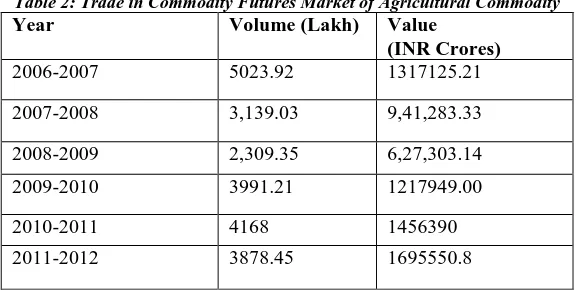
Table 2: Trade in Commodity Futures Market of Agricultural Commodity
Source Economic Survey 2008-09 & 2009-10 & 2011-12
The above table shows that, the year 2006-07 has witnessed highest traded volume i.e. 5023 lakhs and value of Rs.13,17,125 crores. There is gradual decline in the trade volume (i.e.3139 & 2039 respectively) and value (Rs 9, 41,283 & 6,27,303 crores respectively) for the year 2007-08 and 2008-09. In the year 2009-2010, 2010-11and 2011-12 as a positive sign volume traded (i.e. 3991,4168& 3878 respectively) and value (Rs 1217949, 14,56,390 & 1695550 crores respectively).
Price volatility
Understanding price volatility under market oriented agriculture policy is very important. This is important because the output price volatility is an indispensable input for Farmers, investors and businessman for making business decision (Maynard et.al, 1997). Several price moves are thought to be detrimental to the market since they disrupt trading mechanism causing a loss of liquidity, and prolong the threat to market stability (Becketti and Roborts, 1990, Federal Reserve Board 1997, Darrat & Rahman, 1995).
Market Efficiency
Investment strategy of an investor is influenced by the market efficiency because if market is efficient, there will be no undervalued transaction. An efficient market offers higher than deserved expected returns, given their risk in an emerging market. Market efficiency in the framework of capital market has been defined in many ways, but the most common way has been defined in terms of what sort of data is available to market participants and how they handle that data. Accordingly an efficient capital market is where prices of financial assets correctly reflect all information and quickly adjust to new information (Dimson and Mussavian 1998). This definition is referred to as informational efficiency. Nevertheless, the markets are also economic institutions that require resources and economic agents. Efficient markets are involved in allocating resources in a cost effective manner and to their most profitable use. The random walk hypothesis is used to explain the successive price changes which are independent of each other. An efficient market is one where the actual price of security will help in estimating the “intrinsic value”(Fama 1965). Fama (1970) has been the first to develop the efficient market hypothesis. He formalized his hypothesis further and indicates that a market is called efficient if prices “fully reflect” all available information.
i) Weak – form – efficiency
A market is called weak efficient, if all the information is available regarding past price movements is reflected in the current prices. Then information of future prices cannot be predicted by using past price.
ii) Semi – strong efficiency
Semi strong form markets fully reflect all publically available information in its stock price. Thus one cannot make abnormal profits by using publically available information.
Year Volume (Lakh) Value
(INR Crores)
2006-2007 5023.92 1317125.21
2007-2008 3,139.03 9,41,283.33
2008-2009 2,309.35 6,27,303.14 2009-2010 3991.21 1217949.00
[Hariharan * et al., 5(6): June, 2018]
ISSN: 234-5197
Impact Factor: 3.765
I
NTERNATIONAL
J
OURNALOF
R
ESEARCH
S
CIENCE&
M
ANAGEMENT
iii) Strong – form efficiency
The strong form efficiency suggests that security prices reflect all available information, even private information. It is not possible to forecast future price movements.
Findings
The study reveals that among the various national exchanges MXC has highest trade in other exchange.
The exchange ACE has no trading in the year 2009-10 as the exchange was launched only in October 2010.
The exchange UCXhas no trading in the year 2012-13 as the exchange started its operation in April 2013.
Analysis shows that there is gradual decrease in Trade in Commodity Futures Market of Agricultural Commodity in the year 2008-09 as the government announced ban on futures trading in four agricultural commodities namely Chickpea, Potato, Rubber and Soya oil.
Price volatility is result of various factors that influence the price of agriculture products. The factors are demand and supply of the crop, prevailing weather condition, substitution of other crops, consumer choices so on
Suggestion
Agriculture being the backbone of Indian economy where there is large scale production in various agricultural commodities there is wide scope for future commodity exchange.
There is a need for national exchange to function transparently and effectively.
Awareness need to be created among the farmers and traders on how to utilize commodity future exchange for hedging their risk and for better return.
Conclusion
This study shows that there is phenomenal growth in the Indian commodity market. India is traditionally an agricultural economy. There are certain issues like instability of commodity prices which has been a major concern to the producers as well as the consumers. In India, more than 70% of populations depend on agricultural commodities. Commodity futures markets are a part and parcel of a program for agricultural liberalization. There is a need for liberalization in the sector. Futures markets are on instrument for achieving that liberalization. The present study is carried out with respect of all six National level commodity exchanges in India namely NMCE, Ahmadabad; MCX, Mumbai; NCDEX, Mumbai; ICEX, Mumbai; ACE, Ahmadabad; and UCX, Mumbai. These exchanges are playing very important role in the trading activities in India.
References
[1] Agarwal, N., &Kaur, G. (2010).Agricultural Commodity future trading and its implications.
[2] Ahmad, S., & Jamshed, M.(2014).Nurturing an Agriculture friendly Commodity Derivatives Marketing in India.
[3] Bhagwat, S., & Maravi, A. S. (2016). An Anlysis of Past and Present Status of Commodity Derivatives Market in India.
[4] Bhagwat, S., & Maravi, A. S.(2016).A Study of Commodity Market V/S Multi Commodity Exchange of India Limited (MCX).
[5] G. Anuradha and Bohra Dimple (2012) “Optimizing and analyzing returns in commodity trading using Genetic Algorithm, Simulated Annealing and a novel algorithm ( GaSa)“, International Journal of Emerging Technology and Advanced Engineering, ISSN No: 2250-2459, Volume 2, Issue-12, December 2012, pp. 662-666.