© Universiti Tun Hussein Onn Malaysia Publisher’s Office
IJIE
Journal homepage: http://penerbit.uthm.edu.my/ojs/index.php/ijie
The International
Journal of
Integrated
Engineering
ISSN : 2229-838X e-ISSN : 2600-7916
A Comparative Study on Improvement of Image Compression
Method using Hybrid DCT - DWT Techniques with Huffman
Encoding for Wireless Sensor Network Application
Mumtaz Anwar Hussin
1, Farhana Ahmad Poad
1*
, Ariffuddin Joret
11Department of Communication Engineering, Faculty of Electrical and Electronic Engineering,
Universiti Tun Hussein Onn Malaysia, Parit Raja, Batu Pahat, 86400, Johor
*Corresponding Author
DOI: https://doi.org/10.30880/ijie.2019.11.03.016
Received 24 July 2019; Accepted 29 July 2019; Available online 3 September 2019
1. Introduction
Image is a visual representation, which appear in a 2D form of signal that are commonly presented as analog form [1]. Meanwhile, the digital form are usually used for storage purpose, processing and the transmission through the computer applications. Generally, the images may cover a huge amount of the memory in the RAM and device's storage. WSN is the most standard provision used in commercial and industrial applications while ZigBee is one of the standard of WSN that compatible for high-level communication protocol. Unfortunately, it has limitation in transmitting huge data due to its small protocol, which the data rate is low. Thus, data compression is very important to reduce the size of transmitted data and improve network transmission time. If the data is larger than the allocated capacity of data packet, the image is unable to properly transmit and receive via wirelessly. Therefore, an algorithm that capable of breaking down of longer data strings into shorter ones will be proposed to reduce the data capacity.
2. Image Compression Overview
Image compression had begun since late 40’s, which the information theory’s era starts. As time goes on, human demand is getting higher due to the current sophisticated technology that never end. Nowadays, image compression has been widely utilized in several types of applications especially in communicat ion system. There are two methods of image compression; (i) Lossless image compression, and (ii) Lossy image compression.
Lossless image compression allows the original image to be perfectly reconstructed from the compressed data while lossy image compress ion will have some data loss and error after compression [2]. Therefore, image compres sion is very
Abstract: Nowadays, the demands on the usage of wireless network are increasing rapidly from year to year. Wireless network is a large scale of area where many nodes are connecting to each other to commun icate using a device. Primarily, wireless network also tend to be as a link to transmit and receive any multimedia such as image , sound, video, document and etc. In order to receive the transmitted media correctly, most type of media must be compressed before being transmitted and decompressed after being received by the device or else the device used must have the ability to read the media in a compressed way. In this paper, a hybrid compression of Discrete Cosine Transform (DCT) and Discrete Wavelet Trans form (DWT) with Huffman encoding technique are proposed for Wireless Sensor Network (WSN) application. Data compression is very useful to remove the redundant data and reduce the size of image. After conducting a comprehensive observation, it is found that hybrid compression is suitable due to the process consist of the combination of multiple compression techniques which suits for Wireless Sensor Network’s application focusing on ZigBee platform.
important to reduce the size of transmitted data, to improve network transmission time with good quality of image and providing better performance of system according to specific application, which wanted to be applied.
Pekhteryev et.al [3] has developed an image sensor network for testing transmission of lossy compression image which are JPEG and JPEG 2000. In their work has mentioned that transmission of JPEG 2000 can provide good resolution and quality scalable bit-stream which shows better compression efficiency than JPEG. This is due to JPEG 2000 is a dyadic multi-resolution sub-band (wavelet) transform based while JPEG is a Discrete Cosine Transform (DCT) based and uses Huffman coding. Another work done by Kitakami et.al [4] proposed lossless image compression by using Prediction Partial Matching (PPM) coding which generating a probability distribution to predict the next character in a sequence of coding scheme. The proposed method are compared with Lossless JPEG (JPEG-LS), a standard lossless image compression technique and Context-Based, Adaptive, Lossless Image Coding (CALIC) in terms of compression ratio in bits per pixel. As the result, the proposed method showed better compression ratio than JPEG-LS and CALIC.
Shen et.al [2] propose an adaptive image of lossless compression method by using Vector Quantization (VQ) due to the techniques of quality improvement of VQ is limited at about 27 dB to 30 dB. The past VQ compression required additional data to enhance the image quality while the proposed method enhanced the quality of reconstructed image without any distortion due to the present of additional data to adjust the codebook training. Hence, the image quality is enhanced. Other than that, lossy image compression has been properly tested by Shahidan et.al [5], which implemente d image sequence transfer with data buffering mechanism. As the result, th e data can be buffered into data flash which is efficient in transmitting process. Hence, the image is successfully transferred after processed at the control station and received at the end node.
In 2011, Chantharat et.al [6] use lossless image compression method to transmit an image between transmitter and receiver. They applied DCT technique, quantization, zigzag scanning and Huffman coding before transmitting the image via ZigBee network. Besides, they used two tag and two reader to transmit the image efficiently. As the outcome, it is proved that a multi-diversity system can achieve higher data rate than a point -to-point system, since it is able to achieve fast image transmitting with good image quality. Another work done by Mathur et.al [7] tests lossless image compression to reduce file size and save memory s pace. Based on the results obtained, the compression ratio for grayscale image is better as compared to RGB images after applied using Binary Trees of Huffman coding technique which can generates good codes and useful data structures for storing informatio n. The RGB images have some losses compared to grayscale images due to the storage and pixel value of RGB images are larger than grayscale images.
AL-Ani et.al [8] examines the step in the lossy compression and decompression algorithm by adding the techniques of Run-Length Coding (RLC) other than the basic technique of JPEG image compression. Although, the result indicates a minimal losses in the quality of image, however the performance in terms of Power Signal-to-Noise Ratio (PSNR) is high and the amount of time spent on execution can be easily balanced. Srikanth et.al [9] in their work apply Discrete Wavelet Transform (DWT) for lossless compression type and add a modified Set Partitioning in Hierarchical Tree (SPHIT) algorithm which able to determine the importance of wavelet coefficients method and the scanning order. As the result, the added modified SPHIT giving an excellent rate of distortion performance which displays a good image quality and can provide high compression ratio than past lossless compression ratio.
Moreover, a research done by Khobragade et.al [10] also able to prove that a good quality of image comes from lossless compression method compared to lossy compression method. However, Zhou et.al [11] prove that lossy compression using hybrid method based on DCT and Multistage Vector Quantization (MSVQ) has better image quality. A hybrid method has an improved algorithm by using several small-sized codebooks instead of one codebook as general lossy and lossless compression method. The performance based on hybrid method shows better PSNR value compares to JPEG standard and it can produce high image quality at low bit rate situation. In 2016, Poolakkachalil et.al [12] perform an analysis of lossless compression techniques in Efficient DCT-based image compression system based on Laplacian Transparent Composite Model (LPTCM) and Innovative Lossless Compression Method for discrete -colour images. They applied the algorithm of Transparent Composite Coding (TCC) that co nsist of Contex Adaptive Layer Based Bi-Lev e l Image Coding (CALBIC) and Contex Adaptive Layer-Based Composite Arithmetic Coding (CALCAC) scheme which are able to capture better data dependencies in a block and employs multi-symbol arithmetic coding to improve the problem of low throughput respectively.
Meanwhile, two lossy compression type, JPEG and JPEG 2000 are analyzed by Roy et.al [13] which show a better image quality for JPEG 2000 compared to JPEG. This is due to the method o f JPEG 2000 added a Discrete Wavelet Transform (DWT) technique. Moreover, the performance of JPEG 2000 is more efficient compared to JPEG in terms of high compression ratio and low Mean Squared Error (MSE). In 2017, Surabhi et.al [14] presents information about past work on image compression techniques. They stated that lossless compression technique is often applied for medica l imaging, technical drawings and etc., while lossy compression method are suitable for natural images suc h as photographs where minor loss of fidelity is acceptable. The reason is because of lossy compression tends to have some losses unlike the lossless compression. Thus, the application for lossless compression must not affect the main purpose or the function of the application as compared to application for lossy compression.
many other application in this advanced technology era. Therefore, image compression is very important to reduce the size of transmitted data and to improve network transmission time with good quality image.
3.
Lossless Image Compression
Common lossless image formats are Portable Network Graphic (PNG) and Graph ic Interchange Format (GIF) [15] where both format are useful for storing line drawing, text and iconic graphics at a smaller size. The following are examples of common lossless image compression technique.
3.1
Huffman Coding
Huffman coding is classified in entropy encoding which represents the minimum size of dataset necessary to convey a particular amount of information [3], [6], [11] and [16]. The advantage of Huffman coding is that it can design the most efficient compression method such as for transmit diversity [6].
3.2
Shanon-Fano Coding
Shanon-Fano Coding is also classified under entropy encoding. Shanon -Fano coding is one of the earliest compression techniques had been invented since late 40’s [17].It is much simpler compared to Huffman coding.
3.3
Run-length Coding
Run-length coding replaces data by a (value and length) pair, where “value” is the repeated value and “length” is the number of repetitions. It is classified under dictionary coding where the technique is suited for compressing bi-level images since the occurrence of a long run of a value is rare in ordinary gray-scale images. Therefore, the gray-scale image must decomposed into bit planes and compressed every bit plane s eparately [11].
3.4
Lempel-Ziv-Welch Coding
Lempel-Ziv-Welch (LZW) coding is also classified under dictionary coding which represent the actual values of th e images while transmission [18]. The technique of LZW coding is that they do not analyze the input data but only replaced strings of character with single codes [19]. Data compression occurs after every new found characters of string in the dictionary are added [19].
4.
Lossy Image Compression
The most popular lossy image formats is Joint Photographic Expert Group (JPEG) which the image ca nnot be decompressed with 100% originality for digital images. JPEG used lossy compression based on Disc rete Cosine Transform (DCT) [20]. It is useful for storing photographs at smaller size than a bitmap (BMP) where BMP is the image that is not compressed. The following are examples of common lo ssy image compression technique.
4.1
Discrete Cosine Transform
The Discrete Cosine Transform (DCT) technique is the process of dividing the three color components of the image into many 8×8 blocks [20]. DCT is very suit for image compression because it can conce ntrate the energy of the transformed signal in low frequency. Human eyes are less sensitive to the low frequency component. Thus, after applied DCT technique, the contribution of high frequ ency component can be reduce [8].
4.2
Discrete Wavelet Transform
Discrete Wavelet Transform (DWT) offers less computational complexity without any sacrifice in the quality of image [14]. After the source image is digitized, the signal is decomposed into a sequence of wavelet coefficients. Monika Rathee stated that DWT represents an image as a sum of wavelet functions on different resolution levels [14]. In addition, wavelets are well suited to time-limited data. Hence, wavelet based image compression technique can maintained a better image quality with less errors.
4.3
Lossy Quantization
5.
Summary of Compression Overview
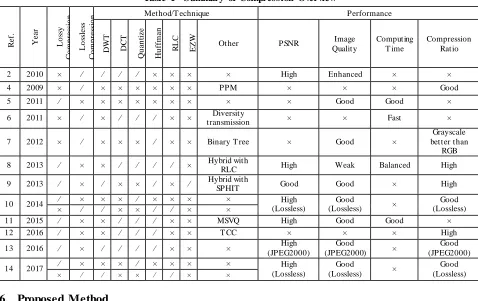
In this work, the type of image compression are reviewed and investigated to observe the suitability of compression technique which can be implemented efficiently based on the performance achieved as shown in Table I. Various technique based on lossy compression and lossless compression are covered by the past researcher in every year. In order to solve limitation of ZigBee due to limitation in transmitting an image, researches related on ZigBee’s application based on image transmission are also included as the reference for this work.
The past research shows that a lossless compression method are good in maintaining the quality of image after compression compared to lossy compression. However, both compression metho ds can still be used according to the application. Generally, lossy and lossless compression techniques mostly use Huffman coding as the process for entropy encoding. It compresses data by replacing input of fixed length symbol to get the output of variable length prefix-fre e codeword. Additionally, all performance based on hybrid techniques provide better results compared to other common method. Therefore, the hybrid technique for lossy compression is proposed for this work, which is intended to reduce the size of the image for the purpose of wireless transmission applications.
Table 1 - Summary of Compression Overview
R e f. Y e a r L o ss y C o m p re ss io n L o ss le ss C o m p re ss io
n Method/T echnique Performance
D W T D C T Q u a n ti z e H u ff m a n R L C
EZW Other PSNR
Image Quality Computing T ime Compression Ratio
2 2010 × ∕ ∕ ∕ ∕ × × × × High Enhanced × ×
4 2009 × ∕ × × × × × × PPM × × × Good
5 2011 ∕ × × × × × × × × × Good Good ×
6 2011 × ∕ × ∕ ∕ ∕ × × Diversity
transmission × × Fast ×
7 2012 × ∕ × × × ∕ × × Binary T ree × Good ×
Grayscale better than
RGB 8 2013 ∕ × × ∕ ∕ ∕ ∕ × Hybrid with
RLC High Weak Balanced High
9 2013 ∕ × ∕ × × ∕ × ∕ Hybrid with SPHIT Good Good × High
10 2014 ∕ × × × ∕ × × × × High
(Lossless)
Good
(Lossless) ×
Good (Lossless)
× ∕ ∕ × × ∕ ∕ × ×
11 2015 ∕ × × ∕ ∕ ∕ × × MSVQ High Good Good ×
12 2016 ∕ × × ∕ ∕ ∕ × × T CC × × × High
13 2016 ∕ × ∕ ∕ ∕ ∕ × × × High
(JPEG2000)
Good
(JPEG2000) ×
Good (JPEG2000)
14 2017 ∕ × × × ∕ × × × × High
(Lossless)
Good
(Lossless) ×
Good (Lossless)
× ∕ ∕ × × ∕ ∕ × ×
6.
Proposed Method
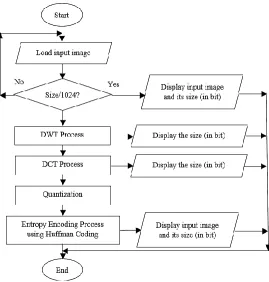
This research works are proposed to transmit a captured image via wireless network as illustrated in Fig. 1. Therefore, a suitable compression method is required for the image to reduce as many size as possible to ease the transmission process. In this work, compression method consists of DCT, DWT and Huffman technique are focuses to reduce image size as many as possible. Then, the image are decompressed according to the reverse process of compression as shown in Fig. 2 to observe the quality of reconstructed image by using MATLAB software. The Red Green Blue (RGB) refers to the division of three-colour code (Red, Green and Blue) with 24 bits.
Fig. 1 - Overall visualization of system architecture
Fig. 2 - Block diagram of overall image compression process
Fig. 3 - Flowchart of image compression process
6.1
Compression Technique
The transformation of 8x8 block is an 8x8 block composed of F(u,v) which also refer as DCT coefficient after transformation. In quantization stage, most of the less important high frequency DCT coefficient to set to be zero. The higher zero can be generated, the better image can be compressed.
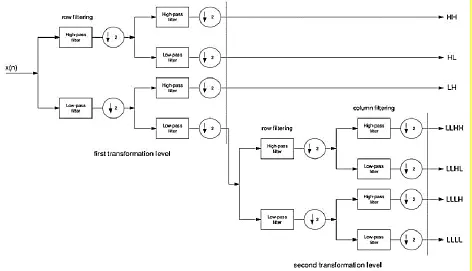
Next, DWT compression technique used the concept of filtering the image and reduce complexities of the design linear algebra view. Fig. 4 shows the concept of DWT. An input image which are selected become the origina l image size. Next, the first transformation level divided the image into half which undergo process of high pass filter (HPF) and low pass filter (LPF). Then, the LPF part of image are cut into half with the same process of HPF and LPF. The next stage are repeating the same process of dividing the LPF part into half [22] and output of two transformation level are shown as in Fig. 5.
Fig. 4 - Filtering stage for two transformation level of DWT compression technique
6.2
Encoding Technique
An entropy encoding is applied by implementing Huffman coding which is an entropy-based algorithm. Huffma n coding are able to rely on the analysis of the frequency of symbols in an array which can be used to compress all sorts of data efficiently. Image compression has been improved for the last three decades which uses the Huffman coding technique. The speciality of Huffman algorithm is to generate the uniquely decipherable Huffman code with a minimu m expected codeword length when the probability distribution of a data source is known to the encoder.
In addition, an entropy can be defined as a measure of information content which it will be able to represent the amount of bits used in the data in particular given image. The advantage of Huffman coding is where it uses a specific method for choosing the representation for particular images which results in a prefix code [23]. Thus, it is the most efficient design in the process of storing images due to the ability in maintain the image data without any loss. Lastly, decompression are applied to investigate the possibility of original image can be obtained by the reverse process of compression method.
6.3
Evaluation of System’s Performance
Huffman coding is classified in entropy encoding which represents the minimum size of dataset necessary to convey a particular amount of information [3], [6], [11] and [16]. The advantage of Huffman coding is that it can design the most efficient compression method such as for transmit diversity [6]. In this work, the performance of compression are observed in terms of computing time, Compression Ratio (CR), Mean Square Error (MSE), Power Signal-to-Noise Ratio (PSNR) and Structural Similarity Index (SSIM). The following are the equation required to obtain the performance of the research work:
Other than that, SSIM are also included to support the observation of quality image performed. The closer the SSIM value to '1', the better quality of image is formed [24]. Another terms can be evaluate is the Processing Time which the time taken for compression and decompression process before and after hybrid method is embedded.
In summary, the method applied for image compression are DCT and DWT compression technique which are categorized as lossy compression type while for encoding technique used is Huffman Encoding which are categorized as lossless compression. Both technique support each other and maintaining the original goal of this work which to reduce the image size by removing redundant and irrelevant image data. Thus, the purpo se of compression is to reduce the size of image while decompression is to obtain the original image with its original quality and size again by evaluating the system’s performance in terms of CR, Processing Time, MSE, PSNR and SSIM.
7.
Preliminary Result
Fig. 6 - (a) Original Input Image; (b) DCT Compressed Image; (c) DWT Compressed Image
Table 2 – Performance based on DCT compression
Image Format
Input Size (kB)
DCT Size (kB)
Compression
Ratio PSNR (dB) SSIM
Computing Time (s)
BMP 768.0530 23.6660 32.4539 : 1 37.4445 0.9364346 4.552258 PNG 575.0900 23.6660 24.3003 : 1 37.4445 0.9364346 4.402310
JPG 75.6299 23.6670 3.1956 : 1 37.4467 0.9363851 4.424085
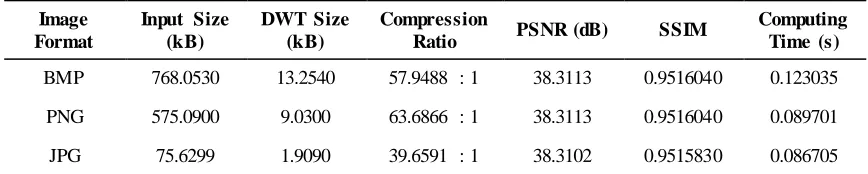
According to Table 3, the performance of DWT compression indicates highest compression ratio for PNG by about 63.6866, followed by BMP with 24.3057.9488 and JPG with 39.6591. In addition, the DWT compression gives higher PSNR and SSIM values by about 2.26% and 1.59%, respectively compared to the DCT compression, which causes a high quality of image is produced. Next, the average computing time of each image format is much faster than the DCT compression by about 45 times. In overall, the DWT compression shows better performance for PNG due to high compression ratio within short amount of computing time. The comparison of original image, DCT compressed image and DWT compressed image are shown in Fig. 6 (a), 4(b) and 4(c), respectively.
Table 3 – Performance based on DWT compression
Image Format
Input Size (kB)
DWT Size (kB)
Compression
Ratio PSNR (dB) SSIM
Computing Time (s)
BMP 768.0530 13.2540 57.9488 : 1 38.3113 0.9516040 0.123035 PNG 575.0900 9.0300 63.6866 : 1 38.3113 0.9516040 0.089701 JPG 75.6299 1.9090 39.6591 : 1 38.3102 0.9515830 0.086705
8.
Conclusion
This paper proposes a hybrid compression of DCT, DWT and Huffman technique for image transmission over ZigBee network. The input image is compared with three different types of image format, which are BMP, JPG and PNG. The DCT and DWT compression technique are applied for each format and the results show that the size of the compressed image is able to reduce by about 96.92% and 99.8% from its original image, thus a good quality of image have been developed. Moreover, the results obtained show better PSNR value compared to [25], [26] and DCT in [27] while for [28] and [29] shows good PSNR value and compression ratio by applying hybrid method. Therefore, a hybrid compression method is proposed to realize higher compression of the input image and reduce larger space of image’s data storage. The next steps to achieve the goal of this work are (i) to investigate the performance of overall hybrid compression, and (ii) to analyze the performance of hybrid decompression stage before a comparison can be done with previous related research paper as stated in [28] and [29], respectively.
Acknowledgement
The authors would like to thank Research, Innovation, Commercialization and Consultation Management (ORICC) Universiti Tun Hussein Onn Malaysia (H180 Tier 1 Fund and H303 GPPS Fund) and Registrar Office for sponsoring the research and development of this project.
References
[1] J. Vrindavanam, S. Chandran, and G. K. Mahanti, “A Survey of Image Compression Methods,” Int. J. Comput.
Appl., no. February 2012, pp. 12–17, 2012.
[2] J. J. Shen and H. C. Huang, “An Adaptive Image Compression Method Based on Vector Quantization,” Proc. -
2010 1st Int. Conf. Pervasive Comput. Signal Process. Appl. PCSPA 2010, pp. 377–381, 2010.
[3] G. Pekhteryev, Z. Sahinoglu, P. Orlik, and G. Bhatti, “Image Transmission over IEEE 802.15.4 and ZigBee Networks,” ISCAS, no. May, pp. 3539–3542, 2005.
[4] M. Kitakami and K. Tai, “Lossless Image Compression by PPM-Based Prediction Coding,” Proc. - 2009 Data
Compression Conf. DCC 2009, p. 452, 2009.
[5] A. A. Shahidan, N. Fisal, A. H. A. H. Fikri, N. N. Ismail, and F. Yunus, “Image Transfer in Wireless Sensor Networks,” 2011 Int. Conf. Commun. Eng. Network s, vol. 19, pp. 158–165, 2011.
[6] W. Chantharat and C. Pirak, “Image Transmission over ZigBee Network with Transmit Diversity,” Ipcsit.Com, vol. 7, pp. 139–143, 2011.
[7] M. K. Mathur, S. Loonker, and D. Saxena, “Lossless Huffman Coding Technique for Image Compression and Reconstruction using Binary Trees,” Ijcta, vol. 3, no. 1, pp. 76–79, 2012.
[8] M. Shaban AL-Ani and F. Hammadi Awad, “The JPEG Image Compression Algorithm,” Int. J. Adv. Eng.
Technol., vol. 6, no. 3, pp. 1055–1062, 2013.
[9] S. Srikanth and S. Meher, “Compression Efficiency for Combining Different Embedded Image Compression Techniques with Huffman Encoding,” Int. Conf. Commun. Signal Process. ICCSP 2013 - Proc., pp. 816–820, 2013.
[10] P. B. Khobragade and S. S. Thakare, “Image Compression Techniques - A Review,” Int. J. Comput. Sci. Inf.
Technol., vol. 5 (1), pp. 272–275, 2014.
[11] X. Zhou, Y. Bai, and C. Wang, “Image Compression Based on Discrete Cosine Transform and Multistage Vector Quantization,” Int. J. Multimed. Ubiquitous Eng., vol. 10, no. 6, pp. 347–356, 2015.
[12] T. K. Poolakkachalil, S. Chandran, R. Muralidharan, and K. Vijayalakshmi, “Comparative Analysis of Lossless Compression Techniques in Efficient DCT-Based Image Compression System Based on Laplacian Transparent Composite Model and an Innovative Lossless Compression Method for Discrete-Color Images,” 2016 3rd
MEC Int. Conf. Big Data Smart City, ICBDSC 2016, pp. 155–160, 2016.
[13] A. Roy and L. P. Saikia, “A Comparative Study on Lossy Image Compression Techniques,” Int. J. Curr.
Trends Eng. Res., vol. 2, no. 6, pp. 16–25, 2016.
[14] N. Surabhi and S. N. Unnithan, “Image Compression Techniques: A Review,” IJEDR, vol. 5, no. 1, pp. 585– 589, 2017.
[15] “What is the differences between JPG, PNG and GIF.”
[16] D. Raj, “Modeling of Image Compression and Decompression using Huffman Code Technique,” Int. J.
Comput. Sci. Mob. Comput., vol. 2, no. 12, pp. 440–447, 2013.
[17] “History of Losslss Data Compression Algorithm.” . [18] “Image Compression Based on Prediction Coding.” .
[19] E. Mishra and K. K. Singh, “Comparision of Various Lossless Image Compression Techniques,” Int. J. Eng.
Res. Appl., vol. 5, no. 6, pp. 36–39, 2015.
Sci., vol. 4, no. 1, pp. 13–17, 2013.
[22] M. Rathee and A. Vij, “Image Compression Using Discrete Haar Wavelet Transforms,” nternational J. Eng.
Innov. Technol., vol. 3, no. 12, pp. 47–51, 2014.
[23] F. I. Khandwani and P. E. Ajmire, “A Survey of Lossless Image Compression Techniques,” Int. J. Electr.
Electron. Comput. Sci. Eng., vol. 5, no. 1, pp. 2348–2273, 2018.
[24] G. Palubinskas, “Mystery Behind Similarity Measures MSE and SSIM,” 2014 IEEE Int. Conf. Image Process.
ICIP 2014, no. October 2014, pp. 575–579, 2014.
[25] V. Yadav, M. Verma, and V. D. Kaushik, “A Hybrid Image Compression Technique for Medical Images,”
Proc. - 2015 Int. Conf. Comput. Intell. Commun. Network s, CICN 2015, pp. 222–227, 2015.
[26] V. S. Thakur, S. Gupta, and K. Thakur, “Hybrid WPT-BDCT Transform for High-Quality Image Compression,” IET Image Process., vol. 11, no. 10, pp. 899–909, 2017.
[27] H. Singh and S. Rana, “Image Compres sion Hybrid using DCT , DWT , Huffman,” Int. J. Sci. Eng. Res., vol. 3, no. 8, pp. 1–4, 2012.
[28] E. Elharar, A. Stern, O. Hadar, and B. Javidi, “A Hybrid Compression Method for Integral Images using Discrete Wavelet Transform and Discrete Cosine Transform,” J. Disp. Technol., vol. 3, no. 3, pp. 321–325, 2007.