Copyright © The Author(s). All Rights Reserved. Published by American Research Institute for Policy Development DOI: 10.15640/jges.v7n2a1 URL: https://doi.org/10.15640/jges.v7n2a1
Structuring and Evaluation of the Factors Affecting the Efficiency of Decision Making
Regarding the Use of Water Bodies
Olga Petrakovska
1& Marharyta Dubnytska
2Abstract
The article describes the results of the research of structuring and evaluation of the factors affecting the efficiency of decision making regarding the use of water bodies. The authors define seven aggregated thematic groups of factors: information, technology, environmental, economic, legal, institutional and social. For estimation of demonstration and qualitative factors, conventional 5-point scales have been developed. In order to determine the significance of each factor, three categories of the subjects involved in decision making have been identified: subjects that justify and influence decision making; subjects that make final decisions; subjects that experience the consequences of decision making. According to the survey results of the representatives of the first two categories, the ranking of expert evaluations was carried out and the significance of the factors was determined. It was proved that information factors are the most significant, among which geospatial information is of particular importance. An algorithm based on the Cobb-Douglas logarithmic function is proposed for integral estimation of the efficiency of decision making regarding the use of water bodies. This approach allows to evaluate the efficiency of the decisions implemented and to forecast the results of the future ones.
Keywords: Water bodies, expert evaluation, efficiency of decision making, ranking, integral estimation. 1. Introduction
Environmental management, in particular the use of water bodies, is an interdisciplinary task (Thompson, 1998). The accounts and evaluation of water bodies were made in two-dimensional information systems for a long time. However, under conditions of today's urbanized areas with significant anthropogenic environmental load, these two-dimensional systems are not sufficient to ensure natural resource management. Western scientists have concluded that water body accounts should be kept in a dimensional environment. Strictly in the availability of three-dimensional information the accounting of water bodies can be complete and adequate (Stoter, 2004).
To solve the task of water body management, it is necessary to structure and evaluate the significance of the factors that affect the efficiency of decision making regarding their use. For said purpose, the authors have analyzed a set of factors and structured them on the disciplinary principle.
The research was conducted in the following sequence: 1) identification of a set of the factors and their analysis;
2) determination of the most significant factors necessary for consideration;
3) structuring of the factors and clustering them in qualitatively homogeneous groups; 4) factor evaluation and ranking;
5) integral estimation of the efficiency of decision making(Charnes, A., Cooper, W. W., Rhodes, E., 1978).
1Head of Land Management and Cadastre Department, National University of Architecture and Construction, Povitroflotsky
avenue 31, Kyiv, Ukraine, 03037; [email protected], ORCID: 0000-0002-9437-9730
2Assistant of Land Management and Cadastre Department, National University of Architecture and Construction, Povitroflotsky
2. Analysis of a set of factors
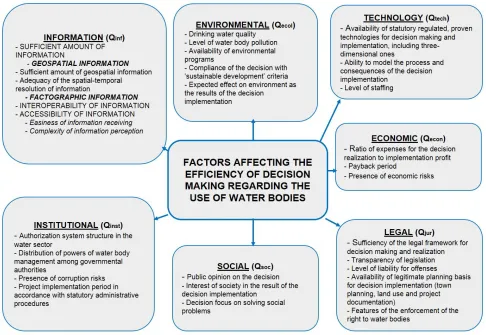
The analysis of a set of the factors affecting the efficiency of decision making regarding the use of water bodies was conducted through a combination of literary source studies and practical experience. This has made it possible to identify the factors that are obligatory for consideration when managing the use of water bodies, which were clustered into seven thematic groups: information, technology, environmental, economic, legal, institutional and social. (Fig. 1).
Fig. 1. Factors affecting the efficiency of decision making regarding the use of water bodies In Ukraine, the reform of the law institute is still continuing, and decentralization has been actively implemented recently, leading to a reallocation of the functions, powers and responsibilities of all management entities. Under such conditions, legal factors
Q
jurare of particular importance (Wozniak, 2019).This group of factors includes the following: the sufficiency of the legal framework for decision-making and realization, transparency of legislation, the level of liability for offenses, the availability of a legitimate planning basis for the implementation of the decision, the features of the enforcement of the right to water bodies. The availability of a legitimate planning base for implementation of the decision means the existence of approved land use, town planning and project documentation.When making any decisions, a significant regulator is the institutional factors reflecting the structure of the authorization system in the field of water use, the distribution of powers of water body management among governmental authorities, the presence of corruption risks, project implementation period in accordance with statutory administrative procedures (Klovienė, 2012).
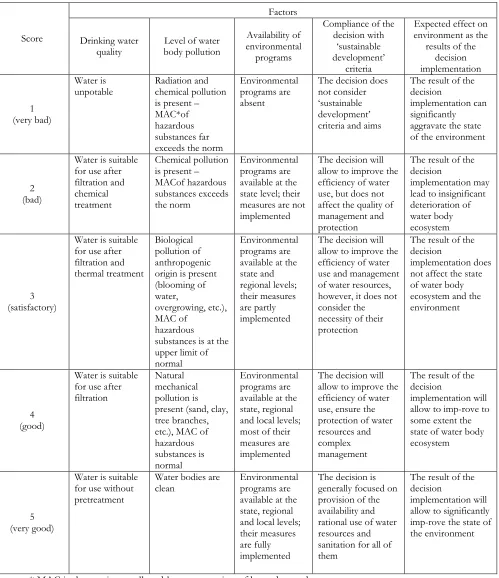
In today's ecologization of society, it is difficult to overestimate the significance of environmental factors ecol
Q
when using water bodies that have water supplying and recreation functions and are the main means of production, etc. Considering the multifunctionality of water bodies, the necessity of considering the decisions on the quality of drinking water, the level of pollution of the water bodies and any other direct or indirect expected negative impactis obvious. At the same time, environmental programs aimed at implementing sustainable development principles are important levers (Pedrazzini, 2011).The group of economic factors Qecon includes the ratio of expenses for the decision realization to implementation profit, payback period and the presence of economic risks(Visnja, Jovičić, Arsovski, Živković-Drezgić and Badjok, 2016).
In the group of technology factors
Q
tech, the main ones are the availability of statutory regulated, proven technologies for decision making and implementation, the ability to model the process and consequences of the decision implementation, and the availability of the necessary staffing (Institute of Medicine, 2013).Any decision can be justified only if there is verified and qualitative information (Choo, 2002). Therefore, special attention is given to the group of information factors
Q
inf,in which the authors additionally distinguished three main subgroups: sufficiency, interoperability and accessibility of information. The emphasis should be placed on the significance of different types of source information – geospatial (cartographic) and facto graphic (semantic / attribute). Such additional division of information makes it possible to structure the information layers of the 3D cadastre of water bodies and evaluate the completeness of different types of data. In assessing the quality of geospatial information, the availability of map data of different temporal dimensions and the level of their spatial-temporal resolution are important indicators. It should also be noted that the information accessibility to a decision-maker is determined by the ease of its obtaining and the complexity of its perception (‘understandability’).3. Scales for factor evaluation
After determining the list of factors affecting the efficiency of decision making regarding the use of water bodies and combining them into qualitatively homogeneous groups, their evaluation and ranking have been carried out. The vast majority of the factors (all groups of factors except economic ones) are characterized by qualitative properties that cannot be numerically expressed. Thus, a qualitative scale of the ordinal type was used for their evaluation, in which the measurement results are defined as
i(
k
i)
, where
iis an arbitrary increasing function. The features of such scales are that they do not record the beginning of the reference, there may be different scales of measurement, even the magnitude when passing from one value to another can be different (Nogin, 2005). In view of this, each factor was rated on a qualitative 5-point scale: 1 (very bad), 2 (bad), 3 (satisfactory), 4 (good), 5 (very good). The substantive content of each graduation is determined according to the thematic groups of factors that must be considered when evaluating the efficiency of decision making (Tables 1 – 7).Table 1. Scale of evaluation of legal factors
Score
Factors
Sufficiency of legal framework for decision making and implementation
Transparency of
legislation Level of liability for offences
Availability of legitimate planning
basis for decision implementation (town planning, land
use and project documentation)
Features of enforcement of
the right to water bodies
1 (very bad)
Legal framework is
absent Legislation is nontransparent, explications are blocked
Liability for offences is not prescribed
Legitimate planning basis for decision implementation is absent and cannot be developed
Water bodies cannot be used lawfully
2 (bad)
Common legal framework is available, but some its provisions block adoption and realization of individual decisions Legislation is nontransparent, explications are provided, however, there is now certainty as to application of specific rules of law
Disciplinary, civil or administrative liability is prescribed; penalty mechanism is absent Legitimate planning basis for decision implementation is absent, but can be developed Possible use without water body transfer 3 (satisfactory) Common legal framework is available only Legislation requires
further explanations Offence provides for disciplinary, civil or
administrative liability, penalty mechanism is imperfect and does not fully work
Legitimate planning basis for decision implementation is being developed
Transfer of the right to water body use is possible, however, it is difficult to implement
4 (good)
Legal framework is available, but some provisions are discretionary
Legislation is transparent, but some provisions are discretionary
Offence provides for all kinds of liabilities(includin g criminal), but penalty mechanism is imperfect and does not fully work
Legitimate planning basis for decision implementation is partly available
Transfer of the right to water body use is possible and is implemented
5 (very good)
Legal framework is available to the full extent, creates favorable conditions for decision making and implementation Legislation is transparent, accessible and comprehensible
Liability of all kinds (including criminal) is prescribed and imposed for an offence
Legitimate planning basis for decision implementation is available to the full extent
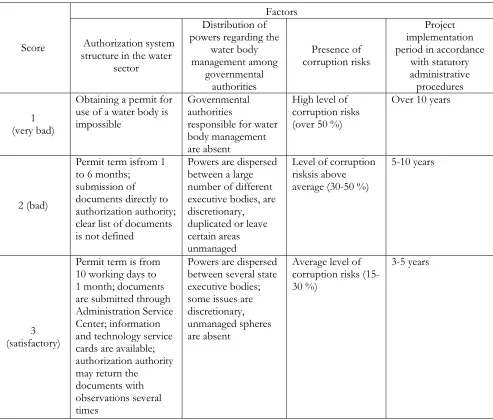
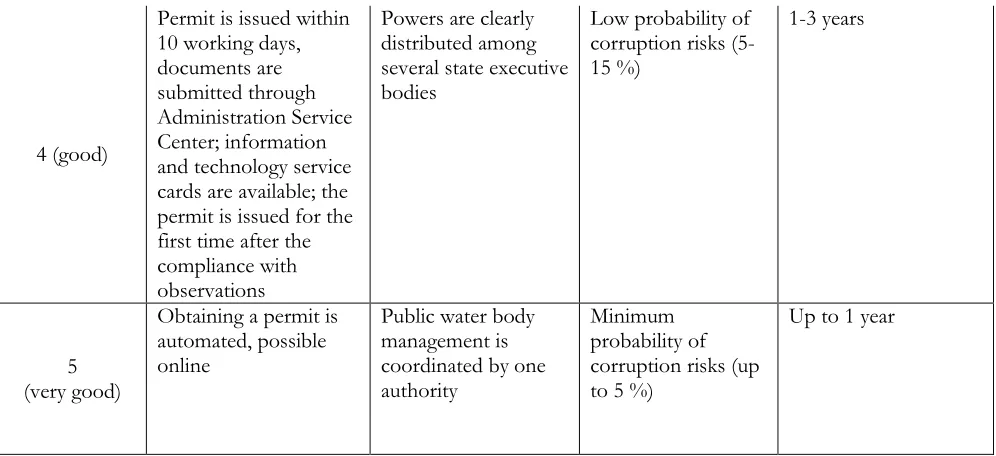
Institutional factors demonstrate the quality of government regulation of decision making (Klovienė, 2012). The structure of the authorization system in the water sector is evaluated in terms of the complexity of obtaining the relevant permits, which is determined by the possibility of centralized or online submission of orders and terms of obtaining permits. The distribution of powers regarding the water body management among governmental authorities illustrates how rational the management structure is, whether there are discretionary issues, or whether some areas of water use remain unmanaged. When assessing corruption risks, it is necessary to note not only the probability of their occurrence, but also the estimated share of these risks in the total cost of the decision implementation, which in size can correlate to the probability in a certain way(Table 2).
Table 2. Scale of evaluation of institutional factors
Score
Factors Authorization system
structure in the water sector
Distribution of powers regarding the
water body management among
governmental authorities
Presence of corruption risks
Project implementation period in accordance
with statutory administrative procedures 1
(very bad)
Obtaining a permit for use of a water body is impossible
Governmental authorities
responsible for water body management are absent
High level of corruption risks (over 50 %)
Over 10 years
2 (bad)
Permit term isfrom 1 to 6 months;
submission of documents directly to authorization authority; clear list of documents is not defined
Powers are dispersed between a large number of different executive bodies, are discretionary, duplicated or leave certain areas unmanaged
Level of corruption risksis above average (30-50 %)
5-10 years
3 (satisfactory)
Permit term is from 10 working days to 1 month; documents are submitted through Administration Service Center; information and technology service cards are available; authorization authority may return the
documents with observations several times
Powers are dispersed between several state executive bodies; some issues are discretionary, unmanaged spheres are absent
Average level of corruption risks (15-30 %)
4 (good)
Permit is issued within 10 working days, documents are submitted through Administration Service Center; information and technology service cards are available; the permit is issued for the first time after the compliance with observations
Powers are clearly distributed among several state executive bodies
Low probability of corruption risks (5-15 %)
1-3 years
5 (very good)
Obtaining a permit is automated, possible online
Public water body management is coordinated by one authority
Minimum probability of corruption risks (up to 5 %)
Up to 1 year
An aggregated evaluation of the decision efficiency is impossible without consideration of social and environmental factors. Social factors characterize the consequences of managerial decision for society and includes public opinion concerning the decision, the interest of the population and industry complex as the result and its focus on solving social problems (Wozniak, 2019) (Table 3).
Table 3. Scale of evaluation of social factors
Score Factors
Public opinion on
managerial decision Interest of society in the result of the decision implementation
Decision focus on solving social problems 1
(very bad) The community is strongly opposed to the decision Society is not interested in the result of the decision implementation
The decision leads to new social problems
2 (bad) Some members of the community are not satisfied with the decision
Individual interest is present The decision aggravates the current social problems 3
(satisfactory) The community is indifferent to the decision Interest of society at the local level is present The decision does not affect social problems 4 (good) Some members of the
community support the decision
Interest of society at the
regional level is present The decision may have a beneficial effect on social problems
5
Table 4. Scale of evaluation of environmental factors
Score
Factors
Drinking water
quality body pollution Level of water
Availability of environmental
programs
Compliance of the decision with
‘sustainable development’
criteria
Expected effect on environment as the
results of the decision implementation
1 (very bad)
Water is
unpotable Radiation and chemical pollution is present – MAC*of hazardous substances far exceeds the norm
Environmental programs are absent
The decision does not consider ‘sustainable development’ criteria and aims
The result of the decision
implementation can significantly aggravate the state of the environment
2 (bad)
Water is suitable for use after filtration and chemical treatment
Chemical pollution is present – MACof hazardous substances exceeds the norm
Environmental programs are available at the state level; their measures are not implemented
The decision will allow to improve the efficiency of water use, but does not affect the quality of management and protection
The result of the decision
implementation may lead to insignificant deterioration of water body ecosystem
3 (satisfactory)
Water is suitable for use after filtration and thermal treatment
Biological pollution of anthropogenic origin is present (blooming of water,
overgrowing, etc.), MAC of
hazardous
substances is at the upper limit of normal
Environmental programs are available at the state and regional levels; their measures are partly implemented
The decision will allow to improve the efficiency of water use and management of water resources, however, it does not consider the necessity of their protection
The result of the decision
implementation does not affect the state of water body ecosystem and the environment
4 (good)
Water is suitable for use after filtration
Natural mechanical pollution is present (sand, clay, tree branches, etc.), MAC of hazardous substances is normal
Environmental programs are available at the state, regional and local levels; most of their measures are implemented
The decision will allow to improve the efficiency of water use, ensure the protection of water resources and complex management
The result of the decision
implementation will allow to imp-rove to some extent the state of water body ecosystem
5 (very good)
Water is suitable for use without pretreatment
Water bodies are
clean Environmental programs are available at the state, regional and local levels; their measures are fully implemented
The decision is generally focused on provision of the availability and rational use of water resources and sanitation for all of them
The result of the decision
implementation will allow to significantly imp-rove the state of the environment
* MAC is the maximum allowable concentration of hazardous substances
Table 5.Scale of evaluation of economic factors
Score
Factors Ratio of expenses for the
decision realization to
implementation profit Payback period Presence of economic risks 1
(very bad)
Losing project (expenses
exceed profit) Over 20 years High probability of default
2 (bad)
Unprofitable project (expenses are equal to profit)
From 10 to 20 years The financial state is unstable, there are signs of insolvency
3 (satisfactory)
The profitability is up to 10%, the project begins to generate a profit after its completion and realization
From 5 to 10 years The ability to fulfill obligations is below average
4 (good)
The profitability is 10%-30%, the project begins to generate a profit after its completion and realization
From 1 to 5 years Low probability of default
5 (very good)
The profitability is 30% and more, the project begins to generate a profit even in the process of its realization
Up to 1 year The least probability of default
Table 6. Scale of evaluation of technology factors
Score
Factors Availability of proven
technologies for decision making and implementation, including
three-dimensional ones
Ability to model the process and consequences of the
decision implementing Level of staffing
1 (very bad)
Proven technologies for decision making and implementation are absent
The process and
consequences of the decision implementing are impossible to be modeled
Qualified staff are absent, training is impossible
2 (bad)
Single experimental technologies for decision making and
implementation are available
The process of the decision implementation is roughly modeled, the consequences are not calculated
Thorough training of staff to achieve a sufficient
qualification level is required
3 (satisfactory)
Technologies for decision making and
implementation are under development and
periodically tested in practice
The process and
consequences of the decision implementation are roughly modeled
Some training of staff for their qualification upgrading is required
4 (good)
Technologies for decision making and
implementation, including three-dimensional, are proven, but rarely used
The process of the decision implementation is modeled in stages, with an average detailing; one variant of the consequences of the decision implementation is calculated
Qualified staff without experience are available
5 (very good)
Technologies for decision making and
implementation, including three-dimensional, are well-proven and actively used
The process and
consequences of the decision implementation are modeled in stages, with a high time fragmentation; several variants of the consequences of implementation are calculated
Qualified staff with experience are available
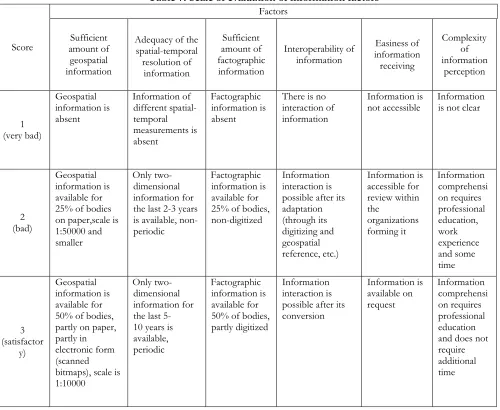
Information, as a set of any findings, data, facts and characteristics regarding relevant phenomena, processes, relationships and events, collected and organized into a usable form, composes the basis of public administration. Therefore, the group of information factors is examined in more detail.
The sufficient amount of geospatial information was estimated by the following factors as: the proportion of water bodies for which such information is available; scale of geospatial information; media type - paper, electronic (raster or vector format). Similarly, the sufficient amount of fact graphic information was considered, depending on the number of objects for which it is present and its availability in digital form.
The adequacy of the spatial-temporal resolution of information depends on the number of its measurements (2D and 3D), the time slice it covers, and the frequency of its receipt.
Interoperability of information is an indicator characterizing the ability of information to interact in the environment of other geoinformation systems.
The easiness of information receiving depends on how complicated the process of information entry from organizations, which create it, is. The complexity of information perception shows how it is easy for a person making the decision to understand its content (Table 7).
Table 7. Scale of evaluation of information factors
Score Factors Sufficient amount of geospatial information
Adequacy of the spatial-temporal resolution of information Sufficient amount of factographic information Interoperability of information Easiness of information receiving Complexity of information perception 1 (very bad) Geospatial information is absent Information of different spatial-temporal measurements is absent Factographic information is absent
There is no interaction of information
Information is
not accessible Information is not clear
2 (bad)
Geospatial information is available for 25% of bodies on paper,scale is 1:50000 and smaller
Only two-dimensional information for the last 2-3 years is available, non-periodic
Factographic information is available for 25% of bodies, non-digitized
Information interaction is possible after its adaptation (through its digitizing and geospatial reference, etc.) Information is accessible for review within the organizations forming it Information comprehensi on requires professional education, work experience and some time 3 (satisfactor y) Geospatial information is available for 50% of bodies, partly on paper, partly in electronic form (scanned bitmaps), scale is 1:10000
Only two-dimensional information for the last 5-10 years is available, periodic
Factographic information is available for 50% of bodies, partly digitized
4 (good)
Geospatial information is available for 75% of bodies, partly in electronic form (scanned bitmaps), partly – digital maps (GIS), scale is 1:2000
Two-dimensional information with elements of
three-dimensional one (bathymetry) for the last 10-20 years is available, periodic
Factographic information is available for 75% of bodies, at least 50% of information is digitized
Information in common universal formats, can be easily integrated into other system at the national level
The most significant information for decision making is on open access
Information comprehensi on requires some preparation
5 (very good)
Geospatial information is available for 100% of bodies, in digital maps (GIS), scale is 1:500
Two-dimensional and three-dimensional information for the last 25-50 years is available, periodic
Factographic information is available for 100% of bodies, digitized and integrated into GIS
Information in common universal formats, can easily interact, is integrated into NSDI*
All
information is on open access
Information is
comprehensi ve without prior preparation
* NSDIis National Spatial Data Infrastructure 4. Ranking of expert evaluations of factors
Having estimated the factors on the above scales, it is necessary to obtain the value of the aggregate demonstration of factors within each group. This task requires determining the significance of each factor. To obtain the values of the ratio of the factors, the method of ranking of expert evaluations was used.
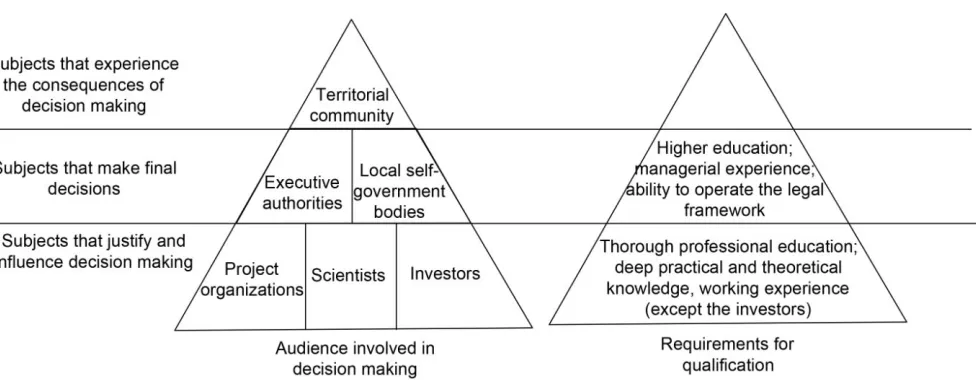
Considering the participation in decision implementation regarding the use of water bodies, all subjects involved in the process were grouped into three categories:
1) subjects that justify and influence decision making; 2) subjects that make final decisions;
3) subjects that experience the consequences of decision making (Fig. 2).
Fig. 2. Structural model of the audience involved in decision making regarding the use of water bodies
Thus, if the source information used for developing such documentation is insufficient and inaccurate, the decision will have negative consequences. In view of this, certain requirements for professional education and practical work experience are given to scientists and representatives of project organizations. Investors can influence decision making regarding the use of water bodies in order to improve their investment efficiency.
Executive authorities and local self-government bodies make final decisions regarding the use of water bodies based on scientific research and the measures proposed in the project documentation. In light of this, it can be argued that the basis for the decision making is the required set of factographic and geospatial information about the water body. There are also certain requirements to the representatives of this category of participants as to the experts – they must have higher education, some managerial experience and be able to operate the legal framework.
For the purpose of expert evaluation of the factors, all the mentioned categories of participants were questioned. A total of 107 experts from the executive authorities, local self-government bodies, project organizations, scientists and investors were involved. The selection of experts (except the investors) was made taking into account the requirements for their qualification, namely: higher education and experience in any field of water management, projecting or management, including water bodies for at least 5 years. The experts were tasked with estimating the factors within each group and comparing the groups with each other in terms of priority. In order to achieve homogeneity of the sample, it included survey data from 100 experts, with 20 representatives from each group. The questionnaire was drawn up considering the need for three-dimensional information for decision making regarding water bodies.
According to the survey, the most significant in decision making regarding the use of water bodies is the group of information factors. In this group, the most important is the availability of sufficient amount of geospatial information, second place is the availability of sufficient amount of fact graphic information and the ease of its obtaining. Instead, according to expert opinion, interoperability of information is the least important
5. Integral estimation of the efficiency of decision making regarding the use of water bodies
To perform integral estimation of the efficiency of decision making considering all the factors studied, an algorithm consisting of three steps is proposed:
1) evaluation of aggregate demonstration of factors within each group; 2) normalization of evaluations of aggregate demonstration of factors;
3) determination of integral estimation of the efficiency of decision making regarding the use of water bodies. At the stage I, the aggregate demonstration of the factors within each group was estimated by calculating the ratio of the value of a particular indicator to its arithmetic mean weighted by the formula 1):
k k k av
b
b
O
O
(1)where
O
avis the average score of thek
-factor; kO
- score of thek
-factor; kb
- ratio of thek
-factor.As the factors are represented by qualitative and quantitative indicators, their value were reduced to a unified qualitative scale of ordinal type. In view of this, the conditional value (estimation) of each factork1,k2,...,kn, involved in the formulation of an interdisciplinary task must have natural numerical values, that is i1,2,...,m. In
the proposed approach, the factors were evaluated from the lowest (worst) value mmin 1to the highest (best) 5
max
m .
Based on the data of expert evaluation, through ranking, the ratio of each factor
b
kis calculated by the formula (2) (Petrunya I. I. et.al., 2011):k k
k
R
R
b
/
(2)The sum of the ratios for the factors of one group should be equal to 1.00, since the individual ratio of each factor characterizes the contribution of this factor to the overall (100%) value of the priority level of the whole group. Thus, formula (1) is transformed as follows (3):
k kav
O
b
O
(3)At the stage II, the estimation of demonstration of each group of factors was subject to further normalization (4):
av k N
O
O
Q
(4)whereQNis normalized estimate ofN-group of factors, including
Q
inf,Q
tech, Qecon,Q
ecol,Q
jur,Q
inst, socQ
;
Ok - the product of k-factor scores;сер
O - average score of k-factor of the corresponding group.
At stage III, an integral estimation of the efficiency of decision making regarding the use of the water body
Q
was determined. For this purpose, a multi-product model of the Cobb-Douglas type function was used, which is a homogeneous first-order linear function of the aggregate estimates of each of the groups of factors (5) (Pogreschuk, Lysyuk, 2010). For our purposes, it was decided to use the Cobb-Douglas function in logarithmic form:jur soc
inst ecol
econ
tech
Q
Q
Q
Q
Q
Q
Q
Q
ln
inf
ln
ln
ln
ln
ln
ln
(5)where
Q
is the integral estimation of the efficiency of decision making regarding the use of the water body; infQ
- normalized estimate of the group of information factors; techQ
- normalized estimate of the group of technology factors; econQ - normalized estimate of the group of economic factors; ecol
Q
- normalized estimate of the group of environmental factors; instQ
- normalized estimate of the group of institutional factors; socQ
- normalized estimate of the group of social factors; jurQ
- normalized estimate of the group of legal factors;ln
- natural logarithm;
, , , , , , - the ratio of each of the groups of factors in forming an integral estimation of the efficiency of decision making; the sum of the weights should be 1.00.
Using the values of the ratio of the groups of factors obtained as a result of the questionnaire, formula (5) takes the form (6):
jur soc
inst ecol
econ
tech
Q
Q
Q
Q
Q
Q
Q
Q
0
,
22
inf
0
,
17
0
,
12
0
,
14
0
,
14
0
,
08
0
,
13
(6)Proposed approach allows to evaluate the efficiency of the decisions already implemented and forecast the result of future ones (Petrakovska, Dubnytska, 2018).
6. Conclusions
Under the results of the research focused on structuring and evaluation of the factor significance that affect the efficiency of decision making regarding the use of water bodies, the following conclusions were made as
1. The set of factors that determine the efficiency of water body use includes seven aggregated thematic groups: information, technology, environmental, economic, legal, institutional and social.
Involving the subjects of the first and second groups to evaluate the efficiency of decision making allows to obtain reliable and objective results of ranking of factors evaluations.
3. Expert estimation of different groups of factors demonstrate that the most significant are information factors, among which the provision of geospatial information is of particular importance.
4. The algorithm of integral estimation of the efficiency of decision making regarding the use of water bodies based on the Cobb-Douglas logarithmic function allows to evaluate the efficiency of the implemented decisions and to forecast the result of future ones.
References
Charnes, A., Cooper, W. W., Rhodes, E. (1978). Measuring the efficiency of decision making units. European Journal of Operational Research, Vol. 2 (6), 429-444.
Choo, C. W. (2002). Information management for the intelligent organization: The Art of Scanning the Environment. (3rd ed.) Metford, New Jersey: Information Today.
Institute of Medicine. 2013. Environmental Decisions in the Face of Uncertainty. Washington, DC: The National Academies Press, (Chapter 3).
Klovienė, Lina, (2012). Institutional factors as criteria for business environment identification. Economics and management, 17 (4), 1245-1251.
Magwair B. et al. (2016). Introduction to geoinformation systems for spatial data infrastructure. Tutorial. Kharkiv: Planet Print. 396.
Nogin, V. D. (2005). Decision making in a multicriteria environment: a quantitative approach. Moscow: FIZMATLIT. 176.
Pedrazzini, F. (2011). Water resources and environmental quality as factors affecting the dynamic and the security of populations. Fifteenth International Water Technology Conference, IWTC-15, Alexandria, Egypt. [Online] Available: https://pdfs.semanticscholar.org/fb1b/4f406c9cce8b62f50e37eb1771b0cb438c7b.pdf (August 19, 2019).
Petrakovska, O. S., Dubnytska, M. V. (2018). Evaluation of Factors Affecting the Efficiency of Managerial Decisions Regarding the Use of Water Objects. Urban and territorial planning. Kyiv, KNUCA, 67, 369-376.
Petrunya I. I. et.al. (2011). Management decisions. Kyiv, Center for Educational Literature, 216. Pogreschuk, B. V., Lysyuk, O. M. (2010). Economic and mathematical modeling. Ternopil, Krok, 372. Stoter, J. E. 3D Cadastre: PhD thesis. Delft, Netherlands Geodetic Commission, 2004, 344.
Thompson, Stephen A., (1998). Water Use Management, and Planning in the United States. (1st ed.). New York: Academic Press, (Chapter 6).
Visnja, I., Jovičić, J., Arsovski, S., Živković-Drezgić, M., Badjok, D. (2016). Economic Factors Affecting Business Decision Making. International Conference on Applied Internet and Information Technologies, 396-403. Wozniak, Krzysztof, (2019), Legal factors affecting business. [Online] Available:
https://ceopedia.org/index.php/Legal_factors_affecting_business (August 19, 2019). Wozniak, Krzysztof, (2019), Social and cultural factors affecting business. [Online] Available: