R E S E A R C H A R T I C L E
Open Access
Development and implementation of a
mini-Clinical Evaluation Exercise (mini-CEX)
program to assess the clinical competencies of
internal medicine residents: from faculty
development to curriculum evaluation
Kuo-Chen Liao
1*, Shou-Jin Pu
1, Maw-Sen Liu
1, Chih-Wei Yang
2and Han-Pin Kuo
3Abstract
Background:The mini-CEX is a valid and reliable method to assess the clinical competencies of trainees. Its data could be useful for educators to redesign curriculum as a process of quality improvement. The aim of this study was to evaluate a mini-CEX assessment program in our internal medicine residency training. We investigated the impact of mini-CEX workshops as a faculty development program on the acquisition of cognitive knowledge and the difference of practice behaviors among faculty members used the mini-CEX to assess residents’performance at work.
Methods:We designed an observational, two-phase study. In the faculty development program, we started a mini-CEX workshop for trainers in 2010, and the short-term outcome of the program was evaluated by comparing the pretest and posttest results to demonstrate the improvement in cognitive knowledge on mini-CEX. From September 2010 to August 2011, we implemented a monthly mini-CEX assessment program in our internal medicine residency training. The data of these mini-CEX assessment forms were collected and analyzed.
Results:In the group of 49 mini-CEX workshop attendees, there was a statistically significant improvement in cognitive knowledge by comparing the pretest and posttest results (67.35 ± 15.25 versus 81.22 ± 10.34,p< 0.001). Among the 863 clinical encounters of mini-CEX, which involved 97 residents and 139 evaluators, 229 (26.5%), 326 (37.8%), and 308 (35.7%) evaluations were completed by the first-year, second-year, and third- year residents separately. We found a statistically significant interaction between level of training and score in dimensions of mini-CEX. The scores in all dimensions measured were better for senior residents. Participation in mini-CEX workshops as a faculty development program strengthened the adherence of trainers to the principles of mini-CEX as a formative assessment in regard to provision of feedback. However, a deficiency in engaging residents’reflection was found.
Conclusions:Faculty development is a prerequisite to train evaluators in order to implement a successful mini-CEX assessment program. We demonstrated the effectiveness of our mini-CEX workshops in terms of knowledge acquisition and enhancement of giving feedback when the faculty members used the tool. Further programs on providing effective feedback should be conducted to increase the impact of the mini-CEX as a formative assessment.
Keywords:Mini-CEX, Mini clinical evaluation exercise, Faculty development
* Correspondence:[email protected]
1Division of General Medicine and Geriatrics, Department of Internal
Medicine, Chang Gung Memorial Hospital, Chang Gung University, College of Medicine, 5 Fusing street, Gueishan, Taoyuan 333, Taiwan
Full list of author information is available at the end of the article
Background
Training competent physicians to improve the quality of health care and to meet societal expectations are the pri-mary goals of current medical education [1]. It has been asserted that educators should design a competency-based training program guided by the principles and structures of outcome-based education [2]. In 1998, the Accreditation Council of Graduate Medical Education (ACGME) began an initiative, called the Outcome Pro-ject, which fostered residency training with a focus on development and assessment of the six competencies, including medical knowledge, patient care, interpersonal and communication skills, systems-based practice, pro-fessionalism, and practice-based learning and improve-ment [3]. Among the assessimprove-ment tools targeted on various competencies evolving for years, the direct observation at workplace has played an important role in the process of these educational reforms [4,5]. In addition to serving as the guidance for feedback on learners’ performance, the results of various assessments could be useful for educators to modify their training programs as a process of quality improvement [6,7].
The American Board of Internal Medicine (ABIM) developed a quality assessment tool, the mini-Clinical Evaluation Exercise (mini-CEX), which has been applied internationally to assess the clinical competencies of trainees at different subspecialties in a wide variety of clin-ical settings [8-11]. For each mini-CEX encounter, one evaluator observes the resident conduct a focused inter-view, physical examination, or therapeutic counseling at a selected workplace, followed by provision of immediate feedback and completion of the rating form. With its fea-ture to provide feedback following a clinical assessment, the mini-CEX also serves as a formative method to guide trainees’ professional development. Previous research on the mini-CEX focused on its validity, reliability, and feasi-bility to assess the clinical skills of residents, and the edu-cational impact of effective feedback to foster their future learning and improvement [12-14].
Since 2006, the Taiwan Association of Medical Educa-tion (TAME) facilitated several medical centers to estab-lish the “General Medicine Training Demonstration Center” with support from the Department of Health, aiming to promote the postgraduate training and pro-vide a holistic patient-centered quality care in Taiwan. An additional project named “The Faculty Development Program for Postgraduate Training”started in 2009 with objectives to equip the clinical teachers with the capabil-ities of teaching and assessing the ACGME six compe-tencies of trainees [15]. Our hospital was one of the certified institutions to implement both “General Medi-cine Training Demonstration Center” and “The Facul-ty Development Program for Postgraduate Training” projects. We conducted a two-hour mini-CEX workshop
to train these clinical teachers to acquire the cognitive knowledge on mini-CEX and its clinical applications. In September 2010, we proposed a monthly mini-CEX as-sessment program to the Department of Internal Medi-cine and each resident was required to be assessed during the course of training.
The aim of this study was to evaluate a mini-CEX as-sessment program in our internal medicine residency training. We specifically investigated the impact of mini-CEX workshops as a faculty development program on the acquisition of cognitive knowledge and the difference of practice behaviors among evaluators used the mini-CEX to assess residents’performance at work.
Methods Study design
We designed this observational, two-phase study to evalu-ate a mini-CEX assessment program in our internal medi-cine residency training by reporting on the outcomes of mini-CEX workshops as a faculty development program and identifying potential opportunities for curricular im-provement. Ethical approval was obtained from the Insti-tutional Review Board of Chang Gung Memorial Hospital.
The faculty development program
We organized a two-hour mini-CEX workshop as one of the assessment curricula within the project of Faculty Development Program of Postgraduate Training. The workshop comprising a pretest, mini-lecture, video-clip rating exercise, small group discussion, and a posttest. A multiple-choice-question test on mini-CEX was designed as the pretest and posttest (Additional file 1). Its contents included the cognitive knowledge on assessment of clin-ical competence, the application of the mini-CEX as a workplace-based assessment tool, and the principles of providing effective feedback. Improvement in cognitive knowledge was assessed by comparing the results between the pretest and posttest. A total of 49 participants attended the mini-CEX workshops were enrolled.
The monthly mini-CEX assessment program
mini-CEX program, we provided a grand round didactic lecture titled“The mini-CEX as a workplace-based assess-ment”for all the residents and faculty members of internal medicine, addressing the issues of in-training evaluation and the procedural aspects of the mini-CEX as a formative assessment. The faculty members were asked to assess residents’performance monthly and handed the completed mini-CEX assessment forms to the office of Internal Medi-cine for statistical analysis.
Feedback analysis
To exam the quality of feedback, two authors (K.C.L. and S.J.P.) reviewed the assessment forms gathered and classified the contents of feedback and reflection. We found that several contents of the written feedback were not easy to be categorized into the dimensions measured by the mini-CEX. That is, most evaluators provided and documented comments in a more customary way rather than organized feedback according to the order of the competencies measured on the mini-CEX form. Similar findings have been described in literature [16]. In order to demonstrate authenticity and avoid misinterpreta-tion, we decided to categorize the contents of written feedback into five specific aspects after discussion, in-cluding history taking, physical examination, counseling and communication skills, attitudes/professionalism, and clinical reasoning. Previous literature also addressed that engagement of resident’s reflection by evaluators was regarded as an indicator of effective feedback [17]. The contents of reflection were conventionally grouped into medical knowledge, clinical skills, and attitude/profes-sionalism (Additional file 2).
Statistical analysis
The continuous variables were expressed as means and standard deviations and compared using Student’st-tests. The categorical variables were summarized as proportions and compared using Chi-square tests or Fisher’s exact tests. Ap-value of less than 0.05 was taken as statistically significant. A repeated measures analysis of variance (RM-ANOVA) was conducted to evaluate the interaction between the score in dimensions of mini-CEX (within-subjects factor) and level of training (between-(within-subjects factor). All data were analyzed using the Statistical Pack-age for the Social Sciences (SPSS) 17.0 for Windows. (Chicago, IL, USA).
Results
The mini-CEX workshops as a faculty development program
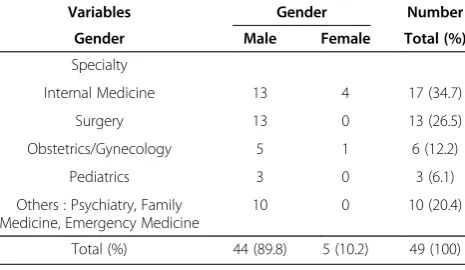
In 2010, a total of 67 trainers of different subspecialties joined our program. Table 1 shows descriptive statistics for 49 trainers attended the mini-CEX workshops. There were 5 (10.2%) female and 44 (89.8%) male trainers,
including 17 internists, 13 surgeons, 6 obstetricians/ gynecologists, 3 pediatricians, and 10 of other specialties (family medicine, emergency medicine, and psychiatry). The mean scores of pretest and posttest were 67.35 ± 15.25 and 81.22 ± 10.34, respectively. Improvement in cog-nitive knowledge was statistically significant (p< 0.001 ).
The monthly mini-CEX assessment program
From September 2010 to August 2011, the data of monthly mini-CEX of internal medicine residents were collected and analyzed, which composed of 863 clinical encounters involving 97 residents and 139 evaluators. Every resident received a mean number of 8.9 mini-CEX assessments (standard deviation 4.2; range 1-20), while every evaluator completed a mean number of 6.2 assess-ment forms (standard deviation 6.2; range 1-38). Among these 863 clinical encounters, 229 (26.5%) assessment forms were completed by the first-year residents, 326 (37.8%) by the second-year residents, and 308 (35.7%) by the third-year residents, while 402 (46.6%) encounters were assessed by chief residents and 461 (53.4%) en-counters assessed by attending physicians. The type of visit was mainly new patient interview (45.8%), and most encounters occurred at inpatient wards (92.9%) and were regarded as moderate in complexity (78.7%) for the mini-CEX assessment. These encounters were focused chiefly on clinical judgment (75.4%), diagnosis and treat-ment (71.6%), and data collection (54.1%). Both residents and evaluators were satisfied with the mini-CEX assess-ment. The descriptive data are shown in Table 2. Add-itionally, in Table 3, we found a statistically significant interaction between the level of training and score in dimensions of mini-CEX. A hypothesis that the level of training would affect performance was significant; the scores in all dimensions of mini-CEX measured were better for senior residents.
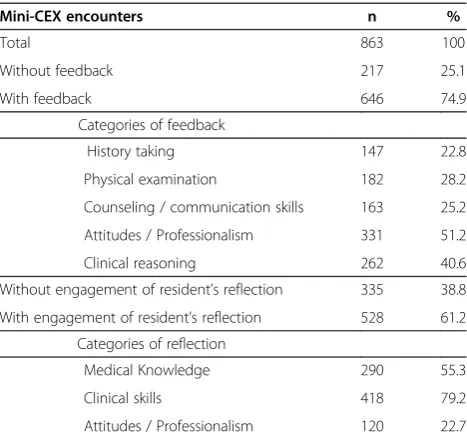
We reviewed the feedback of the collected mini-CEX as-sessment forms and studied their characteristics. Among the 863 mini-CEX encounters, 74.9% were regarded as providing proper feedback. In these mini-CEX assessment Table 1 Descriptive statistics for 49 trainers attended the mini-CEX workshops in 2010
Variables Gender Number
Gender Male Female Total (%)
Specialty
Internal Medicine 13 4 17 (34.7)
Surgery 13 0 13 (26.5)
Obstetrics/Gynecology 5 1 6 (12.2)
Pediatrics 3 0 3 (6.1)
Others : Psychiatry, Family Medicine, Emergency Medicine
10 0 10 (20.4)
forms with feedback, 61.2% evaluators engaged resident’s reflection, which mainly addressed on medical knowledge (55.3%) and clinical skills (79.2%), but less frequently on attitudes/ professionalism (22.7%) as shown in Table 4.
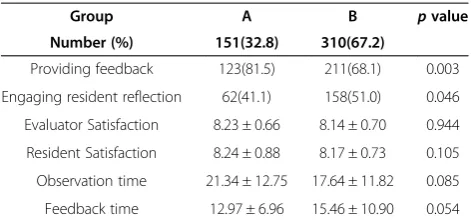
In Table 5, we compared the provision of feedback, engagement of resident’s reflection, satisfaction with mini-CEX, and total time spent on mini-CEX between attending physician evaluators with and without partici-pation in mini-CEX workshops as a faculty development program. The attendees of mini-CEX workshops tended to provide feedback to residents (p= 0.003), but less frequently engaged resident’s reflection (p= 0.045). We found no differences in satisfaction with mini-CEX and the total time spent either on observation or feedback between the two groups.
Discussion
To increase the impact of the mini-CEX as a formative assessment, a faculty development program or rater Table 2 Descriptive statistics in the mini-CEX assessment
forms collected from September 2010 to August 2011
Variable Category Number (%)
Trainee Total 863(100)
R1 229(26.5)
R2 326(37.8)
R3 308(35.7)
Evaluator CR/Fellow 402(46.6)
Attending physician 461(53.4)
Type of visit New patient 395(45.8)
Follow up patient 273(31.6)
Missing 195(22.6)
Setting Ambulatory 32(3.7)
Inpatient 796(92.2)
Missing 35(4.1)
Complexity Low 21(2.4)
Moderate 679(78.7)
High 92(10.7)
Missing 71(8.2)
Focus of evaluation Data collection 467(54.1)
Clinical judgment 651(75.4)
Diagnosis/treatment 618(71.6)
Counseling/education 373(43.2)
Missing 124(14.4)
Satisfaction By resident Mean ± SD
Total 7.96(0.9)
R1 7.84(0.9)
R2 7.97(0.9)
R3 8.04(0.9)
Satisfaction By evaluator
Total 7.98(0.8)
CR /Fellow 7.87(0.9)
Attending physician (workshop attendees)
8.07(0.7)
Attending physician (non- workshop attendees)
8.08(0.7)
Observation time R1 16.88(8.7)
R2 19.18(10.5)
R3 20.29(10.9)
Feedback time R1 12.88(9.5)
R2 14.99(11.9)
R3 13.64(8.7)
SD, standard deviation; R1: first- year resident; R2: second-year resident; R3: third-year resident; CR: chief resident.
Table 3 Evaluation of the interaction between level of training and score in dimensions of mini-CEX by repeated measures analysis of variance (RM-ANOVA)
Source Sum of
squares
d.f. Mean
square F
-value p-value
Level of training 113.270 2 56.635 13.382* .000
Score in dimensions of mini-CEX
33.810 5.566 6.075 29.153* .000
Level of training x Dimensions of mini-CEX
8.161 11.132 0.733 3.518* .000
Error
Between subjects 3457.727 817 4.232
Residual Error 947.520 4547.337 0.208
*the level of significance was set at 0.05; d.f.: degree of freedom.
Table 4 Categories of feedback and reflection in the mini-CEX assessment
Mini-CEX encounters n %
Total 863 100
Without feedback 217 25.1
With feedback 646 74.9
Categories of feedback
History taking 147 22.8
Physical examination 182 28.2
Counseling / communication skills 163 25.2
Attitudes / Professionalism 331 51.2
Clinical reasoning 262 40.6
Without engagement of resident’s reflection 335 38.8
With engagement of resident’s reflection 528 61.2
Categories of reflection
Medical Knowledge 290 55.3
Clinical skills 418 79.2
training program plays an important role. A variety of fac-ulty development programs have been designed and im-plemented successfully in worldwide institutions [18-20]. It is also the obligations of educators to choose proper assess-ment methods to evaluate the outcomes of education linking with the objectives and goals of their curricula. In our study, even though we successfully demonstrated the short-term outcome of mini-CEX workshops as a faculty development program by an improvement in cognitive knowledge, we still questioned the sustainability of these gains and effects on trainers’practice behaviors of teaching at workplaces. Analyzing the collected data of mini-CEX, we found that the evaluators with participation in the faculty development program tended to adhere to the principles of mini-CEX as a formative assessment by pro-viding feedback to trainees more frequently. These results indirectly demonstrated the sustained impact of our faculty development program. However, there was a deficiency in engaging trainee’s reflection found in the group of work-shop attendees. According to Archer’s model for effective feedback [21], which addressed self-monitoring (reflection on action) supported by external feedback and linkage with personal goals (action plan) in a coherent process, the result in our study points out future improvement for faculty de-velopment program through the process of curriculum evaluation.
We achieved the goal to assess residents’performance confronting with patients of different complexities under various circumstances in our monthly mini-CEX assess-ment program. These mini-CEX results were regarded as components of a continuous learning curve for each resident and offered a clear guidance for both residents and educators to bring about personal and curricular improvement. In the meanwhile, the assessment process provided an interaction between residents and evaluators, either in communicating contents of feedback and future improvement strategies with each other, or in evaluators’ role-modeling approaches to patients during or after the exercise as a teaching method [22]. A previous qualitative study showed that the residents perceived the mini-CEX
as anxiety-provoking because of its dual roles of assess-ment and education [23]. To impleassess-ment a faculty develop-ment and longitudinal assessdevelop-ment program throughout the continuum of education, recruiting both residents and educators could be a solution to relieve mutual ten-sions and assume a constructive attitude toward clinical assessments [14].
Our study also demonstrated that the mini-CEX was a feasible tool to evaluate professional development of residents since level of training was significantly attributed to higher scores in all dimensions measured. When used alone, the mini-CEX may be insufficient to reflect trainees’ mastery of each competency. Previous studies showed the validity of the mini-CEX was supported by the strong correlations in scores between the mini-CEX and other assessments [5,24]. Residents’ performance mature grad-ually at each level and their learning should be facilitated by means of providing effective feedback at each teachable moment. Compared with the results in feedback analysis, attitude/professionalism was the commonest category of feedback; on the contrary, this was the least frequent cat-egory of resident’s reflection in our study. Formative as-sessment as the mini-CEX has its strength in real-time observation on a trainee’s attitude toward patients during encounters at different workplaces. To maximize the ef-fect of feedback, we must nurture trainee reflection-in-action rather than a trainer-driven, but a two-way process in which trainers provide comments and at the same time encourage trainees to self-reflect on their performance [21]. The cultivation of professionalism in residency pro-gram requires organizational approaches since the social and educational environments of training institutions have a profound influence on the hidden curriculum. It has been challenging to demonstrate this competency learnt and internalized by residents even though there are evolv-ing assessment tools specifically focusevolv-ing on profes-sionalism [25-27]. The mini-CEX was a practical tool for evaluators to observe contexts of professionalism ex-pressed in a resident’s interaction with patients. Promoting a culture of professionalism and providing opportunities for self-reflection must be built into our current program to foster both cognitive and behavioral changes [28].
Although more of the participants attending our mini-CEX workshops provided recommendations as feedback, those without participation spent more time giving feed-back and engaged residents’reflection more often. Further qualitative studies should be conducted to investigate this contradictory finding, such as the perceptions from evaluators and trainees, specificity of feedback contents, and process of delivering feedback. Provision of feedback from the evaluators to residents after observing resident-patient interaction is a complex and dynamic process and is influenced by many variables, including faculty members’ tensions in balancing positive and negative Table 5 Comparison of mini-CEX encounters assessed by
different evaluators
Group A B pvalue
Number (%) 151(32.8) 310(67.2)
Providing feedback 123(81.5) 211(68.1) 0.003
Engaging resident reflection 62(41.1) 158(51.0) 0.046
Evaluator Satisfaction 8.23 ± 0.66 8.14 ± 0.70 0.944
Resident Satisfaction 8.24 ± 0.88 8.17 ± 0.73 0.105
Observation time 21.34 ± 12.75 17.64 ± 11.82 0.085
Feedback time 12.97 ± 6.96 15.46 ± 10.90 0.054
feedback, their own perceived self-efficacy, their per-ceptions of the resident’s insight, skill, and potential, the faculty member-resident relationship and contextual factors [16]. Interventions like workshops on provision of effective feedback or modification of the assessment in-strument could be considered in future programs to facili-tate interactive and high-quality feedback in the mini-CEX [17,29].
Our study has several limitations. First, this was a sin-gle specialty and institution study and the results could not be generalizable to residents in other settings or contexts. The institutional environment is an important determinant for implementing a long-term formative as-sessment program and developing support of a feedback culture. Second, the retrospective analysis on the written feedback might preclude the actual feedback contents and also lead to underestimation of feedback quantity. An approach of video-taped sessions in the mini-CEX might be an alternative method to overcome this limita-tion. Nevertheless, videotaping is both time and labor-consuming and even difficult to conduct in a long-term continuous assessment program. Third, when considering workshop effectiveness, the faculty should be evaluated using models that evaluate their ability as raters, such as generalizability analysis or variance components analysis. These statistical models would be helpful to determine how much variance in scores is due to the raters. The multiple-choice-question pretest/ posttest we used in the study could only demonstrate the short-term outcome of mini-CEX workshops in knowledge acquisition. Finally, a substantial amount of missing data in each mini-CEX as-sessment form would bias the interpretation of our results.
Conclusion
We demonstrated the outcomes of mini-CEX workshops as a faculty development program by providing the evi-dence of improvement in cognitive knowledge and its sustained impact on the practice behaviors of workshop attendees when they used mini-CEX to assess residents’ performance in terms of providing feedback. Using the data from the mini-CEX assessment program, we also demonstrated the feasibility of this instrument to moni-tor the professional development of internal medicine residents. Future faculty development program specifically on giving effective feedback should be provided to facilitate residents’learning as a process of quality improvement.
Consent
This study was approved by the ethical review board of Chang Gung Memorial Hospital. The faculty members and residents of internal medicine were informed of the purpose of the study and assured of confidentiality. Written informed consents were obtained from the participants enrolled for publication of this report.
Additional files
Additional file 1:Mini-CEX pre/posttest.
Additional file 2:Categorization of evaluator’s feedback in feedback analysis.
Competing interests
The authors declare that they have no competing interests.
Authors’contributions
KCL designed the mini-CEX written test, conducted the mini-CEX workshop, and served as the mini-CEX grand round lecturer. KCL and SJP developed the design of this study and were responsible for data collection, statistical analysis, and manuscript drafting. MSL, CWY, HPK contributed to the interpretation of data and feedback on the manuscript. All authors read and approved the final manuscript.
Acknowledgments
This work was supported in part by an educational grant from the Department of Health in Taiwan (099-VMRPG39004). Part of the results in this project (The monthly mini-CEX assessment program) was drafted in a poster and displayed at the AMEE Annual Meeting in Lyon, France, 25-29 August 2012.
Author details
1Division of General Medicine and Geriatrics, Department of Internal
Medicine, Chang Gung Memorial Hospital, Chang Gung University, College of Medicine, 5 Fusing street, Gueishan, Taoyuan 333, Taiwan.2Division of
Nephrology, Department of Internal Medicine, Chang Gung Memorial Hospital, Chang Gung University, College of Medicine, Taoyuan, Taiwan.
3Division of Thoracic Medicine, Department of Internal Medicine, Chang
Gung Memorial Hospital, Chang Gung University, College of Medicine, Taoyuan, Taiwan.
Received: 26 May 2012 Accepted: 20 February 2013 Published: 26 February 2013
References
1. Frank JR, Danoff D:The CanMEDS initiative: implementing an outcomes-based framework of physician competencies.Med Teach2007,29(7):642–647. 2. Harden RM:Outcome-Based Education: the future is today.Med Teach
2007,29(7):625–629.
3. Swing SR:The ACGME outcome project: retrospective and prospective.
Med Teach2007,29(7):648–654.
4. Kogan JR, Holmboe ES, Hauer KE:Tools for direct observation and assessment of clinical skills of medical trainees: a systematic review.
JAMA2009,302(12):1316–1326.
5. Pelgrim EA, Kramer AW, Mokkink HG, van den Elsen L, Grol RP, van der Vleuten CP:In-training assessment using direct observation of single-patient encounters: a literature review.Adv Health Sci Educ Theory Pract 2011,16(1):131–142.
6. Gozu A, Windish DM, Knight AM, Thomas PA, Bass EB, Kern DE:Long term impact of a longitudinal faculty program in curriculum development: A case control study.J Gen Intern Med2006,21:81–81.
7. Gozu A, Windish DM, Knight AM, Thomas PA, Kolodner K, Bass EB, Sisson SD, Kern DE:Long-term follow-up of a 10-month programme in curriculum development for medical educators: a cohort study.Med Educ 2008,42(7):684–692.
8. Norcini JJ, Blank LL, Arnold GK, Kimball HR:The mini-CEX (clinical evaluation exercise): a preliminary investigation.Ann Intern Med1995,
123(10):795–799.
9. Norcini JJ, Blank LL, Duffy FD, Fortna GS:The mini-CEX: a method for assessing clinical skills.Ann Intern Med2003,138(6):476–481.
10. Kogan JR, Bellini LM, Shea JA:Implementation of the mini-CEX to evaluate medical students’clinical skills.Acad Med2002,77(11):1156–1157. 11. Weller JM, Jolly B, Misur MP, Merry AF, Jones A, Crossley JG, Pedersen K,
12. Cook DA, Beckman TJ, Mandrekar JN, Pankratz VS:Internal structure of mini-CEX scores for internal medicine residents: factor analysis and generalizability.Adv Health Sci Educ Theory Pract2010,15(5):633–645. 13. Singh T, Sharma M:Mini-clinical examination (CEX) as a tool for formative
assessment.Natl Med J India2010,23(2):100–102.
14. Sidhu RS, Hatala R, Barron S, Broudo M, Pachev G, Page G:Reliability and acceptance of the mini-clinical evaluation exercise as a performance assessment of practicing physicians.Acad Med2009,84(10 Suppl):S113–S115. 15. Lee FY, Yang YY, Hsu HC, Chuang CL, Lee WS, Chang CC, Huang CC, Chen
JW, Cheng HM, Jap TS:Clinical instructors’perception of a faculty development programme promoting postgraduate year-1 (PGY1) residents’ACGME six core competencies: a 2-year study.BMJ open2011,
1(2):e000200.
16. Kogan JR, Conforti LN, Bernabeo EC, Durning SJ, Hauer KE, Holmboe ES:
Faculty staff perceptions of feedback to residents after direct observation of clinical skills.Med Educ2012,46(2):201–215.
17. Holmboe ES, Yepes M, Williams F, Huot SJ:Feedback and the mini clinical evaluation exercise.J Gen Intern Med2004,19(5 Pt 2):558–561.
18. Cole KA, Barker LR, Kolodner K, Williamson P, Wright SM, Kern DE:Faculty development in teaching skills: an intensive longitudinal model.Acad Med2004,79(5):469–480.
19. Steinert Y, Mann K, Centeno A, Dolmans D, Spencer J, Gelula M, Prideaux D:
A systematic review of faculty development initiatives designed to improve teaching effectiveness in medical education: BEME Guide No. 8.
Med Teach2006,28(6):497–526.
20. Skeff KM, Stratos GA, Bergen MR, Regula DP Jr:A pilot study of faculty development for basic science teachers.Acad Med1998,73(6):701–704. 21. Archer JC:State of the science in health professional education: effective
feedback.Med Educ2010,44(1):101–108.
22. Weller JM, Jones A, Merry AF, Jolly B, Saunders D:Investigation of trainee and specialist reactions to the mini-Clinical Evaluation Exercise in anaesthesia: implications for implementation.Br J Anaesth2009,
103(4):524–530.
23. Malhotra S, Hatala R, Courneya CA:Internal medicine residents’ perceptions of the Mini-Clinical Evaluation Exercise.Med Teach2008,
30(4):414–419.
24. Durning SJ, Cation LJ, Markert RJ, Pangaro LN:Assessing the reliability and validity of the mini-clinical evaluation exercise for internal medicine residency training.Acad Med2002,77(9):900–904.
25. Epstein RM, Hundert EM:Defining and assessing professional competence.JAMA2002,287(2):226–235.
26. Branch WT Jr:Use of critical incident reports in medical education A perspective.J general Intern Med2005,20(11):1063–1067.
27. Cruess R, McIlroy JH, Cruess S, Ginsburg S, Steinert Y:The Professionalism Mini-evaluation Exercise: a preliminary investigation.Acad Med2006,
81(10 Suppl):S74–S78.
28. Stern DT, Papadakis M:The developing physician–becoming a professional.N Engl J Med2006,355(17):1794–1799.
29. Fernando N, Cleland J, McKenzie H, Cassar K:Identifying the factors that determine feedback given to undergraduate medical students following formative mini-CEX assessments.Med Educ2008,42(1):89–95.
doi:10.1186/1472-6920-13-31
Cite this article as:Liaoet al.:Development and implementation of a mini-Clinical Evaluation Exercise (mini-CEX) program to assess the clinical competencies of internal medicine residents: from faculty development to curriculum evaluation.BMC Medical Education2013
13:31.
Submit your next manuscript to BioMed Central and take full advantage of:
• Convenient online submission
• Thorough peer review
• No space constraints or color figure charges
• Immediate publication on acceptance
• Inclusion in PubMed, CAS, Scopus and Google Scholar
• Research which is freely available for redistribution