www.ijaera.org 2017, IJA-ERA - All Rights Reserved 53
Performance Enhancement for Coexistence
Adaptive Interference Draining using
Rectangular Antenna’s for MUE’s
Nidhi Raman1*, Amanpreet Kaur 2 & Rohit Batra3
1Student, EECE Department, The North Cap University, Gurugram, India *Corresponding Author E-mail: [email protected]
2Assistant Professor, EECE Department, The North Cap University, Gurugram, India
E-mail: [email protected]
3Deputy General Manager, Networks, Airtel, Gurugram, India
E-mail: [email protected]
Abstract: In this research, the mobile network is designed with several layers of small and large cells in the heterogeneous network. This architecture is faced with the task of supply allocation (power, channel, time) for small cells in order to guarantee reliable and high-quality service to both primary (macro-cell) users as well as secondary (femtocell) users. Intra-tier femtocell interference is dealing with minimum mean squared error (MMSE) interference in Rectangular antennas that this proposed two-tier interference management approach improves the performance of the femtocell users in between multiple users, by maintaining the desirable quality of the communication channel for macro-cell users. In proposed scheme by using Rectangular patch, antenna will react as in multiple input multiple output band for femtocell user. The frequency sub bands which are presently not recycled within the macro-cell, so the process is based on FFR for assigning the frequency bands. The simulation results show that the proposed approach gain for macro-cell and small cell tiers, in terms of average Signal to noise improving up to 37.2 dB that is virtual to the non-cooperative case, which is for a network with 350 SBSs and 200 MUEs which is improvement in higher spectrum sensing for MUE’S.
Keywords: Degrees of freedom (DoF), interference alignment feasibility, and interference broadcast channel, multi-input–multioutput (MIMO), MUE, SUE, Rectangular Antenna, MMSE
I. INTRODUCTION
In the wireless communication network is to increase the capacity and coverage of existing cellular network. Mainly the interest is focused on increasing quality of service (QoS) and data rates for the indoor coverage/capacity, e.g., residential or enterprise companies, because according to recent surveys a considerable percentage of data services will going to take place indoor and nowadays, femtocells are used as a solution for that. It was also estimated that in 2012 there would be 70 million FAPs will be installed around the world and more than 150 million customers will be there. [10]
www.ijaera.org 2017, IJA-ERA - All Rights Reserved 54 Macrocell is intervened by the inter-cell and by using the FFR technique that will mitigate the
interference. The Femto cells apply the dissimilar sub-band to prevent interference from the macro-cell. Then that Sub-band will be reused in the coverage of macro-cell as much as possible.
In addition to detection of multiuser, joint design of transmitters and receivers [5] and transmit power control [4], [6] offers interference mitigation that is required in interference limited systems. Our approach does not involve explicit frequency partitioning between the tiers, i.e., relies solely on the greater flexibility, space dimensions, hence it is possible to have a frequency partitioning scheme which will increase the number of uplink users sharing each sub-band as well. Our methods assume cooperation amongst the femtocells within a cluster in a similar manner to cooperative multi-cell networks [17]. To both consumers and operators, the femto cell accompanies differing advantages, such as increased indoor coverage, improved system capacity, made operation expense, smaller expense and Quality of Service (QoS).
A. Interference Draining
Interference discussions often tend to focus on one-on-one interference; that is, one interferer transmitting RF power that causes interference to one victim. Examples include co-channel interference, adjacent channel interference, and blocking desensitization. Interference that is caused by more than one transmitter is referred to as many-on-one interference.
B. Macrocells & Femtocell
The femtocell architecture is much more different than existing cellular networks and thus, interaction on scenarios with coexistence of LTE Macrocells and Femtocells is one of the main issues for femtocell network deployment. First of all, as compared to external antenna Femto-cell have low antenna heights and then the customer has flexible choice of placement by incurring the problems such that a improperly placed Femto-cell can interfere with the rest of the network, and if needed it will provide the additional capacity. [9] Femto-cells are an element that has to be taken into account in future handover planning and network in order to mitigate their impact on existing networks because they have three different access methods to indicate which users are allowed and which are restricted to use femtocell .
C. Micro-strip Antennas
The macro-cell users with a minimum received SINR at MBS (macro-cell base station). Intra-tier femtocell interference is dealing with minimum mean squared error (MMSE) interference in Rectangular antennas which will improves the performance of femtocell users, by maintaining the quality of the communication channel of macro-cell users.
www.ijaera.org 2017, IJA-ERA - All Rights Reserved 55
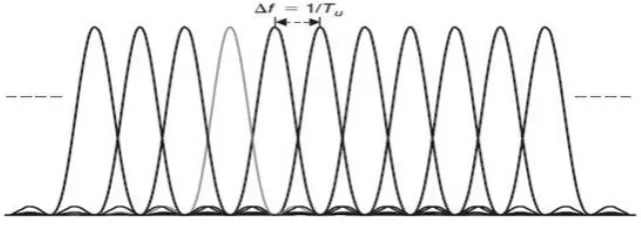
Figure 1: OFDM Subcarrier Spacing for MUEs
The orthogonally is reached by separating sub-carriers with spacing as illustrated in Figure 1. The LTE sub-carrier spacing is set to ∆= 15. Due to orthogonality an OFDM modulator can be implemented by using IFFT (Inverse Fast Fourier Transform) algorithm and demodulator by FFT
II. LITRATURESURVEY
The interference mitigation strategies that are proposed by author in [15] that is used to suppress the cross tier interference at a macrocell BS by adjusting the maximum transmit power of Femto cell user by closed-loop or open-loop power control. In [16] this we analyze the mechanism for the generation of the uplink interference scenario and guidelines provides for mitigation of interference in two-tier macro and femtocell co-existing networks. In [17], the downlink of macro to Femto cell interference is analyzed and methods are proposed for reducing interference with deployment of co-channel femtocell.
In [18] a scheme is proposed for distributed femtocell power allocation by exploiting the inadequate channel information of neighboring macrocell to very effectively reduce the cross-tier interference on them. [19] Addresses the cross-tier interference problem of uplink and proposes a solution to the near-far effects of issues by utilizing the information feedback of interfering macrocell through infrastructure network at the HeNB for the recovery of the symbols sent by the HUE of interfered signal. For co-channel deployment which is presented in [20], a self-organizing femtocell framework is formed which is composed of 3 complementary control loops.
In OFDMA, two-tier macro cell femtocell network an interference avoidance technique is proposed in [11] by combining intra cell handovers and power control. In [12] a cognitive femtocell network architecture is proposed that will incorporates Femto cells, cognitive radio and that proposes a joint power control, channel assignment and assignment scheme for base station of the networks of cognitive and femtocell.
Zhang et al. 2011 and Yu et al. 2011 in [13, 14] uses the cognitive radio for smart grids and home networks, they suggest intelligent spectrum allocation, and in [15] they have considered a parallel spectrum sensing for sensing performance and balancing efficiency in cognitive radio networks.
III. SYSTEM MODEL
www.ijaera.org 2017, IJA-ERA - All Rights Reserved 56
A. Open Access method
Some advantages are presented by open access method like the overall capacity of the network is improved and due to in practice macro-cell users can now connect the nearby femtocells at any location where the coverage of macro-cell is deficient.
B. Close Access method
The close access method is more probable to be deployed in the home environment network; which shows that if in any case power leaks through doors and windows that will be detected as interference by the passing macro-cell users, which result in decreasing their signal quality.
C. Hybrid Access
In hybrid access, the impact on the femtocell owner by controlling the most of the interference problems of closed access are excluded.
D. Time Synchronization
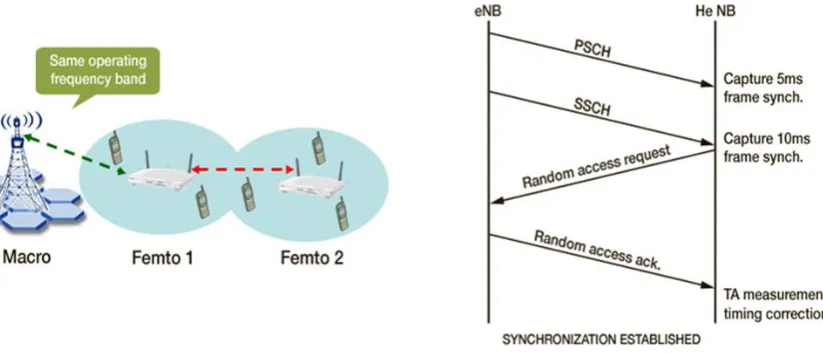
The transmission instants will be between different-different cells which leads to the uplink period of some cells that are overlapping with that downlink of others, that will cause increase in inter cell interference in the network [10] and for achieving time synchronization the FAPS that are equipped with high precision oscillators, however this option is not suitable
Figure 2. MIMO IBC for SUE Elements and Femto1 & 2
IV. RESULTS
A. Femtocell to Macrocell Handover :
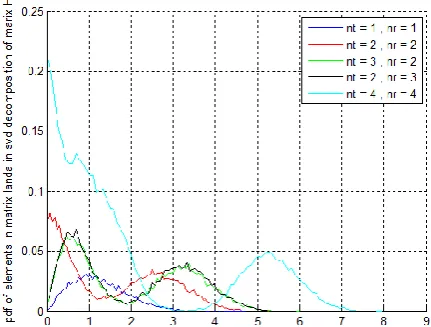
www.ijaera.org 2017, IJA-ERA - All Rights Reserved 57 Figure 3. Femtocell to Macrocell Handover in different MIMO
B. Macrocell to Femtocell Handover
In 2G and 3G systems broadcast a neighbor list used by a mobile station attached to the scenario of mass deployment of femtocell such handoff protocol causes complexity because of the huge number of information needed to build this neighbor list. Moreover, since serving NodeB wants to select an suitable one from many femtocells the MAC overhead becomes crucial due to the increased size of the neighbor cell list message.
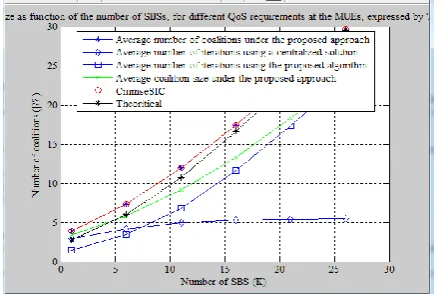
Figure 4. No of Coalition with No of SBS in network
Through the analysis of movement pattern that is based upon sequential pattern tapping among these sub-areas, due to which it is possible to predict pattern of next sub-area movement when the mobile user approaches the femtocell. The idea consists on keeping the connection of macro-cell rather than conducting the handover of macro → Femto, when the mobile user can be a temporary femtocell visitor so based on the next movement pattern analysis. Another important factor to take into account in handover is the interference since a UE scans many femtocells.
Thus, the foundation of the macro and femto handover is defined as follows:
Sf>Sth and Tc>Tth
Where:
www.ijaera.org 2017, IJA-ERA - All Rights Reserved 58 - Sth stands for the threshold value which is predefined.
- Tc stands for MUE Zone for cell residence time of the user
Figure 5. All MUE by Antenna with plane wave coalition
Figure 6. Different capacity bits with signal noise
www.ijaera.org 2017, IJA-ERA - All Rights Reserved 59 V. CONCLUSION
The system is based on algorithms where limits such as the user velocity and the residence time of the MUE and SUE in a Femtocell are determinant for the reducing of unnecessary and it provide balance spectrum for individual MUE which handle on the behalf of right angle for spectrum sensing in small-scale draining, and it can be enhanced and extended in some of the specific areas. Which coherent for higher range with MIMO system in rectangular patch antenna based and deployed in different areas taking into account access antenna technique that involve at the packet. We can do with this in future could be the shrinking of cell size in the network which can be done by using network coding duty cycle in genetic optimization that will manage the interferences and improve the spectral efficiency of femtocells.
Conflict of interest: The authors declare that they have no conflict of interest.
Ethical statement: The authors declare that they have followed ethical responsibilities.
REFERENCES
[1] 3GPP, "Requirements for Evolved UTRA (E-UTRA) and Evolved UTRAN (E-UTRAN)," p. 18, 2008. [2] Lucent, Alcatel, The LTE Network Architecture - Strategic White Paper.
[3] Global mobile Suppliers Association (GSA), "http://www.gsacom.com/news/gsa_350.php," 4 4 2012. [4] E. DAHLMAN, S. PARKVALL, J. SKÖLD and P. BEMING, 3G Evolution HSPA and LTE for Mobile
Broadband. 1st edition, Oxford: Academic Press, 2007, p. 448.
[5] R. Moray, "3GPP LTE: Introducing Single-Carrier FDMA. Agilent Technologies," 2008. [6] H. G. MYUNG, "Technical Overview of 3GPP LTE [online]. LTE Watch Blog," 2008. [7] V8.8.0, 3GPP TS 36.211, "Physical Channels and Modulation," 2009.
[8] "LTE Resources Guide," 2008.
[9] J. Han and B. Wu, "Handover in the 3GPP Long Term Evolution (LTE) Systems".
[10] D. L. Perez, A. Valcarce and G. d. l. Roche, "OFDMA Femtocells: A Roadmap on Interference Avoidance," IEEE Topics in Radio Communications, Vols. 0163-6804-09, 2009.
[11] J. S. Kim and T. J. Lee, "Handover in UMTS Networks with Hybrid Access Femtocells," IEEE, Vols. ISBN 978-89-5519-146-2, no. 904, 2010.
[12] V. Chandrasekhar and J. Andrews, "Femtocell Networks: A Survey," Topics in Radio Communications, Vols. 0163-6804-08, 2008.
[13] Vikram Chandrasekhar and Jeffrey G. Andrews, "Femtocell Networks: A Survey”, IEEE Communications Magazine, September 2008.
[14] H-S Jo, C Mun, J Moon, J-G Yook, Interference mitigation using uplink power control for two-tier femtocell networks. IEEE Trans. Wirel. Commun 8(10), 4906–4910 (2009)
[15] Z Shi, MC Reed, M Zhao, On uplink interference scenarios in two-tier macro and femto co-existing UMTS networks. EURASIP J. Wirel. Commun. Network 2010 (2010) Article ID 240745
[16] Z Bharucha, G Auer, T Abe, Downlink femto-to-macro control channel interference for LTE.Proceedings of WCNC (Cancun, Mexico, 2011), pp. 1259–1264
[17] MS Kim, HW Je, FA Tobagi, Cross-tier interference mitigation for two-tier OFDMA femtocell networks with limited macrocell information. Proceedings of GLOBECOM (Miami, USA, 2010), pp. 1–5
[18] M Ndong, T Fujii, Interference cancellation for spectrum shared femtocell networks with macrocell information feedback. Proceedings of 2011 Third International, Conference on Ubiquitous and Future Networks (ICUFN) (Dalian, China, 2011), pp. 224–229
[19] JH Yun, KG Shin, CTRL: a self-organizing femtocell management architecture for co-channel deployment. Proceedings of MobiCom (Chicago, USA, 2010), pp. 61–72