An Algorithm for Optimized Time, Cost, and
Reliability in a Distributed Computing
System
Pankaj SaxenaDepartment of Computer Applications, Teerthanker Mahaveer University, Moradabad (U.P), INDIA Email: [email protected]
Dr. Kapil Govil
Department of Computer Applications, Teerthanker Mahaveer University, Moradabad (U.P), INDIA Email: [email protected]
---ABSTRACT---
Distributed Computing System (DCS) refers to multiple computer systems working on a single problem. A distributed system consists of a collection of autonomous computers, connected through a network which enables computers to coordinate their activities and to share the resources of the system. In distributed computing, a single problem is divided into many parts, and each part is solved by different computers. As long as the computers are networked, they can communicate with each other to solve the problem. DCS consists of multiple software components that are on multiple computers, but run as a single system. The computers that are in a distributed system can be physically close together and connected by a local network, or they can be geographically distant and connected by a wide area network. The ultimate goal of distributed computing is to maximize performance in a time effective, cost-effective, and reliability effective manner. In DCS the whole workload is divided into small and independent units, called tasks and it allocates onto the available processors. It also ensures fault tolerance and enables resource accessibility in the event that one of the components fails. The problem is addressed of assigning a task to a distributed computing system. The assignment of the modules of tasks is done statically. We have to give an algorithm to solve the problem of static task assignment in DCS, i.e. given a set of communicating tasks to be executed on a distributed system on a set of processors, to which processor should each task be assigned to get the more reliable results in lesser time and cost. In this paper an efficient algorithm for task allocation in terms of optimum time or optimum cost or optimum reliability is presented where numbers of tasks are more then the number of processors.
Keywords - Cost, Distributed Computing System (DCS), Reliability, Task, Time.
--- Date of Submission: 14, February 2013 Date of Acceptance: 10, March 2013 ---
I. INTRODUCTION
D
istributed Computing System (DCS) is a collection of independent computers interconnected by transmission channels that appear to the users of the system as a single computer. Distributed systems are groups of networked computers. The word distributed in terms such as DCS, referred to computer networks where individual computers were physically distributed within some geographical area. The terms are nowadays used in a much wider sense. Each node of DCS is equipped with a processor, a local memory, and interfaces. The purpose of the distributed system is to coordinate the use of shared resources or provide communication services to the users. In distributed computing, each processor has its own private memory (distributed memory). The processors in a typical distributed system run concurrently in parallel. The required processing power for task assignment [25] applications in a DCS can not be achieved with a singlecapabilities. Reliability [3, 4, 8] is defined to be the probability that the system will not fail during the time that it is processing the tasks. The problem of task assignment [17, 20, 21] in DCS has been studied for many years with many variations. It is one of the fundamental optimization problems in DCS. We consider that communicating tasks are to be assigned to different processors with communication links to minimize the overall execution and communication cost [7] and to maximize the reliability [11]. To optimize the performance of a DCS, several issues arise such as the minimization of time and cost as well as maximization of system reliability [9, 26].
2. OBJECTIVE
The objective of this paper is to design an algorithm to enhance the performance of distributed network in terms of optimized processing time, cost and reliability [15]. The objective of this paper includes allocation of tasks statically [6, 14] and to calculate the overall optimized processing time, cost and reliability in a Distributed Computing System (DCS). The main objective is to give an algorithm in a better and easy way because many algorithms exist in this reference so it is also an objective to experiment the algorithm on different inputs for developing a skilled algorithm. There are certain other things such that a proper balancing of load [24] on processors in a way that no processor should be in an idle mode is also an objective in preparing the algorithm. Objective is also that there must be the full advantage by taking the tasks statically [19] in completing the work for getting optimized time, cost and reliability in an efficient manner.
3.NOTATIONS
T : Set of tasks P : Set of processors CM : Communication Matrix PCTR : Processor Cost Time Reliability
MPCTR : Modified Processor Cost Time Reliability FPCTR : Fused Processor Cost Time Reliability
4.TECHNIQUE
We have considered a set of task T, which contains three tasks t1, t2, and t3, a set of processors P which contains
three processors p1, p2 and p3, also every task contains
some number of modules. For obtaining the optimal time or cost or reliability for each task initially the emphasis will be on those modules of tasks which have the maximum probability of data transfer. Now, in case of time and cost the elements will be added and in case of reliability they will be multiplied. Now we have taken a matrix in which the time, cost and reliability of modules are defined and define a communication matrix by considering the communication between tasks. On the basis of highest communication we get a matrix namely FPCTR (,,). Now from this table we can get the separate tables for time, cost and reliability. Load count is taken as an integer variable which contains binary values either 1 or 0. We will assign it a value 0 to the processor if no task is assigned otherwise a value 1 will be assigned to the load
count. By considering that the preference should be given to the idle processor we assign load count as 1 or 0. Now, in each table we will do the addition of each row and will also take the average of each row on the basis of sum of each row. Now, we will subtract the values from average. Negative and zero values will not be considered. For time and cost [13, 18] minimum value will be allocated and for reliability maximum value will be considered. Now the tasks can be allocated [22, 23] for getting the optimized results in terms of time, cost & reliability [12], also Etime, Ecost and Ereliablity can be calculated. The function for obtaining the overall assignment time [Etime], cost [Ecost], and reliability [Ereliablity] is as follows-
The function for obtaining the overall assignment time [Etime], cost [Ecost], and reliability [Ereliablity] is as follows-
=
∑ ∑
= =
n
1 i
n
1 j
ij ij
x
ET
Etime
(i)
=
∑ ∑
= =
n
1 i
n
1 j
ij ij
x
EC
Ecost
(ii)
=
∏
∑
= =
n
1 i
n
1 j
ij ij
x
ER
y
Ereliablit
(iii) ≥ =
Otherwise 0,
processor j
to assigned is
task i if , 1 x
Where,
th th
ij
5. ALGORITHM
Step I : Start Algorithm
Step II : Take the set of different tasks T, Set of different processors P and different modules in each task.
Step III : Input the matrix PCTR (,,). Select time/cost/reliability data corresponding to each task as needed.
Step IV : Input matrix CM (,,) by considering the communication time between modules of each task.
Step V : Consider each task on the basis of time or cost or reliability.
Step VI : On the basis of Step 5 we get the matrix MPCTR (,,). This matrix will be derived from matrix PCTR (,,).
Step VII : Fused the modules of tasks in MPCTR (,,), on the basis of highest communication we get the matrix FPCTR (,,).
Step VIII : From FPCTR (,,) we can take separate tables for time, cost and reliability.
Step IX : While (all tasks! = allocated)
Step X : {
b. on selecting corresponding processing time/cost/reliability by subtracting it from average of corresponding row we get revised processing RPRM (,). Negative and zero values will not be considered.
c. for time and cost minimum value will be allocated and for reliability maximum value will be considered from Table I,II and III respectively.
d. assign a load count 1 if the task is allocated , otherwise a 0 check value will be assigned, by doing this the preference will be given to the processor which has a 0 load count to distribute the tasks for balancing the load
}
Step XI : Compute the processor wise overall
processing time, cost and reliability.
Step XII : Display the result.
Step XIII : End of algorithm.
6.IMPLEMENTATION
Let us consider a set of tasks T. This set consists three tasks t1, t2, and t3. We may define it as, T= {t1, t2, t3}. Now,
consider the task t1 has a set of task M1. This set consists
the five modules. We may define it as, M1= {m11, m12, m13,
m14, m15}. Now, for task t2 considers the set of task
M2.This set consists the four modules. We may define it
as, M2= {m21, m22, m23, m24}. Now, for task t3 considers the
set of task M3. This set consists the six modules. We may
define it as, M3= {m31, m32, m33, m34, m35, m36}. The total
number of processors are three and it can be define as, P= {p1, p2, p3}. The graphical representation of this problem is
shown in figure 1.
Figure1: Task allocation in DCS
For different task t1, t2 and t3 there are three set of tasks
M1, M2 and M3. These set of tasks contains different
individual tasks components which are called modules.
The processing time (t), cost (c) and reliability (r) of each module of every task on various processors are known and mentioned in the matrix namely, PCTR (,,)-
999221 . 0 2500 170 999281 . 0 2300 110 999450 . 0 2300 140 m 999210 . 0 2700 200 999280 . 0 2900 140 999429 . 0 2900 150 m 999409 . 0 2800 210 999275 . 0 2700 190 999428 . 0 2800 105 m 999407 . 0 2900 290 999277 . 0 2500 180 999427 . 0 2600 110 m 999405 . 0 2700 180 999288 . 0 2100 175 999425 . 0 2500 190 m 999144 . 0 2200 160 999782 . 0 2000 155 999321 . 0 2100 100 m 999103 . 0 2100 160 999701 . 0 3000 150 999222 . 0 2700 160 m 999903 . 0 2300 155 999222 . 0 2900 170 999220 . 0 2600 080 m 999775 . 0 2400 070 999444 . 0 2800 080 999981 . 0 2200 190 m 999772 . 0 2500 080 999329 . 0 2500 090 999781 . 0 3000 180 m 999786 . 0 2600 100 999327 . 0 2800 090 999555 . 0 2100 130 m 999701 . 0 2100 110 999224 . 0 2700 100 999505 . 0 2900 125 m 999390 . 0 2900 130 999223 . 0 2100 110 999123 . 0 2600 110 m 999384 . 0 2800 120 999225 . 0 3000 150 999321 . 0 2500 160 m 999301 . 0 2700 130 999201 . 0 2000 140 999456 . 0 2000 150 m r c t r c t r c t Modules Tasks p p p Processors 36 35 34 33 3 32 31 24 23 22 2 21 15 14 13 1 12 11 3 2 1 − − − − − − − − − − − − − − − − − − − − − − − − − − − − − − − − − − − − − − − − − − − − − − − − − − − − − − − − − − − − − − − − − − − − − − − − − − − − − − − − − − − − − − − − − − − − − − − − t t t
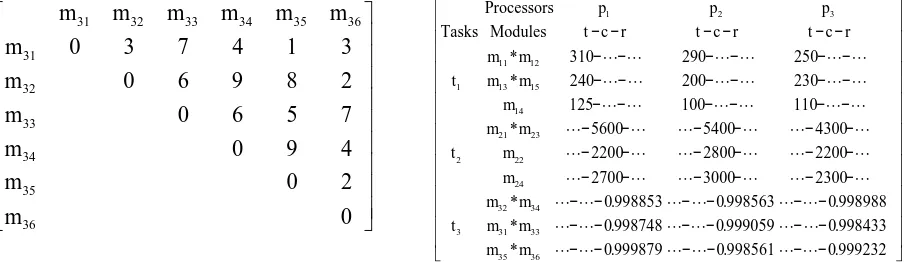
The considered communication time among the modules of each task is mentioned in the matrices, namely CM (,,).
For task t1, the matrix CM (1,) is as:
0 m 2 0 m 7 3 0 m 1 6 4 0 m 3 4 8 9 0 m m m m m m 15 14 13 12 11 15 14 13 12 11
For task t2, the matrix CM (2,) is as:
0 m 2 0 m 7 8 0 m 9 9 4 0 m m m m m 24 23 22 21 24 23 22 21
0
m
2
0
m
4
9
0
m
7
5
6
0
m
2
8
9
6
0
m
3
1
4
7
3
0
m
m
m
m
m
m
m
36 35 34 33 32 31 36 35 34 33 32 31Here it is considered that task t1 is based on the constraint
of execution time (one may choose the either cost or reliability constraint), task t2 is based on the constraint of
cost (one may choose the either time or reliability constraint), and task t3 is based on the constraint of
reliability (one may choose the either time or cost constraint).
Hence, we can use the following form of data from matrix PCTR (,,) i.e. execution time for task t1, execution cost for
task t2, and execution reliability for task t3 and can get the
matrix namely MPCTR (,,) in the following way-
999221 . 0 999281 . 0 999450 . 0 m 999210 . 0 999280 . 0 999429 . 0 m 999409 . 0 999275 . 0 999428 . 0 m t 999407 . 0 999277 . 0 999427 . 0 m 999405 . 0 999288 . 0 999425 . 0 m 999144 . 0 999782 . 0 999321 . 0 m 2100 3000 2700 m 2300 2900 2600 m t 2400 2800 2200 m 2500 2500 3000 m 100 090 130 m 110 100 125 m 130 110 110 m t 120 150 160 m 130 140 150 m r c t r c t r c t Modules Tasks p p p Processors 36 35 34 3 33 32 31 24 23 2 22 21 15 14 13 1 12 11 3 2 1 − − − − − − − − − − − − − − − − − − − − − − − − − − − − − − − − − − − − − − − − − − − − − − − − − − − − − − − − − − − − − − − − − − − − − − − − − − − − − − − − − − − − − − − − − − − − − − − −
Now, the task t1 have five modules so on the basis of
highest communication the modules m11&m12, m13&m15
will be fused. The task t2 have four modules so on the basis
of highest communication the modules m21&m23 will be
fused. The task t3 have six modules so on the basis of
highest communication the modules m32&m34, m31&m33,
m35&m36 will be fused. The resulting matrix namely
FPCTR (,,) will be:
− − − − − − − − − − − − − − − − − − − − − − − − − − − − − − − − − − − − − − − − − − − − − − − − − − − − − − − − − − − − 999232 . 0 998561 . 0 999879 . 0 m * m 998433 . 0 999059 . 0 998748 . 0 m * m t 998988 . 0 998563 . 0 998853 . 0 m * m 2300 3000 2700 m 2200 2800 2200 m t 4300 5400 5600 m * m 110 100 125 m 230 200 240 m * m t 250 290 310 m * m r c t r c t r c t Modules Tasks p p p Processors 36 35 33 31 3 34 32 24 22 2 23 21 14 15 13 1 12 11 3 2 1
Now, from the FPCTR (,,) table we can get three tables namely Table I, Table II and Table III which are given below-
Table I: Processing Time
110
230
250
p
100
200
290
p
125
240
310
p
m
m
*
m
m
*
m
3 2 1 14 15 13 12 11Table II: Processing Cost
2300
2200
4300
p
3000
2800
5400
p
2700
2200
5600
p
m
m
m
*
m
3 2 1 24 22 23 21Table III: Processing Reliability
3 2 3 4 3 1 3 3 3 5 3 6
1
2
3
m
* m
m
* m
m
* m
p
0 .9 9 8 8 5 3
0 .9 9 8 7 4 8
0 .9 9 9 8 7 9
p
0 .9 9 8 5 6 3
0 .9 9 9 0 5 9
0 .9 9 8 5 6 1
p
0 .9 9 8 9 8 8
0 .9 9 8 4 3 3
0 .9 9 9 2 3 2
processor which has a 0 Load Count to distribute the tasks for balancing the load. Negative and zero values will not be considered. Now for time and cost we will consider the minimum value and for reliability maximum value will be taken for allocating to the processor from the above table. By implementing these steps in Table II which is for cost factor and in Table III which is for reliability factor we will get the following three tables-
Table IV: Overall Processing Time
1 110
m p
640 1
290 m
* m p
1 240
m * m p
Etime Count Load Time task Allocated processors
14 3
12 11 2
15 13 1
Results of Table IV can be shown graphically as in figure 2-
Figure2: Processing Time by Processors
Table V: Overall Processing Cost
1 2300
m p
10700 1
2800 m
p
1 5600
m * m p
Ecost Count Load Cost Task Allocated processor
24 3
21 2
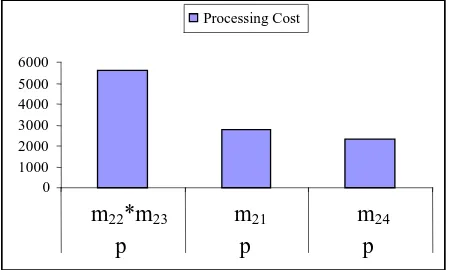
23 22 1
Results of Table V can be shown graphically as in figure 3-
Figure 3: Processing Cost in Completing Tasks
Table VI: Overall Processing Reliability
1 998433 . 0 m * m p
995852 . 0 1 998561 . 0 m * m p
1 998853 . 0 m * m p
y Ereliablit Value
Check Reliablity Task
Allocatede Processor
36 33 3
32 31 2
35 34 1
Results of Table VI can be shown graphically as in figure 4-
Figure 4: Processing Reliability in Completing Tasks
7.CONCLUSION
In the present paper conclusively we design an algorithm for achieving better performance to enhance the efficiency on Distributed Computing System (DCS) in terms of optimized time, cost and reliability. We have taken a problem to assign the task to the processors where the numbers of tasks are greater then the number of processors in a DCS and the presented algorithms on different inputs
0.9982 0.9983 0.9984 0.9985 0.9986 0.9987 0.9988 0.9989
m
34*m
35m
31*m
32m
33*m
36p
p
p
Processing Reliability 0
1000 2000 3000 4000 5000 6000
m
22*m
23m
21m
24p
p
p
Processing Cost
0 50 100 150 200 250 300 350
m
13*m
15m
11*m
12m
14p
p
p
show better performance while comparing the results with some other algorithms. We get this conclusion by taking three tasks namely t1, t2 and t3 with many modules, for
process the task t1 in minimum time, task t2 in minimum
cost and task t3 with maximum reliability. This algorithm
shows the optimized results as shown in the table given
below-1 2 3
1 13 15 11 12 14
2 22 23 21 24
3 34 35 31 32 33 36
Processors Optimal Optimal Optimal
Tasks p p p Etime Ecost Ereliablity
t m *m m *m m 640
t m *m m m 10700
t m *m m *m m *m 0.995852
The analysis of any algorithm specifically emphasis on time complexity. The timecomplexity is a measure of the amount of time required to execute an algorithm. Time complexity expresses the relationship between the size of the input and the run time for the algorithm. It is a function of input size ’n’.The time complexity of the above mentioned algorithm is O (mn). By taking several input examples, the above algorithm gives the results mentioned below-
91 13
7
84 12
7
66 11
6
60 10
6
45 9
5
40 8
5
28 7
4
24 6
4
15 5
3
12 4
3
Results Optimal task(m)
of No. (n) Processors No.of
The graphical representation of the above results are shown by figure 5, 6, 7, 8 and 9 as given below-
No. of Processors:3
0 1 2 3 4 5 6
1 2
N
o
. o
f
ta
sk
s(
m
)
0 5 10 15 20
O
p
tim
a
l r
e
su
lts
No. of tasks(m) Optimal Results
Figure 5: Processor Wise Complexity
No. of Processors:4
5.5 6 6.5 7 7.5
1 2
N
o
. o
f
ta
sk
s(
m
)
22 24 26 28 30
O
p
tim
a
l r
e
su
lt
s
No. of tasks(m) Optimal Results
Figure 6: Processor Wise Complexity
No. of Processors:5
7.5 8 8.5 9 9.5
1 2
N
o
. o
f ta
sk
s(
m
)
36 38 40 42 44 46
O
p
tim
a
l r
esu
lts
No. of tasks(m) Optimal Results
Figure 7: Processor Wise Complexity
No. of Processors:6
9.5 10 10.5 11 11.5
1 2
N
o
. o
f
ta
sk
s(
m
)
56 58 60 62 64 66 68
O
p
tim
a
l r
esu
lt
s
No. of tasks(m) Optimal Results
No. of Processors:7
11.5 12 12.5 13 13.5
1 2
N
o
. o
f ta
sk
s(
m
)
80 82 84 86 88 90 92
O
p
tim
a
l r
e
su
lts
No. of tasks(m) Optimal Results
Figure 9: Processor Wise Complexity
The performance of the suggested algorithm is compared with the algorithm suggested by H.kumar et al [13] as the given table shows the comparison of time complexity between algorithm [13] and our algorithm-
91 260
13 7
84 228
12 7
66 187
11 6
60 160
10 6
45 126
9 5
40 104
8 5
28 77
7 4
24 60
6 4
15 40
5 3
12 28
4 3
O(mn) mn)
O(m
algorithm Present 13]
algorithm[
of complexity Time
of complexity Time
Tasks(m) (n)
Processors
2+
From the above table it is clear that algorithm proposed by us is much better for the optimal allocation of tasks for enhancing the performance of distributed computing system. The graphical representation is given below between algorithm [13] and present algorithm by figure 10, 11, 12, 13 and 14.
No. of Processors(n):3
0 20 40 60
0 1 2 3 4 5 6
No. of tasks(m)
C
o
m
p
le
x
ity
algorithm[13] present algorit hm
FIGURE 10:Complexity Comparisons
No. of Processors(n):4
0 50 100
5.8 6 6.2 6.4 6.6 6.8 7 7.2
No. of tasks(m)
C
o
m
p
le
x
ity
algorithm[13] present algorithm
FIGURE 11:Complexity Comparisons
No. of Processors(n):5
0 50 100 150
7.8 8 8.2 8.4 8.6 8.8 9 9.2
No. of tasks(m)
C
o
m
p
le
x
ity
algorithm[13] present algorithm
FIGURE 12: Complexity Comparison
No. of Processors(n):6
0 50 100 150 200
9.8 10 10.2 10.4 10.6 10.8 11 11.2 No. of tasks(m)
C
o
m
p
le
x
ity
algorithm[13] present algorithm
No. of Processors(n):7
0 100 200 300
11.8 12 12.2 12.4 12.6 12.8 13 13.2
No. of tasks(m)
C
o
m
p
le
x
ity
algorithm[13] present algorithm
FIGURE:14 Complexity Comparisons
8.REFERENCES
[1] Anju Khandelwal, Optimal Execution Cost of Distributed System through Clustering, International Journal of Engineering Science and Technology, 3(3), 2011, 2320-2328.
[2] Ahmed Younes, and Hamed, Task Allocation for Minimizing Cost of Distributed Computing Systems Using Genetic Algorithms, International Journal of Advanced Research in Computer Science and Software Engineering, 2(9), 2012, 1202-1209.
[3] Ajit Kimar Verma, and Mangesh Trimbak Tamhankar, Reliability Based optimal Task Allocation in Distributed Database Management Systems, IEEE Transactions on Reliability, 46(4), 1997, 453-459.
[4] Anurag Raii, and Vikram Kapoor, Reliable Clustering Model for Enhancing Processors Throughput in Distributed Computing System, International Journal of Computer Applications, 38(8), 2012, 47-50.
[5] Boeres, Cristina1, Rebello, and Vinod E.F., A versatile cost modeling approach for multicomputer task scheduling, Journal of Parallel Computing, 25(1), 1999, 63-86.
[6] Braun Tracy D, Siegel Howard Jay, Maciejewski Anthony A, and Hong Ye, Static resource allocation for heterogeneous computing environments with tasks having dependencies, priorities, deadlines, and multiple versions, Journal of Parallel and Distributed Computing, 68(11), 2008, 1504-1516.
[7] Bo yang, Huajun Hu, and Suchang Guo, Cost-oriented task allocation and hardware redundancy policies in heterogeneous distributed computing systems considering software reliability, Journal Computers and Industrial Engineering, 56(4), 2009, 1687-1696.
[8] Dr. Kapil Govil, Processing Reliability based a Clever Task Allocation Algorithm to Enhance the Performance of Distributed Computing Environment,
International Journal of Advanced Networking and Applications, 3(1), 2011,1025-1030.
[9] D. Coit, and A. Smith, Reliability optimization of series-parallel systems using genetic algorithm, IEEE Transaction on Reliability, 45(2), 1996, 254-266.
[10]G.sagar, Anil K, and Sarj E, Task allocation model for distributed systems, International Journal of Systems Science, 22(9), 1991, 1671-1678.
[11]Gamal Attiya, and Yskandar Hama, Task allocation for maximizing reliability of distributed systems: A simulated annealing approach, Journal of Parallel and Distributed Computing, 66(10), 2006, 1259-1266.
[12] Hsieh, Chung-Chi, Hsieh, and Yi-Che, Reliability and cost optimization in distributed computing systems, Journal of Computers & Operations Research, 30(8), 2003, 1103-1119.
[13] H.Kumar, A task allocation model for distributed data network, Journal of Mathematical Sciences, 1(4), 2006, 379-392.
[14] Keren A, and Barak A, Opportunity cost algorithms for reduction of I/O and inter process communication overhead in a computing cluster, IEEE Transaction on Parallel and Distributed Systems, 14(1), 2003, 39-50.
[15]Marwa Shouman, Gamal Attiya, and Ibrahim Z. Morsi, Static Workload Distribution of Parallel Applications in Heterogeneous Distributed Computing Systems with Memory and Communication Capacity Constraints, International Journal of Computer Applications, 34(6), 2011, 18-24.
[16]Manoj B.S, Sekhar Archana, and Siva Ram Murthy C, A state-space search approach for optimizing reliability and cost of execution in distributed sensor networks, Journal of Parallel and Distributed Computing, 69(1), 2009, 12-19.
[17]Manisha Sharma, Harendra Kumar, and Deepak Garg, An Optimal Task Allocation Model through Clustering with Inter-Processor Distances in Heterogeneous Distributed Computing Systems, International Journal of Soft Computing and Engineering, 2(1), 2012, 50-55.
[18]Mostapha Zbakh, and Said El Hajji, Task allocation problem as a non cooperative game, Journal of Theoretical and Applied Information Technology, 16(2), 2010, 110-115.
[20]Nirmeen A. Bahnasawy, Fatma Omara, Magdy A. Koutb, and Mervat Mosa, A new algorithm for static task scheduling for heterogeneous distributed computing system, International Journal of Information and Communication Technology Research, 1(1), 2011, 10-19.
[21] Pradeep Kumar Yadav, M.P. Singh, and Kuldeep Sharma, Task Allocation Model for Reliability and Cost optimization in Distributed Computing System, International Journal of Modeling, Simulation and Scientific Computations, 2(2), 2011, 1-19.
[22]P. K. Yadav, M. P. Singh, and Kuldeep Sharma, An Optimal Task Allocation Model for System Cost Analysis in Heterogeneous Distributed Computing Systems: A Heuristic Approach, International Journal of Computer Applications, 28(4), 2011, 30-37.
[23]Peng-Yeng Yin, Shiuh-Sheng Yu, Pei-Pei Wang, and Yi-Te Wang, Task allocation for maximizing reliability of a distributed system using hybrid particle swarm optimization, Journal of Systems and Software, 8(5), 2007, 724-735.
[24]Qin-Ma Kang, Hong He, Hui-Min Song, and Rong Deng, Task allocation for maximizing reliability of distributed computing systems using honeybee mating optimization, Journal of Systems and Software, 83(11), 2010, 2165–2174.
[25]Shu Wanneng, Wang Jiangqing, and Min-Min Chromosome, Genetic Algorithm for Load Balancing in Grid Computing, International Journal of Distributed Sensor Network, 5(1), 2009, 62-63.
[26]Sagar G, Sarje, Anil K. Ahmed, and Kamal U., Task allocation techniques for distributed computing systems: a review, Journal of Microcomputer Applications, 12(2), 1989, 97-105.