www.ijaera.org 2016, IJAERA - All Rights Reserved 441
A review on Image Processing techniques
using Pattern matching in LabVIEW
Shuprajhaa T1, Subasree S2, Vaitheeshwari M3, Sivakumar S41, 2, 3 UG scholar, Instrumentation and Control Engineering, Saranathan College of Engineering
Trichy, Tamil Nadu, India
4Assistant Professor, Instrumentation and Control Engineering, Saranathan College of Engineering
Trichy, Tamil Nadu India
Abstract: Image processing is one of the advanced technological methods used for various applications. There are several methods to implement image processing. Recent advancements and research study has proved that traditional algorithm based methods of image processing have not shown reliable accurate results. This paper attempts to bring out the possible approaches to implement image processing in LabVIEW, a user friendly graphical user interface software customized by National Instruments. Image processing in LabVIEW involves capturing the image of the object to be analyzed and comparing it with the reference image of the perfect one both geometrically and pattern wise. The essence of this technique in LabVIEW is that the accuracy and the percentage of matching could be set manually using the NI Vision Assistant Module.
Keywords:LabVIEW; Image processing; NI Vision Assistant.
I. INTRODUCTION
Image processing technique is a methodology adopted to perform complex and tedious operations on an image. Some unknown useful information about the image could be brought out as a result of image processing procedure. The output of this technique may yield another image sometimes but in many cases it may bring out the characteristics or features associated with the original image. The original image for processing is acquired through USB camera or web camera. The second step is the analysis of the acquired image. Finally, the output is presented as the processed image or processed output.
There are many techniques of implementing image processing. They range from ancient algorithm based techniques to modern intelligent techniques. The two major classification of image processing technique is analog image processing technique and digital image processing technique. When an acquired image is altered by means of electrical parameters it is termed as analog image processing. In digital image processing, the image is processed by means of more accurate and reliable digital computers and other digital systems. The acquired image is first converted into a digitized format and then allowed to undergo the process.
Image processing provides highly reliable results using pattern matching.
[1] Presents the representation of two images through the process of geometric comparison.
www.ijaera.org 2016, IJAERA - All Rights Reserved 442
II. IMAGE PROCESSING USING NI VISION ASSISTANT
Implementation of innovative ideas in a graphical user interface is very mandatory for the success of any concept. This is true because graphical programming syntax makes the code to become simple to visualize, create and code engineering systems. This could be easily accomplished using National Instruments, software named Laboratory Virtual Instrumentation Electronic Workbench (LabVIEW). LabVIEW. Though Image processing could be implemented in many already available readymade methods, implementation of the same in LabVIEW makes it more accurate and reliable. LabVIEW supports image processing technique with the aid of special functional blocks in two categories split as Low Level VI and High Level VI. The IMAQ Vision Assistant module comes under the high level VI. IMAQ Vision Assistant is a prototype of the vision application in LabVIEW. It helps to perform the vision conceptual functions more specifically and precisely.
IMAQ Vision Assistant can be installed in a personal computer using a 233 MHz Pentium-class processor. Using a Pentium III or Celeron 600 MHz or equivalent is recommended. To support the facility of acquiring images from real time LabVIEW must be aided by National Instruments Image Acquisition (IMAQ) hardware.
Prototyping algorithm could be easily built in a new script in the Vision Assistant window. These custom algorithms help to perform several image processing functions. After testing the custom algorithm built inside the scripting window of the Vision Assistant00 could be integrated to the main VI using the Vision Assistant functional block.
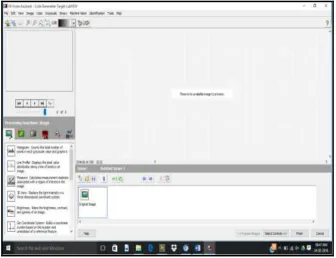
The major parts of Vision Assistant (as shown in Fig 1) are script window which contains the algorithm to be prototyped, image browser which is the repository of the current image browsed into the Vision Assistant, processing window which updates the changes in the image instantaneously as the user modifies the image parameters, Function window or parameter window which contains all the functions to build the desired algorithm to accomplish the image processing techniques.
www.ijaera.org 2016, IJAERA - All Rights Reserved 443 The Vision Assistant has special features and facilities which are broadly classified under five
domains namely Image processing functions, colour processing functions, grayscale processing functions, Binary processing functions, Machine vision processing functions and Identification Processing functions.
Each of these processing functions has several other functions under them, the common of which includes histograms, pattern matching, colour matching, colour pattern matching, geometric pattern matching, edge detection, object tracking, contour analysis, shape detection, golden template comparison, circle detection, particle analysis, Filters, detect texture defects, Colour plane extractor, colour segmentation, colour classification, 3D view and set co-ordinate system.
IMAQ Vision has two algorithms for calibration: perspective and nonlinear. The perspective algorithm corrects for perspective errors. Nonlinear is generally used for lens distortion and other nonlinear effects, such as an image on a curved surface. The nonlinear algorithm computes pixel to rea l-world mappings in a rectangular region centered on each dot in the calibration grid.
III. IMAGE PROCESSING IN INDUSTRIAL SECTOR
Image processing is highly applied in industrial sector in the defect analysis sector. This technique proves to be of utmost usefulness to avoid manual detection of faults and defects. Analysis and identification of defects is of prime importance in the industrial sector. As automation has become the ruling strategy in recent days, recognition of perfect objects and isolating them from the defect ones not only help the industries to keep up their standards high but also help in avoiding loss of time and power. Image processing is one of the modern methodologies adopted to accomplish the removal of defective products. As technological developments have sensed the advantages of image processing many industries adopt this technique. External defect recognition is well achieved by processing the image of the object. There are two major functions implemented used to identify external defects. They are – Pattern matching and Geometric pattern matching. The user needs to specify the template image, Search space, score and region of interest for both these functions to be implemented. The image to be inspected could be fed from the file of stored images or could be captured dynamically using any acquisition device such as a USB camera.
A. Pattern matching:
Pattern matching quickly locates regions of grayscale images that match a known reference pattern, also referred to as a model or a template. This could be implemented in two stages totally. Learning becomes the first stage while matching becomes the second. Gray scale value is extracted from the template image provided by the user. This is done in the learning stage. The algorithm organizes and stores the information in a manner that facilitates faster searching in the inspection image.
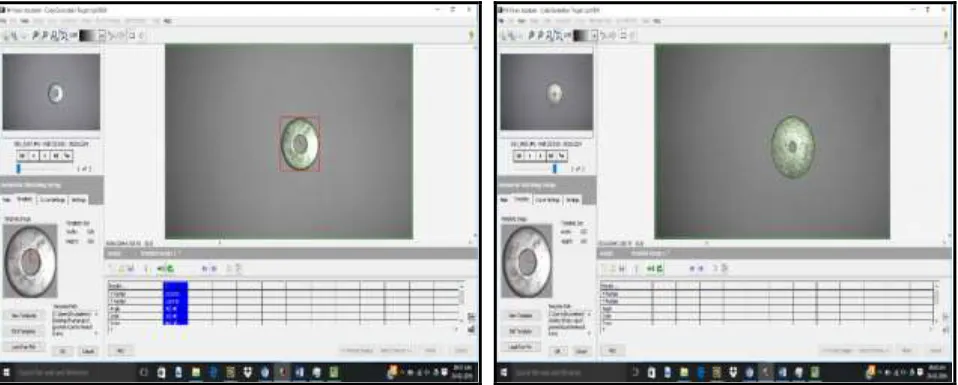
The image to be inspected is processed in the matching stage of pattern matching. Now, the algorithm extracts the gray value from the inspection image. This corresponds to the information learned from the template. Then, the algorithm finds matches by locating regions in the inspection image where the highest cross-correlation is observed. Fig 2.a and Fig 2.b clearly shows the results of matched pattern when pattern matching function is implemented. Fig 2.a shows that the inspected image has one matched output with the template. Fig 2.b shows no matched pattern.
www.ijaera.org 2016, IJAERA - All Rights Reserved 444
Figure 2.a: Pattern template matched Figure 2.b: Pattern template not matched
B. Geometric Pattern Matching:
Geometric matching locates regions in a grayscale image that match a model, or template, of a reference pattern. Geometric matching is specialized to locate templates that are characterized by distinct geometric or shape information. Region of interest is an area of image in which you want to focus your image analysis. Geometric matching quickly locates known reference or fiducial patterns in an image using edge information. The presence or absence, number of and location of a specified template model could be identified in the image to be inspected using the geometric pattern matching.
Figure 3.a: Geometric template pattern matched Figure 3.b: Geometric pattern template not matched
www.ijaera.org 2016, IJAERA - All Rights Reserved 445 and uses the gradient value and the position of the point from the center of the template to perform
the matching. The feature-based geometric matching method extracts geometric features from the curves and uses these geometric features to perform the matching. Fig 3.a and Fig 3.b shows the result of geometric pattern matching. Fig 3.a shows that the geometric template is matched in the image to be inspected. Whereas the template does not match in the inspected image in Fig 3.b because of the difference in geometry between the template and the inspected image.
IV. CONCLUSION
Thus implementation of image processing in LabVIEW could be easily accomplished using NI Vision Assistant. The industrial aspect of image processing seems to be highly accurate and reliable when implemented using this technique for the identification of defects. Pattern matching and Geometric pattern matching prove to be the mandatory checking criteria for defect identification in the manufactured products. Thus this paper clearly details the usage and theoretical process of these two functions of image processing.
V. REFERENCES
[1] Gaurav Sharma, Sonali Sood, Gurjot Singh Gaba, “Image Recognition System using Geometric Matching and Contour detection”, International Journal of Computer Applications (0975 – 8887) Volume 51– No.17.