www.ijaera.org 2016, IJA-ERA - All Rights Reserved 34
Optical Sensor for Detecting 2,4-Dinitrotoluene
based on Polyaniline
Lalit Kumar1*, Balpreet Kaur1 ,Shikha Sharma1, Rohit Bhatia2, Puja Munjal3 1Hindu College, Department of Physics, University of Delhi, Delhi, India 2Division of Sustainable Technology, Rudraksh Prodhyogiki Sangathan. Delhi, India.
3Jagannath International Management School, Delhi, India
Abstract: This paper reports the use of in-situ polymerization method as a simple route for fabricating low-cost, highly sensitive 2, 4-Dinitrotoluene (2, 4-DNT) sensor made of polyaniline (PANI) coatings on glass substrates. The 2, 4-DNT sensing capabilities of the polyaniline film were studied using UV visible absorption spectroscopy. A significant change was observed in the absorption spectra of the film after it was exposed to different concentrations of 2, 4-DNT, in the range 0.5 mM-100 mM.
Keywords: Polyaniline (PANI), 2, 4-Dinitrotoluene (2, 4-DNT), UV-Visible spectroscopy
I. INTRODUCTION
In the recent times, we have witnessed a colossal interest in the research and development activity aimed at realization of sensors for the detection of explosive compounds. Such security and environmental needs have generated major demands for effective and innovative field-deployable devices for detecting organic explosives in a sensitive, reliable, and cost-effective manner. Because of its potential harm as a concealed weapon, 2, 4, 6-trinitrotoluene (TNT) has become a target analyte of high interest for chemical sensor devices including its precursor, the one-nitro-group-less analog, 2, dinitrotoluene (2,DNT) Many studies have been reported in the literature for the detection of 2, 4-DNT, based on electrical and optical methods [1-3]. In the present work, we have fabricated 2, 4-DNT sensor based on a polymer (polyaniline) as sensing layer on a glass substrate.
Polyaniline (PANI) is an extensively investigated polymer and intrigued the scientific community due to its concomitant chemical, electrical and optical properties. It is regarded as one of the most promising conducting polymer, with high potential in commercial applications. The potential areas of application includes secondary batteries, photovoltaic devices, micro-electronic devices, memory device, biological sensors, gas sensors etc. [4-5]. The various techniques used to deposit the PANI films are electrochemical polymerization, spin coating, Langmuir-Blodgett technique, in- situ polymerization technique among others [6-9]. In-situ polymerization technique allows for an easier realization of the industrial processing of PANI with controllable sizes and morphologies.
International Journal of Advanced Engineering Research and Applications (IJA-ERA)
Volume – 2, Issue – 1 May – 2016
www.ijaera.org 2016, IJA-ERA - All Rights Reserved 35
Materials and Method
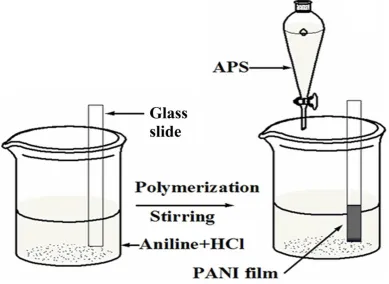
APS (ammonium persulphate), HCl (Thomas Baker -hydrochloric acid) and 2, 4-Dinitrotoluene (Thomas Baker -2, 4-DNT,) were used as received. Aniline (Thomas Baker) was purified by vacuum distillation prior to use. Double distilled water was used in the experiment. Glass slides cut into desired size, were used as substrates. We have prepared the sensor using in situ polymerization technique. This technique allows the deposition of thin PANI film, on any substrate (here glass), demonstrating the method’s adaptability, as schematically shown in Figure.1. The polymerization on the glass was performed for 20 minutes. The glass substrate drawn out from the reaction vessel, 20 minutes after the reaction was initiated gives a greenish appearance. The films were then washed with copious amount of distilled water, to remove the residual moieties.
Figure 1: Scheme of in-situ polymerization in the presence of a glass substrate.
Structural properties by scanning electron microscopy (SEM)
www.ijaera.org 2016, IJA-ERA - All Rights Reserved 36
Figure 2: SEM images of polyaniline film grown on glass, for 20 minutes deposition time (a) unwashed, (b) completely washed.
UV Visible studies
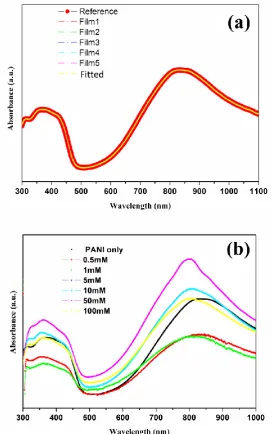
For sensing, separate PANI films were utilized corresponding to each concentration of 2, 4-DNT. For all the virgin samples of PANI film, UV visible spectroscopy was done to assure, identical characteristics of the film. One can observe for all the PANI films, three peaks at nearly E1 = 3.35
eV, E2 = 2.84 eV and E3 = 1.47 eV, respectively in the spectrum all the PANI films [10]. These three
peaks are the characteristics peaks assigned to PANI thin films. The peak at E1 is the first electronic
transitions occurring from the upper defect band to the conduction band (π-π* transitions). The peak centered at E2 is direct optical transition from the second highest occupied molecular energy level in
the valence band to the polaron band and the last peak at E3 is direct optical transitions between the
International Journal of Advanced Engineering Research and Applications (IJA-ERA)
Volume – 2, Issue – 1 May – 2016
www.ijaera.org 2016, IJA-ERA - All Rights Reserved 37
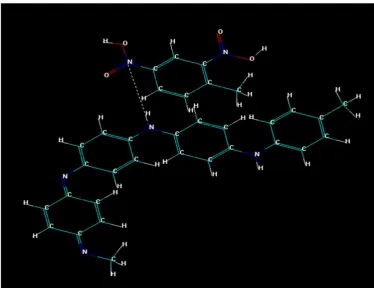
to competing nature nitrogen dioxide and methyl on one hand methyl increase in the electron density by releasing electrons, whereas nitrogen dioxide decreases the same due to electron withdrawing nature.
Figure 3: UV–Vis spectra of PANI films (a) only PANI films and fitted spectra, using Matlab software (b) On exposure to 2, 4-DNT, in the range 0.5 mM-100mM.
www.ijaera.org 2016, IJA-ERA - All Rights Reserved 38
Figure 4: Schematic depiction of hydrogen bonding interactions between PANI and 2, 4- DNT molecules.
II. CONCLUSIONS
International Journal of Advanced Engineering Research and Applications (IJA-ERA)
Volume – 2, Issue – 1 May – 2016
www.ijaera.org 2016, IJA-ERA - All Rights Reserved 39 ACKNOWLEDGMENT
Authors would like to acknowledge Prof. S. Annapoorni, Department of Physics and Astrophysics, for her valuable discussions and UV-Visible spectroscopy facility. They would like to thank University Science and Instrumentation Centre (USIC), University of Delhi, for SEM facility. Balpreet Kaur and Shikha Sharma, would like to thank department of science and technology (DST) for INSPIRE fellowship.
Conflict of interest: The authors declare that they have no conflict of interest.
Ethical statement: The authors declare that they have followed ethical responsibilities.
REFERENCES
[1] J. M. Sylvia, J. A. Janni, J. D. Klein, and K.M. Spencer (2000). Surface-enhanced raman detection of 2,4-dinitrotoluene impurity vapor as a marker to locate landmines. Analytical Chemistry, vol. 72, pp. 5834-5840.
[2] H. Ko and V. V. Tsukruk (2008). Nanoparticle-Decorated Nanocanals for Surface-Enhanced Raman Scattering. Small, vol. 4, pp. 1980–1984.
[3] L.A. Pinnaduwage,T, Thundat, J.E. Hawk, D.L. Hedden, P.F. Britt, E.J. Houser, S. Stepnowski, R.A. McGill and D. Bubb ( 2004 ). Detection of 2,4-dinitrotoluene using microcantilever sensors.Sensors and Actuators B, vol. 99, pp. 223–229.
[4] A.L. Kukla, Y.M. Shirshov and S.A. Piletsky (1996) . Ammonia sensors based on sensitive polyaniline films. Sensors and Actuators B, vol. 37, pp. 135–140.
[5] F. Tavoli and N.Alizadeh (2013). Optical ammonia gas sensor based on nanostructure dye-doped polypyrrole. Sensors and Actuators B, vol. 176, pp.761-767.
[6] W. Cao and Y.Duan (2005) . Optical fiber-based evanescent ammonia sensor. Sensors and Actuators B, vol. 110, pp. 252-259.
[7] G.Gustafsson, Y. Cao, G. M. Treacy, F.Klavetter, N.Colaneri and A.J.Heeger (1992). Flexible light-emitting-diodes made from soluble conducting polymers. Nature,vol. 357, pp. 477 – 479.
[8] R. V. Salvatierra , C. E. Cava , L. S. Roman and A. J.G. Zarbin (2013). ITO-Free and Flexible Organic Photovoltaic Device Based on High Transparent and Conductive Polyaniline/Carbon Nanotube Thin Films. Advanced Functional Materials, vol. 23, pp. 1490–1499.
[9] Y. Wang, Z. Yang, Z. Hou, D. Xu, L. Wei, E. Siu-Wai Kong and Y. Zhang (2010) Flexible gas sensors with assembled carbon nanotube thin films for DMMP vapor detection. Sensors and Actuators B, vol.150, pp. 708–714.