Original Research Article
Urban health extension service utilization and associated factors in the
community of Gullele sub-city administration, Addis Ababa, Ethiopia
Aderajew Mekonnen Girmay
1*, Martin R. Evans
2, Sirak Robele Gari
1,
Azage Gebreyohannes Gebremariam
1, Mulumebet Tadesse Reta
3INTRODUCTION
Across the globe many countries, especially developing countries, are striving to achieve universal health coverage starting from the „Health for All‟ movement of
1977 by the World Health Organisation (WHO) or the Almata declaration. That is why Ethiopia initiated both rural and urban heath extension programs at different times.1,2 Establishing an effective and responsive health delivery system is an integral part of the over-all
ABSTRACT
Background: In Addis Ababa, the capital of Ethiopia, the urban health extension program was started in 2009. Its approach is based on the assumption that access to and quality of primary health care in urban communities can be improved through transfer of health knowledge and skills to households. The study was conducted to assess the status of urban health extension service utilization and associated factors.
Methods: A community based cross–sectional study was conducted to collect data from 628 participants. Sample size was determined by using a single population proportion formula. Binary logistic regression was used for data analysis.
Results: The proportion of community utilization of the urban health extension program was found to be 86%. Respondents‟ odds of utilizing urban health extension services among those who participated in the planning of urban health extension program activities were 2.8 (AOR=2.8; 95% CI: 1.43-3.70) times the odds of those who did not participate. The household respondents who utilized toilet with hand washing facilities had odds of utilizing urban health extension services that are higher by 2.62 (AOR=2.62 with 95% CI: 1.70-9.77) compared to those not utilizing toilet with hand washing facilities.
Conclusions: The study provided important information regarding to the status of community utilization of urban health extension services. Respondents who utilized toilet with hand washing facilities were higher among the respondents who utilized and implemented the urban health extension packages. Respondents who participated in the planning of urban health extension program activities were those who significantly utilized and implemented the urban health extension program.
Keywords: Urban health extension program, Gullele sub-city, Knowledge, Logistic regression, Addis Ababa 1
Ethiopian Institute of Water Resources, Addis Ababa University, Addis Ababa, Ethiopia 2
Microbiology Consultant and Laboratory Director, New York, USA 3
Gullele Health Office, Addis Ababa, Ethiopia
Received: 08 December 2018
Revised: 13 January 2019
Accepted: 15 January 2019
*Correspondence:
Mr. Aderajew Mekonnen Girmay, E-mail: [email protected]
Copyright: © the author(s), publisher and licensee Medip Academy. This is an open-access article distributed under the terms of the Creative Commons Attribution Non-Commercial License, which permits unrestricted non-commercial use, distribution, and reproduction in any medium, provided the original work is properly cited.
development that aims to reduce poverty and achieve economic growth and development.3 Moreover, primary health care services are fundamental to improving health and health equity, particularly in the context of low and middle-income households.4
To improve accessibility and coverage of primary health
care, Ethiopia is implementing health sector
transformation plan.5 As a result, in the past decade Ethiopia has delivered ambitious health programs.6 Of these, the 2003 and 2009 Health Extension Programs (HEP), made a significant improvement to the health and well-being of the population and are among those mentioned.7-9 The country started the health extension program in its rural areas in 2003 as part of the transformation plan to bring radical change to health service delivery, mainly diseases prevention, health promotion and selected curative health interventions. Moreover, to achieve and scale-up service provision of important health interventions, the program targeted the household and community level.5,10-14 Besides this, the federal government launched an urban health extension program at the capital city, Addis Ababa in 2009 through deploying diploma and degree holder extension workers and health professional supervisors respectively. The urban health extension program (UHEP) is a new government plan designed to ensure and enhance health equity by creating interest for essential health services through the provision of appropriate and sufficient health information at a household level in Addis Ababa, Ethiopia.15,16 Although many of the interventions are similar to the rural program, prevention and control of
non-communicable diseases, mental health, and
prevention of injury and provision of first AID are included in the urban health extension packages because of their significant impact on the urban population.15,17 This program provides 15 different packages mainly focusing on four major parts of care: disease prevention and control, family health, hygiene and environmental sanitation, and health education and communication.18
The urban health extension program provides an important health promotion and disease prevention health service targeting mainly households, to improve the public health status through the active involvement of the residents. In the Addis Ababa city administration, the program creates intensive sensitization with the slogans of “our health is producing by ourselves” and “all roads lead to urban heath extension program”.18,19 Although it is difficult to attribute improvements in health care directly to the rollout of the health extension program, between 2005 and 2011, under-five mortality decreased from 123 per 1,000 live births to 88 per 1,000 live births; the contraceptive prevalence rate increased from 15 percent to 29 percent; stunting in under-five children declined from 52 percent to 44 percent; the prevalence of anemia among women decreased from 27 percent to 17 percent; the total fertility rate decreased from 5.4 to 4.8; and use of insecticide-treated nets increased from 1.3 percent to 42 percent.5,8,20
To implement the urban health extension program effectively and efficiently, since 2009 the country has been deploying specially trained, new professional community based health workers and supervisors in urban areas of the country including Addis Ababa to scale up the health of the residents.20 The urban health extension workers spend 75% of their time visiting their outreach activities in the community although they face different challenges in the urban areas. In addition, with the help of urban health extension supervisors, the urban health extension workers provide three month training sessions to selected household members. In addition to providing training, the selected household members are supported regularly by the urban health extension workers and supervisors in order to implement the packages practically. Then household members who implemented at least 75% and above in the practice of the packages of the urban health extension were graduated
and certified as a model family or model
households.12,21,22
According the sub-city report of 2016, Gullele is among the 10 sub-cities in the Addis Ababa City Administration with a total population of 327,312. Since 2009, the sub-city has trained 138 health extension professionals and 22 health extension program supervisors. Moreover, according to the sub-city report of 2017, the sub-city trained and graduated a total of 53,604 (67.2%) model households or model family with an implementation rate of 75% and above utilizing the health extension program packages.
Despite the urban health extension program providing significant improvement in health promotion and diseases prevention and control, there are a lot of challenges regarding the implementation of urban health extension programs particularly hygiene and sanitation, non
communicable disease prevention and control
METHODS
Study design and period
A community based cross–sectional study was conducted in the community of Gullele sub-city, from February to April 2018.
Study area
Gullele sub-city is organized in ten districts and located in northern part of the Addis Ababa, near the Mount Entoto and Entoto Natural Park. To provide both preventive and curative services, the sub-city has a total of two referral hospitals, ten public health centers, ten district health offices, 31 private clinics and two NGO health centers. Moreover, the sub-city has a total of 138 health extension workers and 22 health extension supervisors. In 2017, the total expected number of households in the sub-city was 79,832. The ratio of health extension workers to the households was 1:578 even though it is expected to be 1:500. Moreover, the ratio of supervisors to the urban health extension workers was at least 1:7. The source populations were all the households in Gullele and the study populations were all head of households i.e. no apostrophe in Gullele who met the inclusion criteria.
Sample size determination
The sample size was calculated using a single population proportion formula with the assumptions of 95% confidence interval (α=0.05) and 4% margin of error. The population proportion of health extension service utilization was considered as 39% which was taken from a study conducted in Abuna Gindeberet, West Shoa Zone, on utilization of health extension service among community, [Kelbessa et al 2014]. Hence,
2 2
) (
) 1 ( * ) (
d p p Z
n
n =
=571
After adding a 10% of non-response rate, the final sample size was 628.
Sampling and data collection procedure
The sub-city was stratified into ten districts. The sampling frame or number of households was obtained from each district administration. Each district sample allocation was done based on the number of households using a proportional sample allocation formula. Finally, study subjects (head of households) were selected by a simple random sampling method. In scenarios where the
randomly selected households were not present on the date of data collection, the next households were substituted. All household heads aged above 18 years old and those who lived in the study area for more than one year constituted the inclusion criteria. Those who had hearing loss and those who were too sick to take part in the study were excluded. Interviews were administered using a structured questionnaire and observation of mainly closed ended questions. The questionnaire was first prepared in English and translated to Amharic and back to English for consistency. Data were collected by 15 trained BSc (Bachelor of Science) holder health professionals and supervised by four experienced masters‟ degree holders. Two days of training were given to data collectors and supervisors to increase the reliability of the data. The data collectors were informed about the confidentiality and anonymity, written consent was obtained before the data collection. To ensure data quality, pre-testing was done on 5% of the total sample size and questionnaires were checked for clarity, completeness and consistency. Questions that posed difficulty or lacked clarity were rephrased and corrected. The supervisors checked about 5% of the questionnaires for completion, clarity and proper identification of the respondents. Finally, the data was cleaned thoroughly and double entered before analyses were conducted.
For this study, urban health extension service utilization was measured using respondent's utilization of health extension services. Respondent's implementation scores above or equal to 75% of the packages were considered as having utilized the Urban Health Extension packages and respondent's score below the 75% was classified as not having utilized the services. Moreover, knowledge of UHEP was measured based on the respondent's ability to respond to questions related to health extension packages. Respondent's score of below <75% of the packages were classified as having unsatisfactory knowledge and those who score above or equal to ≥75% of the packages were considered as having satisfactory knowledge on the packages/services.
Graduated model families or households were defined as households who attended at least 75% of the three month training sessions on urban health extension packages, had a completion notice from urban health extension professionals or had received a model graduated certificate from district health office.
Data analysis
The data was first checked for completeness and entered into SPSS version 20 computer software for analysis.The Chi-square test was used to test the presence of an
association between dependent and independent
Ethical approval
The study was approved by Ethical Clearance Committee of Gullele Health Office in the date 2/2/2018 with Ref. No Gu/S/Ho/2/2018 which is under the Addis Ababa health bureau. Additionally, a letter of support was obtained from Gullele Sub-city administration. Written consent was obtained from every respondent after explaining the objectives of the study. Study participants were informed that participation was voluntary and they have freedom to withdraw at any time while they were being interviewed. Confidentiality was assured by omitting personal identifiers.
RESULTS
Socio demographic characteristics of the respondents
From the total of 628 head of household respondents, 572 (91.1%) were female. The age of respondents ranges from 18-85 years with mean age of 41.31 years. Of the total respondents, 140 (22.3%), were found to be above age group of 52 years. Concerning educational status of the respondents, nearly one third, 192 (30.6%), were found to have an education level between one to eight grades. Most of the respondents, 523 (83.35%), were followers of the Orthodox Christian religion. Concerning marital status and occupational status, more than half of the respondents, 410 (65.3%), and 383 (61.0%) were married and house wives respectively. Nearly three fourth of respondents, 456 (72%), had four and above family size (Table 1).
Knowledge and status of urban health extension service utilization
The 15 parameters of the urban health extension packages were used to assess the community‟s knowledge and utilization of urban health extension packages. Based on self-reporting by the respondents, 540 (86%) of the respondents had utilized urban heath extension services. Further, 555 (88.4%) of the respondents have knowledge about the urban health extension program (Table 2).
The status of respondents’ utilization of the urban health extension packages
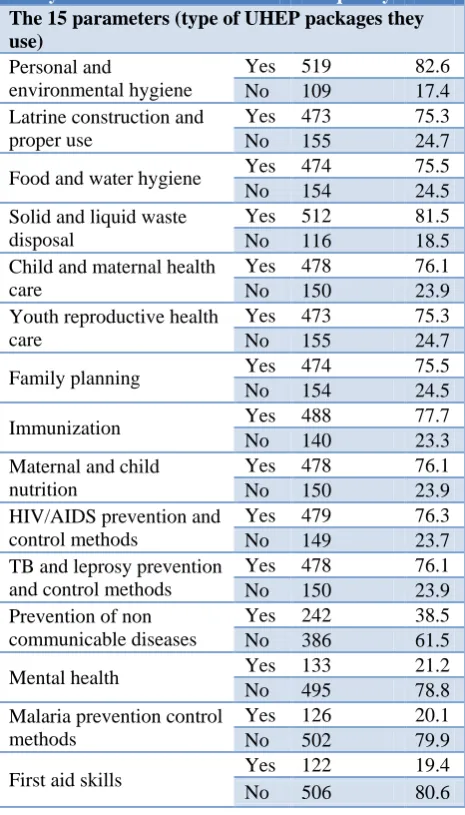
Three fourths, or 473 (75.3%) of the study participants had constructed and used a latrine properly. Moreover, above three fourths or 512 (81.5%) of the participants disposed of wastes properly. Also about 488 (77.7%), 478 (76.1%) and 474 (75.5%) of them had utilized immunization, child and maternal health and family planning services or packages, respectively. In addition, more than three fourths or 478 (76.1%) of the participants family had utilized maternal and child nutrition services. Regarding the HIV AIDS package, 479 (76.3%) of the participants who knew HIV/AIDS prevention and control methods had utilized them. Whereas packages like mental health, malaria prevention control methods and first aid skills packages were the least utilized (Table 3).
Table 1: Sociodemographic characteristics of the community of Gullele Sub-city, Addis Ababa
Ethiopia, 2018 (n=628).
Study variables Frequency Percentage
(%)
Age (in years)
18-22 25 4
23-27 75 11.9
28-32 100 15.9
33-37 91 14.5
38-42 87 13.9
43-47 44 7
48-52 66 10.5
>52 140 22.3
Sex
Male 56 8.9
Female 572 91.1
Educational status
Illiterate 132 21.0
Read and write 60 9.6
1-8 grade 192 30.6
9-12 grade 147 23.4
Above grade 12 97 15.4
Marital status
Single 78 12.4
Married 410 65.3
Widowed 100 15.9
Divorced 40 6.4
Religion
Orthodox 523 83.3
Muslim 53 8.4
Protestant 48 7.6
Other 4 0.6
Occupational status
House wife 383 61.0
Private 153 24.4
Merchant 27 4.3
Government employed 51 8.1
Daily labor 14 2.2
Family size
Less than 4 172 27.4
Above 4 456 72.6
Knowledge and attitude of respondent on the urban health extension services utilization
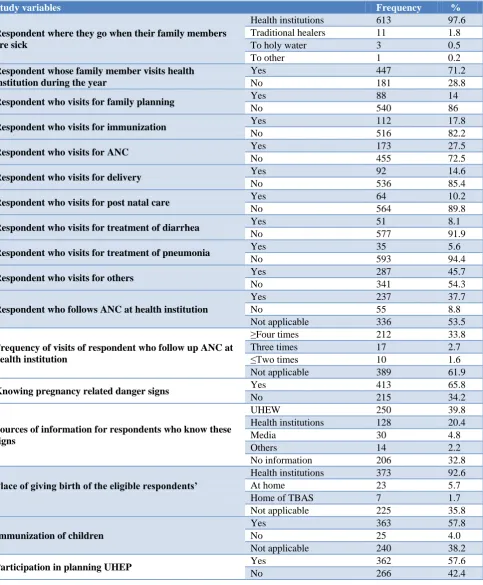
birth attendants (TBAS) within a year. Most of the respondents, 529 (84.2%) had graduated as model families. Of the total households, 283 (45.1%) were visited by urban health extension workers for four days per week. Within a year prior to the study, 265 (73%) of the eligible respondents obtained prevention of mother to child transmission of HIV (PMTCT) services (Table 4).
Table 2: Knowledge and status of urban health extension program/services utilization.
Study variables Frequency Percentage
(%)
Knowledge of the UHEP/services
Satisfactory 555 88.4
Unsatisfactory 73 11.6
Utilization of UHEP/services
Utilized 540 86
Unutilized 88 14
Table 3: The status of respondents’ utilization of the urban health extension packages.
Study variables Frequency %
The 15 parameters (type of UHEP packages they use)
Personal and
environmental hygiene
Yes 519 82.6
No 109 17.4
Latrine construction and proper use
Yes 473 75.3
No 155 24.7
Food and water hygiene Yes 474 75.5
No 154 24.5
Solid and liquid waste disposal
Yes 512 81.5
No 116 18.5
Child and maternal health care
Yes 478 76.1
No 150 23.9
Youth reproductive health care
Yes 473 75.3
No 155 24.7
Family planning Yes 474 75.5
No 154 24.5
Immunization Yes 488 77.7
No 140 23.3
Maternal and child nutrition
Yes 478 76.1
No 150 23.9
HIV/AIDS prevention and control methods
Yes 479 76.3
No 149 23.7
TB and leprosy prevention and control methods
Yes 478 76.1
No 150 23.9
Prevention of non communicable diseases
Yes 242 38.5
No 386 61.5
Mental health Yes 133 21.2
No 495 78.8
Malaria prevention control methods
Yes 126 20.1
No 502 79.9
First aid skills Yes 122 19.4
No 506 80.6
Practice of the respondents on utilization of the urban health extension services
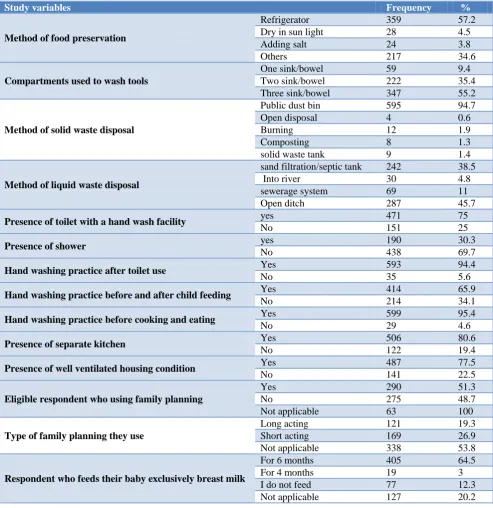
More than half of the respondents, 359 (57.2%) used a refrigerator for food preservation. Further, 347 (55.2%), 222 (35.4%) and 59 (9.4%) of respondents used a three, two and one compartment dish washing system to wash food utensils, respectively. With respect to solid waste disposal, 595 (94.7%) used proper solid waste storage (closed pedal dust bin) in their home and transferred to a public solid waste station. Whereas 4 (0.9%), 12 (1.9%), 8 (1.3%) and 9 (1.4%) used open disposal, burning, composting and disposing into a solid waste tank, respectively.
Concerning liquid waste disposal methods, 287 (45.7%) and 242 (38.5%) of the participants used an open ditch and sand filtration pit/septic tank, respectively. Moreover, 30 (4.8%) and 69 (11%) of them, released waste to the river and sewerage system, respectively. Regarding the presence of a toilet with hand washing facility and shower, 471 (75%) and 190 (30.3%) of the respondents had a toilet with hand washing facility and shower in their compound, respectively.
Regarding hand washing practices, 593 (94.4%), 599 (95.4%) and 414 (65.5%) had washed their hands after using the toilet, before cooking and eating food and before feeding child, respectively. Concerning the kitchen, 506 (80.6%) of respondents have a separate kitchen from their sleeping room. Regarding water sources, 580 (92.4%) of the respondents obtained water from tap water in their compound and 377 (65.1%) of the respondents use jarcan and other materials to store it. Moreover, regarding using family planning and type of family planning, 290 (51.3%) of the eligible respondents used family planning; of these 113 (20%) used long acting and 177 (31.3%) used short acting family planning methods. Regarding exclusive breast feeding and immunization, 405 (64.5%) and 363 (57.8%) fed exclusively for six months and immunized their children, respectively (Table 5).
Factors associated with utilization of urban health extension program services
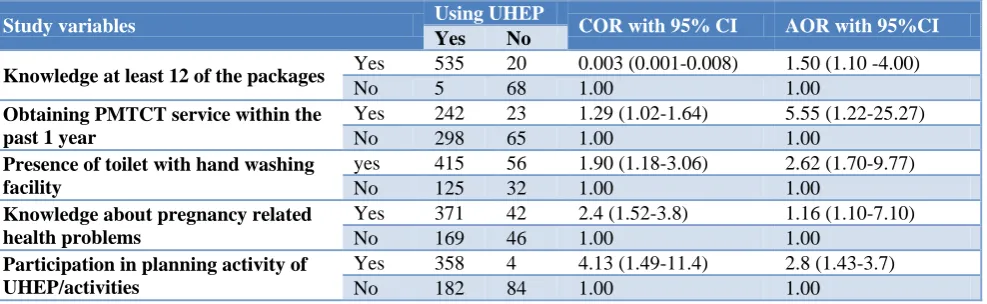
In the multivariable logistic regression model, knowledge of at least twelve packages (>75%) of the UHEP, PMTCT service, presence of toilet with hand washing facility, participation in planning activities of the UHEP and knowledge about pregnancy related health problems were significantly associated (p<0.05) with utilization of the urban health extension services.
using PMTCT services (AOR=5.55; 95% CI: 1.22-25.27) than those who did not use PMTCT services. Besides, the household respondents who utilized toilet with hand washing facilities had odds of utilizing urban health extension services that are higher by 2.62 (AOR=2.62 with 95% CI: 1.70-9.77) compared to those not utilizing toilet with hand washing facilities. The respondents‟ odds of utilizing urban health extension services among those
who participated in the planning of urban health extension program activities were 2.8 (AOR=2.8; 95% CI: 1.43-3.70) times the odds of those who did not participate. In addition, the odds of those who had knowledge about pregnancy related health problems were 1.16 (AOR=1.16; (95% CI: 1.10-7.10) times higher than those who had not (Table 6).
Table 4: Knowledge and attitudeof respondents towards the urban health extension services utilization.
Study variables Frequency %
Respondent where they go when their family members are sick
Health institutions 613 97.6
Traditional healers 11 1.8
To holy water 3 0.5
To other 1 0.2
Respondent whose family member visits health institution during the year
Yes 447 71.2
No 181 28.8
Respondent who visits for family planning Yes 88 14
No 540 86
Respondent who visits for immunization Yes 112 17.8
No 516 82.2
Respondent who visits for ANC Yes 173 27.5
No 455 72.5
Respondent who visits for delivery Yes 92 14.6
No 536 85.4
Respondent who visits for post natal care Yes 64 10.2
No 564 89.8
Respondent who visits for treatment of diarrhea Yes 51 8.1
No 577 91.9
Respondent who visits for treatment of pneumonia Yes 35 5.6
No 593 94.4
Respondent who visits for others Yes 287 45.7
No 341 54.3
Respondent who follows ANC at health institution
Yes 237 37.7
No 55 8.8
Not applicable 336 53.5
Frequency of visits of respondent who follow up ANC at health institution
≥Four times 212 33.8
Three times 17 2.7
≤Two times 10 1.6
Not applicable 389 61.9
Knowing pregnancy related danger signs Yes 413 65.8
No 215 34.2
Sources of information for respondents who know these signs
UHEW 250 39.8
Health institutions 128 20.4
Media 30 4.8
Others 14 2.2
No information 206 32.8
Place of giving birth of the eligible respondents’
Health institutions 373 92.6
At home 23 5.7
Home of TBAS 7 1.7
Not applicable 225 35.8
Immunization of children
Yes 363 57.8
No 25 4.0
Not applicable 240 38.2
Participation in planning UHEP Yes 362 57.6
No 266 42.4
Study variables Frequency %
Graduated model family in UHEP Yes 529 84.2
No 99 15.8
Certification in UHEP Yes 208 33.1
No 420 66.1
Frequently of urban health extension workers visit
Four day/ week 283 45.1
Two day/week 83 13.2
One day/week 143 22.8
No visit 119 18.9
Obtaining PMTCT service In the past 1 year
Yes 265 42.2
No 97 15.4
Not applicable 266 42.4
Table 5: Practice of the respondents on utilization of the urban health extension services.
Study variables Frequency %
Method of food preservation
Refrigerator 359 57.2
Dry in sun light 28 4.5
Adding salt 24 3.8
Others 217 34.6
Compartments used to wash tools
One sink/bowel 59 9.4
Two sink/bowel 222 35.4
Three sink/bowel 347 55.2
Method of solid waste disposal
Public dust bin 595 94.7
Open disposal 4 0.6
Burning 12 1.9
Composting 8 1.3
solid waste tank 9 1.4
Method of liquid waste disposal
sand filtration/septic tank 242 38.5
Into river 30 4.8
sewerage system 69 11
Open ditch 287 45.7
Presence of toilet with a hand wash facility yes 471 75
No 151 25
Presence of shower yes 190 30.3
No 438 69.7
Hand washing practice after toilet use Yes 593 94.4
No 35 5.6
Hand washing practice before and after child feeding Yes 414 65.9
No 214 34.1
Hand washing practice before cooking and eating Yes 599 95.4
No 29 4.6
Presence of separate kitchen Yes 506 80.6
No 122 19.4
Presence of well ventilated housing condition Yes 487 77.5
No 141 22.5
Eligible respondent who using family planning
Yes 290 51.3
No 275 48.7
Not applicable 63 100
Type of family planning they use
Long acting 121 19.3
Short acting 169 26.9
Not applicable 338 53.8
Respondent who feeds their baby exclusively breast milk
For 6 months 405 64.5
For 4 months 19 3
I do not feed 77 12.3
Not applicable 127 20.2
Study variables Frequency %
Sources of water
Tap water in the compound 580 92.4
Public tap water 34 5.4
Stream water 13 2.1
Other source 1 0.2
Storage of water
Water tank 184 29.3
Water pot 35 5.6
Jarcan and others 409 65.1
Table 6: Multivariable analysis.
Study variables Using UHEP COR with 95% CI AOR with 95%CI
Yes No
Knowledge at least 12 of the packages Yes 535 20 0.003 (0.001-0.008) 1.50 (1.10 -4.00)
No 5 68 1.00 1.00
Obtaining PMTCT service within the past 1 year
Yes 242 23 1.29 (1.02-1.64) 5.55 (1.22-25.27)
No 298 65 1.00 1.00
Presence of toilet with hand washing facility
yes 415 56 1.90 (1.18-3.06) 2.62 (1.70-9.77)
No 125 32 1.00 1.00
Knowledge about pregnancy related health problems
Yes 371 42 2.4 (1.52-3.8) 1.16 (1.10-7.10)
No 169 46 1.00 1.00
Participation in planning activity of UHEP/activities
Yes 358 4 4.13 (1.49-11.4) 2.8 (1.43-3.7)
No 182 84 1.00 1.00
DISCUSSION
The results of this study revealed that the proportion of the community utilization of urban health extension packages /services was 86%. This finding was higher than a study conducted three years ago in Gindeberet in which the proportion of utilization of health extension was found to be 39% with 95% CI of (4.0, 12.0%). This might be due to the level of commitment of health extension workers and supervisors or difference in the study area. Moreover, this higher result may be due to the economic status of the urban residents which may assist them in implementing the packages of UHEP at the urban area. Besides, this could be due to the possibility of higher educational status and gretaer awareness to the advantages of the packages of the program among the urban residents than the rural population.
Respondents who had knowledge about UHEP enhanced their utilization of the packages from the urban health extension program. This could be due to provding effective theoretical and practical training to the participants. Moreover, it may be due to the presence of good relationships between urban health extension professionals and their model households.
Part of health promotion and diseases prevention and control activities were improved among the respondents who were utilizing the urban health extension program. Because using hand washing facilities, PMTCT services and knowledge about pregnancy related health problems were higher among the model household members or participants of the urban health extension program. This
could be due to the effective transfer of health knowledge through the urban health extensions professionals to their model households. Moreover, it might be due to good psychological acceptance of the program packages among the participants rather than those who did not participate and utilize the packages.
Of all the 15 urban health extension program packages/services, personal and environmental hygiene, solid and liquid waste disposal, latrine construction and proper use, knowing HIV AIDS prevention and control methods were among the highly utilized services by the study participants. This might be due to strong awareness of the environmental hygiene and sanitation and HIV AID packages. Moreover, it could be due to the major governmental attention in order to create citizens who are more informed about proper health care.
governmental and nongovernmental organizations though providing of training to the community to create a knowledgeable society.
Of the total respondents, 519 (82.6%) and 512 (81.2%) of the study participants had personal and environmental hygiene practice and used proper solid and liquid management respectively. This result was consistent with a study conducted on Strengthening Ethiopia‟s Urban Health Program (SEUHP) by John Snow Inc, Addis Ababa, Ethiopia, on the situational analysis of urban sanitation and waste management.24 However, services of the urban health extension like first aid skills, malaria prevention and control, non-communicable diseases prevention and control and mental health care were services less utilized [122 (19.4%), 126 (20.1%), 133 (21.2%) 244 (38.5)], respectively. This may be due to lack of attention or disinterest in the packages.
CONCLUSION
The study provided important information regarding the status of community utilization of urban health extension services and associated factors. These results indicate that utilizing urban health extension services and the presence of knowledge among the respondents had a direct relationship. Being a graduated model household in the urban health extension program has enhanced the utilization of the program packages. The household respondents who utilized toilet with hand washing facilities was higher among the respondents who utilized and implemented the urban health extension packages. Moreover, respondents who participated in the planning of urban health extension program activities were implemented the urban health extension program. Of the packages of urban health extension program, personal and environmental hygiene, solid and liquid management were among those highly utilized by most of the participants.
Although the proportion of community‟s utilization of the urban health extension service was relatively high, the packages of first aid skills, malaria prevention and control, non communicable diseases prevention and control and mental health were among the services less utilized by the study participants. Thus, the Gullele Health Office, Addis Ababa Health Bureau, Federal Ministry of Health and other concerned bodies should be creating intensive awareness targeted to increase community implementation and utilization of these urban health extension services. In particular, the less implemented and utilized packages like first aid skills, malaria prevention and control, non communicable diseases prevention and control, requires a new strategy in order to narrow the gap. In addition, further research should be undertaken to determine factors affecting utilization of health extension services from the perspective of both urban health extension workers and the community on a wider scale.
Limitations of the study
Even though, this study provided important information regarding the status of community‟s utilization of urban health extension services and assessed some of the factors that influence health extension service utilization among communities, lack of previous related studies conducted on this particular topic, being a cross sectional study, social desirability and recall bias among study participants were the drawback of this study.
ACKNOWLEDGEMENTS
We the authors wish to thank to Gullele Sub-city Health Office and Gullele sub-city administration for their permission to undertake this research. In addition, we the authors like to express our gratitude to the data collectors, supervisors and study participants.
Funding: No funding sources Conflict of interest: None declared
Ethical approval: The study was approved by the Institutional Ethics Committeeof Gullele Health Office
REFERENCES
1. Kok MC, Dieleman M, Taegtmeyer M, Broerse JE,
Kane SS, Ormel H, et al. Which intervention design factors influence performance of community health workers in low-and middle-income countries? A
systematic review. Health Policy Planning.
2014;30(9):1207-27.
2. Admasu K, Balcha T, Getahun H. Model villages: a platform for community-based primary health care. Lancet Global Health. 2016;4(2):78-9.
3. Donnelly J. Ethiopia gears up for more major health reforms. The Lancet. 2011;377(9781):1907-8.
4. Fetene N, Linnander E, Fekadu B, Alemu H, Omer
H, Canavan M, et al. The Ethiopian health extension
program and variation in health systems
performance: what matters? PloS One.
2016;11(5):e0156438.
5. Workie NW, Ramana GN. The health extension program in Ethiopia. 2013.
6. Edhs M. Ethiopia Mini Demographic and Health Survey. Ethiopia: Central Statistical Agency Addis Ababa. 2014.
7. Admassie A, Seid N, May JF, Megquier S,
Moreland S. The demographic dividend: An
opportunity for Ethiopia„s transformation.
Washington, DC: Population Reference Bureau and Ethiopian Economics Association. 2015.
8. Jackson R, Tesfay FH, Godefay H, Gebrehiwot TG.
Health Extension Workers' and Mothers' Attitudes to Maternal Health Service Utilization and Acceptance in Adwa Woreda, Tigray Region, Ethiopia. PLoS One. 2016;11(3):e0150747.
health services in Tigray Region, Ethiopia: a segmented linear regression analysis. PloS one. 2015;10(7):e0131195.
10. Kelbessa Z, Baraki N, Egata G. Level of health extension service utilization and associated factors among community in Abuna Gindeberet District, West Shoa Zone, Oromia Regional State, Ethiopia. BMC Health Services Res. 2014;14(1):324.
11. Teklehaimanot HD, Teklehaimanot A, Tedella AA, Abdella M. Use of balanced scorecard methodology for performance measurement of the Health Extension Program in Ethiopia. Am J Tropical Med Hygiene. 2016;94(5):1157-69.
12. Yitayal M, Berhane Y, Worku A, Kebede Y. The
community-based Health extension Program
significantly improved contraceptive utilization in West gojjam Zone, ethiopia. J Multidisciplinary Healthcare. 2014;7:201.
13. Koblinsky M, Tain F, Gaym A, Karim A, Carnell M, Tesfaye S. Responding to the maternal health care challenge: The Ethiopian Health Extension Program. Ethiopian J Health Develop. 2010;24(1). 14. Jackson R, Hailemariam A. The role of health
extension workers in linking pregnant women with health facilities for delivery in rural and pastoralist areas of Ethiopia. Ethiopian J Health Sci. 2016;26(5):471-8.
15. Lemma S, Nahusenay MH, Egata G, Yitayal M, Tewahido MD, Berhane Y, et al. Strengthening Ethiopia‟s Urb. 2015.
16. Sibamo EL, Berheto TM. Community satisfaction with the urban health extension service in South Ethiopia and associated factors. BMC Health Services Res. 2015;15(1):160.
17. Banteyerga H. Ethiopia‟s health extension program: improving health through community involvement. MEDICC Rev. 2011;13(3):46-9.
18. Amare SA. The impact of Ethiopian Health Services Extension Program on maternal and child health outcomes: the case of Tigray Region. 2013.
19. Tesfa B, Jibat N. Health Extension Program as innovative health care service: the socio-cultural
factors affecting its implementation in Jimma Zone, South Western Oromia. Int J Sociol Anthropol. 2014;6(8):235-45.
20. Gebreegziabher EA, Astawesegn FH, Anjulo AA, Kerie MW. Urban Health Extension Services Utilization in Bishoftu Town, Oromia Regional State, Central Ethiopia. BMC Health Services Res. 2017;17(1):195.
21. Kok MC, Kea AZ, Datiko DG, Broerse JE,
Dieleman M, Taegtmeyer M, et al. A qualitative
assessment of health extension workers‟
relationships with the community and health sector in Ethiopia: opportunities for enhancing maternal health performance. Human Resources Health. 2015;13(1):80.
22. Medhanyie A, Spigt M, Kifle Y, Schaay N, Sanders D, Blanco R, et al. The role of health extension workers in improving utilization of maternal health services in rural areas in Ethiopia: a cross sectional study. BMC Health Services Res. 2012;12(1):352. 23. San Sebastian M, Lemma H. Efficiency of the
health extension programme in Tigray, Ethiopia: a data envelopment analysis. BMC International Health Human Rights. 2010;10(1):16.
24. Teklehaimanot HD, Teklehaimanot A. Human
resource development for a community-based health extension program: a case study from Ethiopia. Human Resources Health. 2013;11(1):39.
25. Bekele A, Kefale M, Tadesse M. Preliminary assessment of the implementation of the health services extension program: the case of southern Ethiopia. Ethiopian J Health Develop (EJHD). 2016;22(3):302-5.