Original Research Article
Knowledge, attitude and practices regarding generic medicines
and its usage: a community-based study
Kirthinath Ballala
1,2, Chythra R. Rao
1,2*, Aparna S. Chaudhary
1,2,
Ashwini S. Bidnurmath
1,2, Akhilesh K. Pandey
1,2INTRODUCTION
Medicines play a pivotal role in the process of human development as their rational utilization can decrease morbidity, mortality and improve one’s quality of life.1 Affordability and accessibility of medications is crucial, but they have become a challenge due to escalating healthcare expenditures globally. India has been referred to as the pharmacy of the low-income and middle-income
world.2 Globally, India’s pharmaceutical industry is the third largest in terms of volume of medicines exported.3 Despite this, several essential medicines remain inaccessible within India especially to the poor, due to policy and implementation failures in ensuring access.4,5
In developing countries like India where private pharmacy companies form the main source of medicines
ABSTRACT
Background: India is the largest provider of generic medications globally. Despite this, several essential medicines remain inaccessible to majority of the general population, due to poor awareness, unavailability of drugs, distrust about the quality of the medicines, poor policy implementation and inadequate recommendation by doctors.
Methods: A community-based cross-sectional study was carried out among 1151 adults in rural and urban areas attached to the community outreach area of a University Medical College. Written informed consent was taken from the participants. Data was collected using a pre-tested semi-structured online questionnaire and analysed using SPSS 15.0.
Results: Knowledge regarding generic medicines was found to be low among the surveyed population (666, 57.9%), irrespective of their socio-economic status, education, occupation, place of residence or presence of chronic illnesses. As the knowledge was poor, participants were briefed about the generic medicines and their benefits. Thereafter, the attitude was assessed and found to be favourable among more than half (633, 55.0%) of the surveyed population. The usage of Generic medicines was found to be poor among the respondents. Only 53 (4.6%) of the total study population had switched from branded to generic medicines in the past six months as generic medicines were less expensive compared to their branded counterparts.
Conclusions: The awareness about generic drugs and its usage was poor in the surveyed population. A favourable attitude towards generic drugs was achieved by educating the people about their similarity to branded medications. Therefore, there is a need to educate people not only about the quality, safety and efficacy of the generic medicines but also about the government initiatives like the Jan Aushadhi scheme.
Keywords: Generic drugs, Jan Aushadhi, Awareness, Usage, Cross-sectional
Department of Community Medicine, 1Kasturba Medical College, Manipal, 2Manipal Academy of Higher Education, Manipal, Karnataka, India
Received: 28 February 2019
Accepted: 04 April 2019
*Correspondence:
Dr. Chythra R. Rao,
E-mail: [email protected]
Copyright: © the author(s), publisher and licensee Medip Academy. This is an open-access article distributed under the terms of the Creative Commons Attribution Non-Commercial License, which permits unrestricted non-commercial use, distribution, and reproduction in any medium, provided the original work is properly cited.
in the market, drug pricing becomes a major issue. In India, very few people have health insurance, which leads to 70% of Indians paying for healthcare out of their own pockets. With the expanding healthcare expenses, the significance of the generic drugs has augmented worldwide.6
To counter this, the Government of India in 2008 launched the ―Jan Aushadhi Campaign" to provide quality generic medicines. By the end of 2017, 3075 Generic Medicine Stores were opened countrywide to
reduce expenditure; increase accessibility and
affordability of medications for the general population.7 Generic medicines as defined by Food and Drug Administration (FDA) of United States of America are not only alike to a branded drug in its dosage, safety, quality and efficacy but they are also inexpensive in
comparison to the branded counterparts.8 The
manufacturing pharmaceutical companies advertise their brand to make them popular, influence the prescription behaviour to increase the sale of their own branded medicine, and once the brand is established, make money out of it by pricing their medicines exorbitantly, which is why compared to their branded counterparts, generic medications are less expensive and more affordable.9
Though the common perception seems to be that Generic Medicines are of poor quality, studies have shown Generic Medicines to have the same composition and quality as branded medications.10-13 Despite this, usage of Generic medication has not become a communally acceptable practice in India. Some determining factors could be poor awareness among the general population, non-availability of drugs, distrust about the quality of the medicine and doctors not recommending generic medicines.14,15 With this background, the current study was designed to assess the knowledge, attitude and practices of the general population towards generic medications and their usage in Udupi district where a larger proportion of people visit private health-care settings.
METHODS
A community-based cross-sectional study was carried out in the field practice area of Department of Community Medicine attached to a University Medical College in Udupi District of Karnataka. The field practice area caters to a population of 40,000 individuals through a range of primary health care services provided through rural health centres and auxiliary nurse midwives. The study was conducted for duration of one month (January 2018- February 2018). Study population included all adults aged 18 years and above who were willing to participate in the study. Written informed consent was taken and data was collected using personal interviews of the participants. Data was collected using pre-tested semi-structured questionnaire using Google form (Annexure 1). The questionnaire and the proforma were developed,
Department of Community Medicine. With respect to validity of the questionnaire, content validity and face validity was tested and evaluated with the help of experts from Community Medicine. The reliability of the questionnaire was tested among different settings - rural & urban areas & population including various age groups & across gender, in the form of a pilot study. Google forms were employed as part of the go green initiative and ease of use. The forms were created by using docs.google.com/forms. A blank format was chosen, to which the questions along with choice of options were added. The forms provided multiple options to choose the field types, such as multiple choice, checkboxes, short answer etc. It also allows sharing the form with multiple users. The forms also have a response tab wherein we could check the current response and further pool the collected data into Excel spreadsheets. Faculty along with post-graduates, medico-social workers and auxiliary nurse midwives working in the department were involved in collection of data in the community. Prior to data collection, all data collectors were trained to use the google forms. The questionnaire link on the google form was shared with the data collectors on their respective mobile phones. The questionnaire was administered by the data collector to the patients visiting the rural health clinics to test for its feasibility before administering it among the general population. The questions were asked by the trained assistants to the patients; the answers provided by the patients were entered in the google forms by the trained assistants. The questionnaire collected information about the socio-demographic details, health-seeking behaviour, morbidity profile of the family was collected in addition to their knowledge, attitude and practices regarding generic medications. All the individuals aged 18 years and above who voluntarily participated in the study were included while the participants who did not provide consent were excluded from the study. The participants were given brief information about generic medicines after the data collection was done. Issues addressed in this were: why were generic medicine stores started by the government of India, the composition of generic medications and how their composition is similar as that of their branded counterparts, their affordability, reason for their low cost and finally about their similar adverse effects profile. They were also given information about the generic medical stores located in the town. The data collection was done on mobile phones using the google forms. At the end of each day, as the data collectors submitted their forms online, the information automatically got updated to a Google forms database. The data thus captured was automatically transcribed onto excel format which could be further downloaded and analysed.
Sample size calculation
to be 5% among general population,16 with 30% relative precision, at 95% confidence level. Sample size obtained was 844. Accounting for 10% non-response rate, the final sample size needed was 928.
Scoring system
Knowledge – Knowledge component had 17 main questionswith few sub-questions. For each main question a score of 1 was given to every correct answer and zero for incorrect. The score was then calculated. Maximum score of 14 was obtained out of 17 in the results with 57.8% (666) having a score of zero. As a result of this, while reporting a total score of zero was considered as no knowledge while a score of one or more was considered as some knowledge. The scoring pattern was based on the decision of the authors.
Attitude – Attitude component had 11 main questions and for each question a score of 1 was given to every correct response and 0 for incorrect answer. The score was then calculated. Maximum total score was 9 was obtained out of 11 in the results. A score of 5 and above was taken as favourable attitude and a score less than 5 as unfavourable.
Practice – Practice component had 5 questions and for each question a score of 1 was given to every correct response and 0 for incorrect answer. The score was then calculated. Maximum total score of 2 was obtained out 5 in the results. For evaluation, a score of zero was taken as no practice while score of 1 and/or 2 was taken as some practice.
Data analysis
The data was entered and analysed in SPSS version 15.0. Data was summarized as frequencies and percentages. Chi-square test was used to test the association between various variables (age, profession, education etc.) and knowledge, attitude and practices. A p value of <0.05 was considered to be statistically significant.
RESULTS
Socio-demographic details
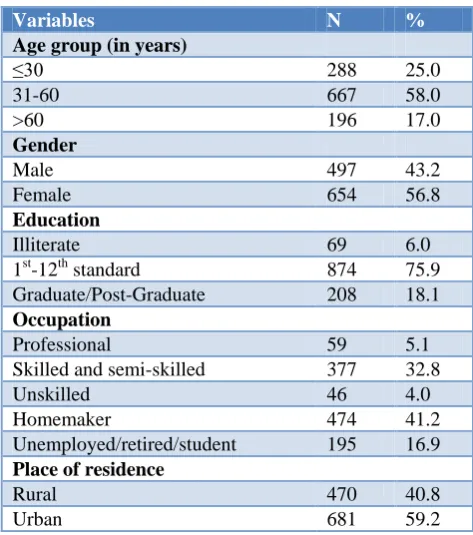
In the study, a total of 1151 individual were interviewed. More than half, 667 (58%) of the study population belonged to the age group of 31-60 years with a mean age of 43.5±16.2 years. Of the surveyed population 654 (56.8%) were females. Out of 1151, 1082 (94%) of the individuals were literate; with most of them being educated upto 12th standard (874, 75.9%).
Of the surveyed population, 474 (41.2%) were homemakers while 377 (32.8%) belonged to skilled and semi-skilled working class (Table 1).
Table 1: Socio-demographic profile of the study population (n=1151).
Variables N %
Age group (in years)
≤30 288 25.0
31-60 667 58.0
>60 196 17.0
Gender
Male 497 43.2
Female 654 56.8
Education
Illiterate 69 6.0
1st-12th standard 874 75.9
Graduate/Post-Graduate 208 18.1
Occupation
Professional 59 5.1
Skilled and semi-skilled 377 32.8
Unskilled 46 4.0
Homemaker 474 41.2
Unemployed/retired/student 195 16.9
Place of residence
Rural 470 40.8
Urban 681 59.2
Nearly half, 538 (46.7%) of the individuals felt that Doctor’s prescription was the most important factor influencing the purchase of the type of medications. One-third of the population, 487 (42.3%) also felt that price of the medication along with Doctor’s prescription was another major factor which influenced the purchase of medication.
Knowledge
Table 2: Knowledge regarding generic medicine among the study participants (n=1151).
Variable No knowledge (n=666) Some knowledge
(n=485)
P value by chi-square test
N (%) N (%)
Card holder
BPL Card (n=587) 332 (56.6) 255 (43.4)
0.297
APL Card (n=454) 263 (57.9) 191 (42.1)
No Card (n=110) 71 (64.5) 39 (35.5)
Health insurance
Have health insurance (n=635) 367 (57.8) 268 (42.2)
0.504
Do not have Health insurance (n=516) 299 (57.9) 217 (42.1)
Chronic illness
With chronic illness (n=327) 184 (56.3) 143 (43.7)
0.508
Without chronic illness (n=824) 482 (58.2) 342 (41.5)
Area
Rural (n=470) 273 (58.1) 197 (41.9)
0.474
Urban (n=681) 393 (57.7) 288 (42.3)
Education
Illiterate (n=69) 40 (58) 29 (42)
0.612
1st to 12th Standard (n=874) 512 (58.6) 362 (41.4)
Graduate/ Post-Graduate (n=208) 114 (54.8) 94 (45.2)
Occupation
Professional (n=59) 30 (50.8) 29 (49.2)
0.696
Skilled & Semi-skilled (n=377) 226 (59.9) 151 (40.1)
Unskilled (n=46) 25 (54.3) 21 (45.7)
Homemaker (n=474) 271 (57.2) 203 (42.8)
Unemployed/Retired/Student (n=195) 114 (58.5) 81 (41.5)
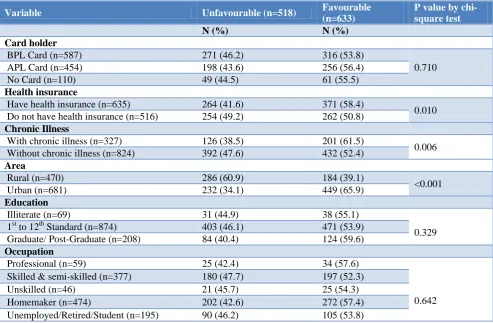
Table 3: Attitude of the study participants towards generic medicines (n=1151).
Variable Unfavourable (n=518) Favourable
(n=633)
P value by chi-square test
N (%) N (%)
Card holder
BPL Card (n=587) 271 (46.2) 316 (53.8)
0.710
APL Card (n=454) 198 (43.6) 256 (56.4)
No Card (n=110) 49 (44.5) 61 (55.5)
Health insurance
Have health insurance (n=635) 264 (41.6) 371 (58.4)
0.010
Do not have health insurance (n=516) 254 (49.2) 262 (50.8)
Chronic Illness
With chronic illness (n=327) 126 (38.5) 201 (61.5)
0.006
Without chronic illness (n=824) 392 (47.6) 432 (52.4)
Area
Rural (n=470) 286 (60.9) 184 (39.1)
<0.001
Urban (n=681) 232 (34.1) 449 (65.9)
Education
Illiterate (n=69) 31 (44.9) 38 (55.1)
0.329
1st to 12th Standard (n=874) 403 (46.1) 471 (53.9)
Graduate/ Post-Graduate (n=208) 84 (40.4) 124 (59.6)
Occupation
Professional (n=59) 25 (42.4) 34 (57.6)
0.642
Skilled & semi-skilled (n=377) 180 (47.7) 197 (52.3)
Unskilled (n=46) 21 (45.7) 25 (54.3)
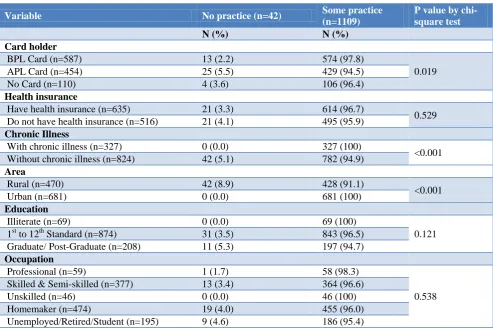
Table 4: Association of socio-demographic variables with utilization of generic medicines among the study participants (n=1151).
Variable No practice (n=42) Some practice
(n=1109)
P value by chi-square test
N (%) N (%)
Card holder
BPL Card (n=587) 13 (2.2) 574 (97.8)
0.019
APL Card (n=454) 25 (5.5) 429 (94.5)
No Card (n=110) 4 (3.6) 106 (96.4)
Health insurance
Have health insurance (n=635) 21 (3.3) 614 (96.7)
0.529
Do not have health insurance (n=516) 21 (4.1) 495 (95.9)
Chronic Illness
With chronic illness (n=327) 0 (0.0) 327 (100)
<0.001
Without chronic illness (n=824) 42 (5.1) 782 (94.9)
Area
Rural (n=470) 42 (8.9) 428 (91.1)
<0.001
Urban (n=681) 0 (0.0) 681 (100)
Education
Illiterate (n=69) 0 (0.0) 69 (100)
0.121
1st to 12th Standard (n=874) 31 (3.5) 843 (96.5)
Graduate/ Post-Graduate (n=208) 11 (5.3) 197 (94.7)
Occupation
Professional (n=59) 1 (1.7) 58 (98.3)
0.538
Skilled & Semi-skilled (n=377) 13 (3.4) 364 (96.6)
Unskilled (n=46) 0 (0.0) 46 (100)
Homemaker (n=474) 19 (4.0) 455 (96.0)
Unemployed/Retired/Student (n=195) 9 (4.6) 186 (95.4)
Attitude
Since it was observed that the knowledge was poor among the surveyed population irrespective of their socio-economic status, education, occupation, place of residence and presence or absence of chronic illnesses, a brief introduction regarding generic medicines was given before assessing the attitude of the individuals. A favourable attitude was observed in almost half (633, 55.0%) of the surveyed population after being informed about the generic medicines and their benefits. Among the cardholders, APL card holders showed the most favourable attitude (256, 56.4%) followed by no card holders (61, 55.5%) and BPL card holders (316, 53.8%). A significantly (p<0.05) favourable attitude was observed among people with health insurance (371, 58.4%), people with chronic illness (201, 61.5%) and among those residing in urban area (449, 65.9%). People with higher education i.e., graduates and post-graduates showed favourable attitude (124, 59.6%) towards generic medicines and its usage compared to illiterates (38, 55.1%) and individuals with education up to 12th standard (471, 53.9%). Professionals and individuals with white collar jobs (34, 57.6%) and homemakers (272, 57.4%) showed a higher favourable attitude compared to other working classes (Table 3).
Practices
As the knowledge was poor, usage of generic medicine was also found to be poor in the surveyed population.
Most (1057, 91.8%) of the surveyed population did not procure generic medicines due to lack of awareness or poor knowledge about them. Only 53 (4.6%) of the total study population had switched from branded to generic medicines in the past six months.
DISCUSSION
In India, almost 70% of the expenditure made in healthcare sector is out of pockets.6 With this background, generic medicines were introduced in 2008 by Government of India under the ―Jan Aushadhi Campaign‖ to provide medications at an affordable price.15 Despite this the awareness regarding generic medicines is poor in the population. This gap of knowledge could be attributed to distrust about the quality and efficacy of these medicines among the health-care providers.16 A similar finding was observed in the systematic review wherein lack of trust towards the manufacturers and the drug quality were the main reasons listed by pharmacists and physicians for reduced amount of usage of generic drugs in less established healthcare systems.17 In contrast, participants had basic knowledge and showed a positive attitude towards generic medicines and generic substitution in Palestinian community pharmacies.18 However, a study conducted in Belagavi, Karnataka to assess and increase the knowledge of physicians and pharmacist towards generic drugs and its usage. The results of the study showed an improvement in the perception of physicians and pharmacists towards generic drugs use after the educational session.19
Studies done in past were mainly conducted among the healthcare providers to understand their perception of generic medicines, but very few studies were done among the general population to assess their awareness and perceptions towards generic medicines. Better knowledge and perception of generic medicines is crucial in the successful adoption of national generic medicine policy and guidelines and could be greatly complemented by pharmacists and other health care providers.17 In a systematic review by Dunne SS et al. it was concluded that more than healthcare providers, it was the patients’ who had mistrust in the generic medications as they believed that low cost was equivalent to lower quality.20 In contrast another systematic review concluded that, a significant proportion of doctors, pharmacists and lay people hold negative perceptions about generic medicines. It is likely these attitudes present barriers to the wider use of generics.21
The present study assessed the knowledge, attitude and practice of the general population in both rural and urban settings of Udupi district towards generic medications. The mean age of the study population was 43.5±16.2 years which was higher than the mean age of the respondents in study done in Brazil by Lira et al (37.1±15.8 years).22 In this study, most of the respondents were females (654, 56.8%) which was similar to that of a
Malaysian study (112, 55.4%) and a Brazilian study (180, 64.7%)respectively.22,23
Nearly 90% (1025) of the surveyed individuals adhered to their doctor’s prescription while purchasing medications which was comparable to the study from Malaysia (143, 70.8%).23
Only 42.1% of the individuals in our study population had heard about the generic drugs, which was similar to that of a study done by Wong et al (49%); where the educational status of the population interviewed was similar to the present study.23 The awareness was found to be more in comparison to a study done by Hebbar et al (5%).24 The awareness regarding generic drugs was reported to be 99.6%, by Lira et al, due to the introduction of generic drugs nearly two decades ago.22
With respect to usage of generic drugs, 132 (11.5%) respondents or their family members had taken generic drugs in past and only 157 (13.6%) usually purchased generic medicines. In a study from Brazil, the usage (81%) and purchase (78.3%) was far higher than the present study population.22 The good results obtained among the Brazilian population was attributed to awareness-heightening and popularization programs for generic drugs, run by the Brazilian Government and the pharmaceutical companies producing these types of medications.
Limitations
The present study was limited to the awareness and practices of the lay public towards generic drugs in a specific geographical area. The findings could be further strengthened by involving the practitioners’ perspective on generic drugs. Attitudes and beliefs of doctors and pharmacists with respect to generic drugs could not be assessed. The acceptance of generic medicines could only be strengthened when the doctors believe in the utility and efficacy of the generic drugs and prescribe the same, as the lay public rely on a doctors’ prescription for purchasing drugs.
CONCLUSION
ACKNOWLEDGEMENTS
The authors wish to express their gratitude to the participants of the study and the staff of Jan Aushadhi stores for providing all the necessary details about generic medicines.
Funding: No funding sources Conflict of interest: None declared Ethical approval: Not required
REFERENCES
1. Basak SC, Sathyanarayana D. Exploring knowledge
and perceptions of generic medicines among drug retailers and community pharmacists. Indian J Pharm Sci. 2012;74(6):571-5.
2. Jack A. ―World’s pharmacy‖ faces new challenges
from Western drug companies. BMJ.
2012;345:6207.
3. Annual report 2014-15. New Delhi:Ministry of chemicals and fertilizers;2015. Available at http://chemicals.nic.in/sites/default/files/Annual%20 report2014-15.pdf. Accessed on 29 April 2018. 4. Maiti R, Bhatia V, Padhy BM, Hota D. Essential
medicines: An Indian perspective. Indian J Community Med. 2015;40(4):223-32.
5. Bhargava A, Kalantri SP. The crisis in access to essential medicines in India: key issues which call for action. Indian J Med Ethics. 2013;10:86–95.
6. Galani V. Choice of better medicine in
India:Branded vs Generic Medicine. Pharma Pharmacol Int J. 2017;5(3):00125.
7. Introduction to Jan Aushadhi. Available at
http://www.janaushadhi.gov.in/
about_jan_aushadhi.html. Accessed 29 April 2018. 8. Ahire K, Shukla M, Gattani M, Singh V, Singh M.
A survey-based study in current scenario of Generic and Branded Medicine. 2013;5(3):705-11.
9. Janodia M. Differences in price of medicines available from pharmaceutical companies and ―Jan Aushadhi‖ stores. Value Health. 2015;18:850. 10. Patel A, Gauld R, Norris P, Rades T. Quality of
generic medicines in South Africa:perceptions versus reality—a qualitative study. BMC Health Serv Res. 2012;12:297.
11. Aivalli PK, Elias MA, Pati MK, Bhanuprakash S, Munegowda C, Shroff ZC et al. Perceptions of the quality of generic medicines:implications for trust in public services within the local health system in Tumkur, India. BMJ Global Health. 2018;2:644. 12. Singh B, Nanda A, Budhwar V, Marwaha RK. A
comparative evaluation of the quality & price of generic medicine with their branded counterparts. Pharma Tutor. 2016;4:43-9.
13. Singal GL, Nanda A, Kotwani A.A comparative evaluation of price and quality of some branded versus branded–generic medicines of the same manufacturer in India. Indian J Pharmacol. 2011;43(2):131–6.
14. Indian Brand Equity Foundation; 2017. Available at https://www.ibef.org/industry/pharmaceutical-india.aspx. Accessed on 5 May 2018.
15. Accessibility, Acceptability, Affordability: A National Perspective Pradhan Mantri Bhartiya
Janaushadhi Pariyojana 2015. Available at
http://janaushadhi.gov.in/ pmjy.aspx. Accessed on 27 January 2019
16. Das M, Choudhury S, Maity S, Hazra A, Pradhan T, Pal A, et al. Generic versus Branded Medicine: An observational study among patients with chronic diseases attending a public hospital outpatient department. J Natural Sci Biol Med. 2017;8(1):26-31.
17. Toverud EL, Hartmann K, Håkonsen H. A
systematic review of physicians’ and pharmacists’ perspectives on generic drug use:what are the global challenges? Applied Health Economics Health Policy. 2015;13(1):35-45.
18. Shraim NY, Al Taha TA, Qawasmeh RF, Jarrar HN,
Shtaya MAN, Shayeb LA, et al. Knowledge, attitudes and practices of community pharmacists on generic medicines in Palestine:a cross-sectional study. BMC Health Serv Res. 2017;17(1):847. 19. Rashmilata R, Shivputrayya GM, Geetanjali S.
Knowledge and Self-Practice of Pharmacists and Prescribers Towards the Uses of Generic Drugs In Community Settings in Belagavi, Karnataka, INDIA. Indian J Pharm Pract. 2016;9(4):219. 20. Dunne SS, Dunne CP. What do people really think
of generic medicines? A systematic review and critical appraisal of literature on stakeholder
perceptions of generic drugs. BMC Med.
2015;13:173.
21. Colgan S, Faasse K, Martin LR, Stephens MH, Grey A, Petrieet KJ. Perceptions of generic medication in the general population, doctors and pharmacists: a systematic review. BMJ Open 2015;5:008915. 22. Lira CA, Oliveira JN, Andrade MS,
Vancini-Campanharo CR, Vancini RL. Knowledge,
perceptions and use of generic drugs: a cross
sectional study. Einstein (Sao Paulo).
2014;12(3):267-73.
23. Wong ZY, Hassali MA, Alrasheedy AA, Saleem F,
Yahaya AH, Aljadhey H. Patients’ beliefs about generic medicines in Malaysia. Pharma Pract. 2014;12(4):474.
24. Hebbar SK, GK Nalini, P Deepak, Sahana GN, Nagaral JV. Assessment of awareness of generic
drugs among healthcare professionals and
laypersons. Int J Basic Clin Pharmacol.
2017;6(3):680-3.