* To whom all correspondence should be addressed. E-mail: [email protected]
Investigating the Relationship between Perceived
Usefulness and Satisfaction with Query Reformulation
Tools: The Viewpoints of Information Sciences Researchers
Hoda Shaker1,2*, Mohammad Reza Farhadpoor3 and Fariba Nazari3
1Expert of Scientometrics, Vice-Chancellor of Development of Research and Technology, Ahvaz Jundishapur University of Medical Sciences, Ahvaz, Iran. 2MA in Information Science and Knowledge, Department of Information Science
and Knowledge, Faculty of Literature and Humanity, Ahvaz Branch, Islamic Azad University of Ahvaz, Ahvaz, Iran.
2Faculty member of Information Sciences and Knowledge Department, Faculty of Literature and Humanity, Ahvaz Branch, Islamic Azad University of Ahvaz, Ahvaz, Iran. 3Faculty member of Information Sciences and Knowledge Department, Faculty of Literature and
Humanity, Ahvaz Branch, Islamic Azad University of Ahvaz, Ahvaz, Iran. http://dx.doi.org/10.13005/bbra/2048
(Received: 28 January 2016; accepted: 20 February 2016)
This study aims to study the relationship between perceived usefulness and satisfaction with query reformulation tools in the Science Direct Database. A descriptive analytic method was used to study the relationship between variables; the data were collected using a researcher-made questionnaire. The participants were selected among the students of Information Sciences in Islamic Azad University of Research and Science Center of Khuzestan (n = 28). The findings showed that users main reason for query reformulation was not having enough time to investigate all retrieved results (Mean = 4.66). They also showed that based on perceived satisfaction and usefulness, the users used the query tools which bounded them to the topic (Mean = 3.92 for usefulness and M = 3.83 for satisfaction). In addition, Pearson’s correlation co-efficiency (r = 0.939) at (0.001) significance level showed that users perceived usefulness from query reformulation tools increased satisfaction. Perceiving the usefulness of query reformulation tools improves the use of results. However, the usefulness is not the same for all tools and needs to be reviewed.
Keywords: Query Reformulation, Search Usefulness, Search Satisfaction, Search Assessments.
Whenever a user is in need of information, he has to produce information or get use of information produced by others (Babaee, 2003). If it is possible to define information production in the realm of thought and research, getting use of others’ information calls for a chain of complicated activities which are located in the field of the search for information. The search for information is an imprecise process. When users enter a system of accessing information, often they
have a vague perception of the way they can access the information. The vague stream of accessing information in different resources and media in itself does not produce value for those who need it, and likewise, the information does not flow toward people based on their need, rather, they themselves go for information in different contexts and look for it.
this relationship lacks the appropriate construct and features as stated in printed resources, it can never establish a connection between user and resources. In fact, user interface is an environment in computer systems such as sites, data bases, and software sets that create interaction between systems and users that is it transfers information from a user to the system and vice versa; in other words, it includes relationship feedback (Yamin Firooz, 2003, p. 160). The bilateral nature of user interface study has led to the complexity and difficulty of its study; since studying human as an intelligent creature and one side of this type of research, with diversity of motives, behaviors and judgment criteria, it seems to be more complex than computer system as the second side. Baeza-Yates and Ribeiro (2010, p. 417) believe that user interface environment should help the user to understand and express his/her information needs, and codify query, select resources, understand research results, and peruse users’ research development process. In the process of information retrieval, user interface is like a bridge that connects the user to the retrieval systems. The effectiveness of the interface plays on important role in interactive relationship. The way retrieval system is designed to be compatible with human being is important in that understanding man’s behavior while looking for something, reviewing or learning is the key of creating an effective retrieval system. Simply put, it is not sufficient to understand the qualities of an ordinary user; rather the key point is that individuals have behavioral qualities, habits, patterns and thinking culture special to them, and even their own tendencies, manners, and even weakness and indolence in their attempts, and because of that design and quality of an interface, directly affects the retrieval process.
Shneiderman (2009) believes that providing informant feedback, facilitating the cancellation of transaction, support an internal control position, reducing users’ overload, and providing substitution interface environments for new-beginner and skillful users are parts of important principals in designing users’ interface and emphasizes that each of them, based on the particular use of interface environment, be used differently. Although it seems that user’s interaction with information retrieval system comes to an end in the framework of retrieved results for the query
based on information needs of the user; there is no guarantee that it is the end pant of search process. User’s judgment about retrieved results relation may face him with various scenarios, of which one might be the end of search. The theoretical definition of relevance is generally monitoring the relationship and compatibility between need or user’s information problem and the information content of the document. This general and operational concept indicates that the user can decide about the acceptance or rejection of received information from an information system.
One of the common scenarios is user’s decision to revise or reformulate query. Retrieval strategy is a user’s key behavior while searching the web (Jansen, Booth and Spink, 2009). With the hope of retrieving better results, the users frequently revise his initial search. Revision of retrieval is called “redefining query” (Huang and Efthimiadis, 2009). Salton and McGill sited in (Meadow, Boyce, Kraft and Barry, 2011, p. 445) emphasized the clarification of relationship feedback, and after a user retrieved a set of records, a subset of them would be evaluated by him. Topical expressions of records which are known to be related, can be extracted, highly valued and used later. In the opposite direction, the set of query expressions which appeared in records with little relevance might have less value in the next resumption. In simple words, query reformulation is a process in which by the cooperation of the user and system, the revision and rearrangement of initial query is done manually so that the user can get to optimum results. In the interactional models of information retrieval, it is assumed that query reformulation is the product of interaction between a user and information retrieval system, which reflects the mutual effect between general and deep layers of a user’s interaction (Rieh and Xie, 2006).
queries. Inam et al. (2012) stated that the searching web is now more complex than ever due to the great load of information. As a result, users face many problems in determining the type of query they need. The purpose of Query Reformulation Methods (QRM) is to provide the users with results based on their expectations. Science Direct data base, one of the most famous and comprehensive ones in various fields and subjects, was developed by Elsevier in 1823 (Hasanzadeh and Navidi, 2011, p. 164), whose interface provide many different facilities for query reformulation to the users, so that the users can improve their search result. Query reformulation in this data base is carried out using “search edition tools”, “limiting to the type of
publication”, “to the type of resource”, “to the topic”, “to the year” and “search-within-results tools”, and “screening information”. Using query reformulation tools (QRT), like any other tool, is influenced by users’ perception of its satisfaction and usefulness. Perceived satisfaction is users’ attention to created satisfaction about search while the results are produced. In fact, satisfaction is the time a user prints, saves, marks, e-mails or copies a document or part of it. In addition, it is important to consider spending more time by the users in fast investigation of documents and the great importance with which the document is perceived by the users (Beg, 2007). Oliver (2006) defines satisfaction indicators as expectations, efficiency,
Table 2. Descriptive statistics of fredman’s test for users’ most important reasons for their need to query reformulation
Users’ Reasons for their need to Reformulation N M SD Min Max
Not having enough time to explore all retrieval results 28 3.57 1.200 1 5 Lack of relationship between results and information needs 28 3.64 1.162 1 5 Little amount of retrieved results 28 2.64 1.367 1 5
High amount of retrieved results 28 3.36 1.496 1 5
Difficulty of finding relevant information 28 3.18 1.188 1 5 Boring process of exploring the great amount of retrieved results 28 3.25 1.295 1 5 Disappointing retrieved results based on documents relationship feature 28 2.89 0.994 1 5
Table 3. Fredman’s variance analysis results for users’ most important reasons for their needs to query reformulation
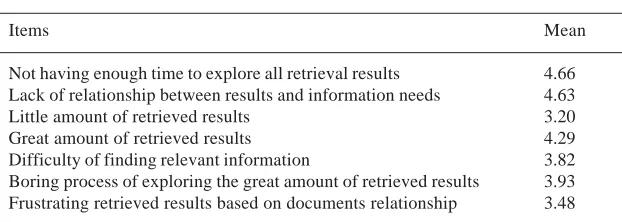
Items Mean
Not having enough time to explore all retrieval results 4.66 Lack of relationship between results and information needs 4.63 Little amount of retrieved results 3.20 Great amount of retrieved results 4.29 Difficulty of finding relevant information 3.82 Boring process of exploring the great amount of retrieved results 3.93 Frustrating retrieved results based on documents relationship 3.48
Table 1. Patterns applied for preparing items in questionnaire
Previous Research Variable explanations
Task speed, Promotion and development of Usefulness items Hendrickson et al. (1993) performance, Increase of efficiency, Increase of
effectiveness, ease of work, helpfulness
Expectation, efficiency, Being beyond Customer’s Satisfaction items Oliver (2006) expectations, Meeting Expectations, Decision to Reuse,
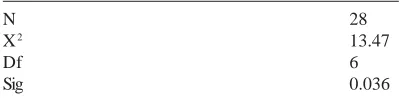
Table 4. Result of K square test, users’ most important reasons for their need to query reformation
N 28
X2 13.47
Df 6
Sig 0.036
Table 5. Users’ perceived usefulness mean from query reformulation tools
Factor N M SD SEM
Users’ perceived usefulness of search revision tools 28 3.87 0.655 0.123 Users’ perceived usefulness of the tool of limiting to publication type 28 3.70 0.917 0.173 Users’ perceived usefulness of the tool of limiting to resource type 28 3.91 0.758 0.143 Users’ perceived usefulness of the tool of limiting to topic 28 3.92 0.849 0.160 Users’ perceived usefulness of the tool of limiting to year 28 3.63 0.954 0.180 Users’ perceived usefulness of the tool of results search 28 3.64 1.01 0.191 Sum(Users’ perceived usefulness of query retrieval tools) 28 3.78 0.650 0.122
Table 6. One-way t-test results for users’ perceived usefulness about query reformulation tools
Ideal mean -3
Confidence level Mean Significance Degree of t Users’ perceived 99% difference s level (sig.) freedom(df) usefulness of the
Greater Smaller query
than than reformulation tools
1.032 0.528 0.780 0.000 27 6.355
Table 7. Mean of users' satisfaction with query reformulation tools
Factor N M SD SEM
Users' satisfaction rate with search revision tool 28 3.46 0.833 0.157 Users' satisfaction rate with limiting to publication type tool 28 3.52 0.828 0.156 Users' satisfaction rate with limiting to resource tool 28 3.79 0.831 0.157 Users' satisfaction rate with limiting to topic tool 28 3.83 0.910 0.172 Users' satisfaction rate with limiting to year tool 28 3.40 1.07 0.203 Users' satisfaction rate with results search tool 28 3.64 0.996 0.188 Sum(Users' satisfactions rate with Query Reformulation Tools) 28 3.61 0.703 0.133
Table 8. One-way t-test results for testing users' satisfaction with query reformulation tools
Ideal mean -3
Confidence level Mean Significance Degree of t Users’ perceived 99% difference s level (sig.) freedom(df) usefulness of the
Greater Smaller query
than than reformulation tools
0.882 0.336 0.609 0.000 27 4.580
being beyond customer’s imagination, meeting expectations, willingness to reuse, and praising and recommending a product or tool to others.
usefulness points out a customer’s perceptions about the outcome of an experience (Davis et al. (1992). Hendrickson et al. (1993) define usefulness criteria of a product/tool as speed of task, promotion, and improvement of performance, increase of efficiency, increase of impact, ease of doing a work, and helpfulness.
Knowing that most research on investigation and evaluation of IRS and different tools are carried out in laboratories, it would be a risk to generalize their findings to the real-world and general settings. Therefore, due to the significance of studying these tools in real-world setting and in the context of a common data base, this study was an attempt to explore the relationship between perceived usefulness and satisfaction from QRTs in Science Direct data base to provide useful results to the programmers of data bases in their future designs.
Literature Review
So far no research has been done on query reformulation in Iran, but review of the related literature shows that several studies have been performed in other countries on this field. Belkin et al. (2001), in a research entitled “Interactive exploration, design and evaluation of support for query reformulation in interactive information retrieval, report on the developed search tools for supporting interactive query reformulation in interactive (TREC) investigation task.
Rieh and Xie (2006) in their research entitled “Analysis of Multiple query Reformulation
on the Web: the interactive information retrieval context” stated that the purpose of their study was to explore various aspects and patterns of web query reformulation with an emphasis on query sequence. It was used to design search motor of the web and is the performances of an interactive reformulation tool.
Lioma and Ounis (2008) in their study entitled “A syntactically-based query reformulation technique for information retrieval” (SQR) introduced an automatic new QRM, based on superficial syntactical principals from different languages samples, and applied it to increase the performance of IRS. The test results show that SQR remarkably emphasized performance increase and, at least it is comparable to pseudo feedback of relationship.
Mastora et al. (2008) investigated the development patterns and query reformulation, especially generalizations, features, movement and parallel substitutes of equivalents in the framework of research method, in which they used two-step query method. The development step in which the search strategy is prepared and the reformulation step in which the search strategy is changed manually or by system. The results showed that the users reformulated their queries using controlled expressions in gained results, while in the process of reformulating query, they basically used expressions will parallel definitions. Huang and Efthimaidis (2009) reported that the users usually revise the previous search queries hoping
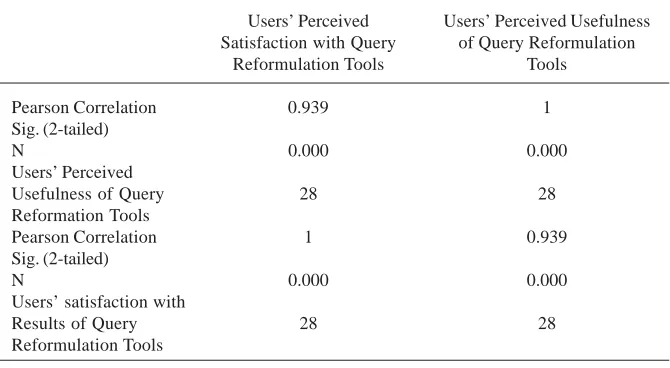
Table 9. Pearson’s correlation coefficient (r) for exploring the relationship between users’ perceived usefulness of reformulation tools and their satisfaction with results
Users’ Perceived Users’ Perceived Usefulness Satisfaction with Query of Query Reformulation
Reformulation Tools Tools
Pearson Correlation 0.939 1
Sig. (2-tailed)
N 0.000 0.000
Users’ Perceived
Usefulness of Query 28 28
Reformation Tools
Pearson Correlation 1 0.939
Sig. (2-tailed)
N 0.000 0.000
Users’ satisfaction with
Results of Query 28 28
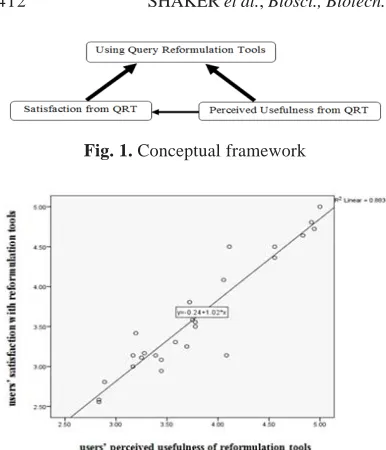
Fig. 2. Distribution of users’ perceived usefulness of query reformulation tools and their satisfaction
of retrieval results Fig. 1. Conceptual framework
to retrieve better results. These changes are called query reformulation or query revision. As a result of their study, query revision strategies were classified and an indicator with high accuracy for identifying any type of reformulation was developed. The efficiency of reformulations is measured by user’s clicking.
Inam et al. (2012), too, in a research entitled “Ontology based query reformulation using rhetorical relations” point out that searching in web is very difficult due to great load of information. Users are to face many problems in determining their need in the form of query. QRMs are needed to provide users with their ideal results. In this study, the method for query reformulation was introduced based on Cross-document Structure Theory (CST), and Rhetorical Structure Theory (RST) and the results were satisfactory, so that the resulted reformulated query sets by this rhetorical method were close to the main query which finally, provided the users with more information.
A review of the related literature proves that, it is a fact that search satisfaction is one of the indicators of determining user’s success level of accessing information to meet his needs of information. In search system, question plays an important role in creating confidence from search
satisfaction. Also, its role is significant in perceiving and understanding the manner of posing question, so that it brings about the best benefits to the user. Satisfaction mostly emphasizes evaluation and reaction of users toward results; ignoring the fact that using different tools and facilities of a search interface, the results and even their arrangement many be changed. What is considered in the present study to remove this challenge is exploring usefulness of tools as another criterion for evaluating tools and facilities besides satisfaction. The usefulness of a tool is an important factor that influences its use. As a result, based on reviewing previous literature and research, the theoretical framework for this study is as follows:
Purpose and Research Questions
The main purpose of the study is to explore the relationship between perceived usefulness and satisfaction from query reformulation tools. Accordingly, the special goals were proposed as determining users’ reasons in their need for using query reformulation, the condition of perceived usefulness and users’ satisfaction from reformulation tools, and defining the relationship between perceived usefulness from query reformulation tools and their satisfaction from retrieval results, accordingly, the following questions and hypotheses were formed.
Research Questions
1. What are the most important reasons of users for their need to query reformulation? 2. How is users’ perceived perception of query
reformulation tools (QRT)?
3. How satisfied are the users from query reformulation tools?
Research hypothesis
H1: There is a significant relationship between users’ perceived usefulness of query reformulation tools and their satisfaction with retrieval results.
Research Method
Second, they were taught how to use Science Direct data base and its various tools. Third, the initial search was done by users. The results were arranged based on their relations and they selected relevant document from retrieved results. Fourth, they were required to answer the questions in the relevant section, in case they need to reformulate retrieved results. Fifth, they were asked to repeat different reformulation tools on initial retrieved results based on the number of tools and every time their relationship feedback (precision coefficient) was measured. Sixth, the perceived usefulness and perceived satisfaction of each tool was evaluated by users.
Instruments
Three types of instrument were used in this study:
1- Questionnaire, 2- Webcam Capturing Ashampoo Snap 4 software (for filming desktop page while the subjects were working), 3-Researcher’s direct observation on search process. Questionnaire is an important instrument to collect data, but observing by software or direct observation are just to make sure of search process, or filming was for vague or suspicious cases.
For preparing questionnaire items works of other researchers in similar studies were consulted (Table 1) whose validity was determined formally and, the reliability was calculated using Cranach’s alpha co-efficiency which equaled 0.966.
Data Analysis
Q1: What are users’ most important reasons for their need to query reformulation?
In order to know users’ most important reasons for their need to query reformulation, by studying related research, the reasons were classified to 7 groups, and Fredman’s Test was used to find the answer. In other words, Fredman’s test tried to find out whether the Mean differed for the 7 variables, and if differed, which was the greatest (Table 2).
Table 3 illustrates the mean of variables using fredman’s Test. As observed, there is a significant difference between means. “Lack of retrieved results” variable showed greater difference with other items (M = 2.64).
Table 4 shows that the number of lines dedicated to each 7 variable are 28. In this table, the statistical amount of test, statistical degree of
freedom and significance level are presented. Fredman’s variance analysis results showed that k square test (X2 = 13.47, df = 6, p< 0.05) was
significant and that it was an acceptable analysis. In other words, (not having enough time to explore all retrieved results) with a mean of (4.66) was users’ most important reason for query reformulation, and (fewer retrieved results) with a mean of (3.20) was ranked the last.
Q2: How is users’ perception of query reformulation tools?
((Search Revision)) tools, ((limiting to publication type)), ((limiting to the resource type)), ((limiting to the topic)), ((limiting based on year)) and ((search in results)) are the tools of query reformulation in Science Direct data base. To answer the second research question the subjects were to answer the following 5-item Likert scale after using any of reformulation tools:
a) Using this tool helped me to faster get to the result,
b) Compared to initial results, using this tool brought about successful results for me, c) Using this tool helped me save some time, d) Using this tool helped me to have results
more qualitatively related to my ideal ones, e) Using and working with this tool is easy for
me,
f) Using this tool is helpful for me based on relevant retrieved results.
The five Likert scale items were (very much, very, medium, little, very little)
Table 5 indicates that, mean of users’ perception of usefulness from ((search revision tools)) equals 3.70, ((the tool of limiting to resource)) equals 3.91, ((the tool of limiting to topic)) equals 3.64 and the sum is 3.78, which is reasonable and higher than mean.
Accordingly, the highest mean of perceived usefulness is related to ((the tool of limiting to topic)) and the lowest mean belongs to ((the tool of limiting to year)). The average score of answers varied between 3.63 and 3.92, which proves the usefulness of QRT to the users.
that with 95% confidence, the users’ perceived usefulness of QRT was more than average, and that they are considered useful for users.
Q3: How satisfied are the users with query reformulation tools?
In order to respond to these questions, the respondents were required to answer satisfaction related items in Likert scale as follows: a) I expected accuracy of retrieved results,
which was met by this tool,
b) Considering relevant retrieved results, I believe it is an effective and efficient tool, c) The retrieved results were higher than my
expectation based on relevance
d) In future searches, I will get use of it again, e) I will recommend these tools to others to
increase retrieved relationship.
The 5 Likert Scale items were (very much, very, medium, little, very little).
Table 7 indicates that the mean of users’ satisfaction with ((search revision tools)) is 3.46 , for ((limiting to publication type tool)) it is 3.52, for (( limiting to resource tools)) it is 3.79, for ((limiting to topic tools)) it is 3.83, for ((limiting to year)) it is 3.40, for users’ satisfaction with (( results search tools)) it is 3.64, and totally the mean is 3.61 which is acceptable and greater than mean. Accordingly, the highest satisfaction rate mean belongs to ((limiting to topic tools)) and the lowest mean belongs to ((limiting to year tools)). The average score of answers varied between 3.40 and 3.83, which means that users’ satisfaction with QRTs was higher than mean.
The test results presented in table 8 show that sample mean for this question equals 3.61. Also it is observed that obtained “t” is 4.58 at (á =0.05) and is greater than critical “t” in the table. Therefore, the difference between estimated mean and ideal mean is significant. Accordingly, it is concluded that with a confidence of 95%, users’ satisfaction with QRTs is more than average and was satisfactory for users.
Hypothesis
There is a significant relationship between users’ perceived usefulness of query reformulation tools and their satisfaction with retrieval results.
As it is seen in Table 9, at 2-tailed Significance level, the significance level of Pearson correlation test (r ) for exploring the relationship between users’ perceived usefulness of users from
QRTs and their satisfaction with results equals 0.000 which is smaller than 0.05 for minimum significance level. As calculated Pearson’s correlation coefficient is 0.939, it is greater than critical r = 0.373 with 95%. Confidence and df = 26; therefore H1 is accepted and H0 is rejected. So the significant and meaningful relationship between the 2 variables is justified.
In other words, with 95% confidence, we can claim that there is a significant relationship between users’ perceived usefulness of QRTs and their satisfaction with retrieval results. The distribution diagram well illustrates the correlation.
RESULTS AND DISCUSSION
Using query reformulation tools, after evaluation of initial retrieved results is done by users. Query reformulation tools moderate retrieval results. In simple words, using reformulation tools arises from a user’s dissatisfaction with initial search results, and then he reorganizes the results in order to get to a specific level of satisfaction. Research results show that lack of relationship between results and information need, not having enough time to explore all retrieved results, great amount of retrieved results, difficulty of finding relevant information, disappointing retrieved results based on documents relationship feature and fewer retrieved results were the most important reasons for users, respectively to get use of QRTs (Table 2).
resource little)), ((search revision)), ((limiting to publication type)), ((searching in results)) and ((limiting based on year)), i.e. the highest usefulness mean perceived by users was for ((limiting to the topic tools)) and the lowest mean belonged to ((limiting to year tools)) (Table 5) and it can be concluded that with 95% confidence, users’ perceived usefulness of QRTs was higher than average, users believe that these tools are helpful (Table 6). Also the research findings were in accordance with Mastora, Monopoli and Kapidakis (2008) and Huang and Efthimiadis (2009). The general conclusion is that perceiving the usefulness of query reformulation tools increases their use of results. Of course usefulness is not the same for all tools and needs to be reviewed.
It is worth mentioning that the user’s lack of familiarity with applying tools and even their application for different types of search on different topics can lead to different usefulness rates.
In addition, the finding of the present research show that the highest satisfaction mean belonged to ((limiting to topic tools)) and the lowest mean belonged to ((limiting based on year tools)) among other query reformulation tools (Table 7).
Therefore it is implied that with 95% confidence, users’ satisfaction from QRTs was higher than average and they were satisfactory for users (Table 8).
As Science Direct data base covers various topics and fields, it can lead to different satisfaction rate from reformulation tools. If a great amount of retrieved information exists, and historically it covers a greater span, limiting to year tools can also be very helpful. But when the search results are limited, the user is unwilling to use limiting to year tools.
The finding also indicated that with 95% confidence, it is claimed that there is a significant relationship between users’ perceived usefulness of QRTs and their satisfaction with retrieval results (Table 9).
Pearson correlation is r = 0.939 which means a strong relationship between usefulness and satisfaction. The final result is that the more QRTs are perceived useful by users, the more satisfied they are with them.
The important point is that, paying
attention to the nature and efficiency of existing tools in user interface of the Science Direct database can improve its performance and also appropriately inform the users to effectively use these tools.
REFERENCES
1. Babai, M. Information Need Analysis. Tehran: Center of Information and Documents of Iran, 2003.
2. Baeza-Yates, R. & Riberio-Neto, B. New Territories in Information Retrieval. (A. H. Ghasemi, Trans. 2nd Volume. Tehran: Dabizesh; chapar, 2010.
3. Beg, M.M.S. & Ahmad, N., Web Search Enhancement by Mining User Actions. Journal of Information Science, 2007; 177(23): 5203-5218.
4. Belkin, N.J., Cool, C., Kelly, D., Lin, S.J., Park, S.Y., Perez-Carballo, J. & Sikora, C., Iterative exploration, design and evaluation of support for query reformulation in interactive information retrieval. Information Processing and Management, 2001; 37(3): 403-434. 5. Dang, V., Bendersky, M. & Croft, W.B., Learning
to rank query reformulations. In SIGIR ‘10 Proceedings of the 33rd International ACM SIGIR Conference on Research and Development in Information Retrieval 2010; 807-808. New York, USA.
6. Davis, F.D., Perceived usefulness, perceived ease of use, and user acceptance on information technology. MIS Quarterly, 1989; 13(3): 319-339.
7. Davis, F.D., Bagozzi, R.P. & Warshaw, P.R., Extrinsic and intrinsic motivation to use computer in the workplace. Journal of Applied Social Psychology, 1992; 22(14): 1109-1130. 8. Hasnzadeh, M. & Navidi, F., Sources of
Information in the Field of Medicine and Health Sciences. Tehran: Ketabdar publications, 2011. 9. Hendrickson, A.R., Massey, P.D. & Cronan, T.P., On the test-retest reliability of perceived usefulness and perceived ease of use scales. MIS Quarterly, 1993; 17(2), 297-230.
10. Huang, J. & Efthimiadis, E.N., Analyzing and evaluating query reformulation strategies in web search logs. In CIKM ‘09 Proceedings of the 18th ACM Conference on Information and Knowledge Management 2009; 86-77. NewYork, USA.
Computer Science Issues, 2012l; 9(4): 261. 12. Jansen, B.J., Booth, D.L. & Spink, A., Patterns
of query reformulation during web searching. Journal of the American Society for Information Science and Technology, 2009; 60(7): 1358-1371. 13. Lioma, C. & Ounis, I., A syntactically-based query reformulation technique for information retrieval. Journal of Information Processing and Management, 2008; 44(1): 143-162.
14. Mathwick, C. & Malhotra, R. K., The effect of dynamic retail experiences on experiential perceptions of value: an Internet and catalog comparison. Journal of Retailing, 2001; 78 (1): 51- 60.
15. Meadow, C.h., Boyce, B.R., Kraft, D.H. & Barry, C., Text Information Retrieval Systems. (N. Hariri, Trans.). Tehran: Chapar Publication, 2011.
16. Mostora, A., Monopoli, M. & Kapidakis, S., Exploring query formulation and reformulation: a preliminary study to map user ’s search behavior. Research and Advanced Technology
for Digital Libraries, 2008; 5173: 427-430. 17. Oliver, R.L., Customer satisfaction research. In
R. Grover, M. Vriens (Eds.). The Handbook of marketing research. Thousand Oaks: SAGE Publications, 2006.
18. Rieh, S.Y. & Xie H., Analysis of multiple query reformulation on the web: the interactive information retrieval context. Information Processing and Management, 2006; 42(3): 751-768.
19. Saracevic, T., Relevance in Information Science. (H. Mokhtari & A. Mirzaee, Trans.). Tehran: chapar publication, 2010.
20. Shneiderman, B., Plaisant, C., Cohen, M. & Jacobs, S., Designing the user interface: Strategies for effective human- computer interaction. Boston, MA: Addison-Wesley, Reading, 2009.