http://www.ijcmph.com pISSN 2394-6032 | eISSN 2394-6040
Original Research Article
A community based screening of gestational diabetes mellitus within 16
weeks of pregnancy: a study from Mysuru district, Karnataka
Abhishek Kumar Sinha*, Madhu B., Narayana Murthy M. R.
INTRODUCTION
“Gestational diabetes mellitus” (GDM) is defined as carbohydrate intolerance with onset or recognition during pregnancy. Women diagnosed to have GDM are at increased risk of fetal and neonatal complications and congenital malformations.1 Even maternal and perinatal complications, both immediate and long term are increased with GDM and are also risk of future development of type II DM.
As pregnancy progresses, insulin resistance and diabetogenic stress due to placental hormones necessitate compensatory increase in insulin secretion. Screening and diagnosis of GDM is traditionally delayed until late second or early third trimester of pregnancy with the rationale that diabetogenic effects of pregnancy decreases with gestation.
The burden of diabetes mellitus in India, is fast gaining a potential epidemics status of having the highest number
ABSTRACT
Background: Gestational diabetes mellitus is defined as carbohydrate intolerance with onset/recognition during pregnancy where maternal and perinatal complications are increased. Aged care facilities in rural areas reports disparity in the management of gestational diabetes as compared with urban counter parts. As a need to address this, study conducted with objective to estimate prevalence of gestational diabetes mellitus within 16 weeks of gestation for GDM by oral glucose challenges test.
Methods: Antenatal mothers attending primary health centers within 16 weeks of gestation were screened for GDM. Two hours, venous samples were calculated for estimation of blood glucose level. Plasma glucose level of >140mg/dl was considered as OGTT positive.
Results: Among 301 patients examined 11 mothers had OGTT positive results. GDM was seen in 3.7% of Mothers. GDM is found significantly associated with increasing age (p=0.01, t=2.52, mean difference 2.54 CI 0.5-4.5), weight (p=0.04, t=2.24, mean difference 10.8 CI 0.11-21.5), and BMI (p<0.01, t=2.97, mean difference 3.6 CI 1.2-6). GDM was seen more in multigravida (P=0.01). Statistically significant association of GDM was found with mean systolic (p<0.01, t=2.62, mean difference 8.08 CI 2.01-14.14) and diastolic blood pressure (P<0.01, t=3.44, mean difference 7.87 CI 3.38-12.36). A multiple regression shows these variables statistically significantly predicted GDM, F (5, 295)= 7, p<0.001, R2=0.106.
Conclusions: GDM is statistically associated with increasing age, increasing weight, BMI and multiple gravida in pregnancy. It is recommended to screen for GDM within the 1st trimester & follow up needed to prevent further complications.
Keywords: Gestational diabetes mellitus, Antenatal mothers, Rural
Department Of Community Medicine, JSS Medical College, Mysuru, Karnataka, India
Received: 23 April 2018
Accepted: 09 May 2018
*Correspondence:
Dr. Abhishek Kumar Sinha,
E-mail: [email protected]
Copyright: © the author(s), publisher and licensee Medip Academy. This is an open-access article distributed under the terms of the Creative Commons Attribution Non-Commercial License, which permits unrestricted non-commercial use, distribution, and reproduction in any medium, provided the original work is properly cited.
of people with diabetes mellitus. Aged care facilities in rural areas reports disparity in the management of gestational diabetes as compared with urban counter parts. More needs to be done to address the rural and urban inequality of GDM.
Government policy guidelines help in funding programs for public awareness about gestational diabetes mellitus and its risk reduction measures. Effective early identification of high risk group of subsequent development of GDM is likely to improve pregnancy outcome because, appropriate dietary advice and improvement in physical activities will reduce the risk of development of GDM and early management will reduce the incidence of GDM and its associated maternal and perinatal complication.2,3
With this background the study was conducted in rural Mysuru to screen pregnant women in Mysuru within 16 weeks of gestation for GDM.
Objectives
To estimate prevalence of gestational diabetes mellitus within 16 weeks of gestation for GDM by oral glucose challenges test.
METHODS
The study was carried out in seven talks of Mysuru district. The study protocol was approved by Ethical committee of JSS University, Mysuru. Before the start of study, permission obtained from District health officer of Mysuru Taluk. Medical Officers, Health workers, anganwadi workers were contacted and explained about the need of the study. The Medical Officers, Health workers of respective PHC’s conducted meeting at their respective centers with pregnant ladies after taking informed consent and explained them regarding the oral glucose challenge test (OGCT) and their benefits. On the date of visit consecutive antenatal women attending primary Health centers within 16 weeks of gestation were identified and screened for gestational diabetes mellitus. Patients with known diabetes mellitus, chronic kidney disease, and chronic pancreatitis were excluded from the study. After two hours, venous samples were calculated and brought to the Biochemistry lab of JSS Medical College, Mysuru in cold chain for estimation of blood glucose level. After obtaining the results from the lab the same were sent to respective medical officer for further management. During the 2 hours waiting period the demographic details, detailed obstetric history and relevant clinical information and other biochemical investigation details available from the Thayi card was noted in the proforma. Plasma glucose level of >140 mg/dl was considered as OGTT positive.
RESULTS
A total of 301 mothers participated in the study. Their mean age was 22.19±3.3 years. Majority of them that is 54 were of 20 years old. 40% were less than 20 years of age. Among the participants 3.7% were illiterate, 12.3% had studied up to primary, 44.2% had studied up to high school, 30.2% up to pre-university and 9.6% graduates. Among 301 participants 67.8% of them had BPL (Below poverty line) cards and 8.3% had health insurance. They stayed at a mean distance of 3.9km around primary health centre. Consanguineous marriage was seen in 24% of participants. Among these 301 antenatal mothers 60% were in first trimester and 55% were primigravida, 35% were second gravid and 9% were pregnant for more than 2 times. Bad obstetric history was seen in 7% of them. Among the mothers 3.3% had family history of diabetes mellitus and 1 mother had history of gestational diabetes in her mother. Their mean BMI was 21±4 with 26% being low weight, 48.55% normal, 10.3% overweight and 14.6% obese. Mean blood pressure was 108±10 mm of Hg systolic and 68±8 mm of Hg diastolic.
Figure 1: Distribution of mothers based on presence of gestational diabetes mellitus.
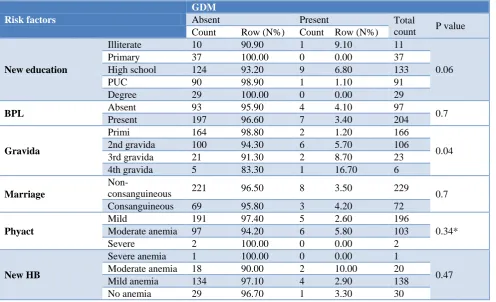
Among 301 patients examined 11 mothers had OGTT positive results. Gestational diabetes Mellitus was seen in 3.7% of mothers (Figure 1). GDM is found significantly associated with increasing age (p=0.01, t=2.52, mean difference 2.54; CI 0.5-4.5), weight (p=0.04, t=2.24, mean difference 10.8; CI 0.11-21.5), and BMI (p<0.01, t=2.97, mean difference 3.6; CI 1.2-6) (Table 2). GDM was seen more in multigravida who were pregnant for 3rd or more times and it was statistically significant (p=0.01) (Table 1). Statistically significant association of GDM was found with mean systolic (p<0.01, t=2.62, mean difference 8.08; CI 2.01-14.14) and diastolic blood pressure (p<0.01, t=3.44, mean difference 7.87; CI 3.38-12.36). Mothers with GDM had higher systolic and diastolic blood pressure compared to those who did not have GDM. A multiple regression was run to predict GDM from, age, weight, BMI, systolic blood pressure and diastolic blood pressure. These variables statistically significantly predicted GDM, F (5, 295)=7, p<0.001, R2=0.106.
absent 96%
Table 1: Factors associated with gestational diabetes.
Risk factors
GDM
Absent Present Total
count P value Count Row (N%) Count Row (N%)
New education
Illiterate 10 90.90 1 9.10 11
0.06 Primary 37 100.00 0 0.00 37
High school 124 93.20 9 6.80 133
PUC 90 98.90 1 1.10 91
Degree 29 100.00 0 0.00 29
BPL Absent 93 95.90 4 4.10 97 0.7
Present 197 96.60 7 3.40 204
Gravida
Primi 164 98.80 2 1.20 166
0.04 2nd gravida 100 94.30 6 5.70 106
3rd gravida 21 91.30 2 8.70 23 4th gravida 5 83.30 1 16.70 6
Marriage
Non-consanguineous 221 96.50 8 3.50 229 0.7 Consanguineous 69 95.80 3 4.20 72
Phyact
Mild 191 97.40 5 2.60 196
0.34* Moderate anemia 97 94.20 6 5.80 103
Severe 2 100.00 0 0.00 2
New HB
Severe anemia 1 100.00 0 0.00 1
0.47 Moderate anemia 18 90.00 2 10.00 20
Mild anemia 134 97.10 4 2.90 138 No anemia 29 96.70 1 3.30 30 *Fisher exact.
Table 2: Factors associated with GDM.
GDM
Absent Present
t valve Mean difference
Confidence interval
P value
Mean±SD Mean±SD Lower Higher
Age 22 ±3.27 25±3.4 -2.52 -2.540 -4.522 -.557 0.012*
Height 154±8 156±6.9 -0.90 -2.277 -6.966 2.412 0.349
Weight 49.1±9.2 60.0±16 -2.24 -10.8497 -16.5956 -5.1039 0.048*
BMI 20.9±4 24.5±5.1 -2.80 -3.6220 -6.0187 -1.2253 0.003*
SBP 107±10 115±13.1 -2.62 -8.081 -14.147 -2.015 0.009*
DBP 68±7.4 76±8.8 -2.02 -7.870 -12.360 -3.380 0.001*
HB 6.47±5 6.56±5.2 -0.06 -.09715 -3.15377 2.95947 0.950 *Statistically significant at p<0.05.
DISCUSSION
Gestational diabetes was found in 4% of mothers. GDM was statistically associated with increasing age, weight, BMI and gravida. Mean systolic and mean diastolic blood pressure was significantly more in mothers with GDM. In a study done among rural Haryana GDM is seen in 13.9% of antenatal women of more than 24wks gestations 4 and is associated with gravid >3, maternal age >25 years and family history of diabetes. Similar findings were also seen in present study where GDM was significantly more in 3rd and 4th gravida compared to primigravida. Prevalence was lesser than the above study because mothers of more than 24 wks gestation are screened in
were considered for present study. In an another house to house study done among rural population of western India, GDM prevalence is 9.5% and is associated with higher body mass index.5 Similar prevalence is seen in mothers screened before and after 24 wks. In present study screening was done before 16 wks which is important for early diagnosis and management. GDM was also associated with gestational weight and BMI.
also.7 In a study by Nahum, 25 patients out of 255 had gestational diabetes and 96% of them were identified by screening at 16 weeks.8 In a cross sectional study done in Tamil Nadu, it is seen that prevalence of GDM was 18.5% by IADPSG criteria with no significant urban/rural differences (urban 19.8% vs. rural 16.1%, p = 0.46) and 14.6% according to WHO 1999 criteria.9 In study done by Caralon et al GDM is statistically associated with ethnicity where Asian women had more prevalence and increasing age (p<0.001).10 Study done in Beijing shows gestational diabetes is present in 19.7% of women and age, family history of diabetes mellitus, pre-pregnancy body mass index, BMI gain before 24 weeks and maternal birth weight were risk factors which were statistically significant. Fasting plasma glucose at first prenatal visit is also risk factor for GDM.7 Prevalence was lesser in present study because 2014 MOH China criteria and IADPSG criteria are considered in above studies where 153 mg/dl is taken as maximum cutoff, but in present study PPBS of 140 mg/dl is considered as OGTT positive. Finding similar to above study was also found in present study where GDM was statistically associated with weight and BMI during gestation, but no significance was found between family history as in rural areas, most of diabetic cases are under diagnosed. Gestational diabetes is associated with pregnancy induced hypertension in studies conducted by Bryson et al, Yaun et al and Parveen et al.11-13 In present study it was seen that mean systolic blood pressure and mean diastolic blood pressure was more in mothers with gestational diabetes than those without GDM.
CONCLUSION
Among study participants 4% mothers were diagnosed as having gestational diabetes mellitus under 16 weeks. GDM is statistically associated with increasing age, increasing weight, BMI and multiple gravida in pregnancy. It is recommended to screen for GDM within the 1st trimester which is an essential preventive measure for diabetes. As systolic and diastolic blood pressures are associated with GDM, a close follow up and check over blood pressure monitoring is needed to prevent further complications.Intensive care during pregnancy in term of adequate nutritional education, physical activities and lifestyle gives a long term benefit in the prevention of obesity, IGT and diabetes in the offspring and prevention of diabetes mellitus and hypertension in mothers. Further longitudinal studies are recommended to find causal association of weight, blood pressure and other risk factors with gestational diabetes so that measures to mitigate these risk factors can be initiated at the earliest.
ACKNOWLEDGEMENTS
Special thanks to all the pregnant women who participated in the study, District health officer, Mysuru, Medical officers of Mysuru taluk, ANM’s and Health workers of respective PHC’s.
Funding: No funding sources Conflict of interest: None declared
Ethical approval: The study was approved by the Institutional Ethics Committee
REFERENCES
1. Lepercq J. Fetal complications of GDM. In: Diapedia. Diapedia.org; 2013. Available at: http://www.diapedia.org/41040851409/rev/13. Accessed on 4 April 2018.
2. Aune D, Sen A, Henriksen T, Saugstad OD, Tonstad S. Physical activity and the risk of gestational diabetes mellitus: a systematic review and dose– response meta-analysis of epidemiological studies. Eur J Epidemiol. 2016;31(10):967–97.
3. Pons RS, Rockett FC, de Almeida Rubin B, Oppermann MLR, Bosa VL. Risk factors for gestational diabetes mellitus in a sample of pregnant women diagnosed with the disease. Diabetol Metab Syndr. 2015;7(1):80.
4. Rajput M, Bairwa M, Rajput R. Prevalence of gestational diabetes mellitus in rural Haryana: A community-based study. Indian J Endocrinol Metab. 2014;18(3):350–4.
5. Bhatt AA, Dhore PB, Purandare VB, Sayyad MG, Mandal MK, Unnikrishnan AG. Gestational diabetes mellitus in rural population of Western India – Results of a community survey. Indian J Endocrinol Metab. 2015;19(4):507–10.
6. Gupta K, Parmar M, Dubey S. Incidence of Gestational Diabetes Mellitus in Pregnant women from Rural Background Attending Antenatal Care Clinic. Int J Med Res Rev. 2015;3(02).
7. Varghese R, Thomas B, Hail DMA, Rauf DA, Sadi DMA, Sualiti DAA, et al. The Prevalence, Risk Factors, Maternal and Fetal outcomes in Gestational Diabetes Mellitus. Int J Drug Development Res. 2012;4(3).
8. Nahum GG, Wilson SB, Stanislaw H. Early-pregnancy glucose screening for gestational diabetes mellitus. J Reprod Med. 2002;47(8):656–62. 9. Bhavadharini B, Mahalakshmi MM, Anjana RM,
Maheswari K, Uma R, Deepa M, et al. Prevalence of Gestational Diabetes Mellitus in urban and rural Tamil Nadu using IADPSG and WHO 1999 criteria (WINGS 6). Clin Diabetes Endocrinol. 2016:2. 10. Carolan M, Davey M-A, Biro MA, Kealy M.
Maternal age, ethnicity and gestational diabetes mellitus. Midwifery. 2012;28(6):778–83.
11. Bryson CL, Ioannou GN, Rulyak SJ, Critchlow C. Association between Gestational Diabetes and Pregnancy-induced Hypertension. Am J Epidemiol. 2003;158(12):1148–53.
13. Perveen S, Jabeen Q, Iqbal MZ. Relationship between gestational diabetes and pregnancy induced hypertension (PIH), Int Current Pharma J. 2015;4(11):453-6.