Original Research Article
A descriptive study on the use of social networking websites and
physical health profile of their users among college students in
Thrissur district, Kerala
Mohammed Ibrahim N., John George T.*, Jenyz M. Mundodan, Jini M. P.
INTRODUCTION
In the early years since 2000, the internet became personal as social networking websites were introduced and embraced by the masses. Boyd and Ellison define Social Networking Sites (SNS) as: “web-based services that allow individuals to construct a public or semi-public profile within a bounded system, articulate a list of other users with whom they share a connection and view and traverse their list of connections and those made by others within the system. The nature and nomenclature of these connections may vary from site to site”.1
Facebook, Twitter, LinkedIn, Friendster, MySpace, Classmate, Yahoo 360 are the main such sites.
What makes SNS unique is not that they allow individuals to meet strangers, but rather that they enable users to articulate and make visible their social networks. While SNS have implemented a wide variety of technical features, their backbone consists of visible profiles that display an articulated list of Friends who are also users of the system. Profiles are unique pages where one can "type oneself into being”.2
Since their introduction, social networking websites have attracted millions of users, many of whom integrated their sites as a daily practice. Today, Facebook is the largest social network in the world, followed by Twitter. One out of every seven people on earth is on Facebook ABSTRACT
Background: The internet has become much more personal since social network sites (SNS) were introduced and embraced by the masses. Since their introduction, social networking websites have attracted millions of users, many of whom use these sites daily. Its excessive usage can influence physical health of their users.
Methods: A descriptive study was conducted among students of selected colleges in Thrissur district. The subjects included 400 SNS users selected using systematic random sampling. Data was collected using a pre tested structured questionnaire.
Results: The mean age of the study population was 19.13±1.09 years. Most of the subjects used Facebook along with (78%) or without (33.5%) the usage of other social networking websites. Among the subjects, 64% were daily users with 39.5% reporting 1-2 hours use per day and 29.5% reporting 2-4 hours use per day. 74% subjects reported mobile phone as method of access to SNS. The prevalence of visual problems, eyestrain, headache, appetite problems and postural pain were significantly high in daily SNS users.
Conclusions: The study shows how virtual online world is interfering with their physical health. Daily SNS use had negative effects on physical health of the college students in this study.
Keywords: Adverse physical health effects, College students, Social network sites, Usage Department of Community Medicine, Amala Institute of Medical sciences, Thrissur, Kerala, India
Received: 06 April 2018
Revised: 17 May 2018
Accepted: 18 May 2018
*Correspondence:
Dr. John George T.,
E-mail: [email protected]
Copyright: © the author(s), publisher and licensee Medip Academy. This is an open-access article distributed under the terms of the Creative Commons Attribution Non-Commercial License, which permits unrestricted non-commercial use, distribution, and reproduction in any medium, provided the original work is properly cited.
and has more than 1.18 billion active users as of August 2015. The number of monthly active users of Facebook in India has increased by 5% to 88 million as of September 2013. The major number of users belong to age group 18 to 24 comprising of 48%.3
The excessive use of these sites affects the mental as well as physical health. Students do not take their meals on time and take proper rest. They take an excessive amount of coffee or tea to remain active and focused, which affects negatively on their health. Moreover, chronic users complain of back pain, eye problems, headache and gastrointestinal problems.4
Studies on SNS are in the nascent stage in India. Social networking websites are becoming more and more popular and have become part of daily life among youngsters. Its excessive usage can influence their physical and mental wellbeing. Hence the current study was conducted to study the pattern of usage of social networking websites and effects of SNS on physical health status among college students in Thrissur district.
METHODS
A descriptive study was conducted among students of selected colleges in Thrissur district, Kerala from November 2015 to October 2017.
The prevalence of mild to moderate anxiety among users of social networking website in the age group 18 to 24 in India was 21% according to study by Akriti et al.4 Based on this the sample size was calculated to be 376 (with relative error of 20%); which was then rounded up to 400. A list of all the arts, science and commerce colleges from Thrissur district were prepared, and from the 49 colleges, eight colleges were picked up for the purpose of study using simple random sampling. From eight selected colleges, 400 SNS users among students between the age group of 18 to 24 years were identified and selected by systematic random sampling from the student registers available at the colleges. Students who used any SNS in the past 6 months belonging to selected colleges were included into the study; those who have gave history of any diagnosed psychiatric morbidity were excluded.
Data was collected from selected participants using a pre-tested structured questionnaire, which were self-administered by the participants after giving written informed consent. The questionnaire included the following parts: demographic profile, pattern of use of SNS and physical health status.
The demographic profile included age, gender, religion, marital status, field of education, year of study and stay of participants. Pattern of SNS use included question like types of SNS used, frequency of usage, time spent on daily and so on. Physical health status questionnaire include visual problems, eye strain, headache, appetite problems, change in weight and postural pain (back, neck, shoulder, arms, and wrist pain).
Ethical clearance was obtained from Institutional Ethics Committee of Amala Institute of Medical Sciences, Thrissur prior to commencement. Data were entered and analysed using the statistical software SPSS version 23. Statistical analysis included descriptive statistics, and Pearson’s Chi-square test and Fisher exact test was used to compare categorical variables. A p value of <0.05 was considered significant.
RESULTS
Demographic characteristics
The age of the study subjects ranged from 18 to 23 years. The mean age (SD) of the study population was 19.13 (1.09) years, the median age being 19.0 years. Majority (64.4%) fell in the age group of 18-19 years. The participants belonged to different fields of education; a third of the participants were from Bachelor of Commerce [B.Com] (30.3%), followed by Bachelor of Science [B.Sc.] (23.8%), Bachelor of Arts [B.A] (22.8%), Bachelor of Business Administration [BBA] (15.8%) and Bachelors in Computer Application [BCA] (7.5%) respectively. Further details have been given in Table 1.
Table 1: Socio-demographic profile of participants.
Frequency Percentage (%)
Age
18-19 258 64.4
20-21 133 33.3
22-23 9 2.3
Sex
Male 200 50
Female 200 50
Religion
Hindu 169 42.3
Christian 139 34.8
Muslim 92 23.0
Field of education
B.Sc. 95 23.7
B.A 91 22.8
B.Com 121 30.3
BCA 30 7.5
BBA 63 15.7
Year of study
1st-year 175 43.8
2nd-year 105 26.2
3rd-year 120 30.0
Place of stay
Hostel 42 10.5
Days scholar 325 81.2
Paying guest 33 8.3
Total 400 100.0
Pattern of SNS usage
Facebook alone for social networking. Just over one-fourth (27.8%) used Twitter, with 18 (4.5%) using Twitter as their only Social Networking platform. There were 170 (42.6%) participants using LinkedIn (Table 2).
Table 2: SNS used by participants.
Frequency Percentage (%)
Facebook 134 33.5
Twitter 18 4.5
LinkedIn 69 17.3
Facebook & Twitter 78 19.5
Facebook & LinkedIn 86 21.5
Facebook, Twitter and
LinkedIn 15 3.8
Total 400 100.0
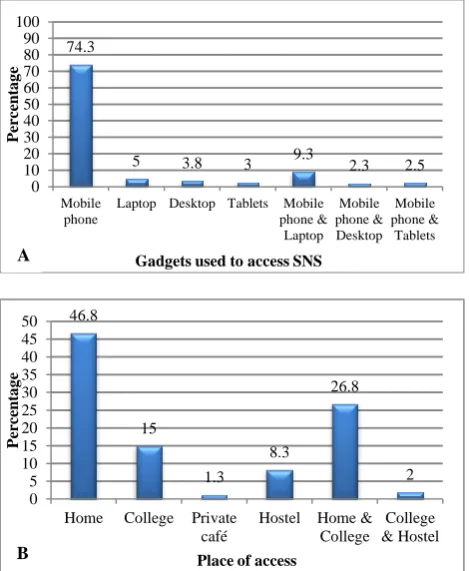
Nearly three fourths (73.6%) accessed SNS at their home, of whom 187 accessed it almost exclusively at their home. There were five students (1.3%) who accessed SNS through private café. Mobile phone was the most commonly used gadget (88.3%) to access SNS, with 297 (74.3%) accessing SNS only through their mobile phones. There were 57 (14.3%), 24 (6%) and 22 (5.5%) respectively who used Laptops, Desktops and Tablets (either exclusively or in addition to Mobile Phones) (Figure 1).
Figure 1: (A and B) Distribution of study participants based on place and mode of access.
A majority of students (64%) accessed SNS on a daily basis while 36% of them used weekly or monthly.
Among the daily users, 29% logged in 2-5 times in a day, while almost an equal number (28.5%) 5-10 times; there were 16 (6.5%) who accessed SNS more than 10 times a day. Similarly, 39.5% said they used SNS for 1-2 hour, while 4% used it for more than 4 hours a day (Table 3).
Table 3: Pattern of use of SNS among daily users (n=256).
Frequency Percentage (%)
Frequency of use every day
At least once 52 20
2-5 times 115 45
5-10 times 73 28.5
>10 times 16 6.5
Average amount of time spent on SNS
20 min or less 69 27
1-2 hours 101 39.5
2-4 hours 76 29.6
>4 hours 10 3.9
Total 256 100
The students were found to be using social network sites mainly to remain in contact with their friends and relatives (51%), remaining for knowledge and educational purpose (16.8%), just for fun (12.8%), to spend spare time when bored (11%), for networking and social purpose (7.8% ) and chatting (0.8%) respectively.
SNS usage and health problems
The common health problems experienced by the participants were Headache (46.5%), postural pain (44.5%), eye strain (43.8%), mood swings (37.5%), appetite change (33.3%), eye sight problems (27.8%), feel more lethargic (21.8%), weight gain (12.3%) and weight loss (7.2%).
Figure 2: Association of daily usage of SNS and change in weight.
Daily use of SNS was found to be significantly associated with diminished eyesight (34.4% v/s 15.9%, p<0.001), eye strain (50% v/s 32.6%, p<0.001) and headache (56.2% v/s 29.2%, p<0.001). Problems with appetite were
74.3
5 3.8 3 9.3 2.3 2.5 0 10 20 30 40 50 60 70 80 90 100 Mobile phone
Laptop Desktop Tablets Mobile phone & Laptop Mobile phone & Desktop Mobile phone & Tablets Pe rc en ta g e
Gadgets used to access SNS
46.8 15 1.3 8.3 26.8 2 0 5 10 15 20 25 30 35 40 45 50
Home College Private café
Hostel Home & College College & Hostel Pe rc en ta g e
Place of access
34 15 200 122 22 7 0 50 100 150 200 250
Access SNS Daily Does not access SNS daily
Fr
eq
u
en
cy
Frequency of accessing SNS
also significantly higher among daily users of SNS as compared to non-daily users (39.4% 22.2%, p<0.001). A greater proportion of daily users had weight gain (13.3% v/s 10.4%) as well weight loss (8.6% v/s 4.8%). However, change in weight was not significantly higher
in the daily users as compared to the non-daily users (p=0.236) (Figure 2) Postural pain like back or neck or wrist pain was seen in 50.4% of daily users as compared to 34% on non-daily users (p=0.002) (Table 4).
Table 4: Association of daily usage of SNS and health problems.
Daily usage of SNS
Total P value
Yes No
Affected eyesight 88 (34.4) 23 (15.9) 111 (27.8) <0.001
Eye strain 128 (50.0) 47 (32.6) 175 (43.7) <0.001
Headache 144 (56.2) 42 (29.2) 186 (46.5) 0.002
Affected appetite 101 (39.4) 32 (22.2) 133 (33.6) <0.001
Postural pain 129 (50.4) 49 (34.0) 178 (44.5) 0.002
DISCUSSION
The present study was conducted among college students aged between 18 to 23 years studying in various colleges of Thrissur district. The most commonly used SNS was Facebook (78%), similar to the study by Sponcil & Gitimu et al, in a USA, where 88.5% recognized Facebook as their preferred social media site.5 A majority of students (64%) accessed SNS on a daily basis while 36% of them used weekly or monthly in the present study. A similar study conducted in Nepal has been shown that majority (84.1%) of the students accessed Facebook on daily basis. Similar pattern of SNS use has been demonstrated by Gray et al and Masthi et al.6,7 Twenty nine percent of the participants logged in to SNS 2-5 times in a day, and most of daily users used for 1-2 hour (39.5%). This study was comparable with Rajesh Kumar Jha et al study, in their study most of the students spent time on Facebook on average 1–2 h daily.8 Another study conducted by Ellison et al and Kalpidou et al findings found to have consistent with this study.910
Nearly half the participants (46.8%) usually accessed SNS while at their home alone and 26.8% of students accessed SNS from both homes and colleges. According to Bicen et al, in their study, 29% of the participants use Facebook at home, 20% of them use Facebook at café/restaurants, 17% of them use the Facebook at University, 7% of them use Facebook at Internet Café, 5% of them use the Facebook at working place.11 Mobile phone was the most commonly used device to access SNS; this was comparable to findings of previous studies.12,7 This particular method of accessing SNS could be due to increased availability of internet access and newer versions of operating systems on mobile devices that support SNS use.
Reasons for using Facebook
In this study majority of students were found to be using social network sites mainly to remain in contact with their friends and relatives (51%), only 16.8% were found to be using for knowledge and educational purpose.
Another study conducted in USA by Pempek et al shows that 85% of college students used Facebook to communicate with friends, both on campus and from their former high schools.13 According to Hew, Facebook has very little educational value and the participants mainly used Facebook to keep in contact with the known individuals which were found to be concurring with this study.14 Jha et al, in their study demonstrated that only 5% of participants used Facebook for academic purpose8, while other studies conducted by Raacke et al and Gray et alreported academic use to be higher (10.9 and 25.5% respectively).6,8,15 This difference could be due to academic culture and varied institutional policies on the use of internet in these institutions.
Effects of SNS on physical health
Every invention has both negative and positive effects. The same was the case with SNS. The adverse health effects experienced by the participants were headache (46.5%), followed by postural pain, eye strain, mood swings and so on. A study conducted by Akriti et al, showed similar findings and in their study adverse health effects experienced by the participants were headache (38%), followed by postural pain (22%), eye strain (28%), mood swings (39%) and weight gain (18%). Another study conducted by Jha et al elicited adverse health effects such as burning eyes (21.0%), disturbed sleep (19.0%), headache (16.2%), postural pain (12%) and reduced appetite 4 (0.9%).4,8
In the present study prevalence of adverse health problems were significantly associated with daily usage of SNS. Visual problems, eye strain, appetite problems, postural pain and headache were significantly higher (p<0.001) in the SNS daily users. Daily usage of SNS was not found to be significant with a change in weight (p=0.236).
conducted within the premises of the institutions, the probability of social desirability bias in the responses given by the participants cannot be ruled out. Also, being a cross-sectional study, it cannot establish a temporal relationship or causality;s we can only comment on the association between SNS use and various health factors.
CONCLUSION
Humans are social animals and Social Networking Sites like Facebook, Twitter and LinkedIn now provide a great resource for fulfilling their needs by allowing them to connect immediately. In this study, the pattern of usage of SNS and impact of excessive online social networking on participants’ physical health was evaluated. The study shows how virtual online world is interfering with their health. Visual problems, eyestrain, headache, appetite problems and postural pain were found to be significantly higher in excessive SNS users.
It is important to involve the parents of students, educational institutions, and the SNS authority, to collaborate on how to encourage students to limit social media usage and bring awareness to the consequences of excessive use, especially among the student population.
ACKNOWLEDGEMENTS
The authors thank the authorities of the participant institutions for their cooperation.
Funding: No funding sources Conflict of interest: None declared
Ethical approval: The study was approved by the
Institutional Ethics Committee of Amala Institute of
Medical Sciences, Thrissur, Kerala
REFERENCES
1. Boyd DM, Ellison NB. Social Network Sites: Definition, History, and Scholarship. J Comput Commun. 2007;13(1):210–30.
2. Sundén J. Material Virtualities: Approaching Online Textual Embodiment. Order A Journal On The Theory Of Ordered Sets And Its Applications. 2003;13:225.
3. Duggan M, Smith A. Social Media Update 2013. Pew Research Center, 2013.
4. Akriti S, Anita K. Cross sectional study on the use of social network sites and the health profile of its
users between the age 18 to 24 from Delhi. New Indian J Surg. 2014;4(2):1–10.
5. Sponcil M, Gitimu P. Use of social media by college students : Relationship to communication and self-concept. J Technol Res. 2013;4:1–14. 6. Gray K, Annabell L, Kennedy G. Medical students’
use of Facebook to support learning: Insights from four case studies. Med Teach. 2010;32(12):971–6. 7. Ramesh Masthi N, Sonakshi S, Cadabam S.
Facebook addiction among health university students in Bengaluru. Int J Heal Allied Sci. 2015;4(1):18.
8. Jha RK, Shah DK, Basnet S, Paudel KR, Sah P, Sah AK, et al. Facebook use and its effects on the life of health science students in a private medical college of Nepal. BMC Res Notes. 2016;9(1):378.
9. Ellison NB, Steinfield C, Lampe C. The benefits of facebook “friends:” Social capital and college students’ use of online social network sites. J Comput Commun. 2007;12(4):1143–68.
10. Kalpidou M, Costin D, Morris J. The Relationship Between Facebook and the Well-Being of Undergraduate College Students. Cyberpsychology, Behav Soc Netw. 2011;14(4):183–9.
11. Bicen H, Cavus N. Social network sites usage habits of undergraduate students: Case study of Facebook. In: Procedia - Social and Behavioral Sci. 2011: 943– 947.
12. Gafni R, Deri M. Costs and benefits of Facebook for undergraduate students. Interdiscip J Information, Knowledge, Manag. 2012;7:45–61.
13. Pempek TA, Yermolayeva YA, Calvert SL. College students’ social networking experiences on Facebook. J Appl Dev Psychol. 2009;30(3):227–38. 14. Hew KF. Students’ and teachers’ use of Facebook.
Computers in Human Behavior. 2011;27:662–76. 15. Raacke J, Bonds-Raacke J. MySpace and Facebook:
Applying the Uses and Gratifications Theory to Exploring Friend-Networking Sites. Cyber Psychology Behav. 2008;11(2):169–74.