Open Access
in Biomedical Research
Science Policy Briefing
•
September 2012
Contents
2 • Foreword3 • Executive summary 3 • Introduction
6 • Open access: where are we today in biomedical research?
12 • The international landscape of open access in biomedical research
13 • The European landscape of open access in biomedical research
16 • Diverging opinions on how best to achieve open access in biomedical research 19 • Recommendations
20 • Conclusions
21 • Useful websites and abbreviations 22 • List of contributors
Foreword
Open access publishing has the potential to revolutionise the way in which biomedical scientists publish and access the latest results in their field. There are opportunities to accelerate the use of open access but there are also hurdles to its widespread uptake.
Over the past few months, various reports and
communications have been published on the topic of open access. These include the Finch Group report on 18 June 2012, the Publishing and the Ecology of European Research (PEER) final report on 19 June 2012, the European Research Council (ERC) announcement of its new open access policy on 13 July 2012, and the European Commission’s launch of a communication and recommendations to Member States ‘Towards better access to scientific information’ on 17 July 2012. On the same day, Science Europe reaffirmed its commitment to strengthening the European Research Area and recognised open access as a priority area in which a common policy and action plan will be developed and implemented. This intensive period shows the timeliness of our publication.
In recognition of the importance of open access to the biomedical sciences, the European Medical Research Councils (EMRC) of the European Science Foundation (ESF), at the instigation of its Core Group member Professor Josef Syka of the Czech Science Foundation and the Academy of Sciences of the Czech Republic (GAČR and AVČR), launched an activity to investigate what, if any, steps EMRC could usefully take to improve the open access landscape in the biomedical field across Europe. EMRC task force meetings held in September and November 2011 led to the identification of a number of issues and the drafting of a preliminary document. These issues included the coexistence between open access and the traditional business model of scientific publishers (including scientific learned societies), the recognised challenges associated with researchers understanding the concept of open access and depositing their research in local repositories, the recognition of PubMed Central (PMC) as a model of disciplinary repository in the biomedical field, and the desirability and/or feasibility of expanding UK PubMed Central (UKPMC) to include more European biomedical research outputs. While this report was in preparation, the ERC joined UKPMC and funders agreed to rename it ‘Europe PMC’ as of November 2012.
An expert group meeting took place in Madrid on 21-22 March 2012 hosted by the Spanish ‘Consejo Superior de Investigaciones Científicas’ (CSIC), one of the task force member organisations. Participants included publishers (Elsevier, BioMed Central, Public Library of Science), the European Commission, nominated experts from 12 ESF Member Organisations (including the task force members) and other research performing/funding organisations, foundations or charities, including the
Spanish Foundation for Science and Technology (FECYT), ES; the Spanish National Health Institute Carlos III (ISCIII), ES; the Wellcome Trust, UK; the Academy of Sciences, CZ; the National Institute of Health (ISS), IT; and the Foundation for National Scientific Computing (FCCN), PT. Other participants included open access experts from the Research Information Network (RIN), the Scholarly Publishing and Academic Resources Coalition (SPARC) Europe, the Association of European Research Libraries (LIBER), the European Association for Cancer Research (EACR) and Knowledge Exchange, as well as experts from several European infrastructures, including the European Organization for Nuclear Research (CERN) and the European Molecular Biology Laboratory - European Bioinformatics Institute (EMBL-EBI). The many valuable inputs from participants made it clear that the current model for accessing biomedical research is far from ideal and that all research stakeholders (funding agencies, publishers, research performing institutions, research libraries and learned societies) need to work together to shift to an open access model in the field. However, a number of potential hurdles, discussed in this briefing, remain to be overcome.
Finally, we would like to thank the Science Policy Briefing Chair, Professor Syka, the task force, the expert group members and the ESF-EMRC staff – all listed at the end of the publication – for their excellent work.
Professor Liselotte Højgaard
EMRC Chair
Professor Pär Omling
ESF President and Science Europe Vice-President
Introduction
The Internet and technological developments that have arisen from it in recent years have the potential to radically change science publishing and maximise the impact of research in a way that was not possible or even envisioned when publishing was a subscription- and paper-based process. We envisage a full open access future – one in which all published research generated by science researchers in the European Union (EU) is immediately available online in human and machine readable form, published under a license that allows unlimited re-use while ensuring authors’ rights of attri-bution, and with secure automatic archiving in publicly run databases.
The concept is not new: the 2002 Budapest Open Access Initiative1 and the Bethesda Statement on Open Access Publishing2, which was agreed on in 2003 by the biomedical research community, discussed how to provide open access to primary scientific literature as rapidly as possible. The Berlin Declaration on Open Access to Knowledge in the Sciences and Humanities was also published in 20033. A definition is provided in Box 1.
A successful model for the future will maximise the value of research investments by:
• increasing access to the results of research undertaken in Europe, preferably so that everyone in the world has free access at the point of use to all the published out-puts of research;
• increasing access in Europe to the global outputs of research;
• ensuring that the published outputs of research are subject to effective quality assurance through peer review;
• ensuring that the scholarly communication system develops in a sustainable way and operates cost-effec-tively; and
• ensuring the long-term preservation of the records of science.
The objective of this ESF-EMRC Science Policy Briefing is to accelerate the adoption of open access in order to guarantee equitable access to European biomedical research outputs worldwide. In this document, the term ‘research outputs’ refers to research publications (journal articles and conference papers4), mostly generated from
1. www.soros.org/openaccess/read
2. www.earlham.edu/~peters/fos/bethesda.htm
3. http://oa.mpg.de/lang/en-uk/berlin-prozess/berliner-erklarung/ 4. Research Information Network (RIN), Publishing Research
Executive summary
This Science Policy Briefing aims to accelerate the adop-tion of open access to research articles in the biomedical sci-ences. Open access refers to the free availability on the public Internet of scholarly articles published in an elec-tronic format, permitting any user to read and re-use the content provided only that the author is properly acknowl-edged and cited. We consider open access to be crucial for the free flow of information
between researchers and within society as a whole, and the digital revolution of recent years provides an oppor-tunity that has not yet been fully realised to transform access to scholarly publications. To achieve this goal this briefing makes a number of recommendations:
1. There is a moral imperative for open access: research papers should be made freely available to all to read, use and re-use, with appropriate acknowledge-ment, in order to maximise the value of biomedical research, build on the body of knowledge, accelerate the process of discovery and improve human health. 2. Individual agencies must work together to raise
awareness of the moral imperative for open access: agencies and organisations that fund and perform research, libraries, publishers and researchers must work in concert to raise awareness of the moral imperative for open access publishing. National, European and international partnerships are the basis for the successful achievement of open access to research outputs. Specific actions that different agencies need to undertake in order to move towards this goal are outlined in this briefing.
3. All research stakeholders should work together to support the extension of Europe PubMed Central into a Europe-wide PubMed Central: in order to facilitate discoveries and innovation in biomedical research, research stakeholders should collaborate to establish a Europe-wide repository in biomedicine as a partner site to the US equivalent PubMed Central. The recently rebranded Europe PubMed Central represents a valuable means to achieving this goal, provided that the diversity of European partner man-dates and policies can be integrated.
Hippocratic Oath
•••
Science (PLoS8) and BioMed Central (BMC9) fully operate on this model. Several universities, research institutions and research funders10 support the gold
route, which means that authors in these institu-tions either publish in open access journals or pay publication charges (funded by the research funder or an institutional open access fund) to make their article available in open access. Gold open access journals do not charge readers and grant extensive usage rights in accordance with the Budapest Open Access Initiative definition.
Box 3.
The green route
The green route (also known as self-archiving) involves researchers depositing in an institutional or subject-based repository, subject to copyright/license permissions11, copies of the articles they publish, whether in an open access or a traditional journal that requires a subscription from readers or their libraries. The repository will then make those copies available to the public, either immediately upon pub-lication or after an embargo period.
The embargo duration is correlated to the read-ership ‘half-life’ of biomedical papers, which is typically 6-12 months (vs. 24 for science and technol-ogy and 36 for arts and humanities12). The embargo ensures the continued value of subscriptions for commercially published journals. Advocates of open access would like to keep this period as short as possible. The rate at which accepted manuscripts are deposited in institutional and discipline-based repositories is driven by the enforcement of man-dates by funders and/or institutions.
8. www.plos.org
9. www.biomedcentral.com
10. Funders: research funding organisations, charities, philanthropic associations, governments, etc.
11. For example, Elsevier’s conditions of use: http://libraryconnect. elsevier.com/newsletters/supporting-usersorganizations/2011-04/ways-use-journal-articles-published-elsevier
12. RIN, JISC, Research Libraries UK, PRC and the Wellcome Trust joint report. Heading for the open road: costs and benefits of transitions in
scholarly communications (2011). http://rinarchive.jisc-collections.ac.uk/
our-work/communicating-and-disseminating-research/heading-open-road-costs-and-benefits-transitions-s
public funding, and not to research data (genomics, pro-tein, gene data, etc.) or books.
Researchers can currently make their work freely available through two main mechanisms: the gold route (Box 2) and the green route (Box 3). The two mecha-nisms coexist and are complementary. The controversial hybrid model will not be the focus of this briefing, although it is an important element to mention5.
Box 1.
Definition of open access
The Budapest Open Access Initiative defines open access pertaining to scientific and scholarly research articles as follows: “By ‘open access’ to this literature, we mean its free availability on the pub-lic Internet, permitting any users to read, download, copy, distribute, print, search, or link to the full texts of these articles, crawl them for indexing, pass them as data to software, or use them for any other lawful purpose, without financial, legal, or technical barri-ers other than those inseparable from gaining access to the Internet itself. The only constraint on reproduc-tion and distribureproduc-tion, and the only role for copyright in this domain, should be to give authors control over the integrity of their work and the right to be properly acknowledged and cited.”
Box 2.
The gold route
Through the gold route researchers publish their articles in journals that offer open access publishing by making articles available free of charge to read-ers immediately upon publication, usually in return for the payment of an article processing charge by the author.
Gold open access includes the secure archiv-ing of articles in publicly available archives such as PubMed Central (PMC)6 or UKPMC7. Some jour-nals such as those published by the Public Library of •••
Consortium (PRC) and Joint Information Systems Committee (JISC) report. Access to scholarly content: gaps and barriers (2011). http:// rinarchive.jisc-collections.ac.uk/node/1172. A key finding of this report stresses that journal articles and conference papers are critical for advanced research and scholarship and are rated as ‘important’ by 90.4% and 58.2% of survey respondents, respectively.
5. The hybrid model is often criticised as publishers receive income from subscriptions and from article processing charges for the same journals. 6. www.ncbi.nlm.nih.gov/pmc
We need to find new ways of facilitating and acceler-ating knowledge sharing and new discovery potential, not only to improve human health but also to promote economic growth. Ultimately what is needed is easy, immediate free access to literature, for use and re-use, for both humans and machines. EMRC supports the gold route to open access publishing as the ultimate goal to maximise the discoverability, access and re-use of biomedical research in Europe, wherever it is funded or performed, but under the condition that article process-ing charges (APCs) are affordable and sustainable.
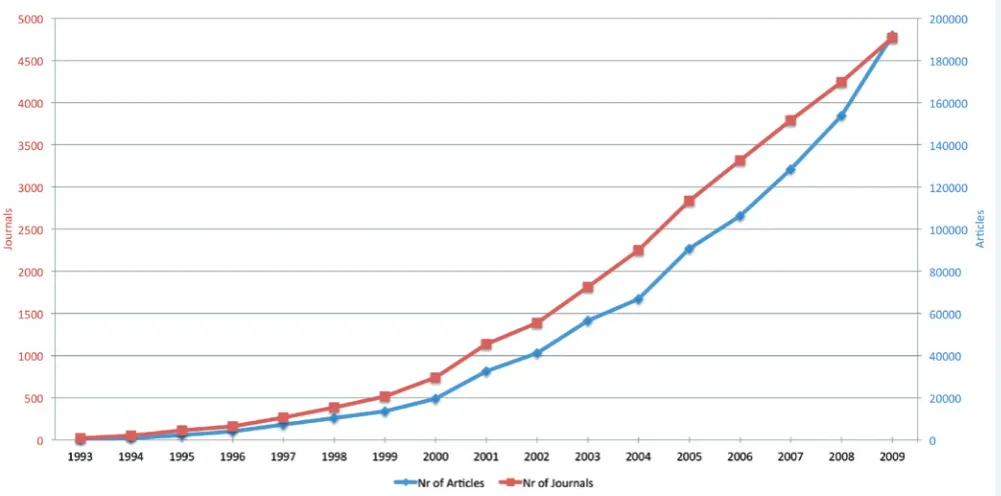
Whilst there is evidence of tremendous growth in open access publishing in the last 10 years13 (Figure 1), a recent editorial calculated that at a projected 20% annual growth, only about 27% of papers will be published in gold open access by 202014.
It is acknowledged that the shift in publishing models will take time and that proactive incentives are required to help “move academic prestige to open access”15 sooner. Therefore, it is also essential to promote the green route
13. Laakso M, Welling P, Bukvova H, Nyman L, Björk BC, Hedlund T. The development of open access journal publishing from 1993 to 2009.
PLoS ONE. 6(6): e20961 (2011)
14. Open Access, Editorial. Nature Materials. 11(5): 353 (2012)
15. For instance: http://techland.time.com/2012/04/26/if-harvard-cant- afford-academic-journal-subscriptions-maybe-its-time-for-an-open-access-model/ (26 April 2012), www.knowledge-exchange.info/Default. aspx?ID=459 and www.guardian.co.uk/science/2012/apr/15/better-models-for-open-access (15 April 2012)
open access and advocate for a maximum permissible embargo period of 6 months for the benefit of research-ers and the public16 – bearing in mind that in any event both gold and green routes are complementary.
EMRC instigated this Science Policy Briefing to examine whether there are new opportunities for open access in biomedical research within Europe that will benefit European biomedical researchers and European society as a whole.
This briefing will first focus on the current status of open access in biomedical research, with sections on the specificities of biomedical research, the barriers to open access, issues relating to publishers and institutional repositories and a description of the international and European landscapes. The briefing will then present the various opinions expressed by the task force on how best to achieve open access in biomedical research in the future. Finally a series of recommendations on common principles will be made.
16. For instance: Open Access, Editorial. Nature Materials. 11(5): 353 (2012) and www.nature.com/authors/policies/license.html
Open access: where are we
today in biomedical research?
The specific importance of open access
to biomedical research
The biomedical community is attached to peer review and publication in high-quality journals has a central role in a researcher’s career. Set against this, traditional journal subscriptions are stretching the finances of universities and research institutions and cannot be maintained at a time of severe financial constraints in the public sector17. Furthermore, it is important that availability and accessibility are not adversely affected by copyright issues. This adds to the pressure to seek new methods of publishing research findings in an openly accessible way.
For many years the biomedical field has benefited from PubMed, a free bibliographic database provided by the National Library of Medicine (NLM)18 in the US. Since 2000, a direct link to full-text articles in PubMed Central (PMC)19 has been provided. The content of PMC is derived from both self-archiving by researchers and publishers20 making their journal content available in the repository (a list of participating journals is avail-able in PMC21). The entire content of full open access journals is directly deposited in PMC by publishers immediately upon publication. There also exist a num-ber of subscription-based journals which make their full content available in PMC after an embargo period of 6-12 months (see the PMC journal list). The existence of this structured international disciplinary archive makes the biomedical field more advanced than most others; it has revolutionised medical publishing by radically changing the way research results are circulated and has undoubtedly facilitated biomedical research, innovation and discoveries.
PMC International (PMCI)22 is a collaborative effort between the National Institutes of Health (NIH) and
17. The recent statement by Harvard University shows that this issue even affects the best resourced universities. http://isites.harvard.edu/icb/icb. do?keyword=k77982&tabgroupid=icb.tabgroup143448
(17 April 2012)
18. PubMed is linked to a number of resources such as those of genomics or proteomics. www.nlm.nih.gov/
19. PMC is the database of freely available full-text biomedical literature developed by the US NLM. It currently contains around 2.5 million articles. www.ncbi.nlm.nih.gov/pmc/
20. Publishers include commercial publishers (Elsevier, Nature Publishing Group, Springer, Wiley-Blackwell, Wolters Kluwer, etc.) and scientific learned societies.
21. www.ncbi.nlm.nih.gov/pmc/journals/ 22. www.ncbi.nlm.nih.gov/pmc/about/pmci/
organisations in others countries to create a network of digital archives. UKPMC and PMC Canada are such collaborative centres. There is a big push among funding agencies for researchers to deliver articles into reposito-ries that can be freely accessed. This pressure is coming from the US23, the European Commission24 and national funders such as the UKPMC funders in the UK, e.g., Medical Research Council (MRC)25 and Wellcome Trust26, as well as international organisations such as the United Nations Educational, Scientific and Cultural Organisation (UNESCO)27.
Problems with access
to health literature
Access to scientific literature has a direct impact on soci-ety, with several studies demonstrating a link between quality of healthcare and access to biomedical informa-tion28.
Nevertheless, there are countless stories29 about researchers, practitioners, health and science policy-makers and students in developing and developed countries not being able to access relevant health-related information and being restricted to reading only abstracts. Paywalls30 constitute a disincentive to access full journal articles.
The most common barrier to accessing journal arti-cles in both academia and industry is the requirement for researchers to pay for access31. In a 2006 study32, 35%
23. www.whitehouse.gov/sites/default/files/microsites/ostp/public_ access-final.pdf
24. http://ec.europa.eu/research/science-society/open_access 25. www.mrc.ac.uk/Ourresearch/Ethicsresearchguidance/
Openaccesspublishing/index.htm and www.rcuk.ac.uk/research/Pages/ outputs.aspx
26. www.wellcome.ac.uk/About-us/Policy/Spotlight-issues/Open-access/ and www.bbc.co.uk/news/science-environment-17668722
27. www.unesco.org/new/en/communication-and-information/resources/ publications-and-communication-materials/publications/full-list/policy-guidelines-for-the-development-and-promotion-of-open-access/ 28. For example: Jennings SKG et al. The effects of on-screen, point of care computer reminders on processes and outcomes of care. Cochrane
Database of Systematic Reviews, Issue 3. Art. No.: CD001096 (2009);
McGowan J et al. Just-in-time information improved decision-making in primary care: a randomized controlled trial. PLoS ONE. 3(11): e3785 (2008); Chaudhry B et al. Systematic review: impact of health information technology on quality, efficiency, and costs of medical care. Ann Intern
Med. 144(10): 742-752 (2006).
29. For example: Yamey G. Excluding the poor from accessing biomedical literature: A rights violation that impedes global health. Health and
Human Rights. 10(1): 21-42 (2008). www.hhrjournal.org/index.php/hhr/
article/view/20
30. Systems preventing Internet users from accessing webpage content without a paid subscription. http://en.wikipedia.org/wiki/Paywall 31. RIN, PRC and JISC report. Access to scholarly content: gaps and barriers (2011). http://rinarchive.jisc-collections.ac.uk/node/1172
of respondents said they experienced some difficulty in accessing all the articles they needed. Reported access was best in the wealthy English-speaking countries (US, Canada, UK, Australia), not so good in smaller European countries, the Middle East and Asia and even worse in the rest of the world.
Research and development enterprises also face barri-ers when trying to access up-to-date quality information. Pay-per-view and subscriptions are the main channels, although access rates remain below those of large com-panies and universities33. A 2011 study shows that almost 80% of innovation-based small and medium enterprises (SMEs) in Denmark have difficulties accessing research information, which severely hampers product develop-ment and has a significant financial impact on both the SMEs themselves and the economy34. Studies in the UK have shown that subscription access imposes consider-able additional costs on businesses and organisations seeking to build on academic research, not only in terms of access charges but also in terms of time spent search-ing for ways to access articles and in duplication of work35,36,37. Limited access to up-to-date research thus has a negative impact on innovation projects.
Important barriers to open access
in biomedical research
Many researchers are still confused about the con-cept of open access, with some believing that it simply refers to publication, which is by definition in the pub-lic domain. Others appear to be reluctant to publish in open access or to place papers in their local repository. In the UK, for example, where APCs are often mentioned as a major barrier to open access, the Wellcome Trust
and microbiology (2006). www.homepages.ucl.ac.uk/~uczciro/
prcwhitepaper.pdf
33. PRC. Access by UK small and medium-sized enterprises to professional
and academic information (2009). www.publishingresearch.net/
SMEaccess.htm
34. Report on SMEs in Denmark (2011): www.fi.dk/publikationer/2011/ adgang-til-forskningsresultater-og-teknisk-information-i-danmark (in English and Danish)
35. Research report to JISC from HOST Policy Research. Benefits to the private sector of open access to higher education and scholarly research (2011).
http://open-access.org.uk/wp-content/uploads/2011/10/OAIG_Benefits_ OA_PrivateSector.pdf
36. Research report to JISC from the Office of Public Management and the National Council of Voluntary Organisations. Benefits of open access to scholarly research for voluntary and charitable sector organisations (2012). http://ie-repository.jisc.ac.uk/576/
37. Research report to JISC from Rightscom Ltd and Matrix Evidence Ltd. Benefits of open access to scholarly research to the public sector (2012). http://ie-repository.jisc.ac.uk/575/
found that compliance with its open access mandate was only 50%, even when funds were made available for open access publishing. Scientists need to be given incentives to publish in open access and to be made much more aware of the use, importance and benefits of open access publishing.
There is still a perception amongst researchers that making their paper openly available through repositories will reduce their choice of journals in which to pub-lish. This perception is hard to shift and is unfounded. The MRC (UK) displays on its website a list of around 250 journals in which MRC-funded researchers publish most38, and most of the journals offer an open access option compliant with the MRC policy.
Whilst open access publishing is more common in biomedical research than in other disciplines, there remain several barriers to the full adoption of this model.
The Study of Open Access Publishing (SOAP)39 col-lected the views of nearly 40,000 researchers on open access. The main reasons for authors not publishing in open access are a lack of funding and a perceived lack of quality of open access journals in their field compared to traditional publications.
Whilst the majority of the most popular journals offer an option to publish in open access, finding the relevant information on some journal websites is often difficult, or the explanation given ambiguous. This is particularly the case for ‘hybrid’ journals, which handle the open access APC publishing process in parallel with the traditional subscription-based model. All of this adds to the researcher’s administrative burden. Gold open access journals have much more straightforward processes, which are proving to be increasingly attrac-tive to authors who want their results to be disseminated quickly.
The perceived costs of publishing in open access are also often acknowledged as a disincentive. Whilst authors have always paid significant publication charges, even in the traditional subscription-based publishing model, the addition of $1,000 to $5,000 (ca. €760 to €3,800) per paper is perceived by many as too expensive and/or unaffordable. This perception is heightened by the fact that subscription costs, usually paid from librar-ies’ budgets, are not so visible to them.
38. ‘MRC frequently used journals: summary of publisher open access policies’, last updated in July 2012. www.mrc.ac.uk/Utilities/ Documentrecord/index.htm?d=MRC007842
39. SOAP was funded by the European Commission as a part of the Seventh Research Framework Programme (FP7) – Science and Society, and ran from March 2009 to February 2011.
Finally, self-submission of a manuscript to a repos-itory (see section on page 10) is often perceived as yet another administrative burden at the end of an already long publication process.
Most biomedical research is financed by public agen-cies, which are increasingly implementing directives and policies aimed at ensuring that the outputs of taxpayer-supported research are made publicly available. Open access mandates by funding agencies may relate to articles only or to articles and data, and they can take different shapes, the most common being the deposit of the final or author’s version of work in a repository, or the open access ‘paid’ option with the payment of an APC46. Notably, a large number of biomedical research funding and performing agencies have an open access policy in place47. However, researchers still lack awareness of these mandates and of their requirements and conditions. The lack of consistency in funders’ policies adds to the con-fusion, as research is often funded from more than one source.
In addition, an increasing number of universities in Europe have also issued open access mandates. This upsurge has sparked a heated debate amongst some com-mercial publishers who consider these policies a threat to their income and have proposed restrictions such as embargo periods, APCs and licensing agreements or insisted that institutional libraries retain their subscrip-tions before these mandates can be implemented. The key issue is to clarify whether these publishers oppose short embargoes prior to making these outputs publicly avail-able or whether they oppose open access mandates as such, which would be a head-on clash with strategies and policies emerging from publicly funded organisations48.
Against this background, it is vital that science funders, research performing institutions, researchers and libraries redouble their efforts to ensure that the huge benefits that open access offers for advancing sci-ence and innovation, and for society as a whole, can be realised.
The publishing business model
and the rise of open access journals
Biomedical journals account for 59% of journals across all disciplines and their articles for 58% of all articles published. The largest publisher (measured by number
46. www.sherpa.ac.uk/romeo/PaidOA.php?la=en&version= 47. For a full list: www.sherpa.ac.uk/juliet/
48. Recent discussions around the Research Works Act can be found at, for instance: http://thomas.loc.gov/cgi-bin/bdquery/z?d112:h.r.3699: The availability of grant funding coupled with
funders’ mandates has certainly had an impact on the availability of open access journals in biomedicine. A recent study40 of the open access journals listed in the Directory of Open Access Journals (DOAJ)41 (8,228 as of 24 September 2012) concluded that just over 100,000 articles were published and made available to the global scientific community in 2010 through APC-funded open access at an estimated cost of $91 million (ca. €70 million). This figure is far below the estimated 1.5 mil-lion articles that are published annually in English in science, technology and medicine journals.
Biomedical journals also have some of the highest APCs of any discipline, with prices ranging from $1,500 to $3,000 (ca. €1,130-€2,400) for full open access jour-nals. Hybrid journals usually charge a higher APC, up to $5,000 for Cell (ca. €3,800) or £400 (ca. €500) per page for The Lancet (both published by Elsevier) with the most common fee being $3,000 (ca. €2,400)42. There is a risk that publishers will increase the price of APCs, restrict archiving in institutional repositories (IRs) and maintain the hybrid model, which would have a nega-tive impact on institutions’ budgets. This strategy may threaten the achievement of the ultimate goal – open access to research outputs worldwide. Whilst the cost of knowledge dissemination must take into account the wider benefits to society, research and economic growth, it is important to recognise that the balance of costs between gold and green open access will need to be monitored carefully in order to ensure long-term sustainability, particularly in research-intensive uni-versities43. The entry of new players in the publishing market, such as PLoS, the soon-to-be-launched eLife44 or
PeerJ45, as well as the development of new ways of com-municating scientific discoveries, are also likely to have a positive impact in terms of controlling publishing costs.
40. Solomon DJ and Björk BC. A study of open access journals using article
processing charges (2012). www.openaccesspublishing.org/apc2/preprint.pdf
41. www.doaj.org 42. See reference 38
43. All universities would see savings from worldwide gold open access when APCs are at current averages (£570, around €730) but results would differ if universities adopted gold open access unilaterally. In this case, the gold open access scenario would cost more than the present subscription-based model whereas green open access would offer the greatest economic benefits to individual universities, unless additional funds are made available to cover gold open access costs. See full study in Swan A and Houghton J. Going for gold? The costs and benefits of gold open access for UK research institutions: further economic modelling. Report to the UK Open
Access Implementation Group (2012). http://ie-repository.jisc.ac.uk/610/
44. www.elifesciences.org
of journals from all disciplines) is Elsevier, followed by Springer-Kluwer49, Wiley-Blackwell and Taylor & Francis50. Predominant publishing agreements lie at the heart of the current crisis of restricted access to scientific literature. Until recently, publishers enjoyed, in practice, a monopoly as they were the only conduits offering access to research outputs. This situation facilitated the implementation of an economic strategy based on price increases for both print and online journal subscriptions beyond annual inflation rates. Most journal publishing revenues are generated from academic library subscrip-tions (68-75% of total revenue), followed by corporate subscriptions (15-17%), advertising (4%), membership fees and personal subscriptions (3%), and various author-side payments (3%)51.
However, the Internet provides enormous possibili-ties to researchers for enhancing the dissemination and re-use of research and for targeting the right audience. These possibilities have been embraced by some pub-lishers, many of whom are new. The BioMed Central (BMC) and Public Library of Science (PLoS) journal series, eLife or BioResearch Open Access52, for example, are only available online. The role of publishers is there-fore undergoing a dramatic transformation. While some have been more agile in adapting to this new environ-ment, others have struggled to see how they can preserve revenues whilst shifting from a pay- at-the-point-of-pub-lishing to a pay-at-the-point-of-reading system. At this juncture, critical issues need to be resolved, such as how to ensure the use of appropriate licensing to maximise re-use, while protecting authors’ right to attribution and devising a system for publishers to develop sustainable
business models that support open access.
Licenses
When talking about open access to publications, it is important to make a distinction between the right to ‘read’ and the right to ‘re-use’, sometimes expressed as free access vs. open access53 or ‘gratis’ vs. ‘libre’54. In the 49. Springer Science+Business Media reached an agreement with Wolters Kluwer to acquire the Pharma Marketing and Publishing Services division in autumn 2011. www.springer.com/about+springer/media/press releases?SGWID=0-11002-6-1293721-0
50. www.mcafee.cc/Journal/Summary.pdf (Preston McAfee, March 2012) 51. RIN report. Activities, costs and funding flows in the scholarly
communications system (2008).
http://rinarchive.jisc-collections.ac.uk/our-work/communicating-and- disseminating-research/activities-costs-and-funding-flows-scholarly-commu
52. www.liebertpub.com/biores
53. MacCallum C. When is open access not open access? PLoS Biol. 5(10): e285 (2007). www.plosbiology.org/article/info:doi/10.1371/journal. pbio.0050285
54. Suber P. ‘Gratis and libre open access’. Scholarly Publishing and
traditional publishing model, authors are often asked to transfer copyright to the publishers at the time of publi-cation55. In doing so, they usually forsake their right to re-use the content of the paper without the publisher’s permission56. More often, the author’s version (unlike the publisher’s version) can be self-archived after an agreed embargo period of usually between 6 and 12 months57.
The Creative Commons attribution license (CC BY), which allows most re-use of work,58 ensures that the licensed version of work is available free in perpetuity and clearly stipulates the authors’ right to attribution and what can be done with the material after publica-tion.
The usual perception is that, in contrast to the situa-tion with gold open access, most articles deposited under green open access (see next section) are free to access but not to re-use. However, the boundaries are not clear. For instance, the 2008 Harvard open access policies59 grant the institution a wide set of non-exclusive rights, and the terms of use for their repository60 grant re-use rights which go well beyond fair use rights61. It is the first adopted policy to focus on permissions rather than on deposits62.
It is clear from the complexity of the various licenses, mandates and embargo periods that further work is required to clarify the terms under which scientific research outputs are published and exactly what rights are transferred, licensed or retained, in order to enable wider diffusion and re-use of research papers. A task force was recently set up by the Confederation of Open Access Repositories with a mandate to issue further guidance in this domain63.
Business models
Many large commercial publishers offer APC schemes whereby authors can publish articles that are made
Academic Resources Coalition (SPARC) Open Access Newsletter (August
2008). www.earlham.edu/~peters/fos/newsletter/08-02-08.htm#gratis-libre
55. Example of an Elsevier Transfer of Copyright Agreement: www.entcs. org/ctf2.pdf
56. For example, Elsevier’s ‘Ways to use journal articles’:
http://libraryconnect.elsevier.com/newsletters/supporting-usersorganizations/2011-04/ways-use-journal-articles-published-elsevier 57. A list of publisher copyright and self-archiving policies is made available by the University of Nottingham through the Sherpa/RoMEO platform: www.sherpa.ac.uk/romeo
58. http://creativecommons.org/licenses/by/3.0/deed.en 59. http://osc.hul.harvard.edu/policies
60. http://osc.hul.harvard.edu/dash/termsofuse 61. Suber P. SPARC Open Access Newsletter (June 2012). www.earlham.edu/~peters/fos/newsletter/06-02-12.htm 62. Suber P. SPARC Open Access Newsletter (March 2008). www.earlham.edu/~peters/fos/newsletter/03-02-08.htm
freely available upon publication64 in subscription-based journals (the so-called hybrid open access). An increasing number of publishers are also launching gold open access titles. Some, such as Springer, embraced the new open access model fairly early on and developed new collections that are only available in open access (SpringerOpen) whilst accommodating funders’ man-dates with hybrid models. Others, such as Elsevier, have only recently launched open access journals. Another open access-oriented practice observed amongst tradi-tional publishers has been the acquisition of gold open access publishers (e.g., Springer’s purchase of BMC in 2008 and Wolters Kluwer Health’s acquisition of Medknow Publications in 2011).
However, the charging of an open access APC is seen by many funding organisations and research institu-tions as a ‘double-dipping’ practice65, whereby publishers charge two or three times for the same content. Some universities even have policies that clearly state that money is not to be used for this purpose66.
The benefits of depositing an article in a repository upon publication as an alternative are also recognised by research funders and institutions. These reposito-ries include repositoreposito-ries hosted by institutions to which authors are affiliated and renowned central repositories of peer-reviewed articles.
However, traditional business models of large sub-scription-based publishers have not greatly adapted to the new publishing scenarios vis-à-vis institutions. New and sustainable business and funding models are required, such as that created by the Alliance of German Science Organisations Priority Initiative ‘Digital Information’67. Efforts to include open access archiving clauses in model licenses and negotiation guidelines are being made by a growing number of national consortia. This new strategy looks beyond negotiations, guarantee-ing the greatest amount of content for the lowest price in order to include greater usage rights for the licensed content68.
64. www.sherpa.ac.uk/romeo/PaidOA.php?la=en&version= 65. Double dipping (see http://definitions.uslegal.com/d/double-dipping/): practice of receiving compensation, benefits, etc. from two or more sources in a way regarded as unethical. For instance, publishers being paid by libraries for subscription-based journals and open access APCs.
66. A good compilation of open access funds schemes developed by single research institutions and universities is available from: http://oad. simmons.edu/oadwiki/OA_journal_funds. Institutions that adhered to the Compact for Equity Publishing Fund (COPE) commit themselves to establishing a fund to pay for open access fees of gold open access journals only. See:www.oacompact.org/faq/#whichjournals
67. www.allianzinitiative.de/en
68. repositories.org/news/liber-award/ and www.coar-repositories.org/working-groups/licenses-task-force
Many scientific societies rely on their publications as a key source of income and could be affected by a greater move towards open access publishing. Scientific society journals already seem to be feeling the impact, most likely because it is easier for libraries to cancel their subscriptions with these societies than with big publish-ers with whom the library may have a contract involving multiple titles bundled into one agreement (so-called ‘big deals’). It is worth noting that not all scholarly socie-ties are against open access and that the number of open access journals published by learned societies has grown by 25% since 200769.
It is now time to reconsider the publishers’ role. Funders have the opportunity to redefine the services they need from publishers in the new electronic environ-ment and to stipulate how they would like to purchase services that are still very important to the research community.
Transition to a model where instead of charging for access, publishers charge for services such as coordi-nating peer review, providing brand value, formatting, web-hosting and archiving is now a real possibility. Within this context, the Publisher and Library Solutions group (JISC-PALS)70, through their forum for the development and dissemination of best practice and innovation, should help demonstrate the value that pub-lishers and librarians working together can offer higher education and beyond.
In conclusion, while there is no doubt that publishers can add value to scholarly publications, recent discus-sions in the US (see section on page 13) surrounding the proposal for the Research Works Act71 and the Federal Research Public Access Act (FRPAA)72 have highlighted some fundamental differences in the perception of what the role of publishers should be73.
Green open access:
the repositories approach
Repositories are commonly divided into national, insti-tutional, or subject/disciplinary repositories.
69. Suber P. SPARC Open Access Newsletter (December 2011). www. earlham.edu/~peters/fos/newsletter/12-02-11.htm and www.arl.org/ sparc/publications/open-access-journals-from-society-publishers.shtml 70. www.jisc.ac.uk/aboutus/howjiscworks/committees/workinggroups/ palsmetadatagroup.aspx
71. http://thomas.loc.gov/cgi-bin/bdquery/z?d112:h.r.3699: 72. http://thomas.loc.gov/cgi-bin/bdquery/z?d112:S2096: and http:// thomas.loc.gov/cgi-bin/bdquery/z?d112:HR4004:
Green open access has been instrumental in the rapid increase in the free availability and readability of research outputs. As shown in Figure 2, open access repositories and their contents have grown dramatically since September 200474. The Directory of Open Access Repositories OpenDOAR75 lists 2,205 IRs worldwide (as of 24 September 2012). Of those with medicine and health outputs, 43.3% are located in Europe, 20.6% in the US, 18.9% in Asia, and 10.6% in South America. Approximately a fifth of all annual research outputs are made available in open access, and a large proportion of these outputs are hosted in repositories76, which are more than mere platforms providing access to data, grey literature and preservation services77. IRs are widespread and many multidisciplinary and university repositories house medical research outputs.
An increasing number of research institutions and universities are seeing the many benefits to be gained from setting up their own platforms to provide open access to a wide variety of activity outputs, organise institutional and scientific material for analysis and internal management purposes, store and preserve digital assets and enhance the online visibility of their institution and researchers by showcasing their fields of excellence. The value of IRs is also being increased by linking them into the Current Research Information Systems (CRIS) of universities and research institutes78.
Since the development of scientific online journals,
long-term digitalpreservation of research outputs has become a major challenge because electronic access to journals and publishers’ platforms is purchased for only a limited period of time. The setting up of IRs ena-bles universities, research institutions and funders to have a view of both their present and past output, some-times even at a national level.
The cost of setting up an IR can vary greatly79 but
74. See ‘Dramatic growth of open access’ series in Heather Morrison’s blog (30 June 2012). http://poeticeconomics.blogspot.com.es/search/label/ dramatic%20growth%20of%20open%20access and Bielefeld Academic Search Engine (BASE) statistics. http://www.base-search.net/about/en/ about_statistics.php?menu=2
75. www.opendoar.org/
76. SPARC Europe. ‘A thumbs up for open access, but an expensive way of getting there’ (11 July 2012). http://sparceurope.org/sparc-europe-response-to-the-finch-report/
77. Report of the working group on expanding access to published research findings (Finch group report). Accessibility, sustainability, excellence: how to expand access to research publications (June 2012). www.researchinfonet.org/publish/finch
78. A Current Research Information System, commonly known as ‘CRIS’, is any informational tool dedicated to providing access to and disseminating research information. See: www.eurocris.org and http://sonexworkgroup. blogspot.com/2011/08/repositories-and-cris-working-smartly.html 79. Barton MR and Walker JH. Building a business plan for DSpace, MIT Libraries’ Digital Institutional Repository. Journal of Digital
a recent study showed that for all the universities ana-lysed, during a transition period when subscriptions are maintained, the cost of adopting green open access was much lower than that of gold open access, except in cases where additional funds were released for gold open access80. Large disciplinary repositories may initially seem to be much more expensive but they can offer sig-nificant economies of scale. Centralising databases has also been shown to be highly cost-effective81. The cur-rent cost of administering PMC ($3.5 to 4 million, ca.
Information 4, no. 2 (2003). DSpace@MIT estimated its annual
running costs at $285,000 (ca. €215,000). http://18.7.29.232/bitstream/ handle/1721.1/26700/Barton_2003_Building.pdf?sequence=1. See also: Publishing and the Ecology of European Research (PEER) Economics Report (2011). A survey for the Association of Research Libraries found start-up costs ranged from $8,000 (ca. €6,000) to $1,800,000 (ca. €1,358,000). The range for ongoing operations budgets for implementers is $8,600 (ca. €6,500) to $500,000 (ca. €377,000). www.peerproject.eu/fileadmin/ media/reports/PEER_Economics_Report.pdf
80. Swan A and Houghton J.Going for gold? The costs and benefits of gold open access for UK research institutions: further economic modelling.
Report to the UK Open Access Implementation Group (2012). For all
possible university models and open access scenarios examined, the cost of adopting green open access would be much lower than the cost of gold open access, with green open access self-archiving in parallel with subscription publishing costing institutions around one-tenth the amount that gold open access might cost. http://ie-repository.jisc.ac.uk/610/ 81. Kurtz MJ, Eichhorn G, Accomazzi A, Grant C, Demleitner M and Murray SS. Worldwide use and impact of the NASA Astrophysics Data System digital library. J. Am. Soc. Inf. Sci. Technol. 56: 36-45 (2005) or http://arxiv.org/pdf/0909.4786.pdf. The concept of ‘utility time’ is defined as a measure of how a tool improves efficiency. For a research tool such as the National Aeronautics and Space Administration (NASA) Astrophysics Data System digital library (ADS/URANIA), this is the amount of research (or researcher’s) time gained by using it compared with not using it. In 2002, the utility time of using this single, central searchable access point amounted to the equivalent of 736 full-time equivalent researchers or $250 million (around €200 million) or the astronomical research done in France.
€2.6 million per annum) represents only around 1/100 of 1% of the NIH’s $31 billion research budget for 201182.
Automated ways of feeding IRs with content are currently being explored, as spontaneous self-archiving amounts to only around 15%. The only institutions that consistently achieve a near-100% annual self-archiving rate are those that adopt a self-archiving mandate, put appropriate infrastructures (platforms) in place to support researchers through user-friendly technol-ogy and provide relevant support from library staff83. For instance, the library staff at the Spanish ‘Consejo Superior de Investigaciones Científicas’ (CSIC) boast an average deposit rate of 85% in Digital.CSIC84.
Motivating factors for self-archiving (indexation by Google, Google Scholar and other search engines, pro-vision of usage statistics, research preservation, links to authors’ CVs and higher citation rates when articles are available in open access) do not always outweigh the demotivating factors (technophobia, lack of knowledge/ reticence over copyright issues, time consumption, fear of plagiarism, lack of awareness of benefits)85.
Sixty-five percent of the larger scientific publish-ers formally allow some form of self-archiving86, with some policies including an embargo period. Whilst large medicine and health publishers have until recently been green publishers, thus allowing the deposit of pre-print87 and post-print88 versions by default, some have started to revise their position in the light of increasing numbers of open access mandates89. However, there is no clear evidence to date that large-scale, systematic depositing
82. Committee for Economic Development report. The future of taxpayer-funded research: who will control access to the results? (2012). www. ced.org/images/content/issues/innovation-technology/DCCReport_ Final_2_9-12.pdf
83. Stevan Harnad’s keynote address (18 May 2010):
http://openaccess.eprints.org/index.php?/archives/719-guid.html See also: Swan A. Open access self-archiving: an introduction (2005). http:// eprints.soton.ac.uk/261006/and PEER Behavioural Research: authors
and users vis-à-vis journals and repositories (2011). www.peerproject.eu/
fileadmin/media/reports/PEER_D4_final_report_29SEPT11.pdf 84. Digital.CSIC annual report (2011) available from:
http://digital.csic.es/handle/10261/52123
85. Swan A. The open access citation advantage: studies and results to date (2010). http://eprints.soton.ac.uk/268516/
See also: http://opcit.eprints.org/oacitation-biblio.html and www.plosone.org/article/info:doi/10.1371/journal.pone.0013636 86. Sherpa/RoMEO analyses: www.sherpa.ac.uk/romeo/statistics 87. Wikipedia definition: “A draft of a scientific paper that has not yet been published in a peer-reviewed scientific journal”.
88. Final peer-reviewed manuscript accepted for journal publication, including all modifications from the peer review process but not yet formatted by the publisher.
89. The Swedish libraries have taken a public position disagreeing with these new constraints. www.kb.se/OpenAccess_english/OA-News/ Statement-about-Elseviers--new-policy-concerning-authors-rights-to-self-archive-articles/ (10 June 2011) and http://openaccess.kb.se/?p=637 (31 January 2012)
of authors’ final peer-reviewed manuscripts into reposi-tories harm publishers; there does, however, appear to be evidence of increased total usage through green open access, including usage at the publisher’s site90.
There is growing interest, mostly from institutions, in the inclusion of open access clauses in electronic resources licenses that “allow authors from authorised institutions, or institutions to promptly store their articles appearing in licensed journals generally in the form pub-lished by the publisher in a repository of their choice and to make them available in open access”.91
More harmonisation and wider aggregation efforts are needed to promote international networks of open scientific infrastructures and to minimise the dispersion of data resulting from the implementation of different open access policies and mandates, be they institutional, national or funder-based.
The international landscape
of open access in biomedical
research
UNESCO
UNESCO promotes open access and has a dedicated Global Open Access Portal (GOAP)92 in operation since April 2011 that is expanding rapidly with the addition of new open access initiatives and projects at a global level. The organisation places particular emphasis on scientific information emanating from publicly funded research, and works with partners to improve awareness of the benefits of open access among policy-makers, research-ers and knowledge managresearch-ers. UNESCO also recently released its ‘Policy Guidelines for the Development and Promotion of Open Access’93.
90. Findings from the PEER final report (June 2012), described under the European Commission section on page 13. www.peerproject.eu/reports/ 91. Knowledge Exchange report. Incorporating new developments in daily licensing practice: setting conditions for open access, patron driven access,
and data and text mining (2011). http://www.knowledge-exchange.info/
Default.aspx?ID=485 92. www.unesco.org/ci/goap
The US NIH Public Access Policy
In 2007 US Congress passed a law requiring that all NIH-funded manuscripts be made freely available in PMC no later than 12 months after publication94.
The NIH policy honours, and is consistent with, US copyright law. It is based on the principle that an author, as the creator of the work, holds the copyright in the original paper. Traditionally, authors transfer all their rights to the publisher when an article is accepted for publication in a journal. The NIH policy simply asks authors to retain a small portion of these rights, allow-ing NIH to distribute the accepted manuscript through the PMC system in return for the funding the authors receive from NIH. NIH does not claim copyright on the version of the paper in PMC and users of PMC are expected to honour any copyright that applies to the paper. Authors are free to publish in any journal pro-vided that they retain the right to deposit a copy of their peer-reviewed manuscript in PMC, in compliance with the policy.
Unlike the Wellcome Trust and other funding agen-cies that have arranged with publishers to pay open access APCs, NIH has no such arrangements. However, its grants policy has long allowed its researchers to pay reasonable publication charges from their grant funds. (Even when there is no open access fee, authors some-times have to pay page and figure charges).
PMC contains more than 77,000 NIH-funded papers published in 2011 alone; this is an estimated 75% of all NIH-funded papers published that year. Interestingly, 75% of all NIH-funded articles published since mid-2008, when the mandatory policy first took effect, are deposited in PMC.
Approximately 60% of NIH-funded articles in PMC are deposited in the form of a final peer-reviewed manu-script95. The remaining 40% come from publishers who supply the final published version of the article to PMC directly. Some articles come from open access publishers such as PLoS and BMC, but many come from traditional publishers that allow NIH to make a final published version freely available 12 months after publication. In September 2012, almost 1,400 journals had agreements with PMC to deposit all NIH-funded articles or the entire contents of the journal96.
Although publishers have often stated that the NIH
94. http://publicaccess.nih.gov/policy.htm
95. However, this number does not correspond to all individual authors uploading their manuscripts, since bulk upload mechanisms are used by some commercial publishers.
96. Current journal totals in:
http://publicaccess.nih.gov/submit_process_journals.htm
policy will harm the scientific publishing industry, damage the peer review process and adversely affect the scientific quality of articles, there are no data to sup-port these assertions. Instead, data published by the International Association of Scientific, Technical and Medical Publishers (STM)97 show continued growth in the industry, despite the recession98.
Nevertheless, open access is still a topic of hot politi-cal debate. The proposed Research Works Act99, which would have effectively repealed the NIH public access policy, was strongly rejected. Concerns persist that leg-islations such as the Stop Online Piracy Act (SOPA)100 introduced in October 2011 could significantly restrict the free flow of scientific information. On the oppo-site side of the fence, in 2010, US Congress introduced the FRPAA101 which mandates public access 6 months after publication to research funded by all federal agen-cies with annual extramural research budgets of $100 million (ca. €75 million) or more. In February 2012 the Public Access Bill was introduced as a bipartisan legis-lation to encourage open access to research funded by US federal agencies102, and the University of California, San Francisco recently implemented a policy to make research papers immediately accessible to the public free of charge103.
The European landscape
of open access in biomedical
research
European Commission
The European Commission first showed interest in 2005 with a study on the economic and technical evolu-tion of scientific publicaevolu-tion markets in Europe104. Open access to research results rapidly became an important aspect of the broader area of knowledge circulation,
97. www.stm-assoc.org/
98. market-size-and-growth-2006-2010/ and www.stm-assoc.org/industry-statistics/stm-subsegment-forecast-2011-2014/
99. http://thomas.loc.gov/cgi-bin/query/z?c112:H.R.3699.IH:/ 100. http://judiciary.house.gov/issues/issues_RogueWebsites.html 101. http://thomas.loc.gov/cgi-bin/bdquery/z?d112:S2096: and http://thomas.loc.gov/cgi-bin/bdquery/z?d112:HR4004: 102. www.arl.org/sparc/media/blog/FRPAA_Spotlight_New_ Bipartisan_Cosponsors.shtml
which the Commission undertook to explore in a coher-ent way within the Sevcoher-enth Framework Programme (FP7) and in line with specific statements made in the EU communications Innovation Union105 and A Digital Agenda for Europe106.
Following an invitation from the Council of EU Research Ministers to experiment with open access, the Commission launched the Open Access Pilot in FP7 in 2008107. The pilot, which runs until the end of the framework programme, mandates open access to peer-reviewed articles resulting from research funded in 7 areas. Grant agreements contain a special clause requir-ing beneficiaries to deposit their final published articles or final peer-reviewed manuscripts in an institutional or subject-based repository and to make their best effort to ensure open access to these articles within a defined period (6-month embargo in the case of health). In addi-tion to the pilot, FP7 rules of participaaddi-tion also allow all projects to have open access APCs eligible for reimburse-ment. The EU-funded portal OpenAIRE (Open Access Infrastructure for Research in Europe)108 has supported the Open Access Pilot since 2009, with mechanisms for the identification, deposit, access, harvest and monitor-ing of FP7-funded articles.
In 2011, the European Commission collected feedback on the experiences of both the pilot imple-mentation and the reimbursement of open access publishing costs109. Almost 70% of respondents with an opinion thought that it was better to use self-archiving than open access publishing to satisfy the open access requirements in FP7. Answers provided important input for the future of the open access policy and practices in Horizon 2020, the future EU framework programme for research and innovation. In its proposal for rules for the participation and dissemination in Horizon 2020, the Commission stated that open access will be the “norm” for research funded through this €80 billion research funding programme110. The enlarged scope and new forms of funding as well as the need for flexibility of rules in this area have been taken into account. With regard to dissemination through research publications,
105. http://ec.europa.eu/research/innovation-union/pdf/innovation-union-communication_en.pdf#view=fit&pagemode=none 106. http://eur-lex.europa.eu/LexUriServ/LexUriServ. do?uri=COM:2010:0245:FIN:EN:PDF
107. http://ec.europa.eu/research/science-society/document_library/ pdf_06/open-access-pilot_en.pdf
108. www.openaire.eu/
109. http://ec.europa.eu/research/science-society/document_library/ pdf_06/survey-on-open-access-in-fp7_en.pdf
110. http://news.sciencemag.org/scienceinsider/2012/05/horizon-2020-a-80-billion-battle.html (24 May 2012) and www.timeshighereducation. co.uk/story.asp?sectioncode=26&storycode=419949&c=1 (17 May 2012)
an open access mandate will be applied to all projects. On 17 July 2012, the European Commission announced its open access policy for publicly funded research and published its recommendations to EU Member States on access to and preservation of scien-tific information111. The goal is for 60% of European publicly funded research articles to be available under open access by 2016. Both the gold and green routes are considered valid approaches112.
In recent years the European Commission has funded a number of projects with open access issues at their core. One of these was the eContentplus-funded Publishing and the Ecology of European Research (PEER) project113, set up to investigate the effects of the large-scale, systematic depositing of authors’ final peer-reviewed manuscripts (green open access) on reader access, author visibility and journal viability. The PEER final report highlights the results of behavioural, eco-nomics and usage research and offers reflections on open access scenarios with a focus on development possibili-ties for green open access114.
European Research Council
The open access policy of the European Research Council (ERC) is spelled out in the ERC Scientific Council guidelines dated 20 June 2012, where the Council reaffirmed its open access policy and strongly encouraged ERC-funded researchers to make their pub-lications publicly available in open access as soon as possible, and no later than 6 months after the official publication date of the original article, using discipline-specific repositories. When no appropriate repository is available, researchers are urged to use IRs or their own webpages115. The recommended repository for life sci-ences is UKPMC, to be known as Europe PMC from 1 November 2012 (see Box 5)116.
111. European Commission Recommendation (17 July 2012). http:// ec.europa.eu/research/science-society/document_library/pdf_06/ recommendation-access-and-preservation-scientific-information_ en.pdf and http://ec.europa.eu/research/science-society/index. cfm?fuseaction=public.topic&id=1301&lang=1
112. European Commission Press Release (17 July 2012). http://europa.eu/ rapid/pressReleasesAction.do?reference=IP/12/790&format=HTML&a ged=0&language=EN&guiLanguage=en
113. www.peerproject.eu/
114. www.peerproject.eu/reports/ (18 June 2012)
115. ERC Scientific Council. Open access guidelines for researchers funded
by the ERC (20 June 2012). http://erc.europa.eu/sites/default/files/
A recent analysis of a sample of over 600 journal arti-cles indicated that 62% of artiarti-cles from ERC projects are available in open access across research domains, and the figure is close to 70% in life sciences117.
Science Europe (formerly EUROHORCs)
In 2008, the former European Heads of Research Councils (EUROHORCs, now regrouped under
Science Europe118) issued a statement including a set of recommendations for the adoption of a minimal standard on open access by its 50 Member Organisations (research performing and funding organisations)119. A working group on open access was established to exam-ine possibilities to move beyond this minimum standard and implement the roadmap for actions to a ‘Common policy on Open Access and Permanent Access to research data’, one of the 10 items required to build a globally competitive European Research Area (ERA) according to the EUROHORCs and ESF vision120.
On 17 July 2012, Science Europe signed a joint statement with the European Commission and other stakeholder organisations to reaffirm its commitment to strengthening the ERA. Science Europe members will now develop and implement a common open access policy and action plan. Actions in this area include encouraging publishers to shift to an open access business model. Further work will involve sharing of experiences and identification of best practices in rela-tion to author- or institurela-tion-paid publicarela-tion charges, and examination of how best to cover the costs of open access publishing121.
European countries
A number of organisations in European countries have engaged in the open access movement since 2003 by
will make recommendations in the future.
117. ERC report. Open access status of journal articles from ERC-funded
projects (June 2012). http://erc.europa.eu/sites/default/files/document/
file/open_access_study_status_journal_articles_ERC_funded_projects. pdf
118. www.scienceeurope.org
119. www.eurohorcs.org/SiteCollectionDocuments/EUROHORCs_ Recommendations_OpenAccess_200805.pdf
120. ESF-EUROHORCs report. The EUROHORCs and ESF vision on a globally competitive ERA and their road map for actions to help build it (June 2008). www.esf.org/publications/corporate-publications.html 121. Science Europe News (17 July 2012). www.scienceeurope.org/index. php?page=news and Paul Boyle’s, President of Science Europe, speech (17 July 2012). www.scienceeurope.org/uploads/Public%20documents%20 and%20speeches/120717_SE_short_statement_ERA_signing.pdf
signing the Berlin Declaration122. The Berlin Open Access Conference is organised every year to follow up on the development and implementation of open access initiatives in the European landscape and beyond.
The situation in individual countries is dependent on the national research environment and organisation. Most countries have established repositories, either at the institutional123 or national124 level. A number of institutions/funders have put mandates in place125 and some countries/regions have issued open access laws126. A panorama of repositories, open access journals, poli-cies and other initiatives for each EU Member State is available on the OpenAIRE website127.
The UK is a special case in terms of biomedical research because of UK PubMed Central (UKPMC), an initiative established in partnership with PMCI in January 2007 and built in collaboration with the National Center for Biotechnology Information (NCBI). The service is now run by the European Molecular Biology Laboratory’s European Bioinformatics Institute (EMBL-EBI) in Hinxton (UK), in partnership with the British Library and the University of Manchester.
UKPMC is the responsibility of the UKPMC Funders’ Group led by the Wellcome Trust. It is sup-ported by 19 funders of life sciences research, including 16 in the UK and 3 in continental Europe: the Austrian Science Fund (Fonds zur Förderung der wissen-schaftlichen Forschung, FWF) (Box 4), Telethon Italy and the ERC128. All UKPMC funders have common open access principles, requiring archiving of research papers in UKPMC within 6 months of publication129. The overall infrastructure costs are shared between funders on a scale that is proportional to the size of their research budgets. This set-up enables smaller funders to benefit from the same collective infrastructure.
122. http://oa.mpg.de/lang/en-uk/berlin-prozess/signatoren/ 123. For instance: the Spanish National Research Council Digital.CSIC (http://digital.csic.es), the Spanish National Health Institute Carlos III Scientific Electronic Library Online, SciELO Spain (http://scielo.isciii.es/ scielo.php), or the Italian National Institute of Health DSpace ISS (http:// dspace.iss.it/dspace/)
124. For instance: the French HAL - Hyper Articles en Ligne (http:// hal.archives-ouvertes.fr/) or the Scientific Open Access Repository of Portugal RCAAP (www.rcaap.pt)
125. Some Spanish universities and Portuguese academic and research institutions.
126. For instance: Spain’s Law of Science, Technology and Innovation (2011). www.boe.es/boe/dias/2011/06/02/pdfs/BOE-A-2011-9617.pdf
127. www.openaire.eu/en/open-access/country-information 128. http://ukpmc.ac.uk/Funders/