Resilience and Quality Of Life:
Perceptions and
Reverberations in the Managers' Discourses
Davi Sabbak Thomé Vaz dos Santos, Ceuma University
Carlos César Ronchi, Ceuma University
Nehemias Pinto Bandeira, Ceuma University
Thiago Cardoso Ferreira, Ceuma University
José Samuel de Miranda Melo Júnior, Ceuma University
Abstract
The present article aims to evaluate the resilience relevance for the managers’ quality of life from a medium size company in São Luís, Maranhão, Brazil. This research is exploratory and descriptive with qualitative approach, where five managers from that organization were interviewed. It was found that most of the interviewees consider resilience as a positive factor and contributor for obtaining satisfactory quality of life, as is to help them while they exercise their activities as managers. Furthermore, it was found that, in the interviewees’ conception, the quality of life is an element that is associated to several conditions that may positively collaborate for evolving the subject’s psychic, social and physical balance.
Key Words: Quality of life. Resilience. Discourse.
1. INTRODUCTION
This article has as object of study a medium size company in Maranhão state, Brazil, aiming to evaluate the resilience reverberations for quality of life in its managers’ perceptions. Since the beginning of modern administration, the manager is observed as one of the elements that contribute for consecution of organizations’ good results. One of the main functions is to orient its team, by working the behavior of its commanded people. In this sphere,
In this sphere, the resilience is essential for the team in front of the organizational processes, reflecting in the quality of life.
In this context, it can be inferred that the quality of life is not related only to health factors, but also to others life elements, as family and further social circles, besides the physical space in which the individual practices its work activities. Among these last ones figures the practice of exercising leadership in an organisation, hypothesis that arises interest. This research is necessary due to the potential of contribution for understanding the relationship between resilient individual and quality of life; as far as it dedicates to offer elements in order leaders may develop strategies before their team members and the environment demands.
Thus, the present work turns to the confrontation of the following research problem: How the resilience may affect managers’ quality of life? Such questioning requires both, bibliographical review about the theme and use of observation mechanisms and information collection by means of interview and posterior qualitative analysis, while research techniques.
As regards of the approach method, the research is eminently inductive, though part of the punctual analysis of scenery from a local company to formulate a conclusion as a general term.
2. QUALITY OF LIFE
Minayo, Hartz and Buss’s (2010) studies express that the quality of life is not a recent term, being used in several contexts, as example of clinical researches. The authors mention that, in the management, more and more this definition has been valued as necessary for a better health development. They also remind that, the World Health Organization (WHO) defined, in 1948, that health is not only absence of illness, but also the set of physical, social and mental well-being. For that reason, for evaluation of quality of life, it is necessary taking into account each individuals’ life condition, in a way that it can be analyzed the whole economics, social and personal context in which it lives. All the environments that surround a human being’s daily life are able to cause harms and benefits to the mental and physical health, that is, the quality of life can suffer both external and internal interferences.
competencies. The worker uses passing most of its day involved in work activities. Thus, part of what occurs in these activities may reflects in its behavior, performance and health. Under that assumption, Souza and Medeiros (2007) affirm that the quality of life at work (QLW) requires a little bit of balance for that the individual be able to separate personal life from professional life. Meanwhile, companies must adapt to the constant changes in the market, in front of the individual’s needs, understanding that the interferences that occur in the personal sphere may affect the professional circle.
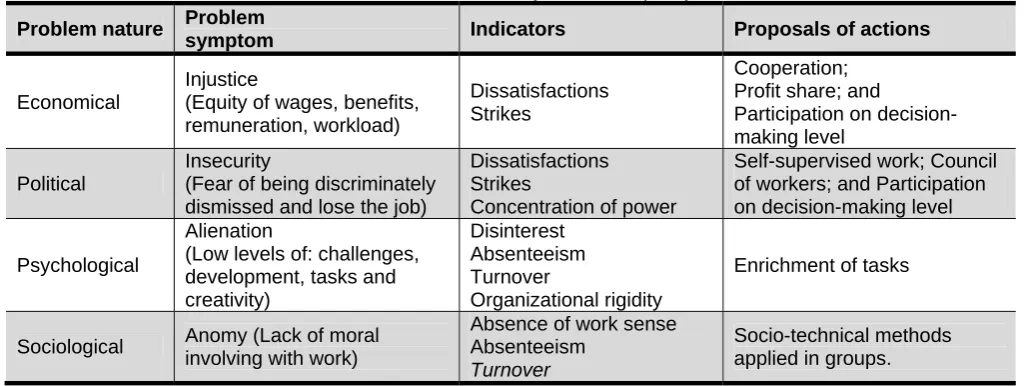
In Walton’s (1973) perspective, the QLW term has as function to recover environmental and humanistic principles rejected by industrial entities in favor of the technological evolution, industrial productivity and economic development, the welcoming of the needs and workers’ pretensions. Comprising aspects related to a worker’s greater performance in decisions that refers to its respect, leading it to the industrial democracy, work humanization, emphasizing the organizations’ social obligation. From Fernandes’ (1996) point of view, the QLW is dynamic, being possible to influence in the company’s culture and organizational climate. Therefore, it is necessary that this quality of life at work interferes positively in the well-being of the workers. Meanwhile, Ronchi (2015) understands that the quality of life, in general, is connected to human being’s extrinsic and intrinsic factors, being that they may generate consequences for the quality of life at work of individuals. Thus, as extrinsic factors, four dimensions are presented, which may affect the quality of life according to the following table:
Table 1 – Dimensions that may affect the quality of life.
Problem nature Problem
symptom Indicators Proposals of actions
Economical
Injustice
(Equity of wages, benefits, remuneration, workload)
Dissatisfactions Strikes
Cooperation; Profit share; and
Participation on decision-making level
Political
Insecurity
(Fear of being discriminately dismissed and lose the job)
Dissatisfactions Strikes
Concentration of power
Self-supervised work; Council of workers; and Participation on decision-making level
Psychological
Alienation
(Low levels of: challenges, development, tasks and creativity)
Disinterest Absenteeism Turnover
Organizational rigidity
Enrichment of tasks
Sociological Anomy (Lack of moral involving with work)
Absence of work sense Absenteeism
Turnover
Socio-technical methods applied in groups.
Source: Westley W.A. Problems and solutions in the quality of working life (2001/1979). Ronchi, C.C.
As intrinsic elements, it is highlighted the following dimensions, which may influence the human being’s quality of life:
Table 2 – Model of components of well-being and mental health.
Self-acceptance The individuals who accept themselves, as well present positive attitudes about themselves. It is the central aspect of mental health.
Positive relationship They tend to practice empathy and affection by others, since they seek for identification and friendship.
Autonomy These individuals tend to independence from external approvals with respect to their self-evaluation.
Environment They tend to choose and create adequate environments to their own characteristics, as well as dominate them.
Purposes of life They tend to present a sense of direction and meaning of life. They keep goals and intention giving meaning to it.
Growth They present need of growth and personal improvement constant in different challenges of life.
Source: Ronchi, 2017.
the quality of life is an important factor for any individual. It encompasses the human being’ physical, mental and spiritual health, directly interfering in its day-by-day, be in the personal or organizational environment.
3.RESILIENCE
The evidences indicate that the leadership is linked to the resilience, factor that deserves an in-depth study. Rutter’s (1987) researches spot that the concept of resilience is applied to define the individual who evolves healthily and that, independently on living risk situations, it reaches its goals. The author states that it is a peculiar variable in response to the threats that may be experienced in distinct ways by different persons. Ronchi (2015), about this context, deduces that resilience can be classified as a capacity that the individual must develop to confront adverse events, since it daily experiences risk situations. Guzzo and Trombeta (2002) complement, stating that the word have been defined as factor needed for individual’s mental health.
Tavares’ (2001) studies evince that resilience can be seen through three perspectives. In physical perspective, it is the quality of matter to return to its initial state when subjected to physical damages. In the medical perspective, it is the capacity of an individual handles with illness with or without use of medicines. In the psychological perspective, it is the human being’ capacity, individually or in-group, to overcome adverse situations without losing mental balance. It is certain that the environment passes by several changes; the study of resilience is important factor for those who want to lead.
The Piovan’s (2010) verifications explain that life offers alternatives and choices in a way that the decision made may generate consequences. In the organizational environment, these choices may affect workers directly or indirectly, triggering conflicts that need to be managed so as not to lose control of the situation. Conner (1995) highlights that individuals who have greater level of resilience capacity are more apt to experience the constant changes that occur in the organizational environment, presenting few anomalies caused by these transformations. The author points that the workers need to manage better their emotions in the working environment, avoiding, thus, consequences as physical or psychological exhaustion, depression, and conflict with co-workers, among others.
Rutter’s (1987) studies express that the resilience must not be designated as an individual’s fixed characteristic, because in case the context experienced suffer changes, the phenomenon can change. Melillo and Elbio (2005) demonstrate that, In the middle of the different concepts about the term, are basic characteristics of the resilient individual: low sensitivity, effective coping, cognitive abilities, resistance to destruction, positive vital behaviors and special temperament. All them are evinced in adverse situations and stress motivators. These characteristics allow that the resilient individual be able to overcome crisis moments without its mental condition be affected. The authors defend that the resilience emanates from the relationship of an individual with one or more persons beside it and does not constitute a definitive state, that is, the individual can be more or less resilient, depending on the situation and environment conditions. Ronchi (2015) complements emphasizing that, the individual be resilient in a certain scenery does not assure that it will be again in a same future situation.
Conner’s (1995) inferences justify the resilience in five basic features: positivity, focus, flexibility, organization and proactivity. These aspects correlate in order to direct the individual to handle with adverse situations. For the author, the resilient individual is the one who demonstrates confidence, is flexible in front of uncertainties, being able to adapt itself to the changes. In view of what has been exposed, it is important to underscore that resilience is an important attribute for the leadership. Carmello (2008) enunciates that organizations need resilient executives, able to manage transformations consciously and competently, what happens by implementing changes with success for themselves and for their workers and using consistently their tools, so that their team may understand and apply same strategies. The author still states that, the resilient being maximizes its energy, fixing personal and collective resources around it, distinguishing limitations and problems, besides to demonstrate its feelings clearly and in a concise way. França (2006) explains that, when taking care of commanding a team, the leader must perform the function to work its workers’ psychic field. In this sphere, the resilience becomes a differentiated tool on the team exposed to transformations. This situation focuses both on the individual’s life at the organizational environment, and on its personal life.
From the arguments worked, it can be concluded that resilience is an important particularity present in some individuals, because it provides them with many other attributes such as flexibility, resistance, adaptability, positivity, among others, fundamental for that the individual be able to overcome adverse situations without suffering damages.
4.METHODOLOGY
The corpus of the research is about the speeches given by five managers of a medium company in the state of Maranhão, Brazil. This research is exploratory and descriptive, with a qualitative approach, since it analyzes discourses, perceptions and points of view. The research was applied in a company of petroleum and gas sector with its directive team, seen in this way:
(man, 27 years old, graduate in Law), 1 Operation and Maintenance Manager (man, 28 years old, graduate in Electrical Engineering), 1 Accounting Coordinator (man, 32 years old, graduate in Accounting) and 1 Administrative/Financial Coordinator (man, 31 years old, graduate in Business Economics). Making up 50% of the managers of this organization. The professionals interviewed denominated President, Administrative/Financial Manager, Operation and Maintenance Manager, Administrative/Financial Coordinator and Accounting Coordinator is between 27 and 56 years old. The semi-structured interviews took place from June to July 2016, with the meetings being held in the company's general office, duly recorded in audio.
Orlandi’s (2009) studies explain that, ‘in the analysis of the discourse, it is sought to understand the language making sense, as symbolic work, part of general social work, constitutive of the man and its history.’ Maingueneau (2005) understands that discourse is ‘dispersion of texts whose mode of historical inscription allows defining as a space of declarative regularities.’ Caregnato and Mutti (2006) complement the feelings demonstrating that the analysis of the discourse seeks investigating the aspects presented in different ways of production, being that they may be verbal and nonverbal, since their origin provides essences for interpretations; they may be interwoven with textual groups (oral or written) or figures and body language. In order to better understand the content obtained with the interviews, the corpus of the analysis was determined in three categories described below. It is known that several categories can be investigated, however, due to the limitation of space in an article, prioritized the categories cited, since it is understood that these are essential to assimilate representations of the speeches
Table 4 – Definition of categories Category of analysis Definition of categories
(Categ. A) Quality of Life
Physical, social and mental well-being; Condition of life, intrinsic and extrinsic factors, environmental and humanistic principles.
(Categ. B) Leadership
Manager, power, collective acceptance, influence, motivation, stimulus, importance, success, goal, posture.
(Categ. C) Resilience
Non-fixed characteristic, adversity, capacity, physical, psychological and medical perspective; Emotion, endurance, flexibility, positivity, proactivity, focus, organization.
Source: Adapted from De Pree, 1989; Walton, 1973; Rutter, 1987; Conner, 1995; De Vries, 1997; Bennis, 2007; Rue and Ashford, 2010; Minayo, Hartz and Buss, 2010; Ronchi, 2015.
4.1 Category A – Quality of Life: manifestations in the managers’ discourses
Fairclough's (2001, p. 40) inquiries demonstrate that discourse is a reproductive and transformative social act of social existences and the element of language. Based on this assumption, it is perceived that the organizational scope exposes a narrative that involves the importance of the individual to seek better conditions to perform their activities in the organization. The principles of this narrative are linked to what benefits the quality of life can generate for the subject, inside or outside the organization. In this category, the interviewee tends to submerge itself in a continuous search for the balance between personal and professional life.
Sd01. ‘The quality of life at work allows we have balance in interpersonal and professional relationships. Besides, allows the worker’s maintenance of happiness, strong indicator of performance’ (Manager 1, emphasis added).
Sd02. ‘For me, this is the most determinant factor (quality of life) in people’s productivity’ People need to feel well with what they do, need to like what they do. The balance between personal life and professional life is indispensable.’ (Manager 2, emphasis added).
Sd03. ‘Not only important, but essential. Nobody likes a work environment where strain operates. Even productivity becomes low due this, so the quality of life must be present in the organizations that want to stay and grow in the market and also outside it.’ (Manager 3, emphasis added).
Sd04. ‘Yes, both in and out of work.’ (Manager 4, emphasis added).
Illocutionary acts are performed along performing sentences (Habermas, 1996). In this circumstance, these discourses explain a composite of language that makes possible the analysis of organizational fragments. In this way, a recurring fact can be perceived when analyzing the discourses presented, the constant presence of the term ‘productivity’ in the interviewees' analysis. Thus, productivity is highlighted in Manager's discourse 1, referring to how quality of life is an important coefficient to raise its income: ‘...Besides, allows the worker’s maintenance of happiness, strong indicator of performance.’ Manager 2 shares same opinion when reporting that ‘For me, this is the most determinant factor (quality of life) in people’s productivity.’ Under this ground, Rodrigues (1994) sees the quality of life at work as an artifice to favor the subject and the organization simultaneously, through the development of the individual's performance and consequently the growth of its performance.
Manager 5 denotes the presence of productivism in her speech, since for her the work regulates her life. ‘... I believe that seeking the quality of life at work is a way of working, a way to get a job.’ Manager 3 emphasizes in his narrative the importance of the quality of life associated to the productivism so that he can perform well in the company. ‘… the quality of life must be present in the organizations that want to stay and grow in the market and also outside it.’ Following this assumption, Ehrenberg (2010) states that 'discipline is a technique that shapes the coexistence of fellow beings.'
Emphasis on the importance of quality of life reverberates in the environment, be it the work or the interviewees' daily life. In this way, the discontent with the experience in the organizational sphere is a factor that afflicts a large number of employees, regardless of the position held. Such annoyance can be detrimental both to the worker itself and to the organization (Walton, 1973). This statement is evidenced in the fragments of the discourse sequence of Manager 1 ‘The quality of life at work allows we have balance in interpersonal and professional relationships.’ Manager 2 reinforces that ‘The balance between personal life and professional life is indispensable.’ Manager 5 demonstrates the relevance of the presence of the quality of life by making the statement ‘Therefore, quality of life is important both at work and outside it.’ In the same conception, Manager 4 express that ‘Yes, both in and out of work’.
4.2 Category B – Leadership: manifestations in the managers’ discourses
In order for the desired goal be achieved, all elements must be balanced. If the leader is performing its duties unsatisfactorily, its leadership is likely to suffer the consequences of such an act. For França (2006), the leader's identity manifests itself in social circles, at which point the individual establishes bonds with a group of people and, next to it, faces situations in the most diverse, often adverse, situations where the leader's posture influences the other members of the group. In the fragments presented in this narrative, managers reveal how resilience affects their way of leading.
Sd01. “Positively. The manager, as a main environment influencer, needs to use resilience to lead its team. Even in adverse situations, it must maintain control and recover itself without major damages.’ (Manager 1, emphasis added).
Sd02. ‘Briefly ... I understand that maintaining my control contributes to the well-being of the team. If I give in to the pressures easily ... if I let the problems take care of me, it might spill over into the team. I need to be a filter so that the problems that come from outside do not affect the team too much and, at the same time, so that the problems of the team do not affect the external environment.’ (Manager 2, emphasis added).
Sd03. 'I try to be malleable in all situations, not to change myself and always look for an alternative that will have the expected result in the midst of conflicts ... this is a characteristic of resilience, and for it I proceed in this way.' (Manager 3, emphasis added).
Sd04. 'Resilience is very important, much needed for the work environment. Those who do not have resilience have a hard time coping with the pressures of the work environment. It affects my way of leading positively ... I believe that my team tends to see this as an example to follow.’ (Manager 4, emphasis added).
Sd05. ‘It affects as an attitude that my team absorbs as an example, as a way to seek to build futures, to overcome difficulties. I believe that the management is an exercise of overcoming, you work with diverse scenarios and environments extremely turbulent ... Then you need to have capacity of overcoming.’ (Manager 5, emphasis added).
maintaining my control contributes to the well-being of the team. If I give in to the pressures easily ... if I let the problems take care of me, it might spill over into the team.’ The manager 1 points the resilience as an aspect responsible for influencing its personnel, exposing in its language that ‘...The manager, as a main environment influencer, needs to use resilience to lead its team.’ Following the same line of thought, manager 4 shares the same opinion when explaining in its speech that resilience is able to inspire its personnel. ‘...It affects my way of leading positively ... I believe that my team tends to see this as an example to follow.’ The manager 5 complements by demonstrating in her speech that resilience instigates her personnel to achieve goals. ‘...It affects as an attitude that my team absorbs as an example, as a way to seek to build futures, to overcome difficulties.’ On the basis on the foregoing, Lapierre (1995) explains that, the capacity to conduct, coordinate, have the consent of another person, makes up for the ability to inspire, to serve as a model for others. Manager 3 explains that he seeks to act flexibly in order to find options that help it in solving its problems. ‘I try to be malleable in all situations, not to change myself and always look for an alternative that will have the expected result in the midst of conflicts...’.
Starting from this premise, Bergamini (2005) stresses that inspiring and motivating the team, means to propagate purposes and pretensions perseveringly. The author complements by pointing out that the effectiveness of a leader is exposed as it carefully addresses the potential growth of its team members in such a way that they put a common goal ahead of any self-interest. Based on this assumption, Tavares (2013) adds that the ability to be resilient generates benefits not only for the manager itself, but also for the entire team coordinated by it. Consequently, looking for the development and competence in its team of collaborators.
4.3 Category C – Resilience: manifestations in the managers’ discourses
Resilience is designed through the ability that the individual has to react favorably to the demands of its routine, regardless of the adversities encountered during this period. Rutter’s (1999) investigations enunciate that resilience is structured on an allusive defense, exposed by some individuals in adversity phases. In the passages contained in this report the managers point out what they understand by the resilience term as well as if they consider themselves as resilient persons.
4.3.1 Category C – Resilience: resilience in the managers’ perception
Sd01. ‘It is the capacity of absorbing demands under pressure, seeking to solve them, and empower oneself of skills from this experiences.’(Manager 1, emphasis added).
Sd02. ‘I understand it as the capacity to endure change, to endure problems, without affecting the person’s natural behavior.’ (Manager 2, emphasis added).
Sd03. ‘I understand it as the capacity to endure difficulties and day-by-day pressures.’ (Manager 3, emphasis added).
Sd04. ‘Resilience is the capacity that the person has to face, be faced and internalize this in a beneficial way. Do not let this affect its way of acting.’ (Manager 4, emphasis added).
Sd05. ‘It is the capacity you have to start again faced with a loss, faced with a situation of disaggregation. When you experience a difficult situation, adverse to your plans… you start again and look for other ways, being stronger than the negative power that has destroyed the goals you intended reaching.’ (Manager 5, emphasis added).
In these circumstances, the constant use of the word "capacity" in the narrative of the managers is emphasized. Thus, resilience is highlighted in these discourses as a characteristic in which the individual is able to circumvent unfavorable situations without suffering further deterioration. Manager 1 explains that by resilience it understands that ‘It is the capacity of absorbing demands under pressure, seeking to solve them…’. Manager 2 highlights in its discourse that ‘I understand it as the capacity to endure change, to endure problems, without affecting the person’s natural behavior.’Manager 3 highlights that resilience helps solving impasses in their daily life by saying that ‘I understand it as the capacity to endure difficulties and day-by-day pressures.’ In the same thought line, managers 4 and 5 respectively denote that ‘Resilience is the capacity that the person has to face, be faced and internalize this in a beneficial way…’ and ‘It is the capacity you have to start again faced with a loss, faced with a situation of disaggregation.’
and adapt to change.
4.3.1.1 Category C – Resilience: resilience in the managers’ perception
Sd01. ‘Yes... a skill needed for executives who crave success.' (Manager 1, emphasis added).
Sd02. ‘Yes...Something that needs to be constantly developed. But, in a general way, I consider myself resilient.’ (Manager 2, emphasis added).
Sd03. “Yes, I consider myself resilient.’ (Manager 3, emphasis added).
Sd04. ‘I consider myself resilient, we can always improve. But we must be careful not to be resilient to the extreme, not just internalize ... sometimes there is a need to contest.’ (Manager 4, emphasis added).
Sd05. ‘Yes, I consider myself quite resilient.’ (Manager 5, emphasis added).
Through the facts elucidated, it should be noted that all interviewees consider themselves resilient persons. Manager 1 demonstrates that being resilient is essential for managers who seek be successful in the market, by saying that ‘…a skill needed for executives who crave success.' Manager 2 states that resilience needs to be constantly evolving by saying that ‘Yes... Something that needs to be constantly developed. But, in a general way, I consider myself resilient.’ Managers 3 and 5 were brief in stating respectively that ‘Yes, I consider myself quite resilient’ and ‘Yes, I consider myself quite resilient’. While manager 4, besides judging itself a resilient subject, warns of the need for attention so that the individual does not succumb to resilience ‘I consider myself resilient, we can always improve. But we must be careful not to be resilient to the extreme, not just internalize ... sometimes there is a need to contest.’ In relation to the exposed, Ronchi (2016) warns about the imminent danger of organizations handling the subject's resilience aiming only at the achievement of its objectives, it should be noted that in the discursive sequences all respondents have a conception about resilience, a fact that reinforces that it is a discourse commonly used in the corporate world .
5.FINAL CONSIDERATIONS
The research carried out aimed to elucidate the ways in which resilience can affect the quality of life of leaders. As previously quoted, resilience is the propensity to overlap unfavorable situations, without inheriting from them permanent psychic changes. There is a range of resources and tools to facilitate the daily lives of managers, regardless of the area in which they operate. However, even with so many artifices available, professionals find possible difficulties to deal with the constant pressure attributed by the organizations' demands in which they work. Thus, it is important to emphasize that the scarcity of resilience in situations of adversity becomes a determining factor for the loss of motivation, efficiency and the creation of negative habits in the organizational environment.
It was found in the elaboration of this article that for the managers the quality of life is a coefficient that is linked to a series of factors, such as motivation and productivity, which can contribute positively to the development of the physical, social and psychic balance of the individual, besides causing repercussions on the health of the subject. It is evidenced that for the investigated ones, the term leadership brings in its formulation the conduct of influencing individuals in order to achieve common goals, therefore, it is up to the leader to develop an encouraging posture, nevertheless this act can become an exhausting activity.
The study indicates that resilience should not be qualified as a stable characteristic of the individual, since in case the scenario experienced by the subject undergo changes, the condition of the subject can undergo changes. It should be stressed that the individual acting resiliently does not attest that so it will act again in a future circumstance. It should be emphasized that all the speeches given by the interviewees reinforce the need for resilience as a preponderant factor.
REFERENCES
BENNIS, W.G. The challenges of leadership in the modern world: An introduction to the special issue. American Psychologist. Los Angeles, v. 62, n.1, 2007, p. 2-5.
BERGAMINI, C.W. Psicologia aplicada à administração de empresas: psicologia do comportamento organizacional. São Paulo: Atlas, 2005.
CAREGNATO, R.C.A; MUTTI, R. Pesquisa qualitativa: análise de discurso versus análise de conteúdo. Texto Contexto Enferm. Florianópolis, v.15, n. 4, 2006, p. 679-684.
CARMELLO, E. Resiliência: a transformação como ferramenta para construir empresas de valor. São Paulo: Gente, 2008. CONNER, R.J. Gerenciando na velocidade da mudança: Como Gerentes Resilientes são bem-sucedidos e Prosperam
Onde Outros Fracassam. Rio de Janeiro: IBPI Press, 1995.
DERUE, D. S; ASHFORD, S. J. Who Will lead and Who Will follow? A social process of leadership identity construction in organizations. Academy Of Management Review. New York, v. 35, n.4, 2010, p. 627-647.
DESSEN, M. C; PAZ, M. G. Validação de um instrumento de perfil pessoal nas organizações. Avaliação Psicológica. Brasília, v.8, n.3, 2009, p. 347-357.
DE VRIES, K.F.R.M. Liderança na Empresa: Como o comportamento dos Líderes Afeta a Cultura Interna. São Paulo: Atlas, 1997.
EHRENBERG, A. O culto da performance: da aventura empreendedora à depressão nervosa. São Paulo: Idéias & letras, 2010.
FAIRCLOUGH, N. Discurso e mudança social. 2 ed. Brasília: Unb, 2001.
FERNANDES, E.C. Qualidade de Vida no Trabalho: como medir para melhorar. 2.ed. Salvador: Casa da Qualidade, 1996.
FRANÇA, A.C.L. Comportamento organizacional: conceitos e práticas. 2 ed. São Paulo: Saraiva, 2006.
GARMEZY, N. Children in poverty: resilience despite risk. Psychiatry Interpersonal & Biological Processes. Washington, v. 56, n.1, p. 127-136.
GUISELINI, M.A. Qualidade de Vida: Um Programa prático para um corpo saudável. 2 ed. São Paulo: Editora Gente, 1996.
GUZZO, R.S.L.; TROMBETA, L.H.A.P. Enfrentando o cotidiano adverso: Estudo sobre resiliência em adolescentes. Campinas: Alínea, 2002.
HABERMAS, J. Racionalidade e comunicação. Lisboa: Edições 70, 1996. LAPIERRE, L. Imaginário e liderança. São Paulo: Atlas, 1995.
MAINGUENEAU, D. Gênese dos discursos. São Paulo: Parábola Editorial. 2008.
MELILLO, A.; ELBIO, N. S. O. Resiliência: descobrindo as próprias fortalezas. Porto Alegre: Artmed, 2005.
MINAYO, M.H.; Z.; BUSS, P. Qualidade de vida e saúde: um debate necessário. Ciência & Saúde Coletiva, Rio de Janeiro, v.5, n. 1, 2000, p. 7-18.
PASCHOAL, T.E.; TAMAYO, A. Construção e validação da Escala de bem-estar no trabalho. Avaliação Psicológica,
Brasília, v. 7, n. 1, 2008, p.11 – 22. Disponível em: < http://pepsic.bvsalud.org/pdf/avp/v7n1/v7n1a04.pdf>. Acesso em: 01 abr. 2016.
PIOVAN, R. Resiliência: como superar pressões e adversidades no trabalho. 1 ed. São Paulo: Reino Editorial, 2010. PREE, M. Liderar é uma arte: vencendo a crise e inércia com uma administração inovadora. 2 ed. São Paulo: Best Seller,
1989.
RODRIGUES, M.V.C. Ensaios de administração: organização e recursos humanos. Brasília: Unb. 1994. RONCHI, C.C. O processo da liderança: conceitos, tipos e aplicações. 1 ed. Rio de Janeiro: GdN, 2007.
Qualidade de Vida e Trabalho: Fatores Psicossociais e da Organização. Curitiba: Juruá, 2015.
Carreira e resiliência. Curitiba: Juruá, 2017 (No prelo).
RUTTER, M. Psychosocial resilience and protective mechanisms. American Journal of Orthopsychiatry, Menasha, v. 57, n. 3, 1987, p. 316-331.
RUTTER, M. Resilience concepts and findings: implications for family therapy. Journey of Family Therapy. Oxford, v.1, n. 21, 1999, p. 119-144.
SOUZA, J. W.; MEDEIROS, J. P. Diagnóstico da qualidade de vida no trabalho (QVT) de frentistas de postos de combustíveis e suas interfaces com a qualidade dos serviços prestados. Revista de Gestão USP. São Paulo, v. 14, n. 3, 2007, p. 71 – 79.
TAVARES, J.P. Resiliência e Educação. São Paulo: Cortez, 2001. TAVARES, J.P. Liderança Vip. Escrytos, 2013.