Organizational Citizenship and Other Behavioral
Variables Acting on a Merger Environment
Rui Charles
College of technology in quality management in FTEC colleges, Brazil
Ademar Galelli
University of Caxias do Sul, Brazil
Maria Emilia Camargo University of Caxias do Sul, Brazil
Abstract
Organizations change their management practices, often performing merger, due to external factors such as changes or social, political, environmental and economic problems. The company focus of this research, called Alpha, with strategic objectives to expand their business and be more competitive in the market, in December 2008 sold part of its shareholding (49%) to a company named Beta. This research was conducted with employees of the company Alfa, located in Caxias do Sul, Brazil. The objective of this study was to measure aspects of organizational behavior in a business merger environment. This quantitative research was classified as exploratory (case study), whose data were processed using techniques such as factor analysis and ANOVA. As results, moderate degrees of organizational behavior with significant variability in different subgroups of the respondent population were identified. Significant behavioral variables, drawn from the survey instrument, were: organizational commitment, organizational citizenship (initiative, loyalty and fidelity) and job satisfaction. Regarding merge qualifying variables came up significantly: work and task, motivation and communication.
Keywords: Organizational Citizenship. Behavioral Variables. Fusion environment
1.INTRODUCTION
The potential shock of organizational cultures, management styles, low level of involvement, leadership ineffective, fear, anxiety and loss of status can generate problems for organizations. Although there are difficulties, the increasing pressures on businesses, increase organizational efficiency, come the same influencing to change their business strategies (Bowditch and Buono, 1992). In General, this makes the employees through frequent changes in labor relations, is in the same location, or by the change of working environment (Linde; Schalk, 2008).
For some time, if assessed organizational efficiency through the profit, but it became clear over time that the efficiency is related to personality, traditions, cognitive guidance, perception, among others (Argyris, 1975). More recently, the Organizational Citizenship Behavior, as a discretionary behavior that is not part of the functional requirements of an employee, but that helps to promote the effective functioning of the Organization (Robbins, 2008).
In this research, exploratory character (case study), were measured variables on organizational behavior. Organizational citizenship were used some benchmarks, based on literature explored for Organ (1988), Borman and Motowidlo (1997), Podsakoff, MacKenzie, Paine and Bachrach (2000), Rego (2002), Borman (2004) and Organ, Posdakoff and Mackenzie (2006).
Objective of this research was to measure the commitment of employees using a scale developed by Mowday, Steers and Porter (1979), the job satisfaction through the scale developed by Hackman and Oldham (1974) and, finally, identify the level of variables Fusion in an organizational environment of an auto parts company, for theory of the Empson (2001), Baptiste (2002), Henderson (2002), Bowditch and Buono (2003), Sverke, Chaison and Sjöberg (2004), Zhu, May and Rosenfeld (2004), Seo and Hill (2005), Linde and Schalk (2008), Butler (2008) and Patalano (2009).
2.THEORETICAL FRAMEWORK
2.1 Organizational Citizenship Behavior
Organ (1988) describes that this innovative and spontaneous behavior is approached by Katz and Kahn (1976) as Organizational Citizenship Behavior. The behavior is individual, discretionary, not directly or explicitly recognized by the formal system of rewards, and that promotes the effective functioning of the organization. It is not a requirement of executive function or job description, is a matter of personal choice. Organ (1997) States that the Organizational Citizenship Behavior contributes to organizational effectiveness.
Organizational Citizenship Behavior can be defined as "the discretionary behaviors, not directly or explicitly recognized by the formal system of rewards, and that, as a whole, promote the effective functioning of the Organization". (Organ,1988). Second Organ (1997), the Organizational Citizenship Behavior is discretionary in the sense of going beyond the requirements of the job description. This is due to changes in jobs, roles, exchange of staff and the very definition of work
It turns out that there is no consensus in the literature about the variables of the Organizational Citizenship Behavior. Podsakoff, MacKenzie, Paine and Bachrach (2000), Paillé (2009), Borman (2004), Turnipseed and Murkison (1996) did not identify exactly the same variables for Organizational Citizenship Behavior.
2.2. Organizational Commitment, and Organizational Citizenship Behavior
Organizational commitment has been widely studied in Organizational Psychology, as "an essential variable related to employee satisfaction and organizational effectiveness." (Chacón, Vecina and Dávila, 2007, p. 629). For Mowday, Porter and Steers (1982), organizational commitment is a force on the identification of an individual and your involvement in an organization. For Medeiros, Albuquerque, Siqueira and Marques, (2003), organizational commitment, like search, variable must be a part of more complex models that encompass organizational variables and performance.
Organ & Ryan (1995) submitted the organizational commitment to a meta-analysis, making correlations with the behavior of citizenship, and identified a significant correlation between them. In the studies that were conducted by Schappe (1998), there was a clear relationship between the organizational commitment, job satisfaction and procedure of Justice with the background to the Organizational Citizenship Behavior (altruism, courtesy, sportsmanship, civic virtue and initiative).
In your research, noted that when the three variables are considered independent, they influence the Organizational Citizenship Behavior, However, when all three are considered together, the only organizational commitment.
2.3. Job satisfaction and organizational citizenship behavior{ XE "2.3.1 Satisfação no trabalho e comportamento de cidadania organizacional" }
There are a number of studies in the area of job satisfaction and one of the most common methods to measure job satisfaction, according to Taber & Taylor (1990), is the Job Diagnostic Survey (JDS) developed by Hackman and Oldham (1974), whose instrument is comprised of seven variables: variety, autonomy, identity, meaning, return of the own work, feedback from agents and how to deal with the other.
The study on organizational citizenship behavior, Robbins (2008) notes that there is a logical relationship between satisfaction and Organizational Citizenship Behavior, as satisfied employees seem to be more likely to speak well of the company, to help others, to exceed the expectations in relation to the your work and be willing to go beyond their regular assignments, for wanting to reciprocate the positive experiences. "Recent research has shown that there is a positive relationship between job satisfaction and multiple variables of organizational citizenship behavior." (Jordan, Campo, Schraeder and Armenakis, 2007, p. 259). Organ and Ryan (1995) highlight that studies with organizational commitment, loyalty and support to the leadership have shown that there is a significant level of correlation between Organizational Citizenship Behavior, and satisfaction.
Organ, Podsakoff and Mackenzie (2006) obtained in a search positive effects on five types of Organizational Citizenship Behavior: altruism, courtesy, sportsmanship, civic virtue and initiative. For Organ & Ryan (1995), accumulation of studies allowed greater precision about the correlation, in population, between satisfaction and Organizational Citizenship Behavior. Recent studies suggest that this correlation exceed the satisfaction and productivity.
2.4 Mergers and Organizational Citizenship Behavior
For Linde and Schalk (2008), in an environment of mergers for economic transactions, competitive forces, partnerships, competitiveness, organizational changes and transformations, in which workers are exposed. In his studies declare that the influence of internal social context and, more specifically, labour relations, in the psychological contract, cannot be ignored.
Bowditch and Buono (2003) highlight that problems or discussions related to individual fears, anxieties, stress reactions, cultural constraints and tensions are variables present in mergers. "The integration of organizational cultures is another challenge facing companies in the process of mergers and acquisitions." (Baptiste, 2002, p. 466).
Butler (2008) found in European companies, which engage in strategic alliances is highly influenced by the culture of origin. Cultural differences between companies from different countries and industries cause problems in strategic alliances. The author points out that the cultural variables versus universalism; pragmatism versus idealism, and traditionalism versus modernity influence on communication skills; interpersonal skills need for achievement, affiliation and power
Astrachan (2004) points out that anxiety is stimulated by the simple announcement that people in an organization, are leaving and that the impact of the anxiety is expressed differently, depending on the number of people who stay or leave the organization.
The integration of members of an organization, as Sverke, Chaison and Sjöberg (2004), is not affected by the effect of a merger. The degrees of commitment, satisfaction and participation ranged together significantly. The compromise tends to increase after the merger, while the satisfaction remains relatively stable.
Another variable of behaviour of individuals, present in a merger, are the fears. There are fears related to the transfer of knowledge of individuals, which, in accordance with Empson (2001), have fear of exploitation; and in this environment of stress, only share your post-merger knowledge with new colleagues, if you obtain knowledge also. This perspective implies that individuals evaluate costs and benefits associated with transfer of knowledge with the colleagues of the merger partners.
3. MATERIAL AND METHOD
3.1 Characterization of the company under study and method employed
The focus of this research, called Alfa, with strategic goals to expand your business and be more competitive in the market in December 2008 sold part of your ownership (49%) to a company (Beta) of the same thread. Alpha currently has more than 300 employees. The Beta company has more than 3,000 employees, with annual revenues over 1 billion reais; has three units in Brazil, five distribution centers and six subsidiaries abroad.
The population considered for this survey covers only employees. It was intended to adopt a confidence interval of 95% and an error of 5%, 100% of the company's employees. The data collection tool was a questionnaire structured in three blocks. In the first block, the issues were worked out with emphasis on seven variables of organizational citizenship behavior, highlighted by Podsakoff, MacKenzie, Paine and Bachrach (2000).
Were used the instruments of research issues, prepared by Rego (2002), Organ, Farh and Zhong (2004), Organ, Podsakoff and Mackenzie (2006), Paillé (2009), Turnipseed and Murkison (1996). Still were part of this block issues related to customer satisfaction. They were extracted from Hackman & Oldham (1974). Were also part of the first block the issues related to organizational commitment studied by Mowday, Steers and Porter (1979).
The second block consisted of issues related to employee perceptions as to the implementation of the merger, based on literature review of this work. The theory used for the preparation of the issues addresses the concepts of the following authors: Empson (2001), Baptiste (2002), Henderson (2002), Bowditch and Buono (2003), Sverke, Chaison and Sjöberg (2004), Zhu, May and Rosenfeld (2004), Seo and Hill (2005), Linde and Schalk (2008), Butler (2008) and Patalano (2009). The measures were the variables related to anxiety, social identity, acculturation, conflict of roles, transparency, organizational justice, fears, knowledge, motivation, change, commitment and satisfaction. The questions designed to assess the variables of the study were answered by respondents using a Likert scale of 5 points ranging from (1) strongly disagree (5) totally agree.
The third block presents data on sex, age, company, area of work and level of education.
4. ANALYSIS AND SEARCH RESULTS
4.1 Factor analysis
The data collection was conducted between the months of September and October 2010. All employees of the company Alfa were invited to participate in the research, 264 questionnaires responded, of which 217 were considered valid.
The factor analysis with Rotation Rotation extracted four factors. The first factor (F1) has organizational commitment related variables and explains 10.798% of the total variance of the data, with internal reliability index Cronbach's alpha equals 0.852.
The second factor (F2) has issues related to the initiative and explains 5.403% of the total variance of the data, with Cronbach's alpha equals 0.757. According to Segundo Podsakoff, MacKenzie, Paine & Bachrach (2000) and Rego (2002), employees with knowledge and skills, develop initiative forward to opportunities within and outside the Organization, using their own time and resources when necessary. In this block are behavioral attributes help, loyalty and individual initiative of the theory of organizational citizenship behavior. Also a matter of affective commitment of the theory of Mowday et al. (1979).
The third factor (F3) has variables related to satisfaction at work and explains 4.68% of the total variance of the data, with Cronbach's alpha equals 0.583. Job satisfaction attributes of Hackman & Oldham (1974), featured in this factor were: autonomy, feedback from work, dealing with the other. It was also found a matter of affective commitment of Mowday, Steers & Porter (1979).
In the fourth (F4) factor are the variables related to loyalty and faithfulness, that explain 4.32% of the total variance of the data, with Cronbach's alpha equal 0.630. The attributes represented are related to sportsmanship and obedience. Were also found two issues of affective commitment, Mowday, Steers range & Porter (1979).
For the fusion block also opted for the factor analysis with Rotation rotation by three factors. The first factor (F1) has work-related variables and assignment of officials in the fusion environment and explains 18.99% of the total variance of the data (Cronbach's alpha equal 0.856). This factor represents the attributes of the theory, such as organizational justice, the fears, the motivation, the quality of work performed and social identity, extracted mainly from theory of the Seo & Hill (2005).
The second factor (F2) has issues related to behavioral characteristics of motivation of employees and explains 12.82% of the total variance of the data (Cronbach's alpha equal to 0.769). The theory attributes studied, that are part of this factor are the commitment, motivation and satisfaction with work.
The third factor (F3) has issues related to communication and explains 7.66% of the total variance of the data (Cronbach's alpha equals 0.608). The attributes of the theory that are part of this factor are communication and transparency.
4.2 ANOVA of the behavioral variables identified
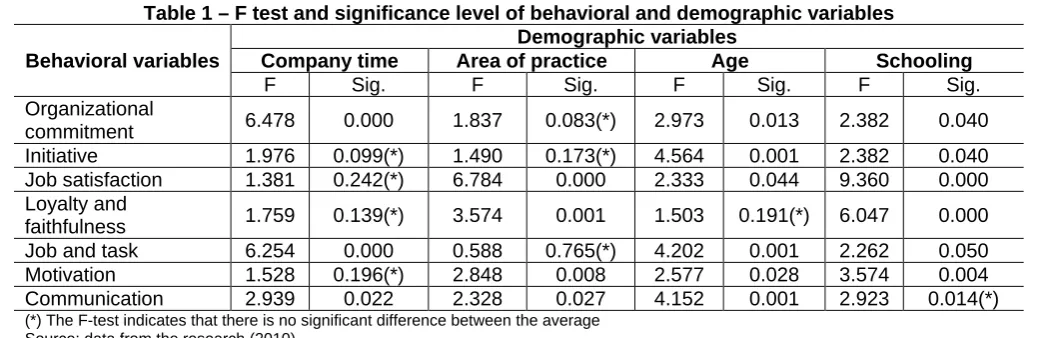
Table 1 presents a summary of the significant differences between the average and the F-test of the behavioral variables and relationships of the merger in relation to demographic variables. In this table, are also the values of F, for medium-sized test that showed no significant differences between the others.
The results show that organizational commitment can be influenced by demographic factors company time, age and education. Already the demographic factor operating area may not influence the commitment of employees.
In relation to the initiative, the demographic variables age and education can influence the behaviour of individuals. However, the initiative may not be influenced by demographic factors time and area of expertise.
The company time may not influence satisfaction behavior of individuals, but their satisfaction results can be influenced by area of expertise, age and education.
The index of loyalty and faithfulness can be affected by demographic factors area of expertise and education, however, the company's time and age are not responsible for the behavior of loyalty and loyalty of employees. The index of the variable fusion work and task level can be related to company time, age and education, but not with the performance area. The table 1 presents F test and significance level of behavioral and demographic variables.
The motivation does not present significant correlation with time, while communication presents positive and significant correlation with the four demographic variables.
Table 1 – F test and significance level of behavioral and demographic variables
Behavioral variables
Demographic variables
Company time Area of practice Age Schooling
F Sig. F Sig. F Sig. F Sig.
Organizational
commitment 6.478 0.000 1.837 0.083(*) 2.973 0.013 2.382 0.040
Initiative 1.976 0.099(*) 1.490 0.173(*) 4.564 0.001 2.382 0.040 Job satisfaction 1.381 0.242(*) 6.784 0.000 2.333 0.044 9.360 0.000 Loyalty and
faithfulness 1.759 0.139(*) 3.574 0.001 1.503 0.191(*) 6.047 0.000 Job and task 6.254 0.000 0.588 0.765(*) 4.202 0.001 2.262 0.050
Motivation 1.528 0.196(*) 2.848 0.008 2.577 0.028 3.574 0.004
Communication 2.939 0.022 2.328 0.027 4.152 0.001 2.923 0.014(*)
5. FINAL CONSIDERATIONS
With respect to the goal of identifying behavioral variables and attributes qualifiers of the merger were identified: commitment, initiative, satisfaction, loyalty and faithfulness, work and task, motivation and communication.
In relation to the specific objective to identify the most significant variables of organizational citizenship behavior present in an environment of variables were identified, initiative and loyalty and fidelity. The attributes that contributed to the significance of the initiative were commitment, motivation and communication. To loyalty and faithfulness were commitment and motivation.
As for the specific purpose of measuring the variables related to organizational commitment, significant relationships were identified between the variables: initiative, job satisfaction, job and task, and motivation. As regards the specific objective measure the level variables from the merger as perception of employees obtained the work and task factors, motivation and communication.
To analyze the correlation between commitment, satisfaction and merger environment, it became clear from these analyses, that there are positive relationships: commitment to the initiative, job satisfaction, job and task and motivation; job satisfaction with commitment, loyalty and faithfulness, and motivation; variable communication relates to initiative and work as well as with task. With regard to the merger environment, there is no positive relationship with commitment, initiative and communication, but there is no positive relationship with job satisfaction.
Behavioral variables and fusion did not show qualifier homogeneity of significant differences with the demographic factors, exception noted for education.
It was observed that only two variables of organizational citizenship were identified: initiative, loyalty and faithfulness.
In relation to the merger, it was noticed that the behavioral variables identified in job and task, motivation and communication were essential to maintain the integrity of the company's management policy.
Finishing this work, it is concluded that, in a merger of two companies, where there are opportunities, threats, cultural, social and economic variables, strains, stress, fears, doubts, resistance to change, all this generates a series of behaviors, the which influence employees on your way to work.
This research has shown that on the occurrence of Alpha company behavioral variables (commitment, initiative, satisfaction, loyalty and faithfulness, work and task, motivation and communication) may have been responsible for setting the company's organizational culture, the forms of acting, to lead, to resolve conflicts, to solve problems, to obtain results, or even, in the form of managing the company.
REFERENCES
Allen, NJ. & Meyer, JP. (1990) The measurement and antecedents of affective, continuance, and normative commitments to the organization. Journal of Occupational Psychology, 1(63), pp. 1-8.
Argyris, CA. (1975). Integração indivíduo-organização. 3. ed. São Paulo: Atlas.
Astrachan, JH. (2004) The impact of separation anxiety as studied in a mergers and acquisitions simulation. The Journal of
Applied Behavior Science, 40(1), pp. 91-110.
Baptiste, RG. (2002) The merger of ACE and CARE: Two caribbean banks. The Journal of Applied Behavioral Science, 38(4), pp. 466-480.
Borman, WC. (2004) The concept of organizational citizenship. American Psychological Society, 13(6),pp. 238-251.
Borman, WC. & Motowidlo, SJ. (1997) Task performance and contextual performance: the meaning for personnel selection research. Human Performance, 10(2), pp. 99-109.
Bowditch, JL. & Buono AF (1992) Elementos de comportamento organizacional. São Paulo: Pioneira.
Bowditch, JL. & Buono, AF. The human side of mergers and acquisitions: managing collisions between people, culture, and organizations. Beard Books, 2003.
Butler, C. (2008) Problems in global strategic alliance management for european defense manufacturing firms.Management
Decision, 46(2), pp. 330-341.
Chacón, F., Vecina, ML., Dávila, MC. (2007) The three-stage model of volunteers’ duration of service. Social Behavior and
Personality, 35(5), pp. 627-642.
Empson, L. (2001) Fear of exploitation and fear of contamination: impediments to knowledge transfer in mergers between professional service firms. Human Relations, 54(7), pp. 839-862.
Gil, AC. (2002) Como elaborar projetos de pesquisa. 4. ed. São Paulo: Atlas.
Hackman, JR. & Oldham, GR. (1974) The job diagnostic survey: an instrument for the diagnosis of jobs and the evaluation of job redesign projects. Office of Naval Research Manpower Administration: Yale University, pp. 1-84.
Henderson, GM. (2002) Transformative learning as a condition for transformational change in organizations. Human
Resource Development Review, 1(2), pp. 186-214.
Jordan, MH., Campo, HS., Schraeder, M. & Armenakis, AA. (2007) Organizational citizenship behavior, job attitudes, and the psychological contract. Military Psychology, 19(4), pp. 259-271.
Katz, D. & Kahn, RL. (1976) Psicologia social das organizações. 2. ed. São Paulo: Atlas.
Linde, B. & Schalk, R. (2008) Influence of pre-merger employment relations and individual characteristics on the psychological contract.Psychological Society of South Africa, 38(2), pp. 305-320.
Malhotra, NK. (2005) Introdução à pesquisa de marketing. São Paulo: Pearson Prentice Hall.
Medeiros, CAF., Albuquerque, LG., Siqueira, M. & Marques, GM. (2003) Comprometimento organizacional: o estado da arte da pesquisa no Brasil. Revista de Administração Contemporânea, 7(4), pp. 187-209.
Megginson, LC., Mosley, DC. & Pietri Júnior, PH. (1986) Administração: conceitos e aplicações. São Paulo: Harbra.
Mowday, RT., Steers, RM. & Porter, LW. (1979) The measurement of organizational commitment. Journal of Vocational
Behavior, 14, pp. 224-247.
Mowday, RT., Porter, LW. & Steers, RM. (1982) Employee organization linkages: the psychology of commitment, absenteism and turnover. New York: Academic Press.
Organ, DW. (1988) Organizational citizenship behaviour: the good soldier syndrome. Lexington, MA: Lexington Books. Organ, DW., Farh, JL. & Zhong, CB. (2004) Organizational citizenship behaviour in the people Republic of China.
Organization Science, 15(2), pp. 241-253.
Organ, DW., Podsakoff, PM. & Mackenzie, SB. (2006) Organizational citizenship behaviour: It’s nature, antecedents, and consequences. London: Sage Publications.
Organ, DW. (1997) Organizational citizenship behaviour: it’s construct clean-up time. Human Performance, 10(2), pp. 85-97. Organ, DW. & Ryan, K. (1995) A meta-analytic review of attitudinal ad dispositional predictors of organizational citizenship
behavior. Personnel Psychologogy, 48, pp. 775-882.
Paillé, P. (2009) Assessing organizational citizenship behavior in the French context: evidence for the four-dimensional model. The Journal of Psychology, 143(2), pp. 133-146.
Patalano, R. (2009) Understanding economic change: the impact of emotion. Const Polit Econ. Springer Science: Business Media, LLC.
Podsakoff, PM. & Mackenzie, WC. (1997) Impact of organizational citizenship behavior on organizational performance: a review and suggestions for future research. Human Performance, 10(2), pp. 133-151.
Podsakoff, PM., MacKenzie, SB., Paine, JB. & Bachrach, DG. (2000) Organizational citizenship behaviors: a critical review of the theoretical and empirical literature and suggestions for future research. Journal of Management, 26(3), pp. 513-563.
Porter, LW. & Lawler, EEIII. (1968) Managerial attitudes and performance. Homewood, Irwin-Dorsey.
Rego, A. (2002) Climas éticos e comportamentos de cidadania organizacional. Revista de Administração de Empresas, 42(1), pp. 50-63.
Robbins, SP. (2008) Fundamentos do comportamento organizacional. São Paulo: Pearson Prentice Hall.
Schappe, SP. (1998) The influence of job satisfaction, organization commitment, and fairness perceptions on organizational citizenship behavior. The Journal of Psychology, 132, pp. 277-290.
Seo, M. & Hill, NS. (2005) Understanding the human side of merger and acquisition. The Journal of Applied Behavioral
Science, 41(4), pp. 422-443.
Sverke, M., Chaison, GN. & Sjöberg, A. (2004) Do union mergers affect the members? Short and long-term effects on attitudes and behaviour.Economic and Industrial Democracy, 25(1), pp. 103-124.
Taber, TD. & Taylor, E. (1990) A review and evaluation of the psychometric properties of the job diagnostic survey.
Personnel Psychology, 43, pp. 467-500.
Turnipseed, D. & Murkison, G. (1996) Organization citizenship behavior: an examination of the influence of the workplace.
Leadership & Organization Development Journal, 17(2), pp. 42-47.
Zhu, Y., May, KS. & Rosenfeld, LB. (2004) Information adequacy and job satisfaction during merger and acquisition.