EVOLUTIONARY ROUTE IN THE SOLID STATE FORMATION OF BUILDING COMPOSITES
Artamonova O.V.
Voronezh State University of Architecture and Civil Engineering, Voronezh, e-mail: [email protected]
We consider the evolutionary route of formation of solid and justifi ed “arsenal nano” modifi cation of the struc-ture of building composites. We discuss the concepts and foundations nanomodifi cation of structures of inorganic building materials in the problems of the development of their advanced technology. It is shown that the disclosure of the evolution of the structure on the nanoscale level is determined by a complex management tools. They include mechanisms play an important role, using a predefi ned nano-sized additives of different nature.
Keywords: system hardening, of building composites, nanomodifi cation of structures
Building on the achievements of nano-chemistry, and referring colleagues have ob-tained results, it is important to discuss with the concept of common positions and strate-gies of technology nanomodifi cation con-struction composites structures. At the same time, using the nanoeffects and nanoscale phenomena consideration is required to sys-tematize the fundamental laws governing the formation and evolution of the solid through all of the original initial and intermediate stag-es of a substantial change in its status , spatial and geometric characteristics in a multi-level scale (from nano- to macro-) structure. And then highlight the key features and areas of research for the development of applied nano-technology management techniques synthesis of matrix structures systems of composites and composite structures themselves.
If we talk about the technology of building materials and stages of transition in the pro-cesses of structure formation of the solid phase state, it must be borne in mind hydration (lime, gypsum, cement), hydrothermal – synthesis (silicate – autoclave ones) system hardening, thermal – synthesis (ceramics, glass) methods for producing composites [1].
When the detection and analysis of gen-eral evolutionary model of formation of solid substance can follow interpretations I.V. Melikhova [4].
In line with modern concepts applicable to systems of any structure in the formation of solid, the following main stages in the evolu-tion of substance: the emergence phase, parti-cle growth, agglomeration, spontaneous trans-formation in time (Figure).
We should talk about the three evolutionary transitions between stages and, accordingly, on the phenomena of molecular, topological and morphological criteria. In the evolution of the solid can be realized (Figure) the two branches
of the development process: the left, the cor-responding small perturbations of the supersat-urating, and the right, corresponding to large supersaturating of the phase-forming – guide macro component.
It is important to emphasize that each step corresponds to a specifi c range of the dimen-sions of the particles formed on it is solid. Shown in Figure dimensional scale illustrates the dimension geometric boundaries and lim-its. It is clear that the most signifi cant “arsenal nano” we can use in the stages of nucleation and growth phase particles at other stages pri-orities are different physic- chemical methods of technology impact, affecting the micro and macro scale evolutionary process. The above should be considered in the development of methods of infl uence on each of the stages and transitions considered evolutionary route.
Stage of the emergence phase
According to thermodynamic theory Gibbs – Volmer [8] of a new phase can for a certain critical degree of supersaturating, which depends on the natures of the raw ma-terials and the presence of condensation nuclei which can be introduced into the system and the outside. Nucleation is possible at a certain (critical) the degrees of supersaturating of the solution that substance whose molecules are involved in the formation of a new phase. Giv-en the rate of supersaturating g can express the critical nucleus size, and write it in the form of:
(1)
Given this correlation equation of the total energy Gibbs nucleus of critical size will be:
The evolutionary path of formation of solid substances and “dimensional scale” of its structural components
From (2) we conclude that the Gibbs energy of formation of nuclei in homogene-ous condensation is equal to one -third of its surface energy, and the remaining two thirds of the energy is compensated with ethyl en-ergetically favorable for the phase transition. From (2) it also follows that the energy of formation of the nucleus and the size of the critical nucleus depends on the degree of su-persaturating of the system: the higher it is, the smaller the size of the resulting embryos are capable of further growth. Thus, bearing in mind the impact of technological capabilities, and in particular nanotechnology, on the gen-eration stage of particles, above all, we should
speak about of such factors as the creation of supersaturating control and the introduction of outside nuclei (nuclei) condensation.
of nano” should bear in mind the types of solid phase nucleation: nucleation in the gas phase, nucleic nucleation in a liquid medium, the nu-cleation on a solid surface, mechano-stimulat-ed nucleation. Depending on the type of phase nucleation stage classifi cation process can in-troduce solids synthesis methods, including in nanostate (Table 1).
Stage of the particle growth
Each particle originated while in supersatu-rated environments, attaches itself to the mol-ecules of the medium more often than they were breaking away from the particles [4]. If the me-dium contains a plurality of different molecules, then the particles in signifi cant quantities fi xed
fi rst molecules having close crystal- structure. In fact, on the surface of the growing particle is controlled by molecular selection.
In this way, i.e. in the form of molecular screening is implemented the fi rst transition in
the route of evolution solid “phase nucleation stage ® growth of particles”. Against the back-ground of reducing the free energy of the sys-tem it is developing phenomenon of the molec-ular screening, in which embryos are clusters of molecules that contain only a little different in structure and size of the molecule. Foul-ing of the particle phase-formFoul-ing substance
is facilitated if the space between the surface of the particles and clusters formed on it, there is a certain structural correspondence.
Form growing particles typically varies during the growth; the nature of changes of these depends on the structure and mechanisms of particle growth.
From the point of view of nanotechnology, it is possible and it is necessary to bear in mind the problem of changes of the concentration of crystallization conditions and the use of addi-tives substances, in particular, nano-addiaddi-tives
Table 1 The main technological methods of synthesis of solids
and management factors depending on phase nucleation agents
Type inception phase of the substance / examples of systems
Technological methods of
synthe-sis solid substance Factors management generation in the
gaseous environment / nanosystems of metals
and oxides metals
plasma chemical ●● changes in the ionization energy of condensed matter; increase in the degree of ionization of condensed matter;
● increase the rate of condensation
cryochemical ●● changes in the concentration of inert gases; lowering the temperature of the deposition surface
nucleation in liquid environment / hydra-tion and hydrothermal synthesis system hard-ening (lime, gypsum,
cement)
sol – gel
● varying the chemical nature of the starting materials;
● changes in the initial pH of the medium;
● changes in the synthesis temperature;
● change the duration of the synthesis
hydrothermal
● varying the chemical nature of the starting materials;
● changes in the synthesis temperature;
● reduce the length of the synthesis;
● increase the pressure in the system
nucleation on surface solid / nanosystems
of metals and their compounds
electrochemical
● an increase in electrical potential;
● varying the nature of the materials and the solvent;
● changing the type and concentration of ions additives;
● changes in the adhesive properties of the deposited particles;
● changes in ambient temperature;
● changes in the conditions of diffusion of matter
mechano-stimulated initiation /
thermal-synthesis system hardening (oxides,
ceramics, glass)
mechanochemical
● increase the energy of impact;
● changes in the duration of exposure;
● change in the position of the functional groups in the molecules of the crystal
ultrasonic ●● change the frequency of the ultrasonic pulse; change the duration of the ultrasonic pulse;
possessing similar to the nuclei of the crystal phase structure, and providing targeted accelera-tion of particle growth phase-forming substances [6], and their morphological modifi cation.
According to V.B. Ratinova additives are divided into four classes:
1 – additives that alter the solubility of the system hardening and entering it into chemical interaction$
2 – additives that react with the curing to form insoluble compounds or malodissot-siruyuschih;
3 – additives, nucleating;
4 – additives, adsorbed on the grains of the solid [7].
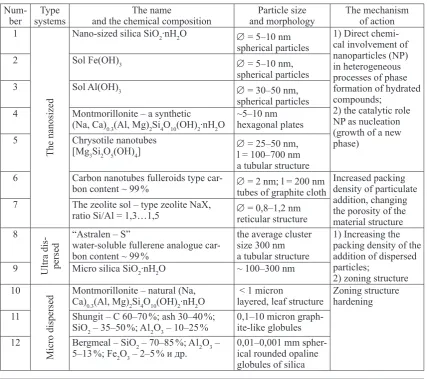
Due to the marked our three global tran-sitions in the evolution of the classifi cation solid additives useful to clarify and separate the oversized on the basis of nano-sized, ultra-fi ne and micro particulates (Table 2). Based on theoretical considerations, it is
believed that nanoscale additives and ultra 1–3 classes can actively participate in the processes of nucleation stage and grade 4 in the growth of the particles.
In general, the structure- modifying effect of participation and nanoscale modifi ers may be the result of inter-related mechanisms. It should be emphasized that the incorporation of additives in curable system (most effi cient in this case will be additive nanoparticles) may facilitate the formation of nuclei, as DG can thus reduce in accordance with equation (2).
Stage of agglomeration
In the course of evolution in the hardening system accumulate aggregates of particles of different size that are placed relative to each other in a certain order, resulting in aggregates become like colloidal crystals. The process can take place in several stages, forming the primary, secondary and tertiary aggregates
Table 2 Modifi ers nano-, ultra-, micro-sized level of dispersion and their mechanism of action
Num-ber systemsType and the chemical compositionThe name and morphologyParticle size The mechanism of action 1
The nanosized
Nano-sized silica SiO2∙nH2O = 5–10 nm spherical particles
1) Direct chemi-cal involvement of nanoparticles (NP) in heterogeneous processes of phase formation of hydrated compounds;
2) the catalytic role NP as nucleation (growth of a new phase)
2 Sol Fe(OH)3 = 5–10 nm,
spherical particles
3 Sol Al(OH)3 = 30–50 nm,
spherical particles 4 Montmorillonite – a synthetic
(Na, Ca)0.3(Al, Mg)2Si4O10(OH)2∙nH2O ~5–10 nmhexagonal plates 5 Chrysotile nanotubes
[Mg3Si2O5(OH)4] l = 100–700 nm = 25–50 nm, a tubular structure 6 Carbon nanotubes fulleroids type
car-bon content ~ 99 % tubes of graphite cloth = 2 nm; l = 200 nm Increased packing density of particulate addition, changing the porosity of the material structure 7 The zeolite sol – type zeolite NaX,
ratio Si/Al = 1,3…1,5 reticular structure = 0,8–1,2 nm 8
Ultra dis- persed
“Astralen – S”
water-soluble fullerene analogue car-bon content ~ 99 %
the average cluster size 300 nm a tubular structure
1) Increasing the packing density of the addition of dispersed particles;
2) zoning structure 9 Micro silica SiO2∙nH2O ~ 100–300 nm
10
Micro dispersed
Montmorillonite – natural (Na,
Ca)0.3(Al, Mg)2Si4O10(OH)2∙nH2O < 1 micronlayered, leaf structure Zoning structure hardening 11 Shungit – С 60–70 %; ash 30–40 %;
SiO2 – 35–50 %; Al2O3 – 10–25 % 0,1–10 micron graph-ite-like globules 12 Bergmeal – SiO2 – 70–85 %; Al2O3 –
to form complex hierarchies. After accumu-lating a suffi cient number of particles of the system when the probability of meeting and fusion of the particles becomes commensurate with the probability of their molecular growth, the process of agglomeration. There comes a second evolutionary transition “growth ® ag-glomeration of particles”. This phenomenon is the main selection topological ranked units consisting in the fact that the medium destroys and eliminates disordered aggregates and pro-motes ranked forms consisting of particles with similar morphologic parameters.
In real materials technology agglomera-tion step may be controlled by additives and surface-active agents (surfactants) are widely used plasticizers and superplasticizers (SP).
In this regard, it seems to us important structural systematics mechanisms modifying effect of plasticizers and superplasticizers ag-glomeration step in the evolutionary route of solid formation [1]. It should further be noted that the use of plasticizing additives action is often important and necessary condition fur-thermore the possibility of introducing the nano- and ultrafi ne particles in hardening since in normal conditions, these particles are chemi-cally active and prone to spontaneous agglom-eration prevents uniform volume of distribu-tion in the material obtained. Same class of surfactant additives can solve this rather com-plex task nanotechnology.
Stage of spontaneous pattern formation Evolutionary change a hardening system objectively linked to the third evolutionary transition “agglomeration radio ® spontaneous pattern formation”. In the late stage of growth and agglomeration step system state far from equilibrium, so a certain period within the sys-tem simultaneously develop the redistribution of matter and energy, which leads to spontane-ous ordering system. There is a phenomenon of morphological selection and there is a “change in the geometry of the system”, ordered ag-gregates formed a certain shape and size of the place of less ordered forms. Processes leading to the approximation of the size and shape of the particles to equilibrium, and called mor-phological selection. Streamlining processes
occur by two mechanisms: recrystallization and solid phase [5].
From a technological point of view of the stage management of spontaneous pattern formation can be based on the temperature and high-temperature treatment, the use of different types of compaction force press-ing for the introduction of particulate ad-ditives, etc. As a result, nano-modifi cation on the stage of spontaneous pattern forma-tion can form ordered structures hardening close-packed crystals, increase the area of intergranular contacts in malignancy. This is achieved by varying the morphology of the resulting systems, which also determines the type of contact that occurs (private crystal – contact contiguity, fi ber-needle – contact fu-sion, plate-and-prism – contact germination) can also be spontaneously dispersed rein-forcement structure itself.
Conclusion
Thus, evidence-based principles of man-agement structure at the nano – level is a key factor in the development of high-tech compos-ites modifi ed construction of a new generation. Possible “nanotools” to create high-quality building composites quite a lot, the approaches are very diverse and they can count on effec-tive innovaeffec-tive technological solutions that are useful for a wide range of building materials.
References
1. Artamonova O.V., Chernyshov E.M. Concepts and bases of technologies of nanomodifi cation of building composite struc-tures. Part 1: general problems of fundamentality, main direction of investigations and developments // Construction Materials. – 2013. – № 7. – P. 82–95.
2. Edelstein A.S., Camarata R.C. Nanomaterials: Synthe-sis, Properties and Application // Bristol and Philadelphia. – Inst. Physics Publ., 1996. – 648 p.
3. Gusev A.I., Rempel A.A. Nanocrystalline materials. – M.: Fizmatlit, 2000. – 224 p.
4. Melikhov I.V. Physical and chemical evolution of the solid. – M.: BINOM, A laboratory of Knowledge, 2009. – 309 p.
5. Nanoscale materials in chemistry / Ed. By K.J. Klabun-de. – New York: A John. Wiley & Sons Inc, 2001. – 292 p.
6. Poole C., Owens F. Nanotechnology. Per. from English / Ed. Y.I. Golovin. – M.: Techno-sphere, 2004. – 328 p.
7. Ratinov V.B., Ivanov F.M. Chemicals in construction. – M.: Stroyizdat, 1985. – 220 p.