India-U.K. Trade
:
A phenomenon of sliding scenario
-* Dr. S M Shafi
Until 1973 when U.K., was not the member of European Community (now European Union , India’s trade was not geographically as diversified. This was purely due to the reason that India’s Trade was almost exclusively with U.K. Indian merchandise would find other destinations in the European continent only as re-exports from Britishers. India’s trade relations with U.K., are based upon long nourished relationship fostered during British rule in India with British East India Company as its promotor plateform. Based upon mutual trust between the trading communities of the two countries and facilitated with market
opportunities, the relationship got further stronger even after India’s independence from Britain. However, with U.K. joining European Union, India’s trade started getting diversified and trade volumes with U.K started showing falling trends. The present paper traces out the behaviour of falling trade scenario with U.K.
Key Words: India, England, Imports, Exports, CAGR, Commodity Groups, Harmonized
System, DGFT.
INTRODUCTION
efore independence, the direction of India’s foreign trade was not determined by the comparative cost advantages but by the colonial relations between India and United Kingdom. It was United Kingdom that would determine what India should export and what it should import. As a matter of fact, the major portion of India’s foreign trade was with United Kingdom. History repletes that Indian goods exported to U.K. were then re-exported to other parts of the Europe. This pattern of India’s foreign trade continued for some time even after independence because India was yet to explore new destinations and develop formal trading relations with other countries. For example, India’s export earnings with UK and USA were 42 per cent in 1950-51 In the same year the share of UK and USA in India’s imports was 39.1 per cent (Mathur,2010).. Comparatively, the trade with other industrialized countries like, France, Italy, Japan was quite insignificant. As political and economic relations with other countries evolved, the direction of India’s foreign trade became broad based and highly
---
* Dr. S M Shafi is Associate Professor & Head, Department of Finance & Banking, Faculty
of Business Administration, Jazan University, and Kingdom of Saudi Arabia (KSA) E-mail: [email protected]
diversified. At the same time the inception of economic planning in India gave a boost to the efforts of forming trade relations with other countries across the globe. This broad based diversification proved a hedge against economic vulnerabilities of other countries ( Bhalla et al,2004). Upto Independence and even after for some time India’s foreign trade has been mostly with United Kingdom. But over the last many years trade with United Kingdom is on the decline. Nevertheless, with global trade share still hovering around 1.5 to 2 % , there is a greater urgency to increase India’s global trade share ( economic survey of India,2006) and increased trade with U.K. would help in improving India’s global trade share. Within this backdrop the present study is aimed at the following objectives.
Objectives of the study
The study is aimed:
to study India’s Trade with United Kingdom,
to examine the growth prospects of India’s foreign trade with United Kingdom; and
to suggest on the basis of findings of the study, various measures which would fillip and elevate trade relations with United Kingdom
Research Methodology
The present study is purely based on secondary data source. Most of the data have been retrieved from the official website of Directorate General of Foreign Trade of India (DGFT). The data used for the study has been retrieved as 2-digit code of grouped commodities. The other source of data information has been Economic Survey of India and Centre for Monitoring Indian Economy (CMIE), Government of India.
1. Exponential Trend Equation y = abx
2. Logarithmic form of the equation log y = log a + x.log b
3. Corresponding normal equations
log y = N.log a + log b.x
x.log y = log a . x + log b. x2
4. Compound Growth Rate [Gr = 100(b – 1)]
The data pertaining to commodity Exports and Imports from United Kingdom retrieved from the Export and Import Data Bank of DGFT do actually belong to 99 major commodity groups codified as per ITC (HS) code but due to the constraint of time and space, only major commodity groups were taken for research analysis. The selection of the major commodity groups was done objectively on the basis of their import and export value. Highly valued commodity groups were taken for research analysis. The selection, in this regard, was done separately for imported commodities and exported commodities. 24 commodity groups from the export basket and 16 commodity groups from import segment were finally chosen for analysis. The minimum export and import value for a commodity group to qualify for separate analysis was fixed at Rs. 100 crores. The remaining 75 commodity groups in exports and 83 commodity groups in imports were treated in aggregate and separate analysis was conducted under the heading “Miscellaneous Group”.
Trade Analysis & Interpretations
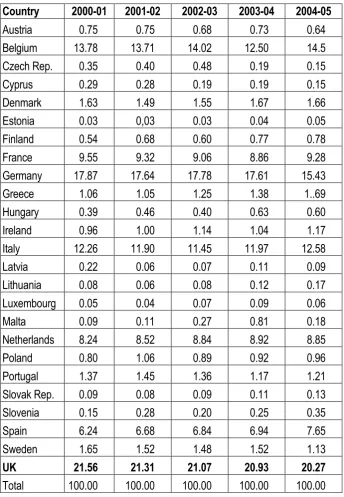
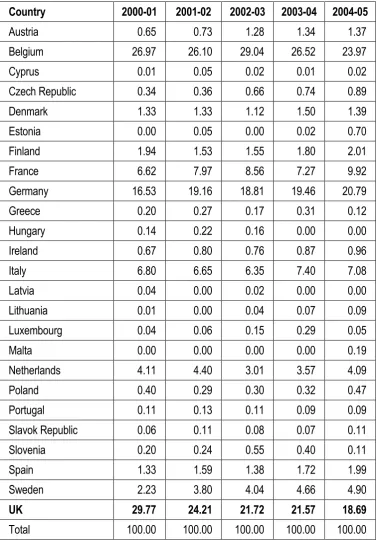
Tables 1 and 2 relating to percentage share of India’s exports to and imports from European Union bring testimony to the fact that India has had historical trade relations with the Great Britain. In fact prior to 1973, when U.K. was yet to join the EU, India’s Exports used to be routed through United Kingdom to the rest of Europe. And maximum of India’s foreign trade was with Great Britain.
The slide of Exports. Based on long nourished relationship between the peoples of the two sides developed during the British colonial rule, India’s export turnover used to be highest with U.K only. However, with each passing year after 1973 the U.K.’s share in India’s Exports started declining. More than 50% of India’s foreign trade was with U.K. but as India’s foreign trade started getting geographically diversified, India’s exports to U.K started sliding. Tracking the data from the year 2000 onwards we observe that that the percentage share of India’s exports was 21.56 percent in 2000-01, which went down to 21.31 percent in 2001-02 and further plunged to 20.27 percent in 2004-05 . In absolute terms, India’s Export to UK were Rs.10501.52 crores, Rs.10305.60 crores, Rs.12081.43 crores, Rs.13892.31 crores and Rs.15790.31 crores in 2000-01, 2001-02, 2002-03, 2003-04 and 2004-05 which has an increasing trend but in relative terms (i.e., percentage share) it has a decreasing propensity (Table 1). Taking a detailed view of the Table 2 , we observe that Belgium with whom trade in raw and finished diamonds, has grown quite rapidly has over the years turned to be an important trading partner for India.
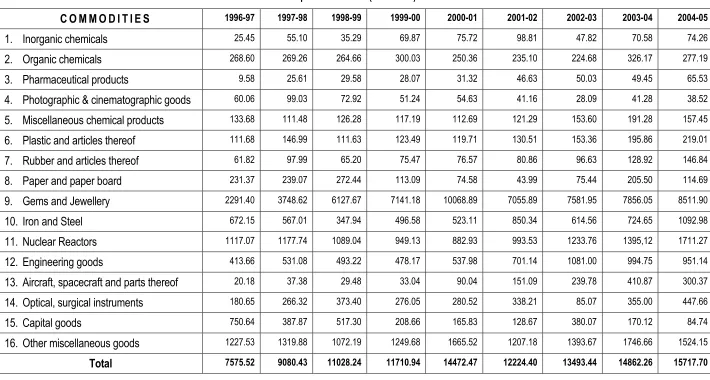
2003-04 (Rs. 14862.26), 202003-04-05 (Rs. 15717.70 cores) but in relative terms, we observe a decreasing trend when taken into consideration all EU-27 member countries trade. There we see that U.K’s share in imports is dwindling with each passing year. Browsing further through the data we observe that United Kingdom’s position in India’s Import trade had been taken over by Belgium. It should, however, be noted that trade with Belgium is exclusively in diamonds and not as diversified as is with countries like United Kingdom and Germany.
India-U.K. Trade as compared with India’s Total Trade
The percentage increase/decrease is one of the important indicators of measuring foreign trade performance. India’s total export effort had shown overwhelming results over the years under study. India’s total exports had grown from Rs.20901798.00 lakhs (2001-02) to Rs.25513728.00 lakhs in 2002-03 marking percentage growth increase of 22.06 percent over the previous year. However, during the same year, the exports to United Kingdom had increased only by 17.23 percent. Whileas, total exports and exports to United Kingdom had absolutely same percentage growth rate in the year 2003-04 i.e. 14.99%, the percentage growth rate in 2004-05 in exports to United Kingdom had been only 14.66% while as total exports had grown at 23.35% in 2004-05. Similarly United Kingdom’s share in India’s total exports was 5.16% in 2000-01, which decreased to 4.95% in 2001-02, However, it again plunged to 4.36 percent in 2004-05.
On the imports front, India’s total imports have grown over the years. In absolute terms India’s imports had grown from 24,519,972.00 lakhs in 2001-02 to 29,720,586.00 lakhs in 2002-03, marking an annual growth rate of 21.21%, while as imports from United Kingdom have increased only by 9.94%. In the year 2004-05, the total imports have grown from 35,910,764.00 lakhs in 2003-04 to 49,053,168.00 lakhs in 2004-05 at a rate of 36.60% over the previous year. Similarly, United Kingdom share in the total imports has also been thinning with every passing year. From a share of 6.27 percent in 2000-01, it dropped to 4.99 percent 2001-02 to 4.52 percent in 2002-03 to 4.14 percent in 2003-04 and lastly dipped to 3.20 percent in 2004-05.
that India’s total trade deficit widens and correspondingly trade with United Kingdom has also been growing on deficit lines all along.
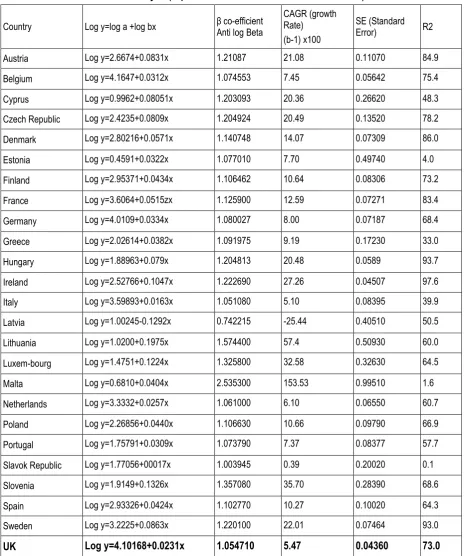
Exponential Growth Trend-The robust indicator
The import and export growth pattern of all EU-member countries have been monitored by Exponential Trend values as are revealed in tables 4 and 5. As is depicted in the Table 5, India’s exports to United Kingdom have compound Annual Growth Rate of 9.00% with R2 at 94.3%. Similarly imports from United Kingdom have been increasing at CAGR of 5.47% (with a dismal R2 = 73.0). Table 6 reveals that Readymade Garments and other clothing accessories has been number one export item to United Kingdom through out the period 1996-97 to 2004-05. In 1996-97 it was 21.07% of total exports to UK. The other major exports have been footwear and other such articles, Fish & other Aquatic invertebrates, Iron & steel, Nuclear reactors, Boilers etc., Cotton, Organic Chemicals, Tobacco, coffee, tea, Mate & Spices. The major import commodities from United Kingdom had been Gems and Jewellery. The share of Gems & Jewellery was 34.84% in 1996-97 while as it was 56.18% in 2003-04 with absolute value of Gems & Jewellery imported from U.K standing at Rs. 7581.95 crores in 2002-03. The import figure of Gems & Jewellery was Rs. 8511.90 crores (54.15%) in 2004-05. The other major import items from United Kingdom are Engineering goods, Nuclear Reactors, Optical surgical Instruments. Their absolute value was 951.14 crores, (6.051%) Reactors, 1711.27crores, (10.88%), optical surgical Instruments 447.66 crores,(2.84%), Iron & steel 1092.98(6.95%) in 2004-05.
Conclusions
of both countries have a well established relationship nourished through generations but over a period this relationship has got thinned on account of trade diversion. There is an urgent need to rejuvenate this relationship. The government of India has to use a multi-pronged approach to enhance trade with its erstwhile major trading partner. The following suggestions are putforth in this regard.
1. Organic Presence. Establishing an organic presence in U.K. through the creation of chain outlets in the form of marketing office, branch office for ensuring speedy transmission of information on latest market trends and potential customers. This would result in greater Indian competitive strength.
2. Hormonisation of Standards. The fundamental contention between the EU and the developing countries is the Standards. Under the EU-India Standards and Quality Programme, modernization of Indian testing laboratories took place (Fontaine,2005). India should ensure to export only that merchandise which would bear those standards and certification as is acceptable to the requirements under U.K.
3. India as Brand. Indian Industry associations particularly CII and ASSOCHAM should make coherent efforts to create a brand name for India in U.K. which would be ensured only through quality products and services.
4. Conducting Industry Exhibitions. Industry exhibitions should conducted in major cities of U.K., to promote the latest Indian product lines and Indian industry should also participate in the trade fairs organized by U.K. in major cities.
5. Need for enhanced role for Indian High Commission. The economic and trade section in the Indian high commission need to upgraded by further augmentation of the staff for collecting relevant information about domicile changing trade laws having implication for exports from India into U.K.
6. Revamping Trading Houses. The export trading houses should be revamped to ensure more focus on the opportunities offered by U.K. market
References:
Bhalla, V.K. and Ramu, S. Shiva, “International Business-Environment and Management”, Anmol Publications, Pvt. Ltd, New Delhi, 2004, p.
Mathur, Vibha. Foreign Trade of India, Himalaya Publishing House , New Delhi, 2010 p 23.
Singh, P.N. “India’s International Trade in the Third Millennium” (2001). In Jiwitesh Kumar Singh [Ed.]: International trade and Business-Emerging Issues and Challenges in the 21st Century, Deep and Deep Publications, New Delhi, p.11
Verma, Binita, “ Problems and Challenges of India’s International Trade during the Post-Reform Period”( 2005). In Jiwitesh Kumar Singh[Ed.]: International Trade and Business-Emerging and Challenges in the 21st Century, Deep and Deep Publications, New Delhi, p.20
Fontaine, Pascal, ‘Europe in 12 Lessons’, European Commission, Directorate General for Press and Communications, Brussels,2005.p.8
India's Imports from and Exports to UK
0.00 2,000.00 4,000.00 6,000.00 8,000.00 10,000.00 12,000.00 14,000.00 16,000.00 18,000.002000-01 2001-02 2002-03 2003-04 2004-05
Years R s . C r o r e s
Imports from UK
Exports to UK
Export Growth with UK in Comparison with Export growth with World
-5
0
5
10
15
20
25
30
35
40
45
2001-02 2002-03 2003-04 2004-05
Years P e r c e n t ( % )
Table 1
India’s Exports to EU: Percentage share of member countries
Country 2000-01 2001-02 2002-03 2003-04 2004-05
Austria 0.75 0.75 0.68 0.73 0.64
Belgium 13.78 13.71 14.02 12.50 14.5
Czech Rep. 0.35 0.40 0.48 0.19 0.15
Cyprus 0.29 0.28 0.19 0.19 0.15
Denmark 1.63 1.49 1.55 1.67 1.66
Estonia 0.03 0,03 0.03 0.04 0.05
Finland 0.54 0.68 0.60 0.77 0.78
France 9.55 9.32 9.06 8.86 9.28
Germany 17.87 17.64 17.78 17.61 15.43
Greece 1.06 1.05 1.25 1.38 1..69
Hungary 0.39 0.46 0.40 0.63 0.60
Ireland 0.96 1.00 1.14 1.04 1.17
Italy 12.26 11.90 11.45 11.97 12.58
Latvia 0.22 0.06 0.07 0.11 0.09
Lithuania 0.08 0.06 0.08 0.12 0.17
Luxembourg 0.05 0.04 0.07 0.09 0.06
Malta 0.09 0.11 0.27 0.81 0.18
Netherlands 8.24 8.52 8.84 8.92 8.85
Poland 0.80 1.06 0.89 0.92 0.96
Portugal 1.37 1.45 1.36 1.17 1.21
Slovak Rep. 0.09 0.08 0.09 0.11 0.13
Slovenia 0.15 0.28 0.20 0.25 0.35
Spain 6.24 6.68 6.84 6.94 7.65
Sweden 1.65 1.52 1.48 1.52 1.13
UK 21.56 21.31 21.07 20.93 20.27
Total 100.00 100.00 100.00 100.00 100.00
Source: Computed from the data from ‘India’s Exports by countries –Commodities; DGFT
Table 2
India’s Imports from EU: Percentage share of member countries
Country 2000-01 2001-02 2002-03 2003-04 2004-05
Austria 0.65 0.73 1.28 1.34 1.37
Belgium 26.97 26.10 29.04 26.52 23.97
Cyprus 0.01 0.05 0.02 0.01 0.02
Czech Republic 0.34 0.36 0.66 0.74 0.89
Denmark 1.33 1.33 1.12 1.50 1.39
Estonia 0.00 0.05 0.00 0.02 0.70
Finland 1.94 1.53 1.55 1.80 2.01
France 6.62 7.97 8.56 7.27 9.92
Germany 16.53 19.16 18.81 19.46 20.79
Greece 0.20 0.27 0.17 0.31 0.12
Hungary 0.14 0.22 0.16 0.00 0.00
Ireland 0.67 0.80 0.76 0.87 0.96
Italy 6.80 6.65 6.35 7.40 7.08
Latvia 0.04 0.00 0.02 0.00 0.00
Lithuania 0.01 0.00 0.04 0.07 0.09
Luxembourg 0.04 0.06 0.15 0.29 0.05
Malta 0.00 0.00 0.00 0.00 0.19
Netherlands 4.11 4.40 3.01 3.57 4.09
Poland 0.40 0.29 0.30 0.32 0.47
Portugal 0.11 0.13 0.11 0.09 0.09
Slavok Republic 0.06 0.11 0.08 0.07 0.11
Slovenia 0.20 0.24 0.55 0.40 0.11
Spain 1.33 1.59 1.38 1.72 1.99
Sweden 2.23 3.80 4.04 4.66 4.90
UK 29.77 24.21 21.72 21.57 18.69
Total 100.00 100.00 100.00 100.00 100.00
Table 3
Import -Export Trade with, U KAnnual Growth Rates, % Share, Comparison with India’s Total Foreign Trade, Trade Balance with U. K., India’s Total Trade Balance
Country: U K Values in Rs. Lacs
Year 2000-2001 2001-2002 2002-2003 2003-2004 2004-2005
EXPORT 1,050,152.63 1,030,560.56 1,208,143.88 1,389,231.25 1,579,031.25
%Growth -1.87 17.23 14.99 13.66
India's Total Export 20,357,102.00 20,901,798.00 25,513,728.00 29,336,674.00 36,187,916.00
%Growth 2.68 22.06 14.98 23.35
%Share 5.16 4.93 4.74 4.74 4.36
IMPORT 1,447,246.75 1,222,440.00 1,343,943.88 1,486,226.38 1,571,770.50
%Growth -15.53 9.94 10.59 5.76
India's Total Import 23,087,276.00 24,519,972.00 29,720,586.00 35,910,764.00 49,053,168.00
%Growth 6.21 21.21 20.83 36.60
%Share 6.27 4.99 4.52 4.14 3.20
TOTAL TRADE 2,497,399.38 2,253,000.56 2,552,087.75 2,875,457.63 3,150,801.75
%Growth -9.79 13.28 12.67 9.58
India's Total Trade 43,444,378.00 45,421,770.00 55,234,314.00 65,247,438.00 85,241,084.00
%Growth 4.55 21.60 18.13 30.64
%Share 5.75 4.96 4.62 4.41 3.70
TRADE BALANCE -397094.12 -191879.44 -135800.00 -96995.13 7,260.75
India's Trade Balance -2,730,174.00 -3,618,174.00 -4,206,858.00 -6,574,090.00 -12,865,252.00
Table 4
Statistical Analysis (Export Growth Rates with EU Member countries)
Country Log y = log a + log bx β co-efficient Anti log Beta (growth Rate) CAGR (b-1) x100
SE (Standard Error) R2
Austria Log y=2.5801+0.0248x 1.0587 5.87 0.03127 86.3 Belgium Log y=3.8345+0.0494x 1.0949 9.49 0.02984 95.9 Cyprus Log y=2.1038+0.0007x 1.0018 0.18 0.06013 0.2 Czech Republic Log y=2.2970+0.0697x 1.1721 17.21 0.07032 90.8 Denmark Log y=2.9368+0.2922x 1.0695 6.95 0.0694 64.1 Estonia Log y=1.3318+0.0414x 1.1001 10.00 0.1452 44.9 Finland Log y=2.5280+0.0462x 1.1124 11.24 0.07713 78.3 France Log y=3.6598+0.0444x 1.1078 10.78 0.043100 91.4
Germany Log y=3.9561+0.0281x 1.0668 6.68 0.04276 84.2
Greece Log y=2.7810+0.0577x 1.1422 14.22 0.09934 77.2 Hungary Log y=2.3421+0.067x 1.1692 16.92 0.07578 88.9 Ireland Log y=2.6850+0.0630x 1.15611 15.61 0.05711 92.4 Italy Log y=3.7743+0.0416x 1.10075 10.71 0.03942 91.8 Latvia Log y=1.6745+0.02610x 1.0867 8.67 0.15760 34.4 Lithuania Log y=1.4249+0.876x 1.2236 22.36 0.12550 83.0 Luxem-bourg Log y=1.4403+0.0794x 1.2006 20.06 0.11070 83.7 Malta Log y=1.9626+0.1013x 1.2628 26.28 0.31230 51.3 Netherlands Log y=3.6375+0.0417x 1.1009 10.09 0.03340 94.0 Poland Log y=2.6734+0.0398x 1.09616 9.61 0.03416 93.2 Portugal Log y=2.804+0.0415x 1.10044 10.64 0.03393 93.8 Slavok Republic Log y=1.6054+0.0883x 1.22560 22.56 0.10030 88.6 Slovenia Log y=1.9511+0.1009x 1.26181 26.18 0.13160 85.5 Spain Log y=3.4922+0.06624x 1.16476 16.47 0.03647 96.7 Sweden Log y=2.8805+0.0284x 1.06760 6.76 0.03389 87.6 UK Log y=4.0232+0.0374x 1.0900 9.00 0.02923 94.3
Table 5
Statistical Analysis (Imports Growth Rates with EU Member countries)
Country Log y=log a +log bx β co-efficient Anti log Beta
CAGR (growth Rate) (b-1) x100
SE (Standard Error) R2
Austria Log y=2.6674+0.0831x 1.21087 21.08 0.11070 84.9
Belgium Log y=4.1647+0.0312x 1.074553 7.45 0.05642 75.4
Cyprus Log y=0.9962+0.08051x 1.203093 20.36 0.26620 48.3
Czech Republic Log y=2.4235+0.0809x 1.204924 20.49 0.13520 78.2
Denmark Log y=2.80216+0.0571x 1.140748 14.07 0.07309 86.0
Estonia Log y=0.4591+0.0322x 1.077010 7.70 0.49740 4.0
Finland Log y=2.95371+0.0434x 1.106462 10.64 0.08306 73.2
France Log y=3.6064+0.0515zx 1.125900 12.59 0.07271 83.4
Germany Log y=4.0109+0.0334x 1.080027 8.00 0.07187 68.4
Greece Log y=2.02614+0.0382x 1.091975 9.19 0.17230 33.0
Hungary Log y=1.88963+0.079x 1.204813 20.48 0.0589 93.7
Ireland Log y=2.52766+0.1047x 1.222690 27.26 0.04507 97.6
Italy Log y=3.59893+0.0163x 1.051080 5.10 0.08395 39.9
Latvia Log y=1.00245-0.1292x 0.742215 -25.44 0.40510 50.5
Lithuania Log y=1.0200+0.1975x 1.574400 57.4 0.50930 60.0
Luxem-bourg Log y=1.4751+0.1224x 1.325800 32.58 0.32630 64.5
Malta Log y=0.6810+0.0404x 2.535300 153.53 0.99510 1.6
Netherlands Log y=3.3332+0.0257x 1.061000 6.10 0.06550 60.7
Poland Log y=2.26856+0.0440x 1.106630 10.66 0.09790 66.9
Portugal Log y=1.75791+0.0309x 1.073790 7.37 0.08377 57.7
Slavok Republic Log y=1.77056+00017x 1.003945 0.39 0.20020 0.1
Slovenia Log y=1.9149+0.1326x 1.357080 35.70 0.28390 68.6
Spain Log y=2.93326+0.0424x 1.102770 10.27 0.10020 64.3
Sweden Log y=3.2225+0.0863x 1.220100 22.01 0.07464 93.0
UK Log y=4.10168+0.0231x 1.054710 5.47 0.04360 73.0
Table 6
India’s Exports to U.K. (Rs. Crores)
C O M M O D I T I E S 1996-97 1997-98 1998-99 1999-00 2000-01 2001-02 2002-03 2003-04 2004-05
Gems and Jewellery 299.60 452.01 622.46 594.88 680.04 829.67 1013.98 1037.95 1041.30 Readymade garments & other clothing accessories 1534.24 1480.70 1549.80 1927.89 2336.60 2550.11 2998.14 3097.64 3485.56 Fish & other Aquatic Invertebrates 180.47 80.37 137.30 197.43 278.20 257.71 321.45 276.58 333.80
Cotton 560.79 519.25 457.19 399.51 362.21 259.16 254.11 251.62 177.54
Organic chemicals 167.04 225.96 193.03 243.19 284.80 306.05 369.69 386.95 366.70 Man-Made staple fibres, & filaments 281.71 269.72 131.13 137.88 149.74 188.96 216.08 278.57 253.97 Tabacco & manufactured tabacco substitutes 145.03 140.50 83.63 121.69 65.71 32.04 54.78 55.99 80.62 Iron & steel and its articles thereof 226.66 290.96 265.24 309.16 417.70 349.71 438.80 554.15 842.51 Salt,sulphar, earths, and stones 5.79 9.03 17.92 25.37 30.50 42.50 85.22 100.98 184.79 Engineering Goods including Electrical Machinery 416.14 187.16 190.93 237.31 373.30 319.75 467.17 588.84 653.58 Coffee, Tea, Mate, & spices 194.13 184.96 303.20 280.43 322.49 243.59 275.41 253.46 270.08 plastics and articles thereof 207.28 85.06 80.27 96.05 110.37 148.63 188.74 238.48 251.82 Nuclear Reactors,Boilers, etc 252.08 310.03 277.92 356.08 470.08 323.15 411.49 613.53 929.63 Articles of leather & Raw hides 329.51 396.14 421.15 471.06 561.87 466.67 490.09 487.80 587.39 Articles of stone, plaster, cement, Asbestos 32.05 38.36 44.57 66.11 87.09 91.06 109.51 128.22 123.92 Edible vegetables & edible fruits, nuts 147.92 183.26 186.00 301.00 256.98 230.88 242.05 217.05 273.45 Tanning & Dyeing extracts 165.07 159.44 113.51 125.49 143.66 111.29 132.83 128.07 116.65 pharmaceutical products 76.31 121.47 89.74 94.50 105.61 140.18 250.35 321.72 395.14 Footwear & other such Articles 410.86 434.75 611.20 717.58 717.82 750.56 706.02 709.66 816.32 Carpet & other floor coverings 101.09 104.30 131.13 137.88 149.74 188.96 216.08 278.57 266.05
Cereals 100.65 170.68 168.53 174.48 307.53 197.06 209.24 229.95 273.36
Table 7
Imports from U.K. (Rs. Crores)
C O M M O D I T I E S 1996-97 1997-98 1998-99 1999-00 2000-01 2001-02 2002-03 2003-04 2004-05
1. Inorganic chemicals 25.45 55.10 35.29 69.87 75.72 98.81 47.82 70.58 74.26
2. Organic chemicals 268.60 269.26 264.66 300.03 250.36 235.10 224.68 326.17 277.19
3. Pharmaceutical products 9.58 25.61 29.58 28.07 31.32 46.63 50.03 49.45 65.53
4. Photographic & cinematographic goods 60.06 99.03 72.92 51.24 54.63 41.16 28.09 41.28 38.52
5. Miscellaneous chemical products 133.68 111.48 126.28 117.19 112.69 121.29 153.60 191.28 157.45
6. Plastic and articles thereof 111.68 146.99 111.63 123.49 119.71 130.51 153.36 195.86 219.01
7. Rubber and articles thereof 61.82 97.99 65.20 75.47 76.57 80.86 96.63 128.92 146.84
8. Paper and paper board 231.37 239.07 272.44 113.09 74.58 43.99 75.44 205.50 114.69
9. Gems and Jewellery 2291.40 3748.62 6127.67 7141.18 10068.89 7055.89 7581.95 7856.05 8511.90
10. Iron and Steel 672.15 567.01 347.94 496.58 523.11 850.34 614.56 724.65 1092.98
11. Nuclear Reactors 1117.07 1177.74 1089.04 949.13 882.93 993.53 1233.76 1395,12 1711.27
12. Engineering goods 413.66 531.08 493.22 478.17 537.98 701.14 1081.00 994.75 951.14
13. Aircraft, spacecraft and parts thereof 20.18 37.38 29.48 33.04 90.04 151.09 239.78 410.87 300.37
14. Optical, surgical instruments 180.65 266.32 373.40 276.05 280.52 338.21 85.07 355.00 447.66
15. Capital goods 750.64 387.87 517.30 208.66 165.83 128.67 380.07 170.12 84.74
16. Other miscellaneous goods 1227.53 1319.88 1072.19 1249.68 1665.52 1207.18 1393.67 1746.66 1524.15